STENT
THROMBOSIS
DR. SAYEEDUR RAHMAN KHAN RUMI
dr.rumibd@gmail.com
MD (CARDIOLOGY) FINAL PART STUDENT
NHFH&RI
Introduction
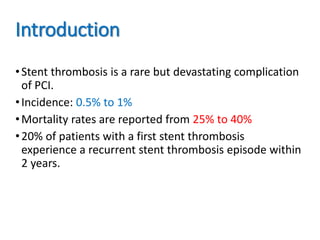
•Stent thrombosis is a rare but devastating complication
of PCI.
•Incidence: 0.5% to 1%
•Mortality rates are reported from 25% to 40%
•20% of patients with a first stent thrombosis
experience a recurrent stent thrombosis episode within
2 years.
Classification
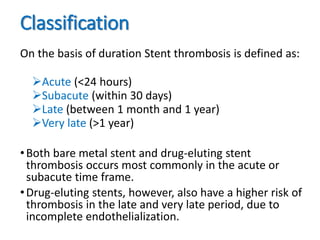
On the basis of duration Stent thrombosis is defined as:
Acute (<24 hours)
Subacute (within 30 days)
Late (between 1 month and 1 year)
Very late (>1 year)
•Both bare metal stent and drug-eluting stent
thrombosis occurs most commonly in the acute or
subacute time frame.
•Drug-eluting stents, however, also have a higher risk of
thrombosis in the late and very late period, due to
incomplete endothelialization.
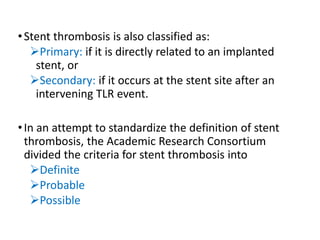
•Stent thrombosis is also classified as:
Primary: if it is directly related to an implanted
stent, or
Secondary: if it occurs at the stent site after an
intervening TLR event.
•In an attempt to standardize the definition of stent
thrombosis, the Academic Research Consortium
divided the criteria for stent thrombosis into
Definite
Probable
Possible
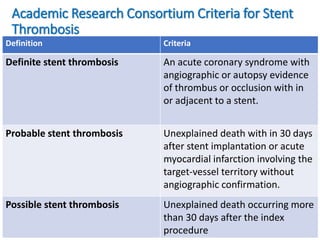
Academic Research Consortium Criteria for Stent
Thrombosis
Definition Criteria
Definite stent thrombosis An acute coronary syndrome with
angiographic or autopsy evidence
of thrombus or occlusion with in
or adjacent to a stent.
Probable stent thrombosis Unexplained death with in 30 days
after stent implantation or acute
myocardial infarction involving the
target-vessel territory without
angiographic confirmation.
Possible stent thrombosis Unexplained death occurring more
than 30 days after the index
procedure
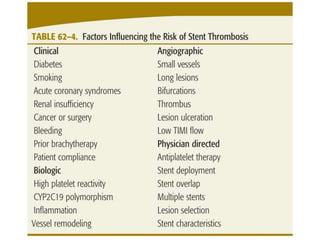
Factors Influencing
the Risk of
Stent Thrombosis
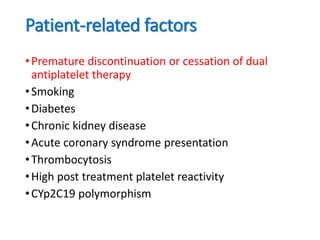
Patient-related factors
•Premature discontinuation or cessation of dual
antiplatelet therapy
•Smoking
•Diabetes
•Chronic kidney disease
•Acute coronary syndrome presentation
•Thrombocytosis
•High post treatment platelet reactivity
•CYp2C19 polymorphism
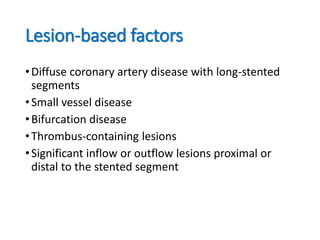
Lesion-based factors
•Diffuse coronary artery disease with long-stented
segments
•Small vessel disease
•Bifurcation disease
•Thrombus-containing lesions
•Significant inflow or outflow lesions proximal or
distal to the stented segment
Stent-related factors
•Poor stent expansion
•Edge dissections limiting inflow or outflow
•Delayed or absent endothelialization of stent struts
•Thicker stent struts
•Hypersensitivity/inflammatory and/or thrombotic
reactions to specific DES polymers
•Strut fractures
•Late malapposition/aneurysm formation
•Development of neoatherosclerosis with in stents with
new plaque rupture
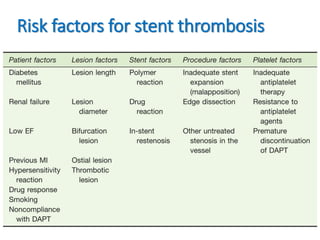
Risk factors for stent thrombosis
Strategies to Minimize
the Occurrence of
Stent Thrombosis
Circulation. 2011;124:1283-1287
Originally published September 12, 2011
Patient selection:
•Screening for likely adherence to prescribed medical
regimens (including ability to afford dual antiplatelet
therapy)
•Careful screening for bleeding risk (or ability to tolerate
dual antiplatelet therapy)
•Confirmation of no upcoming surgical procedures in the
recent future (6 wk for BMS, 6–12 mo for DES)
Stent selection and deployment:
•Consider use of stents with proven lower stent
thrombosis
•Appropriate vessel sizing
•High-pressure stent deployment and post-dilation
•Ensuring absence of edge dissections
•Ensuring adequate inflow and outflow
•Avoiding the use of 2 stents in bifurcation lesions (if
possible)
Peri- and post-procedure care:
•Use of more potent oral antiplatelet regimens (eg,
prasugrel, ticagrelor) in appropriately indicated
clinical scenarios such as acute coronary syndromes
in patients with acceptable bleeding risk
•Patient education and clinical follow-up emphasizing
the importance of adherence to prescribed dual
antiplatelet therapy
•Continuation of dual antiplatelet therapy without
interruption whenever possible if a dental,
endoscopic, or surgical procedure is necessary (which
is feasible for most surgeries other than
neurovascular)
Treatment of Stent Thrombosis
• Stent thrombosis may be treated with emergent
thrombectomy (either aspiration or mechanical) or with
balloon angioplasty alone, often in conjunction with
administration of more potent antiplatelet regimens
including glycoprotein IIb/IIIa inhibitors.
• The placement of additional stents should usually be
avoided unless a mechanical reason for the initial
thrombotic event is ascertained (e.g. edge dissection or
residual untreated disease) .
• The use of adjunctive imaging such as IVUS or OCT will often
reveal a possible cause of stent thrombosis, such as stent
under expansion or malapposition, residual dissection, or
significant inflow or outflow stenosis, and is thus
recommended following thrombectomy.
Treatment (Cont’d)
•In the absence of a mechanical cause, hematologic
evaluation should be performed to exclude a
hypercoagulable state (including resistance to
aspirin or clopidogrel) or thrombocytosis.
•Maintenance antiplatelet therapy is typically
escalated in cases of stent thrombosis (e.g.
clopidogrel is switched to prasugrel or ticagrelor)
Thank You

Stent Thrombosis

  • 1.
    STENT THROMBOSIS DR. SAYEEDUR RAHMANKHAN RUMI dr.rumibd@gmail.com MD (CARDIOLOGY) FINAL PART STUDENT NHFH&RI
  • 2.
    Introduction •Stent thrombosis isa rare but devastating complication of PCI. •Incidence: 0.5% to 1% •Mortality rates are reported from 25% to 40% •20% of patients with a first stent thrombosis experience a recurrent stent thrombosis episode within 2 years.
  • 3.
    Classification On the basisof duration Stent thrombosis is defined as: Acute (<24 hours) Subacute (within 30 days) Late (between 1 month and 1 year) Very late (>1 year) •Both bare metal stent and drug-eluting stent thrombosis occurs most commonly in the acute or subacute time frame. •Drug-eluting stents, however, also have a higher risk of thrombosis in the late and very late period, due to incomplete endothelialization.
  • 4.
    •Stent thrombosis isalso classified as: Primary: if it is directly related to an implanted stent, or Secondary: if it occurs at the stent site after an intervening TLR event. •In an attempt to standardize the definition of stent thrombosis, the Academic Research Consortium divided the criteria for stent thrombosis into Definite Probable Possible
  • 5.
    Academic Research ConsortiumCriteria for Stent Thrombosis Definition Criteria Definite stent thrombosis An acute coronary syndrome with angiographic or autopsy evidence of thrombus or occlusion with in or adjacent to a stent. Probable stent thrombosis Unexplained death with in 30 days after stent implantation or acute myocardial infarction involving the target-vessel territory without angiographic confirmation. Possible stent thrombosis Unexplained death occurring more than 30 days after the index procedure
  • 6.
    Factors Influencing the Riskof Stent Thrombosis
  • 7.
    Patient-related factors •Premature discontinuationor cessation of dual antiplatelet therapy •Smoking •Diabetes •Chronic kidney disease •Acute coronary syndrome presentation •Thrombocytosis •High post treatment platelet reactivity •CYp2C19 polymorphism
  • 8.
    Lesion-based factors •Diffuse coronaryartery disease with long-stented segments •Small vessel disease •Bifurcation disease •Thrombus-containing lesions •Significant inflow or outflow lesions proximal or distal to the stented segment
  • 9.
    Stent-related factors •Poor stentexpansion •Edge dissections limiting inflow or outflow •Delayed or absent endothelialization of stent struts •Thicker stent struts •Hypersensitivity/inflammatory and/or thrombotic reactions to specific DES polymers •Strut fractures •Late malapposition/aneurysm formation •Development of neoatherosclerosis with in stents with new plaque rupture
  • 10.
    Risk factors forstent thrombosis
  • 12.
    Strategies to Minimize theOccurrence of Stent Thrombosis Circulation. 2011;124:1283-1287 Originally published September 12, 2011
  • 13.
    Patient selection: •Screening forlikely adherence to prescribed medical regimens (including ability to afford dual antiplatelet therapy) •Careful screening for bleeding risk (or ability to tolerate dual antiplatelet therapy) •Confirmation of no upcoming surgical procedures in the recent future (6 wk for BMS, 6–12 mo for DES)
  • 14.
    Stent selection anddeployment: •Consider use of stents with proven lower stent thrombosis •Appropriate vessel sizing •High-pressure stent deployment and post-dilation •Ensuring absence of edge dissections •Ensuring adequate inflow and outflow •Avoiding the use of 2 stents in bifurcation lesions (if possible)
  • 15.
    Peri- and post-procedurecare: •Use of more potent oral antiplatelet regimens (eg, prasugrel, ticagrelor) in appropriately indicated clinical scenarios such as acute coronary syndromes in patients with acceptable bleeding risk •Patient education and clinical follow-up emphasizing the importance of adherence to prescribed dual antiplatelet therapy •Continuation of dual antiplatelet therapy without interruption whenever possible if a dental, endoscopic, or surgical procedure is necessary (which is feasible for most surgeries other than neurovascular)
  • 16.
    Treatment of StentThrombosis • Stent thrombosis may be treated with emergent thrombectomy (either aspiration or mechanical) or with balloon angioplasty alone, often in conjunction with administration of more potent antiplatelet regimens including glycoprotein IIb/IIIa inhibitors. • The placement of additional stents should usually be avoided unless a mechanical reason for the initial thrombotic event is ascertained (e.g. edge dissection or residual untreated disease) . • The use of adjunctive imaging such as IVUS or OCT will often reveal a possible cause of stent thrombosis, such as stent under expansion or malapposition, residual dissection, or significant inflow or outflow stenosis, and is thus recommended following thrombectomy.
  • 17.
    Treatment (Cont’d) •In theabsence of a mechanical cause, hematologic evaluation should be performed to exclude a hypercoagulable state (including resistance to aspirin or clopidogrel) or thrombocytosis. •Maintenance antiplatelet therapy is typically escalated in cases of stent thrombosis (e.g. clopidogrel is switched to prasugrel or ticagrelor)
  • 18.