GHAZANFAR IKRAM
Optometry Student
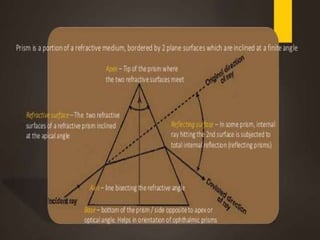
 Prism is a portion of a refractive medium,
bordered by 2 plane surfaces which are
inclined at a finite angle.
 A prism consists of two angled refracting
surfaces
 The simplest form of prism is two flat
surfaces coming together at an angle at the
top.
 Obeying Snell's Law of refraction light
passing through the prism is deviated to the
base
 Angle of deviation - D = (n-1)α ;
 where n- Refractive index, α – refractive angle
 Thus, D = α/2
 RI of glass –> 1.5
 Image formed through prism is virtual, erect
and displaced towards the apex.
 Prism power is defined by the amount of
deviation produced as the light ray traverses
the prism.
 The deviation is measured as the numbers of
centimeters of deflection measured at a
distance of 100cm and expressed in prism
diopters.
 Angular Units:
 The deviation produced by the prism is
 expressed in degrees or radians.
 Prism Dioptre:
 One prism dioptre produces a deviation of
one unit at a plane 100 units from the prism.
 Centrad:
 One centrad produces a deviation of one unit
of arc at a distance of 100 units from the
prism.
 1)Ground prism’s:
 Permanently incorporating the prism into
glasses by decentring the present spherical lens
or by mounting on them.
 Limit 8-10 prism D in each eye or 12
 2) Fresnel prism (or) Wafer prisms:
 Temporary
 Series of plastic Prisms of 1mm.
 Small prisms stacked to give an effect of a large
prism to over come wt.,aberration, and achieve
higher power.
 1-30 prism D in each eye
 Thin Prism:
 Thin prism have no dioptric power but can be
combined with dioptric lenses in a refractive
correction.
 They have an apical angle of less than 10º to
15.
 Ophthalmic prisms are, generally, thin
prisms.
 Thick Prism:
 A prism whose apical angle is greater than
15º to 20º.
 White light incident on a thick prism will
appear to be dispersed into the colour
spectrum when emergent from the second
surface.
 A prism displaying this phenomenon is often
known as a Newton prism.
 Dispersion is usually seen in thick prism
 The orientation of the prism in front of the
eye will affect the position at which the eye
perceives any object to be viewed through
the prism.
 It is, therefore, important to specify
accurately the orientation of the prism so
that its effect on the eyes is known when
incorporated into a refractive correction.
 When prescribing prism it is, of
course,necessary to indicate the direction of
the prism base.
 While most cases will involve prism in one of
the four main directions, up,down, in and out,
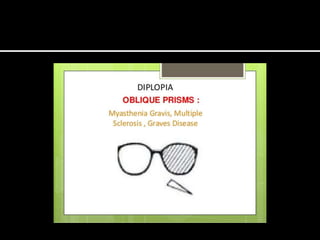
oblique prism may also be ordered.
 There are two accepted methods for
indicating the direction of an oblique prism.
 a)standard notation
 b)360 degree notation
 Standard Notation:
 This is the same axis notation as used for the
 axis of astigmatic lenses.
 This notation requires further indication of the
direction of the base.
 For example, it is not sufficient to order RE: 4
diopter at 135.This could be either up and out at
135 or down and in.
 So the prescription needs the direction as well as
the angle.
 B)360° notation:
 This system of notation is the same as standard
notation in the top two quadrants but continues
to 360 °in the bottom quadrants.
 This system requires no other notation that the
angle.
 So, RE: 4 diopter prism at 135 would mean up
and out, there is no other possibility since down
and in would be RE: 4 diopter prism at 315.
 2)To relieve diplopia in certain cases of
squint:
 Including decompensated heterophoria,small
vertical squint and some paralytic squint with
diplopia in primary position.
 Due to the difference in thickness between
the base and the apex of a prism, refractive
corrections incorporating prism power for
one eye only, the spectacles may be
dispensed with the prism power split
between the two eyes.
 This is usually due to a noticeable and
cosmetically unacceptable difference in
thickness between the spectacle lenses if
they were made up as prescribed.
 It is important that the effect on the eyes as a
pair is maintained when the prism power is
split between the spectacle lenses.
 This can be achieved using the following
rules.

1) If the prismatic power is prescribed
monocularly in a refractive correction that is
similar between the two eyes, the prismatic
power should be split evenly.
 2) Prism power with horizontal base direction
should have the same base direction in both
eyes.
 3) Prism power with a vertical direction
should have opposite base directions in each
eye, with the base direction for the eye in
which the prism was originally prescribed
remaining the same.
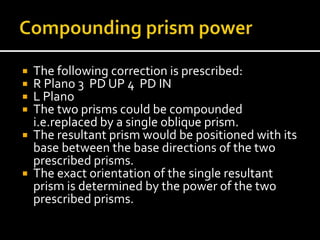
 The following correction is prescribed:
 R Plano 3 PD UP 4 PD IN
 L Plano
 The two prisms could be compounded
i.e.replaced by a single oblique prism.
 The resultant prism would be positioned with its
base between the base directions of the two
prescribed prisms.
 The exact orientation of the single resultant
prism is determined by the power of the two
prescribed prisms.
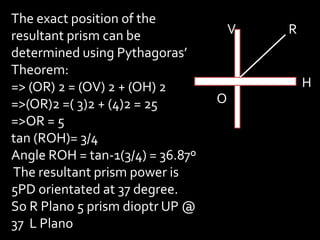
V
O
H
R
The exact position of the
resultant prism can be
determined using Pythagoras’
Theorem:
=> (OR) 2 = (OV) 2 + (OH) 2
=>(OR)2 =( 3)2 + (4)2 = 25
=>OR = 5
tan (ROH)= 3/4
Angle ROH = tan-1(3/4) = 36.87º
The resultant prism power is
5PD orientated at 37 degree.
So R Plano 5 prism dioptr UP @
37 L Plano
 Relieving
 Corrective
 Inverse
 Yolked
 Regional
 Optically reduces the demand to the
controlling fusional vergence system for
bifixation of the target.
 Prescription is less than the angle of deviation
 It moves the image to the range of fusion
 Rxed for intermittent strabismus and
symptomatic heterophorias.
 The most commonly Rxed prism
 Optically eliminates the oculomotor
deviation’
 Rx prism is equal to the magnitude of
deviation.
 Apex toward deviation.
 You put the base in the same direction as the
deviation and optically increases the demand
to the controlling vergence system.
 Strengthning weak muscle and prevent
contracture of antagonist muscle
 Eso---BI
 Exo---BO
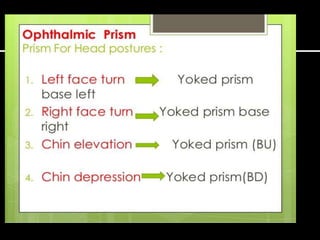
 Move both eyes in the same direction
 For example Base right prism
(BO RE and BI LE)
 More used in Hemianopias
 Also used in paretic muscle and in nystagmus
 Different amount of prisms are needed in
different field of gaze or for different
distances.
 Prism is placed on a particular part of lens
where you prescribe.
Prism
Prism
Prism

Prism

  • 2.
  • 3.
     Prism isa portion of a refractive medium, bordered by 2 plane surfaces which are inclined at a finite angle.  A prism consists of two angled refracting surfaces  The simplest form of prism is two flat surfaces coming together at an angle at the top.
  • 5.
     Obeying Snell'sLaw of refraction light passing through the prism is deviated to the base  Angle of deviation - D = (n-1)α ;  where n- Refractive index, α – refractive angle  Thus, D = α/2  RI of glass –> 1.5
  • 6.
     Image formedthrough prism is virtual, erect and displaced towards the apex.
  • 7.
     Prism poweris defined by the amount of deviation produced as the light ray traverses the prism.  The deviation is measured as the numbers of centimeters of deflection measured at a distance of 100cm and expressed in prism diopters.
  • 8.
     Angular Units: The deviation produced by the prism is  expressed in degrees or radians.  Prism Dioptre:  One prism dioptre produces a deviation of one unit at a plane 100 units from the prism.  Centrad:  One centrad produces a deviation of one unit of arc at a distance of 100 units from the prism.
  • 9.
     1)Ground prism’s: Permanently incorporating the prism into glasses by decentring the present spherical lens or by mounting on them.  Limit 8-10 prism D in each eye or 12  2) Fresnel prism (or) Wafer prisms:  Temporary  Series of plastic Prisms of 1mm.  Small prisms stacked to give an effect of a large prism to over come wt.,aberration, and achieve higher power.  1-30 prism D in each eye
  • 10.
     Thin Prism: Thin prism have no dioptric power but can be combined with dioptric lenses in a refractive correction.  They have an apical angle of less than 10º to 15.  Ophthalmic prisms are, generally, thin prisms.
  • 11.
     Thick Prism: A prism whose apical angle is greater than 15º to 20º.  White light incident on a thick prism will appear to be dispersed into the colour spectrum when emergent from the second surface.  A prism displaying this phenomenon is often known as a Newton prism.  Dispersion is usually seen in thick prism
  • 12.
     The orientationof the prism in front of the eye will affect the position at which the eye perceives any object to be viewed through the prism.  It is, therefore, important to specify accurately the orientation of the prism so that its effect on the eyes is known when incorporated into a refractive correction.
  • 13.
     When prescribingprism it is, of course,necessary to indicate the direction of the prism base.  While most cases will involve prism in one of the four main directions, up,down, in and out, oblique prism may also be ordered.
  • 14.
     There aretwo accepted methods for indicating the direction of an oblique prism.  a)standard notation  b)360 degree notation
  • 15.
     Standard Notation: This is the same axis notation as used for the  axis of astigmatic lenses.  This notation requires further indication of the direction of the base.  For example, it is not sufficient to order RE: 4 diopter at 135.This could be either up and out at 135 or down and in.  So the prescription needs the direction as well as the angle.
  • 16.
     B)360° notation: This system of notation is the same as standard notation in the top two quadrants but continues to 360 °in the bottom quadrants.  This system requires no other notation that the angle.  So, RE: 4 diopter prism at 135 would mean up and out, there is no other possibility since down and in would be RE: 4 diopter prism at 315.
  • 18.
     2)To relievediplopia in certain cases of squint:  Including decompensated heterophoria,small vertical squint and some paralytic squint with diplopia in primary position.
  • 20.
     Due tothe difference in thickness between the base and the apex of a prism, refractive corrections incorporating prism power for one eye only, the spectacles may be dispensed with the prism power split between the two eyes.  This is usually due to a noticeable and cosmetically unacceptable difference in thickness between the spectacle lenses if they were made up as prescribed.
  • 21.
     It isimportant that the effect on the eyes as a pair is maintained when the prism power is split between the spectacle lenses.  This can be achieved using the following rules. 1) If the prismatic power is prescribed monocularly in a refractive correction that is similar between the two eyes, the prismatic power should be split evenly.
  • 22.
     2) Prismpower with horizontal base direction should have the same base direction in both eyes.  3) Prism power with a vertical direction should have opposite base directions in each eye, with the base direction for the eye in which the prism was originally prescribed remaining the same.
  • 23.
     The followingcorrection is prescribed:  R Plano 3 PD UP 4 PD IN  L Plano  The two prisms could be compounded i.e.replaced by a single oblique prism.  The resultant prism would be positioned with its base between the base directions of the two prescribed prisms.  The exact orientation of the single resultant prism is determined by the power of the two prescribed prisms.
  • 24.
    V O H R The exact positionof the resultant prism can be determined using Pythagoras’ Theorem: => (OR) 2 = (OV) 2 + (OH) 2 =>(OR)2 =( 3)2 + (4)2 = 25 =>OR = 5 tan (ROH)= 3/4 Angle ROH = tan-1(3/4) = 36.87º The resultant prism power is 5PD orientated at 37 degree. So R Plano 5 prism dioptr UP @ 37 L Plano
  • 26.
     Relieving  Corrective Inverse  Yolked  Regional
  • 27.
     Optically reducesthe demand to the controlling fusional vergence system for bifixation of the target.  Prescription is less than the angle of deviation  It moves the image to the range of fusion  Rxed for intermittent strabismus and symptomatic heterophorias.  The most commonly Rxed prism
  • 28.
     Optically eliminatesthe oculomotor deviation’  Rx prism is equal to the magnitude of deviation.  Apex toward deviation.
  • 29.
     You putthe base in the same direction as the deviation and optically increases the demand to the controlling vergence system.  Strengthning weak muscle and prevent contracture of antagonist muscle  Eso---BI  Exo---BO
  • 30.
     Move botheyes in the same direction  For example Base right prism (BO RE and BI LE)  More used in Hemianopias  Also used in paretic muscle and in nystagmus
  • 32.
     Different amountof prisms are needed in different field of gaze or for different distances.  Prism is placed on a particular part of lens where you prescribe.