z
FITTING ASSESSMENT OF
SOFT CONTACT LENS
SUCHETA MITRA
M. OPTOMETRY
z
 Requirements of well fitting soft lens
 Characteristics of soft lens fit (optimum, tight, loose)
 Fitting assessment
 Factors affecting soft lens fit
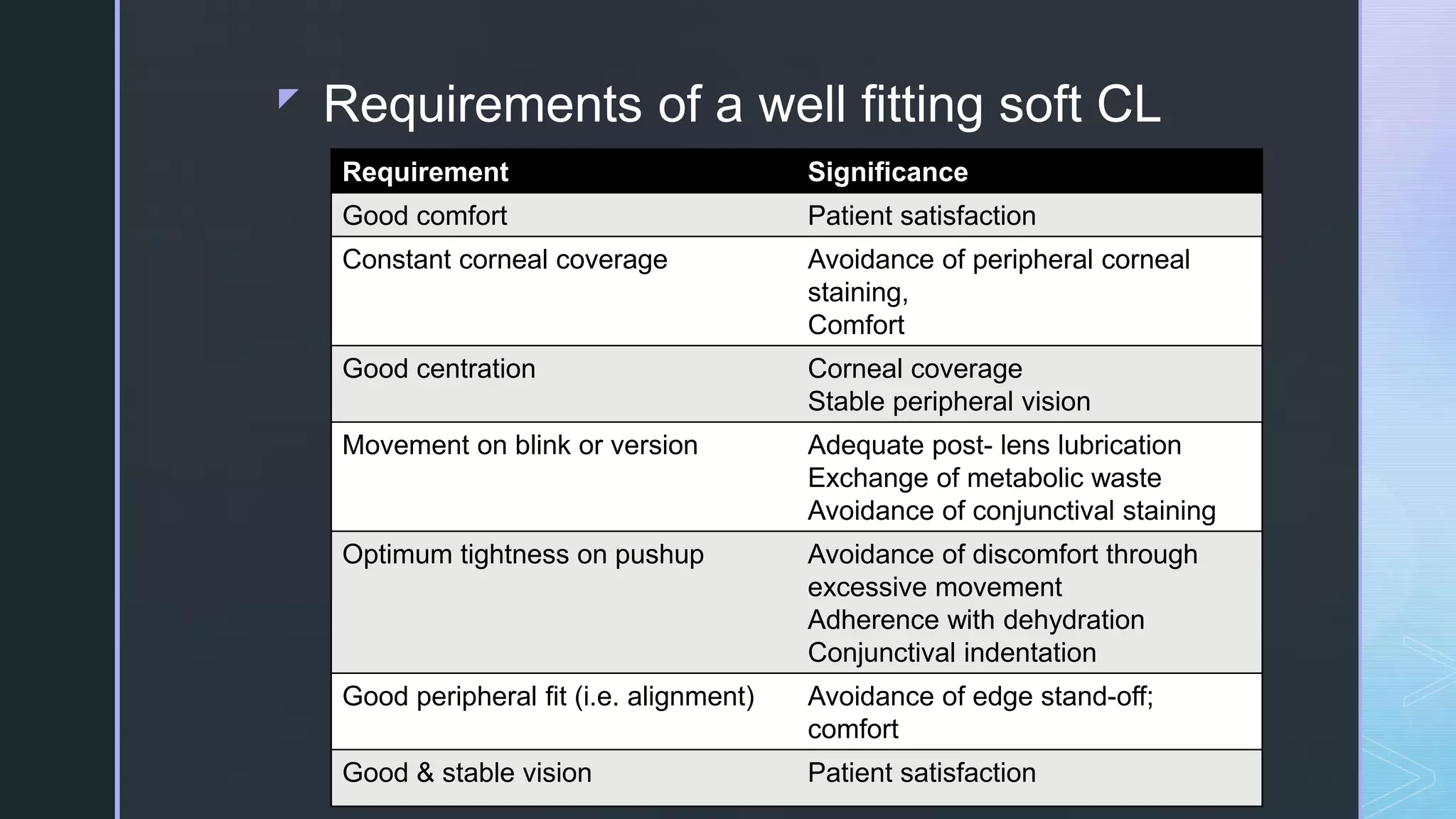
z Requirements of a well fitting soft CL
Requirement Significance
Good comfort Patient satisfaction
Constant corneal coverage Avoidance of peripheral corneal
staining,
Comfort
Good centration Corneal coverage
Stable peripheral vision
Movement on blink or version Adequate post- lens lubrication
Exchange of metabolic waste
Avoidance of conjunctival staining
Optimum tightness on pushup Avoidance of discomfort through
excessive movement
Adherence with dehydration
Conjunctival indentation
Good peripheral fit (i.e. alignment) Avoidance of edge stand-off;
comfort
Good & stable vision Patient satisfaction
z
Lens fit characteristics
Criterion Tight Optimum Loose
Comfort Initially good, Eyes
may feel tired later
Good Poor
Centration Can be good or poor Good Poorly decentred
Post- blink
movement
Little or none 0.2-0.4mm >0.4mm
Lag on version or
up gaze
Little or none 0.2-0.4mm >0.4mm
Tightness on
push-up
Difficult to dislodge &
slow to recover
Easy to dislodge &
smooth recovery
Very easy to dislodge
& fast recovery
Peripheral fit Conjunctival
indentation
Aligned Edge stand –off
Vision Stable or clearer
after blink
Stable Variable
z
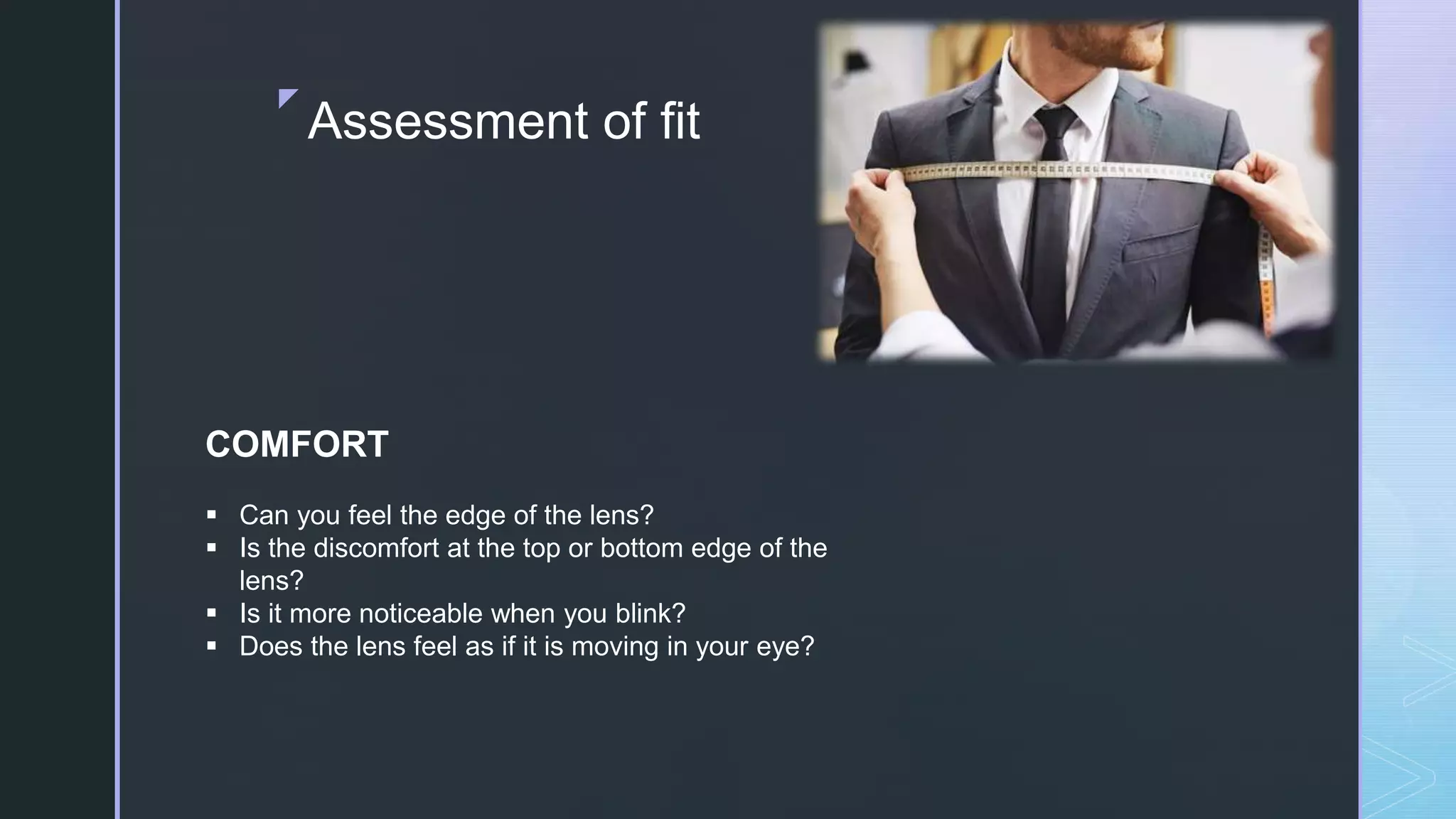
Assessment of fit
COMFORT
 Can you feel the edge of the lens?
 Is the discomfort at the top or bottom edge of the
lens?
 Is it more noticeable when you blink?
 Does the lens feel as if it is moving in your eye?
z
Centration
 Decentration is acceptable
 Full corneal coverage
 Does not compromise comfort
 Loose fitting shows greater decentration
 Higher-power lens designs, the optic zone diameter will be
reduced in order to minimize lens thickness.
 Any decentration does not compromise peripheral vision.
z
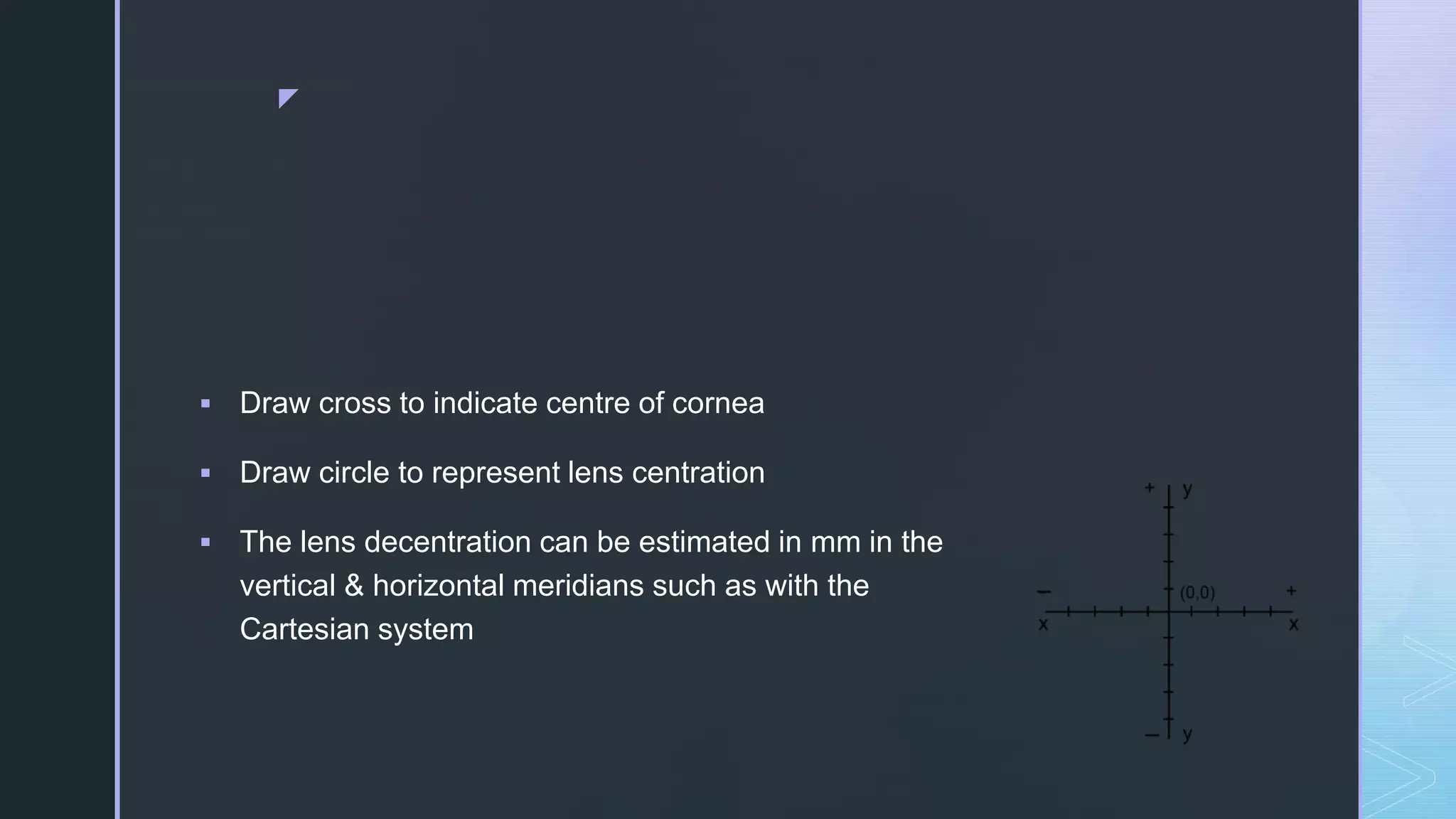
 Draw cross to indicate centre of cornea
 Draw circle to represent lens centration
 The lens decentration can be estimated in mm in the
vertical & horizontal meridians such as with the
Cartesian system
z
Movement
 It is necessary to maintain post-lens lubrication
 Post-blink movement is a more important indicator of tight rather than loose- fitting lenses as virtually all
tight- fitting lenses show little or no movement
 In a normal fit, the lens appears to remain stationary when the lid moves downward during the first part for
the blink
 But then moves upwards by a small amount during the second part of the blink, returning to its original
position immediately after the blink
 Movement on sideways gaze (version lag) can be a sensitive indicator of fit as post-blink movement.
 The assessment of upgaze lag is less useful and, in fact, a large proportion of well fitting lenses show no
movement on upgaze lag
z
Movement in Primary Gaze
• Vertical Lens Movement - VLM
• Correct 0.25 to 0.50 mm
• Steep 0.20 mm or less
• Flat More than 1.00 mm
Usually measured on left/right gaze
 Correct up to 1.00 mm
 Steep 0.25 mm or less
 Flat ` 2.00 mm or more
z
Tightness on push up
 It is undertaken by digitally moving the lens upwards, pushing the
lower lid against the lens edge.
 Assessment of the amount of force necessary to dislodge the lens
upwards coupled with the speed of recentration of the lens from its
dislodged position.
 Grade Push-Up Test: 0 to 100%
Push-Up Values
• Correct: Slow to move, steady recovery 40 - 60%
• Steep: Difficult to move, slow or no recovery 65 - 100%
• Flat: Easy movement & fast recovery 35 - 10%
z
Peripheral fit
 A lens can show good centration and tightness on push-up but
still show poor edge alignment
 examine the periphery under magnification or signs of
indentation of the bulbar conjunctiva.
 When present, this may also be visible on lens removal through
pooling of fluorescein in the indentation
z
VISION
 Correct Good, consistent
 Steep Poor & variable, improves after a blink
 Flat Variable, worse just after a blink
z
SOFT LENS FITTING PROBLEMS
 DISCOMFORT
 Two aspects o the lens design can affect comfort: total diameter and
edge design
 If the lens decentres so that the edge is close to the limbus, the patient
is usually able to localize the discomfort to that part of the limbus.
 As a rule of thumb, steepening BC by 0.4 mm will result in an increase
in diameter o 0.2 mm on the eye
 In case o dryness-related discomfort, an alternative approach is to
change to a more wettable material and / or dehydration resistant
material, such as omafilcon A or senofilcon A
z
In appropriate diameter
 TOO LARGE
 Results in poor flexure in the mid periphery, this can lead to
superior arcuate staining
 The lens may be visible on the eye, particularly if the lens has a
thick periphery or incorporates a deep handling tint.
 TOO SMALL
 Lenses that are too small can cause peripheral corneal staining as
well as discomfort.
z
IN APPROPRIATE FIT
 Too Loose
 Loose- fitting lenses can also cause peripheral corneal staining and
symptoms of discomfort and variable vision
 Patients may also complain of lenses being displaced from the
cornea during wear.
 Switching to a similar lens of steeper BC may not always overcome
the problem, particularly with thin lens designs.
 It may be necessary therefore to change to a lens with a tendency
towards tight fitting.
z
 TOO TIGHT
 Tight lenses induce greater levels of staining than do well- fitting
lenses
 the prevalence of staining increases with increasing degree of
tightness
 Tight- fitting lenses tend to be comfortable but patients occasionally
complain of aching eyes later in the wearing period.
z
POOR VISUAL ACUITY
 Possible reasons for poor vision include the following:
 Uncorrected astigmatism
 Lens deposits
 Poor surface wetting
 Lens imperfections.
 the lens optics can also be inspected by dabbing the lens dry with a
tissue wipe and viewing through the lens with the naked eye while
holding it towards a light source
 The best remedy is to replace the lens to see whether this
overcomes the problem.
z
VARIABLE VISION
 When the visual acuity is normal but the patient complains of
variable vision, the following causes may be suspected:
 incorrect back vertex power, e.g. over-minus, under-plus
 poor binocular balance
 excessive lens movement, i.e. loose fit
 poor pre-lens tear film.
z

Fitting assessment of soft contact lens

  • 1.
    z FITTING ASSESSMENT OF SOFTCONTACT LENS SUCHETA MITRA M. OPTOMETRY
  • 2.
    z  Requirements ofwell fitting soft lens  Characteristics of soft lens fit (optimum, tight, loose)  Fitting assessment  Factors affecting soft lens fit
  • 3.
    z Requirements ofa well fitting soft CL Requirement Significance Good comfort Patient satisfaction Constant corneal coverage Avoidance of peripheral corneal staining, Comfort Good centration Corneal coverage Stable peripheral vision Movement on blink or version Adequate post- lens lubrication Exchange of metabolic waste Avoidance of conjunctival staining Optimum tightness on pushup Avoidance of discomfort through excessive movement Adherence with dehydration Conjunctival indentation Good peripheral fit (i.e. alignment) Avoidance of edge stand-off; comfort Good & stable vision Patient satisfaction
  • 4.
    z Lens fit characteristics CriterionTight Optimum Loose Comfort Initially good, Eyes may feel tired later Good Poor Centration Can be good or poor Good Poorly decentred Post- blink movement Little or none 0.2-0.4mm >0.4mm Lag on version or up gaze Little or none 0.2-0.4mm >0.4mm Tightness on push-up Difficult to dislodge & slow to recover Easy to dislodge & smooth recovery Very easy to dislodge & fast recovery Peripheral fit Conjunctival indentation Aligned Edge stand –off Vision Stable or clearer after blink Stable Variable
  • 5.
    z Assessment of fit COMFORT Can you feel the edge of the lens?  Is the discomfort at the top or bottom edge of the lens?  Is it more noticeable when you blink?  Does the lens feel as if it is moving in your eye?
  • 6.
    z Centration  Decentration isacceptable  Full corneal coverage  Does not compromise comfort  Loose fitting shows greater decentration  Higher-power lens designs, the optic zone diameter will be reduced in order to minimize lens thickness.  Any decentration does not compromise peripheral vision.
  • 7.
    z  Draw crossto indicate centre of cornea  Draw circle to represent lens centration  The lens decentration can be estimated in mm in the vertical & horizontal meridians such as with the Cartesian system
  • 8.
    z Movement  It isnecessary to maintain post-lens lubrication  Post-blink movement is a more important indicator of tight rather than loose- fitting lenses as virtually all tight- fitting lenses show little or no movement  In a normal fit, the lens appears to remain stationary when the lid moves downward during the first part for the blink  But then moves upwards by a small amount during the second part of the blink, returning to its original position immediately after the blink  Movement on sideways gaze (version lag) can be a sensitive indicator of fit as post-blink movement.  The assessment of upgaze lag is less useful and, in fact, a large proportion of well fitting lenses show no movement on upgaze lag
  • 9.
    z Movement in PrimaryGaze • Vertical Lens Movement - VLM • Correct 0.25 to 0.50 mm • Steep 0.20 mm or less • Flat More than 1.00 mm Usually measured on left/right gaze  Correct up to 1.00 mm  Steep 0.25 mm or less  Flat ` 2.00 mm or more
  • 10.
    z Tightness on pushup  It is undertaken by digitally moving the lens upwards, pushing the lower lid against the lens edge.  Assessment of the amount of force necessary to dislodge the lens upwards coupled with the speed of recentration of the lens from its dislodged position.  Grade Push-Up Test: 0 to 100% Push-Up Values • Correct: Slow to move, steady recovery 40 - 60% • Steep: Difficult to move, slow or no recovery 65 - 100% • Flat: Easy movement & fast recovery 35 - 10%
  • 11.
    z Peripheral fit  Alens can show good centration and tightness on push-up but still show poor edge alignment  examine the periphery under magnification or signs of indentation of the bulbar conjunctiva.  When present, this may also be visible on lens removal through pooling of fluorescein in the indentation
  • 12.
    z VISION  Correct Good,consistent  Steep Poor & variable, improves after a blink  Flat Variable, worse just after a blink
  • 13.
    z SOFT LENS FITTINGPROBLEMS  DISCOMFORT  Two aspects o the lens design can affect comfort: total diameter and edge design  If the lens decentres so that the edge is close to the limbus, the patient is usually able to localize the discomfort to that part of the limbus.  As a rule of thumb, steepening BC by 0.4 mm will result in an increase in diameter o 0.2 mm on the eye  In case o dryness-related discomfort, an alternative approach is to change to a more wettable material and / or dehydration resistant material, such as omafilcon A or senofilcon A
  • 14.
    z In appropriate diameter TOO LARGE  Results in poor flexure in the mid periphery, this can lead to superior arcuate staining  The lens may be visible on the eye, particularly if the lens has a thick periphery or incorporates a deep handling tint.  TOO SMALL  Lenses that are too small can cause peripheral corneal staining as well as discomfort.
  • 15.
    z IN APPROPRIATE FIT Too Loose  Loose- fitting lenses can also cause peripheral corneal staining and symptoms of discomfort and variable vision  Patients may also complain of lenses being displaced from the cornea during wear.  Switching to a similar lens of steeper BC may not always overcome the problem, particularly with thin lens designs.  It may be necessary therefore to change to a lens with a tendency towards tight fitting.
  • 16.
    z  TOO TIGHT Tight lenses induce greater levels of staining than do well- fitting lenses  the prevalence of staining increases with increasing degree of tightness  Tight- fitting lenses tend to be comfortable but patients occasionally complain of aching eyes later in the wearing period.
  • 17.
    z POOR VISUAL ACUITY Possible reasons for poor vision include the following:  Uncorrected astigmatism  Lens deposits  Poor surface wetting  Lens imperfections.  the lens optics can also be inspected by dabbing the lens dry with a tissue wipe and viewing through the lens with the naked eye while holding it towards a light source  The best remedy is to replace the lens to see whether this overcomes the problem.
  • 18.
    z VARIABLE VISION  Whenthe visual acuity is normal but the patient complains of variable vision, the following causes may be suspected:  incorrect back vertex power, e.g. over-minus, under-plus  poor binocular balance  excessive lens movement, i.e. loose fit  poor pre-lens tear film.
  • 19.

Editor's Notes

  • #6 We should also see the severity of any discomfort by observing the patient Excessive lacrimation or blepharospasm would suggest more severe reaction