Dr.K.Jaiganesh, MD
Professor of Physiology
MGMCRI
Objectives
1. Complete transection of spinal cord
2. Incomplete transection of spinal cord
Spinal Cord Injuries
Causes (in order of frequency)
Motor Vehicle Accidents
Gunshot wounds/acts of violence
Falls
Sports injuries
Classification of SCI
1. Flexion: Head is suddenly &
forcefully accelerated forward
causing extreme flexion of the
neck “Kiss the Chest
Classification of SCI
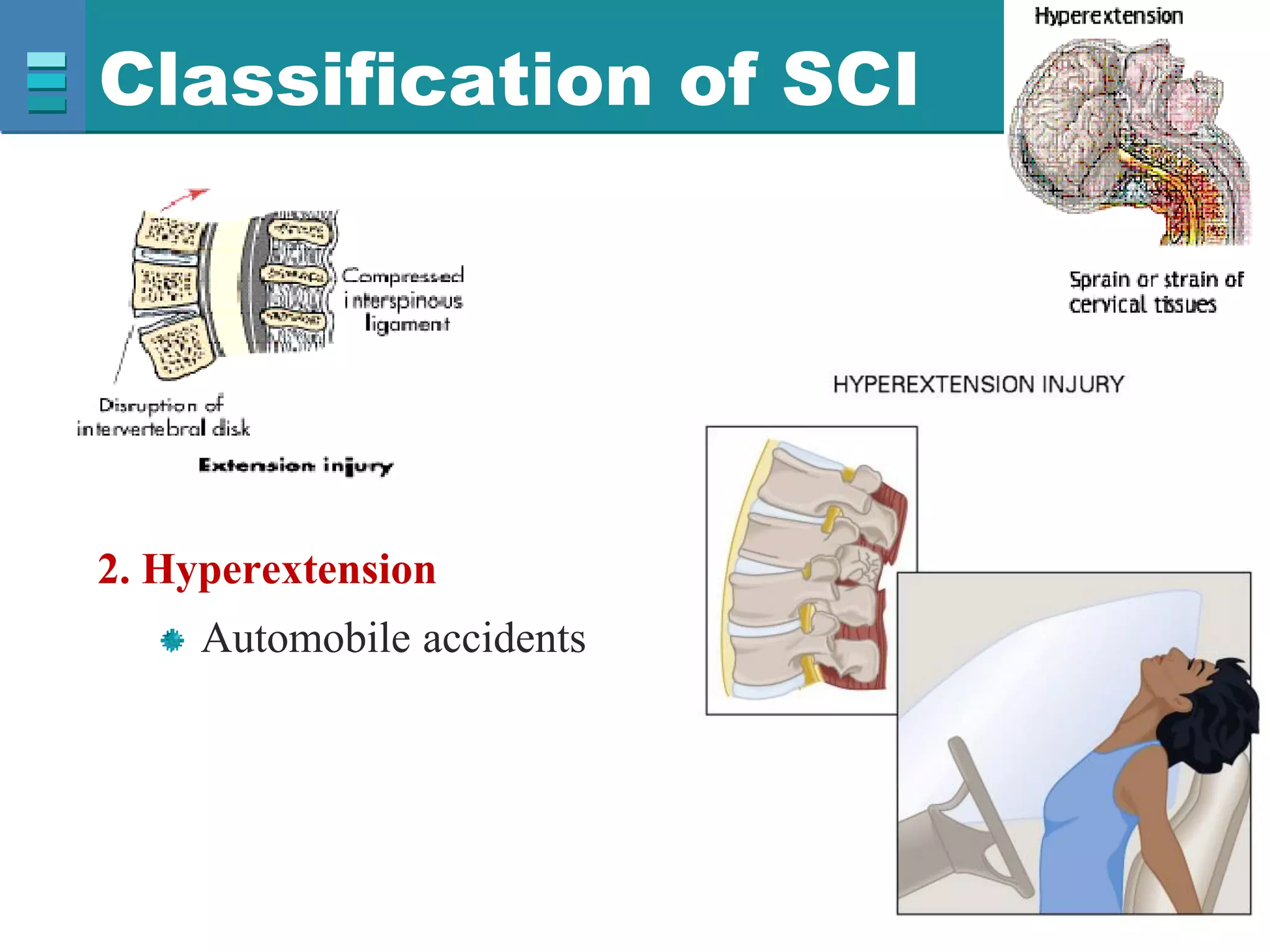
2. Hyperextension
Automobile accidents
Classification of SCI
3. Vertical compression
Blow to the top of the head
Often begins with a sudden,
traumatic force
Classification of SCI
4. Excessive Rotation (either
flexion- or extension-rotation)
Classification of SCI
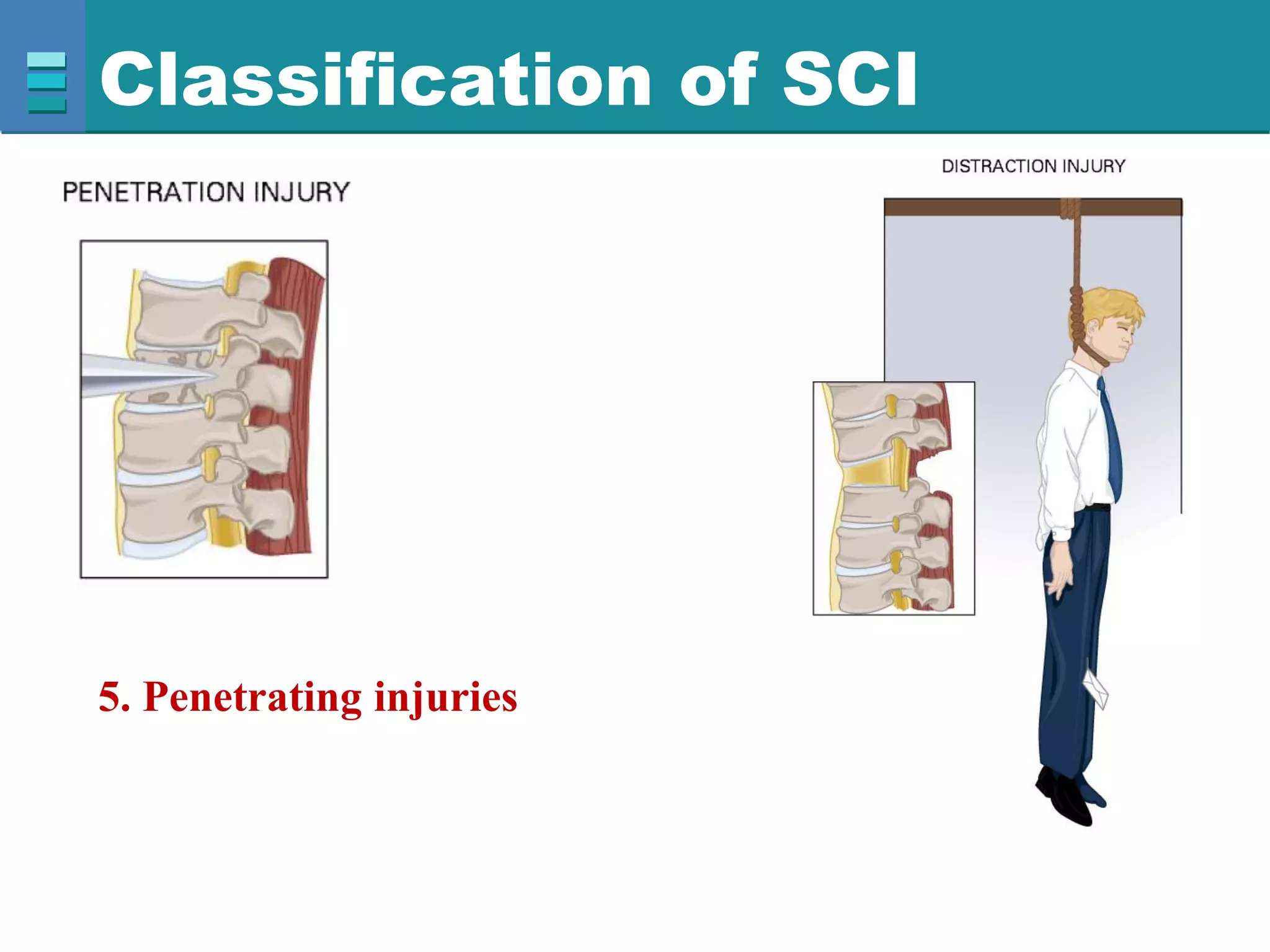
5. Penetrating injuries
Types of Cord Injury
1. Concussion
Similar to cerebral concussion
Temporary and transient disruption of cord function
2. Contusion
Bruising of the cord
Tissue damage, vascular leakage, and swelling
3. Compression - Secondary to:
Displacement of the vertebrae
Herniation of inter vertebral disk
Displacement of vertebral bone fragment
Swelling from adjacent tissue
4. Laceration
Direct damage to cord with associated bleeding, swelling and
potential disruption of cord
5. Hemorrhage
Associated with contusion, laceration, or stretching
6. Transection
Partial or complete severing of cord
Common sites of Spinal Injury
C-1/C-2: Delicate vertebrae
C-7: Transition from flexible cervical
spine to thorax
T-12/L-1: Different flexibility between
thoracic and lumbar regions
Complete spinal cord injury
Most severe form of injury
All sensations & motor functions
will be lost beneath the level of the
injury
Depend on the level of the injury!
Tetraplegia (formerly quadriplegia)
occurs with C-1 to C-8 injuries.
Paraplegia occurs with T-1 to L-4
Complete Cord Transection
Complete spinal cord injury
Stages
1. Stage of spinal shock
2. Stage of reflex activity
3. Stage of reflex failure
Spinal shock:
Begins within hour of injury &
Lasts from few minutes up to several months &
Ends with return of reflex activity: Hyper
reflexia, Muscle spasticity, Reflex bladder
emptying.
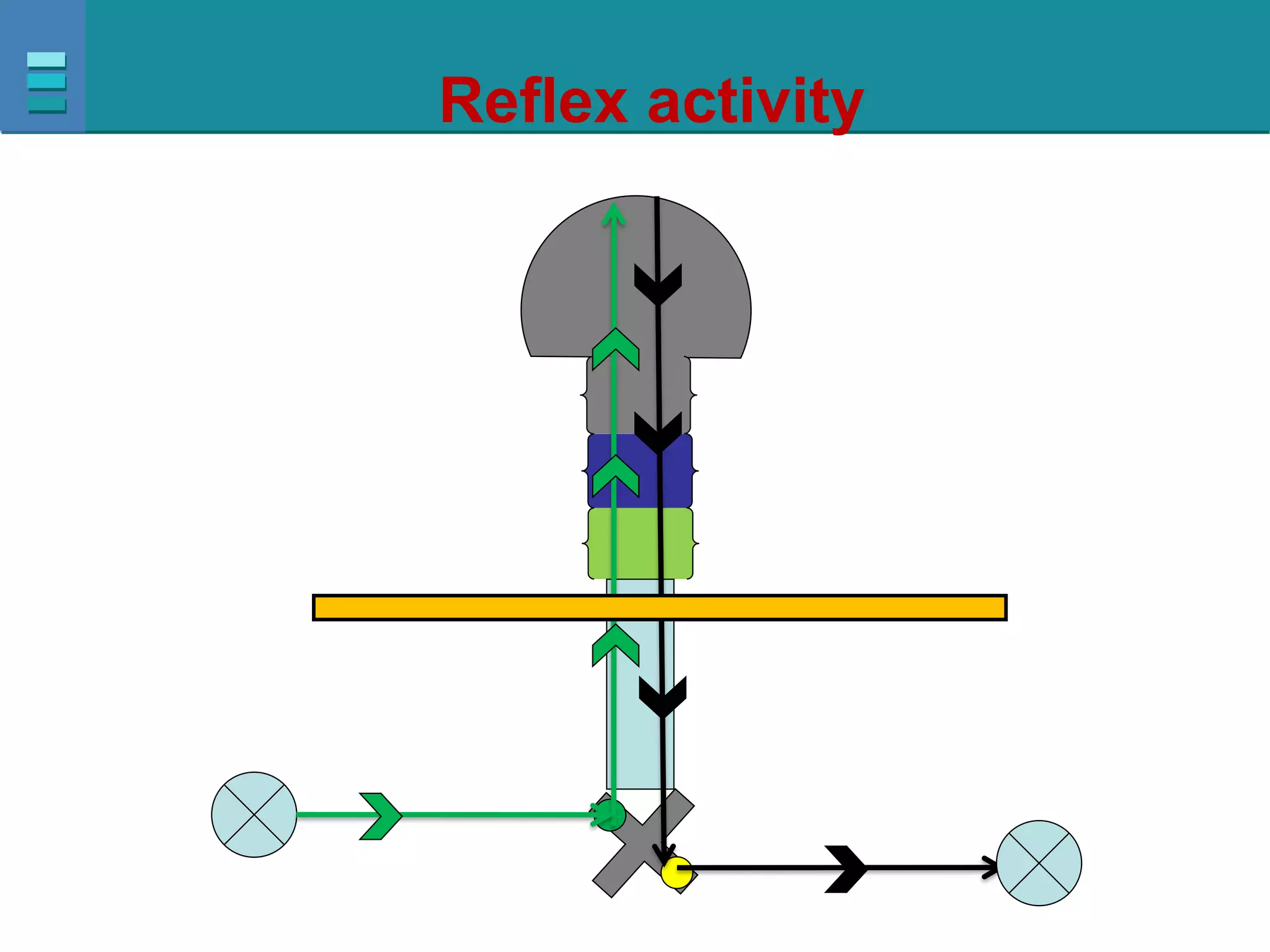
Reflex activity
Stage of spinal shock
1.Spinal Shock - Temporary loss of reflex function (a reflexia) below level of
injury beginning immediately after complete transection of spinal cord
Temporary insult to the cord
Affects body below the level of injury
Cramp like pains at the level of lesion
Loss of all sensations below the lesion
Muscles are paralyzed
Muscle tone is lost
Reflexes are lost
Bladder & the rectum are paralyzed
Sphincters paralyzed but recover their activity faster
Vasomotor tone lost, so BP falls
Skin becomes cold & blue- bed sores may develop
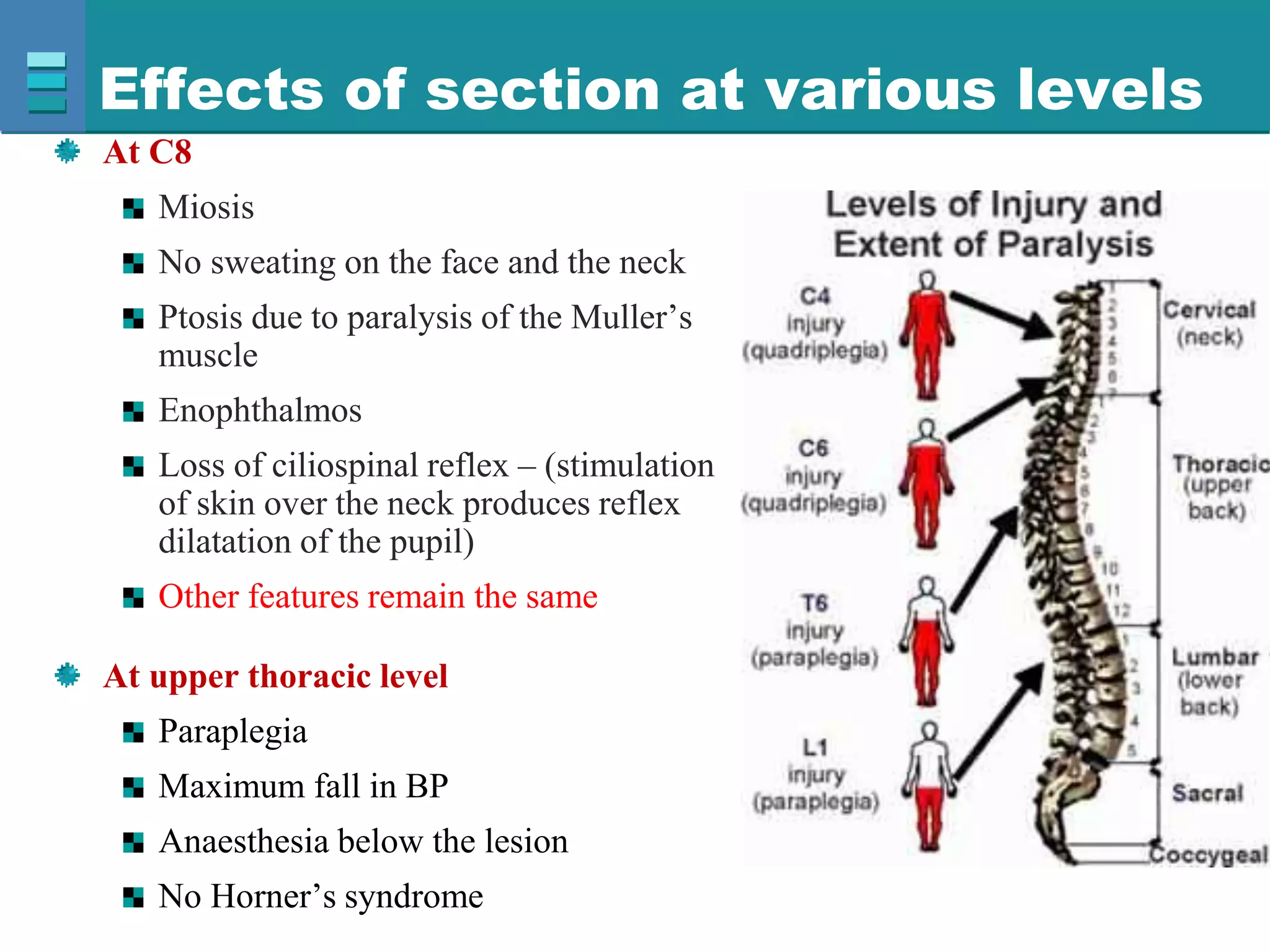
Effects of section at various levels
At C1 segment level
Quadriplegia
Maximum fall in BP
Anaesthesia
Paralysis of respiratory muscles
Death
At C5 segment level
Quadriplegia
Maximum fall in BP
Anaesthesia below the lesion
Diaphragm is not paralysed. So,
respiration is maintained
Horner’s syndrome develops
Effects of section at various levels
At C8
Miosis
No sweating on the face and the neck
Ptosis due to paralysis of the Muller’s
muscle
Enophthalmos
Loss of ciliospinal reflex – (stimulation
of skin over the neck produces reflex
dilatation of the pupil)
Other features remain the same
At upper thoracic level
Paraplegia
Maximum fall in BP
Anaesthesia below the lesion
No Horner’s syndrome
Effects of section at various levels
At lower thoracic level
BP fall is less
Other features remain the same
At or below 2nd lumbar
Minimum or no fall in BP
Paraplegia
Anaesthesia below the lesion
Other features remain the same
Site Sensory Motor BP RS Other
C1 Anaesthesia Quadriplegia Max Fall Paralysis
of RS
muscles
Death
C5 Anaesthesia
below
Quadriplegia Max Fall No Horner‘s
develops
C8 SAME Full
Horner‘s
Upper
Thoracic
Anaesthesia
below
Paraplegia Max fall No
Horner”s
Lower
thoracic
SAME Less BP
fall
At or
below II
lumbar
SAME No BP fall
Stage of reflex activity
Sensations remain lost
Voluntary movements absent
Skeletal muscle tone increases in flexors first then in
extensors
Functional activity of smooth muscle returns
Reflexes appear – Babinski reflex positive
Micturition & Defaecation reflex reappear
Mass reflex - Stroking the inner thigh – flexor
spasm,contraction of abdominal muscles &
evacuation of bladder
BP increases & skin sweats
Stage of reflex failure
Reflexes become functionless
Loss of muscle tone
Muscle wasting (degenerative changes)
General infection – bedsores, UTI, sepsis ----Death
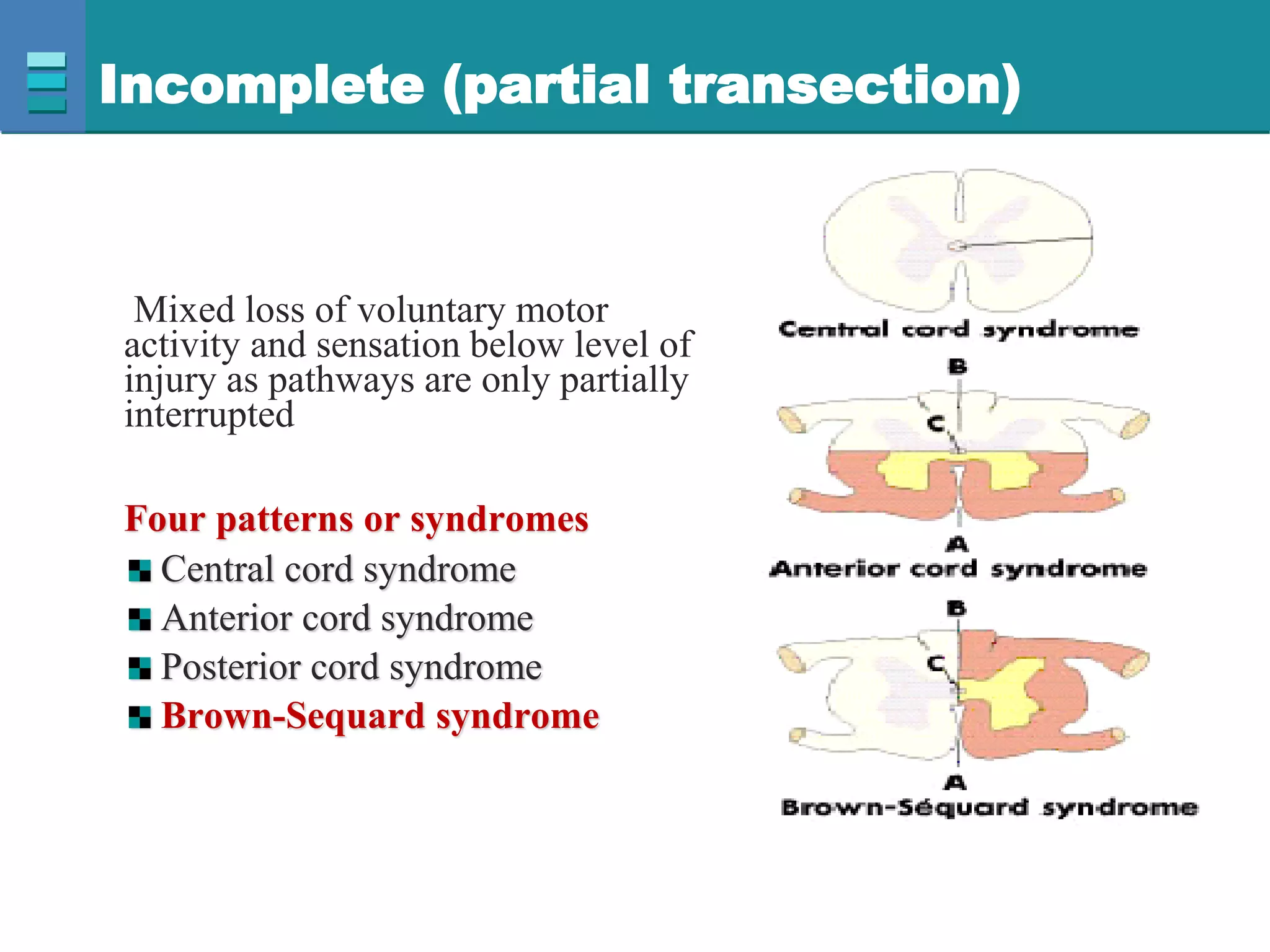
Incomplete (partial transection)
Mixed loss of voluntary motor
activity and sensation below level of
injury as pathways are only partially
interrupted
Four patterns or syndromes
Central cord syndrome
Anterior cord syndrome
Posterior cord syndrome
Brown-Sequard syndrome
Cord Syndrome
Brown-Sequard syndrome
Central cord syndrome
Anterior cord syndrome
Posterior cord syndrome
Brown-Sequard’s Syndrome
Incomplete Transection Cord Injury
Brown-Sequard’s Syndrome
Damage to one half of the
cord on either side
Penetrating injury that
affects one side of the cord
Ischemia,infectious or
inflammatory diseases
(tuberculosis,multiple
sclerosis)& spinal cord
tumor
Ipsilateral sensory and
motor loss
Contralateral pain and
temperature sensation loss
Brown Sequard Syndrome
Below the level of lesion:
 Impairment of ipsilateral light
touch, proprioception and
vibration (dorsal columns) from
site of lesion, caudally
 Impairment of contralateral pain
and temperature (spinothalamic
tract) below level of lesion
 Impairment of ipsilateral
voluntary movements (UMN type
of paralysis) below level of lesion
 Temporary loss of vasomotor tone
Brown Sequard Syndrome
Above the lesion
 Small area of cutaneous hyperaesthesia on the
same side
 No motor involvement on both sides
At the level of lesion
 Complete sensory loss on the same side
 LMN paralysis – same side
 Vasomotor paralysis – same side
 No sensory motor & vasomotor involvement on
the opposite side
Brown Sequard’s Syndrome
Site Function Same side Opp. side
Above the level Sensory
Motor
Vasomotor
Normal
Normal
Normal
Normal
Normal
Normal
At the level Sensory
Motor
Vasomotor
Total sensory loss
LMN type palsy
Vaso dilatation
Normal
Normal
Normal
Below the level Sensory
Motor
Vasomotor
Dorsal column lost
UMN type palsy
Vaso dilatation
Spino thalamic lost
Normal
Normal
9.transection of sc kjg

9.transection of sc kjg

  • 1.
  • 2.
    Objectives 1. Complete transectionof spinal cord 2. Incomplete transection of spinal cord
  • 3.
    Spinal Cord Injuries Causes(in order of frequency) Motor Vehicle Accidents Gunshot wounds/acts of violence Falls Sports injuries
  • 4.
    Classification of SCI 1.Flexion: Head is suddenly & forcefully accelerated forward causing extreme flexion of the neck “Kiss the Chest
  • 5.
    Classification of SCI 2.Hyperextension Automobile accidents
  • 6.
    Classification of SCI 3.Vertical compression Blow to the top of the head Often begins with a sudden, traumatic force
  • 7.
    Classification of SCI 4.Excessive Rotation (either flexion- or extension-rotation)
  • 8.
    Classification of SCI 5.Penetrating injuries
  • 9.
    Types of CordInjury 1. Concussion Similar to cerebral concussion Temporary and transient disruption of cord function 2. Contusion Bruising of the cord Tissue damage, vascular leakage, and swelling 3. Compression - Secondary to: Displacement of the vertebrae Herniation of inter vertebral disk Displacement of vertebral bone fragment Swelling from adjacent tissue 4. Laceration Direct damage to cord with associated bleeding, swelling and potential disruption of cord 5. Hemorrhage Associated with contusion, laceration, or stretching 6. Transection Partial or complete severing of cord
  • 10.
    Common sites ofSpinal Injury C-1/C-2: Delicate vertebrae C-7: Transition from flexible cervical spine to thorax T-12/L-1: Different flexibility between thoracic and lumbar regions
  • 11.
    Complete spinal cordinjury Most severe form of injury All sensations & motor functions will be lost beneath the level of the injury Depend on the level of the injury! Tetraplegia (formerly quadriplegia) occurs with C-1 to C-8 injuries. Paraplegia occurs with T-1 to L-4
  • 12.
  • 13.
    Complete spinal cordinjury Stages 1. Stage of spinal shock 2. Stage of reflex activity 3. Stage of reflex failure Spinal shock: Begins within hour of injury & Lasts from few minutes up to several months & Ends with return of reflex activity: Hyper reflexia, Muscle spasticity, Reflex bladder emptying.
  • 14.
  • 15.
    Stage of spinalshock 1.Spinal Shock - Temporary loss of reflex function (a reflexia) below level of injury beginning immediately after complete transection of spinal cord Temporary insult to the cord Affects body below the level of injury Cramp like pains at the level of lesion Loss of all sensations below the lesion Muscles are paralyzed Muscle tone is lost Reflexes are lost Bladder & the rectum are paralyzed Sphincters paralyzed but recover their activity faster Vasomotor tone lost, so BP falls Skin becomes cold & blue- bed sores may develop
  • 16.
    Effects of sectionat various levels At C1 segment level Quadriplegia Maximum fall in BP Anaesthesia Paralysis of respiratory muscles Death At C5 segment level Quadriplegia Maximum fall in BP Anaesthesia below the lesion Diaphragm is not paralysed. So, respiration is maintained Horner’s syndrome develops
  • 17.
    Effects of sectionat various levels At C8 Miosis No sweating on the face and the neck Ptosis due to paralysis of the Muller’s muscle Enophthalmos Loss of ciliospinal reflex – (stimulation of skin over the neck produces reflex dilatation of the pupil) Other features remain the same At upper thoracic level Paraplegia Maximum fall in BP Anaesthesia below the lesion No Horner’s syndrome
  • 18.
    Effects of sectionat various levels At lower thoracic level BP fall is less Other features remain the same At or below 2nd lumbar Minimum or no fall in BP Paraplegia Anaesthesia below the lesion Other features remain the same
  • 19.
    Site Sensory MotorBP RS Other C1 Anaesthesia Quadriplegia Max Fall Paralysis of RS muscles Death C5 Anaesthesia below Quadriplegia Max Fall No Horner‘s develops C8 SAME Full Horner‘s Upper Thoracic Anaesthesia below Paraplegia Max fall No Horner”s Lower thoracic SAME Less BP fall At or below II lumbar SAME No BP fall
  • 20.
    Stage of reflexactivity Sensations remain lost Voluntary movements absent Skeletal muscle tone increases in flexors first then in extensors Functional activity of smooth muscle returns Reflexes appear – Babinski reflex positive Micturition & Defaecation reflex reappear Mass reflex - Stroking the inner thigh – flexor spasm,contraction of abdominal muscles & evacuation of bladder BP increases & skin sweats
  • 21.
    Stage of reflexfailure Reflexes become functionless Loss of muscle tone Muscle wasting (degenerative changes) General infection – bedsores, UTI, sepsis ----Death
  • 22.
    Incomplete (partial transection) Mixedloss of voluntary motor activity and sensation below level of injury as pathways are only partially interrupted Four patterns or syndromes Central cord syndrome Anterior cord syndrome Posterior cord syndrome Brown-Sequard syndrome
  • 23.
    Cord Syndrome Brown-Sequard syndrome Centralcord syndrome Anterior cord syndrome Posterior cord syndrome
  • 24.
    Brown-Sequard’s Syndrome Incomplete TransectionCord Injury Brown-Sequard’s Syndrome Damage to one half of the cord on either side Penetrating injury that affects one side of the cord Ischemia,infectious or inflammatory diseases (tuberculosis,multiple sclerosis)& spinal cord tumor Ipsilateral sensory and motor loss Contralateral pain and temperature sensation loss
  • 25.
    Brown Sequard Syndrome Belowthe level of lesion:  Impairment of ipsilateral light touch, proprioception and vibration (dorsal columns) from site of lesion, caudally  Impairment of contralateral pain and temperature (spinothalamic tract) below level of lesion  Impairment of ipsilateral voluntary movements (UMN type of paralysis) below level of lesion  Temporary loss of vasomotor tone
  • 26.
    Brown Sequard Syndrome Abovethe lesion  Small area of cutaneous hyperaesthesia on the same side  No motor involvement on both sides At the level of lesion  Complete sensory loss on the same side  LMN paralysis – same side  Vasomotor paralysis – same side  No sensory motor & vasomotor involvement on the opposite side
  • 28.
    Brown Sequard’s Syndrome SiteFunction Same side Opp. side Above the level Sensory Motor Vasomotor Normal Normal Normal Normal Normal Normal At the level Sensory Motor Vasomotor Total sensory loss LMN type palsy Vaso dilatation Normal Normal Normal Below the level Sensory Motor Vasomotor Dorsal column lost UMN type palsy Vaso dilatation Spino thalamic lost Normal Normal