WASTE MANAGEMENT
The poster
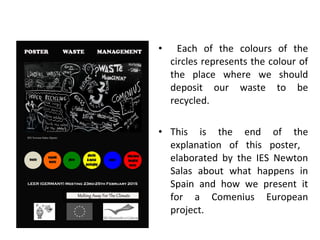
• Firstly the picture is a
project of VISUAL
THINKING.
• That means to try to
connect our ideas with
simple images. The idea
is to link each concept to
an idea to make easier
its memorization
• What we first see in the man
with the question mark in the
head which wonders about
waste management. Then the
three main R´s about the waste
management appear: Reuse,
Reduce and Recycle.
Secondly, we consider what
things can be reused.
We think about recycling
plastic which is written on a
wall. The wall, is built with
bricks and bricks are what we
have to recycle.
There is a piece of paper
underneath with some of the
advantages of using paper.
 Besides, we see the origin of
paper from the tree to the
person who uses it, and there
is a recycling waste bin to use
it again.
Thirdly, we can see the word
“glass” with a wavy shape. This
represents that water flows.
With the shape of a bottle, we
have the different process of
recycling glass.
• Each of the colours of the
circles represents the colour of
the place where we should
deposit our waste to be
recycled.
• This is the end of the
explanation of this poster,
elaborated by the IES Newton
Salas about what happens in
Spain and how we present it
for a Comenius European
project.
WASTE MANAGEMENTReducing waste
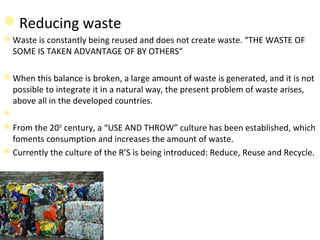
Waste is constantly being reused and does not create waste. “THE WASTE OF
SOME IS TAKEN ADVANTAGE OF BY OTHERS”
When this balance is broken, a large amount of waste is generated, and it is not
possible to integrate it in a natural way, the present problem of waste arises,
above all in the developed countries.

From the 20th
century, a “USE AND THROW” culture has been established, which
foments consumption and increases the amount of waste.
Currently the culture of the R’S is being introduced: Reduce, Reuse and Recycle.
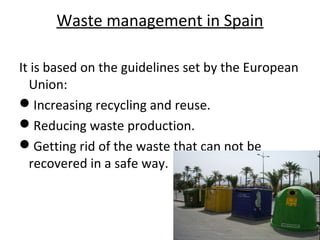
It is based on the guidelines set by the European
Union:
Increasing recycling and reuse.
Reducing waste production.
Getting rid of the waste that can not be
recovered in a safe way.
Waste management in Spain
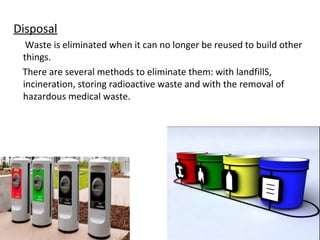
Types of containers according to waste
Recycling
Disposal
Waste is eliminated when it can no longer be reused to build other
things.
There are several methods to eliminate them: with landfillS,
incineration, storing radioactive waste and with the removal of
hazardous medical waste.
TYPES OF WASTE
URBAN SOLID WASTE
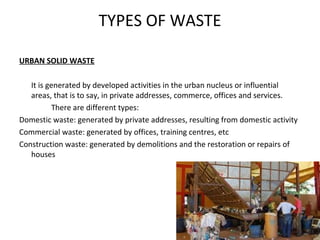
It is generated by developed activities in the urban nucleus or influential
areas, that is to say, in private addresses, commerce, offices and services.
There are different types:
Domestic waste: generated by private addresses, resulting from domestic activity
Commercial waste: generated by offices, training centres, etc
Construction waste: generated by demolitions and the restoration or repairs of
houses
Waste management
Sanitary waste
Sanitary waste generate a series of waste of
very particular characteristics: sanitary
infectious residues, biological and
anatomical remains, blood, alive vaccines,
and the whole material that has been in
touch with these substances, including
needles and sharp and cutting material.
Undoubtedly this category of residues needs
a specific management to avoid the danger
of pollution of the environment, and the
contagion of infectious diseases that
represent a risk for the people´s health.
Industrial waste
It is any element, substance or obtained object like proved
from an industrial process
Great quantity of these industrial residues can be re-used and
recycled, but the problem of this is that the technologies that
they must be used are too much costly
They can be two types: inert or dangerous
Radioactive waste
It includes any type of material that
contains radionuclides or that it is
polluted by them, in proportions superior
to the limits fixed by the regulatory
authority.
 They may not be foreseen to use or to be
useful. Radioactive waste is the material
that issues radioactivity.
WASTE MANAGEMENT
IN OUR SCHOOL
WE RECYCLE PAPER
• In our classes, there is a separate waste bin
for rubbish and a different one for paper. That
paper is recycled daily in our school.
WE RECYCLE CARTONS OF EGGS
• Cartons of eggs are recycled because we use
them to improve the sound of the music
classes. We paint them in different colours
and they are sprayed with a fire retardant and
hanged on the walls.
WE DEPOSIT USED BATTERIES
• We can deposit
used batteries in
a special
container just
outside the school
Learning to use recycled materials
• Teachers adapt their
teaching program to
recycle in class using
objects such as plastic
bottle caps, bricks,
shower gel plastic
bottles etc.
WERECYCLE MOBILE PHONES
By recycling
mobile phones in
our school, We
help an NGO that
provides help to
people in need as
well as supporting
the investigation of
the the San
Filippo Syndrome
in children.
Presentation spain waste management

Presentation spain waste management

  • 1.
  • 2.
    The poster • Firstlythe picture is a project of VISUAL THINKING. • That means to try to connect our ideas with simple images. The idea is to link each concept to an idea to make easier its memorization
  • 3.
    • What wefirst see in the man with the question mark in the head which wonders about waste management. Then the three main R´s about the waste management appear: Reuse, Reduce and Recycle.
  • 4.
    Secondly, we considerwhat things can be reused. We think about recycling plastic which is written on a wall. The wall, is built with bricks and bricks are what we have to recycle. There is a piece of paper underneath with some of the advantages of using paper.  Besides, we see the origin of paper from the tree to the person who uses it, and there is a recycling waste bin to use it again.
  • 5.
    Thirdly, we cansee the word “glass” with a wavy shape. This represents that water flows. With the shape of a bottle, we have the different process of recycling glass.
  • 6.
    • Each ofthe colours of the circles represents the colour of the place where we should deposit our waste to be recycled. • This is the end of the explanation of this poster, elaborated by the IES Newton Salas about what happens in Spain and how we present it for a Comenius European project.
  • 7.
    WASTE MANAGEMENTReducing waste Wasteis constantly being reused and does not create waste. “THE WASTE OF SOME IS TAKEN ADVANTAGE OF BY OTHERS” When this balance is broken, a large amount of waste is generated, and it is not possible to integrate it in a natural way, the present problem of waste arises, above all in the developed countries.  From the 20th century, a “USE AND THROW” culture has been established, which foments consumption and increases the amount of waste. Currently the culture of the R’S is being introduced: Reduce, Reuse and Recycle.
  • 8.
    It is basedon the guidelines set by the European Union: Increasing recycling and reuse. Reducing waste production. Getting rid of the waste that can not be recovered in a safe way. Waste management in Spain
  • 9.
    Types of containersaccording to waste Recycling
  • 10.
    Disposal Waste is eliminatedwhen it can no longer be reused to build other things. There are several methods to eliminate them: with landfillS, incineration, storing radioactive waste and with the removal of hazardous medical waste.
  • 11.
    TYPES OF WASTE URBANSOLID WASTE It is generated by developed activities in the urban nucleus or influential areas, that is to say, in private addresses, commerce, offices and services. There are different types: Domestic waste: generated by private addresses, resulting from domestic activity Commercial waste: generated by offices, training centres, etc Construction waste: generated by demolitions and the restoration or repairs of houses
  • 12.
    Waste management Sanitary waste Sanitarywaste generate a series of waste of very particular characteristics: sanitary infectious residues, biological and anatomical remains, blood, alive vaccines, and the whole material that has been in touch with these substances, including needles and sharp and cutting material. Undoubtedly this category of residues needs a specific management to avoid the danger of pollution of the environment, and the contagion of infectious diseases that represent a risk for the people´s health.
  • 13.
    Industrial waste It isany element, substance or obtained object like proved from an industrial process Great quantity of these industrial residues can be re-used and recycled, but the problem of this is that the technologies that they must be used are too much costly They can be two types: inert or dangerous
  • 14.
    Radioactive waste It includesany type of material that contains radionuclides or that it is polluted by them, in proportions superior to the limits fixed by the regulatory authority.  They may not be foreseen to use or to be useful. Radioactive waste is the material that issues radioactivity.
  • 15.
  • 16.
    WE RECYCLE PAPER •In our classes, there is a separate waste bin for rubbish and a different one for paper. That paper is recycled daily in our school.
  • 17.
    WE RECYCLE CARTONSOF EGGS • Cartons of eggs are recycled because we use them to improve the sound of the music classes. We paint them in different colours and they are sprayed with a fire retardant and hanged on the walls.
  • 18.
    WE DEPOSIT USEDBATTERIES • We can deposit used batteries in a special container just outside the school
  • 19.
    Learning to userecycled materials • Teachers adapt their teaching program to recycle in class using objects such as plastic bottle caps, bricks, shower gel plastic bottles etc.
  • 20.
    WERECYCLE MOBILE PHONES Byrecycling mobile phones in our school, We help an NGO that provides help to people in need as well as supporting the investigation of the the San Filippo Syndrome in children.