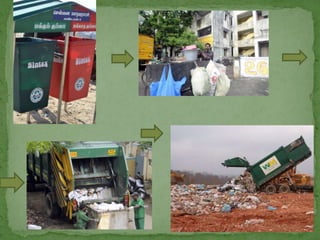
 Generation of waste
 Waste minimization
 Recycling and reuse
 Storage, collection, transport, and transfer
 Treatment
 Landfill disposal
 Environmental considerations
 Financial and marketing aspects
 Policy and regulations
 Education and training
 Planning and implementation.
 Landfill
 Incineration
 Recycling
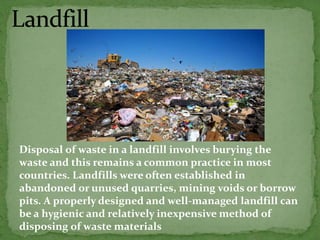
Disposal of waste in a landfill involves burying the
waste and this remains a common practice in most
countries. Landfills were often established in
abandoned or unused quarries, mining voids or borrow
pits. A properly designed and well-managed landfill can
be a hygienic and relatively inexpensive method of
disposing of waste materials
Incineration is a disposal method in which solid
organic wastes are subjected to combustion so as
to convert them into residue and gaseous
products. This method is useful for disposal of
residue of both solid waste management and solid
residue from waste water management. This
process reduces the volumes of solid waste to 20 to
30 percent of the original volume.
The process
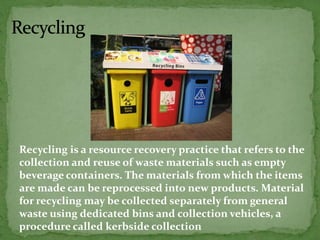
Recycling is a resource recovery practice that refers to the
collection and reuse of waste materials such as empty
beverage containers. The materials from which the items
are made can be reprocessed into new products. Material
for recycling may be collected separately from general
waste using dedicated bins and collection vehicles, a
procedure called kerbside collection
Chennai Solid Waste Management
Department:
Headed by a Superintendent Engineer,
the department looks after removal of
solid waste which is a major responsibility
of the Corporation. Every day 4500 MT of
garbage is collected and removed from
the city. Night conservancy is being
carried out in all important roads and
commercial areas of the city. Door to door
collection of garbage is prescribed in all
zones.
Generation
Per capita Generation per day= 700gms
Estimated Generation of Solid Waste Per day Garbage
4500 MTs. Building debris 700 MTs
Composition
Physical
Food waste 8.00 %
Green waste 32.25 %
Timber(wood) 6.99 %
Consumable plastic 5.86 %
Industrial Plastic 1.18 %
Steel & Material l0.03 %
Rags & Textiles 3.14 %
Paper 6.45 %
Rubber & Leather 1.45 %
Inerts 34.65 %
Chemical Analysis
Waste Generation By Category:
Hospitals & Clinics Separately disposed by
Hospitals.
Moisture Content 27.60 %
PH Value 7.68%
Organic Content 39.06 %
Carbon content 21.53 %
Nitrogen Content 0.73 %
Phosphorous P2O 50.63 %
Potassium K 2 O 0.63 %
Residential 68 %
Commercial 16 %
Halls, Schools,
Institutions
14 %
Industrial 2 %
Activity
•Sweeping, collecting, storing in the specific bins.
•Door to door collection of garbage
•Collecting the Source Separated Waste from the
House holds by Tricycles or Light Motor Vehicles
for unloading in transfer stations.
Secondary Collection: (Transportation)
•Street to disposal site.
•Transportation to disposal site from transfer
station.
•Route schedules for each and every vehicle for
each trip
solid waste management

solid waste management

  • 3.
     Generation ofwaste  Waste minimization  Recycling and reuse  Storage, collection, transport, and transfer  Treatment  Landfill disposal  Environmental considerations  Financial and marketing aspects  Policy and regulations  Education and training  Planning and implementation.
  • 4.
  • 5.
    Disposal of wastein a landfill involves burying the waste and this remains a common practice in most countries. Landfills were often established in abandoned or unused quarries, mining voids or borrow pits. A properly designed and well-managed landfill can be a hygienic and relatively inexpensive method of disposing of waste materials
  • 7.
    Incineration is adisposal method in which solid organic wastes are subjected to combustion so as to convert them into residue and gaseous products. This method is useful for disposal of residue of both solid waste management and solid residue from waste water management. This process reduces the volumes of solid waste to 20 to 30 percent of the original volume.
  • 8.
  • 9.
    Recycling is aresource recovery practice that refers to the collection and reuse of waste materials such as empty beverage containers. The materials from which the items are made can be reprocessed into new products. Material for recycling may be collected separately from general waste using dedicated bins and collection vehicles, a procedure called kerbside collection
  • 11.
    Chennai Solid WasteManagement Department: Headed by a Superintendent Engineer, the department looks after removal of solid waste which is a major responsibility of the Corporation. Every day 4500 MT of garbage is collected and removed from the city. Night conservancy is being carried out in all important roads and commercial areas of the city. Door to door collection of garbage is prescribed in all zones.
  • 12.
    Generation Per capita Generationper day= 700gms Estimated Generation of Solid Waste Per day Garbage 4500 MTs. Building debris 700 MTs Composition Physical Food waste 8.00 % Green waste 32.25 % Timber(wood) 6.99 % Consumable plastic 5.86 % Industrial Plastic 1.18 % Steel & Material l0.03 % Rags & Textiles 3.14 % Paper 6.45 % Rubber & Leather 1.45 % Inerts 34.65 %
  • 13.
    Chemical Analysis Waste GenerationBy Category: Hospitals & Clinics Separately disposed by Hospitals. Moisture Content 27.60 % PH Value 7.68% Organic Content 39.06 % Carbon content 21.53 % Nitrogen Content 0.73 % Phosphorous P2O 50.63 % Potassium K 2 O 0.63 % Residential 68 % Commercial 16 % Halls, Schools, Institutions 14 % Industrial 2 %
  • 14.
    Activity •Sweeping, collecting, storingin the specific bins. •Door to door collection of garbage •Collecting the Source Separated Waste from the House holds by Tricycles or Light Motor Vehicles for unloading in transfer stations. Secondary Collection: (Transportation) •Street to disposal site. •Transportation to disposal site from transfer station. •Route schedules for each and every vehicle for each trip