CONSTRUCTION &
DEMOLITION WASTE
AS A RESOURCE
Dr K M Soni, Chief
Engineer, CPWD, Mumbai
C & D Waste
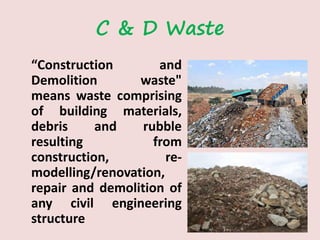
“Construction and
Demolition waste"
means waste comprising
of building materials,
debris and rubble
resulting from
construction, re-
modelling/renovation,
repair and demolition of
any civil engineering
structure
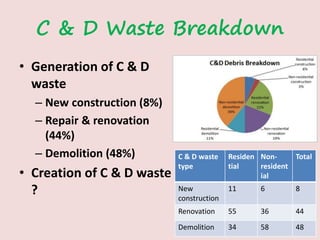
C & D Waste Breakdown
• Generation of C & D
waste
– New construction (8%)
– Repair & renovation
(44%)
– Demolition (48%)
• Creation of C & D waste
?
C & D waste
type
Residen
tial
Non-
resident
ial
Total
New
construction
11 6 8
Renovation 55 36 44
Demolition 34 58 48
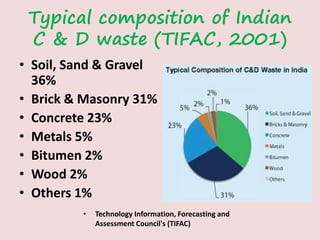
Typical composition of Indian
C & D waste (TIFAC, 2001)
• Soil, Sand & Gravel
36%
• Brick & Masonry 31%
• Concrete 23%
• Metals 5%
• Bitumen 2%
• Wood 2%
• Others 1%
• Technology Information, Forecasting and
Assessment Council's (TIFAC)
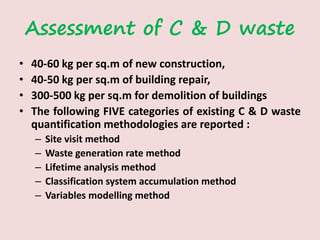
Assessment of C & D waste
• 40-60 kg per sq.m of new construction,
• 40-50 kg per sq.m of building repair,
• 300-500 kg per sq.m for demolition of buildings
• The following FIVE categories of existing C & D waste
quantification methodologies are reported :
– Site visit method
– Waste generation rate method
– Lifetime analysis method
– Classification system accumulation method
– Variables modelling method
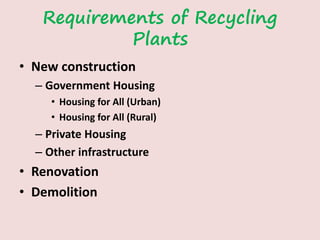
Requirements of Recycling
Plants
• New construction
– Government Housing
• Housing for All (Urban)
• Housing for All (Rural)
– Private Housing
– Other infrastructure
• Renovation
• Demolition
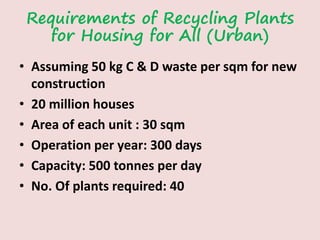
Requirements of Recycling Plants
for Housing for All (Urban)
• Assuming 50 kg C & D waste per sqm for new
construction
• 20 million houses
• Area of each unit : 30 sqm
• Operation per year: 300 days
• Capacity: 500 tonnes per day
• No. Of plants required: 40
Requirements of Recycling Plants
for Housing for All (Rural)
• No. Of houses to be constructed under
PMAY-Gramin: 30 million (60 Plants)
• AMRUT
• HRIDAY
• Smart Cities
• Government construction including local
bodies/development authorities
• Other infrastructure
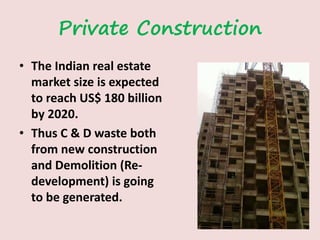
Private Construction
• The Indian real estate
market size is expected
to reach US$ 180 billion
by 2020.
• Thus C & D waste both
from new construction
and Demolition (Re-
development) is going
to be generated.
Generation of C & D Waste
• 10 MT - 15 MT (MT – million tonnes) per year by
MoUD (2000);
• Approximately 25-30 million tonnes of C & D
wastes is generated annually in India (2014)
• 170-200 plants of 500 tonnes per day capacity are
required assuming operating for 300 days a year
• Now it is estimated to be 165-175 million tonnes
per year (BMTPC)
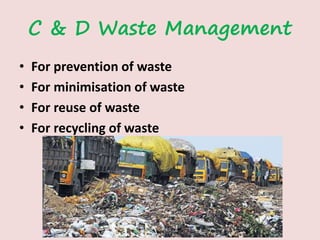
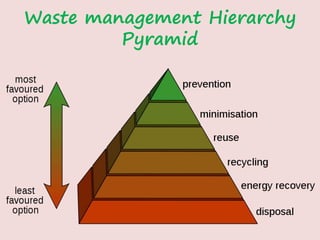
C & D Waste Management
• For prevention of waste
• For minimisation of waste
• For reuse of waste
• For recycling of waste
Waste management Hierarchy
Pyramid
Reasons of Repair/renovation
& Demolition
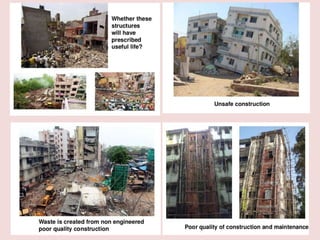
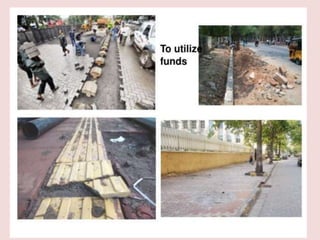
• Due to expiry of useful life of structure
(generation of waste)
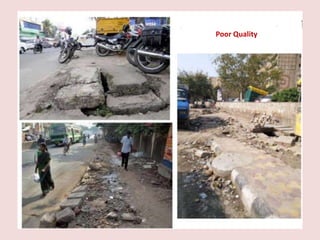
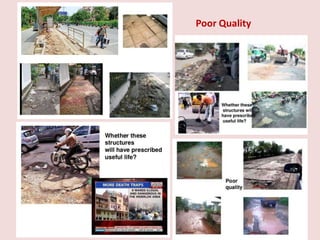
• Due to poor quality of original construction
• Due to unauthorised (poor quality)
construction and additions thereafter
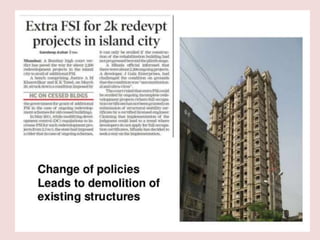
• Due to redevelopment for additional FSI
• Due to frequent renovations and
construction by different agencies due to
poor co-ordination
Leading to creation of waste
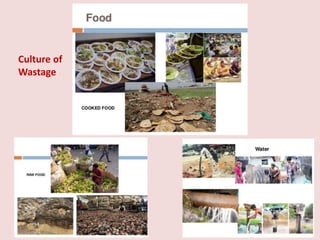
Culture of
Wastage
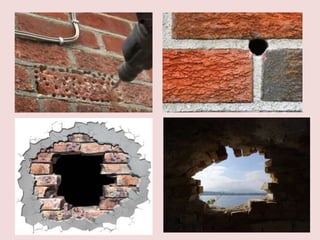
Poor Quality
Poor Quality
Let us stop creating C & D
waste to save natural resources
by adopting “quality” concept
in construction and
Maintenance
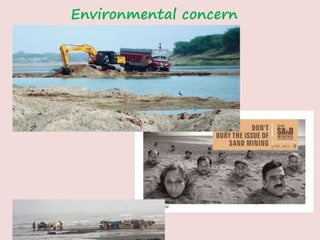
Environmental concern
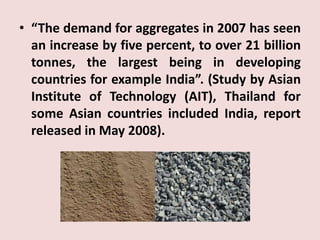
• “The demand for aggregates in 2007 has seen
an increase by five percent, to over 21 billion
tonnes, the largest being in developing
countries for example India”. (Study by Asian
Institute of Technology (AIT), Thailand for
some Asian countries included India, report
released in May 2008).
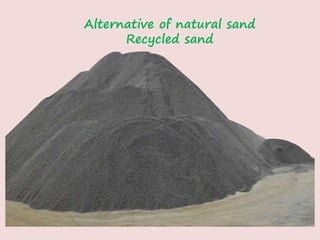
Alternative of natural sand
Recycled sand
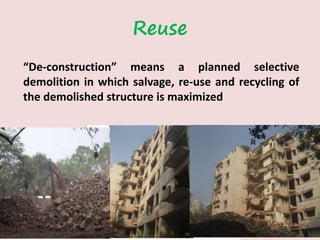
Reuse
“De-construction” means a planned selective
demolition in which salvage, re-use and recycling of
the demolished structure is maximized
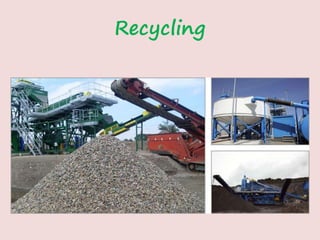
Recycling
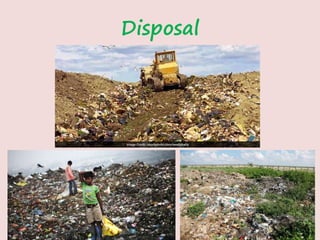
Disposal
C & D Waste Management
Rules 2016
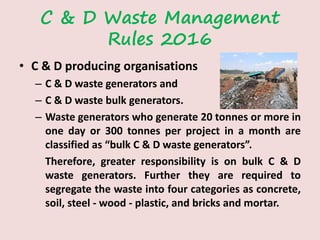
• C & D producing organisations
– C & D waste generators and
– C & D waste bulk generators.
– Waste generators who generate 20 tonnes or more in
one day or 300 tonnes per project in a month are
classified as “bulk C & D waste generators”.
Therefore, greater responsibility is on bulk C & D
waste generators. Further they are required to
segregate the waste into four categories as concrete,
soil, steel - wood - plastic, and bricks and mortar.
Government initiatives
• MoUD vide its circular dated 28th June, 2012 stated all
states to set up C & D Waste recycling / processing
facilities in all cities with population of over ONE million
(10 lakh)
• Guidelines on recycling and reuse of C&D waste by CPWD
March 2014
• Guidelines of utilisation of C & D waste in construction of
dwelling units and other infrastructure in housing
schemes of government (2016) by BMTPC
• C & D waste management rules 2016 of MoEF&CC notified
on 29th March, 2016
• Guidelines of environmental management of C & D waste
CPCB (2017)
Aim of Swachh Bharat Mission
• 100 % solid waste including C & D waste
is to be processed under “The Swachh
Bharat Mission” by 2nd October, 2019
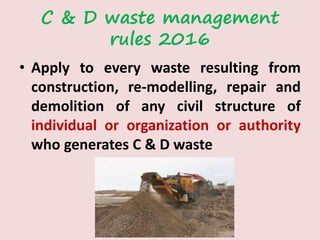
C & D waste management
rules 2016
• Apply to every waste resulting from
construction, re-modelling, repair and
demolition of any civil structure of
individual or organization or authority
who generates C & D waste
C & D waste management
rules 2016
• Construction of new buildings
• Renovation of existing buildings
• Demolition of existing, old dilapidated
structures;
• Excavation/reconstruction of asphalt/ concrete
roads;
• Construction of new fly over bridges/ under
bridges/ sub-ways etc.;
• Renovation/ Installation of new water/
telephone/ internet/ sewer pipe lines etc.
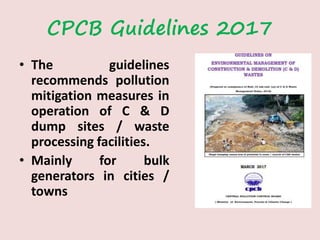
CPCB Guidelines 2017
• The guidelines
recommends pollution
mitigation measures in
operation of C & D
dump sites / waste
processing facilities.
• Mainly for bulk
generators in cities /
towns
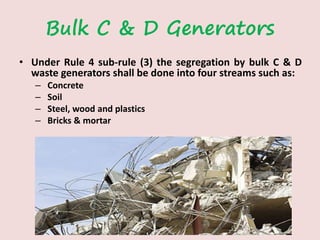
Bulk C & D Generators
• Under Rule 4 sub-rule (3) the segregation by bulk C & D
waste generators shall be done into four streams such as:
– Concrete
– Soil
– Steel, wood and plastics
– Bricks & mortar
Duties of Local Authority
• Management of C & D waste generated
including processing facility and for using the
recycled products in the best possible
manner
• Awareness and dissemination of knowledge
• Incentives for use of material made out of C
D waste including in non-structural concrete,
paving blocks, lower layers of road
pavements, colony and rural roads’
• Rule (11) under Duties of Bureau of Indian
Standards (BIS) and Indian Roads Congress
(IRC) ‘The Bureau of Indian Standards and
Indian Roads Congress shall be responsible
for preparation of code of practices and
standards for use of recycled materials and
products of construction and demolition
waste in respect of construction activities
IS 383: 2016
• IS 383 : 2016 Indian Standard COARSE AND FINE
AGGREGATE FOR CONCRETE – SPECIFICATION
(Third Revision) - Scope: This standard covers
the requirements for aggregates, crushed or
uncrushed, derived from natural sources, such
as river terraces and riverbeds, glacial deposits,
rocks, boulders and gravels, and manufactured
aggregates produced from other than natural
sources, for use in the production of concrete for
normal structural purposes including mass
concrete works.
• These manufactured aggregates are of two
types namely:
– Recycled Aggregate (RA) ‒‒ It is made from C & D
waste which may comprise concrete, brick, tiles,
stone, etc.
– Recycled Concrete Aggregate (RCA) ‒ It is derived
from concrete after requisite processing.
IS: 383 was revised in January, 2016, permitting use
of recycled aggregates up to 25% in plain
concrete, 20% in reinforced concrete of M-25 or
lower grade and up to 100% in lean concretes of
grade less than M-15.
• Roadmap for C & D waste management -
Population of cities Under C & D Waste
Management Rules 2016, the targets for
commissioning C&D processing facilities are
based on population as given below:
• i. Cities with population of one million and
above
• ii. Cities with population of 0.5 –one million
• iii. Cities with population of less than 0.5 million
Time frame
Timeframe for Planning and Implementation
1. Formulation of policy by State
Government: 12 months
2. Identification of sites for collection &
processing facility: 18 months
3. Commissioning and implementation of the
facility: 18 months-36 months
4. Monitoring by SPCBs:
CPWD initiatives
• Central Public Works Department (CPWD) and
National Building Construction Company
(NBCC) have recommended use of recycled
portions of C & D wastes in their construction
activities or if the same is available within 100
km from construction site.
MoU between CPWD &
Stiftelsen Norway
• Stiftelsen SINTEF and CPWD signed MoU
(Memorandum of Understanding) on 25.02.2016 for
an institutional and technical assistance programme
on “Treatment and utilisation of construction and
demolition waste in India” for institutional
cooperation on capacity building and technical
support. The Ministry of Foreign Affairs (MFA) of
Norway have entered into an agreement with SINTEF
on 19.12.2016 allocating a grant to be used
exclusively to finance the Programme during 2017-21.
• The goal of the Programme is to increase the
utilisation level of recovered C&D waste in the
building and construction sector in India by increasing
the treatment and recycling capacity.
Purpose
• To provide assistance to CPWD and ULBs in the
implementation of safe and sound treatment and
utilisation of C&D waste in the construction and civil
engineering sector.
• Target groups are CPWD under the Ministry of Urban
Development, Urban Local Bodies (ULBs) and other
relevant institutions and academia on the one side, and
industry and waste management companies on the other
side.
• To prepare guidelines and regulatory framework, and
provide input to BIS and IRC.
• Capacity building, training and information dissemination
Recycling capacity in India
• Recycling Plant at Burari, Delhi having capacity of 500
MTD capacity. The company collects some 500 tonnes per
day of C&D waste from three designated zones in Delhi
Karol Bagh, Sadar Paharganj and City.
• Second plant is established in East Delhi, near Shastri Park
under East Delhi Municipal Corporation.
• Three plants are proposed in Bangaluru each having
recycling capacity of 750 tonnes per day.
• A plant has been set up in Ahmadabad.
• Gurgaon Municipal Corporation near Delhi is planning a
C&D waste recycling plant on five acres of land.
• Many more plants are planned in various cities and in
near future, C & D waste recycling plants may be
operating in every major city.
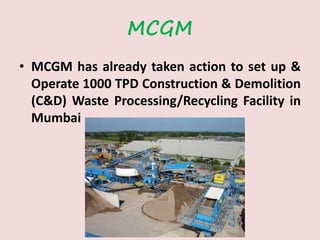
MCGM
• MCGM has already taken action to set up &
Operate 1000 TPD Construction & Demolition
(C&D) Waste Processing/Recycling Facility in
Mumbai
Incentives
• As per the advisory of Delhi Government, all Delhi
Government agencies will be required to incorporate
a clause in their tenders for mandatory use of a
minimum of 2 percent recycled products from C & D
waste in all future contracts for building works and 10
percent recycled products for road works.
• Other incentives like availability of land for setting up
the plant, charging tipping fee and processing fee by
the companies who install the plants may also be
agreed upon by the governments and ULBs.
• Other governments are also going to issue similar
guidelines
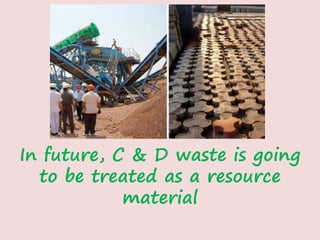
In future, C & D waste is going
to be treated as a resource
material
(The reference of photos and literature taken from various websites
is gratefully acknowledged)

Construction and Demolition Waste as a Resource

  • 1.
    CONSTRUCTION & DEMOLITION WASTE ASA RESOURCE Dr K M Soni, Chief Engineer, CPWD, Mumbai
  • 2.
    C & DWaste “Construction and Demolition waste" means waste comprising of building materials, debris and rubble resulting from construction, re- modelling/renovation, repair and demolition of any civil engineering structure
  • 3.
    C & DWaste Breakdown • Generation of C & D waste – New construction (8%) – Repair & renovation (44%) – Demolition (48%) • Creation of C & D waste ? C & D waste type Residen tial Non- resident ial Total New construction 11 6 8 Renovation 55 36 44 Demolition 34 58 48
  • 4.
    Typical composition ofIndian C & D waste (TIFAC, 2001) • Soil, Sand & Gravel 36% • Brick & Masonry 31% • Concrete 23% • Metals 5% • Bitumen 2% • Wood 2% • Others 1% • Technology Information, Forecasting and Assessment Council's (TIFAC)
  • 5.
    Assessment of C& D waste • 40-60 kg per sq.m of new construction, • 40-50 kg per sq.m of building repair, • 300-500 kg per sq.m for demolition of buildings • The following FIVE categories of existing C & D waste quantification methodologies are reported : – Site visit method – Waste generation rate method – Lifetime analysis method – Classification system accumulation method – Variables modelling method
  • 6.
    Requirements of Recycling Plants •New construction – Government Housing • Housing for All (Urban) • Housing for All (Rural) – Private Housing – Other infrastructure • Renovation • Demolition
  • 7.
    Requirements of RecyclingPlants for Housing for All (Urban) • Assuming 50 kg C & D waste per sqm for new construction • 20 million houses • Area of each unit : 30 sqm • Operation per year: 300 days • Capacity: 500 tonnes per day • No. Of plants required: 40
  • 8.
    Requirements of RecyclingPlants for Housing for All (Rural) • No. Of houses to be constructed under PMAY-Gramin: 30 million (60 Plants) • AMRUT • HRIDAY • Smart Cities • Government construction including local bodies/development authorities • Other infrastructure
  • 9.
    Private Construction • TheIndian real estate market size is expected to reach US$ 180 billion by 2020. • Thus C & D waste both from new construction and Demolition (Re- development) is going to be generated.
  • 10.
    Generation of C& D Waste • 10 MT - 15 MT (MT – million tonnes) per year by MoUD (2000); • Approximately 25-30 million tonnes of C & D wastes is generated annually in India (2014) • 170-200 plants of 500 tonnes per day capacity are required assuming operating for 300 days a year • Now it is estimated to be 165-175 million tonnes per year (BMTPC)
  • 11.
    C & DWaste Management • For prevention of waste • For minimisation of waste • For reuse of waste • For recycling of waste
  • 12.
  • 13.
    Reasons of Repair/renovation &Demolition • Due to expiry of useful life of structure (generation of waste) • Due to poor quality of original construction • Due to unauthorised (poor quality) construction and additions thereafter • Due to redevelopment for additional FSI • Due to frequent renovations and construction by different agencies due to poor co-ordination Leading to creation of waste
  • 14.
  • 16.
  • 17.
  • 21.
    Let us stopcreating C & D waste to save natural resources by adopting “quality” concept in construction and Maintenance
  • 22.
  • 23.
    • “The demandfor aggregates in 2007 has seen an increase by five percent, to over 21 billion tonnes, the largest being in developing countries for example India”. (Study by Asian Institute of Technology (AIT), Thailand for some Asian countries included India, report released in May 2008).
  • 24.
    Alternative of naturalsand Recycled sand
  • 25.
    Reuse “De-construction” means aplanned selective demolition in which salvage, re-use and recycling of the demolished structure is maximized
  • 26.
  • 27.
  • 28.
    C & DWaste Management Rules 2016 • C & D producing organisations – C & D waste generators and – C & D waste bulk generators. – Waste generators who generate 20 tonnes or more in one day or 300 tonnes per project in a month are classified as “bulk C & D waste generators”. Therefore, greater responsibility is on bulk C & D waste generators. Further they are required to segregate the waste into four categories as concrete, soil, steel - wood - plastic, and bricks and mortar.
  • 29.
    Government initiatives • MoUDvide its circular dated 28th June, 2012 stated all states to set up C & D Waste recycling / processing facilities in all cities with population of over ONE million (10 lakh) • Guidelines on recycling and reuse of C&D waste by CPWD March 2014 • Guidelines of utilisation of C & D waste in construction of dwelling units and other infrastructure in housing schemes of government (2016) by BMTPC • C & D waste management rules 2016 of MoEF&CC notified on 29th March, 2016 • Guidelines of environmental management of C & D waste CPCB (2017)
  • 30.
    Aim of SwachhBharat Mission • 100 % solid waste including C & D waste is to be processed under “The Swachh Bharat Mission” by 2nd October, 2019
  • 31.
    C & Dwaste management rules 2016 • Apply to every waste resulting from construction, re-modelling, repair and demolition of any civil structure of individual or organization or authority who generates C & D waste
  • 32.
    C & Dwaste management rules 2016 • Construction of new buildings • Renovation of existing buildings • Demolition of existing, old dilapidated structures; • Excavation/reconstruction of asphalt/ concrete roads; • Construction of new fly over bridges/ under bridges/ sub-ways etc.; • Renovation/ Installation of new water/ telephone/ internet/ sewer pipe lines etc.
  • 33.
    CPCB Guidelines 2017 •The guidelines recommends pollution mitigation measures in operation of C & D dump sites / waste processing facilities. • Mainly for bulk generators in cities / towns
  • 34.
    Bulk C &D Generators • Under Rule 4 sub-rule (3) the segregation by bulk C & D waste generators shall be done into four streams such as: – Concrete – Soil – Steel, wood and plastics – Bricks & mortar
  • 35.
    Duties of LocalAuthority • Management of C & D waste generated including processing facility and for using the recycled products in the best possible manner • Awareness and dissemination of knowledge • Incentives for use of material made out of C D waste including in non-structural concrete, paving blocks, lower layers of road pavements, colony and rural roads’
  • 36.
    • Rule (11)under Duties of Bureau of Indian Standards (BIS) and Indian Roads Congress (IRC) ‘The Bureau of Indian Standards and Indian Roads Congress shall be responsible for preparation of code of practices and standards for use of recycled materials and products of construction and demolition waste in respect of construction activities
  • 37.
    IS 383: 2016 •IS 383 : 2016 Indian Standard COARSE AND FINE AGGREGATE FOR CONCRETE – SPECIFICATION (Third Revision) - Scope: This standard covers the requirements for aggregates, crushed or uncrushed, derived from natural sources, such as river terraces and riverbeds, glacial deposits, rocks, boulders and gravels, and manufactured aggregates produced from other than natural sources, for use in the production of concrete for normal structural purposes including mass concrete works.
  • 38.
    • These manufacturedaggregates are of two types namely: – Recycled Aggregate (RA) ‒‒ It is made from C & D waste which may comprise concrete, brick, tiles, stone, etc. – Recycled Concrete Aggregate (RCA) ‒ It is derived from concrete after requisite processing. IS: 383 was revised in January, 2016, permitting use of recycled aggregates up to 25% in plain concrete, 20% in reinforced concrete of M-25 or lower grade and up to 100% in lean concretes of grade less than M-15.
  • 39.
    • Roadmap forC & D waste management - Population of cities Under C & D Waste Management Rules 2016, the targets for commissioning C&D processing facilities are based on population as given below: • i. Cities with population of one million and above • ii. Cities with population of 0.5 –one million • iii. Cities with population of less than 0.5 million
  • 40.
    Time frame Timeframe forPlanning and Implementation 1. Formulation of policy by State Government: 12 months 2. Identification of sites for collection & processing facility: 18 months 3. Commissioning and implementation of the facility: 18 months-36 months 4. Monitoring by SPCBs:
  • 41.
    CPWD initiatives • CentralPublic Works Department (CPWD) and National Building Construction Company (NBCC) have recommended use of recycled portions of C & D wastes in their construction activities or if the same is available within 100 km from construction site.
  • 42.
    MoU between CPWD& Stiftelsen Norway • Stiftelsen SINTEF and CPWD signed MoU (Memorandum of Understanding) on 25.02.2016 for an institutional and technical assistance programme on “Treatment and utilisation of construction and demolition waste in India” for institutional cooperation on capacity building and technical support. The Ministry of Foreign Affairs (MFA) of Norway have entered into an agreement with SINTEF on 19.12.2016 allocating a grant to be used exclusively to finance the Programme during 2017-21. • The goal of the Programme is to increase the utilisation level of recovered C&D waste in the building and construction sector in India by increasing the treatment and recycling capacity.
  • 43.
    Purpose • To provideassistance to CPWD and ULBs in the implementation of safe and sound treatment and utilisation of C&D waste in the construction and civil engineering sector. • Target groups are CPWD under the Ministry of Urban Development, Urban Local Bodies (ULBs) and other relevant institutions and academia on the one side, and industry and waste management companies on the other side. • To prepare guidelines and regulatory framework, and provide input to BIS and IRC. • Capacity building, training and information dissemination
  • 44.
    Recycling capacity inIndia • Recycling Plant at Burari, Delhi having capacity of 500 MTD capacity. The company collects some 500 tonnes per day of C&D waste from three designated zones in Delhi Karol Bagh, Sadar Paharganj and City. • Second plant is established in East Delhi, near Shastri Park under East Delhi Municipal Corporation. • Three plants are proposed in Bangaluru each having recycling capacity of 750 tonnes per day. • A plant has been set up in Ahmadabad. • Gurgaon Municipal Corporation near Delhi is planning a C&D waste recycling plant on five acres of land. • Many more plants are planned in various cities and in near future, C & D waste recycling plants may be operating in every major city.
  • 45.
    MCGM • MCGM hasalready taken action to set up & Operate 1000 TPD Construction & Demolition (C&D) Waste Processing/Recycling Facility in Mumbai
  • 46.
    Incentives • As perthe advisory of Delhi Government, all Delhi Government agencies will be required to incorporate a clause in their tenders for mandatory use of a minimum of 2 percent recycled products from C & D waste in all future contracts for building works and 10 percent recycled products for road works. • Other incentives like availability of land for setting up the plant, charging tipping fee and processing fee by the companies who install the plants may also be agreed upon by the governments and ULBs. • Other governments are also going to issue similar guidelines
  • 47.
    In future, C& D waste is going to be treated as a resource material
  • 48.
    (The reference ofphotos and literature taken from various websites is gratefully acknowledged)