WASTE
MANAGEMENT
By Md Aashif Raza
1RI21CS060
INTRODUCTION
• Waste management or waste disposal includes the processes and actions required to manage
waste from its inception to its final disposal.
• This includes the collection, transport, treatment and disposal of waste, together with
monitoring and regulation of the waste management process and waste-related laws,
technologies, economic mechanisms.
• ‘Waste management’ shall mean “the collection, transport, recovery and disposal of waste,
including the supervision of such operation and after care of disposal sites”
• However the newer concepts of ‘waste management’ talk about ‘Reduce, Reuse and
Recycle of waste’ over and above waste disposal.
WASTE
• Waste includes all items that people no longer have any use for, which they either intend to
get rid of or have already discarded.(European Topic Centre on Sustainable Consumption
and Production)**
• Any material which is not needed by the owner, producer or processor.
Types Of Waste On The Basis Of Their Physical State
Solid waste
Liquid waste
Gaseous waste
Types Of Waste On The Basis Of Their Physical State
Solid waste
Liquid waste
Gaseous waste
• Solid wastes – These are the unwanted substances that are discarded by human society.
These include urban wastes, industrial wastes, agricultural wastes, biomedical wastes and
radioactive wastes.
• Liquid wastes – Wastes generated from washing, flushing or manufacturing processes of
industries are called liquid wastes.
• Gaseous wastes – These are the wastes that are released in the form of gases from
automobiles, factories or burning of fossil fuels like petroleum. They get mixed in the other
gases atmosphere and occasionally cause events such as smog and acid rain.
EFFECTS OF WASTE
ENVIRONMENTAL EFFECTS:
 Surface water contamination
 Ground Water contamination
 Soil contamination
 Air contamination
ECONOMIC EFFECTS:
 Municipal wellbeing
 Recycling revenue
The Three Rs Of Waste Management
Reduce
Reuse
Recycle
• Reduce – The First “R” of Waste Hierarchy
The first R in the waste hierarchy is “Reduce.”
The crucial thing in the waste management
procedure is to maintain a perfect balance in
consumption and recycle & reuse. If the
consumption is less, the rate of recycling or
reuse will also be less.
• Reuse – The Second “R” of Waste Hierarchy
If you have a bag full of old things that are not in
use, then you can find out a way to reuse these
thrown away things. The reuse of old stuff can
reduce waste and does not affect the waste
hierarchy. If you do not have any use of any of
these thrown away items, then you can also donate
it to someone who needs it.
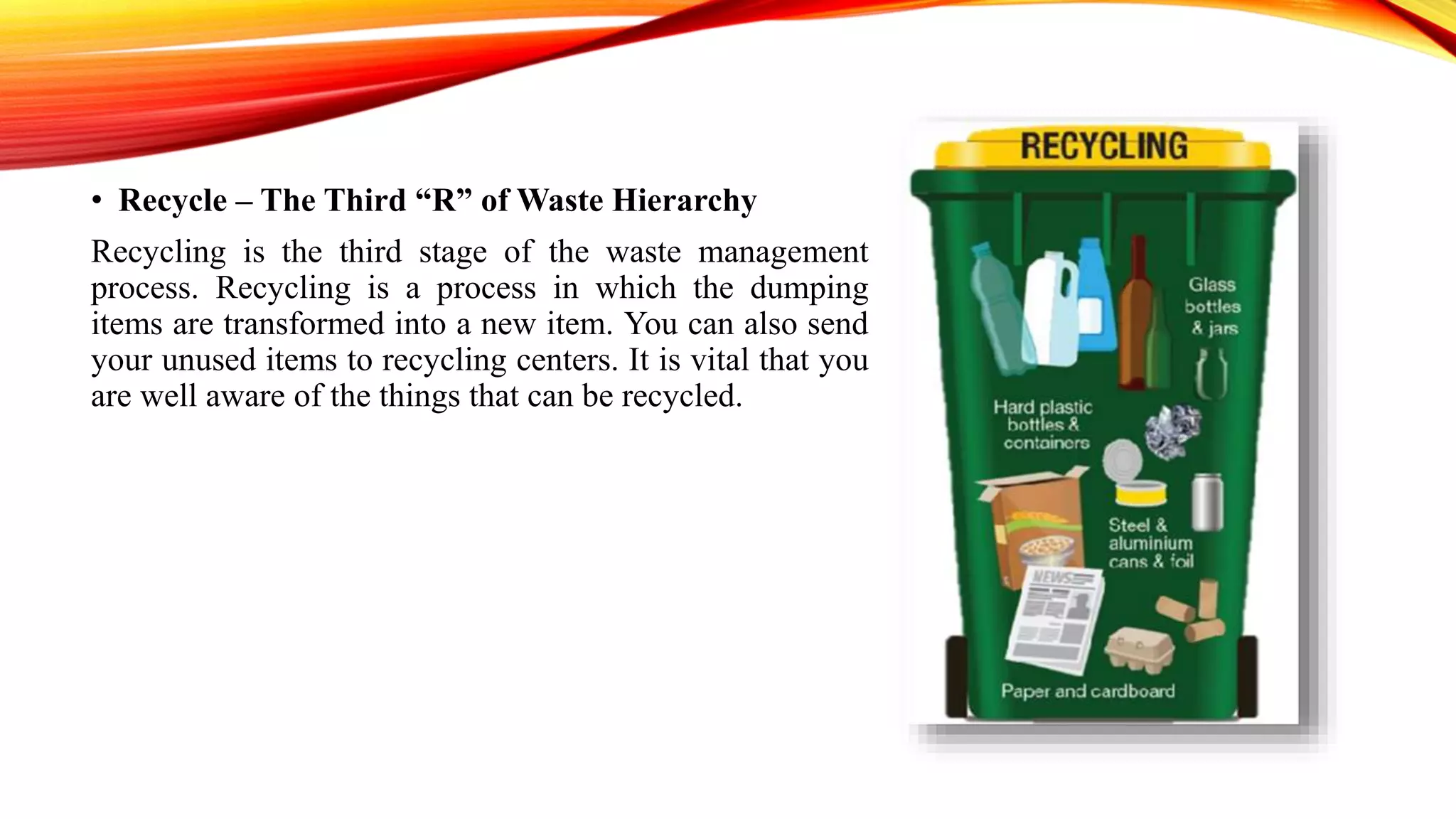
• Recycle – The Third “R” of Waste Hierarchy
Recycling is the third stage of the waste management
process. Recycling is a process in which the dumping
items are transformed into a new item. You can also send
your unused items to recycling centers. It is vital that you
are well aware of the things that can be recycled.
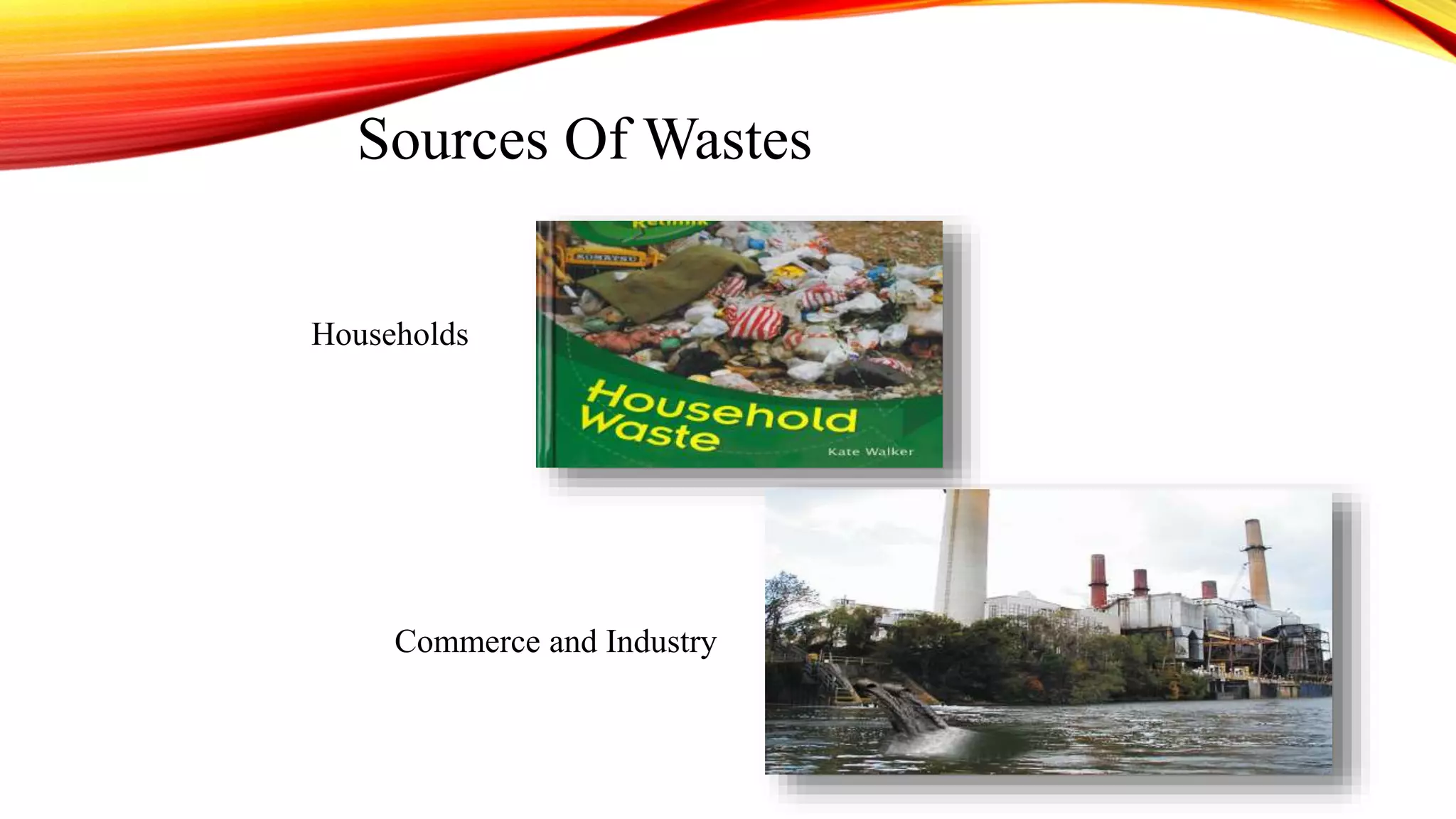
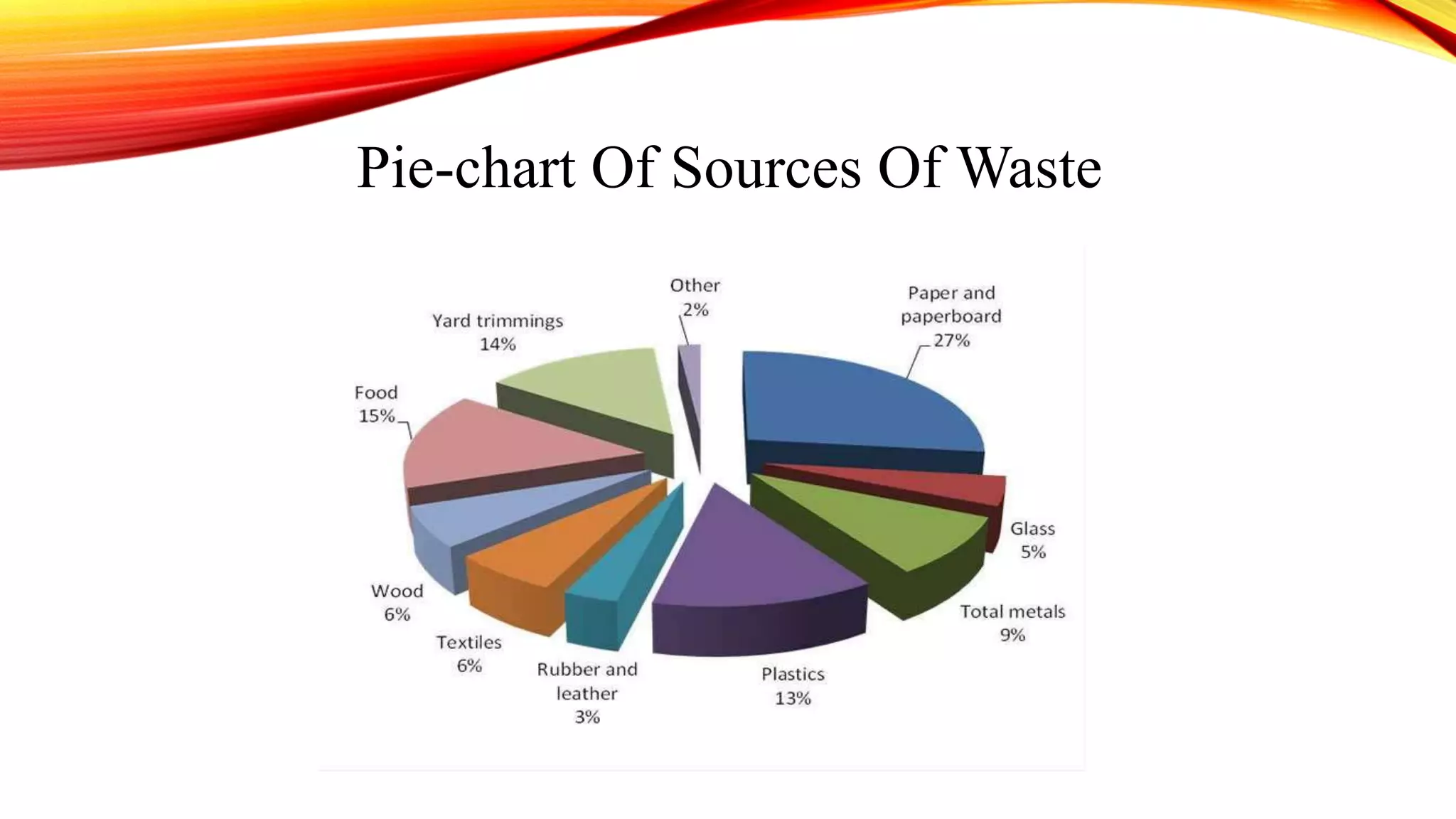
Sources Of Wastes
Households
Commerce and Industry
Pie-chart Of Sources Of Waste
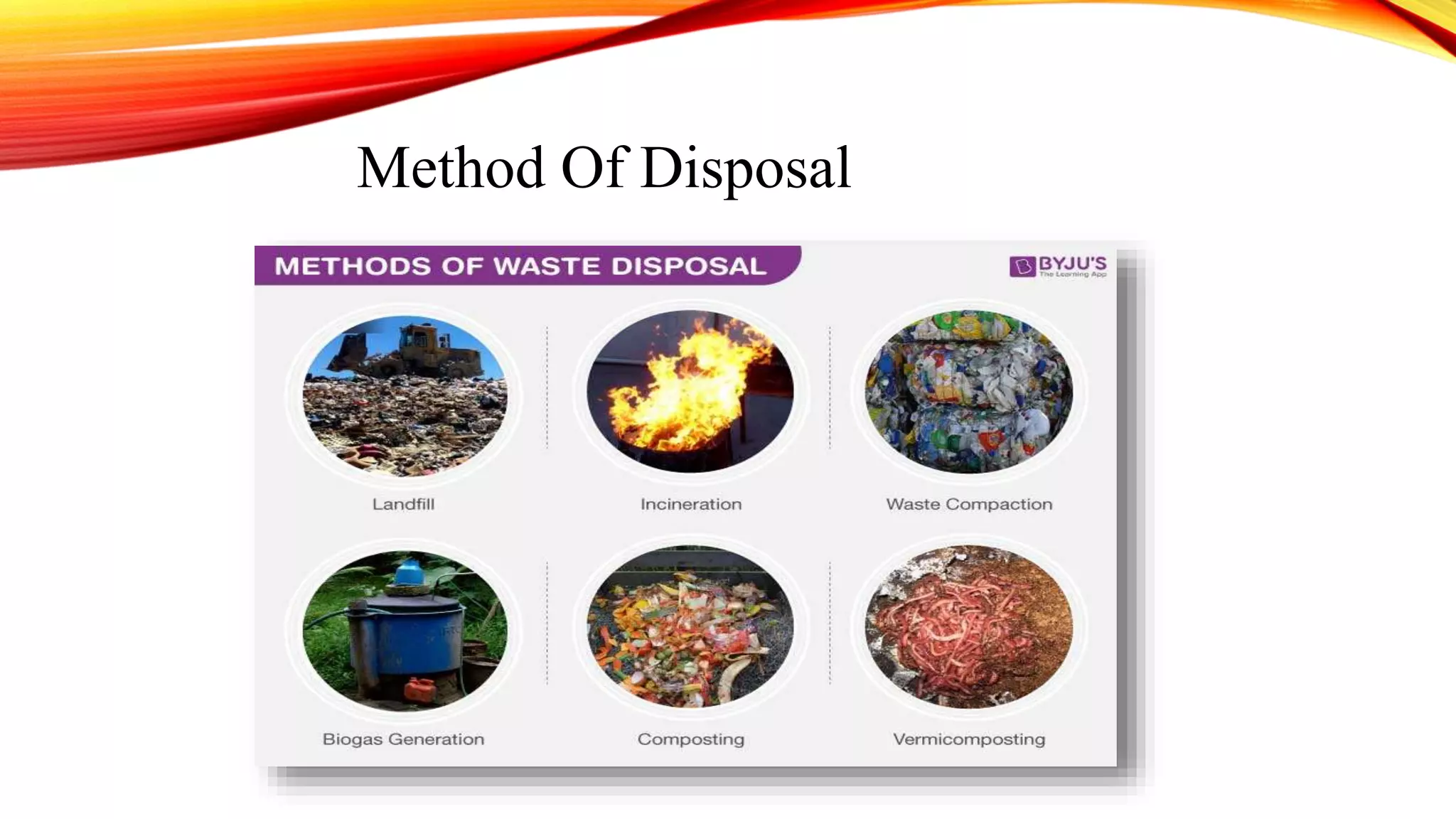
Method Of Disposal
• Landfill
In this process, the waste that cannot be reused or recycled are separated out and spread as a
thin layer in low-lying areas across a city. A layer of soil is added after each layer of garbage.
However, once this process is complete, the area is declared unfit for construction of buildings
for the next 20 years. Instead, it can only be used as a playground or a park.
• Incineration
Incineration is the process of controlled combustion of garbage to reduce it to incombustible
matter such as ash and waste gas. The exhaust gases from this process may be toxic, hence it is
treated before being released into the environment. This process reduces the volume of waste
by 90 per cent and is considered as one of the most hygienic methods of waste disposal. In
some cases, the heat generated is used to produce electricity. However, some consider this
process, not quite environmentally friendly due to the generation of greenhouse gases such as
carbon dioxide and carbon monoxide.
• Waste Compaction
The waste materials such as cans and plastic bottles are compacted into blocks and sent for
recycling. This process prevents the oxidation of metals and reduces airspace need, thus
making transportation and positioning easy.
• Biogas generation
Biogas typically refers to a mixture of different gases produced by the breakdown of organic
matter in the absence of oxygen. Biogas can be produced from raw materials such as
agricultural waste, manure, municipal waste, plant material, sewage, green waste or food
waste. It is a renewable energy source and in many cases exerts a very small carbon footprint.
• Vermicomposting
Vermicomposting is the process of using worms for the degradation of organic matter into
nutrient-rich manure. Worms consume and digest the organic matter. The by-products of
digestion which are excreted out by the worms make the soil nutrient-rich, thus enhancing the
growth of bacteria and fungi. It is also far more effective than traditional composting.
CONCLUSION
• The behaviour of generating garbage is too dangerous not only for today's generation, but
also for future generations. It is critical to educate people and encourage them to practise
Recycle, Reuse, and Reduce instead of producing waste. Waste disposal should be a priority
for municipalities and governments.
THANK YOU

Waste management.pptx

  • 1.
  • 2.
    INTRODUCTION • Waste managementor waste disposal includes the processes and actions required to manage waste from its inception to its final disposal. • This includes the collection, transport, treatment and disposal of waste, together with monitoring and regulation of the waste management process and waste-related laws, technologies, economic mechanisms. • ‘Waste management’ shall mean “the collection, transport, recovery and disposal of waste, including the supervision of such operation and after care of disposal sites” • However the newer concepts of ‘waste management’ talk about ‘Reduce, Reuse and Recycle of waste’ over and above waste disposal.
  • 3.
    WASTE • Waste includesall items that people no longer have any use for, which they either intend to get rid of or have already discarded.(European Topic Centre on Sustainable Consumption and Production)** • Any material which is not needed by the owner, producer or processor.
  • 4.
    Types Of WasteOn The Basis Of Their Physical State Solid waste Liquid waste Gaseous waste
  • 5.
    Types Of WasteOn The Basis Of Their Physical State Solid waste Liquid waste Gaseous waste
  • 6.
    • Solid wastes– These are the unwanted substances that are discarded by human society. These include urban wastes, industrial wastes, agricultural wastes, biomedical wastes and radioactive wastes. • Liquid wastes – Wastes generated from washing, flushing or manufacturing processes of industries are called liquid wastes. • Gaseous wastes – These are the wastes that are released in the form of gases from automobiles, factories or burning of fossil fuels like petroleum. They get mixed in the other gases atmosphere and occasionally cause events such as smog and acid rain.
  • 7.
    EFFECTS OF WASTE ENVIRONMENTALEFFECTS:  Surface water contamination  Ground Water contamination  Soil contamination  Air contamination ECONOMIC EFFECTS:  Municipal wellbeing  Recycling revenue
  • 8.
    The Three RsOf Waste Management Reduce Reuse Recycle
  • 9.
    • Reduce –The First “R” of Waste Hierarchy The first R in the waste hierarchy is “Reduce.” The crucial thing in the waste management procedure is to maintain a perfect balance in consumption and recycle & reuse. If the consumption is less, the rate of recycling or reuse will also be less.
  • 10.
    • Reuse –The Second “R” of Waste Hierarchy If you have a bag full of old things that are not in use, then you can find out a way to reuse these thrown away things. The reuse of old stuff can reduce waste and does not affect the waste hierarchy. If you do not have any use of any of these thrown away items, then you can also donate it to someone who needs it.
  • 11.
    • Recycle –The Third “R” of Waste Hierarchy Recycling is the third stage of the waste management process. Recycling is a process in which the dumping items are transformed into a new item. You can also send your unused items to recycling centers. It is vital that you are well aware of the things that can be recycled.
  • 12.
  • 14.
  • 15.
  • 16.
    • Landfill In thisprocess, the waste that cannot be reused or recycled are separated out and spread as a thin layer in low-lying areas across a city. A layer of soil is added after each layer of garbage. However, once this process is complete, the area is declared unfit for construction of buildings for the next 20 years. Instead, it can only be used as a playground or a park. • Incineration Incineration is the process of controlled combustion of garbage to reduce it to incombustible matter such as ash and waste gas. The exhaust gases from this process may be toxic, hence it is treated before being released into the environment. This process reduces the volume of waste by 90 per cent and is considered as one of the most hygienic methods of waste disposal. In some cases, the heat generated is used to produce electricity. However, some consider this process, not quite environmentally friendly due to the generation of greenhouse gases such as carbon dioxide and carbon monoxide.
  • 17.
    • Waste Compaction Thewaste materials such as cans and plastic bottles are compacted into blocks and sent for recycling. This process prevents the oxidation of metals and reduces airspace need, thus making transportation and positioning easy. • Biogas generation Biogas typically refers to a mixture of different gases produced by the breakdown of organic matter in the absence of oxygen. Biogas can be produced from raw materials such as agricultural waste, manure, municipal waste, plant material, sewage, green waste or food waste. It is a renewable energy source and in many cases exerts a very small carbon footprint.
  • 18.
    • Vermicomposting Vermicomposting isthe process of using worms for the degradation of organic matter into nutrient-rich manure. Worms consume and digest the organic matter. The by-products of digestion which are excreted out by the worms make the soil nutrient-rich, thus enhancing the growth of bacteria and fungi. It is also far more effective than traditional composting.
  • 19.
    CONCLUSION • The behaviourof generating garbage is too dangerous not only for today's generation, but also for future generations. It is critical to educate people and encourage them to practise Recycle, Reuse, and Reduce instead of producing waste. Waste disposal should be a priority for municipalities and governments.
  • 20.