BY
9042411665
WHAT IS SOLID WASTE ???WHAT IS SOLID WASTE ???
 Solid wastes are the wastes arising from human
and animal activities that are normally solid and
are discarded as useless or unwanted.
 Solid wastes can also be defined as the organic
and inorganic waste materials produced by
various activities of the society, which have lost
their value to the first user(s).
 Residential
 Commercial
 Institutional
 Municipal
 Industrial
 Agricultural
CLASSIFICATION BASED ONCLASSIFICATION BASED ON
SOURCESSOURCES
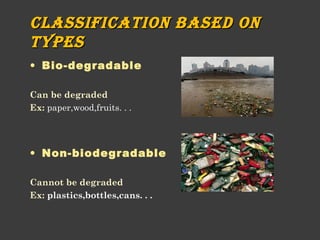
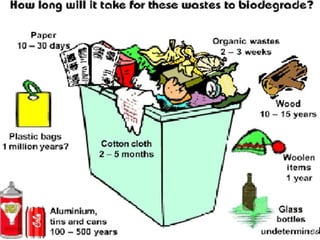
• Bio-degradable
Can be degraded
Ex: paper,wood,fruits. . .
• Non-biodegradable
Cannot be degraded
Ex: plastics,bottles,cans. . .
CLASSIFICATION BASED ONCLASSIFICATION BASED ON
TYPESTYPES
• Hazardous waste
• Garbage
• Bulky wastes
• Ashes & residues
• Dead animals
• Sewage waste
• Construction & demolition wastes
• Combustible & nonCombustible
wastes
Solid Wastes
Type Description Sources
Garbage
Food waste: wastes from the preparation, cooking
and serving of food.
Market refuse, waste from the handling, storage,
and sale of produce and meat.
Households, institutions and commercial concerns
such as hotels, stores, restaurants, markets,
etc.
Combustible and
non–combustible
Combustible (primary organic) paper, cardboard,
cartons, wood, boxes, plastic, rags, cloth,
bedding, leather, rubber, grass, leaves, yard
trimmings, etc.
Non-combustible (primary inorganic) metals, tin,
cans, glass bottles, crockery, stones, etc.
Ashes
Residue from fires used for cooking and for
heating building cinders
Bulky wastes
Large auto parts, tyres, stoves, refrigerators other
large appliances, furniture, large crates,
trees, branches, stumps, etc.
Streets, sidewalks, alleys, vacant lots, etc.Street wastes Street sweepings, dirt, leaves, etc.
Dead animals Dogs, cats, rats, donkeys, etc.
Abandoned vehicles Automobiles and spare parts
Construction and
demolition wastes
Roofing, and sheathing scraps, rubble, broken
concrete, plaster, conduit pipe, wire,
insulation, etc.
Construction and demolition sites.
Industrial wastes
Solid wastes resulting from industry processes and
manufacturing operations, such as, food
processing wastes, boiler house cinders,
wood, plastic and metal scraps, shavings, etc
Factories, power plants, etc.
Hazardous wastes
Pathological wastes, explosives, radioactive
materials, etc.
Households, hospitals, institutions, stores,
industry, etc.
Animal and agricultural Manure, crop residues, etc. Livestock, farms, feedlots and agriculture
Sewage treatment residue
Coarse screening grit, septic tank sludge,
dewatered sludge.
Sewage treatment plants and septic tanks.
Classification of Solid Wastes
NEED OF SOLID WASTE MANAGEMENT IN INDIANEED OF SOLID WASTE MANAGEMENT IN INDIA
• 7.2 million tonnes of hazardous waste
• One Sq km of additional landfill area every-year
• Waste collection is very low for all Indian cities
• In addition to this industries discharge about 150 million tonnes of
high volume low hazard waste every year, which is mostly dumped
on open low lying land areas.
Source: Estimate of Ministry of Environment & Forest
Dust bin is at one place & waste is at ------------ !
What you Observed?
e to building of hazardous and flammable gases in the dump, occasional breakouts of fires are
ssible. Thus creating air pollution problems releasing emissions of volatile organic compounds.
Possibilities of fire
Public waste
Private enterprise
The rich produce it, the poor deal with it.
The rich who make it are considered ‘clean’;
The poor who deal with it are considered ‘dirty’."
AFTER THE YATRA / POLITICAL MEETINGS,AFTER THE YATRA / POLITICAL MEETINGS,
ALL THAT WAS LEFT WAS LITTER AND GARBAGE ON THE ROADSALL THAT WAS LEFT WAS LITTER AND GARBAGE ON THE ROADS
Beauty of our Roads!
ILL EFFECTS OF IMPROPER SOLID WASTE
MANAGEMENT
• Air pollution
• Water pollution
• Clotting the open air sewage lines available there
• Reducing the aesthetic appearance of city
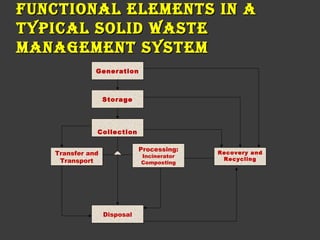
FUNCTIONAL ELEMENTS IN AFUNCTIONAL ELEMENTS IN A
TYPICAL SOLID WASTETYPICAL SOLID WASTE
MANAGEMENT SYSTEMMANAGEMENT SYSTEM
Transfer and
Transport
Generation
Storage
Collection
Processing:
Incinerator
Composting
Recovery and
Recycling
Disposal
PROCESSING TECHNIQUES
• Incineration is a waste treatment process that involves the combustion of
solid waste at 1000C.
• waste materials are converted into ash, flue gas, and heat.
• The ash is mostly formed by the inorganic constituents of the waste and gases
due to organic waste.
• The heat generated by incineration is used to generate electric power.
INCINERATION:
INCINERATION PLANT OBERHAUSEN, GERMANY
COMPOSTING:
 Composting is a biological process in which microorganisms,
mainly fungi and bacteria, convert degradable organic waste
into humus like substance.
Vermi-composting
DISPOSALDISPOSAL
TECHNIQUES
 Landfill is the site for the disposal of waste materials by burial
and is the oldest form of waste treatment.
LANDFILLS:
RULES TO BE FOLLOWED FOR WASTERULES TO BE FOLLOWED FOR WASTE
MANAGEMENTMANAGEMENT
 REFUSE:
Instead of buying new containers from the market, use the
ones that are in the home.
 REUSE:
Do not throw away the soft drink cans or the bottles; paint on
them and use them as pencil stands or small vases.
 RECYCLE:
Segregate your wastes so that non-perishable wastes are easily
collected and taken for recycling.
 REDUCE:
Carry your own shopping bag while going for shopping
There should never be a waste
“Everything comes from the
nature &
It should go back to the nature”

Solid waste management

  • 1.
  • 2.
    WHAT IS SOLIDWASTE ???WHAT IS SOLID WASTE ???  Solid wastes are the wastes arising from human and animal activities that are normally solid and are discarded as useless or unwanted.  Solid wastes can also be defined as the organic and inorganic waste materials produced by various activities of the society, which have lost their value to the first user(s).
  • 3.
     Residential  Commercial Institutional  Municipal  Industrial  Agricultural CLASSIFICATION BASED ONCLASSIFICATION BASED ON SOURCESSOURCES
  • 4.
    • Bio-degradable Can bedegraded Ex: paper,wood,fruits. . . • Non-biodegradable Cannot be degraded Ex: plastics,bottles,cans. . . CLASSIFICATION BASED ONCLASSIFICATION BASED ON TYPESTYPES
  • 6.
    • Hazardous waste •Garbage • Bulky wastes • Ashes & residues • Dead animals • Sewage waste • Construction & demolition wastes • Combustible & nonCombustible wastes
  • 7.
    Solid Wastes Type DescriptionSources Garbage Food waste: wastes from the preparation, cooking and serving of food. Market refuse, waste from the handling, storage, and sale of produce and meat. Households, institutions and commercial concerns such as hotels, stores, restaurants, markets, etc. Combustible and non–combustible Combustible (primary organic) paper, cardboard, cartons, wood, boxes, plastic, rags, cloth, bedding, leather, rubber, grass, leaves, yard trimmings, etc. Non-combustible (primary inorganic) metals, tin, cans, glass bottles, crockery, stones, etc. Ashes Residue from fires used for cooking and for heating building cinders Bulky wastes Large auto parts, tyres, stoves, refrigerators other large appliances, furniture, large crates, trees, branches, stumps, etc. Streets, sidewalks, alleys, vacant lots, etc.Street wastes Street sweepings, dirt, leaves, etc. Dead animals Dogs, cats, rats, donkeys, etc. Abandoned vehicles Automobiles and spare parts Construction and demolition wastes Roofing, and sheathing scraps, rubble, broken concrete, plaster, conduit pipe, wire, insulation, etc. Construction and demolition sites. Industrial wastes Solid wastes resulting from industry processes and manufacturing operations, such as, food processing wastes, boiler house cinders, wood, plastic and metal scraps, shavings, etc Factories, power plants, etc. Hazardous wastes Pathological wastes, explosives, radioactive materials, etc. Households, hospitals, institutions, stores, industry, etc. Animal and agricultural Manure, crop residues, etc. Livestock, farms, feedlots and agriculture Sewage treatment residue Coarse screening grit, septic tank sludge, dewatered sludge. Sewage treatment plants and septic tanks. Classification of Solid Wastes
  • 8.
    NEED OF SOLIDWASTE MANAGEMENT IN INDIANEED OF SOLID WASTE MANAGEMENT IN INDIA • 7.2 million tonnes of hazardous waste • One Sq km of additional landfill area every-year • Waste collection is very low for all Indian cities • In addition to this industries discharge about 150 million tonnes of high volume low hazard waste every year, which is mostly dumped on open low lying land areas. Source: Estimate of Ministry of Environment & Forest
  • 9.
    Dust bin isat one place & waste is at ------------ !
  • 10.
  • 11.
    e to buildingof hazardous and flammable gases in the dump, occasional breakouts of fires are ssible. Thus creating air pollution problems releasing emissions of volatile organic compounds. Possibilities of fire
  • 12.
    Public waste Private enterprise Therich produce it, the poor deal with it. The rich who make it are considered ‘clean’; The poor who deal with it are considered ‘dirty’."
  • 13.
    AFTER THE YATRA/ POLITICAL MEETINGS,AFTER THE YATRA / POLITICAL MEETINGS, ALL THAT WAS LEFT WAS LITTER AND GARBAGE ON THE ROADSALL THAT WAS LEFT WAS LITTER AND GARBAGE ON THE ROADS Beauty of our Roads!
  • 14.
    ILL EFFECTS OFIMPROPER SOLID WASTE MANAGEMENT • Air pollution • Water pollution • Clotting the open air sewage lines available there • Reducing the aesthetic appearance of city
  • 15.
    FUNCTIONAL ELEMENTS INAFUNCTIONAL ELEMENTS IN A TYPICAL SOLID WASTETYPICAL SOLID WASTE MANAGEMENT SYSTEMMANAGEMENT SYSTEM Transfer and Transport Generation Storage Collection Processing: Incinerator Composting Recovery and Recycling Disposal
  • 16.
    PROCESSING TECHNIQUES • Incinerationis a waste treatment process that involves the combustion of solid waste at 1000C. • waste materials are converted into ash, flue gas, and heat. • The ash is mostly formed by the inorganic constituents of the waste and gases due to organic waste. • The heat generated by incineration is used to generate electric power. INCINERATION: INCINERATION PLANT OBERHAUSEN, GERMANY
  • 17.
    COMPOSTING:  Composting isa biological process in which microorganisms, mainly fungi and bacteria, convert degradable organic waste into humus like substance. Vermi-composting
  • 18.
    DISPOSALDISPOSAL TECHNIQUES  Landfill isthe site for the disposal of waste materials by burial and is the oldest form of waste treatment. LANDFILLS:
  • 19.
    RULES TO BEFOLLOWED FOR WASTERULES TO BE FOLLOWED FOR WASTE MANAGEMENTMANAGEMENT  REFUSE: Instead of buying new containers from the market, use the ones that are in the home.  REUSE: Do not throw away the soft drink cans or the bottles; paint on them and use them as pencil stands or small vases.  RECYCLE: Segregate your wastes so that non-perishable wastes are easily collected and taken for recycling.  REDUCE: Carry your own shopping bag while going for shopping
  • 20.
    There should neverbe a waste “Everything comes from the nature & It should go back to the nature”