Material separation and processing techniques in waste management (1)
This document discusses various material separation and processing techniques used in waste management. It begins with an introduction to waste separation and its purposes. It then outlines different separation processes like picking, screening, magnetic separation, air classification, optical separation, eddy current methods, and flotation. Each process is described in detail with examples. The document also discusses how separated materials like plastics, paper, glass, and metals can be further processed and recycled. It concludes that the appropriate separation and processing techniques depend on the type of waste and intended use of recovered materials.
Material separation and processing techniques in waste management (1)
1.
M A TE R I A L
S E P A R A T I O N A N D
P R O C E S S I N G
T E C H N I Q U E S I N
W A S T E
M A N A G E M E N T
P R E S E N T E D B Y: K A N Z A S A L E E M
2.
INTRODUCTION
Waste separation isthe process by which waste is separated into
different elements.
Separation is used to permit more efficient processing of waste
components.
And can be separated in
Material recovery facilities
Mechanical biological treatment system
2Department of Environmental Scieces, QAU Islamabad
3.
TYPES OF SEPARATIONPROCESSES
Picking
Screening
Magnetic separation
Air classification
Optical separation
Eddy's current method
Flotation
3Department of Environmental Scieces, QAU Islamabad
4.
PICKING
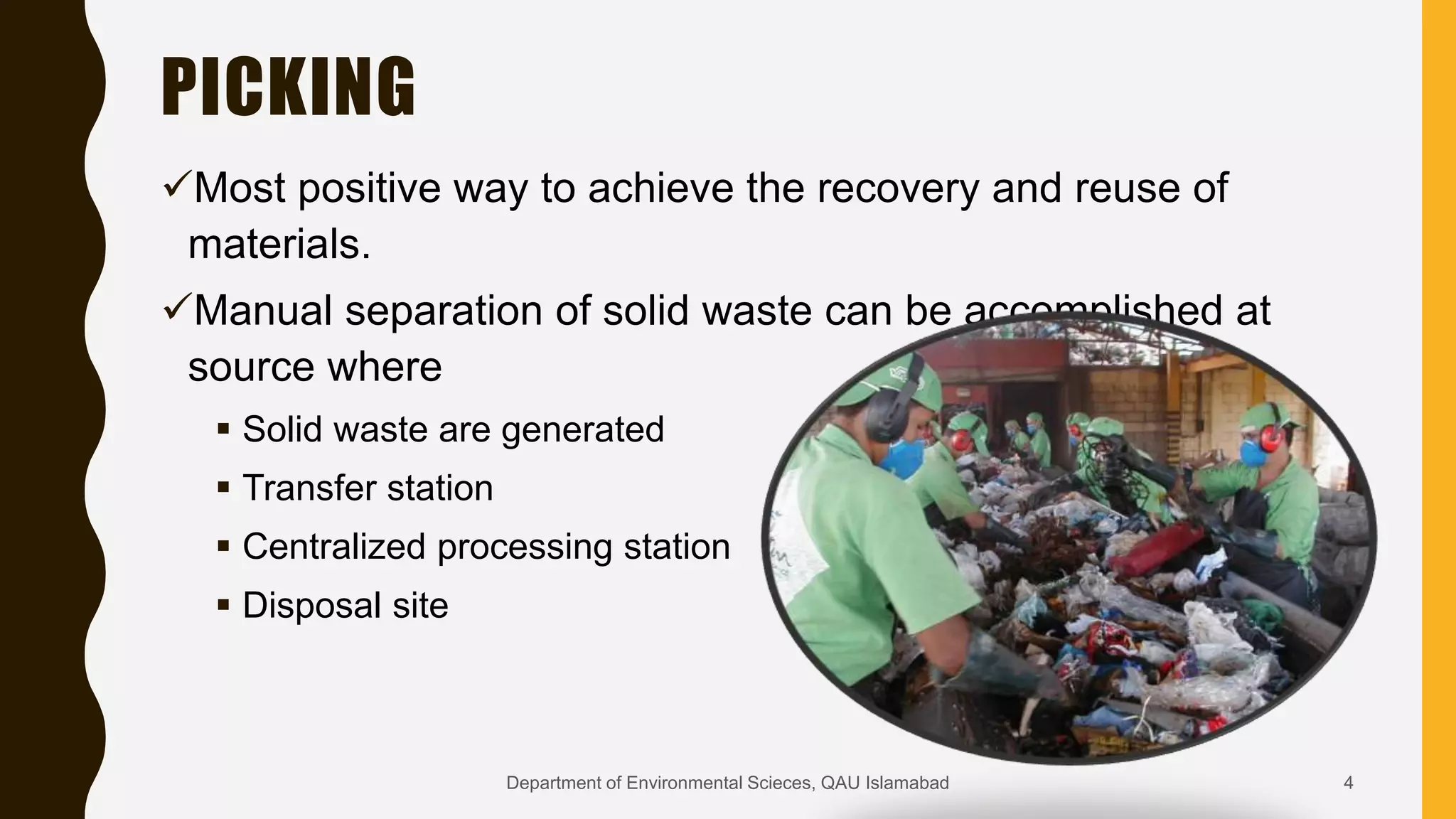
Most positive wayto achieve the recovery and reuse of
materials.
Manual separation of solid waste can be accomplished at
source where
Solid waste are generated
Transfer station
Centralized processing station
Disposal site
4Department of Environmental Scieces, QAU Islamabad
5.
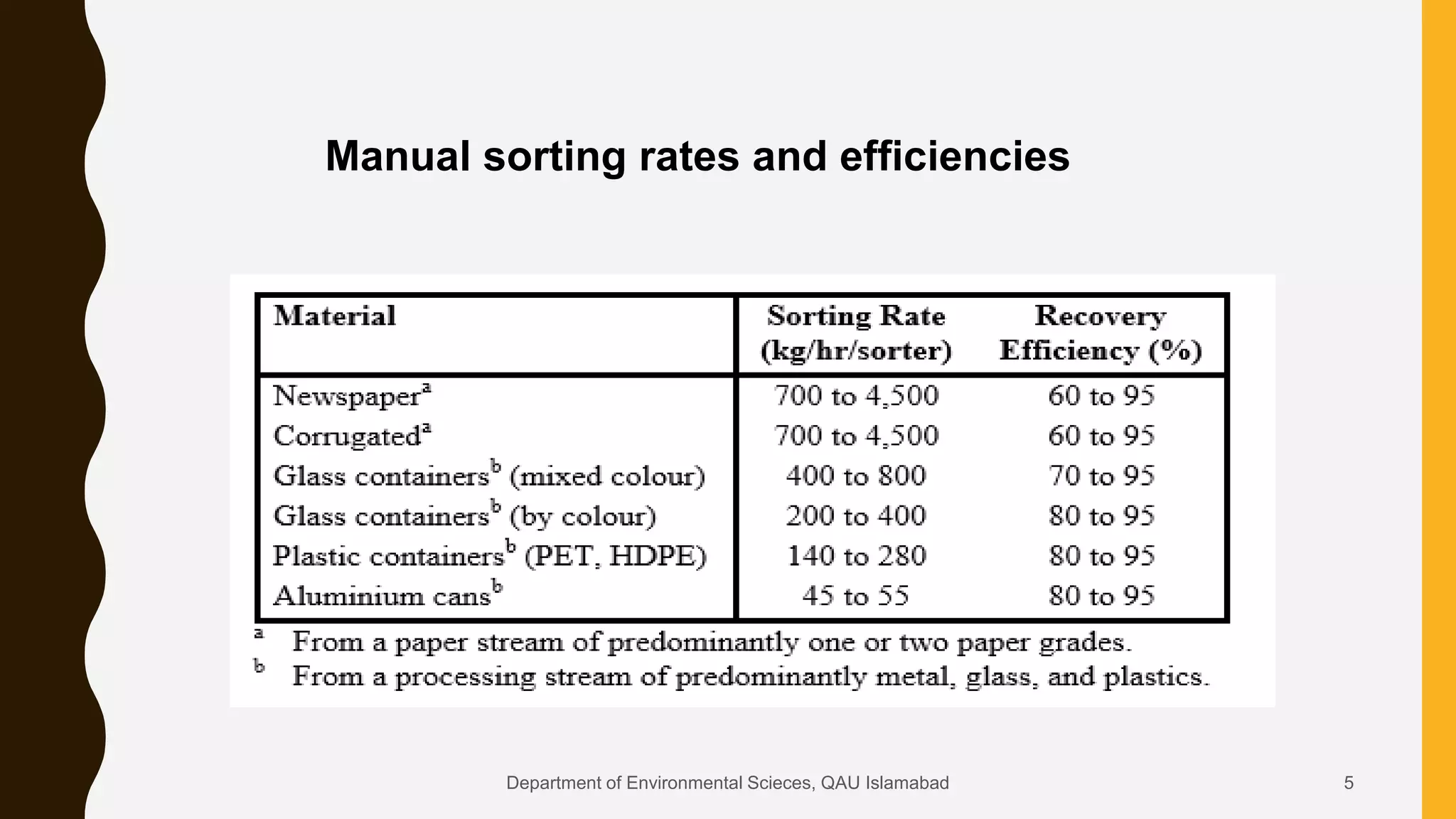
Manual sorting ratesand efficiencies
5Department of Environmental Scieces, QAU Islamabad
6.
SCREENING
Screens are usedfor achieving efficient separation of
particles through dependence on differences between particle
sizes with respect to any two dimensions.
Screening process can be use for oversized feed stocks as
well as for undersized feed stock.
Types of screening process
a) Tromel screening
b) Disc screening
6Department of Environmental Scieces, QAU Islamabad
7.
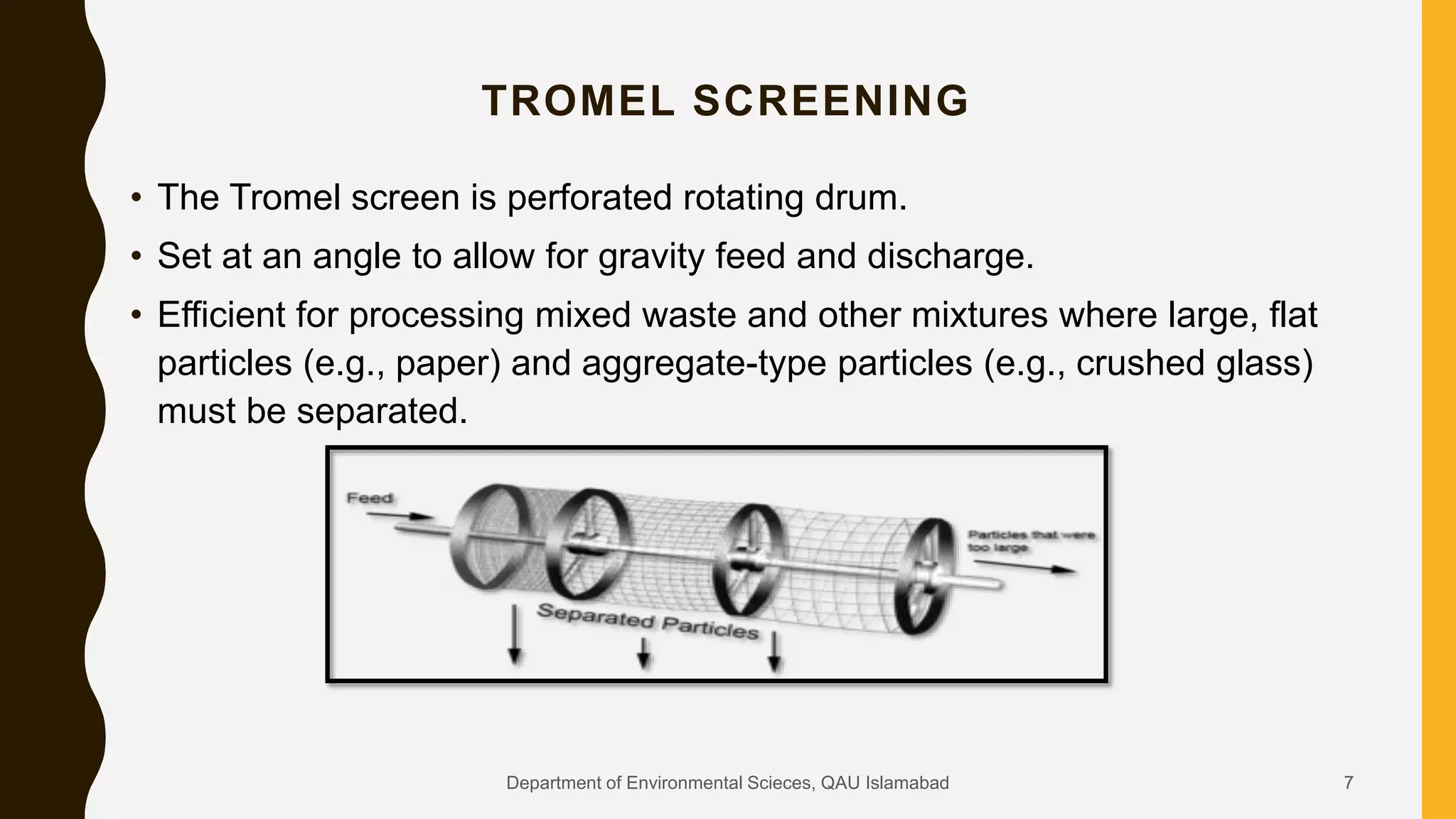
• The Tromelscreen is perforated rotating drum.
• Set at an angle to allow for gravity feed and discharge.
• Efficient for processing mixed waste and other mixtures where large, flat
particles (e.g., paper) and aggregate-type particles (e.g., crushed glass)
must be separated.
TROMEL SCREENING
7Department of Environmental Scieces, QAU Islamabad
8.
DISC SCREENING
• Discscreens have been employed in many waste processing facilities.
• A disc screen consists of a number of evenly spaced shafts in a
horizontal plane fitted with discs such that their interference patterns
form openings through which the undersize material will flow. All of the
shafts rotate in the same direction, thus carrying infeed material from
one end of the screen to the other.
8Department of Environmental Scieces, QAU Islamabad
9.
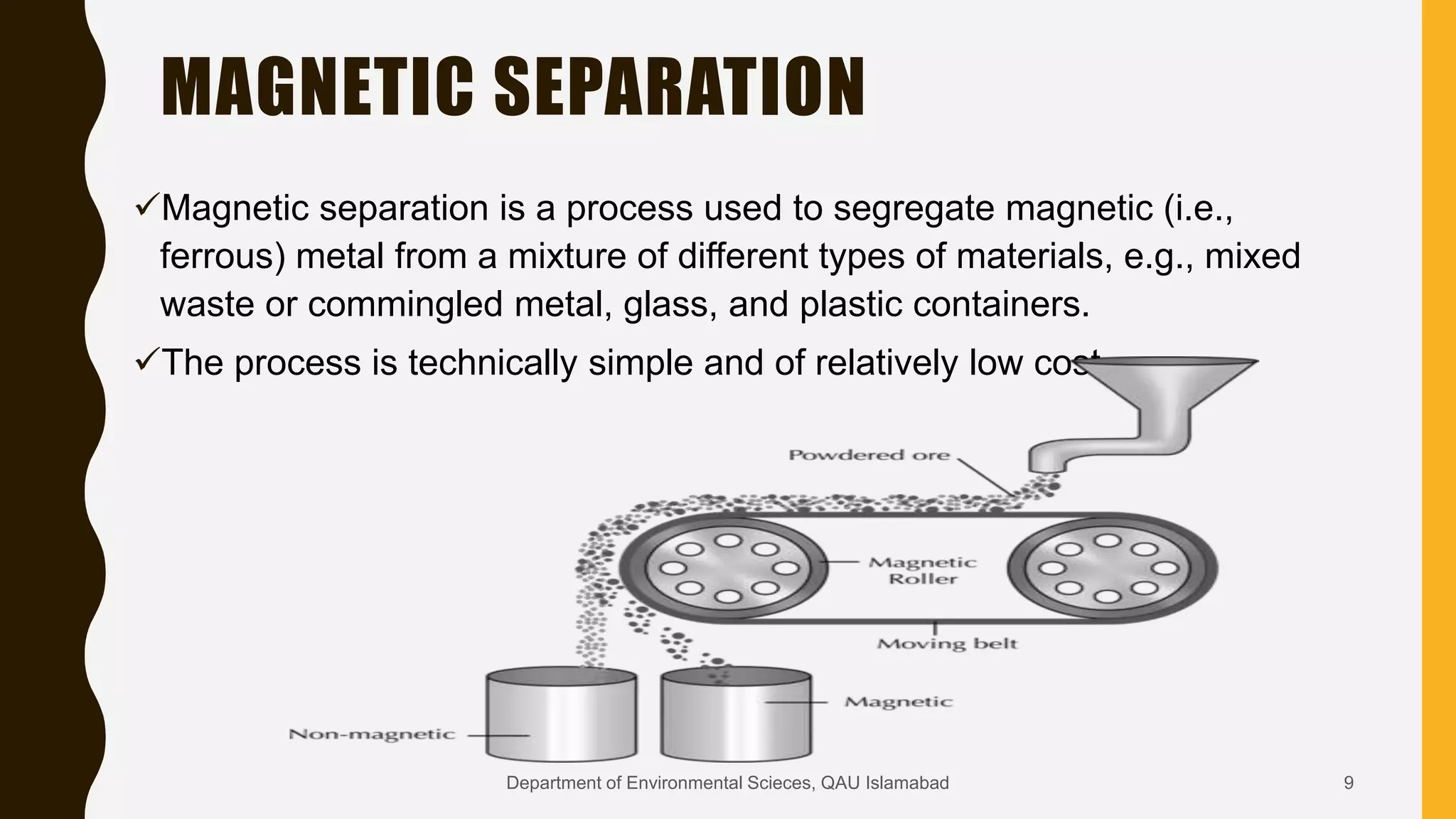
MAGNETIC SEPARATION
Magnetic separationis a process used to segregate magnetic (i.e.,
ferrous) metal from a mixture of different types of materials, e.g., mixed
waste or commingled metal, glass, and plastic containers.
The process is technically simple and of relatively low cost.
9Department of Environmental Scieces, QAU Islamabad
10.
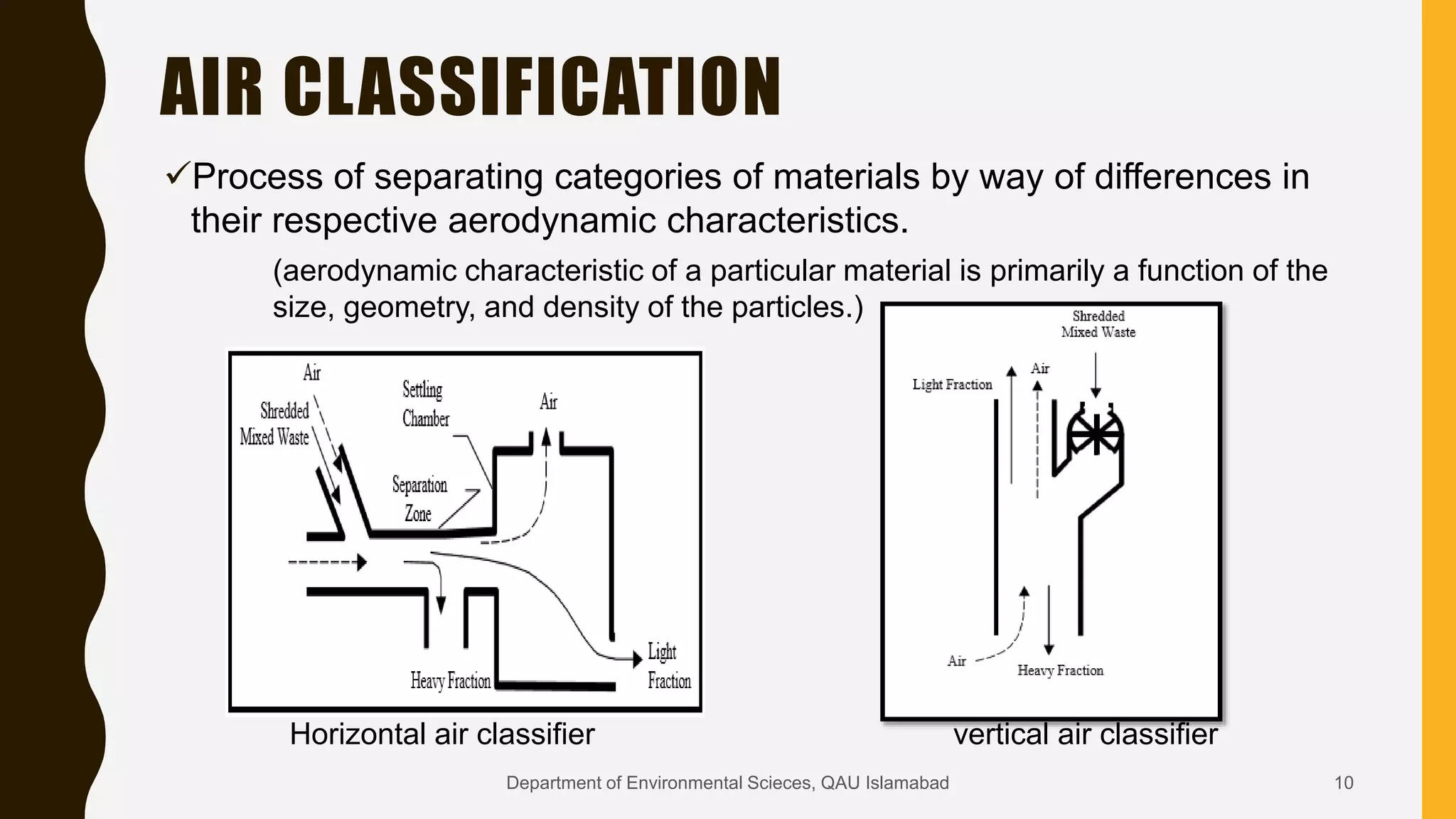
AIR CLASSIFICATION
Process ofseparating categories of materials by way of differences in
their respective aerodynamic characteristics.
(aerodynamic characteristic of a particular material is primarily a function of the
size, geometry, and density of the particles.)
Horizontal air classifier vertical air classifier
10Department of Environmental Scieces, QAU Islamabad
11.
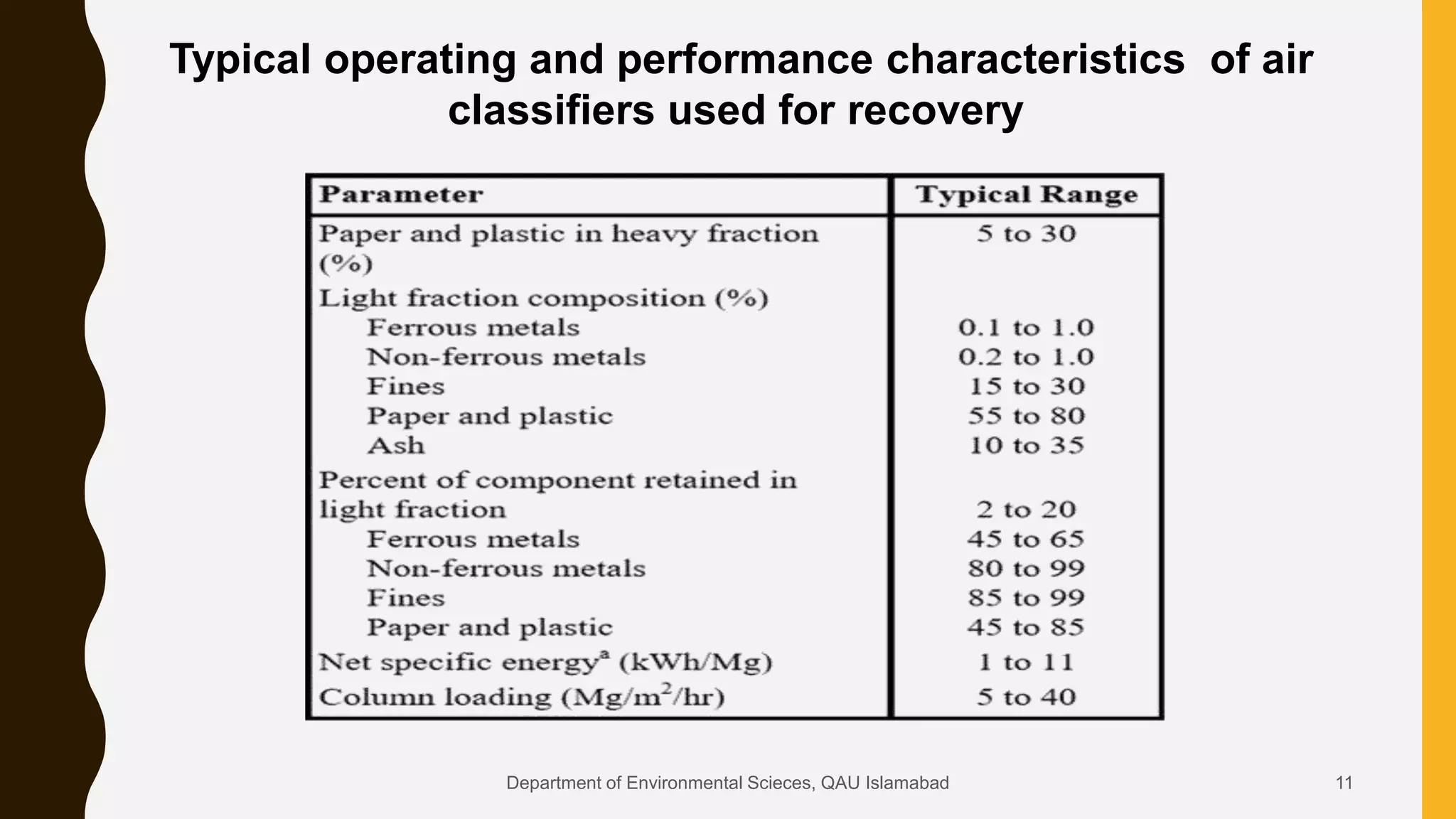
Typical operating andperformance characteristics of air
classifiers used for recovery
11Department of Environmental Scieces, QAU Islamabad
12.
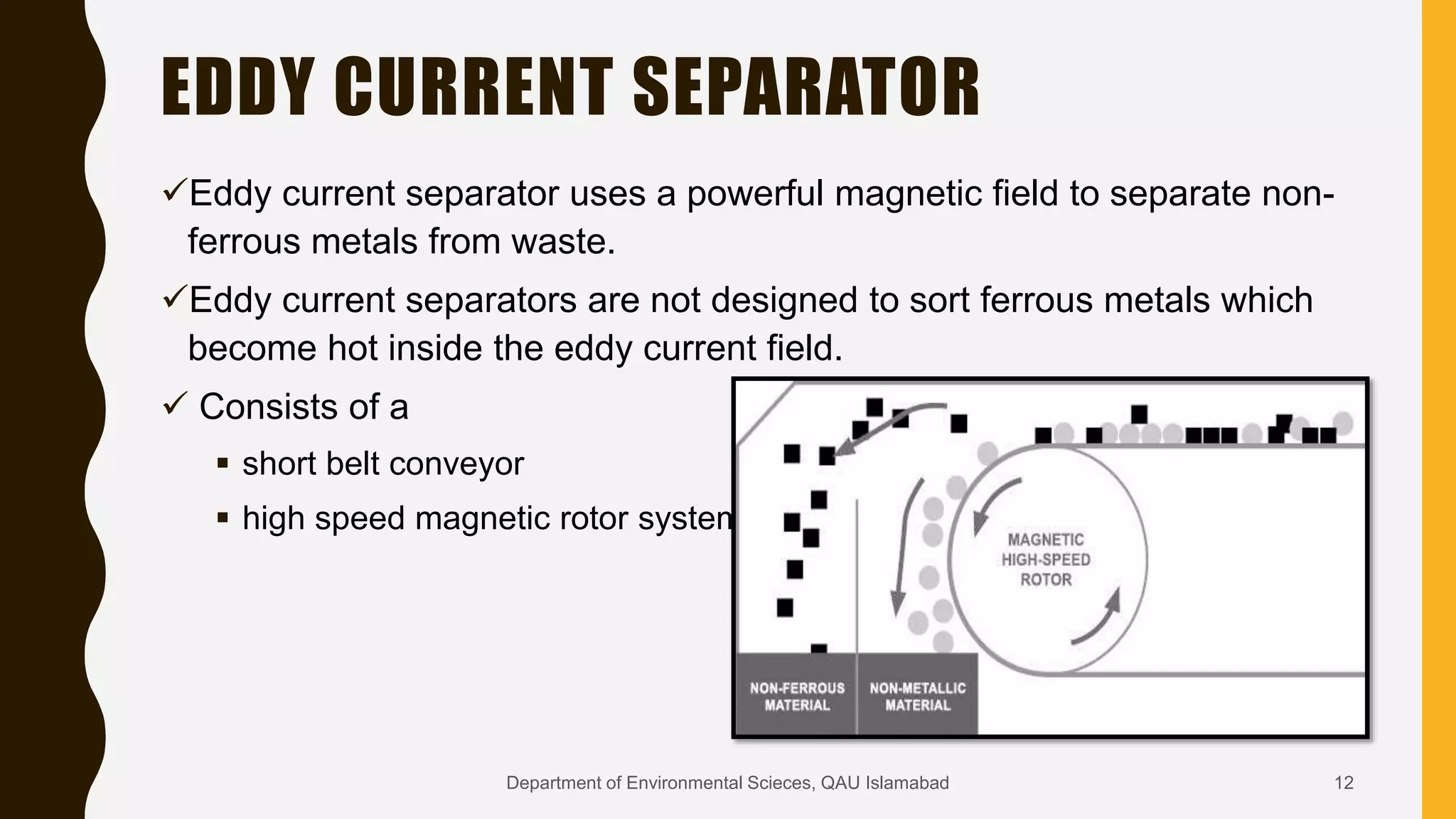
EDDY CURRENT SEPARATOR
Eddycurrent separator uses a powerful magnetic field to separate non-
ferrous metals from waste.
Eddy current separators are not designed to sort ferrous metals which
become hot inside the eddy current field.
Consists of a
short belt conveyor
high speed magnetic rotor system
12Department of Environmental Scieces, QAU Islamabad
13.
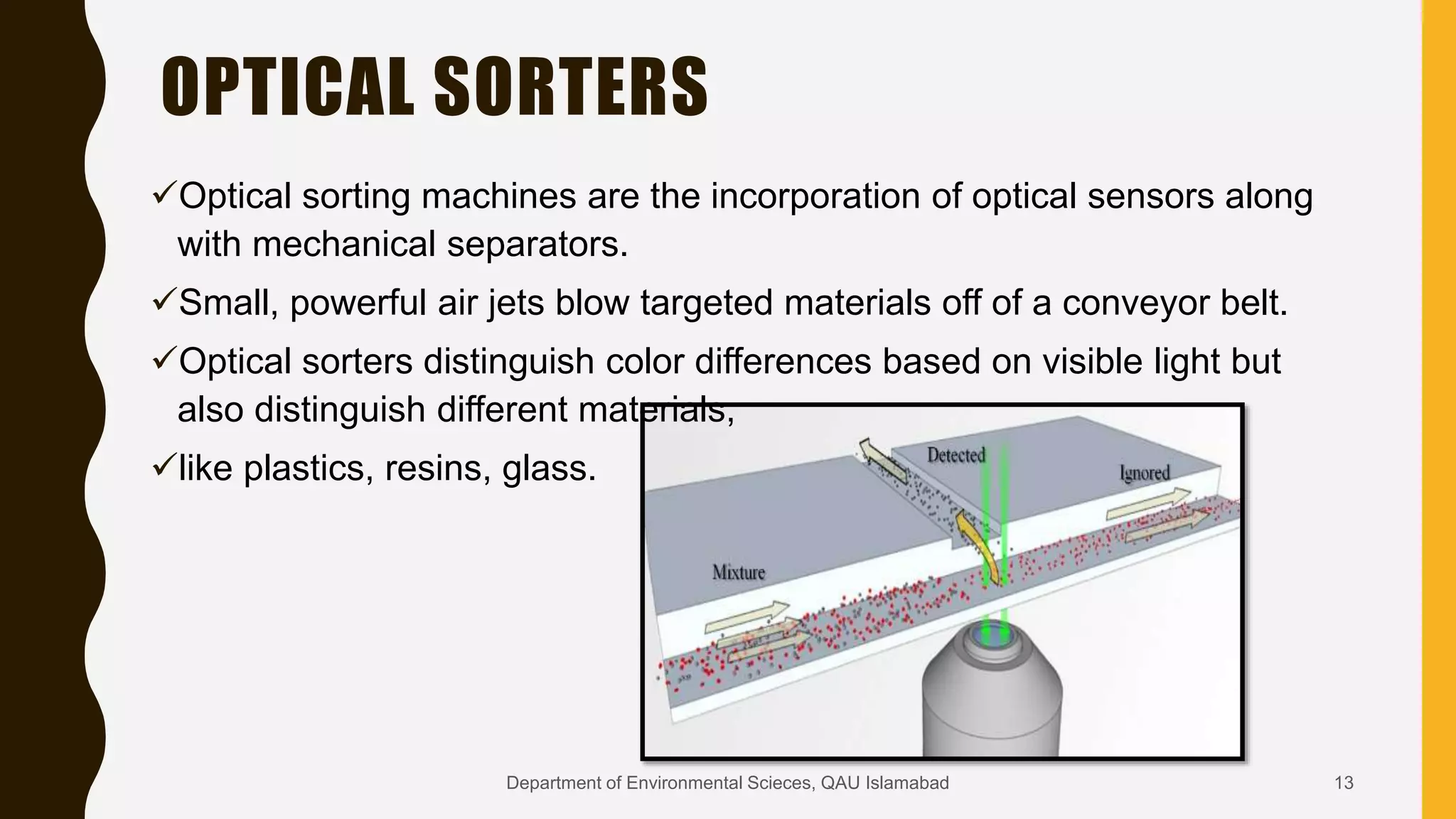
OPTICAL SORTERS
Optical sortingmachines are the incorporation of optical sensors along
with mechanical separators.
Small, powerful air jets blow targeted materials off of a conveyor belt.
Optical sorters distinguish color differences based on visible light but
also distinguish different materials,
like plastics, resins, glass.
13Department of Environmental Scieces, QAU Islamabad
14.
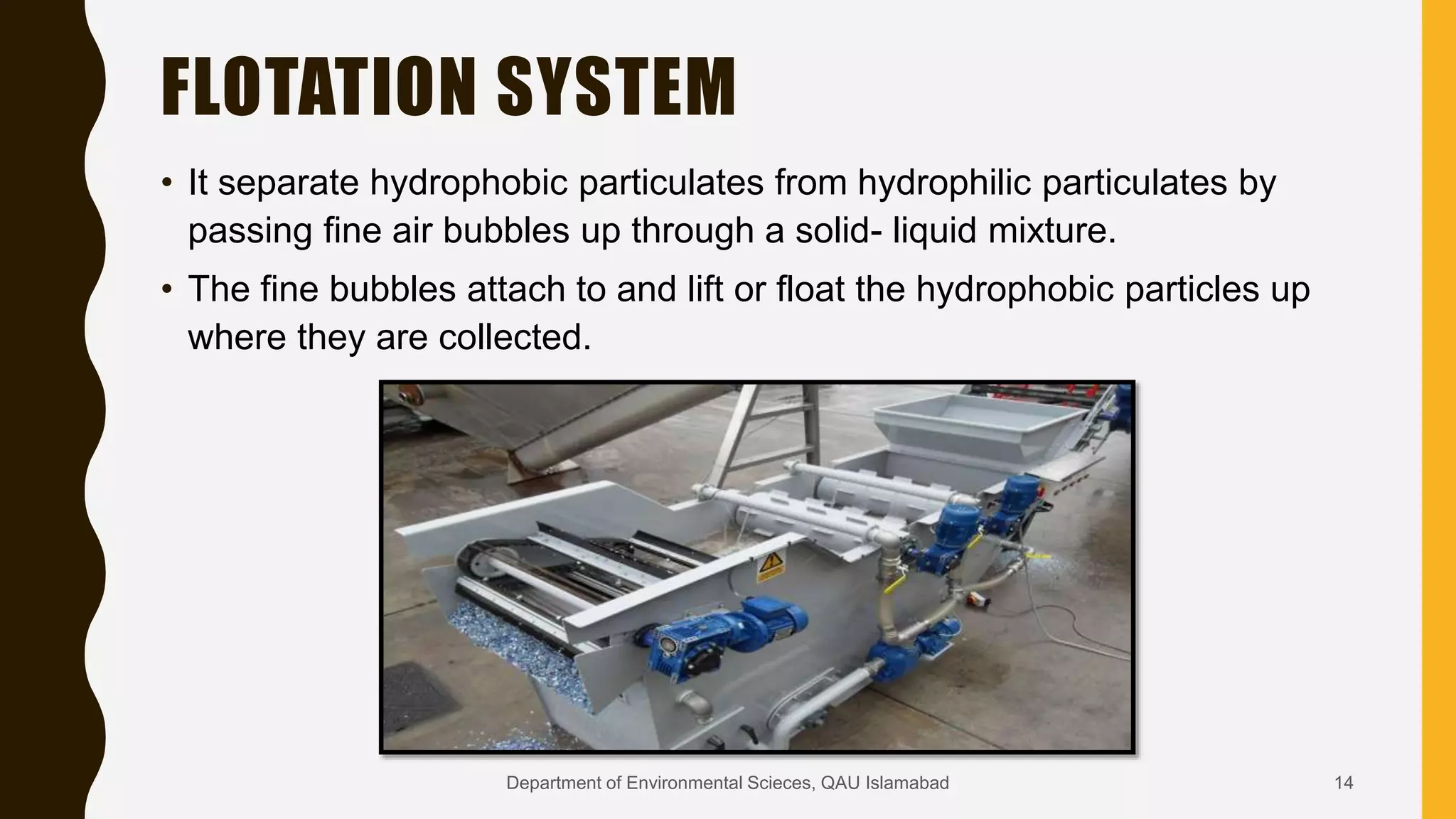
FLOTATION SYSTEM
• Itseparate hydrophobic particulates from hydrophilic particulates by
passing fine air bubbles up through a solid- liquid mixture.
• The fine bubbles attach to and lift or float the hydrophobic particles up
where they are collected.
14Department of Environmental Scieces, QAU Islamabad
15.
PROCESSING OF WASTE
Processingtechniques are used in solid waste management systems
To improve the efficiency of solid-Waste disposal systems
To recover Resources
To prepare materials for the recovery of conversion products and
energy
15Department of Environmental Scieces, QAU Islamabad
16.
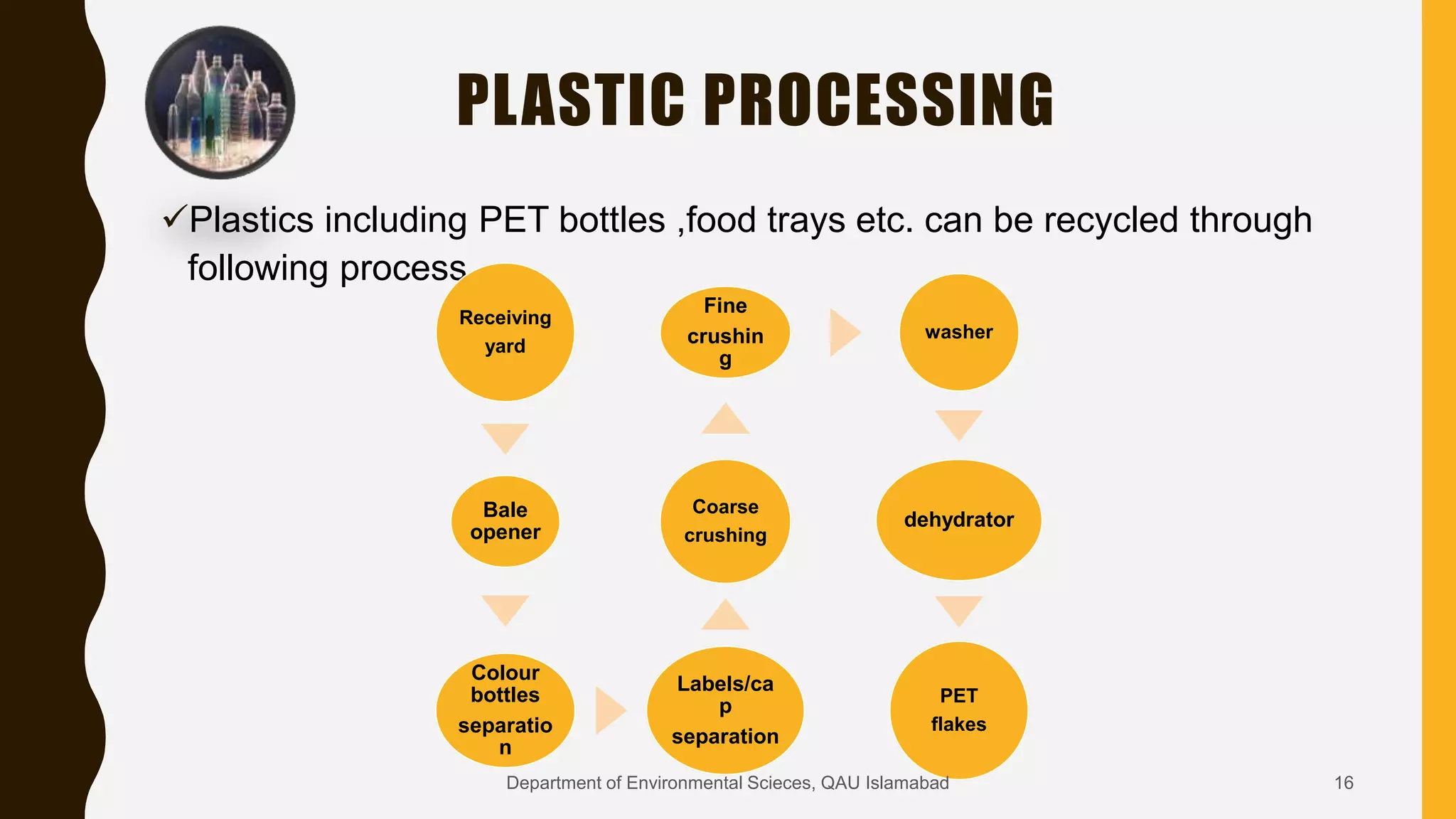
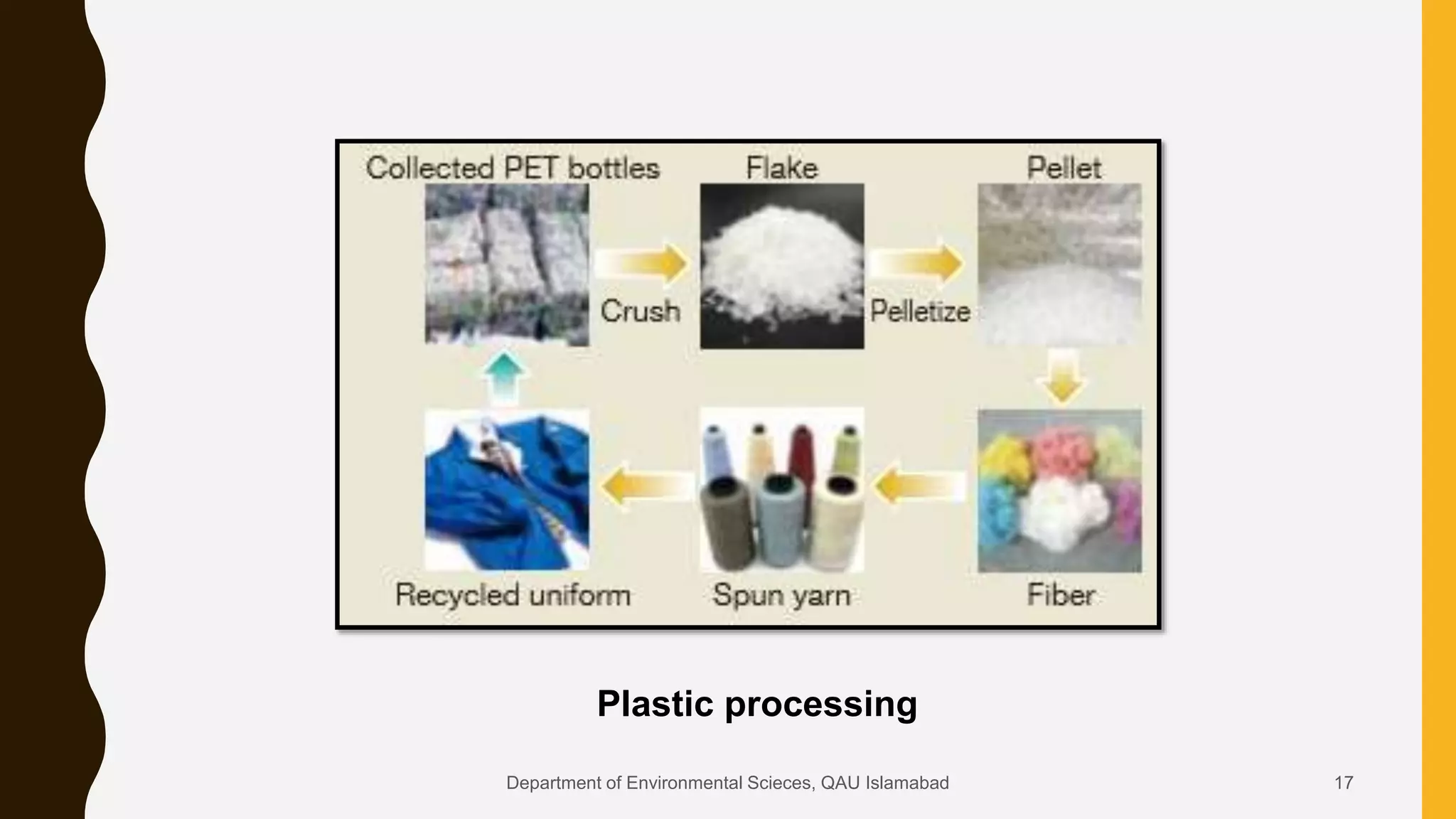
Plastics including PETbottles ,food trays etc. can be recycled through
following process.
Receiving
yard
Bale
opener
Colour
bottles
separatio
n
Labels/ca
p
separation
Coarse
crushing
Fine
crushin
g
washer
dehydrator
PET
flakes
PLASTIC PROCESSING
16Department of Environmental Scieces, QAU Islamabad
PAPER PROCESSING
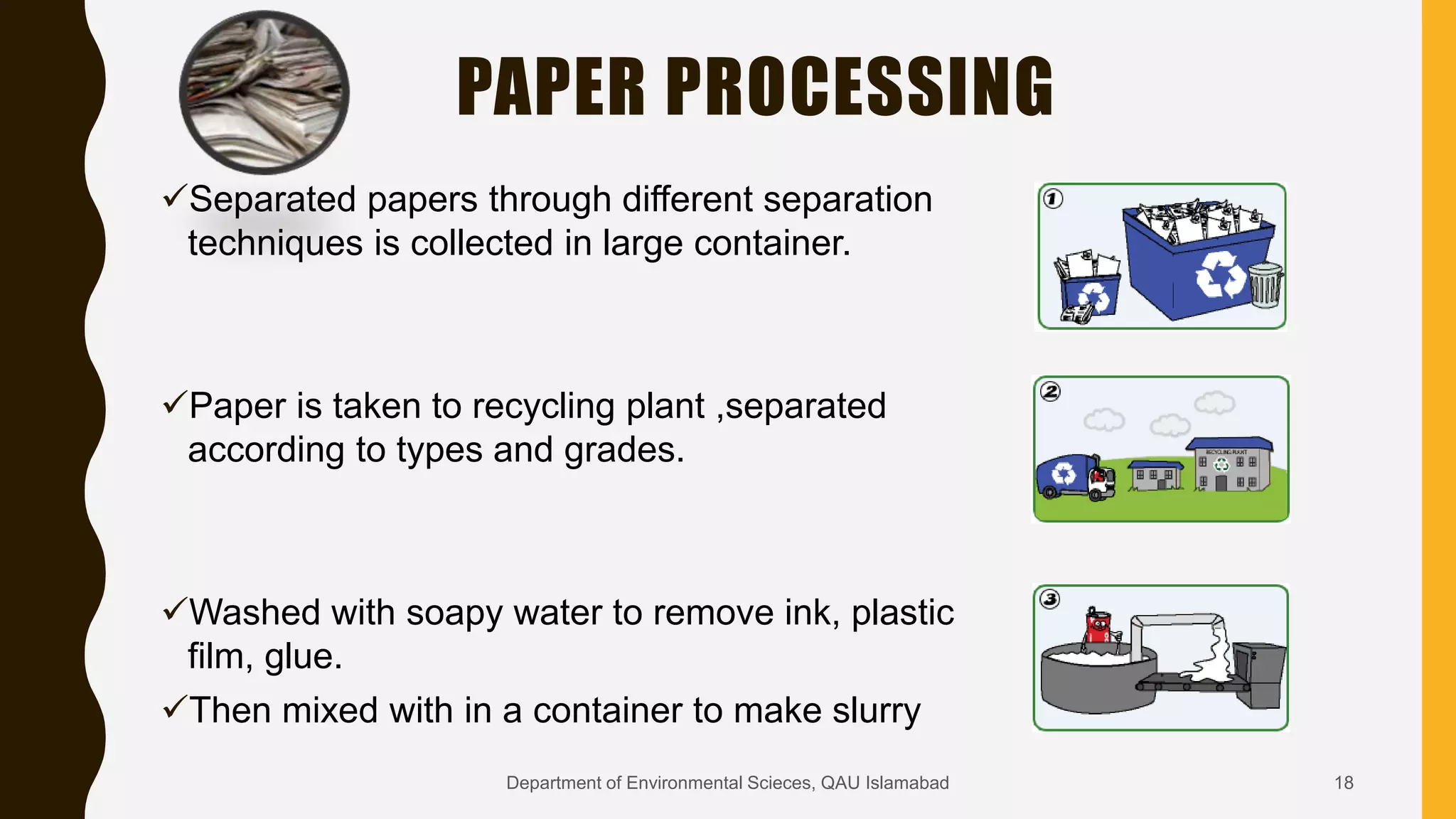
Separated papersthrough different separation
techniques is collected in large container.
Paper is taken to recycling plant ,separated
according to types and grades.
Washed with soapy water to remove ink, plastic
film, glue.
Then mixed with in a container to make slurry
18Department of Environmental Scieces, QAU Islamabad
19.
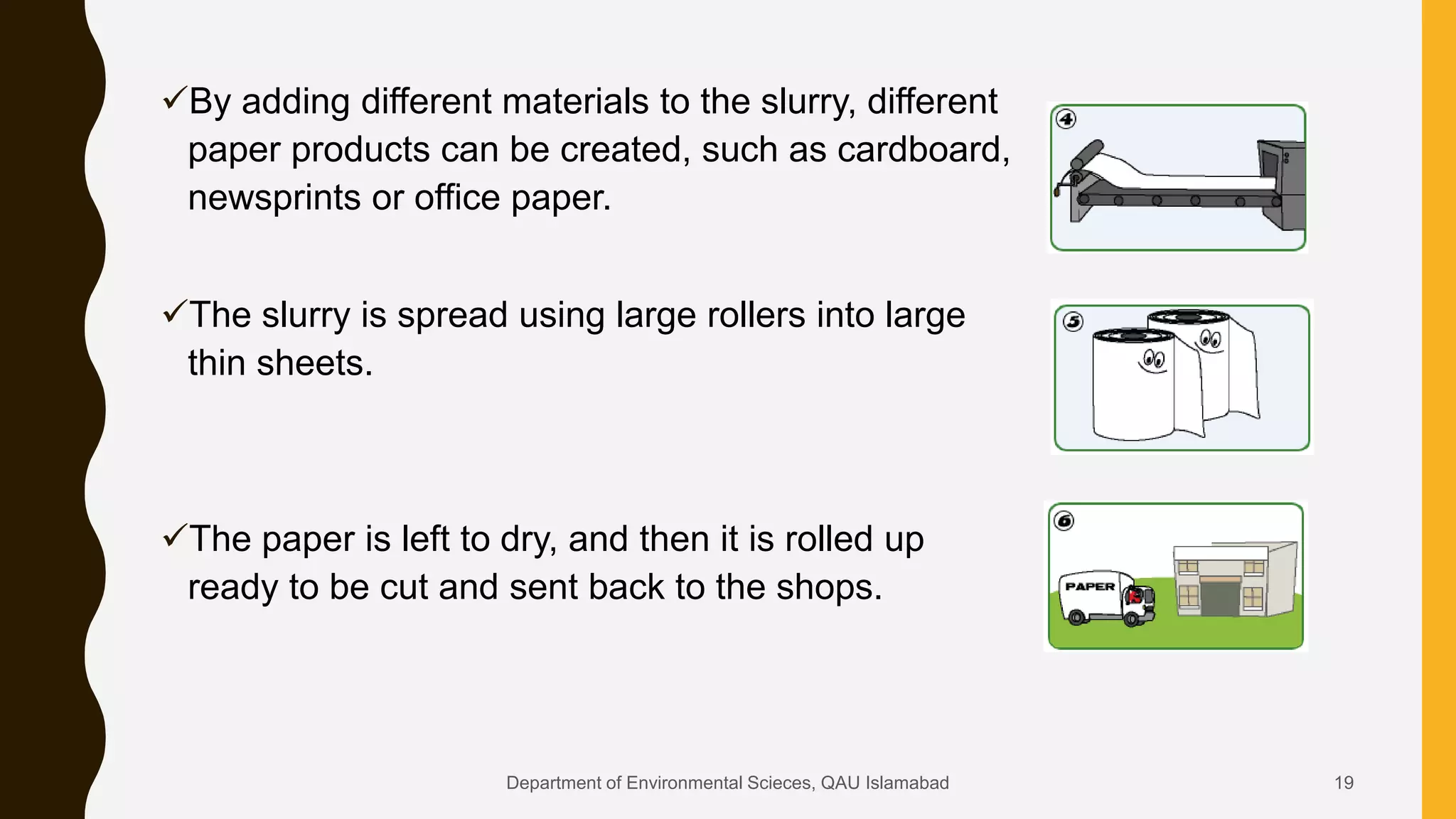
By adding differentmaterials to the slurry, different
paper products can be created, such as cardboard,
newsprints or office paper.
The slurry is spread using large rollers into large
thin sheets.
The paper is left to dry, and then it is rolled up
ready to be cut and sent back to the shops.
19Department of Environmental Scieces, QAU Islamabad
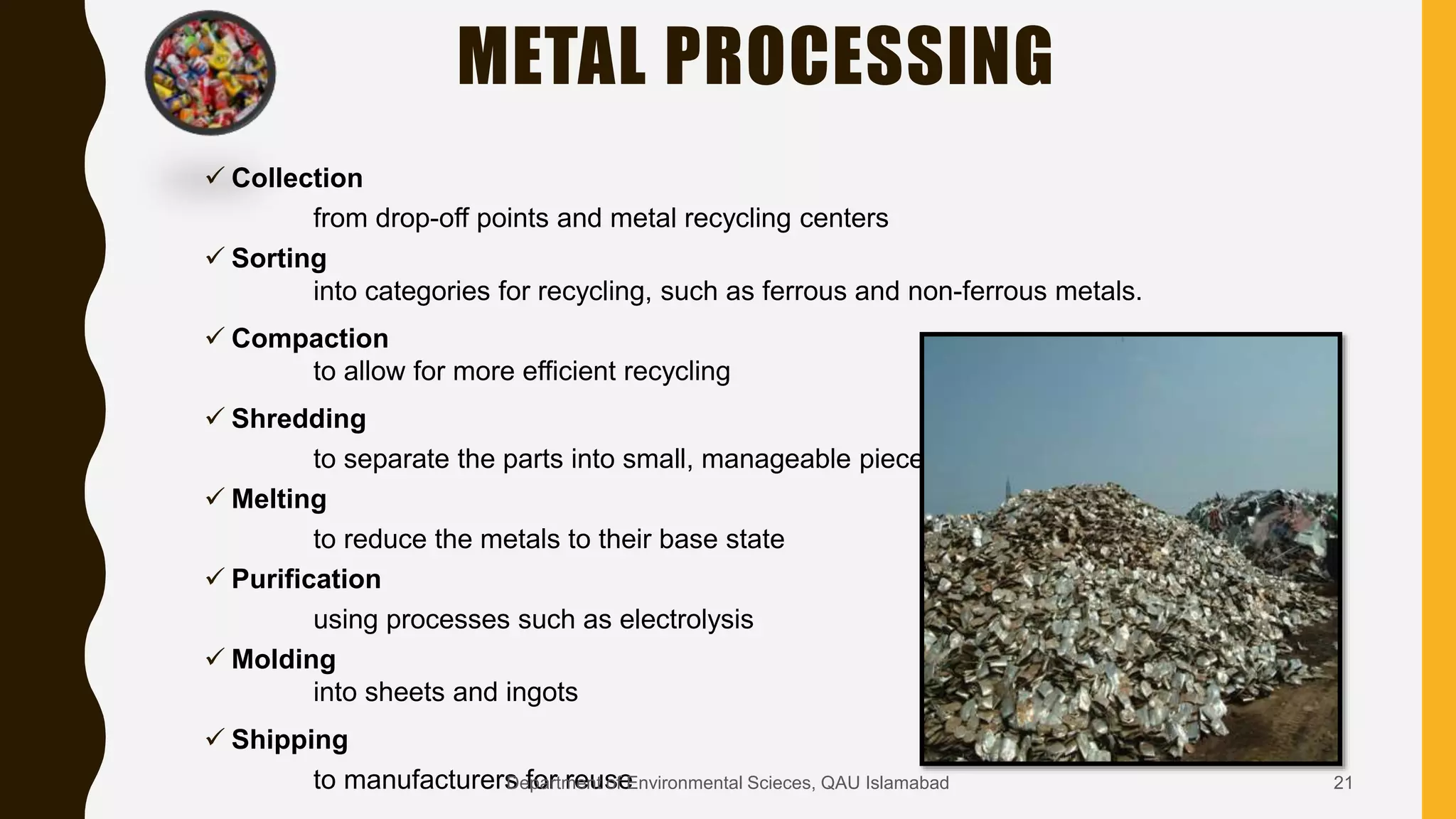
METAL PROCESSING
Collection
fromdrop-off points and metal recycling centers
Sorting
into categories for recycling, such as ferrous and non-ferrous metals.
Compaction
to allow for more efficient recycling
Shredding
to separate the parts into small, manageable pieces
Melting
to reduce the metals to their base state
Purification
using processes such as electrolysis
Molding
into sheets and ingots
Shipping
to manufacturers for reuse 21Department of Environmental Scieces, QAU Islamabad
22.
CONCLUSION
Waste separation processesdepend upon:
Nature of waste
Efficiency of the process
Finances
Time
Waste processing technique depend upon the intended use of waste
material.
22Department of Environmental Scieces, QAU Islamabad



![Pollution.ppt [Autosaved].ppt yogesh kumbhar](https://cdn.slidesharecdn.com/ss_thumbnails/pollution-251205194856-d30cfee8-thumbnail.jpg?width=640&height=640&fit=bounds)


