




SHYAMOLI TEXTILE ENGINEERING COLLEGE
UNIVERSITY OF DHAKA
Affiliated to
WELCOME
TO
MY PRESENTARION
DESIZING PROCESS
DESCRIPTION
Desizing is done in order to remove the size from the warp yarns of the woven
fabrics. Warp yarns are coated with sizing agents prior to weaving in order to reduce
their frictional properties, decrease yarn breakages on the loom and improve
weaving productivity by increasing weft insertion speeds. The sizing material present
on the warp yarns can act as a resist towards dyes and chemicals in textile wet
processing. It must, therefore, be removed before any subsequent wet processing of
the fabric.
DESIZING
1. Toremove the starch material from the fabric.
2. Toincrease the absorbency power of the fabric.
3. Toincrease the affinity of the fabric to the dry chemicals.
4. Tomake the fabric suitable for the next process.
5. Toincrease the luster of the fabric increase of dyeing and printing.
OBJECTS OF DESIZING:
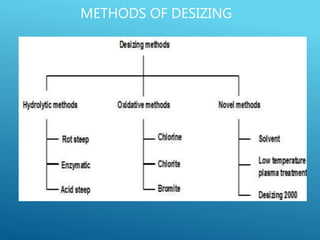
METHODS OF DESIZING
HYDROLYTIC METHODS
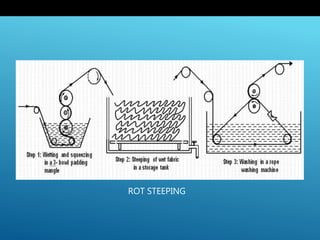
1. This is the oldest and cheapest method of desizing.
2. Here no special chemical is used.
3. The cloth is first passed through warm water at 40C in a padding mangle
where the cloth is squeezed to about 100% expression.
4. The cloth is then allowed to stand for 24 hours.
5. The microorganisms, naturally present in w ater, multiply and secrete starch-
liquefying (hydrolysing) enzymes, which break down the starch present in the
size to w ater-soluble products.
6. The cloth is then w ashed to remove these products.
ROT STEEPING
ROT STEEPING
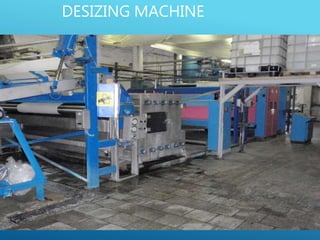
DESIZING MACHINE
used to hydrolyse the —Dilutesulphuric acid or hydrochloric acid may be
starch from the sized fabric.
ACID DESIZING
 A 0.25% - 0.5 % solution of the acid at room
temperature (30o C) is suitable for this process.
 The cloth is impregnated with the dilute acid solution
in a two-bowl or three- bowl padding mangle and
then stored for 8-12 hours in a closed concrete pit.
The advantage in the use of enzymes is that starches are decomposed without
damaging cellulose fibre.
ENZYMATIC DESIZING:
Mainly two types of enzymes. Such as:
1. Animal enzymes: Example: Viveral, Novofermosol, Degomma, Waste
pancreas, Clotted blood, Liver, etc.
2. Vegetable enzymes:
There are two types vegetable enzymes.
a) Malt extract enzymes: Example: Diastafor, Diastase, Gabahit,
Maltoferment, Maltostase etc.
b) Bacterial enzymes: Example: Rapidase, Biolase, Arcy etc.
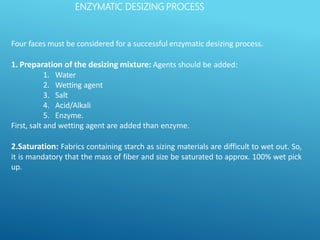
Four faces must be considered for a successful enzymatic desizing process.
1. Preparation of the desizing mixture: Agents should be added:
1. Water
2. Wetting agent
3. Salt
4. Acid/Alkali
5. Enzyme.
First, salt and wetting agent are added than enzyme.
2.Saturation: Fabrics containing starch as sizing materials are difficult to wet out. So,
it is mandatory that the mass of fiber and size be saturated to approx. 100% wet pick
up.
ENZYMATIC DESIZING PROCESS
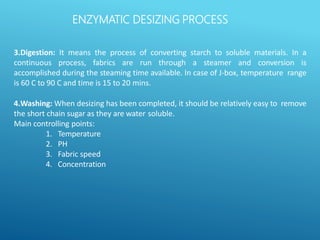
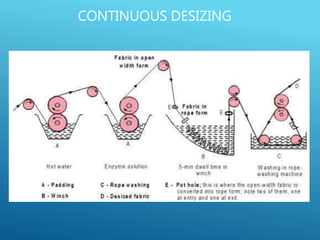
3.Digestion: It means the process of converting starch to soluble materials. In a
continuous process, fabrics are run through a steamer and conversion is
accomplished during the steaming time available. In case of J-box, temperature range
is 60 C to 90 C and time is 15 to 20 mins.
4.Washing: When desizing has been completed, it should be relatively easy to remove
the short chain sugar as they are water soluble.
Main controlling points:
1. Temperature
2. PH
3. Fabric speed
4. Concentration
ENZYMATIC DESIZING PROCESS
CONTINUOUS DESIZING
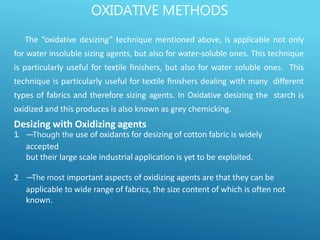
OXIDATIVE METHODS
The “oxidative desizing” technique mentioned above, is applicable not only
for water insoluble sizing agents, but also for water-soluble ones. This technique
is particularly useful for textile finishers, but also for water soluble ones. This
technique is particularly useful for textile finishers dealing with many different
types of fabrics and therefore sizing agents. In Oxidative desizing the starch is
oxidized and this produces is also known as grey chemicking.
Desizing with Oxidizing agents
1. —Though the use of oxidants for desizing of cotton fabric is widely
accepted
but their large scale industrial application is yet to be exploited.
2. —The most important aspects of oxidizing agents are that they can be
applicable to wide range of fabrics, the size content of which is often not
known.
Sodium bromite, the salt of bromous acid, HBrO2 (like sodium chlorite, the salt
of cholorous acid, HClO2), has powerful oxidizing action on starch. This is due to
the combined effect of bromous acid, HBrO2 and hypobromous acid, HOBr. This is
accompanied by the conversion of bromine dioxide into oxygen and bromine.
Hydrolysis of bromine thus formed produces more hypobromous acid. Of the
different modes of oxidation of starch, the following one is the most likely one,
involving breaking up of relatively stable either linkage of the glucose ring by
sodium bromite.
If as shown above ethers are vulnerable to oxidation by sodium bromite,
one would expect depolymerisation of the ether linkages (Oxygen Bridge joining
two glucose units). Any significant degree of depolymerisation would
then convert starch into water soluble products.
BROMITE DESIZING
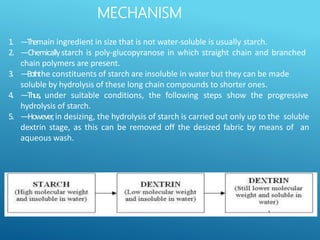
1. —Themain ingredient in size that is not water-soluble is usually starch.
2. —Chemicallystarch is poly-glucopyranose in which straight chain and branched
chain polymers are present.
3. —Boththe constituents of starch are insoluble in water but they can be made
soluble by hydrolysis of these long chain compounds to shorter ones.
4. —Thus, under suitable conditions, the following steps show the progressive
hydrolysis of starch.
5. —However,in desizing, the hydrolysis of starch is carried out only up to the soluble
dextrin stage, as this can be removed off the desized fabric by means of an
aqueous wash.
MECHANISM
Presentation on Textile Desizing

Presentation on Textile Desizing

  • 1.
    SHYAMOLI TEXTILE ENGINEERINGCOLLEGE UNIVERSITY OF DHAKA Affiliated to
  • 2.
  • 3.
  • 4.
    Desizing is donein order to remove the size from the warp yarns of the woven fabrics. Warp yarns are coated with sizing agents prior to weaving in order to reduce their frictional properties, decrease yarn breakages on the loom and improve weaving productivity by increasing weft insertion speeds. The sizing material present on the warp yarns can act as a resist towards dyes and chemicals in textile wet processing. It must, therefore, be removed before any subsequent wet processing of the fabric. DESIZING
  • 5.
    1. Toremove thestarch material from the fabric. 2. Toincrease the absorbency power of the fabric. 3. Toincrease the affinity of the fabric to the dry chemicals. 4. Tomake the fabric suitable for the next process. 5. Toincrease the luster of the fabric increase of dyeing and printing. OBJECTS OF DESIZING:
  • 6.
  • 7.
  • 8.
    1. This isthe oldest and cheapest method of desizing. 2. Here no special chemical is used. 3. The cloth is first passed through warm water at 40C in a padding mangle where the cloth is squeezed to about 100% expression. 4. The cloth is then allowed to stand for 24 hours. 5. The microorganisms, naturally present in w ater, multiply and secrete starch- liquefying (hydrolysing) enzymes, which break down the starch present in the size to w ater-soluble products. 6. The cloth is then w ashed to remove these products. ROT STEEPING
  • 9.
  • 10.
  • 11.
    used to hydrolysethe —Dilutesulphuric acid or hydrochloric acid may be starch from the sized fabric. ACID DESIZING  A 0.25% - 0.5 % solution of the acid at room temperature (30o C) is suitable for this process.  The cloth is impregnated with the dilute acid solution in a two-bowl or three- bowl padding mangle and then stored for 8-12 hours in a closed concrete pit.
  • 12.
    The advantage inthe use of enzymes is that starches are decomposed without damaging cellulose fibre. ENZYMATIC DESIZING: Mainly two types of enzymes. Such as: 1. Animal enzymes: Example: Viveral, Novofermosol, Degomma, Waste pancreas, Clotted blood, Liver, etc. 2. Vegetable enzymes: There are two types vegetable enzymes. a) Malt extract enzymes: Example: Diastafor, Diastase, Gabahit, Maltoferment, Maltostase etc. b) Bacterial enzymes: Example: Rapidase, Biolase, Arcy etc.
  • 13.
    Four faces mustbe considered for a successful enzymatic desizing process. 1. Preparation of the desizing mixture: Agents should be added: 1. Water 2. Wetting agent 3. Salt 4. Acid/Alkali 5. Enzyme. First, salt and wetting agent are added than enzyme. 2.Saturation: Fabrics containing starch as sizing materials are difficult to wet out. So, it is mandatory that the mass of fiber and size be saturated to approx. 100% wet pick up. ENZYMATIC DESIZING PROCESS
  • 14.
    3.Digestion: It meansthe process of converting starch to soluble materials. In a continuous process, fabrics are run through a steamer and conversion is accomplished during the steaming time available. In case of J-box, temperature range is 60 C to 90 C and time is 15 to 20 mins. 4.Washing: When desizing has been completed, it should be relatively easy to remove the short chain sugar as they are water soluble. Main controlling points: 1. Temperature 2. PH 3. Fabric speed 4. Concentration ENZYMATIC DESIZING PROCESS
  • 15.
  • 16.
    OXIDATIVE METHODS The “oxidativedesizing” technique mentioned above, is applicable not only for water insoluble sizing agents, but also for water-soluble ones. This technique is particularly useful for textile finishers, but also for water soluble ones. This technique is particularly useful for textile finishers dealing with many different types of fabrics and therefore sizing agents. In Oxidative desizing the starch is oxidized and this produces is also known as grey chemicking. Desizing with Oxidizing agents 1. —Though the use of oxidants for desizing of cotton fabric is widely accepted but their large scale industrial application is yet to be exploited. 2. —The most important aspects of oxidizing agents are that they can be applicable to wide range of fabrics, the size content of which is often not known.
  • 17.
    Sodium bromite, thesalt of bromous acid, HBrO2 (like sodium chlorite, the salt of cholorous acid, HClO2), has powerful oxidizing action on starch. This is due to the combined effect of bromous acid, HBrO2 and hypobromous acid, HOBr. This is accompanied by the conversion of bromine dioxide into oxygen and bromine. Hydrolysis of bromine thus formed produces more hypobromous acid. Of the different modes of oxidation of starch, the following one is the most likely one, involving breaking up of relatively stable either linkage of the glucose ring by sodium bromite. If as shown above ethers are vulnerable to oxidation by sodium bromite, one would expect depolymerisation of the ether linkages (Oxygen Bridge joining two glucose units). Any significant degree of depolymerisation would then convert starch into water soluble products. BROMITE DESIZING
  • 18.
    1. —Themain ingredientin size that is not water-soluble is usually starch. 2. —Chemicallystarch is poly-glucopyranose in which straight chain and branched chain polymers are present. 3. —Boththe constituents of starch are insoluble in water but they can be made soluble by hydrolysis of these long chain compounds to shorter ones. 4. —Thus, under suitable conditions, the following steps show the progressive hydrolysis of starch. 5. —However,in desizing, the hydrolysis of starch is carried out only up to the soluble dextrin stage, as this can be removed off the desized fabric by means of an aqueous wash. MECHANISM