
Softening Finishes
Asaye Dessie
2019
Introduction
 Softening finishes are among the most important of textile
chemical after treatments.
 With chemical softeners, textiles can achieve an agreeable,
soft hand (supple, pliant, sleek and fluffy), some smoothness,
more flexibility and better drape and pliability.
 Chemicals used to impart the desired softness in fabric is
termed as SOFTNERS.
 The hand of a fabric is a subjective sensation felt by the skin
when a textile fabric is touched with the finger tips and
gently compressed.
 The perceived softness of a textile is the combination of
several measurable physical phenomena such as:
 elasticity,
 compressibility and
 smoothness.
Cont..
During preparation, textiles can become embrittled
because natural oils and waxes or fibre preparations are
removed.
Finishing with softeners can overcome this deficiency
and even improve on the original suppleness.
Other properties improved by softeners include
 the feeling of added fullness,
 antistatic properties and
 sewability.
Disadvantages sometimes seen with chemical softeners
include:
Reduced crock fastness,
yellowing of white goods,
changes in hue of dyed goods and
Mechanisms of the Softening
Effect
Softeners provide their main effects on the surface of the fibres.
Small softener molecules, in addition, penetrate the fibre and provide an
internal plasticization of the fiber forming polymer by reducing of the
glass transition temperature Tg.
The physical arrangement of the usual softener molecules on the fibre
surface is important and shown in Fig below.
It depends on the ionic nature of the softener molecule and the relative
hydrophobicity of the fibre surface.
Softeners orient themselves toward the fibre creating a new surface
consisting of molecular chains that provide the characteristic softening and
lubricity.
1.1 Schematic orientation of softeners on fibre surfaces. (a)
Cationic softener and (b) anionic softener at fibre surface. Non-
ionic softener at (c) hydro–phobic and (d) hydrophilic fibre
Softening Mechanism of Cationic
Softeners
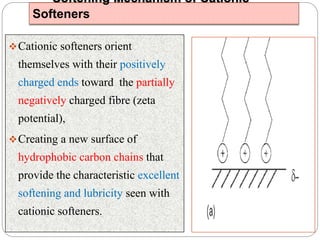
Cationic softeners orient
themselves with their positively
charged ends toward the partially
negatively charged fibre (zeta
potential),
Creating a new surface of
hydrophobic carbon chains that
provide the characteristic excellent
softening and lubricity seen with
cationic softeners.
Softening Mechanism of Anionic Softeners
 Anionic softeners orient themselves
with their negatively charged ends
repelled away from the negatively
charged fibre surface.
 This leads to higher hydrophilicity,
but less softening than with cationic
softeners.
Softening Mechanism of Non-Ionic Softeners
 The orientation of non-ionic
softeners depends on the nature
of the fibre surface, with the
hydrophilic portion of the
softener being attracted to
hydrophilic surfaces and the
hydrophobic portion being
attracted to hydrophobic
surfaces.
Desirable Properties of Textile Softener:
It should be easy to handle.
It should have good compatibility to other chemicals.
It should not affect the shade of the material.
It should not affect the fastness of dyed material.
It should not cause any yellowing effect on dyed and finished
material.
It should be stable to high temperature.
It should be non volatile by water vapour.
It should be non toxic and non caustic.
It should be easily bio degradable.
Product types and their chemistry
 Most softeners consist of molecules with both a hydrophobic and a
hydrophilic part.
 Therefore, they can be classified as surfactants (surface active
agents) and are to be found concentrated at the fibre surfaces.
 Most softeners have a low water solubility.
 Therefore softening products are usually sold as oil in water
emulsions containing 20–30 % solids.
 The softener molecules typically contain a long alkyl group,
sometimes branched, of more than 16 and up to 22 carbon atoms,
but most have 18 corresponding to the stearyl residue.
 Exceptions to this molecular structure are the special categories of
silicones, paraffins and polyethylene softeners.
 About one-third of the softeners used in the textile industry are
silicone based.
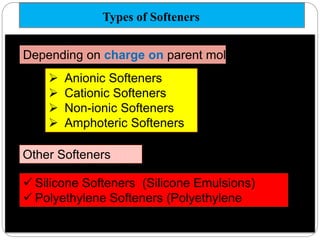
Types of Softeners
 Anionic Softeners
 Cationic Softeners
 Non-ionic Softeners
 Amphoteric Softeners
Other Softeners
 Silicone Softeners (Silicone Emulsions)
 Polyethylene Softeners (Polyethylene
Emulsions)
Depending on charge on parent molecule.
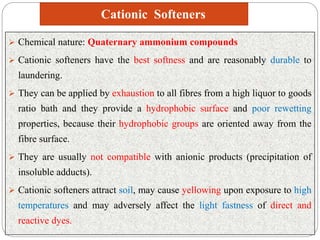
Cationic Softeners
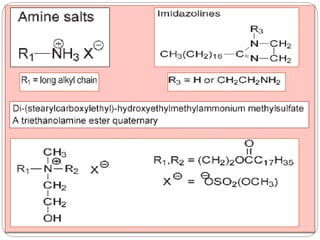
 Chemical nature: Quaternary ammonium compounds
 Cationic softeners have the best softness and are reasonably durable to
laundering.
 They can be applied by exhaustion to all fibres from a high liquor to goods
ratio bath and they provide a hydrophobic surface and poor rewetting
properties, because their hydrophobic groups are oriented away from the
fibre surface.
 They are usually not compatible with anionic products (precipitation of
insoluble adducts).
 Cationic softeners attract soil, may cause yellowing upon exposure to high
temperatures and may adversely affect the light fastness of direct and
reactive dyes.
Cont…
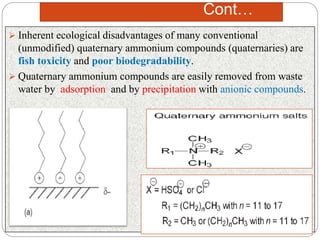
 Inherent ecological disadvantages of many conventional
(unmodified) quaternary ammonium compounds (quaternaries) are
fish toxicity and poor biodegradability.
 Quaternary ammonium compounds are easily removed from waste
water by adsorption and by precipitation with anionic compounds.
Cationic Softeners
Advantages
1. Soft, lofty, silky handle to most
fabrics at low levels of add-on
2. Substantive to most fibres
3. Good lubricant properties and
often have positive effect on
wet fastness
4. Improve tear strength, abrasion
resistance and sewability
5. Improve antistatic properties (
especially on synthetics)
Dis-Advantages
1. Incompatible with anionic
auxiliaries including FBA's
2. Free amine causes yellowing
and may change dye shade or
affect light fastness
3. May react with residual
chlorine from bleach baths
4. Adversely affect soil removal
properties,
5. Can cause tendering of
sulphur dyed fabrics
Anionic Softeners
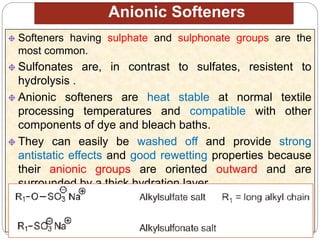
Softeners having sulphate and sulphonate groups are the
most common.
Sulfonates are, in contrast to sulfates, resistent to
hydrolysis .
Anionic softeners are heat stable at normal textile
processing temperatures and compatible with other
components of dye and bleach baths.
They can easily be washed off and provide strong
antistatic effects and good rewetting properties because
their anionic groups are oriented outward and are
surrounded by a thick hydration layer.
They are often used for special applications, such as
medical textiles, or in combination with anionic
fluorescent brightening agents.
Anionic Softeners
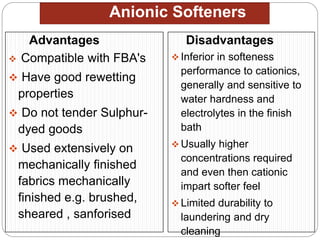
Advantages
 Compatible with FBA's
 Have good rewetting
properties
 Do not tender Sulphur-
dyed goods
 Used extensively on
mechanically finished
fabrics mechanically
finished e.g. brushed,
sheared , sanforised
Disadvantages
 Inferior in softeness
performance to cationics,
generally and sensitive to
water hardness and
electrolytes in the finish
bath
 Usually higher
concentrations required
and even then cationic
impart softer feel
 Limited durability to
laundering and dry
cleaning
Amphoteric Softeners
 Surfactants containing potentially anionic and cationic groups within the
same molecule.
 Typical properties are good softening effects, low
permanence to washing and high antistatic effects (because
of their strong ionic character).
 They have fewer ecological problems than similar cationic
products.
 Examples of the betaine and the amine oxide type are shown
below.
 The main application range is hygiene and terry-cloth articles.
 Good compatibility with easy-care finishes, Flame-retardants and
hydrophilic finishes.
 Expensive, poor temperature stability.
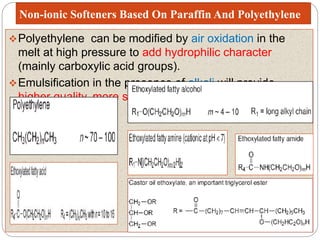
Non-ionic Softeners Based On Paraffin And Polyethylene
Polyethylene can be modified by air oxidation in the
melt at high pressure to add hydrophilic character
(mainly carboxylic acid groups).
Emulsification in the presence of alkali will provide
higher quality, more stable products.
Non-ionic Softeners
Advantages
They show high
lubricity (reduced
surface friction) that is
not durable to dry
cleaning,
they are stable to
extreme pH conditions
and heat at normal
textile processing
conditions, and
are reasonably priced
and compatible with
Dis-advantages
Handle generally
poorest out of
anionic, cationic and
non- ionic
Usually have
negative effect on
wet fastness
properties of dyes
Cannot easily be
applied by exhaust.
Ethoxylated Non-ionic Softeners
 These polyglycol ethers are synthesized by the
addition of ethylene oxide to fatty alcohols,
carboxylic acids, esters, amides or amines.
 They are surfactants and often used as antistatic
agents and as components of fibre spin finishes.
 Their main characteristics are
 relatively high substantivity and hydrophilicity,
 non-yellowing and sometimes a low softening
effect and lubricity, and
 a potential for foaming during processing.
Silicone Softeners
 Non-ionic and cationic examples of silicone softeners are available.
 They provide very high softness, special unique hand, high lubricity,
good sewability, elastic resilience, crease recovery, abrasion
resistance and tear strength.
 They show good temperature stability and durability, with a high
degree of permanence for those products that form crosslinked films
and a range of properties from hydrophobic to hydrophilic.
 Depending on their method of synthesis, silicone softeners can
contain variable amounts of volatile siloxane oligomers.
 Together with volatile emulsifiers these oligomers can cause
pollution problems in the waste air from tenter frames.
 In textile finishing, silicones are also used as water repellents,
elastomeric finishes, coatings and as defoamers.
Cont….
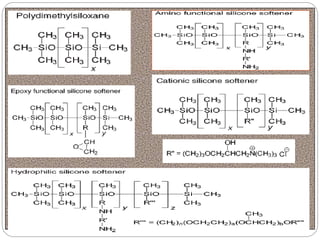
The high molecular flexibility of the silicone chain is the reason for
the very low glass transition temperature (about –100 °C) and for
their special softness.
They postulate that to a great extent the methyl groups of the
OSi(CH3)2-structure shield the oxygen atoms from outside contact.
Therefore the surface of fibres finished with polydimethylsiloxane is
mostly non-polar and hydrophobic.
In the case of cellulose, wool, silk and polyamide fibres, there are
strong hydrogen bonds between the hydroxyl or amino groups of the
fibres and the amino groups of the modified silicones.
Silicone Softeners On Polar Fibres.
 These bonds act as an anchor for the silicone, which forms an
evenly distributed film on the fibre surface.
 Good water repellency and very soft hand are the result.
 With an optimal content of amino side groups, the polysiloxane
segments between the anchor sites are long enough to maintain their
high flexibility.
 This is the main reason for the softness and the lubricating effect of
amino functional silicones on polar fibres.
1.2 Schematic arrangement of amino-modified silicone softeners on the fibre a =
loops of the polydimethylsiloxane chain, b = partially cationic amino ethylaminopropyl
side groups (about half of them are positively charged), c = fibre surface with
Silicone Softeners On Non-polar
Fibres
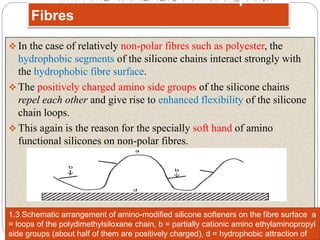
 In the case of relatively non-polar fibres such as polyester, the
hydrophobic segments of the silicone chains interact strongly with
the hydrophobic fibre surface.
 The positively charged amino side groups of the silicone chains
repel each other and give rise to enhanced flexibility of the silicone
chain loops.
 This again is the reason for the specially soft hand of amino
functional silicones on non-polar fibres.
1.3 Schematic arrangement of amino-modified silicone softeners on the fibre surface a
= loops of the polydimethylsiloxane chain, b = partially cationic amino ethylaminopropyl
side groups (about half of them are positively charged), d = hydrophobic attraction of
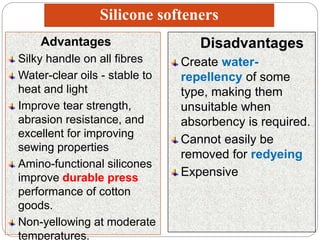
Silicone softeners
Advantages
Silky handle on all fibres
Water-clear oils - stable to
heat and light
Improve tear strength,
abrasion resistance, and
excellent for improving
sewing properties
Amino-functional silicones
improve durable press
performance of cotton
goods.
Non-yellowing at moderate
temperatures.
Disadvantages
Create water-
repellency of some
type, making them
unsuitable when
absorbency is required.
Cannot easily be
removed for redyeing
Expensive
Softeners
+, characteristic present; –, characteristic absent.
Naturally, non-ionic softeners have the best compatibility with
other finishing compounds.
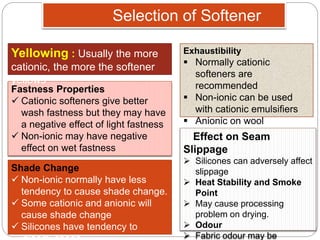
Selection of Softener
Fastness Properties
 Cationic softeners give better
wash fastness but they may have
a negative effect of light fastness
 Non-ionic may have negative
effect on wet fastness
Yellowing : Usually the more
cationic, the more the softener
yellows
Shade Change
 Non-ionic normally have less
tendency to cause shade change.
 Some cationic and anionic will
cause shade change
 Silicones have tendency to
Exhaustibility
 Normally cationic
softeners are
recommended
 Non-ionic can be used
with cationic emulsifiers
 Anionic on wool
Effect on Seam
Slippage
 Silicones can adversely affect
slippage
 Heat Stability and Smoke
Point
 May cause processing
problem on drying.
 Odour
 Fabric odour may be
THANKS FOR YOUR ATTENTION!!!

Softening Finishes

  • 1.
  • 2.
    Introduction  Softening finishesare among the most important of textile chemical after treatments.  With chemical softeners, textiles can achieve an agreeable, soft hand (supple, pliant, sleek and fluffy), some smoothness, more flexibility and better drape and pliability.  Chemicals used to impart the desired softness in fabric is termed as SOFTNERS.  The hand of a fabric is a subjective sensation felt by the skin when a textile fabric is touched with the finger tips and gently compressed.  The perceived softness of a textile is the combination of several measurable physical phenomena such as:  elasticity,  compressibility and  smoothness.
  • 3.
    Cont.. During preparation, textilescan become embrittled because natural oils and waxes or fibre preparations are removed. Finishing with softeners can overcome this deficiency and even improve on the original suppleness. Other properties improved by softeners include  the feeling of added fullness,  antistatic properties and  sewability. Disadvantages sometimes seen with chemical softeners include: Reduced crock fastness, yellowing of white goods, changes in hue of dyed goods and
  • 4.
    Mechanisms of theSoftening Effect Softeners provide their main effects on the surface of the fibres. Small softener molecules, in addition, penetrate the fibre and provide an internal plasticization of the fiber forming polymer by reducing of the glass transition temperature Tg. The physical arrangement of the usual softener molecules on the fibre surface is important and shown in Fig below. It depends on the ionic nature of the softener molecule and the relative hydrophobicity of the fibre surface. Softeners orient themselves toward the fibre creating a new surface consisting of molecular chains that provide the characteristic softening and lubricity.
  • 5.
    1.1 Schematic orientationof softeners on fibre surfaces. (a) Cationic softener and (b) anionic softener at fibre surface. Non- ionic softener at (c) hydro–phobic and (d) hydrophilic fibre
  • 6.
    Softening Mechanism ofCationic Softeners Cationic softeners orient themselves with their positively charged ends toward the partially negatively charged fibre (zeta potential), Creating a new surface of hydrophobic carbon chains that provide the characteristic excellent softening and lubricity seen with cationic softeners.
  • 7.
    Softening Mechanism ofAnionic Softeners  Anionic softeners orient themselves with their negatively charged ends repelled away from the negatively charged fibre surface.  This leads to higher hydrophilicity, but less softening than with cationic softeners.
  • 8.
    Softening Mechanism ofNon-Ionic Softeners  The orientation of non-ionic softeners depends on the nature of the fibre surface, with the hydrophilic portion of the softener being attracted to hydrophilic surfaces and the hydrophobic portion being attracted to hydrophobic surfaces.
  • 9.
    Desirable Properties ofTextile Softener: It should be easy to handle. It should have good compatibility to other chemicals. It should not affect the shade of the material. It should not affect the fastness of dyed material. It should not cause any yellowing effect on dyed and finished material. It should be stable to high temperature. It should be non volatile by water vapour. It should be non toxic and non caustic. It should be easily bio degradable.
  • 10.
    Product types andtheir chemistry  Most softeners consist of molecules with both a hydrophobic and a hydrophilic part.  Therefore, they can be classified as surfactants (surface active agents) and are to be found concentrated at the fibre surfaces.  Most softeners have a low water solubility.  Therefore softening products are usually sold as oil in water emulsions containing 20–30 % solids.  The softener molecules typically contain a long alkyl group, sometimes branched, of more than 16 and up to 22 carbon atoms, but most have 18 corresponding to the stearyl residue.  Exceptions to this molecular structure are the special categories of silicones, paraffins and polyethylene softeners.  About one-third of the softeners used in the textile industry are silicone based.
  • 11.
    Types of Softeners Anionic Softeners  Cationic Softeners  Non-ionic Softeners  Amphoteric Softeners Other Softeners  Silicone Softeners (Silicone Emulsions)  Polyethylene Softeners (Polyethylene Emulsions) Depending on charge on parent molecule.
  • 12.
    Cationic Softeners  Chemicalnature: Quaternary ammonium compounds  Cationic softeners have the best softness and are reasonably durable to laundering.  They can be applied by exhaustion to all fibres from a high liquor to goods ratio bath and they provide a hydrophobic surface and poor rewetting properties, because their hydrophobic groups are oriented away from the fibre surface.  They are usually not compatible with anionic products (precipitation of insoluble adducts).  Cationic softeners attract soil, may cause yellowing upon exposure to high temperatures and may adversely affect the light fastness of direct and reactive dyes.
  • 13.
    Cont…  Inherent ecologicaldisadvantages of many conventional (unmodified) quaternary ammonium compounds (quaternaries) are fish toxicity and poor biodegradability.  Quaternary ammonium compounds are easily removed from waste water by adsorption and by precipitation with anionic compounds.
  • 15.
    Cationic Softeners Advantages 1. Soft,lofty, silky handle to most fabrics at low levels of add-on 2. Substantive to most fibres 3. Good lubricant properties and often have positive effect on wet fastness 4. Improve tear strength, abrasion resistance and sewability 5. Improve antistatic properties ( especially on synthetics) Dis-Advantages 1. Incompatible with anionic auxiliaries including FBA's 2. Free amine causes yellowing and may change dye shade or affect light fastness 3. May react with residual chlorine from bleach baths 4. Adversely affect soil removal properties, 5. Can cause tendering of sulphur dyed fabrics
  • 16.
    Anionic Softeners Softeners havingsulphate and sulphonate groups are the most common. Sulfonates are, in contrast to sulfates, resistent to hydrolysis . Anionic softeners are heat stable at normal textile processing temperatures and compatible with other components of dye and bleach baths. They can easily be washed off and provide strong antistatic effects and good rewetting properties because their anionic groups are oriented outward and are surrounded by a thick hydration layer. They are often used for special applications, such as medical textiles, or in combination with anionic fluorescent brightening agents.
  • 17.
    Anionic Softeners Advantages  Compatiblewith FBA's  Have good rewetting properties  Do not tender Sulphur- dyed goods  Used extensively on mechanically finished fabrics mechanically finished e.g. brushed, sheared , sanforised Disadvantages  Inferior in softeness performance to cationics, generally and sensitive to water hardness and electrolytes in the finish bath  Usually higher concentrations required and even then cationic impart softer feel  Limited durability to laundering and dry cleaning
  • 18.
    Amphoteric Softeners  Surfactantscontaining potentially anionic and cationic groups within the same molecule.  Typical properties are good softening effects, low permanence to washing and high antistatic effects (because of their strong ionic character).  They have fewer ecological problems than similar cationic products.  Examples of the betaine and the amine oxide type are shown below.  The main application range is hygiene and terry-cloth articles.  Good compatibility with easy-care finishes, Flame-retardants and hydrophilic finishes.  Expensive, poor temperature stability.
  • 19.
    Non-ionic Softeners BasedOn Paraffin And Polyethylene Polyethylene can be modified by air oxidation in the melt at high pressure to add hydrophilic character (mainly carboxylic acid groups). Emulsification in the presence of alkali will provide higher quality, more stable products.
  • 20.
    Non-ionic Softeners Advantages They showhigh lubricity (reduced surface friction) that is not durable to dry cleaning, they are stable to extreme pH conditions and heat at normal textile processing conditions, and are reasonably priced and compatible with Dis-advantages Handle generally poorest out of anionic, cationic and non- ionic Usually have negative effect on wet fastness properties of dyes Cannot easily be applied by exhaust.
  • 21.
    Ethoxylated Non-ionic Softeners These polyglycol ethers are synthesized by the addition of ethylene oxide to fatty alcohols, carboxylic acids, esters, amides or amines.  They are surfactants and often used as antistatic agents and as components of fibre spin finishes.  Their main characteristics are  relatively high substantivity and hydrophilicity,  non-yellowing and sometimes a low softening effect and lubricity, and  a potential for foaming during processing.
  • 22.
    Silicone Softeners  Non-ionicand cationic examples of silicone softeners are available.  They provide very high softness, special unique hand, high lubricity, good sewability, elastic resilience, crease recovery, abrasion resistance and tear strength.  They show good temperature stability and durability, with a high degree of permanence for those products that form crosslinked films and a range of properties from hydrophobic to hydrophilic.  Depending on their method of synthesis, silicone softeners can contain variable amounts of volatile siloxane oligomers.  Together with volatile emulsifiers these oligomers can cause pollution problems in the waste air from tenter frames.  In textile finishing, silicones are also used as water repellents, elastomeric finishes, coatings and as defoamers.
  • 23.
    Cont…. The high molecularflexibility of the silicone chain is the reason for the very low glass transition temperature (about –100 °C) and for their special softness. They postulate that to a great extent the methyl groups of the OSi(CH3)2-structure shield the oxygen atoms from outside contact. Therefore the surface of fibres finished with polydimethylsiloxane is mostly non-polar and hydrophobic. In the case of cellulose, wool, silk and polyamide fibres, there are strong hydrogen bonds between the hydroxyl or amino groups of the fibres and the amino groups of the modified silicones.
  • 24.
    Silicone Softeners OnPolar Fibres.  These bonds act as an anchor for the silicone, which forms an evenly distributed film on the fibre surface.  Good water repellency and very soft hand are the result.  With an optimal content of amino side groups, the polysiloxane segments between the anchor sites are long enough to maintain their high flexibility.  This is the main reason for the softness and the lubricating effect of amino functional silicones on polar fibres. 1.2 Schematic arrangement of amino-modified silicone softeners on the fibre a = loops of the polydimethylsiloxane chain, b = partially cationic amino ethylaminopropyl side groups (about half of them are positively charged), c = fibre surface with
  • 25.
    Silicone Softeners OnNon-polar Fibres  In the case of relatively non-polar fibres such as polyester, the hydrophobic segments of the silicone chains interact strongly with the hydrophobic fibre surface.  The positively charged amino side groups of the silicone chains repel each other and give rise to enhanced flexibility of the silicone chain loops.  This again is the reason for the specially soft hand of amino functional silicones on non-polar fibres. 1.3 Schematic arrangement of amino-modified silicone softeners on the fibre surface a = loops of the polydimethylsiloxane chain, b = partially cationic amino ethylaminopropyl side groups (about half of them are positively charged), d = hydrophobic attraction of
  • 27.
    Silicone softeners Advantages Silky handleon all fibres Water-clear oils - stable to heat and light Improve tear strength, abrasion resistance, and excellent for improving sewing properties Amino-functional silicones improve durable press performance of cotton goods. Non-yellowing at moderate temperatures. Disadvantages Create water- repellency of some type, making them unsuitable when absorbency is required. Cannot easily be removed for redyeing Expensive
  • 28.
    Softeners +, characteristic present;–, characteristic absent. Naturally, non-ionic softeners have the best compatibility with other finishing compounds.
  • 29.
    Selection of Softener FastnessProperties  Cationic softeners give better wash fastness but they may have a negative effect of light fastness  Non-ionic may have negative effect on wet fastness Yellowing : Usually the more cationic, the more the softener yellows Shade Change  Non-ionic normally have less tendency to cause shade change.  Some cationic and anionic will cause shade change  Silicones have tendency to Exhaustibility  Normally cationic softeners are recommended  Non-ionic can be used with cationic emulsifiers  Anionic on wool Effect on Seam Slippage  Silicones can adversely affect slippage  Heat Stability and Smoke Point  May cause processing problem on drying.  Odour  Fabric odour may be
  • 30.
    THANKS FOR YOURATTENTION!!!