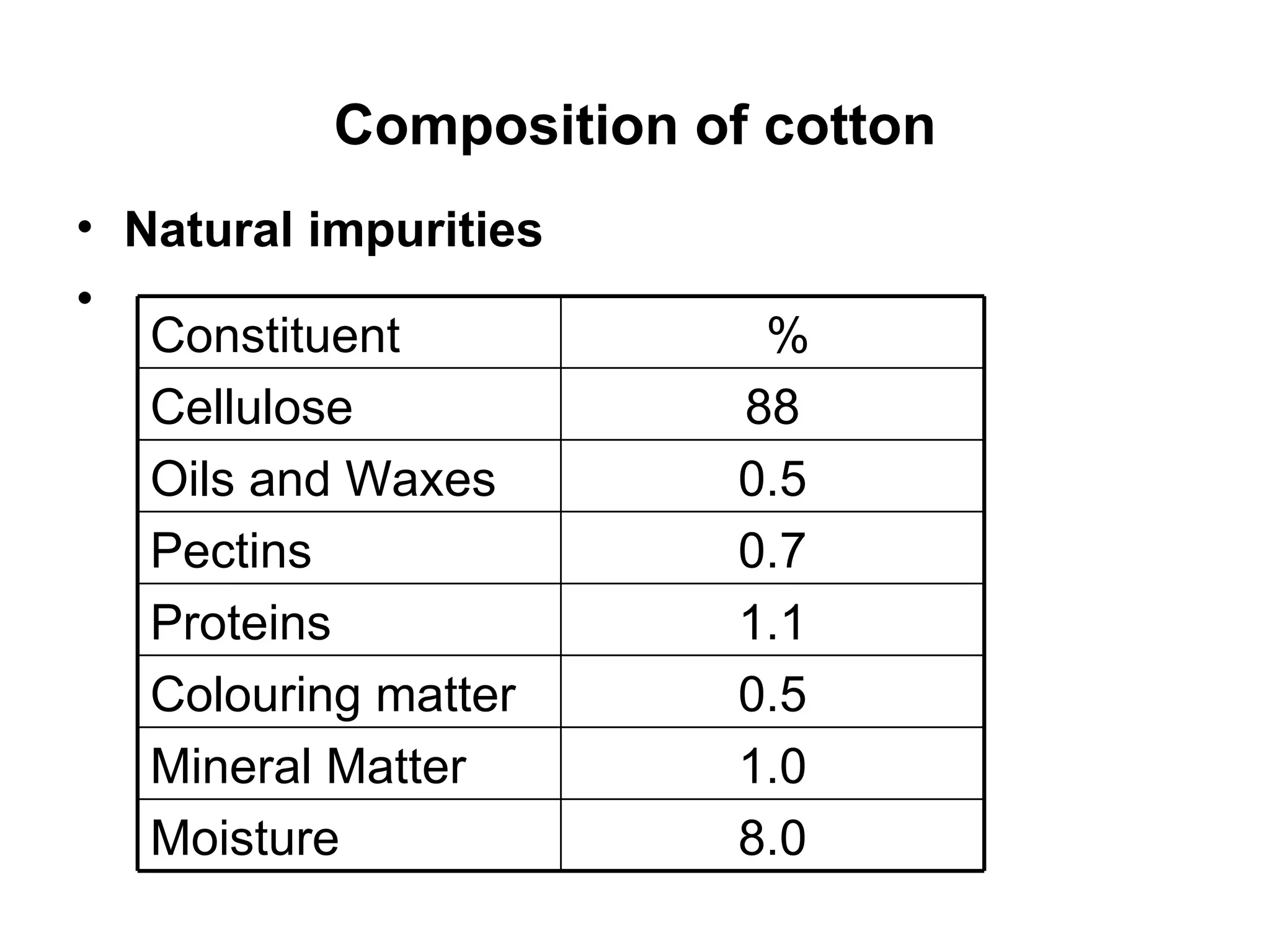
Composition of cotton Natural impurities 8.0 Moisture 1.0 Mineral Matter  0.5 Colouring matter 1.1 Proteins 0.7 Pectins 0.5 Oils and Waxes 88 Cellulose % Constituent
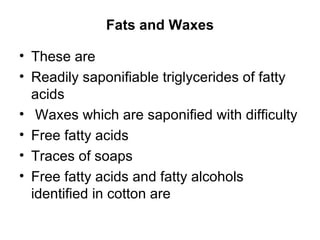
Fats and Waxes These are  Readily saponifiable triglycerides of fatty acids Waxes which are saponified with difficulty Free fatty acids Traces of soaps Free fatty acids and fatty alcohols identified in cotton are
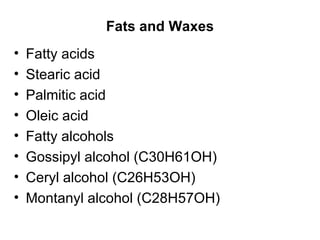
Fats and Waxes Fatty acids Stearic acid Palmitic acid Oleic acid Fatty alcohols Gossipyl alcohol (C30H61OH) Ceryl alcohol (C26H53OH) Montanyl alcohol (C28H57OH)
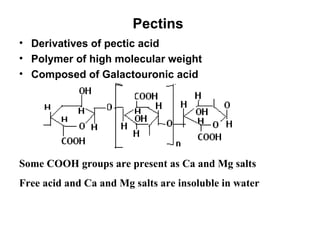
Pectins  Derivatives of pectic acid  Polymer of high molecular weight Composed of Galactouronic acid Some COOH groups are present as Ca and Mg salts Free acid and Ca and Mg salts are insoluble in water
Proteins Nitrogenous compounds Present in primary wall and Lumen Some of the amino acids identified are Leucine Valine Proline,  Alanine etc. Yellowish (Creamish) colour of cotton is related to Proteins and  Colouring matter
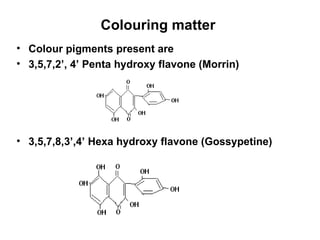
Colouring matter  Colour pigments present are 3,5,7,2’, 4’ Penta hydroxy flavone (Morrin) 3,5,7,8,3’,4’ Hexa hydroxy flavone (Gossypetine)
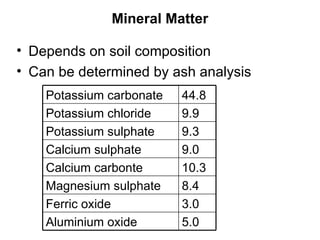
Mineral Matter Depends on soil composition Can be determined by ash analysis 5.0 Aluminium oxide 3.0 Ferric oxide 8.4 Magnesium sulphate 10.3 Calcium carbonte  9.0 Calcium sulphate 9.3 Potassium sulphate 9.9 Potassium chloride 44.8 Potassium carbonate
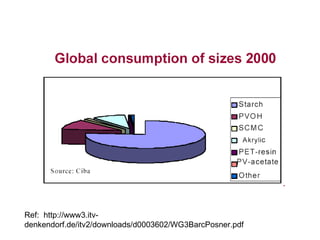
Added Impurities Sizing agents: Agents used to give protective coating to warp threads  Minimize the breaking of warp threads during weaving Improve weaving productvity. The operation is known as sizing. Starch is one of the most important sizing agent for cotton
Purpose Purpose To remove added and natural impurities from textile material  Removal impurities to the maximum extent possible with minimum effect on fibre strength. To impart desirable properties to textile material
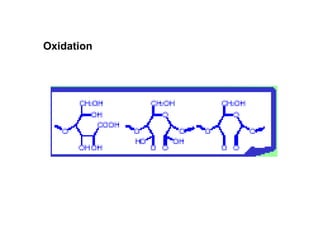
Principle of preparatory processes The impurity is insoluble in water Conversion of water insoluble impurity to its water soluble form. Chemical reactions involved (Cotton) Hydrolysis Oxidation The choice of chemicals depends on chemical nature of impurity.
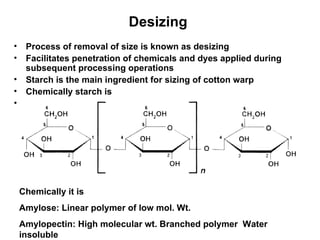
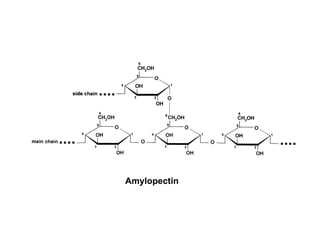
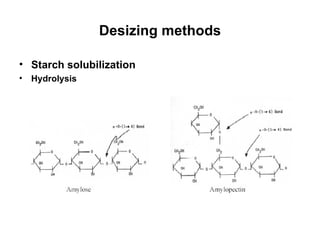
Desizing   Process of removal of size is known as desizing Facilitates penetration of chemicals and dyes applied during subsequent processing operations  Starch is the main ingredient for sizing of cotton warp Chemically starch is  Chemically it is  Amylose: Linear polymer of low mol. Wt.  Amylopectin: High molecular wt. Branched polymer  Water insoluble
  Amylopectin
Desizing methods Starch solubilization Hydrolysis
Oxidation
Ref:  http://www3.itv-denkendorf.de/itv2/downloads/d0003602/WG3BarcPosner.pdf
Hydrolytic desizing  Rot steeping Acid Desizing Enzyme Desizing
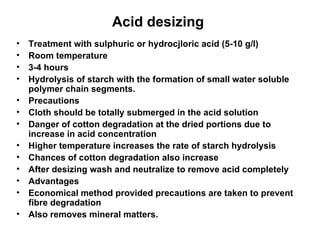
Acid desizing  Treatment with sulphuric or hydrocjloric acid (5-10 g/l) Room temperature 3-4 hours Hydrolysis of starch with the formation of small water soluble polymer chain segments. Precautions Cloth should be totally submerged in the acid solution Danger of cotton degradation at the dried portions due to increase in acid concentration Higher temperature increases the rate of starch hydrolysis Chances of cotton degradation also increase After desizing wash and neutralize to remove acid completely Advantages Economical method provided precautions are taken to prevent fibre degradation Also removes mineral matters.
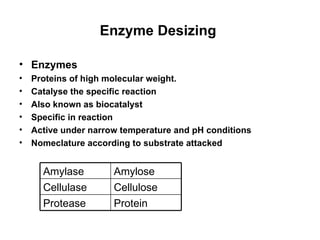
Enzyme Desizing  Enzymes Proteins of high molecular weight. Catalyse the specific reaction Also known as biocatalyst  Specific in reaction Active under narrow temperature and pH conditions Nomeclature according to substrate attacked  Protein  Protease Cellulose Cellulase Amylose Amylase
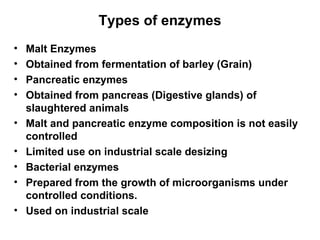
Types of enzymes Malt Enzymes Obtained from fermentation of barley (Grain) Pancreatic enzymes Obtained from pancreas (Digestive glands) of slaughtered animals Malt and pancreatic enzyme composition is not easily controlled Limited use on industrial scale desizing  Bacterial enzymes Prepared from the growth of microorganisms under controlled conditions. Used on industrial scale
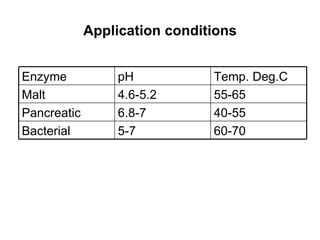
Application conditions 60-70 5-7 Bacterial 40-55 6.8-7 Pancreatic 55-65 4.6-5.2 Malt Temp. Deg.C pH Enzyme
Enzyme desizing process In textile industry enzymes  desizing was first used in 1857. cloth was steeped for several hours in water containing Barley 1n 1900 Malt enzyme  In 1912 Bacterial enzymes were introduced Presently bacterial enzymes are most popular Some bacterial enzymes are stable upto 100 deg.C
Industrial methods   Fabric form Rope Open width  Processes Batch wise Semi continuous Continuous
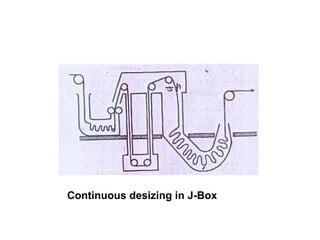
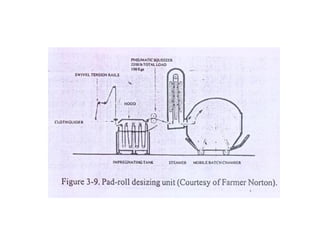
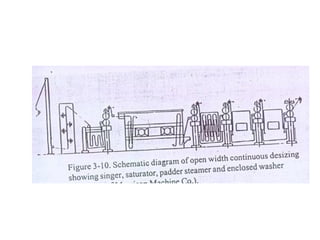
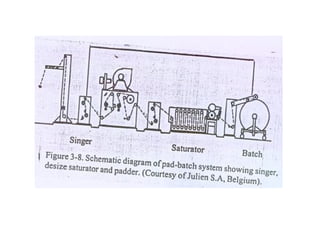
Equipments Batch wise operation Fabric in rope form Kier Fabric in open width form Jigger  Semi continous Pad – batch Saturate-Store in a pit or wagan Continuous Pad-steam-Wash Pad-Store in J box-Wash
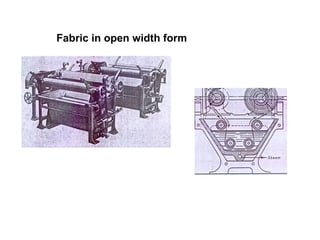
Fabric in open width form
Continuous desizing in J-Box


Lecture 2 composition of cotton, desizing

  • 1.
    Composition of cottonNatural impurities 8.0 Moisture 1.0 Mineral Matter 0.5 Colouring matter 1.1 Proteins 0.7 Pectins 0.5 Oils and Waxes 88 Cellulose % Constituent
  • 2.
    Fats and WaxesThese are Readily saponifiable triglycerides of fatty acids Waxes which are saponified with difficulty Free fatty acids Traces of soaps Free fatty acids and fatty alcohols identified in cotton are
  • 3.
    Fats and WaxesFatty acids Stearic acid Palmitic acid Oleic acid Fatty alcohols Gossipyl alcohol (C30H61OH) Ceryl alcohol (C26H53OH) Montanyl alcohol (C28H57OH)
  • 4.
    Pectins Derivativesof pectic acid Polymer of high molecular weight Composed of Galactouronic acid Some COOH groups are present as Ca and Mg salts Free acid and Ca and Mg salts are insoluble in water
  • 5.
    Proteins Nitrogenous compoundsPresent in primary wall and Lumen Some of the amino acids identified are Leucine Valine Proline, Alanine etc. Yellowish (Creamish) colour of cotton is related to Proteins and Colouring matter
  • 6.
    Colouring matter Colour pigments present are 3,5,7,2’, 4’ Penta hydroxy flavone (Morrin) 3,5,7,8,3’,4’ Hexa hydroxy flavone (Gossypetine)
  • 7.
    Mineral Matter Dependson soil composition Can be determined by ash analysis 5.0 Aluminium oxide 3.0 Ferric oxide 8.4 Magnesium sulphate 10.3 Calcium carbonte 9.0 Calcium sulphate 9.3 Potassium sulphate 9.9 Potassium chloride 44.8 Potassium carbonate
  • 8.
    Added Impurities Sizingagents: Agents used to give protective coating to warp threads Minimize the breaking of warp threads during weaving Improve weaving productvity. The operation is known as sizing. Starch is one of the most important sizing agent for cotton
  • 9.
    Purpose Purpose Toremove added and natural impurities from textile material Removal impurities to the maximum extent possible with minimum effect on fibre strength. To impart desirable properties to textile material
  • 10.
    Principle of preparatoryprocesses The impurity is insoluble in water Conversion of water insoluble impurity to its water soluble form. Chemical reactions involved (Cotton) Hydrolysis Oxidation The choice of chemicals depends on chemical nature of impurity.
  • 11.
    Desizing Process of removal of size is known as desizing Facilitates penetration of chemicals and dyes applied during subsequent processing operations Starch is the main ingredient for sizing of cotton warp Chemically starch is Chemically it is Amylose: Linear polymer of low mol. Wt. Amylopectin: High molecular wt. Branched polymer Water insoluble
  • 12.
  • 13.
    Desizing methods Starchsolubilization Hydrolysis
  • 14.
  • 15.
  • 16.
    Hydrolytic desizing Rot steeping Acid Desizing Enzyme Desizing
  • 17.
    Acid desizing Treatment with sulphuric or hydrocjloric acid (5-10 g/l) Room temperature 3-4 hours Hydrolysis of starch with the formation of small water soluble polymer chain segments. Precautions Cloth should be totally submerged in the acid solution Danger of cotton degradation at the dried portions due to increase in acid concentration Higher temperature increases the rate of starch hydrolysis Chances of cotton degradation also increase After desizing wash and neutralize to remove acid completely Advantages Economical method provided precautions are taken to prevent fibre degradation Also removes mineral matters.
  • 18.
    Enzyme Desizing Enzymes Proteins of high molecular weight. Catalyse the specific reaction Also known as biocatalyst Specific in reaction Active under narrow temperature and pH conditions Nomeclature according to substrate attacked Protein Protease Cellulose Cellulase Amylose Amylase
  • 19.
    Types of enzymesMalt Enzymes Obtained from fermentation of barley (Grain) Pancreatic enzymes Obtained from pancreas (Digestive glands) of slaughtered animals Malt and pancreatic enzyme composition is not easily controlled Limited use on industrial scale desizing Bacterial enzymes Prepared from the growth of microorganisms under controlled conditions. Used on industrial scale
  • 20.
    Application conditions 60-705-7 Bacterial 40-55 6.8-7 Pancreatic 55-65 4.6-5.2 Malt Temp. Deg.C pH Enzyme
  • 21.
    Enzyme desizing processIn textile industry enzymes desizing was first used in 1857. cloth was steeped for several hours in water containing Barley 1n 1900 Malt enzyme In 1912 Bacterial enzymes were introduced Presently bacterial enzymes are most popular Some bacterial enzymes are stable upto 100 deg.C
  • 22.
    Industrial methods Fabric form Rope Open width Processes Batch wise Semi continuous Continuous
  • 23.
    Equipments Batch wiseoperation Fabric in rope form Kier Fabric in open width form Jigger Semi continous Pad – batch Saturate-Store in a pit or wagan Continuous Pad-steam-Wash Pad-Store in J box-Wash
  • 24.
    Fabric in openwidth form
  • 25.
  • 26.
  • 27.
  • 28.