Shyamoli Textile Engineering College
Presentation on
Bleaching
Bleaching
“After the removal of the waxes and other hydrophobic type of
impurities from grey fabric by the desizing and scouring the fabric is
now in a more absorbent state. But still have the pale appearance
due to the presence of natural coloring material like pigment etc,
these pigment cannot be removed the only way to tackle these
pigment is to decolourise them using suitable oxidizing agents. This
will make the fabric in a super white form. This process of
decolouration of natural pigments is called the bleaching”.
Mechanism of Bleaching
The mechanism of bleaching is very complicated and not
completely understood. One opinion is that the color producing
agents in natural fibers are often organic compounds containing
conjugated double bonds. De coloration can occur by breaking up
the chrophore, most likely destroying one or more of the double
bonds within the conjugated system. The bleaching agents either
oxidize or reduce the coloring matter … thus whiteness obtained is
of permanent nature. Primitive bleaching - expose scoured fabric
to the sun - light served as an oxidation catalyst.
Objects of Bleaching
* Removal of coloured impurities.
*Removal of the seed coats.
*Minimum tendering of fibre.
*Technically reliable & simple mode of operation.
*Low chemical & energy consumption.
*Increasing the degree of whiteness.
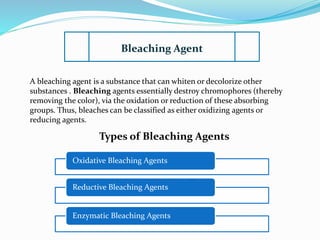
Bleaching Agent
A bleaching agent is a substance that can whiten or decolorize other
substances . Bleaching agents essentially destroy chromophores (thereby
removing the color), via the oxidation or reduction of these absorbing
groups. Thus, bleaches can be classified as either oxidizing agents or
reducing agents.
Oxidative Bleaching Agents
Reductive Bleaching Agents
Enzymatic Bleaching Agents
Types of Bleaching Agents
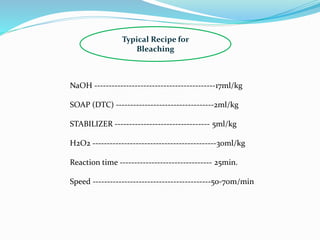
NaOH ------------------------------------------17ml/kg
SOAP (DTC) ----------------------------------2ml/kg
STABILIZER --------------------------------- 5ml/kg
H2O2 -------------------------------------------30ml/kg
Reaction time -------------------------------- 25min.
Speed -----------------------------------------50-70m/min
Typical Recipe for
Bleaching
Factors Affecting Hypochlorite Bleaching
Effect of pH pH has a profound effect on bleaching with hypochlorite.
• Addition of caustic favors the formation of OCl- ion.
• Na2CO3 is used to buffer the bleach bath to pH 9 - 10.
• At pH > 10, little to no bleaching takes place.
• When acid is added, the HOCl concentration increases.
• pH 5 - 8.5, HOCl is the major species present … very rapid bleaching
takes place, … but rapid degradation of fiber.
• When the pH drops below 5, chlorine gas is liberated and the solution
has no bleaching effectiveness at all.
• The optimum pH for bleaching is between 9 and 10.
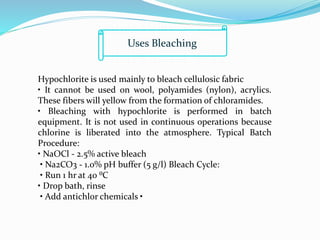
Uses Bleaching
Hypochlorite is used mainly to bleach cellulosic fabric
• It cannot be used on wool, polyamides (nylon), acrylics.
These fibers will yellow from the formation of chloramides.
• Bleaching with hypochlorite is performed in batch
equipment. It is not used in continuous operations because
chlorine is liberated into the atmosphere. Typical Batch
Procedure:
• NaOCl - 2.5% active bleach
• Na2CO3 - 1.0% pH buffer (5 g/l) Bleach Cycle:
• Run 1 hr at 40 ⁰C
• Drop bath, rinse
• Add antichlor chemicals •
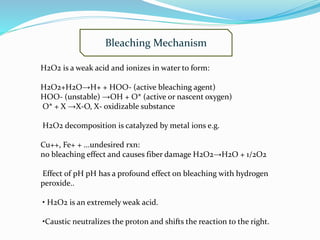
H2O2 is a weak acid and ionizes in water to form:
H2O2+H2O→H+ + HOO- (active bleaching agent)
HOO- (unstable) →OH + O* (active or nascent oxygen)
O* + X →X-O, X- oxidizable substance
H2O2 decomposition is catalyzed by metal ions e.g.
Cu++, Fe+ + ...undesired rxn:
no bleaching effect and causes fiber damage H2O2→H2O + 1/2O2
Effect of pH pH has a profound effect on bleaching with hydrogen
peroxide..
• H2O2 is an extremely weak acid.
•Caustic neutralizes the proton and shifts the reaction to the right.
Bleaching Mechanism
pH has a profound effect on bleaching with hypochlorite.
Addition of caustic favors the formation of OCl- ion.
Na2CO3 is used to buffer the bleach bath to pH 9 - 10.
At pH > 10, little to no bleaching takes place.
When acid is added, the HOCl concentration increases.
pH 5 - 8.5, HOCl is the major species present … very rapid bleaching takes
place, … but rapid degradation of fiber.
When the pH drops below 5, chlorine gas is liberated and the solution has
no bleaching effectiveness at all.
The optimum pH for bleaching is between 9 and 10.
Effect of pH
Time and temperature of bleaching are interrelated.
• Concentration is also interrelated with time and temperature.
•1 hr at 40 ⁰C is satisfactory for effective bleaching.
• Copper and iron catalyze the oxidation of cellulose by sodium
hypochlorite degrading the fiber. .
• Stainless steel equipment is required and care must be taken that the
water supply be free of metal ions and rust from pipes. Antichlor
• Fabrics bleached with hypochlorite will develop a distinctive chlorine
odor
• An antichlor treatment with sodium bisulfite and acetic acid removes
any residual chlorine from the cloth
Effect of Time
Temperature & Matals
• Cotton is bleached in the raw state, as yarn and in the piece.
• In principle, the bleaching of cotton is a comparatively simple process in
which three main operations are involved, viz.
(1) boiling with an alkali;
(2) bleaching the organic colouring matters by means of a hypochlorite or
some other oxidizing agent;
(3) souring i.e. treating with weak hydrochloric or sulphuric acid. For loose
cotton and yarn these three operations are sufficient, but for piece goods a
larger number of operations is usually necessary in order to obtain a
satisfactory result
Bleaching of Cotton
• Filament viscose rayon may not require bleaching since this is normally
carried out during manufacture. However, viscose in staple form
requires bleaching as it may not necessarily include a bleaching
treatment during its manufacture.
•The same reagents as those used for bleaching linen and cotton fabrics
are useful for these fibers.
For very good whiteness, rayon may be bleached on a jigger with alkaline
hypochlorite or combined scour and bleach using hydrogen peroxide
containing sodium silicate and alkaline detergents-at a temperature of
about 70°C.
Bleaching of Viscose
• Safe for Rayons, Acrylics and polyester
.• Complete removal of kitties, waxes etc. with bleaching.
• Feel of the fabric extremely good.
• Hard water does not interfere.
• Aqueous solution is extremely stable.
• Chlorite bleaching results in a degree of whiteness which cannot be
achieved with hydrogen peroxide in a single stage process.
Advantages:
Disadvantages
• Treatment under acidic conditions so all alkali must be
removed before hand.
• ClO2 liberation causes pollution and corrodes
equipment.
• Continuous methods cannot be used.
• More expensive than H2O2.
Presentation on Textile Bleaching

Presentation on Textile Bleaching

  • 1.
    Shyamoli Textile EngineeringCollege Presentation on Bleaching
  • 2.
    Bleaching “After the removalof the waxes and other hydrophobic type of impurities from grey fabric by the desizing and scouring the fabric is now in a more absorbent state. But still have the pale appearance due to the presence of natural coloring material like pigment etc, these pigment cannot be removed the only way to tackle these pigment is to decolourise them using suitable oxidizing agents. This will make the fabric in a super white form. This process of decolouration of natural pigments is called the bleaching”.
  • 4.
    Mechanism of Bleaching Themechanism of bleaching is very complicated and not completely understood. One opinion is that the color producing agents in natural fibers are often organic compounds containing conjugated double bonds. De coloration can occur by breaking up the chrophore, most likely destroying one or more of the double bonds within the conjugated system. The bleaching agents either oxidize or reduce the coloring matter … thus whiteness obtained is of permanent nature. Primitive bleaching - expose scoured fabric to the sun - light served as an oxidation catalyst.
  • 5.
    Objects of Bleaching *Removal of coloured impurities. *Removal of the seed coats. *Minimum tendering of fibre. *Technically reliable & simple mode of operation. *Low chemical & energy consumption. *Increasing the degree of whiteness.
  • 6.
    Bleaching Agent A bleachingagent is a substance that can whiten or decolorize other substances . Bleaching agents essentially destroy chromophores (thereby removing the color), via the oxidation or reduction of these absorbing groups. Thus, bleaches can be classified as either oxidizing agents or reducing agents. Oxidative Bleaching Agents Reductive Bleaching Agents Enzymatic Bleaching Agents Types of Bleaching Agents
  • 7.
    NaOH ------------------------------------------17ml/kg SOAP (DTC)----------------------------------2ml/kg STABILIZER --------------------------------- 5ml/kg H2O2 -------------------------------------------30ml/kg Reaction time -------------------------------- 25min. Speed -----------------------------------------50-70m/min Typical Recipe for Bleaching
  • 8.
    Factors Affecting HypochloriteBleaching Effect of pH pH has a profound effect on bleaching with hypochlorite. • Addition of caustic favors the formation of OCl- ion. • Na2CO3 is used to buffer the bleach bath to pH 9 - 10. • At pH > 10, little to no bleaching takes place. • When acid is added, the HOCl concentration increases. • pH 5 - 8.5, HOCl is the major species present … very rapid bleaching takes place, … but rapid degradation of fiber. • When the pH drops below 5, chlorine gas is liberated and the solution has no bleaching effectiveness at all. • The optimum pH for bleaching is between 9 and 10.
  • 9.
    Uses Bleaching Hypochlorite isused mainly to bleach cellulosic fabric • It cannot be used on wool, polyamides (nylon), acrylics. These fibers will yellow from the formation of chloramides. • Bleaching with hypochlorite is performed in batch equipment. It is not used in continuous operations because chlorine is liberated into the atmosphere. Typical Batch Procedure: • NaOCl - 2.5% active bleach • Na2CO3 - 1.0% pH buffer (5 g/l) Bleach Cycle: • Run 1 hr at 40 ⁰C • Drop bath, rinse • Add antichlor chemicals •
  • 10.
    H2O2 is aweak acid and ionizes in water to form: H2O2+H2O→H+ + HOO- (active bleaching agent) HOO- (unstable) →OH + O* (active or nascent oxygen) O* + X →X-O, X- oxidizable substance H2O2 decomposition is catalyzed by metal ions e.g. Cu++, Fe+ + ...undesired rxn: no bleaching effect and causes fiber damage H2O2→H2O + 1/2O2 Effect of pH pH has a profound effect on bleaching with hydrogen peroxide.. • H2O2 is an extremely weak acid. •Caustic neutralizes the proton and shifts the reaction to the right. Bleaching Mechanism
  • 11.
    pH has aprofound effect on bleaching with hypochlorite. Addition of caustic favors the formation of OCl- ion. Na2CO3 is used to buffer the bleach bath to pH 9 - 10. At pH > 10, little to no bleaching takes place. When acid is added, the HOCl concentration increases. pH 5 - 8.5, HOCl is the major species present … very rapid bleaching takes place, … but rapid degradation of fiber. When the pH drops below 5, chlorine gas is liberated and the solution has no bleaching effectiveness at all. The optimum pH for bleaching is between 9 and 10. Effect of pH
  • 12.
    Time and temperatureof bleaching are interrelated. • Concentration is also interrelated with time and temperature. •1 hr at 40 ⁰C is satisfactory for effective bleaching. • Copper and iron catalyze the oxidation of cellulose by sodium hypochlorite degrading the fiber. . • Stainless steel equipment is required and care must be taken that the water supply be free of metal ions and rust from pipes. Antichlor • Fabrics bleached with hypochlorite will develop a distinctive chlorine odor • An antichlor treatment with sodium bisulfite and acetic acid removes any residual chlorine from the cloth Effect of Time Temperature & Matals
  • 13.
    • Cotton isbleached in the raw state, as yarn and in the piece. • In principle, the bleaching of cotton is a comparatively simple process in which three main operations are involved, viz. (1) boiling with an alkali; (2) bleaching the organic colouring matters by means of a hypochlorite or some other oxidizing agent; (3) souring i.e. treating with weak hydrochloric or sulphuric acid. For loose cotton and yarn these three operations are sufficient, but for piece goods a larger number of operations is usually necessary in order to obtain a satisfactory result Bleaching of Cotton
  • 14.
    • Filament viscoserayon may not require bleaching since this is normally carried out during manufacture. However, viscose in staple form requires bleaching as it may not necessarily include a bleaching treatment during its manufacture. •The same reagents as those used for bleaching linen and cotton fabrics are useful for these fibers. For very good whiteness, rayon may be bleached on a jigger with alkaline hypochlorite or combined scour and bleach using hydrogen peroxide containing sodium silicate and alkaline detergents-at a temperature of about 70°C. Bleaching of Viscose
  • 15.
    • Safe forRayons, Acrylics and polyester .• Complete removal of kitties, waxes etc. with bleaching. • Feel of the fabric extremely good. • Hard water does not interfere. • Aqueous solution is extremely stable. • Chlorite bleaching results in a degree of whiteness which cannot be achieved with hydrogen peroxide in a single stage process. Advantages:
  • 16.
    Disadvantages • Treatment underacidic conditions so all alkali must be removed before hand. • ClO2 liberation causes pollution and corrodes equipment. • Continuous methods cannot be used. • More expensive than H2O2.