Desizing
 Desizing is done in order to removes the size from warp
yarn of the woven fabric. Warp yarn are coated with sizing
agents period to weaving in order to reduce their fractional
properties, decrease yarn breakage in loom and improve
weaving productivity by increasing weft insertion speed.
 The sizing materials present on warp yarn acts as a resist
toward dye and chemicals in textile wet processing. it
must therefore be removed before any subsequent wet
processing of the fabric.
Objectives of desizing
 The object is to remove from the grey fabric the size that has
been applied during weaving and thus to make the fabric ready
for further processes.
 The main ingredient in size that is not water-soluble is usually
starch.
 Chemically starchis poly-glucopyranose in which straight
chain and branched chain polymers are present.
 .
Chemistry of desizing
 The main ingredient in size that is not water-soluble
is usually starch.
 Chemically starch is poly-glucopyranose in which
straight chain and branched chain polymers are
present.
 Both the constituents of starch are insoluble in water
but they can be made soluble by hydrolysis of these
long chain compounds to shorter ones.
Mechanism
The main ingredient in size that is not water-soluble is usually starch.
Chemically starch is poly-glucopyranose in which straight chain and
branched chain polymers are present.
Both the constituents of starch are insoluble in water but they can be
made soluble by hydrolysis of these long chain compounds to shorter
ones.
Thus, under suitable conditions, the following steps show the
progressive hydrolysis ofstarch.
However, in desizing, the hydrolysis of starch is carried out only up
to the soluble dextrin stage, as this can be removed off the desized
fabric by means of an aqueous wash.
Mechanism contd.
Methods of desizing
 Rot steeping
 Enzymatic desizing
 Acidic desizing
 Oxidative desizing
Rot Steep
 This is the oldest and cheapest method of desizing.
 Here no special chemical is used.
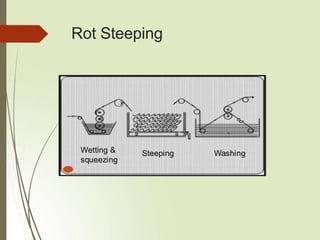
 The cloth is first passed through warm water at 40C in a padding
mangle where the cloth is squeezed to about 100% expression.
 The cloth is then allowed to stand for 24 hours.
 The microorganisms, naturally present in water, multiply and
secrete starch-liquefying (hydrolysing) enzymes, which break down
the starch present in the size to w ater-soluble products
 The cloth is then washed to remove these products.
Rot Steeping
Wetting &
squeezing
Steeping Washing
Rot steep
Advantages
 Rot steeping is the cheapest of all the desizing methods.
 No chemicals are required.
Disadvantages
 A large floor space is required for this process.
 The process is slow, so desizing time is long.
 Mildew may attack the cloth during steeping
 and cause stains on the fabric.
Acid Desizing
 Dilute sulphuric acid or hydrochloric acid may be
used to hydrolyse the starch from the sizedfabric.
 A 0.25% - 0.5 % solution of the acid at room
temperature (30o C) is suitable for this process.
 The cloth is impregnated with the dilute acid solution
in a two-bowl or three- bowl padding mangle and then
stored for 8-12 hours in a closed concretepit
Acid Desizing
Advantages
 Acid desizing is an economical process.
 The process is effective and gives fairly uniform desizing, as it
is a chemical- based process. It does not require specific
conditions of pH and can be done at room temperature.
 It is a much quicker process than rot steep desizing.
Acid desizing
Disadvantage
 The main disadvantage of the process is that mineral acid is
harmful to cellulose fibres if proper care is not taken.
 Especially during the storage stage, the acid-wet fabric must
not be allowed to dry.
 This would cause the formation of hydrocellulose, which will
weaken the fibre.
Enzymatic Desizing
The hydrolysis of starch using enzymes under
particular concentration, temperature and duration is
called enzymatic desizing.
Enzymatic desizing is the most widely experienced
method to desize the starch.
Although traditionally enzymes are used under mild process
conditions, genetic engineering has allowed development of robust
enzymes which can be used at higher temperatures to
increase the rate of desizing.
High temperature enzymatic desizing
Novozymes, an enzyme producing major, introduced an alkaline
amylase with a broad activity spectrum, capable of application over the
pH range 5-10 and from 20-85°C. This has enabled
combined desizing and bioscouring to achieve commercial
acceptance in a number of textile mills. They have also
developed enzymes for use in high temperature. The details are
given below:
Aquazym® PS ( Novozymes)
A heat-stable alpha-amylase used in high-temperature continuous
desizing processes (Pad Steam).
Enzymatic desizing
Advantages
 Time required for the desizing process isless.
 It is continuous process, so greater production canbe
achieved.
 Closely constructed fabric can be easily desized, due to the
effective enzyme action.
 There is no chance for the cellulose to get hydrolysed,
as in acid desizing.
Enzymatic desizing
Disadvantages
 Lower additional cleaning effect
towards otherimpurities.
 No effect on certain starches (e.g. tapioca starch)
Oxidative desizing
Desizing with Oxidizing agents
 Though the use of oxidants for desizing of cotton
fabric is widely accepted but their large scale
industrial application is yet to be exploited.
The most important aspects of oxidizing agents are that
they can be applicable to wide range of fabrics, the size
content of which is often not known.
Oxidative desizing
Advantages
The advantages of oxidative desizing are
supplementary cleaning effect, effectiveness for
tapioca starches but oxidizing agents may
damage tofibres.
Assessment of desizing efficiency
TEGEWA violetscale
Reagent preparation
Put potassium iodide [10g of KI (100%)] in 100 ml of water; then add 0.6358 g of iodine (100%);
stir well until iodine is completely dissolved in the KI solution. After this, add 800 ml
of ethanol. Then by adding water the volume should be raised to 1000 ml.
Method of testing
Put one or twodrops of the above solution on a fabric. Rub it gently and then assess the colour
change as per the Tegewa scale. Before testing, the fabric should be coldand
thereshould not be any residual alkalinity in it.
Assessment
No Colour Change = No starch is present
Pale blue to bluish violet = Presence of starch size or a blend of starch+ synthetic size
Brown = Presence of modified starch or a blend of starch/PVA size

Textile Desizing Slide.pptx

  • 1.
    Desizing  Desizing isdone in order to removes the size from warp yarn of the woven fabric. Warp yarn are coated with sizing agents period to weaving in order to reduce their fractional properties, decrease yarn breakage in loom and improve weaving productivity by increasing weft insertion speed.  The sizing materials present on warp yarn acts as a resist toward dye and chemicals in textile wet processing. it must therefore be removed before any subsequent wet processing of the fabric.
  • 2.
    Objectives of desizing The object is to remove from the grey fabric the size that has been applied during weaving and thus to make the fabric ready for further processes.  The main ingredient in size that is not water-soluble is usually starch.  Chemically starchis poly-glucopyranose in which straight chain and branched chain polymers are present.  .
  • 3.
    Chemistry of desizing The main ingredient in size that is not water-soluble is usually starch.  Chemically starch is poly-glucopyranose in which straight chain and branched chain polymers are present.  Both the constituents of starch are insoluble in water but they can be made soluble by hydrolysis of these long chain compounds to shorter ones.
  • 4.
    Mechanism The main ingredientin size that is not water-soluble is usually starch. Chemically starch is poly-glucopyranose in which straight chain and branched chain polymers are present. Both the constituents of starch are insoluble in water but they can be made soluble by hydrolysis of these long chain compounds to shorter ones. Thus, under suitable conditions, the following steps show the progressive hydrolysis ofstarch. However, in desizing, the hydrolysis of starch is carried out only up to the soluble dextrin stage, as this can be removed off the desized fabric by means of an aqueous wash.
  • 5.
  • 6.
    Methods of desizing Rot steeping  Enzymatic desizing  Acidic desizing  Oxidative desizing
  • 7.
    Rot Steep  Thisis the oldest and cheapest method of desizing.  Here no special chemical is used.  The cloth is first passed through warm water at 40C in a padding mangle where the cloth is squeezed to about 100% expression.  The cloth is then allowed to stand for 24 hours.  The microorganisms, naturally present in water, multiply and secrete starch-liquefying (hydrolysing) enzymes, which break down the starch present in the size to w ater-soluble products  The cloth is then washed to remove these products.
  • 8.
  • 9.
    Rot steep Advantages  Rotsteeping is the cheapest of all the desizing methods.  No chemicals are required. Disadvantages  A large floor space is required for this process.  The process is slow, so desizing time is long.  Mildew may attack the cloth during steeping  and cause stains on the fabric.
  • 10.
    Acid Desizing  Dilutesulphuric acid or hydrochloric acid may be used to hydrolyse the starch from the sizedfabric.  A 0.25% - 0.5 % solution of the acid at room temperature (30o C) is suitable for this process.  The cloth is impregnated with the dilute acid solution in a two-bowl or three- bowl padding mangle and then stored for 8-12 hours in a closed concretepit
  • 11.
    Acid Desizing Advantages  Aciddesizing is an economical process.  The process is effective and gives fairly uniform desizing, as it is a chemical- based process. It does not require specific conditions of pH and can be done at room temperature.  It is a much quicker process than rot steep desizing.
  • 12.
    Acid desizing Disadvantage  Themain disadvantage of the process is that mineral acid is harmful to cellulose fibres if proper care is not taken.  Especially during the storage stage, the acid-wet fabric must not be allowed to dry.  This would cause the formation of hydrocellulose, which will weaken the fibre.
  • 13.
    Enzymatic Desizing The hydrolysisof starch using enzymes under particular concentration, temperature and duration is called enzymatic desizing. Enzymatic desizing is the most widely experienced method to desize the starch.
  • 14.
    Although traditionally enzymesare used under mild process conditions, genetic engineering has allowed development of robust enzymes which can be used at higher temperatures to increase the rate of desizing. High temperature enzymatic desizing Novozymes, an enzyme producing major, introduced an alkaline amylase with a broad activity spectrum, capable of application over the pH range 5-10 and from 20-85°C. This has enabled combined desizing and bioscouring to achieve commercial acceptance in a number of textile mills. They have also developed enzymes for use in high temperature. The details are given below: Aquazym® PS ( Novozymes) A heat-stable alpha-amylase used in high-temperature continuous desizing processes (Pad Steam).
  • 15.
    Enzymatic desizing Advantages  Timerequired for the desizing process isless.  It is continuous process, so greater production canbe achieved.  Closely constructed fabric can be easily desized, due to the effective enzyme action.  There is no chance for the cellulose to get hydrolysed, as in acid desizing.
  • 16.
    Enzymatic desizing Disadvantages  Loweradditional cleaning effect towards otherimpurities.  No effect on certain starches (e.g. tapioca starch)
  • 17.
    Oxidative desizing Desizing withOxidizing agents  Though the use of oxidants for desizing of cotton fabric is widely accepted but their large scale industrial application is yet to be exploited. The most important aspects of oxidizing agents are that they can be applicable to wide range of fabrics, the size content of which is often not known.
  • 18.
    Oxidative desizing Advantages The advantagesof oxidative desizing are supplementary cleaning effect, effectiveness for tapioca starches but oxidizing agents may damage tofibres.
  • 19.
    Assessment of desizingefficiency TEGEWA violetscale Reagent preparation Put potassium iodide [10g of KI (100%)] in 100 ml of water; then add 0.6358 g of iodine (100%); stir well until iodine is completely dissolved in the KI solution. After this, add 800 ml of ethanol. Then by adding water the volume should be raised to 1000 ml. Method of testing Put one or twodrops of the above solution on a fabric. Rub it gently and then assess the colour change as per the Tegewa scale. Before testing, the fabric should be coldand thereshould not be any residual alkalinity in it. Assessment No Colour Change = No starch is present Pale blue to bluish violet = Presence of starch size or a blend of starch+ synthetic size Brown = Presence of modified starch or a blend of starch/PVA size