




Shyamoli Textile Engineering College
B.Sc In Textile Engineering
Leve-2,Term-1(session:2016-2017)
WELCOME
• TO MY PRESENTATION
PRESENTED BY
Name: Amanuzzaman
ROLL : TE-69/17
BSc in Textile Engineering
LEVEL -2 ,TERM-1
Presantation On
Scouring
• The process to remove fats,oil,waxy substances and added other impurities
by certain percentage of alkali treatment and which increases the
absorbency power of the textile materials, is called scouring.
• Objects of scouring:
1. To remove the oily,waxy and other additional impurities.
2. To increase the absorbency of the textile goods.
3. To clean the fabric by alkali,soap or detergent.
4. To make the fabric suitable for achieving good effect in dyeing and printing
process.
5. To remove the natural color
6. To remove the non cellulosic substances in case of cotton.
scouring
•Changes occurring of cotton fiber during scouring
process:
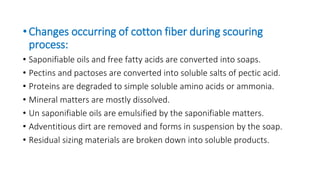
• Saponifiable oils and free fatty acids are converted into soaps.
• Pectins and pactoses are converted into soluble salts of pectic acid.
• Proteins are degraded to simple soluble amino acids or ammonia.
• Mineral matters are mostly dissolved.
• Un saponifiable oils are emulsified by the saponifiable matters.
• Adventitious dirt are removed and forms in suspension by the soap.
• Residual sizing materials are broken down into soluble products.
•Mechanism:
• Saponification:
The vegetable oil, which is immiscible with water, is glycerine of fatty
acids. When such oils are heated with a solution of sodium hydroxide
in water, the oil splits up into its constituents-fatty acid and glycerine.
Glycerine is miscible with water easily and the fatty acids reacts with
sodium hydroxide present in the solution forming its sodium salt
i.e.soap which is also soluble in water. Thus oil is removed.
• Emulsification:
Wax and non saponifiable oils are removed by emulsification as they
are immiscible in water. Normal washing soap is used as a emulsifying
agent which makes emulsion of them.
•Scouring process depends on:
• The type of cotton.
• The color of cotton.
• The cleanliness of cotton.
• The twist and count of the yarn.
• The construction of the fabric.
• The shade % and type of shade of finished product.
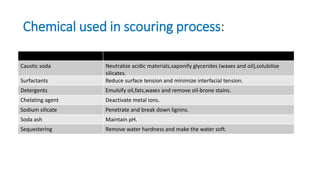
Chemical used in scouring process:
Main chemicals Use
Caustic soda Neutralize acidic materials,saponify glycerides (waxes and oil),solubilise
silicates.
Surfactants Reduce surface tension and minimize interfacial tension.
Detergents Emulsify oil,fats,waxes and remove oil-brone stains.
Chelating agent Deactivate metal ions.
Sodium silicate Penetrate and break down lignins.
Soda ash Maintain pH.
Sequestering Remove water hardness and make the water soft.
Scouring proces
Generally, there are two principle methods of scouring:
• Discontinuous method(Kier boiling process or winch dyeing machine)
• Continuous method(Scouring in J box)
Kier boiler process/ discontinuous process:
• In this process of cotton scouring, the fabric is scoured in rope form,
by alkali liquor.
Kier means specially constructed large cylindrical iron vessel. The kier
boiler may be-
a. horizontal(yarn scouring)
b. vertical(fabric scouring).
• Kier boiler capacity: maximum 5ton, but in industrially 2-3 ton kier
• Standard Recipe: The amount of different chemicals used in a kier
boiler may vary according to,
Hardness of water.
Quality / Quantity of cotton.
Fabric construction/ texture, yarn twist etc.
But in generally, the following amounts of the chemical are used.
Caustic Soda (Strong)→ 2-5 g/l
Soda ash (mild)→ 0.3-0.5%
Sequestering agent→0.05-0.5%
Wetting agent→ 0.25-1.0%
M:L→1:10
Temp→100˚C-120˚C
Time→ 6 hours (close vessel) and 8 hours (open vessel)
Main parts of kier boiler
• Cylindrical vessel
• Mixing tank(liquor prepared according to recipe)
• Multi tubular heat exchanger(heating the liquor)
• Perforated false bottom
• Circular tube(spray liquor on fabric)
Working procedure
• Procedure:
• The fabric is loaded in the m/c and kept in rope form.
• The hot liquor is pumped and sprayed by circular tube on to the fabric
• The liquor passes slowly over the packed cloth and collects at the false
bottom of the kier.
• The liquor again pumped into the heater by a centrifugal pump and
this cycle is repeated
• After scouring ,the fabric is washed with 80C water to remove
impurities on the fabric
J box/Continuous Scouring
• Scouring in the J Box:
In continuous process J-box is used for cotton scouring. It looks like English letter j
so it is called J-box. In J-box cotton is scoured open width and rope form.
• General recipe of scouring in J-box:
• Alkali : 4 to 6 g/l
• Wetting agent : 4 to 5 g/l
• Sequestering agent: 3 to 4 g/l
• Detergent: 1 to 2 g/l
• M:L →1:3
• Impregnation temperature : 70to 800c.
• Impregnation time : 40 to 90 second.
• Pick up : 90 to 100%
• Storing time in J box : 1 to 2 hours.
• Temperature in J box : 98to 102c.
Description and Working Principle
The scouring process in J-box can be divided into four units. They are
a) Impregnation box
b) Pre-heater.
c) J-box.
d) Washing unit.
a) Impregnation box:
Fabric is passed into impregnation box in open width form and
through the guide rollers and padded by caustic soda and wetting
agent. The temperature for impregnation should be maintained at 70
to 800c for about 40 to 90 seconds. Then the fabric is squeezed and
passed on to the next unit.
• b) Pre heater:
In this unit the material is passed to the thermostatic controlling
system at temperature of about 90 to 1000c for about 30 seconds.
Then the material is passed to the J-box.
c) J-box:
In j-box,fabric is stored in this solution of NaOH for about 30 minute at
a temperature of 100c. The capacity of normal J-box is about 12000 to
15000 pounds. The material from the J-box is passed to the washing
unit passing through squeeze roller.
d)Washing unit:
The water soluble impurities or products that were left on the
material are removed by washing. First of all the materials are washed
in hot water at the temperature above 800c, then it is cold washed
and finally dried.
Advantage:
1. The process is a continuous process. So consumes less time.
2. The process is economical.
3. Scouring,desizing and bleaching performed at a time.
Disadvantage:
1. The result of scouring is not good as compared with kier boiler.
2. The process is not hydrophilic as kier boiler.
3. Huge damage may occur due to power failure
Assessment of scouring/Absorbency test:
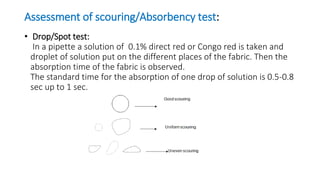
• Drop/Spot test:
In a pipette a solution of 0.1% direct red or Congo red is taken and
droplet of solution put on the different places of the fabric. Then the
absorption time of the fabric is observed.
The standard time for the absorption of one drop of solution is 0.5-0.8
sec up to 1 sec.
Thank
You
Any
Question??
?

Presentation on Textile Scouring

  • 1.
    Shyamoli Textile EngineeringCollege B.Sc In Textile Engineering Leve-2,Term-1(session:2016-2017)
  • 2.
    WELCOME • TO MYPRESENTATION
  • 3.
    PRESENTED BY Name: Amanuzzaman ROLL: TE-69/17 BSc in Textile Engineering LEVEL -2 ,TERM-1
  • 4.
  • 5.
    • The processto remove fats,oil,waxy substances and added other impurities by certain percentage of alkali treatment and which increases the absorbency power of the textile materials, is called scouring. • Objects of scouring: 1. To remove the oily,waxy and other additional impurities. 2. To increase the absorbency of the textile goods. 3. To clean the fabric by alkali,soap or detergent. 4. To make the fabric suitable for achieving good effect in dyeing and printing process. 5. To remove the natural color 6. To remove the non cellulosic substances in case of cotton. scouring
  • 6.
    •Changes occurring ofcotton fiber during scouring process: • Saponifiable oils and free fatty acids are converted into soaps. • Pectins and pactoses are converted into soluble salts of pectic acid. • Proteins are degraded to simple soluble amino acids or ammonia. • Mineral matters are mostly dissolved. • Un saponifiable oils are emulsified by the saponifiable matters. • Adventitious dirt are removed and forms in suspension by the soap. • Residual sizing materials are broken down into soluble products.
  • 7.
    •Mechanism: • Saponification: The vegetableoil, which is immiscible with water, is glycerine of fatty acids. When such oils are heated with a solution of sodium hydroxide in water, the oil splits up into its constituents-fatty acid and glycerine. Glycerine is miscible with water easily and the fatty acids reacts with sodium hydroxide present in the solution forming its sodium salt i.e.soap which is also soluble in water. Thus oil is removed. • Emulsification: Wax and non saponifiable oils are removed by emulsification as they are immiscible in water. Normal washing soap is used as a emulsifying agent which makes emulsion of them.
  • 8.
    •Scouring process dependson: • The type of cotton. • The color of cotton. • The cleanliness of cotton. • The twist and count of the yarn. • The construction of the fabric. • The shade % and type of shade of finished product.
  • 9.
    Chemical used inscouring process: Main chemicals Use Caustic soda Neutralize acidic materials,saponify glycerides (waxes and oil),solubilise silicates. Surfactants Reduce surface tension and minimize interfacial tension. Detergents Emulsify oil,fats,waxes and remove oil-brone stains. Chelating agent Deactivate metal ions. Sodium silicate Penetrate and break down lignins. Soda ash Maintain pH. Sequestering Remove water hardness and make the water soft.
  • 10.
    Scouring proces Generally, thereare two principle methods of scouring: • Discontinuous method(Kier boiling process or winch dyeing machine) • Continuous method(Scouring in J box)
  • 11.
    Kier boiler process/discontinuous process: • In this process of cotton scouring, the fabric is scoured in rope form, by alkali liquor. Kier means specially constructed large cylindrical iron vessel. The kier boiler may be- a. horizontal(yarn scouring) b. vertical(fabric scouring). • Kier boiler capacity: maximum 5ton, but in industrially 2-3 ton kier
  • 12.
    • Standard Recipe:The amount of different chemicals used in a kier boiler may vary according to, Hardness of water. Quality / Quantity of cotton. Fabric construction/ texture, yarn twist etc. But in generally, the following amounts of the chemical are used. Caustic Soda (Strong)→ 2-5 g/l Soda ash (mild)→ 0.3-0.5% Sequestering agent→0.05-0.5% Wetting agent→ 0.25-1.0% M:L→1:10 Temp→100˚C-120˚C Time→ 6 hours (close vessel) and 8 hours (open vessel)
  • 13.
    Main parts ofkier boiler • Cylindrical vessel • Mixing tank(liquor prepared according to recipe) • Multi tubular heat exchanger(heating the liquor) • Perforated false bottom • Circular tube(spray liquor on fabric)
  • 14.
  • 15.
    • Procedure: • Thefabric is loaded in the m/c and kept in rope form. • The hot liquor is pumped and sprayed by circular tube on to the fabric • The liquor passes slowly over the packed cloth and collects at the false bottom of the kier. • The liquor again pumped into the heater by a centrifugal pump and this cycle is repeated • After scouring ,the fabric is washed with 80C water to remove impurities on the fabric
  • 16.
    J box/Continuous Scouring •Scouring in the J Box: In continuous process J-box is used for cotton scouring. It looks like English letter j so it is called J-box. In J-box cotton is scoured open width and rope form. • General recipe of scouring in J-box: • Alkali : 4 to 6 g/l • Wetting agent : 4 to 5 g/l • Sequestering agent: 3 to 4 g/l • Detergent: 1 to 2 g/l • M:L →1:3 • Impregnation temperature : 70to 800c. • Impregnation time : 40 to 90 second. • Pick up : 90 to 100% • Storing time in J box : 1 to 2 hours. • Temperature in J box : 98to 102c.
  • 17.
    Description and WorkingPrinciple The scouring process in J-box can be divided into four units. They are a) Impregnation box b) Pre-heater. c) J-box. d) Washing unit. a) Impregnation box: Fabric is passed into impregnation box in open width form and through the guide rollers and padded by caustic soda and wetting agent. The temperature for impregnation should be maintained at 70 to 800c for about 40 to 90 seconds. Then the fabric is squeezed and passed on to the next unit.
  • 18.
    • b) Preheater: In this unit the material is passed to the thermostatic controlling system at temperature of about 90 to 1000c for about 30 seconds. Then the material is passed to the J-box. c) J-box: In j-box,fabric is stored in this solution of NaOH for about 30 minute at a temperature of 100c. The capacity of normal J-box is about 12000 to 15000 pounds. The material from the J-box is passed to the washing unit passing through squeeze roller. d)Washing unit: The water soluble impurities or products that were left on the material are removed by washing. First of all the materials are washed in hot water at the temperature above 800c, then it is cold washed and finally dried.
  • 19.
    Advantage: 1. The processis a continuous process. So consumes less time. 2. The process is economical. 3. Scouring,desizing and bleaching performed at a time. Disadvantage: 1. The result of scouring is not good as compared with kier boiler. 2. The process is not hydrophilic as kier boiler. 3. Huge damage may occur due to power failure
  • 20.
    Assessment of scouring/Absorbencytest: • Drop/Spot test: In a pipette a solution of 0.1% direct red or Congo red is taken and droplet of solution put on the different places of the fabric. Then the absorption time of the fabric is observed. The standard time for the absorption of one drop of solution is 0.5-0.8 sec up to 1 sec.
  • 21.
  • 22.