INTRODUCTION TO TEXTILE
MANUFACTURING
(TXT-175)
By: Nirmal Malik
Assignment# 4 – FABRIC PORTFOLIO
5 Points
• Woven Fabrics
• Types of Weave Construction and their thread counts.
• Face & Back of fabrics.
• Selvage.
• Indicate warp & Weft.
• Knitted Fabrics
• Types of knitted Fabrics
• Indicate Wales n Courses.
• Types of Knitting Needles(Pictures).
• Non Woven Fabrics
• Types of Non Woven fabrics and samples.
Journal # 3,4 & 5 (3 points)
Submission Date: 13-Nov-2014
• Innovative Video on Woven Fabric/ weaving
• Innovative Video on Knitted Fabric/ Knitting
• Innovative Video on Non-Woven Fabric
FABRIC COLORATION
There are two methods fabric coloration:
1. Dyeing
2. Printing
DYEING
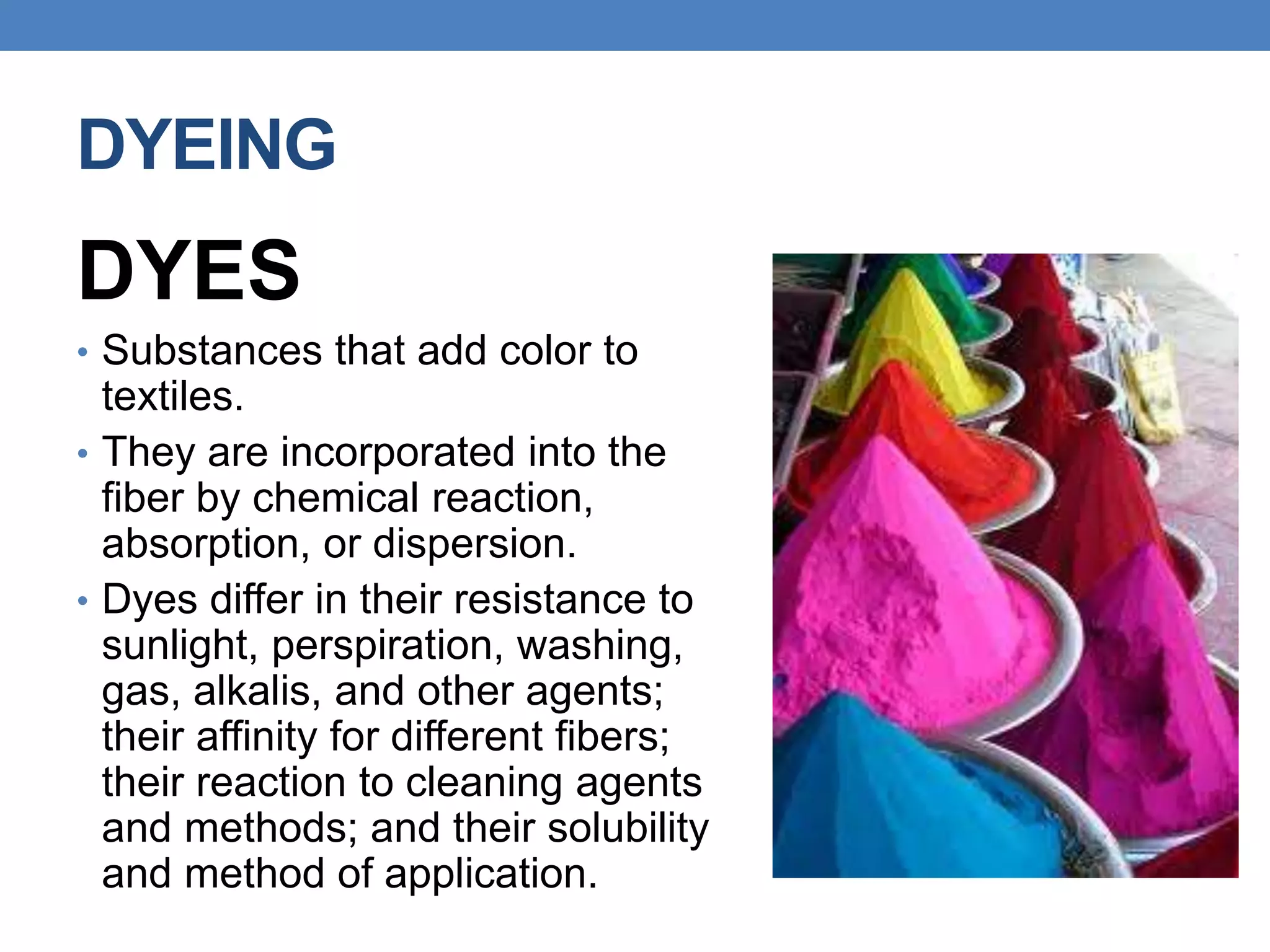
DYES
• Substances that add color to
textiles.
• They are incorporated into the
fiber by chemical reaction,
absorption, or dispersion.
• Dyes differ in their resistance to
sunlight, perspiration, washing,
gas, alkalis, and other agents;
their affinity for different fibers;
their reaction to cleaning agents
and methods; and their solubility
and method of application.
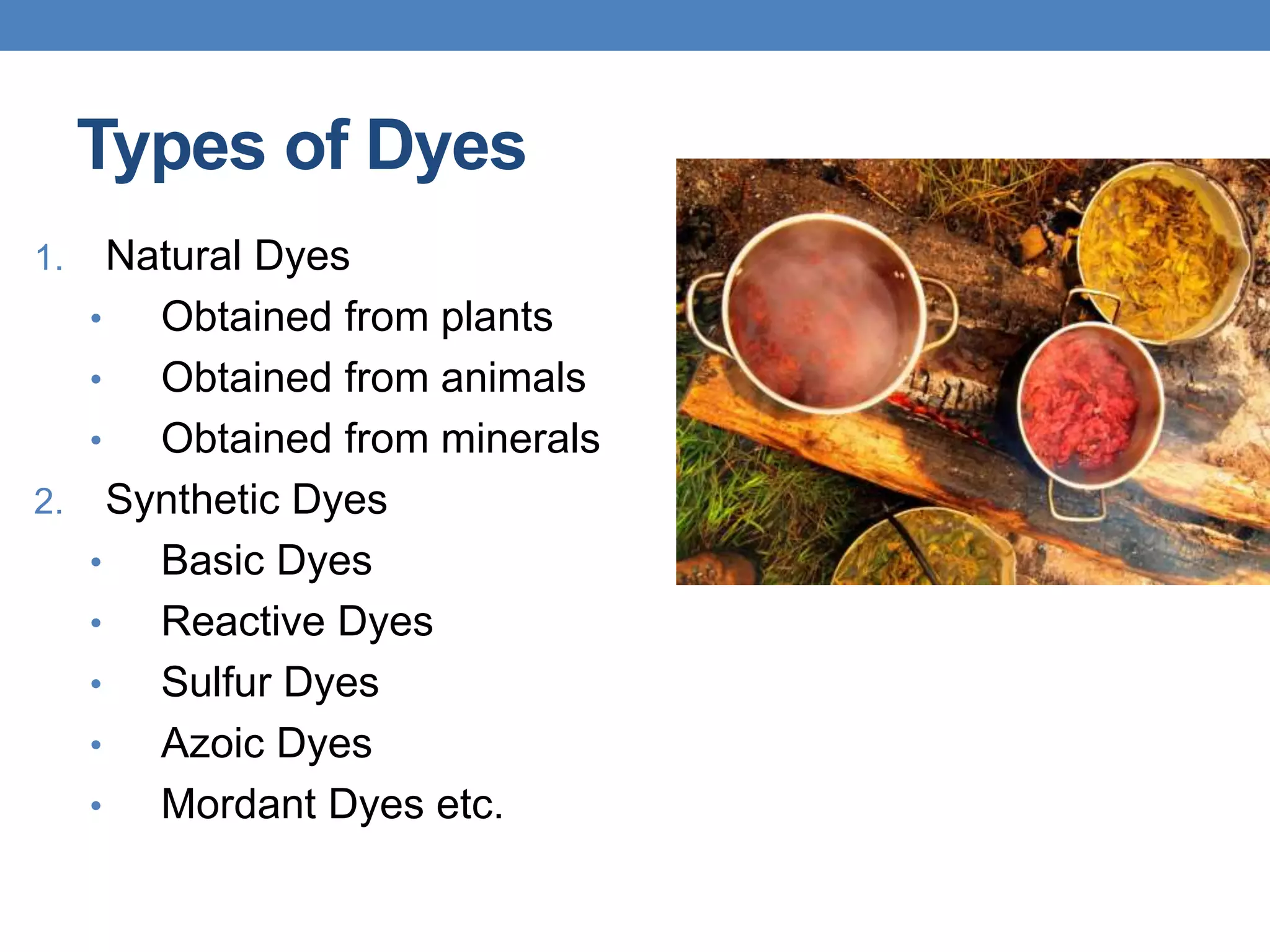
Types of Dyes
1. Natural Dyes
• Obtained from plants
• Obtained from animals
• Obtained from minerals
2. Synthetic Dyes
• Basic Dyes
• Reactive Dyes
• Sulfur Dyes
• Azoic Dyes
• Mordant Dyes etc.
DYEING
• Dyeing is the process of imparting colors to a textile material
through a dye (color).
• Color is applied to fabric by different methods of dyeing for
different types of fiber and at different stages of the textile
production process.
• These methods include
1. Direct dyeing
2. Stock dyeing
3. Top dyeing
4. Yarn dyeing
5. Piece dyeing
6. Solution pigmenting or dope dyeing
7. Garment dyeing etc.
Of these Direct dyeing and Yarn Dyeing methods are the most popular
ones.
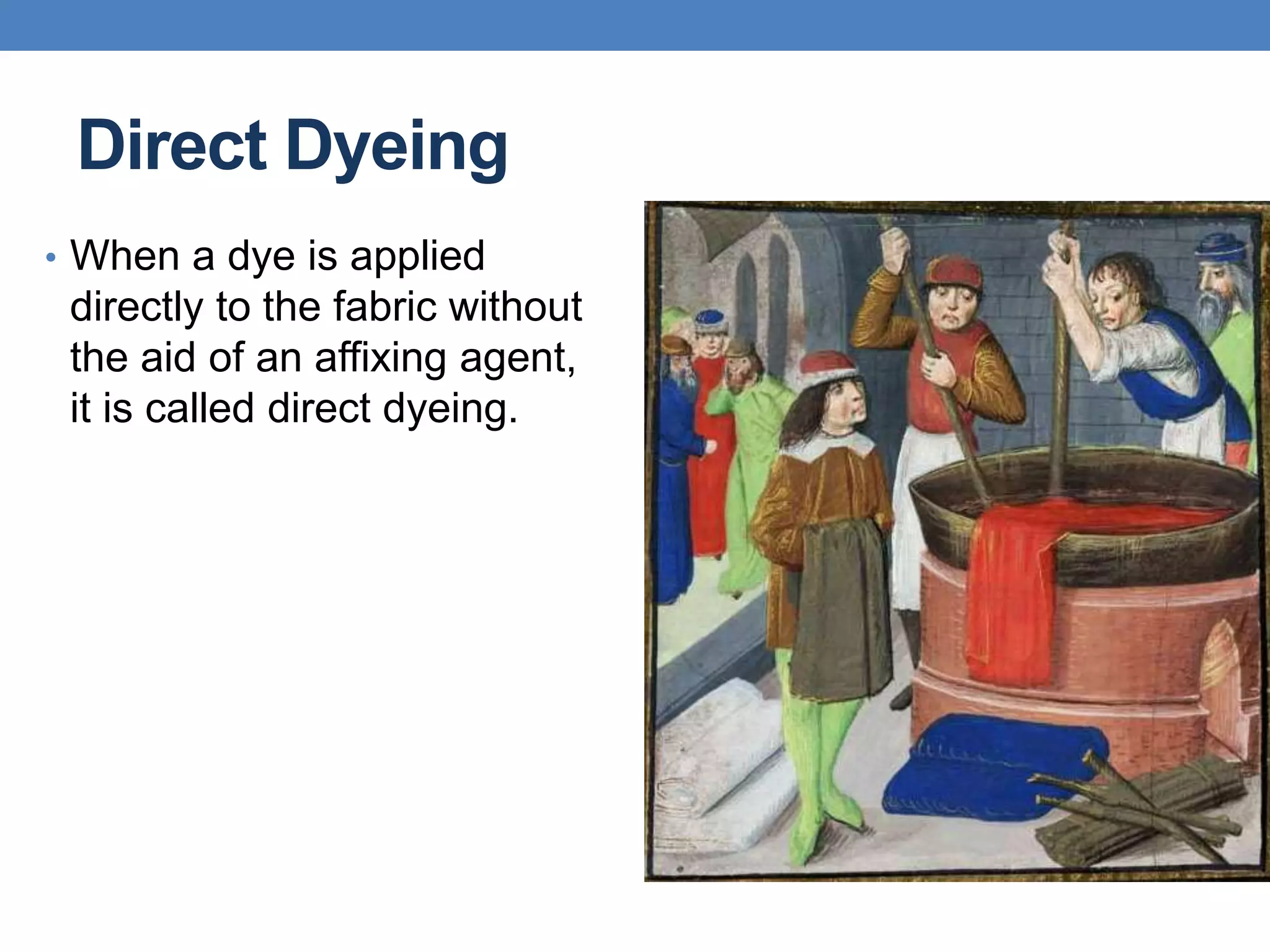
Direct Dyeing
• When a dye is applied
directly to the fabric without
the aid of an affixing agent,
it is called direct dyeing.
Stock Dyeing
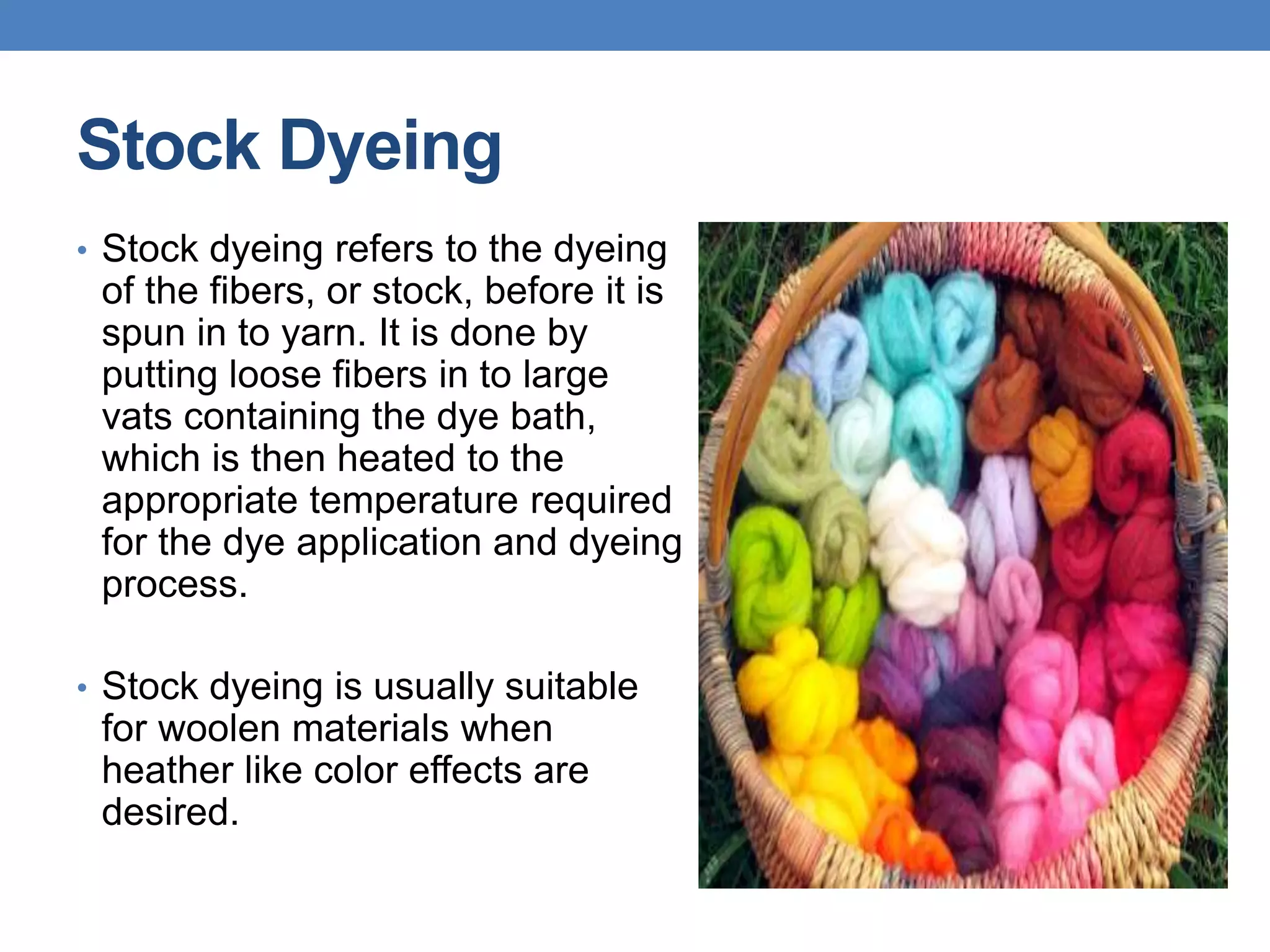
• Stock dyeing refers to the dyeing
of the fibers, or stock, before it is
spun in to yarn. It is done by
putting loose fibers in to large
vats containing the dye bath,
which is then heated to the
appropriate temperature required
for the dye application and dyeing
process.
• Stock dyeing is usually suitable
for woolen materials when
heather like color effects are
desired.
Top Dyeing
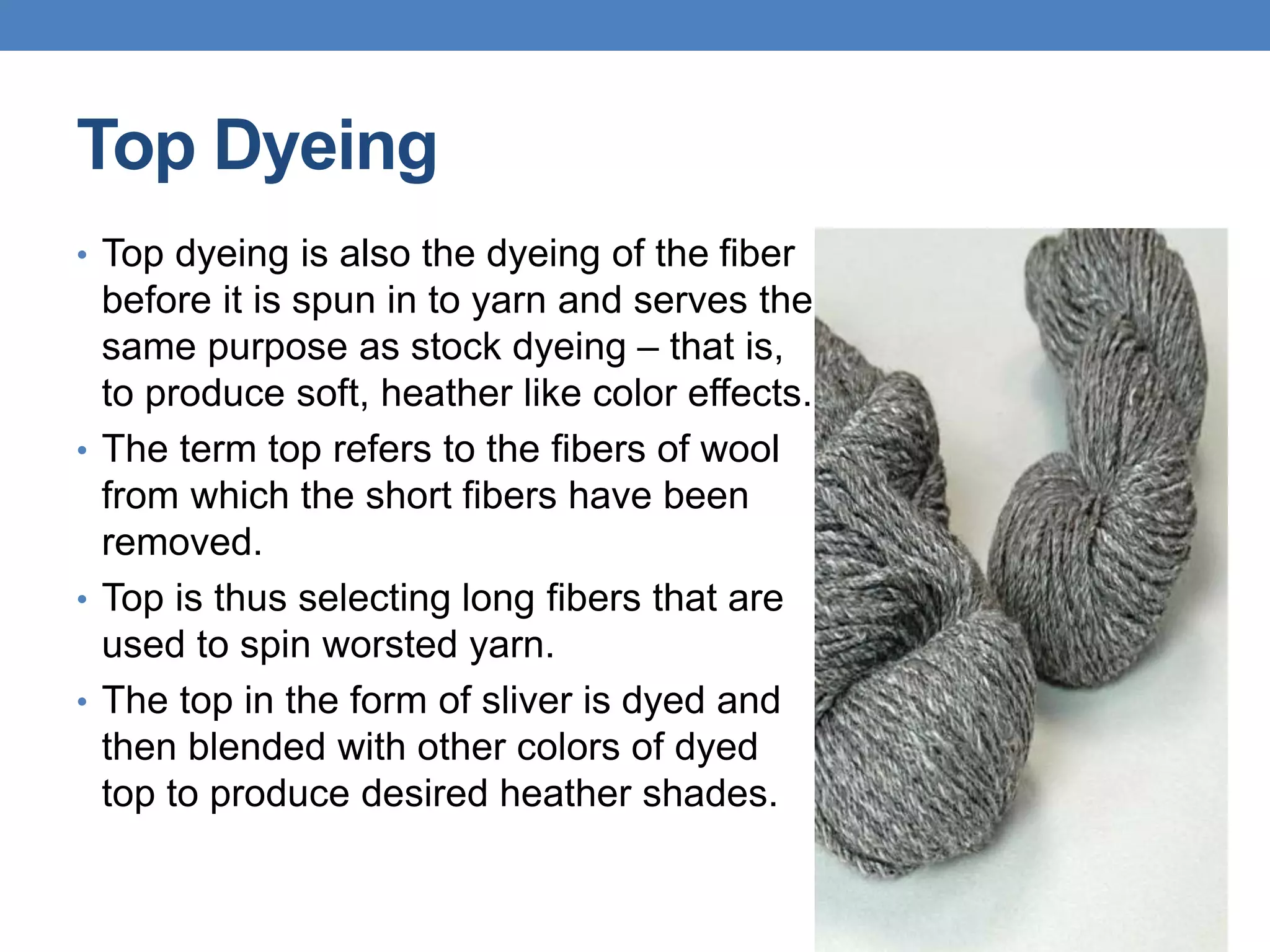
• Top dyeing is also the dyeing of the fiber
before it is spun in to yarn and serves the
same purpose as stock dyeing – that is,
to produce soft, heather like color effects.
• The term top refers to the fibers of wool
from which the short fibers have been
removed.
• Top is thus selecting long fibers that are
used to spin worsted yarn.
• The top in the form of sliver is dyed and
then blended with other colors of dyed
top to produce desired heather shades.
Solution Pigmenting Or Dope Dyeing
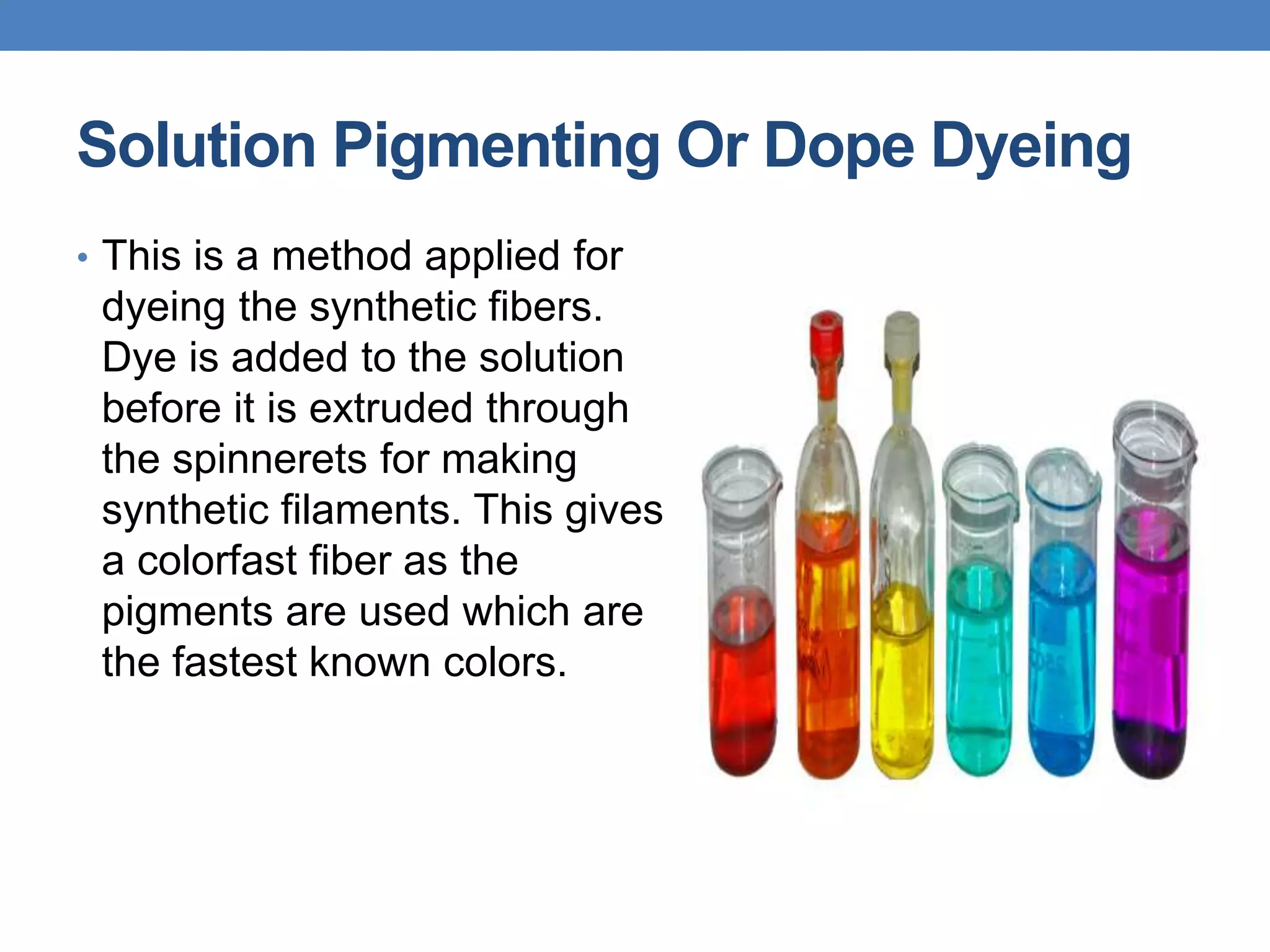
• This is a method applied for
dyeing the synthetic fibers.
Dye is added to the solution
before it is extruded through
the spinnerets for making
synthetic filaments. This gives
a colorfast fiber as the
pigments are used which are
the fastest known colors.
Yarn Dyeing
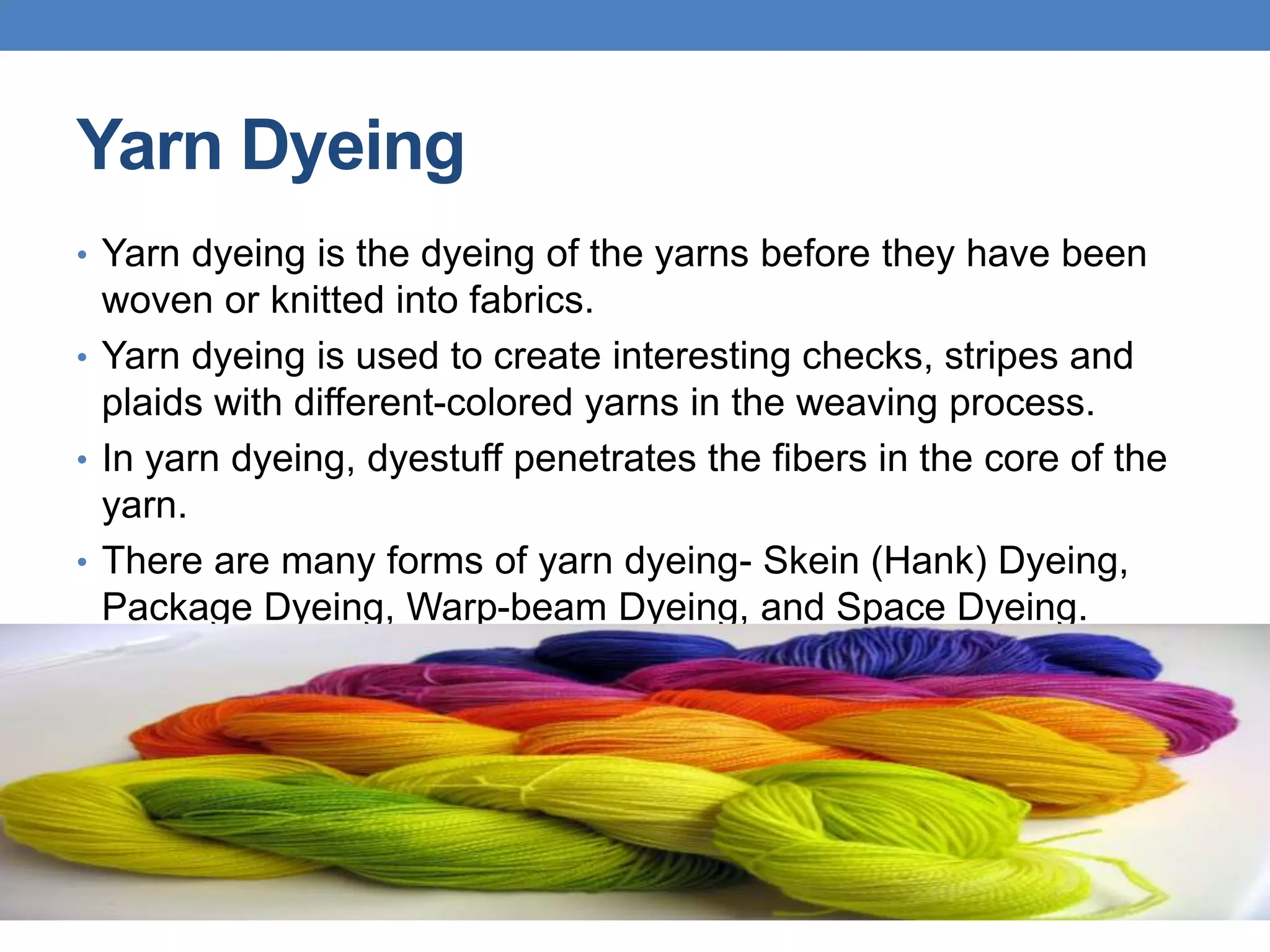
• Yarn dyeing is the dyeing of the yarns before they have been
woven or knitted into fabrics.
• Yarn dyeing is used to create interesting checks, stripes and
plaids with different-colored yarns in the weaving process.
• In yarn dyeing, dyestuff penetrates the fibers in the core of the
yarn.
• There are many forms of yarn dyeing- Skein (Hank) Dyeing,
Package Dyeing, Warp-beam Dyeing, and Space Dyeing.
A. Skein (Hank) Dyeing
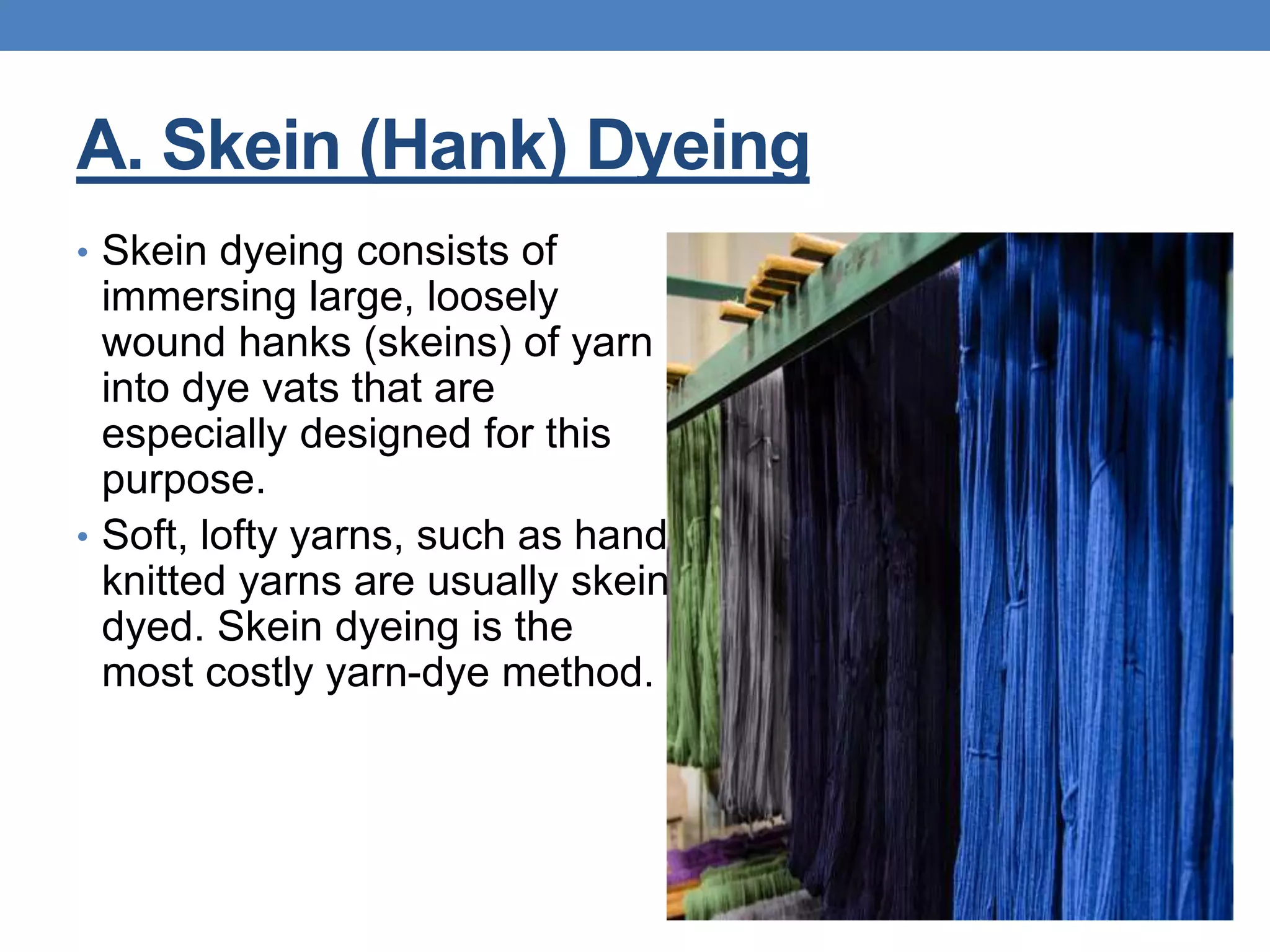
• Skein dyeing consists of
immersing large, loosely
wound hanks (skeins) of yarn
into dye vats that are
especially designed for this
purpose.
• Soft, lofty yarns, such as hand
knitted yarns are usually skein
dyed. Skein dyeing is the
most costly yarn-dye method.
B. Package Dyeing
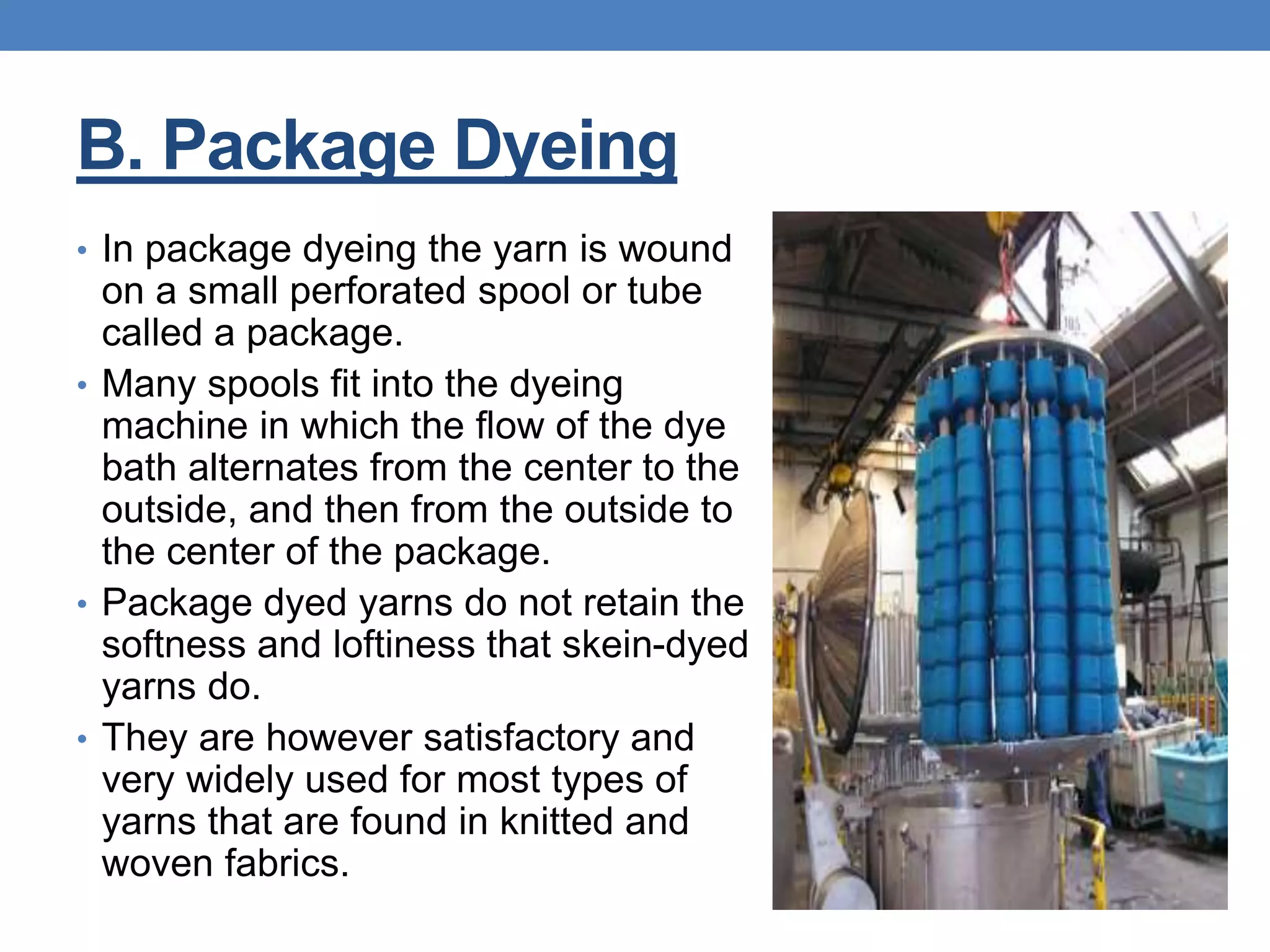
• In package dyeing the yarn is wound
on a small perforated spool or tube
called a package.
• Many spools fit into the dyeing
machine in which the flow of the dye
bath alternates from the center to the
outside, and then from the outside to
the center of the package.
• Package dyed yarns do not retain the
softness and loftiness that skein-dyed
yarns do.
• They are however satisfactory and
very widely used for most types of
yarns that are found in knitted and
woven fabrics.
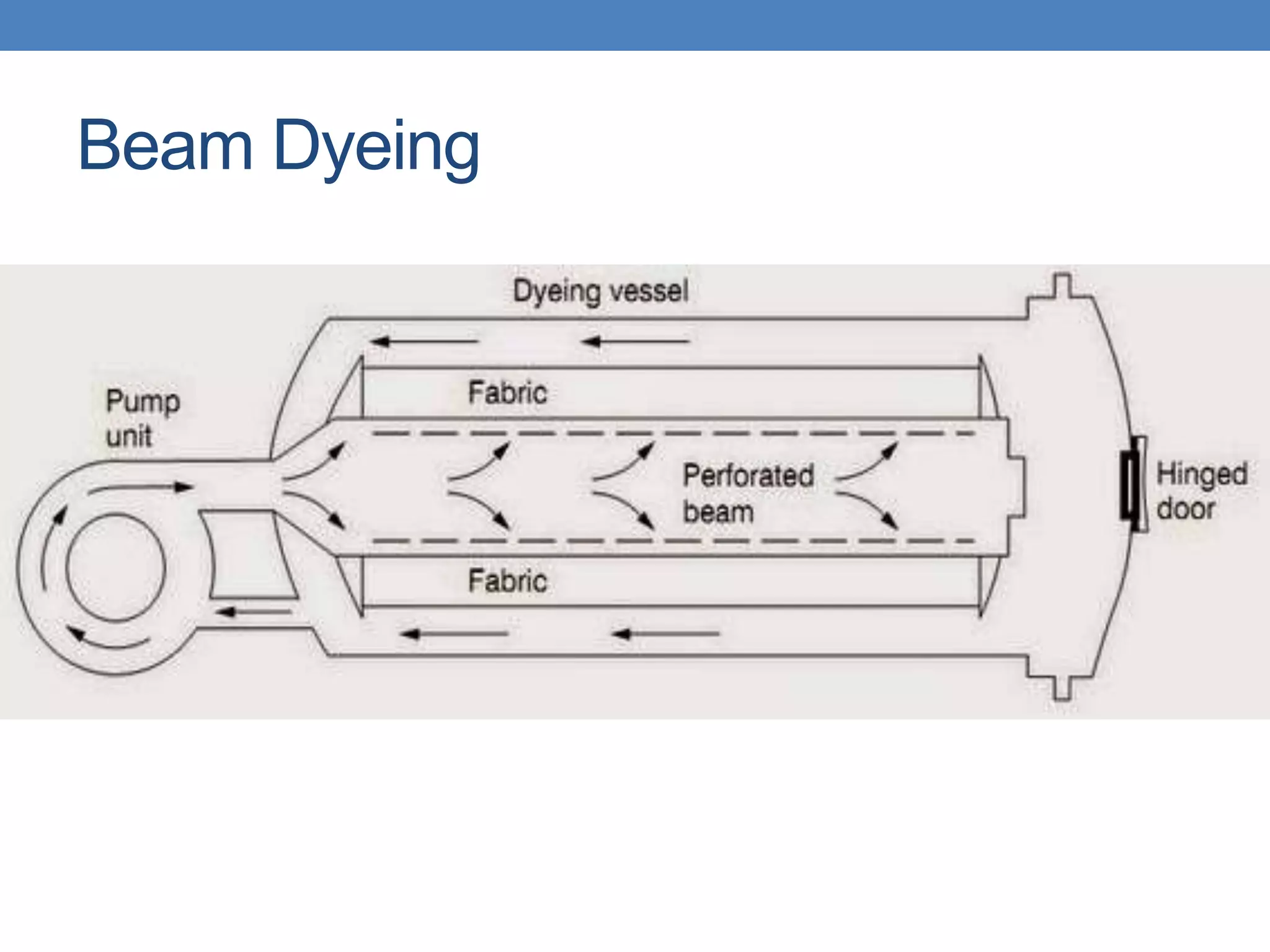
C. Warp Beam Dyeing
• Beam dyeing is the much larger
version of package dyeing.
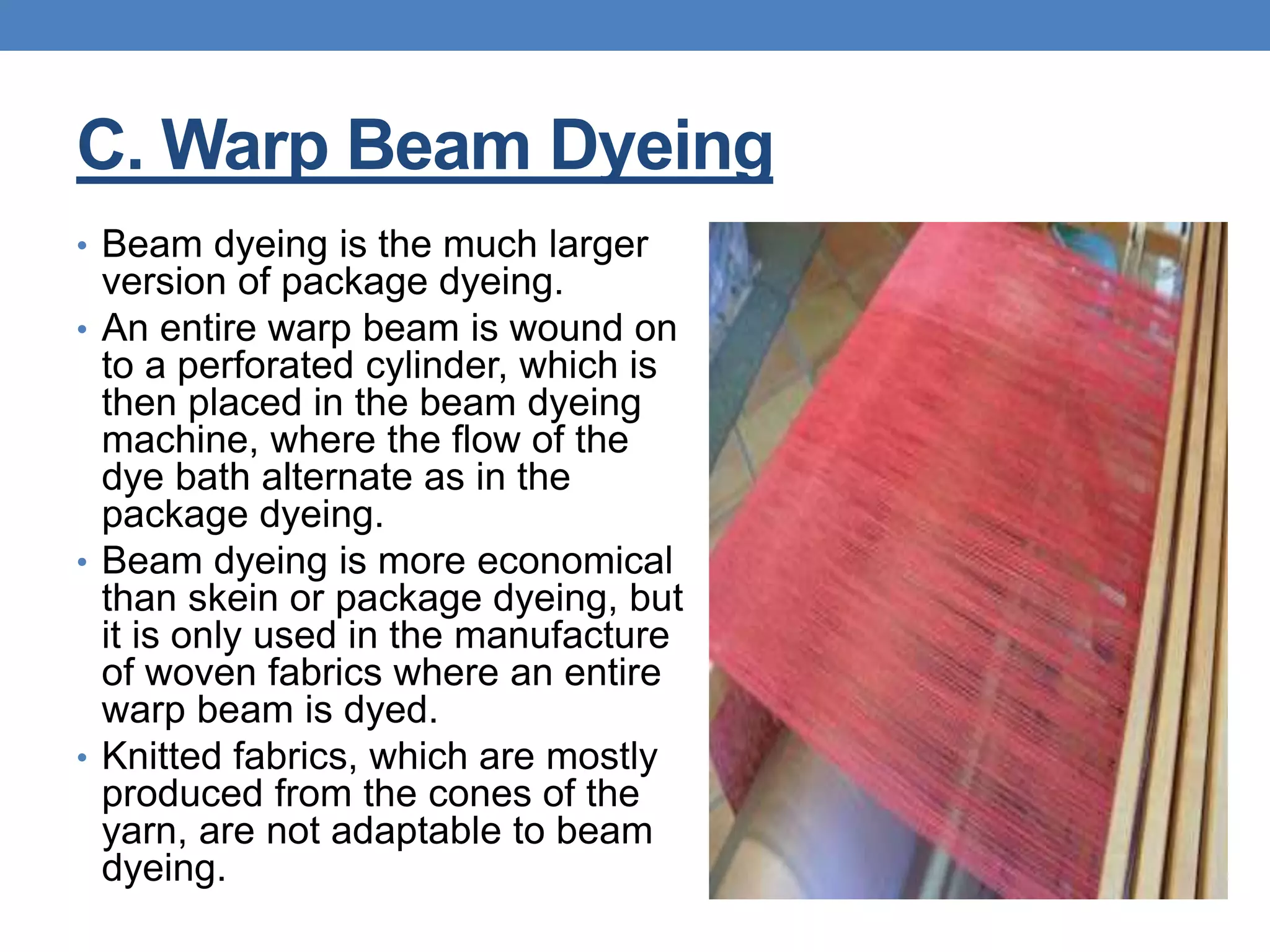
• An entire warp beam is wound on
to a perforated cylinder, which is
then placed in the beam dyeing
machine, where the flow of the
dye bath alternate as in the
package dyeing.
• Beam dyeing is more economical
than skein or package dyeing, but
it is only used in the manufacture
of woven fabrics where an entire
warp beam is dyed.
• Knitted fabrics, which are mostly
produced from the cones of the
yarn, are not adaptable to beam
dyeing.
D. Space Dyeing
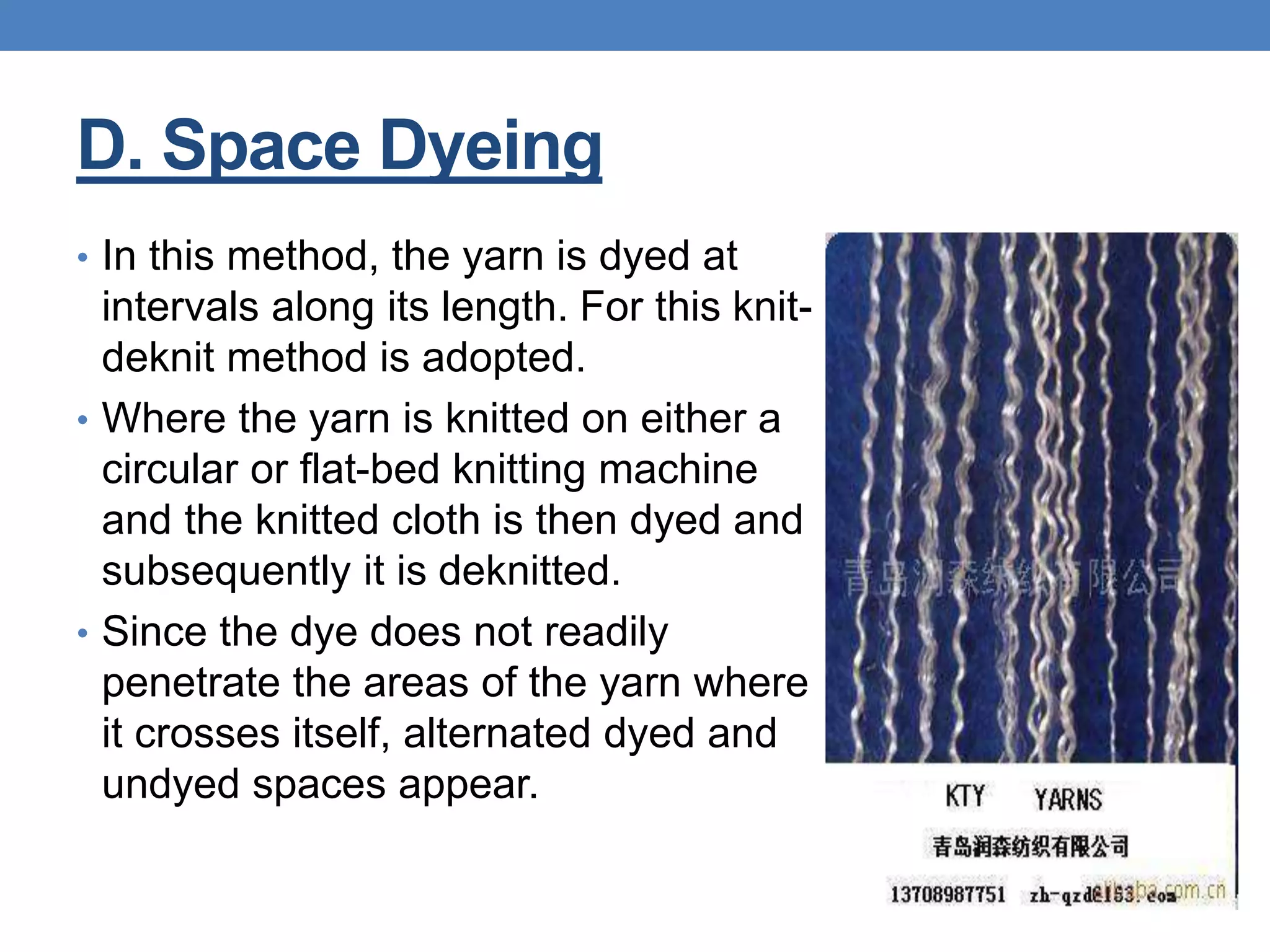
• In this method, the yarn is dyed at
intervals along its length. For this knit-
deknit method is adopted.
• Where the yarn is knitted on either a
circular or flat-bed knitting machine
and the knitted cloth is then dyed and
subsequently it is deknitted.
• Since the dye does not readily
penetrate the areas of the yarn where
it crosses itself, alternated dyed and
undyed spaces appear.
Piece Dyeing
• The constructed fabrics are piece dyed for the flexibility they provide.
The textile manufacturer can dye the whole fabric in batches
according to the fashion demands of the time thus avoiding wastage
and resultantly loss. There are several methods prevalent or piece
dyeing.
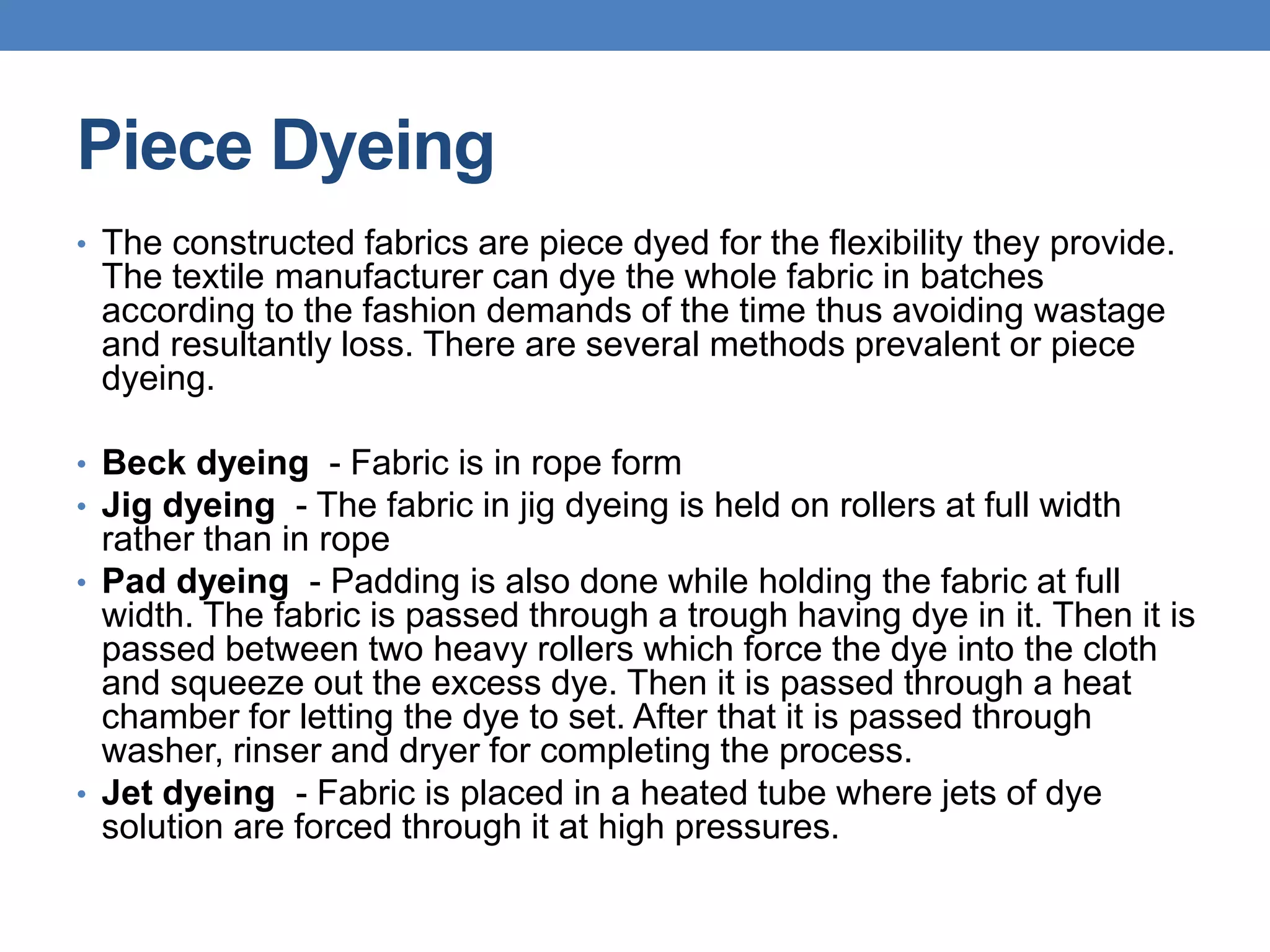
• Beck dyeing - Fabric is in rope form
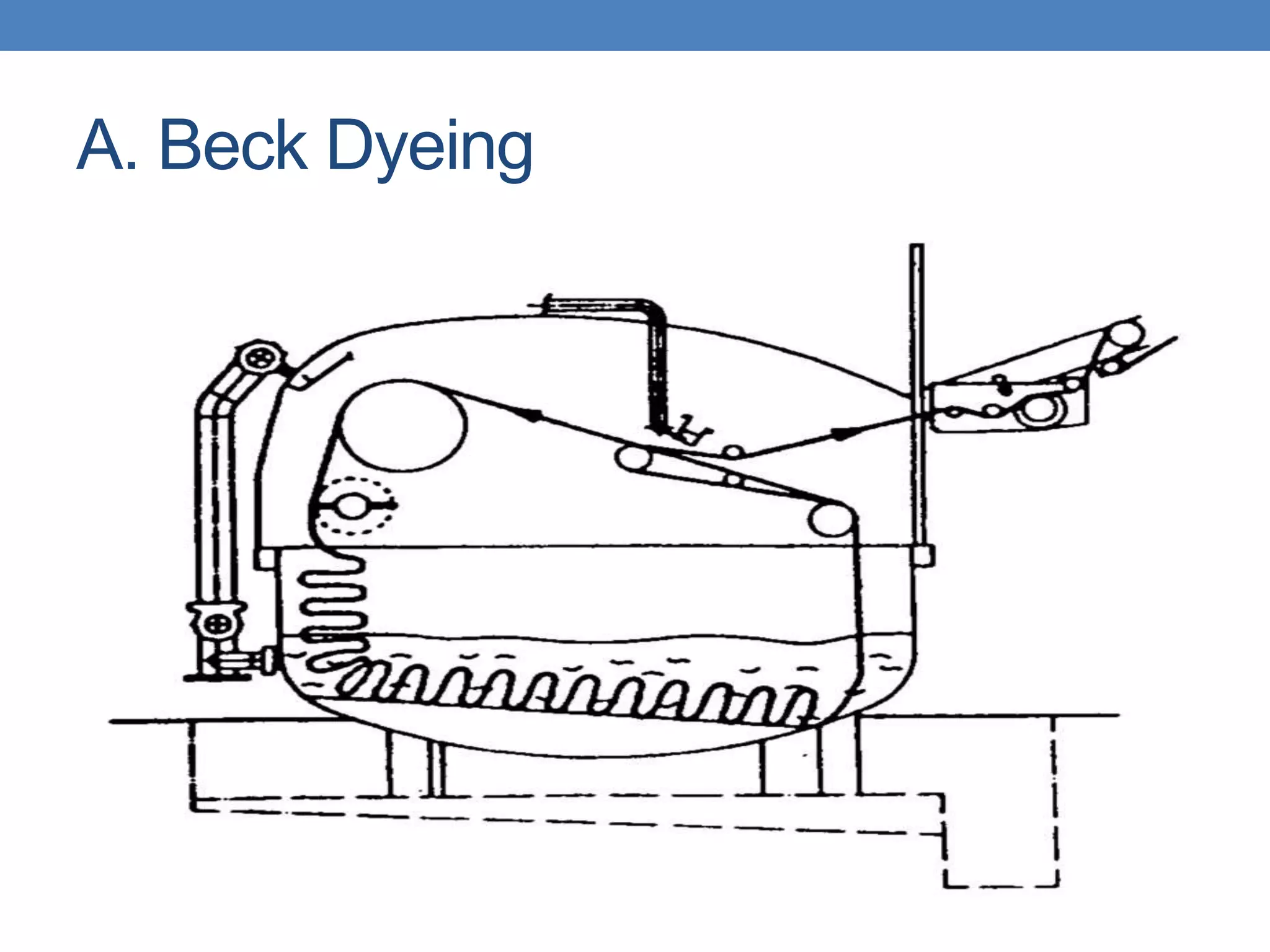
• Jig dyeing - The fabric in jig dyeing is held on rollers at full width
rather than in rope
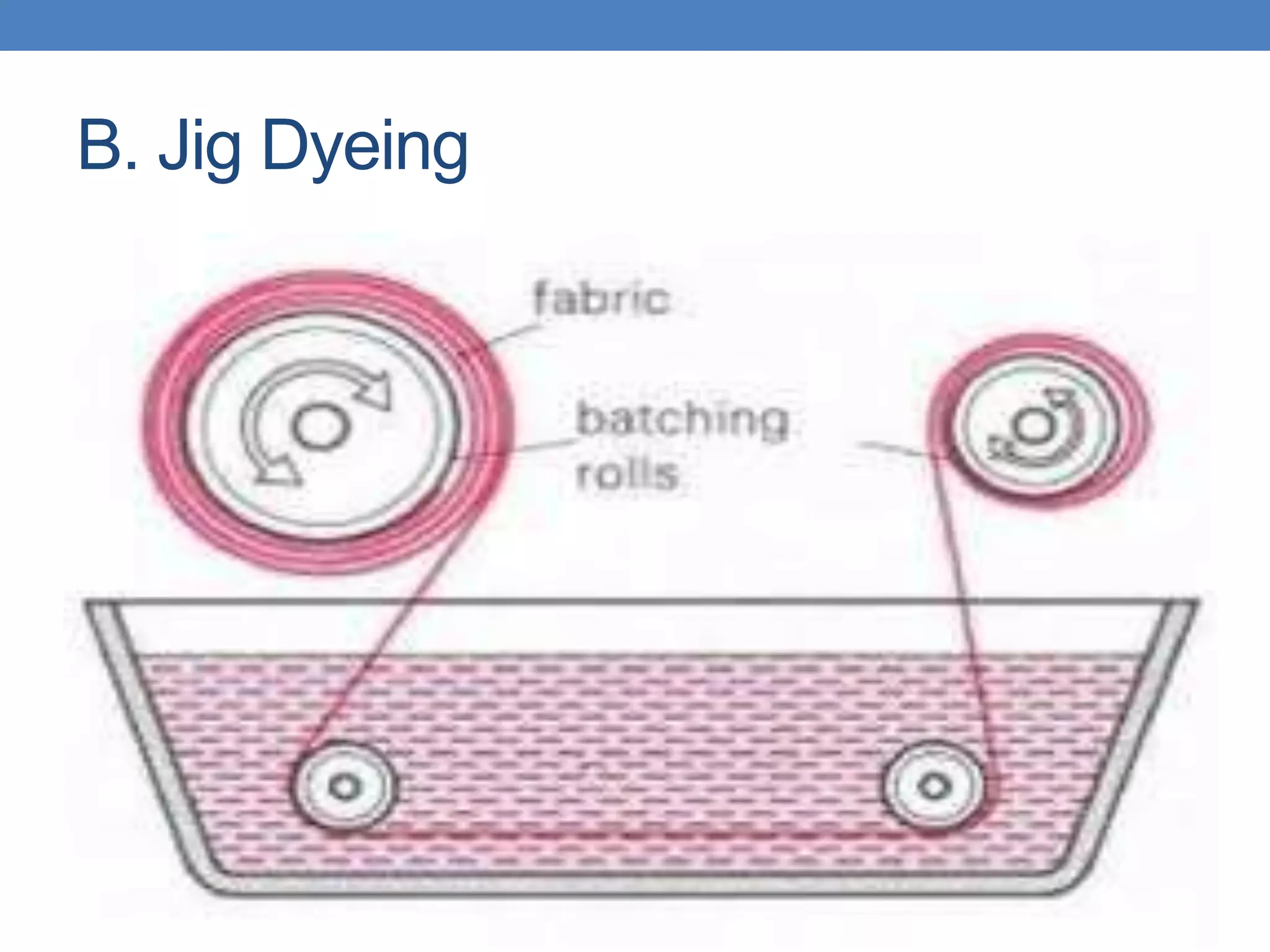
• Pad dyeing - Padding is also done while holding the fabric at full
width. The fabric is passed through a trough having dye in it. Then it is
passed between two heavy rollers which force the dye into the cloth
and squeeze out the excess dye. Then it is passed through a heat
chamber for letting the dye to set. After that it is passed through
washer, rinser and dryer for completing the process.
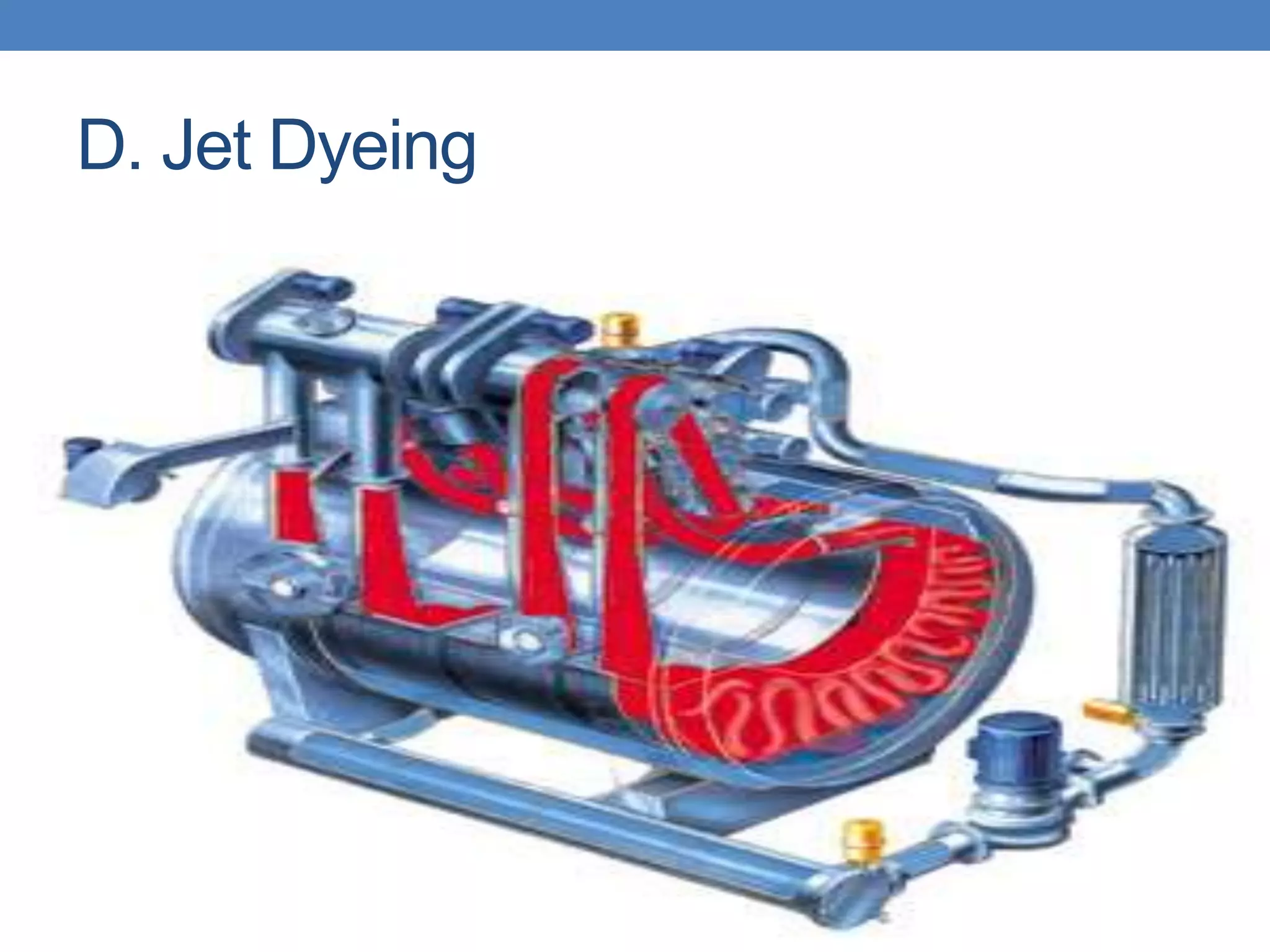
• Jet dyeing - Fabric is placed in a heated tube where jets of dye
solution are forced through it at high pressures.
A. Beck Dyeing
B. Jig Dyeing
C. Pad Dyeing
D. Jet Dyeing
Beam Dyeing
Garment dyeing
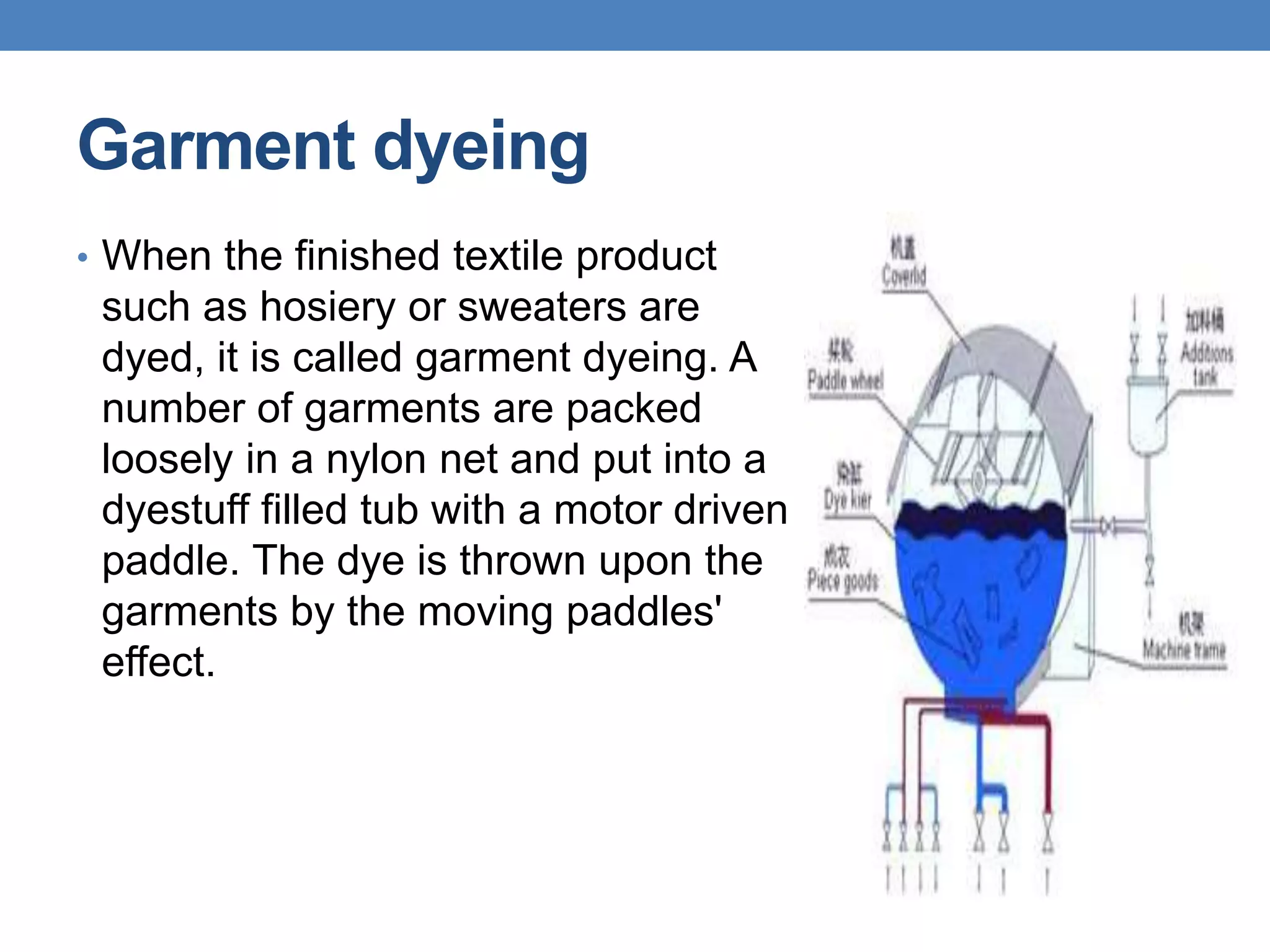
• When the finished textile product
such as hosiery or sweaters are
dyed, it is called garment dyeing. A
number of garments are packed
loosely in a nylon net and put into a
dyestuff filled tub with a motor driven
paddle. The dye is thrown upon the
garments by the moving paddles'
effect.

Dyeing lecture

  • 1.
  • 2.
    Assignment# 4 –FABRIC PORTFOLIO 5 Points • Woven Fabrics • Types of Weave Construction and their thread counts. • Face & Back of fabrics. • Selvage. • Indicate warp & Weft. • Knitted Fabrics • Types of knitted Fabrics • Indicate Wales n Courses. • Types of Knitting Needles(Pictures). • Non Woven Fabrics • Types of Non Woven fabrics and samples.
  • 3.
    Journal # 3,4& 5 (3 points) Submission Date: 13-Nov-2014 • Innovative Video on Woven Fabric/ weaving • Innovative Video on Knitted Fabric/ Knitting • Innovative Video on Non-Woven Fabric
  • 4.
    FABRIC COLORATION There aretwo methods fabric coloration: 1. Dyeing 2. Printing
  • 5.
    DYEING DYES • Substances thatadd color to textiles. • They are incorporated into the fiber by chemical reaction, absorption, or dispersion. • Dyes differ in their resistance to sunlight, perspiration, washing, gas, alkalis, and other agents; their affinity for different fibers; their reaction to cleaning agents and methods; and their solubility and method of application.
  • 6.
    Types of Dyes 1.Natural Dyes • Obtained from plants • Obtained from animals • Obtained from minerals 2. Synthetic Dyes • Basic Dyes • Reactive Dyes • Sulfur Dyes • Azoic Dyes • Mordant Dyes etc.
  • 7.
    DYEING • Dyeing isthe process of imparting colors to a textile material through a dye (color). • Color is applied to fabric by different methods of dyeing for different types of fiber and at different stages of the textile production process. • These methods include 1. Direct dyeing 2. Stock dyeing 3. Top dyeing 4. Yarn dyeing 5. Piece dyeing 6. Solution pigmenting or dope dyeing 7. Garment dyeing etc. Of these Direct dyeing and Yarn Dyeing methods are the most popular ones.
  • 8.
    Direct Dyeing • Whena dye is applied directly to the fabric without the aid of an affixing agent, it is called direct dyeing.
  • 9.
    Stock Dyeing • Stockdyeing refers to the dyeing of the fibers, or stock, before it is spun in to yarn. It is done by putting loose fibers in to large vats containing the dye bath, which is then heated to the appropriate temperature required for the dye application and dyeing process. • Stock dyeing is usually suitable for woolen materials when heather like color effects are desired.
  • 10.
    Top Dyeing • Topdyeing is also the dyeing of the fiber before it is spun in to yarn and serves the same purpose as stock dyeing – that is, to produce soft, heather like color effects. • The term top refers to the fibers of wool from which the short fibers have been removed. • Top is thus selecting long fibers that are used to spin worsted yarn. • The top in the form of sliver is dyed and then blended with other colors of dyed top to produce desired heather shades.
  • 11.
    Solution Pigmenting OrDope Dyeing • This is a method applied for dyeing the synthetic fibers. Dye is added to the solution before it is extruded through the spinnerets for making synthetic filaments. This gives a colorfast fiber as the pigments are used which are the fastest known colors.
  • 12.
    Yarn Dyeing • Yarndyeing is the dyeing of the yarns before they have been woven or knitted into fabrics. • Yarn dyeing is used to create interesting checks, stripes and plaids with different-colored yarns in the weaving process. • In yarn dyeing, dyestuff penetrates the fibers in the core of the yarn. • There are many forms of yarn dyeing- Skein (Hank) Dyeing, Package Dyeing, Warp-beam Dyeing, and Space Dyeing.
  • 13.
    A. Skein (Hank)Dyeing • Skein dyeing consists of immersing large, loosely wound hanks (skeins) of yarn into dye vats that are especially designed for this purpose. • Soft, lofty yarns, such as hand knitted yarns are usually skein dyed. Skein dyeing is the most costly yarn-dye method.
  • 14.
    B. Package Dyeing •In package dyeing the yarn is wound on a small perforated spool or tube called a package. • Many spools fit into the dyeing machine in which the flow of the dye bath alternates from the center to the outside, and then from the outside to the center of the package. • Package dyed yarns do not retain the softness and loftiness that skein-dyed yarns do. • They are however satisfactory and very widely used for most types of yarns that are found in knitted and woven fabrics.
  • 15.
    C. Warp BeamDyeing • Beam dyeing is the much larger version of package dyeing. • An entire warp beam is wound on to a perforated cylinder, which is then placed in the beam dyeing machine, where the flow of the dye bath alternate as in the package dyeing. • Beam dyeing is more economical than skein or package dyeing, but it is only used in the manufacture of woven fabrics where an entire warp beam is dyed. • Knitted fabrics, which are mostly produced from the cones of the yarn, are not adaptable to beam dyeing.
  • 16.
    D. Space Dyeing •In this method, the yarn is dyed at intervals along its length. For this knit- deknit method is adopted. • Where the yarn is knitted on either a circular or flat-bed knitting machine and the knitted cloth is then dyed and subsequently it is deknitted. • Since the dye does not readily penetrate the areas of the yarn where it crosses itself, alternated dyed and undyed spaces appear.
  • 17.
    Piece Dyeing • Theconstructed fabrics are piece dyed for the flexibility they provide. The textile manufacturer can dye the whole fabric in batches according to the fashion demands of the time thus avoiding wastage and resultantly loss. There are several methods prevalent or piece dyeing. • Beck dyeing - Fabric is in rope form • Jig dyeing - The fabric in jig dyeing is held on rollers at full width rather than in rope • Pad dyeing - Padding is also done while holding the fabric at full width. The fabric is passed through a trough having dye in it. Then it is passed between two heavy rollers which force the dye into the cloth and squeeze out the excess dye. Then it is passed through a heat chamber for letting the dye to set. After that it is passed through washer, rinser and dryer for completing the process. • Jet dyeing - Fabric is placed in a heated tube where jets of dye solution are forced through it at high pressures.
  • 18.
  • 19.
  • 20.
  • 21.
  • 22.
  • 23.
    Garment dyeing • Whenthe finished textile product such as hosiery or sweaters are dyed, it is called garment dyeing. A number of garments are packed loosely in a nylon net and put into a dyestuff filled tub with a motor driven paddle. The dye is thrown upon the garments by the moving paddles' effect.