1
Engr. Abu Sayed, M.Sc in Textile Engineer, Email id- testleader9@gmail.com
DEDICATED TO
MY DEAR SIR MR. SAJESH PERINGETH
Abu Sayed Sajesh sir
ACKNOWLEDGEMENT
At first, I gratefulness goes to Almighty God to give us strength and ability to
understand good or bad. You have made our life more beautiful. May you name be
exalted, honored and glorified.
I am Abu Sayed, not big man but simple man. My home district is Tangail. I am proudful
that my father is a farmer. I have completed the M.Sc in Textile Engineering from
Daffodil Internatioanal University. I am working as laboratory Manager in a reputed
group at Narayanganj.
I want to give my heartiest gratitude to my dear sir Mr. Sajesh (Quality Assurance Manager).
Thanks goes to all Engineers, officers, technicians, employees, staff and all section in- charges
for their cordial behavior help.
SUMMARY
This Manual has arranged on the basis of Textile Dyeing lab procedure, calculations & ETP etc.
Here presenting some Lab & Dyeing calculations in my Practical life. I am not Writer & If I any
mistake, Excuse me. You mind it man is wrong.
2
Engr. Abu Sayed, M.Sc in Textile Engineer, Email id- testleader9@gmail.com
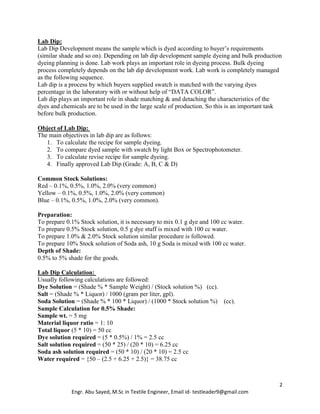
Lab Dip:
Lab Dip Development means the sample which is dyed according to buyer’s requirements
(similar shade and so on). Depending on lab dip development sample dyeing and bulk production
dyeing planning is done. Lab work plays an important role in dyeing process. Bulk dyeing
process completely depends on the lab dip development work. Lab work is completely managed
as the following sequence.
Lab dip is a process by which buyers supplied swatch is matched with the varying dyes
percentage in the laboratory with or without help of “DATA COLOR”.
Lab dip plays an important role in shade matching & and detaching the characteristics of the
dyes and chemicals are to be used in the large scale of production. So this is an important task
before bulk production.
Object of Lab Dip:
The main objectives in lab dip are as follows:
1. To calculate the recipe for sample dyeing.
2. To compare dyed sample with swatch by light Box or Spectrophotometer.
3. To calculate revise recipe for sample dyeing.
4. Finally approved Lab Dip (Grade: A, B, C & D)
Common Stock Solutions:
Red – 0.1%, 0.5%, 1.0%, 2.0% (very common)
Yellow – 0.1%, 0.5%, 1.0%, 2.0% (very common)
Blue – 0.1%, 0.5%, 1.0%, 2.0% (very common).
Preparation:
To prepare 0.1% Stock solution, it is necessary to mix 0.1 g dye and 100 cc water.
To prepare 0.5% Stock solution, 0.5 g dye stuff is mixed with 100 cc water.
To prepare 1.0% & 2.0% Stock solution similar procedure is followed.
To prepare 10% Stock solution of Soda ash, 10 g Soda is mixed with 100 cc water.
Depth of Shade:
0.5% to 5% shade for the goods.
Lab Dip Calculation:
Usually following calculations are followed:
Dye Solution = (Shade % * Sample Weight) / (Stock solution %) (cc).
Salt = (Shade % * Liquor) / 1000 (gram per liter, gpl).
Soda Solution = (Shade % * 100 * Liquor) / (1000 * Stock solution %) (cc).
Sample Calculation for 0.5% Shade:
Sample wt. = 5 mg
Material liquor ratio = 1: 10
Total liquor (5 * 10) = 50 cc
Dye solution required = (5 * 0.5%) / 1% = 2.5 cc
Salt solution required = (50 * 25) / (20 * 10) = 6.25 cc
Soda ash solution required = (50 * 10) / (20 * 10) = 2.5 cc
Water required = {50 – (2.5 + 6.25 + 2.5)} = 38.75 cc
3
Engr. Abu Sayed, M.Sc in Textile Engineer, Email id- testleader9@gmail.com
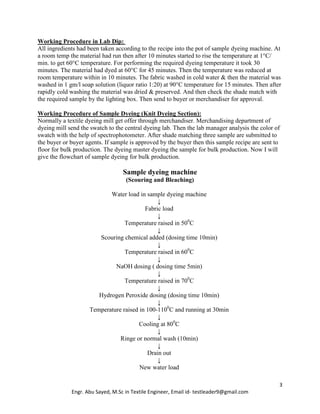
Working Procedure in Lab Dip:
All ingredients had been taken according to the recipe into the pot of sample dyeing machine. At
a room temp the material had run then after 10 minutes started to rise the temperature at 1°C/
min. to get 60°C temperature. For performing the required dyeing temperature it took 30
minutes. The material had dyed at 60°C for 45 minutes. Then the temperature was reduced at
room temperature within in 10 minutes. The fabric washed in cold water & then the material was
washed in 1 gm/l soap solution (liquor ratio 1:20) at 90°C temperature for 15 minutes. Then after
rapidly cold washing the material was dried & preserved. And then check the shade match with
the required sample by the lighting box. Then send to buyer or merchandiser for approval.
Working Procedure of Sample Dyeing (Knit Dyeing Section):
Normally a textile dyeing mill get offer through merchandiser. Merchandising department of
dyeing mill send the swatch to the central dyeing lab. Then the lab manager analysis the color of
swatch with the help of spectrophotometer. After shade matching three sample are submitted to
the buyer or buyer agents. If sample is approved by the buyer then this sample recipe are sent to
floor for bulk production. The dyeing master dyeing the sample for bulk production. Now I will
give the flowchart of sample dyeing for bulk production.
Sample dyeing machine
(Scouring and Bleaching)
Water load in sample dyeing machine
↓
Fabric load
↓
Temperature raised in 500
C
↓
Scouring chemical added (dosing time 10min)
↓
Temperature raised in 600
C
↓
NaOH dosing ( dosing time 5min)
↓
Temperature raised in 700
C
↓
Hydrogen Peroxide dosing (dosing time 10min)
↓
Temperature raised in 100-1100
C and running at 30min
↓
Cooling at 800
C
↓
Ringe or normal wash (10min)
↓
Drain out
↓
New water load
4
Engr. Abu Sayed, M.Sc in Textile Engineer, Email id- testleader9@gmail.com
↓
Temperature raised in 550
C
↓
Add acid + OEM ( for destroying Hydrogen Peroxide power)
↓
pH check and obtain 4.5 by adding acetic acid
↓
Enzyme is added and run time 60 min
↓
Sample check if approved by incharge
↓
Ringe (run time 15min)
↓
Drain out
(Dyeing)
New water load
↓
pH check and obtain 5.6 by adding acetic acid
↓
Temperature raised at 50-550
C
↓
Dyeing auxiliaries added (leveling agent, anti creasing agent, sequestering agent etc)
↓
Salt added and running at 10min
↓
Color is added and dosing time 30 min ( Reactive dye, Disperse dye, Acid dye etc)
↓
Running time 25 min
↓
Temperature raised at 600C
↓
Soda ash (dosing time 35 min)
↓
Sample cutting for checking after 10 min later
↓
If approve then ringe at 20 min
↓
New water load
↓
Add acetic acid for neutralization at 400
C and run at 10min
↓
Ringe at 5 min
↓
Drain out
5
Engr. Abu Sayed, M.Sc in Textile Engineer, Email id- testleader9@gmail.com
↓
New water load
↓
Temperature raised at 90-950
C and 10 min running
↓
Cooling at 800
C
↓
Ringe ( for cut sample)
↓
Shade checking if approve by incharge then
↓
Ringe and running at 15 min
↓
Drain out
↓
New water load
↓
Temperature raised at 300
C
↓
Fixing agent added ( GG-100, ECO, CR) and dosing time 10min
↓
Ringe ( 10min)
↓
Drain out
↓
New water load
↓
Temperature raised at 400
C
↓
Softener added and run time 30 min
↓
Shade matching if approve then
↓
Fabric unload.
6
Engr. Abu Sayed, M.Sc in Textile Engineer, Email id- testleader9@gmail.com
Cotton fabric dyeing by Reactive dyes
Sample weight = 5 gm.
M: L = 1: 10
Recipe:
Reactive dyes = 0.8 %
Reactive dyes = 1.0 %
Reactive dyes = 0.05 %
Salt = 30 g/l
Soda = 10 g/l
Calculations:
We know, Dyes = F. weight in gm x shade %
Stock solution %
Water = 50 ml.
Suppose, Stock solution = 1 %.
Reactive dyes = 5 gm x 0.8 % = 4 ml.
1 %
Reactive dyes = 5 gm x 1.0 % = 5 ml.
1 %
Reactive dyes = 5 gm x 0.05 % = 0.25 ml.
1 %
Salt = 30 g/l = 30 x 50 / 1000 = 1.5 gm.
Soda = 10 g/l = 10 x 50 / 1000 = 0.5 gm.
Total volume = 50 ml
Required water = 50 – (4+5 + 0.25) ml = 40.75 ml.
In dye pot, 5 gm sample + 4 ml +5 ml + 0.25 ml + 1.5 gm + 0.5 gm + 40.75 ml.
Time & Temperature = 60 min x 600
C.
FABRIC DYEING
Fabric dyeing is the method after weaving, knitting or non-woven to make fabrics. This is very
popular method of dyeing as the dyed fabrics will be processed further to garment industries very
easily. Dyeing forms of the fabric dyeing can be used in 2 ways.
1. Open width form using the fabrics to spread without any creases and dye them.
2. Rope form using the fabrics with the form like a rope.
Dyeing work flow chart:
Scouring & bleaching
↓
Per oxide hot with a/acid
↓
Enzymes wash with a/acid
↓
Leveling with sequestering
↓
7
Engr. Abu Sayed, M.Sc in Textile Engineer, Email id- testleader9@gmail.com
Dyeing dosing
↓
Salt dosing
↓
Soda dosing
↓
Sample
↓
Drain
↓
Washing off
↓
A/acid
↓
Softener
↓
Unload
Working Procedure:
Firstly the detergent, Anti-creasing agent, Anti-foaming agent and Stabilizer are mixed in mixing
tank, then load to machine at 50°c
↓
The temperature is risen to 60°c. Now the Caustic Soda is given to bath
↓
The Hydrogen Peroxide is given at 70°c
↓
Raise the temperature at 98°c and run for 60 minutes. Here the Ph = 11-12
↓
Rinse the fabric
↓
Hot wash is done at 80°c × 10 → Drain → Normal wash → Drain
↓
Peroxide is applied at 60°c and run for 15 minutes → Hot wash
↓
Add Acetic Acid at same temperature and run 10 minutes
↓
pH checked (pH=6.5) → Normal wash
↓
Now Acetic Acid applied at 55°c for pH control (pH= 4.50) and then Enzyme is given to bath at
same temperature with 60 minute
↓
Raise the temperature (Grade rate → 2 C/min) at 80°c and run 6 minute
↓
Cold wash is done 2 times and the drained out.
8
Engr. Abu Sayed, M.Sc in Textile Engineer, Email id- testleader9@gmail.com
Procedure for Lab dips by the Different Dyestuff in the Laboratory:
Procedure for100 % Cotton Fabric:
1. Calculate the recipe.
2. Weight the fabric.
3. Take the beaker keep the fabric in to the beaker.
4. Then the dyes, chemicals & required amount of water take in to the beaker by the digital
pipeting.
5. Then weight the salt by the electric balance and add in to the beaker.
6. Then the beaker set in to the lab dyeing machine for dyeing.
7. Start the program for dyeing the whole dyeing time 60 min at 60 °C temperature. ( the dyeing
time and temperature depends on which classes of dyes are used for dyeing .)
8. After 30 min add the then add the soda ash . by pipeting .
9. Again run the program next 30 min at the same temperature .
10. Finished the dyeing time then the sample taken from the beaker first hot wash & then cold
wash.
11. Then acid wash as for neutralization.
12. Then soaping required soap solution 10 min at 90° C temperature.
13. After the fabric again cold.
14. Then dry the lab dip and compare with the standard.
Turquoise Color:
Turquoise is the color of the gem turquoise. It is a slightly greenish shade of cyan. Turquoise is
sometimes described as a mixture of pale blue and green. The name comes from the French for
Turkish.
Turquoise Color
Types of Turquoise Color: There are six type of Turquoise Color. They are given below:
1. Pale Turquoise (web color) (Hex: #AFEEEE) (RGB: 175, 238, 238)
2. Turquoise Blue (Hex: #00FFEF) (RGB: 0, 255, 239)
3. Bright Turquoise (Hex: #08E8DE) (RGB: 8, 232, 222)
4. TURQUOISE (web color) (Hex: #40E0D0) (RGB: 64, 224, 208)
5. Medium Turquoise (web color) (Hex: #48D1CC) (RGB: 72, 209, 204)
6. Deep Turquoise (web color Dark Turquoise) (Hex: #00CED1) (RGB: 0, 206, 209)
9
Engr. Abu Sayed, M.Sc in Textile Engineer, Email id- testleader9@gmail.com
Process Flow Chart for 100% Cotton Knit Fabric (Turquoise Color):
Turquoise is very sensitive color. Its wash fastness is not good. Dyeing process of turquoise
color is slightly difference from other color process.
Process Sequence of Turquoise Color:
Fabric loaded
↓
Treating with anti-creasing agent (Room temperature)
↓
Adding detergent
↓
Adding Antifoaming agent
↓
Caustic dosing (dosing 6min)
↓
Peroxide dosing (60˚c; 5min)
↓
Run time 1 hour 95˚c
↓
Sample check
↓
If ok
↓
Drain out
↓
Normal hot (70˚c, 10min)
↓
Drain
↓
Adding Peroxide Killer
↓
Run time 55˚c, 10min
↓
Adding Acetic Acid
↓
Run time 10min 55˚c (ph-4.5)
↓
Adding enzyme
↓
Run time 1hour, 55˚c
↓
Enzyme hot- 70˚c, 10min
10
Engr. Abu Sayed, M.Sc in Textile Engineer, Email id- testleader9@gmail.com
↓
Drain
↓
Filling in the tank (run time 5min)
↓
Rinsing -4min
↓
Drain
↓
Filling in the tank
↓
Adding Leveling, Antifoaming & Anti-creasing agent (R.T.)
↓
10min run time (R.T.)
↓
10min run time (60˚c)
↓
Color dosing-30min
↓
10min run
↓
½ Salt dosing-5min
↓
½ Salt dosing -5min
↓
Runtime -25min (60˚c)
↓
Sample check
↓
Soda dosing (2 g/l; 20min)
↓
Remaining Soda dosing (30min)
↓
20 min run
↓
Temp rise 80˚c
↓
Run time-1 hour
↓
Rinsing-5min
↓
Drain
↓
11
Engr. Abu Sayed, M.Sc in Textile Engineer, Email id- testleader9@gmail.com
Filling in the tank
↓
Run time (RT)
↓
Drain
↓
Filling in the tank
↓
Normal hot (60˚c,10min)
↓
Sample check
↓
Drain
↓
Adding Acetic Acid (room temp, run time-30min)
↓
Sample check
↓
Drain
↓
Filling in the tank
↓
Adding soaping agent (90˚c, run-10 min)
↓
Drain
↓
Sample check
↓
Filling in the tank
↓
Rinsing (5min room tem)
↓
Drain
↓
Filling in the tank
↓
Run time (5min, room tem)
↓
Drain
↓
Filling in the tank
↓
Dosing-fixing agent (15min)
12
Engr. Abu Sayed, M.Sc in Textile Engineer, Email id- testleader9@gmail.com
↓
Run time (20min, room tem)
↓
Sample check
↓
Drain
↓
Filling in the tank
↓
Dosing softener (5min)
↓
Run time (20min, room tem)
↓
Sample check
↓
Unload.
Package Dyeing (HT HP) - Cheese Yarn Dyeing-II
Reactive Dyeing of cotton yarn in cheese form:
Whether it is Vinylsulphone or Bifunctional dyestuff, you may follow the following dyeing cycle
for yarn dyeing:
The Chemical table shown below contains a Code No. that has to be included time to time when
the dyeing process is going on.
Code No Name of Chemical Grams/liter
1
Acetic Acid 0.5
Sequestering Agent 0.5
2
Acetic Acid 0.5
Vacuum Salt or Glauber's Salt As Recommended
3 Dyestuff O.W.F.
4 Soda Ash As Recommended
5 Acetic Acid 0.5
6
Sequestering Agent 0.5
Anionic Soap 0.5
7 Acetic Acid 0.5
8 Dye fixing Agent Not Necessary
9 Softener 1.0
13
Engr. Abu Sayed, M.Sc in Textile Engineer, Email id- testleader9@gmail.com
Processing Cycle for Yarn Dyeing:
 Set the dye bath with soft water at ambient temperature and as per MLR
 Enter the RFD (Ready For Dyeing) yarn in to the processing vessel.
 Add Chemical [Code-1]. Circulate for 3 minutes (In -> Out) and hold for 10 minutes.
Drain.
 Check pH. It should be 6 - 7. Check for channeling.
 Fill cold water, add chemicals [Code-2], Circulate for 5 minutes (In -> Out) and hold for
10 minutes.
 Raise temperature to 40°C and hold for 5 minutes.
 Add dissolved dyestuff [Code-3] in 2 to 3 portions with Out -> In circulation at 40°C.
 Raise temperature to 60°C @ 1.5°C/minute and hold for 15 minutes.
 Add Chemicals [Code-4] in two parts with In->Out circulation and run for 45 minutes.
 Check the sample and drain the dye bath.
 Rinse at room temperature for 5 minutes and drain.
 Give overflow rinse as per the dept of shade - 3 to 5 minutes.
 Fill fresh water, add chemicals [Code-5] and hold for 5 minutes. Drain.
 Fill hot water (60°C), add chemicals [Code-6] and circulate for 3 minutes.
 Raise the temperature to 95°C and run for 15 minutes. Drain.
 Rinse at 70°C for 10 minutes followed by 5 minutes overflow wash. Drain.
 Fill fresh cold water, add chemicals [Code-7] & [Code-8] and circulate for 3 minutes,
hold for 15 minutes and then drain.
 Fill Cold water, add chemicals [Code-9], circulate for 3 minutes and hold for 10 minutes.
Drain.
 Unload the batch.
Notes on Dyeing:
 For Shades above 7%, two soaping operations are necessary.
 Dye fixing is optional but not a substitute for thorough washing.
 Pressure difference during In->Out and Out ->In operations has to maintain a constant.
Package Dyeing Of Unmercerised Cotton Yarn With High Exhaust Reactive Dyes
14
Engr. Abu Sayed, M.Sc in Textile Engineer, Email id- testleader9@gmail.com
· Start Dyeing @50°C; ensure the starting bath pH be 6; adjust with Acetic Acid if necessary.
· Add salt (vacuum or Glauber’s salt) and hold for 15 minutes.
· Add ½ the volume of dissolved and filtered dyestuff and hold 10 minutes.
· Raise the temperature @2°C/minute to 80°C and hold for 20 minutes.
· Add ½ alkali (Soda ash) and hold 25 minutes.
· Add ½ alkali (Soda ash) and hold for 30 minutes.
· Check sample.
· Drain.
· Cold wash (10 + 10 minutes).
· Neutralize @ 40°C with adequate qty of Acetic acid.
· Cold wash – 10 minutes.
· Hot Wash @ 70°C (2°C/minute) – 10 minutes.
· Soap @ 95°C – 15 minutes (1st
soap).
· Soap @ 95°C – 15 minutes (2nd
soap)
· Soap @ 95°C – 15 minutes (3rd
soap)
· Hot Wash
· Sample check for shade and wash fastness
· Cold wash (10 + 10) minutes
· Acid wash with 1 gpl of acetic acid
· In the same acid bath – cationic softener treatment – 20 minutes
· Check pH – 6
· Unload.
Lycra Yarn – Pretreatment in Package dyeing machine:
Machine Circulation Cycle Settings:
Cheese winding: on plastic cones or cheeses.
Cheese Weight: Not more than 500 grams/cheese
 DEMINERALIZATION:
o Recipe:
 Kierlon Jet B Conc = 0.05%
 Lufibrol MFD = 0.05%
 @ 50°C for 2 cycles
 This is done to remove the unwanted mineral contents from the
fiber.
 Hot Wash = 1 cycle @ 50°C
 Cold Wash = 1 cycle
15
Engr. Abu Sayed, M.Sc in Textile Engineer, Email id- testleader9@gmail.com
 BLEACHING:
o Recipe:
 Soda Ash = 2.0%
 Stabilizer = 0.5%
 Lissopol D paste = 0.5%
 Hydrogen Peroxide(50%) = 2.0%
 @ 65° to 70°C for 45 to 60 minutes.
 Set the bath with chemicals other than H2O2.
 Raise temperature @ 1.5°C/minute
 Hot Wash = 1 cycle @ 50°C
 Peroxide Killer Treatment:
o Recipe:
 Organic Peroxide killer = 0.25%
 Acetic acid = 1.5 g/l
 @ 50°C for 1 cycle
 Drain, Cold wash
 Start Dyeing.
Note:
1. Bleaching temperature should not go beyond 65 to 70°C
2. Cheese weight = 500 grams and less is safer.
3. If you want to use regular cheese weights of 800 to 1000 grams, then the cheeses have to be
conditioned in the autoclave with moist steam at 100°C for 30 minutes, repeatedly, so that a
stable shrinkage percentage of yarn is reached. The linear shrinkage % should be 20 to 25%.
Sample dyeing process for cotton Recipe for cotton fabric
Recipe for Machine Wash Pretreatment
Wetting agent (NOF) – 0.5g/L
Sequestering agent (2146 – 1g/L
Anticreasing agent (JN) – 1g/L
Stabilizer (SIFA) – 0.7g/L
Caustic – 2g/L
H2O2 – 4g/L
Detergent (Sol ax) - 0.5 gm/L
Caustic -1 gm/L
Hydrous - 2 gm/L
Neutralization
Acetic Acid – 0.5g/L
Fabric weight Enzyme treatment
Enzyme UL – 1g/L
Fabric cold wash Dyeing
A/Acid – 0.5g/L
Leveling agent – 1g/L
Ant creasing agent – 1g/L
Dyes – X %
Salt – X g/l [salt & soda depend on liquor ratio
16
Engr. Abu Sayed, M.Sc in Textile Engineer, Email id- testleader9@gmail.com
but general formula is 6:1 salt: soda, if used
power soda then 3:1]
Soda – X g/L
Recipe calculation After Treatment
Fixing agent (Neofix ECO/CIBA fix FRD) -
0.5 g/l
Soaping agent(Lipotol PS-60) - 0.8 g/l
Acetic acid - 1 g/l
Dye + Salt + Water and other chemicals Softening
Acetic acid - 0.2 g/l
Softener (Perrostol CWS) - 1 g/l.
Are taken by pipette in the pot, Then wash
fabric keep in the pot
Set. Time and temp. (60-80˚c x 60)
Fabric unload
Cold wash 2 times
Hot wash with Rsk
Dyer
Shade matching.
Sequence of cotton fabric dyeing Sequence of white fabric dyeing for cotton
Fabric loading
Required amount of water was taken (1:10)
Required amount of water was taken into the
M/C
Scouring
[NOF-0.5g/l, 2146-0.5g/l, JN-0.5g/l,
SIFA0.7g/l, NaOH: 3-4g/l, H2O2 4-8g/l 110°c
x 60 ́].
Fabric loading
Hot wash [NOF, Soda 90°c x 20, 1:10]
Acid wash /chemical remove
[A/Acid-0.5g/l, H2O2-0.5g/l, 60°c x 10 ́].
Scouring [NOF, 2146, JN, SIFA, H2O2 110°c
x 60 ́]
Enzyme
[Enzyme: 0.5g/l; UL/Biosoft 2xl. 50°c x 60 ́
PH 4.5].
Wash
Leveling
[LRDS-0.5-1g/l, JN -0.5g/l10 ́ PH 6.5-7].
Acid wash /chemical remove [A/Acid 60°c x
10 ́]
Salt (Glaubar salt– 60g/l) Enzyme [Enzyme UL 50°c x 45 ́ PH-4.5]
Color [60°-90°c x 60 ́] A/Acid [PH - 6 - 6.5]
Soda (power soda – 15g/l) Syno white 4BK [60°-80°c x 20 ́]
RSK hot [60°c x 60 ́] Washing
A/Acid (neutralization) A/Acid
Fixing [Dyaploe-Dco 30°c x 10 ́ PH 5.5] Softener [Hcs]
Softener [HCS 40°c x 20 ́] Washing
Unload the dyed fabric
17
Engr. Abu Sayed, M.Sc in Textile Engineer, Email id- testleader9@gmail.com
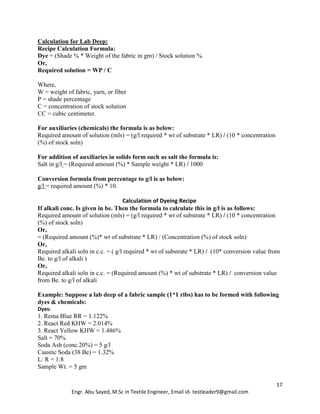
Calculation for Lab Deep:
Recipe Calculation Formula:
Dye = (Shade % * Weight of the fabric in gm) / Stock solution %.
Or,
Required solution = WP / C
Where,
W = weight of fabric, yarn, or fiber
P = shade percentage
C = concentration of stock solution
CC = cubic centimeter.
For auxiliaries (chemicals) the formula is as below:
Required amount of solution (mls) = (g/l required * wt of substrate * LR) / (10 * concentration
(%) of stock soln)
For addition of auxiliaries in solids form such as salt the formula is:
Salt in g/l = (Required amount (%) * Sample weight * LR) / 1000
Conversion formula from percentage to g/l is as below:
g/l = required amount (%) * 10.
Calculation of Dyeing Recipe
If alkali conc. Is given in be. Then the formula to calculate this in g/l is as follows:
Required amount of solution (mls) = (g/l required * wt of substrate * LR) / (10 * concentration
(%) of stock soln)
Or,
= (Required amount (%)* wt of substrate * LR) / (Concentration (%) of stock soln)
Or,
Required alkali soln in c.c. = ( g/l required * wt of substrate * LR) / (10* conversion value from
Be. to g/l of alkali )
Or,
Required alkali soln in c.c. = (Required amount (%) * wt of substrate * LR) / conversion value
from Be. to g/l of alkali
Example: Suppose a lab deep of a fabric sample (1*1 ribs) has to be formed with following
dyes & chemicals:
Dyes:
1. Rema Blue RR = 1.122%
2. React Red KHW = 2.014%
3. React Yellow KHW = 1.486%
Salt = 70%
Soda Ash (conc.20%) = 5 g/l
Caustic Soda (38 Be) = 1.32%
L: R = 1:8
Sample Wt. = 5 gm
18
Engr. Abu Sayed, M.Sc in Textile Engineer, Email id- testleader9@gmail.com
% Stock Soln = 1
Therefore, recipe calculation for dyes and auxiliaries in g/l will be as follows:
For dyes:
We know,
Dye = (Shade % * Weight of the fabric in gm)/ (Stock solution %)
For,
1. Rema Blue RR = (1.122*5)/1=5.61 g/l
2. React Red KHW = (2.014*5)/1= 10.07 g/l
3. React Yellow KHW = (1.486*5)/1= 7.43 g/l.
For auxiliaries:
We know,
Salt in g/l = (Required amount (%) * Sample weight * LR) / 1000
Required Salt = (70*5*8)/1000 = 2.8 gm.
For Soda ash (conc.20%):
We know,
Required amount of solution (mls) = (g/l required * wt of substrate * LR) / (10 * concentration
(%) of stock soln)
Required amount of soda ash in C.C. = (5*5*8)/(10*20) = 1.0
For Caustic soda (38 Be.):
We know,
Required alkali soln in c.c. = (Required amount (%) * wt of substrate * LR) /conversion value
from Be. to g/l of alkali
Required caustic soda = (1.32*5*8)/441 = 0.12 c.c.
[Since 38 °Be.NaOH= 441 gm NaOH 100% per 1lit NaOH soln]
Extra Water required:
= M:L – (required water to make soln of dyes & auxiliaries) = (5*8) – [(5.61+10.07+7.43) +
(1.0+0.12) ]
= 40 – 24.112
= 15.77 (Salt is added in solid form)
Equipments of Recipe Section:
Microprocessor pH Meter (Hanna Instrument)
Digital pipette
Digital Weighting Meter with Glass Box (Explorer, USA)
There are different matching systems followed in Labs. They are:
Tube light matching.
Sun light matching.
Ultra Violet matching.
Sodium light matching (show room).
19
Engr. Abu Sayed, M.Sc in Textile Engineer, Email id- testleader9@gmail.com
Process Sequence of Lab Dip:
Lab dip plays an important role in dyeing process. Bulk dyeing process completely depends on
the lab dip development work. Lab dip is completely managed as the following sequence.
Lab Dip Requisition from buyer
↓
Entry in the computer
↓
First recipe is given by swatch/pantone number
↓
First correction
↓
Second correction
↓
Grading of sample (A, B, C, D)
↓
Yarn and knit sample send to buyer
↓
Approved by buyer
↓
Order for bulk production
↓
Production card with approved sample and recipe send to production section.
Process Flow Chart/Sequence of Dyeing Lab
At first dyeing is performed in dyeing laboratory and then starting for bulk production. A lots of
work is done in the dyeing laboratory. In the dyeing lab, lab dip or sample is developed by the
dyeing master. Lab dip plays an important role in shade matching & this is an important task
before bulk production.
Process Sequence of Dyeing Lab:
Sample/Swatch/Panton no. / TCX no. / TPX no. from the buyer
↓
Determination of sample’s possible color combination by the help of Spectrophotometer or
manual
↓
Dispersion by autodoser
↓
Trial dyeing of first recipe
↓
Unload
↓
Normal wash
↓
Hot wash with detergent
20
Engr. Abu Sayed, M.Sc in Textile Engineer, Email id- testleader9@gmail.com
↓
Oven drying
↓
Ironing
↓
Shade matching in light box ( If Ok then send to buyer for approval)
↓
If not ok
↓
First correction takes from Spectrophotometer or manually
↓
Dispersion by autodoser
↓
Trial dyeing of first recipe
↓
Unload
↓
Normal wash
↓
Hot wash with detergent
↓
Oven drying
↓
Ironing
↓
Shade matching in light box ( If Ok then send to buyer for approval)
↓
If not ok
↓
Second correction takes from Spectrophotometer or manually
↓
Dispersion by auto doser
↓
Trial dyeing of first recipe
↓
Unload
↓
Normal wash
↓
Hot wash with detergent
↓
Oven drying
↓
Ironing
↓
Shade matching in light box
21
Engr. Abu Sayed, M.Sc in Textile Engineer, Email id- testleader9@gmail.com
↓
If ok
↓
Send for buyer’s approval
↓
Bulk production by considering the buyer’s approved sample as standard
Note: This procedure is applicable for yarn or fabric dyeing.
Reactive Dyes - Shade Card 1
Reactive Dyes are used for all cellulosic Fibres, Silk & Viscose Rayon. These colours react with
cellulose in presence of alkali and also form chemical linkage resulting excellent fastness.
Reactive HE' Dyes are reactive dyes containing Bismonochlorotriazinyl group as reactive redical
and high fixation on dyeing fabric blends or, Terycot.These colours are suitable for exhaust
dyeing (801C) of medium and heavy depths.
Salt and Alkali Requirements:
Depth of Shade Salt gm per lit Soda Ash gm per
(O.W.F.) (Na2 .SO4) (Na2CO3)
0 - 0.5% 30 10
0.5 - 1.0% 45 15
1 - 2% 60 15
2 - 4% 70 20
Above 4% 90 20
Dyeing at 800C for 1 hour of the final alkali addition.
Reactive VS' Dyes are reactive dyes containing Vinyl Sulfone groups as reactive radical Suitable
for exhaust dyeing (60°C) , continuous dyeing and printing.
Dyeing at 60°C
Material to Liquor Ratio 1:2 to 1:3 1:4 to 1:6
Glauber's Salt gms/lit 50 50
30% NaOH Soln. ml/lit 3-6 2-3
Soda Ash gms/lit 5 5
Trisodium Phosphate gms/lit 30 20-25
Dyeing at 600
C for 60 minutes final alkali addition.
After-treatment
Rinse in cold water, Hot rinse, soap at boil with 2 gm/l neutral detergent for 15 minutes, Hot
rinse, Cold rinse & Dry.
22
Engr. Abu Sayed, M.Sc in Textile Engineer, Email id- testleader9@gmail.com
NOTES:
 For T. Blue G. dyeing use 50 gms/lit Glauber's Salt for exhaustion and 15 to 20 gms/lit
Soda Ash alongwith 3-5 gms/ lit NaOH (72°Tw) in last twc ends at 800C 'or fixation
 For Reactive Yellow FG, Red C2G & Red 5B, 80 gms/lit Glaubers Salt gives better
colour yield
 In case or Reactive Brill. Blue R only 1 quarter of required Salt is added over first and
second turn. The remaining Salt is added only after the addition of Alkali.
REACTIVE DYES-TANACTIVE HE BRAND DYES
DYEING PROCEDURE-DYEING METHODS -
Winch, jet, package & beam dyeing machines.
These dyes are specially designed for exhaust dyeing methods. The dyeing method selection
depends upon the type of substrate to be dyed and the machinery to be used for dyeing.
Depth of Shade Salt
Unmercerised
cotton(gm/l)
Mercerized cotton or
Viscose Rayon
Soda Ash
(gms/l)
Fixation time
(min.)
Upto 0.10% 10 5 10 30
0.11-0.30% 20 10 10 30
0.31-0.50% 30 20 10 45
0.51-1.00% 45 30 15 45
1.01-2.00% 60 40 15 45
2.01-4.00% 70 55 20 60
Above 4.00% 90 65 20 60
Method No. 1: Salt addition in portions (suitable for mercerized yarn)
This process is recommended for non-circulating liquor machinery and it is suitable for all
depths of shade.
23
Engr. Abu Sayed, M.Sc in Textile Engineer, Email id- testleader9@gmail.com
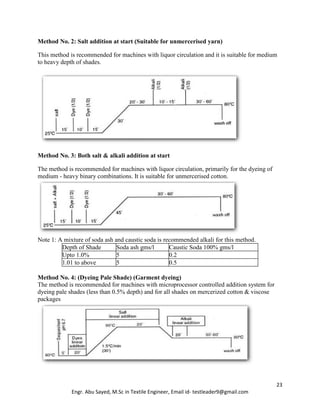
Method No. 2: Salt addition at start (Suitable for unmercerised yarn)
This method is recommended for machines with liquor circulation and it is suitable for medium
to heavy depth of shades.
Method No. 3: Both salt & alkali addition at start
The method is recommended for machines with liquor circulation, primarily for the dyeing of
medium - heavy binary combinations. It is suitable for unmercerised cotton.
Note 1: A mixture of soda ash and caustic soda is recommended alkali for this method.
Depth of Shade Soda ash gms/l Caustic Soda 100% gms/l
Upto 1.0% 5 0.2
1.01 to above 5 0.5
Method No. 4: (Dyeing Pale Shade) (Garment dyeing)
The method is recommended for machines with microprocessor controlled addition system for
dyeing pale shades (less than 0.5% depth) and for all shades on mercerized cotton & viscose
packages
24
Engr. Abu Sayed, M.Sc in Textile Engineer, Email id- testleader9@gmail.com
Method No. 5: Isothermal Method (Dyeing heavy shades garment)
The method is recommended for machines with microprocessor controlled addition systems for
medium to heavy depths (>than 0.5% depth) on unmercerised cotton.
Dyeing method for Jigger machines-
Due to high temperature dyeing the problems of off-shade selvedges of too pale selvedges are
often encountered in dyeing with these machines. The following precautions hence should be
taken to avoid such problems.
1. To use closed type jiggers so that a uniform temperature is possible across the width of
fabric.
2. Batch the fabric evenly.
3. Maintain the dye bath at minimum of 85-90o
C during salt stage.
4. Adjust the dye bath temperature 85-90o
C to ensure that fabric is maintained at minimum
80o
C during alkali addition stage.
Procedure -
Set the dye bath at 90o
C with resist salt 2 gms/l. Now add 1/2 amt. of dye and run one end. Then
add remaining 1/2 amt. & run another one end. Add 1/2 amt. of salt & run one end. Add
remaining 1/2 amt. Of salt and run another end. Maintain 80o
C temperature continue to run for 2
ends. Now add 1/2 amt. of soda ash & run for one end. Then add remaining 1/2 amt. Soda ash &
run for another one end. Then add remaining 1/2 amt. soda ash & run for another one end. Then
run for 4 ends or more if required & wash. (1 end =10 minutes)
Dyeing method for cotton / polyester blend-
The one bath two stage dyeing method for polyester / cotton blend is applicable on jet, beam or
package dyeing machines.
2 gm/l Buffer pH 5 (5.5) X% GAAYACTIVE 'HE' dye
1 gm/l Anionic dispersant 50 gms/l Salt
X% Disperse Dye 15 gms/l T.S.P. Soda ash
25
Engr. Abu Sayed, M.Sc in Textile Engineer, Email id- testleader9@gmail.com
Salt and alkali requirements-
Depth of Shade % on total weight of goods Salt (gms/l) Soda Ash (gms/l)
Upto 0.2% 15 10
0.21-0.4% 20 15
0.41-0.80% 30 15
0.81-1.6% 50 20
Aabove 1.6% 70 20
Washing - off procedure-
In order to obtain maximum wet-fastness properties, brightness and purity of shades with
consistent dyeing results, it is essential to give a through 'Soaping' to clear-off unreached
hydrolyzed dye form the dyed fabric.
The dyed fabric is rinsed repeatedly in cold water to remove most of the alkali, salt and unfixed
dye present and rinse again in warm water not higher than 60o
C. then run in a bath containing:
Anionic detergent - 1-2 gms/liter for 15 minutes at the boil. Then rinse in warm water (up to
60o
C) and finally in cold water. The most satisfactory results in washing-off, particularly for
piece goods, are obtained by employing an Open soaper or perforated beam-washing machine. If
such equipments are not available, conventional ones like jig or winch may be used. For yarn in
the hank form open-vat is employed and for yarn in packaged form the package-dyeing machine
itself used.
About Blend Dyeing:
Blends are any textile material from fibre through yarn to fabric which are deliberate
combinations of chemically or physically different fibrous polymer.cotton and Polyester blend is
an example of chemically different blend and Cotton and Viscose is physically different blend
because both are cellulosic.
Object of Blending:
1. Dilution of an expensive, lusterious fibre by blending with cheaper substitute.
2. To incorporate of more durable component to extendthe useful life.e.g. Core spun yarn.
3. A compromise to take advantage of disirable performance characteristics, contribute by
both fibre component.e.g. P/C blends to get comfort of cotton, strength and crease
recovery of polyester.
4. The development of novel fabric design for garments incorporating multicolour
effect.e.g. Polyester part is dyed and cotton part undyed.
26
Engr. Abu Sayed, M.Sc in Textile Engineer, Email id- testleader9@gmail.com
5. The presence of attractive appearance using byy combination of yarn of different luster,
crimp is possible by blending.
6. Colourant modification is possible by blending.
7. Finishing process modification.
8. Improved moisture absorption.
9. Reduce anstistatic characteristics pilling.
Process Sequence of P/C Blend Dyeing:
Desizing
↓
Scouring
↓
Drying
↓
Heat setting
↓
Mercerization
↓
Drying
↓
PET dye
↓
Reduction clearing
↓
Drying
↓
Singing
↓
Cotton dye
↓
Washing
↓
Soaping
↓
Washing
↓
Drying
27
Engr. Abu Sayed, M.Sc in Textile Engineer, Email id- testleader9@gmail.com
Dyeing P/C Blend with Disperse and Vat Dye:
Recipe:
Disperse dye ----------------------------------------X%
Vat dye-------------------------------------------------Y%
Dispersing agent------------------------------------o.5-1%
Wetting agent-----------------------------------------0.5-1%
PH-------------------------------------------------4-5 with acetic acid(30%)
Procedure:
Prepar the bath with dispersing agent,wetting agent and acetic acid.Treatment for 10-15 minute
at 50-60 degree C.Then add disperse and vat dye in the bath.Dyeing for 10-15 minute.Raise
temp. up to 130 degree C in 60-90 minute.After PET part dyeing cool to 80 degree for proper
levelling then add caustic and hydrose and dyeing 15 minute.Cooling to 60 degree c and dyeing
for 30 minute for better exhaustion.Rinse with cold water and oxidation with hydrogen per oxide
for 15 minute at 50 degree C.Then rinseing with cold water and soaping 95 degree c for 25
minute using 2g/l lissapol.Hot and cold rinse and then final wash off.
Dyeing P/C blend with Disperse and Reactive Dye (Thermosol Process):
Recipe:
Disperse dye -----------------------------------X%
Reactive dye ----------------------------------Y%
Soda ash-----------------------------------------5-20g/l
Migration inhibitor ----------------------------10-20g/l
Wetting agent----------------------------------1-2g/l
Dyeing Procedure:
Padding:
Padding with disperse and reactive dye at 20-30 degree C. Liquor pick up 60-80%.
Predrying:
Partial drying is done to avoid migration of dyes.Here keep m.c 25%.
Drying:
Complete and even dyeing at 110-150 degree C.
Thermofixation:
It's done at 180-220 degree C about 30-45 sec. to fixation dye.Polyester dyeing complete here
Alkali Padding:
Padding at 20-30 degree C.Pick up 50-60%.Caustic and salt used for Procion mx and Procion H.
Steaming:
Steaming is done 103-105 degree C about 30 sec. for procion mx and 45-75 sec.for procion H.
Wash off:
A typical 8 box wash off is given by Cold,hot water and detergent.
Box-1:-------------------------------------water 60 degree C.
Box -2&3:-------------------------------------Detergent 5 gm/l at boil
Box-4&5:---------------------------------------water at the boil
Box-7;-------------------------------------------water 60 degree C.
Box-8:-------------------------------------------Cold water.
28
Engr. Abu Sayed, M.Sc in Textile Engineer, Email id- testleader9@gmail.com
Classification of the methods for dyeing of P/C blend:
Exhaust dyeing method or batch dyeing method-
This is again classified in the following three groups-
1. Two bath dyeing
2. One bath one step dyeing
3. One bath two step dyeing method
Thermosol Dyeing method -
It is again classified in to two groups-
1. Continuous dyeing-
2. Pad batch process (semi-continuous)
Note-In continuous dyeing process may be single bath or double bath.
EXHAUST DYEING:
Two bath dyeing
1. This is the process in which we have to dyed first polyester part in the HTHP beam dyeing
machine or HTHP jet dyeing machine and the cotton part is dyed in the jigger machine.
2. Batch process
3. Machine used for dyeing of polyester part-
 HTHP Beam dyeing machine( First commercialized HTHP machine)
 HTHP jet dyeing machine
4. Machine used for dyeing of cotton part-
5. Jigger dyeing machine used
29
Engr. Abu Sayed, M.Sc in Textile Engineer, Email id- testleader9@gmail.com
PROCESS ROUTE P/C BLEND DYEING:
MACHINE FOR POLYESTER DYEING:
HTHP beam dyeing machine-
No need to explain the whole process of dyeing in beam dyeing machine. Only some important
points we will discuss about it-
Advantages & features:
1. Loading and unloading of the fabric is easy and time of dyeing is short.
2. Dyeing in open width form.
3. Most suitable for those fabrics that might crease, extend or abrade when dyed in
machines where the fabric is in motion.
4. Not appropriate for compact fabrics
5. De-aeration is essential to avoid paler dyed spots.
6. A wetting agent helps to eliminate air bubbles within the fabric roll.
Recipe used HTHP dyeing:
 Disperse dye- X%(depends upon the shade)
 Dispersing agent-1g/l
 Sequestering agent-1-2g/l(If required)
 Defoamers -.5 to 1g/l
 Levelling agent-.5 to 1 g/l
 Wetting agent- .5g/l
 Acetic acid-enough to get ph=5-6
30
Engr. Abu Sayed, M.Sc in Textile Engineer, Email id- testleader9@gmail.com
Flow of the liquor usually in the in-to-out direction, but it can be reversed. Out-to-in flow can
compress the material causing flattening and glazing, particularly on the inner layers.
 Material stationary and liquor is moving.
 Batching is very important; during batching tension should be uniform and optimum.
 M:Lratio is 1:10
 Both cloth and yarn can be dyed on this machine.
Major Chemicals Used in Textile Wet Processing
Introduction:
Chemical analysis always involves the use of different chemicals. In order to assure accurate
analysis results, the chemicals used need to be standardised, the procedures must be followed
exactly and the data obtained have to be analysed statistically. If an instrument is used, it should
be maintained and calibrated properly.
In a chemical analysis, especially involving quantitative analysis, the amount of chemical used is
critical and can be determined by the measurement of concentration if it is a solution, or by
weight, if it is a solid. Sometimes, the concentration of a solution can be easily determined by
using another known solution through titration. For acids and bases, if the concentration is
sufficiently low, the pH concept is generally used to represent the concentration of the acid or
base in the aqueous solution. For the analysis of common chemicals, such as caustic soda, acetic
acid, soda ash, sodium dithionite, hydrogen peroxide, and so on, titrimetric analysis and
gravimetric analysis are widely used. For the analysis of surfactants and other chemicals,
qualitative spot tests and specialised instruments should be utilized.
Before the analysis of chemicals in textile wet processing we should to know about
concentration, titration, weighing, pH etc. Now a short identity of these is given below.
Concentration:
The concentration of a solute is usually expressed as the amount of a solute in a unit volume of a
solution. The amount of a solute can be in grams (g), kilograms (kg), moles (mol), or normals
(n). The unit volume of a solution is always in litres (l).
Titration:
Titration is a method by which the concentration of an unknown solution can be determined
using a standardised solution with a known concentration through a stoichiometric reaction. The
end point of the chemical reaction is indicated by the colour change of an indicator or an
instrumental reading. The standard solution of a known reagent is the titrant and the unknown
solution is the titrand.
Weighing:
Weighing is an important operation in gravimetric analysis. Usually it involves the use of an
31
Engr. Abu Sayed, M.Sc in Textile Engineer, Email id- testleader9@gmail.com
electronic balance with a minimum readability of 0.1 mg. In order to ensure reproducible results,
sample handling is very critical especially when hygroscopic materials are weighed.
pH:
pH is a scale between 0 and 14 used to express the concentration of hydronium (H3O+, or H+)
ions in a solution. It is defined by Equation.
pH = – log [H+]
Major Chemicals Used in Wet Processing:
Acids, bases, salts, surfactants, oxidising agents and reducing agents are the major chemicals
those are widely used in wet processing industry.
Acid:
An acid (from the Latin acidus/acēre meaning sour) is a substance which reacts with a base.
Commonly, acids can be identified as tasting sour, reacting with metals such as calcium, and
reacting with bases such as sodium carbonate. Aqueous acids have a pH under 7, with acidity
increasing the lower the pH. Chemicals or substances having the property of an acid are said to
be acidic.The following standard solutions are used in the acid analysis. They are usually
prepared in advance and consumed within a certain period of time.
1. H2SO4, 0.1 N, 0.25N, 0.5 N and 1 N;
2. HCl, 0.1N, 0.25 N, 0.5 N and 1 N;
3. HNO3, 0.1 N;
There are two types of acid
1. Inorganic acid
2. Organic acid
Inorganic Acid:
Inorganic acid are Sulphuric acid (H2SO4), Hydrochloric acid (HCl), Nitric acid (HNO3),
Phosphoric acid (H3PO4), etc.
Sulphuric Acid (H2SO4):
The concentration of sulphuric acid (H2SO4) can be determined by using Baume’s (ºBé)
hydrometer. The titration of sulphuric acid is carried out using sodium hydroxide in the presence
of phenolphthalein as an indicator. The end point is reached when a faint pink color is persistent.
HCl
The concentration of hydrochloric acid (HCl) can be determined using a hydrometer, in a very
similar manner to the determination of sulphuric acid concentration. Hydrochloric acid is a
volatile acid at high concentration.
32
Engr. Abu Sayed, M.Sc in Textile Engineer, Email id- testleader9@gmail.com
HNO3
The concentration of nitric acid (HNO3) can be determined using a hydrometer. If titration is
used to determine the concentration, phenolphthalein is the indicator.
H3PO4
The concentration of phosphoric acid (H3PO4) can be determined in a similar manner to that
discussed for H2SO4, HCl and HNO3.
Organic Acids:
Organic acids are HCOOH (formic acid), Acetic acid etc.
HCOOH
HCOOH (formic acid) is the simplest organic acid in terms of its organic structure. Concentrated
HCOOH is usually 88% in strength. Since formic acid is a volatile acid, precautions should be
taken to prevent loss of strength in the sample preparation stage. The concentration of formic
acid can be determined by acid– base titration as well as by redox titration owing to the reduction
power of formic acid.
CH3COOH
Acetic acid is a weak acid. It is available at different concentrations. Highly concentrated acetic
acid at 98% and above is called glacial acetic acid because its freezing point range is between
13.3 ºC (98%) and 16.7 ºC (100%). Glacial acetic acid is flammable. The concentration of acetic
acid can easily be determined using acid–base titration with phenolphthalein as an indicator. The
water used should be free from CO2, prepared by boiling before use.
Base:
A base in chemistry is a substance that can accept hydrogen cations (protons) or more generally,
donate a pair of valence electrons. A soluble base is referred to as an alkali if it contains and
releases hydroxide ions (OH−) quantitatively.Bases are two types
1. Inorganic and
2. Organic bases
Inorganic Bases:
Inorganic bases are Sodium hydroxide (NaOH), Sodium carbonate (Na2CO3), Ammonium
hydroxide (NH4OH) etc.
NaOH
Sodium hydroxide (NaOH) is also called caustic soda. It is available in solution at different
concentrations or in solid form. Commercial NaOH often contains a little sodium carbonate
(Na2CO3) as a by-product of the manufacturing process. This small amount of Na2CO3 will
usually not influence its use in textile wet processes.
33
Engr. Abu Sayed, M.Sc in Textile Engineer, Email id- testleader9@gmail.com
Owing to its strong alkalinity, NaOH can react with CO2 in air easily. It can also absorb water
very quickly.
Na2CO3
Sodium carbonate (Na2CO3) is also called soda ash. In textile wet processes, it is often available
in anhydrous form. Its purity can be > 99% Na2CO3 (58% Na2O).
If the concentration of a Na2CO3 solution needs to be determined, a titrimetric method identical
to the ones listed for NaOH in this section can be used. If the existence of bicarbonate is a
concern (very rarely in textile wet processes) the following method can be used to determine the
content of bicarbonate in sodium carbonate.
NH4OH
Ammonium hydroxide (NH4OH) is a water solution of ammonia gas (NH3). It can also be called
aqua ammonia or ammonia water. The concentration determination can be done using either a
hydrometer or an acid–base titration. Since ammonia is volatile, the concentration determination
should be done with care to avoid any loss of strength. If a hydrometer is used, the sample and
the hydrometer should be cooled to 5–10 ºC. Table 4.75 lists the relationship between the
concentration (% w/w) and ºBé of NH4OH at 10 ºC. Acid–base titration can also be used to
determine the concentration of NH4OH.
Organic Bases:
Organic bases are Triethanolamine, N (CH2CH2OH) 3, Ethylenediamine (H2NCH2)2 etc.
Triethanolamine
Triethanolamine, N (CH2CH2OH) 3, is a strong organic base miscible with water, methanol and
acetone. The pH of its 0.1N aqueous solution is 10.5. Analytical grade N(CH2CH2OH)3 is a
highly hygroscopic and viscous liquid with a pale yellow or no colour. Its melting point is
between 18 and 21 ºC. Its density is about 1.12.
Ethylenediamine
Ethylenediamine, (H2NCH2)2, is a strong organic base miscible with water and alcohol. It is a
colourless and viscous liquid with a density of 0.898 and a melting point of 8 ºC. The pH of a
25% aqueous solution is 11.5. Like triethanolamine, it is an aliphatic amine soluble in water and,
therefore, can be determined by the acid–base titration with methyl orange as an indicator.
Salts
Salts are the products of the acid-base neutralisation reaction. The salts used most in textile wet
processes are common salt (NaCl, sodium chloride) and Glauber’s salt (Na2SO4, sodium
34
Engr. Abu Sayed, M.Sc in Textile Engineer, Email id- testleader9@gmail.com
sulphate). The content analysis of salts is usually conducted by using a precipitation titration
method which may be followed by filtering and weighing procedures to obtain the final results.
Sodium chloride
Industrial grade NaCl has a content of 92–98%. The precipitation titration can be conducted
using 0.1 N AgNO3 as the titrant and 5% K2CrO4 as the indicator (the Mohr method). The
sample chloride solution should be buffered with calcium carbonate to a pH between 6.3 and 7.2
in order to avoid any interference from other ions present in the solution.
Sodium sulphate
Na2SO4 is available in two types, anhydrate and decahydrate. Its content analysis can be
conducted based on the precipitation method using barium chloride (BaCl2).
An excess amount of barium chloride is added into the sample solution which has been filtered
beforehand to form BaSO4 precipitate as indicated by the following reaction:
Na2SO4 + BaCl2 →2NaCl + BaSO4↓
Surfactants
Surfactants are widely used in textile wet processes for the purpose of wetting, dispersing,
emulsifying and cleaning. The molecular structures of surfactants have a distinctive hydrophilic
moiety and a distinctive hydrophobic moiety. When they are used at a sufficient concentration,
the surface/interface tension of the solution is lowered and micelles are formed, which give the
solution extra properties.
According to their ionic properties in aqueous solution, traditional surfactants can be divided into
four categories: anionic, cationic, amphoteric and non-ionic.
Surfactants are four types
1. Anionic surfactants ,
2. Cationic surfactants,
3. Non-ionic surfactants and
4. Amphoteric surfactants
Amphoteric surfactants:
Amphoteric surfactants contain both anions and cations. They should show positive results when
tested using either the basic methylene blue test for anionic surfactants or the alternative
bromophenol blue test for cationic surfactants.
A saturated bromine aqueous solution can also be used to determine the type of amphoteric
surfactant. Add 5 ml of 1% sample solution to 1.5 ml saturated bromine aqueous solution.
35
Engr. Abu Sayed, M.Sc in Textile Engineer, Email id- testleader9@gmail.com
Observe the colour of the precipitate. Heat the mixture and observe the change in the precipitate.
If the precipitate is a yellow to yellow-orange colour and is dissolved to form a yellow solution
after heating, the sample is an imidazoline or alanine type of amphoteric surfactant. If the
precipitate is a white to yellow colour and insoluble after heating, the sample is the other type
of amphoteric surfactant.
Oxidising agents and reducing agents
Oxidising agents are mainly used for bleaching and reducing agents are mainly used for vat
dyeing in textile wet processes. These agents are often strong chemicals and need to be handled
with care. The assay of these agents is almost always based on the redox titration. In a redox
reaction, an oxidising agent (oxidant) is reduced (it gains electrons) and a reducing agent
(reductant) isoxidised (it loses electrons). The redox reaction can be written as two half
reactions shown below:
Oxidation reaction: reducing agent → oxidized form + n e–
Reduction reaction: oxidising agent + n e– → reduced form
The net reaction is: reducing agent + oxidising agent → oxidised form + reduced form
Oxidising Agents:
Hydrogen peroxide
Hydrogen peroxide (H2O2) can be titrated with potassium permanganate (KMnO4) in an acid
medium. H2O2 is the reducing agent and KMnO4 is the oxidising agent.
Sodium Hypochlorite
In hypochlorite bleaching of textiles, active chlorine is the species measured for the control of
the bleaching process. Iodometry is the method used to determine the content of active chlorine.
Sodium perborate
Either sodium permanganate or potassium iodide can be used to titrate the sodium perborate
(NaBO3•4H2O). Dissolve 0.2 g of sample in 200 ml distilled water, add 40 ml 6 N H2SO4, and
titrate with 0.1 N sodium permanganate until a pink colour appears.
Reducing Agents:
Sodium hydrosulphite (Na2S2O4)
It is the Dilute of 10 ml 40% formaldehyde with 50 ml distilled water.
Glucose
Glucose (C6H12O6) can be used as a reducing agent in vat and sulphur dye applications. It can
36
Engr. Abu Sayed, M.Sc in Textile Engineer, Email id- testleader9@gmail.com
be analysed by iodometry. Accurately prepare a 0.5% glucose solution.
Sodium thiosulphate
Sodium thiosulphate (Na2S2O3•5H2O) can be titrated easily by iodometry. Accurately weigh a
5 g sample and dissolve it in 500 ml distilled water to make a 1% sample solution.
Miscellaneous Chemicals
Ethanol
The specific gravity of ethanol (C2H5OH) is directly related to its content. Table 4.7 lists the
relationship between the volume% (weight %) and the specific gravity of ethanol at 15 ºC.
Ethylene glycol and glycerol
ASTM method D161518 may be used to estimate the concentration of ethylene glycol and
glycerol in an aqueous medium.
Others
Urea
Urea is tested for the content of nitrogen using H2SO4 and formaldehyde. The indicator used is a
mixed indicator containing 0.5 g phenolphthalein and 0.5 g thymol phthalein dissolved in 100 ml
ethanol. A 25% formaldehyde solution used should be neutralised before use. The procedures of
the method are briefly described below.
1. Dissolve 1 g fully dried sample in a small amount of water; add 3 ml concentrated
H2SO4; mix well and heat on a hot plate.
2. Heat until the release of CO2 (bubbling) has stopped and dense white smoke (SO3) is
emitted; leave to cool down.
3. Add 50 ml distilled water and 2 drops of methyl red indicator.
4. Neutralise the acidity of the solution with 6 N NaOH added dropwise until the red colour
changes to a pink colour; add 0.5 N NaOH slowly to change the solution colour to a faint
pink.
5. Add 40 ml 25% neutralised formaldehyde solution and 5 drops of the mixed indicator;
stand for a few minutes.
Fluorescent whitening agents
Fluorescent whitening agents (FWA) are a special type of chemical that can significantly
increase the apparent whiteness of treated fabrics. They absorb UV radiation and re-emit the
absorbed energy in the blue visible light range which makes the treated fabrics appear whiter.
The easiest test for the effect of FWAs is simply a visual examination of the whiteness of treated
fabrics. Manufacturer’s recommendations should be followed in order to achieve the best
whitening effect.
Ethylenediamine tetraacetate (EDTA)
Ethylenediamine tetraacetate (EDTA) can form a few different water soluble salts with calcium,
potassium and sodium, for example, calcium disodium, trisodium and tetrasodium salts. EDTA
tetrasodium salt is used most widely in many industrial applications as a powerful chelating
37
Engr. Abu Sayed, M.Sc in Textile Engineer, Email id- testleader9@gmail.com
agent. Its 1% solution has a pH of 11.3. It can chelate with many divalent and trivalent metal
ions to form watersoluble metal complexes.
HTHP BEAM DYEING MACHINE:
Sectional diagram of a high-temperature beam dyeing machine
Disadvantages of beam dyeing machine:
 —Fabric of different width can not be dyed together on a single beam.
 —The dyed fabric may be display moiré effect if it is tightly due to shrinkage.
 —Uneven dyeing may occur if the beam is fully loaded, as the dye liquor has penetrate
several layers of fabric.
JET DYEING MACHINE:
38
Engr. Abu Sayed, M.Sc in Textile Engineer, Email id- testleader9@gmail.com
HTHP jet dyeing machine:
The jet dyeing machine is an extension of the HPHT winch dyeing machine. Jet dyeing machine
developed by BURLINGTON Industries and first machine developed in 1963 by Gaston country
Machine co. of U.S.A
Features:
 Both material and liquor is moving.
 Dyeing in rope form.
 Fabric speed usually 200-250mt/min
 The jet dyeing can usually operated up to 1400c under high pressure and having capacity
capable of dyeing 100 to 150 kg of fabric at a time
Chemicals added
 Acids
 Buffers
 Sequestering agent
 Anticrease agent
 Defoamers
 Levelling agent
DEVELOPMENT IN JET DYEING MACHINE:
 Soft flow jet- slow motion of fabric. Suitable for knitted fabric
 Super jet dyeing machine- M:L is 1:1
 Aerodynamic jet dyeing machine
 Jet created by mixture of air + water
 M:L is 1:1 , drain out at a 130c
 Multi-nozzle sot flow jet dyeing machine
Advantages of jet dyeing machine:
1. Fabric of two different width can be dyed at a time so that two lots can be combined
together for dyeing.
2. No special batching device is required for winding the fabric as in beam dyeing.
3. There is no flattening effect or uneven dyeing on the fabric as in beam dyeing
39
Engr. Abu Sayed, M.Sc in Textile Engineer, Email id- testleader9@gmail.com
Disadvantages:
1. There is possibility of entanglement of light-weight fabric during dyeing.
2. Loose fibres removed from the fabric may get redeposited on the fabric surface as well as
on the interior of the jet dyeing vessel, this problem does not arise in beam dyeing.
3. Yarn can not be dyed in a jet dyeing machine whereas it can be dyed in a beam dyeing
machine.
PROBLEMS-
1. Foaming problem
2. Oligomers problem
3. Rope marks
Machine used for cotton dyeing:
Jigger dyeing machine
 Open jigger or closed jigger dyeing machine-
 Closed jigger specially for vat dyeing.
 Liquor is stationary and fabric is moving.
 500 t0 1000 meter of fabric is processed in one time.
 M:L ratio in jigger dyeing machine is about 1:5.
 Usually take 10 min. for each passage
One bath two step dyeing-
One-bath dyeing processes, using both the dyes such as following in the same dye bath.
1. Disperse and vat dyes.
2. Disperse and reactive dyes.
3. Disperse and direct dyes.
Dyeing machine:
Name of the m/c: Dyeing machine
Brand Name: Dilmenlar
Manufacturing Company: Turkey
Year of Manufacturing: 2004
Machine capacity: 150 kg
No. of nozzle: 02
Maximum Temperature: 135°c
Motor: 01
Winch Motor: 01
Pump Motor: 01
Jigger dyeing machine
Jigger dyeing machine is the most commonly used for dyeing all kinds of cotton fabric. There
are mainly two types of jigger dyeing machine. One is open jigger dyeing machine and other is
closed jigger dyeing machine.
The open jigger dyeing machine is shown in the figure. This machine consists of V shaped
stainless steel vessel. Two rollers are fitted above the vessel called as cloth rollers. These rollers
are rotated by power. Out of these two rollers one roller is driven by a motor which is called take
40
Engr. Abu Sayed, M.Sc in Textile Engineer, Email id- testleader9@gmail.com
up roller and the other roller from which the cloth is delivered is called let off roller. When all
the cloth is passed from the let off roller to the take up roller, it is called as one end or one turn.
The number of ends or turns depends upon the type of the fabric and also the percentage of the
shade.
Jigger dyeing machine
Initially, a large length of (50 kg) cloth is wound on the let off roller and take up roller is then
driven by the power. After one end is taken, the take up becomes let off roller. These backward
and forward movements of cloth through the dye liquor absorb more and more dye.
The capacity of the jigger is 100 to 150 gallons. In the modern jigger, automatic devices are
fitted along with the timing switch by using reversing will take place automatically.
When dyeing all the dye liquor should not be added at one time. The dye liquor should be added
in batch wise, in order to get even shade on the cloth. In the present scenario, closed types of
jiggers are used. The main advantage is to prevent heat loss and chemical loses by evaporation.
This type of jigger is very important for dyeing vat, Sulphur etc.
Advantages of Jigger Dyeing Machine
1. The cloth can be dyed in open width form of full width form.
2. Chemical and heat loses are less when compared to winch dyeing machine
3. The material to liquor ratio is 1:3 (or) 1:4 which saves considerable amount of chemical cost
and steam cost.
Disadvantages of Jigger Dyeing Machine
It exerts lot of tension in the warp direction and because of this normally woolen, knitted fabric,
silk etc are not dyed in jigger dyeing machine.
Modern Machinery Used in Dyeing Process:
Modern dyeing machines are made from stainless steels. Steels containing up to 4%
molybdenum are favored to withstand the acid conditions that are common. A dyeing machine
consists essentially of a vessel to contain the dye liquor, provided with equipment for heating,
cooling and circulating the liquor into and around the goods to be dyed or moving the goods
through the dye liquor. The kind of machine employed depends on the nature of the goods to be
dyed. Labor and energy costs are high in relation to total dyeing costs: the dyers aim is to shorten
dyeing times to save steam and electrical power and to avoid spoilage of goods.
Modern dyeing machine
41
Engr. Abu Sayed, M.Sc in Textile Engineer, Email id- testleader9@gmail.com
The conical-pan loose-stock machine is a widely used machine. Fibers are held in an inner
truncated conical vessel while the hot dye liquor is mechanically pumped through. The fiber
mass tends to become compressed in the upper narrow half of the cone, assisting efficient
circulation. Leveling problems are less important as uniformity may be achieved by blending the
dyed fibers prior to spinning.
The Hussong machine is the traditional apparatus. It has a long, square-ended tank as a dye bath
into which a framework of poles carrying hanks can be lowered. The dye liquor is circulated by
an impeller and moves through a perforated false bottom that also houses the open steam pipe for
heating. In modern machines, circulation is improved at the points of contact between hank and
pole. This leads to better leveling and elimination of irregularities caused by uneven cooling. In
package-dyeing machines dye color may be pumped in rather two directions:
1. Through the perforated central spindle and outward through the package or
2. By the reverse path into the outer layers of the package and out of the spindle. In either
case levelness is important.
Some package-dyeing machines are capable of working under pressure at temperatures up to
130C.
The winch is the oldest piece of dyeing machine and takes its name from the slated roller that
moves an endless rope of cloth or endless belt of cloth at full width through the dye liquor.
Pressurized-winch machines have been developed in the U.S.
In an entirely new concept; the Gaston County jet machine circulates fabric in rope form through
a pipe by means of a high-pressure jet of dye color. The jet machine is increasingly important in
high-temperature dyeing of synthetic fibers, especially polyester fabrics. Another machine is the
jig. It has a V-shaped trough holding the dye color and guide rollers to carry the cloth at full
width between two external, powered rollers, the cloth is wound onto each roller alternately, that
is, the cloth is first moved forward, then backward through the dye color until dyeing is
complete. Modern machines, automatically controlled and programmed, can be built to work
under pressure.
It was found that in using Winch machines, there were some inherent problems. So the Jet
dyeing machines when they came up in the 1970’s were specifically designed to overcome those
shortcomings.
In the Jet dyeing machine the reel is completely eliminated. A closed tubular system exists where
the fabric is placed. For transporting the fabric through the tube a jet of dye liquor is supplied
through a venturi. The Jet creates turbulence. This helps in dye penetration along with preventing
the fabric from touching the walls of the tube. As the fabric is often exposed to comparatively
higher concentrations of liquor within the transport tube, so little dye bath is needed in the
bottom of the vessel. This is just enough for the smooth movement from rear to front. Aqueous
jet dyeing machines generally employs a driven winch reel along with a jet nozzle.
The following diagram explains the functioning of a Jet dyeing machine:
42
Engr. Abu Sayed, M.Sc in Textile Engineer, Email id- testleader9@gmail.com
Types of Jet Dyeing Machine:
In deciding the type of dyeing machine the following features are generally taken into
consideration for differentiating. They are the following. Shape of the area where the fabric is
stored i.e. long shaped machine or J-box compact machine. Type of the nozzle along with its
specific positioning i.e. above or below the bath level. Depending more or less in these criteria
for differentiation following types of Jet Machines can be said to be as developments of the
conventional jet dyeing machine.
1. Overflow Dyeing Machine
2. Soft-flow Dyeing Machine
3. Airflow Dyeing Machine
Advantages of Jet Dyeing Machine:
The Jet Dyeing Machine offers the following striking advantages that make them suitable for
fabrics like polyesters.
1. Low consumption of water
2. Short dyeing time
3. Can be easily operated at high temperatures and pressure
4. Comparatively low liquor ratios, typically ranges between 1:4 and 1:20
5. Fabrics are handled carefully and gently
Soft Flow Dyeing Machine:
In the soft flow dyeing machine water is used for keeping the fabric in circulation. The
conceptional difference of this equipment from a conventional jets that operates with a hydraulic
system is that the fabric rope is kept circulating during the whole processing cycle (right from
loading to unloading). There is no stopping of liquor or fabric circulation for usual drain and fill
steps. The principle working behind the technique is very unique. There is a system for fresh
water to enter the vessel via a heat exchanger to a special interchange zone. At the same time the
contaminated liquor is allowed channel out through a drain without any sort of contact with the
fabric or for that matter the new bath in the machine.
Key Features of Soft flow Dyeing Machine:
 Significant savings in processing time.
 Savings in water that is around 50%.
 Excellent separation of different streams results in optimum heat recovery and a distinct
possibility of further use or a dedicated treatment.
43
Engr. Abu Sayed, M.Sc in Textile Engineer, Email id- testleader9@gmail.com
Principle of Soft Flow Dyeing Machine:
Textile material can be dyed using batch, continuous or semi continuous process.
Batch processes are the most common method used to dye textile materials. There are three
general types of batch dyeing machines:
1. In which fabric is circulated
2. In which dye bath is circulated
3. In which both the bath and material is circulated.
Jet dyeing machine is the best example of a machine that circulated both the fabric and the
dyebath. Jet dyeing is used for knitted fabrics. For Terry-towels soft flow dyeing is use.
In jet dyeing machine the fabric is transported by a high speed jet of dye liquid.
As seen in the figure, this pressure is created by venturi. A powerful pump circulates the dyed
bath through a heat exchanger and the cloth chamber. Cloth guide tube helps in circulation of
fabric.
Types of Soft Flow Dyeing Machine:
A few of the commercially popular brands along with their particular technical specifications are
discussed here. The categories are not exhaustive as such.
Multi Nozzle Soft Flow Dyeing Machine:
Technical Features:
1. Very low Liquor ratio - around 1:1 (Wet Fabric)
2. Can reach high temp. up to 140°C
3. Easily dye 30 to 450 g/mt.sq. of fabrics (woven & knitted fabrics)
4. Number of very soft-flow nozzles
5. No pilling effect
6. Wide capacity
44
Engr. Abu Sayed, M.Sc in Textile Engineer, Email id- testleader9@gmail.com
Multi Nozzle Soft flow Dyeing Machine
High Temperature High Pressure Soft Flow Dyeing Machine:
Technical Features:
1. Compact body made of stainless steel.
2. High efficiency heat exchanger for quick heating/cooling.
3. Compact body made of stainless steel.
4. Heating rate - around 4°C/Min upto 900°C - around 3°C/Min upto 135°C At steam
pressure of 6 Bar.
5. Cooling Rate- around 4°C/ Min At water pressure of 4 Bar and 15°C.
6. Maximum working temp is 135°C.
7. Maximum working pressure of 3.2 Bar.
8. Control manual as well as automatic.
9. Heavy duty stainless steel pump.
Soft Flow Dyeing Machine
1. The vigorous agitation of fabric and dye formulation in the cloth increases the dyeing rate and
uniformity. It minimizes creasing as the fabric is not held in any one configuration for very long.
The lower liquor ration allows shorter dye cycles and saves chemicals and energy.
2. In soft flow dyeing machines the fabric is transported by a stream of dye liquor. However, the
transport is assisted by a driven lifter reel.
3. These machines use a jet having lower velocity that that used on conventional jet dyeing
machines.
4. The soft flow machines are gentler on the fabric than conventional jet machines.
45
Engr. Abu Sayed, M.Sc in Textile Engineer, Email id- testleader9@gmail.com
Winch dyeing machine
A dyeing machine consisting essentially of a dye vessel fitted with a driven winch ( usually
above the liquor level) which rotates and draws a length of fabric, normally joined end to end,
through the liquor.
Winch dyeing machine
Winch dyeing machine is a rather old dyeing machine for fabrics in rope form with stationary
liquor and moving material. The machine operates at a maximum temperature of 95-98°C. The
liquor ratio is generally quite high (1:20-1:40). Winch dyeing machines are a low cost design that
is simple to operate and maintain, yet versatile in application proving invaluable for preparation,
washing or after treatments as well as the dyeing stage itself. In all winch dyeing machines a
series of fabric ropes of equal length are immersed in the dye bath but part of each rope is taken
over two reels or the winch itself. The rope of fabric is circulated through the dye bath being
hauled up and over the winch throughout the course of the dyeing operation. Dyestuff and
auxiliaries may be dosed manually or automatically in accordance with the recipe method.
A winch dyeing machine
Description and Dyeing Method on Winch Dyeing Machine
The basic principle of all winch dyeing machines is to have a number of loops or ropes of the
fabric in the dye bath, these ropes are of equal length , which are mostly immersed in the liquor
in the bath. The upper part of each rope runs over two reels which are mounted over dyebath. At
the front of the machine, above the top of the dye liquor , is a smaller reel, which is called jockey
or fly roller.
The fly roller remains free wheeling along with fabric rope. At the back of winch tank is the
winch wheel, which pulls the fabric rope from the dye bath over the jockey reel for dropping in
the dye bath for immersion. From the dropped location, the fabric rope travels back. To be lifted
and fed to winch wheel.
46
Engr. Abu Sayed, M.Sc in Textile Engineer, Email id- testleader9@gmail.com
The dyeing process on winch dyeing machines is based on higher M:L as compared with other
dyeing machines. The process is conducted with very little tension. The total dyeing time is
lengthier as compared to other machines.
Advantages of Winch Dyeing Machine
1. Construction and operation of winch are very simple.
2. The winch dyeing machines are suitable for types of wet processing operations from desizing
to softening.
3. The winch dyeing machine is suitable for practically all types of fabrics, which can withstand
creasing in rope form processing.
4. Thr tension exerted on winch is less than jigger dyeing machine,the material thus dyed is with
fuller hand.
5. The appearance of the dyed goods is clean and smooth on winch dyeing machines.
Limitations of Winch Dyeing Machine
1. Batch dyeing operations needs trimming, sewing, opening out the rope , loading and unloading
for individual lots separately.
2. Since several lengths of fabric are run over the winch reel into the liquor and sewn end to
end,Continuous length processing is not possible in a single batch.
3. Fabric is processed in rope form which may lead to crease marks, particularly in heavy ,
woven , thin and light synthetics.
4. Most of the machine works under atmospheric conditions
Jet Dyeing Machine
This is the most modern machine used for the dyeing of polyester using disperse dyes. In this
machine the cloth is dyed in rope form which is the main disadvantage of the machine.
In this machine, the dye tank contains disperse dye, dispersing agent, leveling agent and acetic
acid. The solution is filled up in the dye tank and it reaches the heat exchanger where the
solution will be heated which then passed on to the centrifugal pump and then to the filter
chamber.
Jet Dyeing Machine
The solution will be filtered and reaches the tubular chamber. Here the material to be dyed will
be loaded and the winch is rotated, so that the material is also rotated. Again the dye liquor
47
Engr. Abu Sayed, M.Sc in Textile Engineer, Email id- testleader9@gmail.com
reaches the heat exchanger and the operation is repeated for 20 to 30 minutes at 135o C. Then
the dye bath is cooled down, after the material is taken out.
Metering wheel is also fixed on winch by external electronic unit. Its purpose is to record the
speed of the fabric. The thermometer, pressure gauge is also fixed in the side of the machine to
note the temperature and pressure under working. A simple device is also fixed to note the shade
under working.
Advantages Jet Dyeing Machine
 Dyeing time is short compared to beam dyeing.
 Material to liquor ratio is 1:5 (or) 1:6
 Production is high compared to beam dyeing machine.
Disadvantages Jet Dyeing Machine
 Cloth is dyed in rope form
 Risk of entanglement
 Chance for crease formation.
Package dyeing machines
Package dyeing machines are the most widely used now a days for dyeing of almost all type of
yarns ,due to economical ,automatic and accurate dyeing results. The term package dyeing
usually denotes for dyeing of any type yarn wound on the compressible dye springs/perforated
solid dyeing tubes or cones. Yarn dyeing in package form is done at high temperature and under
high pressure ,with the packages mounted on hollow spindles .These spindles are fixed on the
dyeing carriers ,which is inserted into the dyeing vessel after closing the lid of the machine ,the
dyeing liquor is forced through the packages in two way pattern (inside to out and outside to in)
and goes on circulating throughout the vessel and yarn. Heat is applied to the dye liquor to
achieve the dyeing temperature, time –temperature and flow reversal are controlled through a
programmer.
Package Dyeing Machine
A series of technical developments in the recent years has resulted into package dyeing being
developed into a highly sophisticated as well as an economic process. Latest design Package
Dyeing machines are amenable to accurate control and automation. These features would likely
48
Engr. Abu Sayed, M.Sc in Textile Engineer, Email id- testleader9@gmail.com
to lead to increases in the application of package dyeing.
The term package dyeing usually denotes for dyeing of yarn that has been wound on perforated
cores. This helps in forcing the dye liquor through the package. With the start of dyeing cycle,
the dye liquor goes on circulating throughout the vessel and tank. This happens till all the dye is
used up or fully exhausted. The dye flows through to the yarn package with the help of the
deliberate perforations in the tube package. Once full exhaustion is brought about, the carrier of
coloured yarn is consequently removed from the vessel. A large centrifuge removes excess water
from the packages. Finally the yarn is dried using an infra red drying oven. The image shows the
process working of a Package dyeing machine.
Working Process of Package Dyeing Machines
The material to be dyed is wound on the dye springs, perforated plastic cheeses or steel cones
and loaded in the carrier spindles ,which are compressed and bolted at the top to make a uniform
and homogeneous dyeing coloumn. The liquor containing dyes chemical and auxilliaries is
forced through with the help of pump, and circulated through the material from inside –out and is
reversed periodically so that each and every part of the material get the same and uniform
treatment. The dyeing cycle is controlled through a micro computer and different chemicals may
be added through the injector pump or color kitchen at any stage of dyeing.
In case of fully flooded machines ,the liquor expands with the rise in temperature (approximately
5% volume increases from 30-130 degree centigrade temperature) is taken back in the expansion
tank through a back cooler. This extra water is then again injected to the dyeing vessel through
an injector pump. Expanded volume of the dye liquor is thus remains in continuous circulation in
the system.
Any type of addition can be done to the machine through the injector pump, the quantity and
time of injection can be controlled through the programmer.
In case of air pad machines ,the air above the liquor acts as a cushion ,which is compressed with
the increase in liquor volume, the pressure is controlled by pre set pressure control valve .In air
pad machines have an advantage ,that entire dye liquor participate in dyeing and dye exhaustion
is perfect. In case some addition has to be done in air pad machines , if the machine temperature
is less than 80 degrees ,the liquor is taken back by back transfer valve to addition tank ,and
injected back to machine vessel. If the machine temperature is above 80 Degree then cooling has
to be done to bring down the machine temperature.
Air pad technology is possible in all types of machines such as vertical kier, horizontal kier and
tubular dyeing machines. The material after dyeing is washed and finished properly in the same
machine and taken out hydro extracted or pressure extracted in the same machine and dried
subsequently.
Advantages of Package Dyeing machine
Package dyeing methodologies have been subjected to intensive research and development. As a
result package dyeing machine has evolved into a very sophisticated apparatus. It offers a
number of advantages.
49
Engr. Abu Sayed, M.Sc in Textile Engineer, Email id- testleader9@gmail.com
Package Dyeing Machine
 Considerable reduction in yarn handling.
 Compatible to automatic control, in the process leading to reproducible dyeing‟s.
 Open to large batches.
 High temperature dyeing a possibility.
 Low liquor ratios, giving savings in water, effluent and energy.
 Uniform and High rates of liquor circulation, that leads to level application of
dyes. Machinery totally enclosed resulting in good working conditions at the dye-house.
Types of Package Dyeing Machines
Different type of Package Dyeing Machines are
1.Vertical Kier Dyeing Machines
2.Horizontal Kier Dyeing Machines
3.Tubular Dyeing Machines
Vertical Kier Dyeing Machines
These machines have a vertical cylindrical dyeing kier, in which material loaded into carriers
with vertical perforated spindles, is dyed .The machine could be fully flooded or air pad type
.These are high pressure machines and suitable up to 1350C temperature dyeing.
Horizontal HTHP Dyeing Machines
These machines are similar to vertical type machines in which the cylindrical dyeing kier is in
horizontal position. The dyeing carriers with vertical spindles are used in these machines, which
are inserted into the machine via trolleys. These machines are erected at the ground level and
hence do not needs an overhead hoist as well as platform, thus making the dye house design and
layout is simple.
Tubular HTHP Dyeing Machines
These machines may be of vertical or horizontal type, and have one or many tubes acting as
small dyeing vessels, each with a single individual spindle. The spindle is taken out of the tube,
loaded and then inserted back into it. These machines can be operated either fully loaded tubes or
to partial loads by using dummies. Since all individual tubes in a machine are connected and
serviced by a main pump, therefore it is also possible to operate as many tubes as required and
disconnecting others.
These machines can be erected at ground level and hence do not need a platform or hoist. These
machines are most flexible as for as the capacity variation is concerned ,without altering the
material to liquor ratio.
50
Engr. Abu Sayed, M.Sc in Textile Engineer, Email id- testleader9@gmail.com
Hydro Extractor:
Hydro-Extractors are also called Centrifuges. Centrifuges are used for water extraction
(dewatering, pre-drying) of textile materials. Values of approx. 15% for residual moisture
content can be achieved depending on the type of textile fiber. Centrifuges with perforated drums
or baskets (Ø up to approx. 2000 mm) which oscillate vertically in ball-and-socket joints
suspended on three points are produced in various designs as pendulating, suspension, cage and
vertical centrifuges, also with so called gliding support bearings as gliding support centrifuges or
in horizontal resp. vertical arrangements as open-width, horizontal and warp-beam centrifuges,
etc. Most centrifuges have electric drives for speeds of approx. 750–1200 rpm and are generally
provided with automatic control over various ranges. For safety reasons, an interlocking lid is
essential on a centrifuge so that the motor cannot be started until the lid is locked, nor the lid
raised until the basket is stationary again after the machine has been stopped.
Hydro Extractor
When used for dewatering loose stock, the cake of loose fibers is transferred from the dyeing
machine to the centrifuge and hydro-extracted before it is run into the fiber opener as a
preliminary stage of drying in a perforated drum drier. If an immersion centrifuge is used,
impregnation of the loose fibers with a spinning lubricant is also possible. In this case, the
material is loaded into the centrifuge, liquor is then pumped in (until it covers the material), and
the goods are finally hydro-extracted. The advantage of such a procedure lies in the fact that a
separate treatment of the textile material in an impregnation vat and the reloading of wet goods
into the centrifuge are eliminated . Impregnation of textile material in the impregnation basket of
a centrifuge is generally quicker and more effective for all processes than in a vat. The
centrifugal force which drives the liquor through the goods during centrifuging accelerates
penetration. It is possible to carry out several processes one after the other in an immersion
centrifuge. In this case, however, separate drain channels and liquor tanks must be provided. The
basket of an immersion centrifuge has an outer casing without perforations which surrounds the
cylindrical basket of a normal centrifuge (extended conically at the top). By this means, it is
possible to fill it with liquor to the level of the upper rim. Only when the basket is set in motion
51
Engr. Abu Sayed, M.Sc in Textile Engineer, Email id- testleader9@gmail.com
does the liquor, which is driven outwards by centrifugal force, rise up the basket casing and run
over the upper rim. Loose fiber material (loose stock) can also be centrifuged continuously. For
the dewatering of yarn packages, other possible options besides the asymmetrical dewatering of
columns of yarn packages in suitably shaped compartments of the centrifuge include
symmetrical dewatering by the rotation of individual packages or columns of yarn packages
which involves less risk of package deformation.
Technical Data:
1. Working width 1300mm
2. Machine speed 5~30M/min
3. Machine for the hydro extractor, softener, air ballooning type of cotton knitted
tubular fabrics without tension, with fabrics entwisting, air balloon, control of the
squeezing pressure and control of the final width of the fabric.
4. Automatic control of the feeding without tension, no edge mark, final folding without
stretching. Versions with simple or double squeezing and imbuing with softeners.
Advantages of Hydro Extractor:
 No deformation of the packages.
 Excellent rewinding properties. Rewinding can even be eliminated in a lot of cases.
 Low residual moisture.
 Even humidity distribution through the package.
 Low energy consumption.
 Dyeing tubes last longer.
 Processes many different size packages.
 Operator of centrifuge can also load dryer.
 Maintenance-free brakes.
 Closed system for effluent.
 Low compressed air consumption.
 Significant energy savings.
HTHP Beaker Dyeing Machine
HTHP Beaker Dyeing Machine is ideally suitable for sample dyeing of fabric and yarn at high
temperature and pressure. This machine is a versatile, compact and maintenance free apparatus
suitable for both Polyester and cotton sample dyeing. In fact it is suitable for dyeing of any fiber
in form. The apparatus is of immense use for dyeing and processing units research/testing
labs, textile engineering institutes and dyes manufacturers.
52
Engr. Abu Sayed, M.Sc in Textile Engineer, Email id- testleader9@gmail.com
Beaker Dyeing Machine
Features of HTHP Beaker Dyeing Machine:
1. The machine comprises of tank, beaker and gear box
2. The beakers are capable of withstanding pressure upto 6.0 Kg/cm square.
3. The machine is complete in stainless steel
4. Ensures a sound free and smooth working.
5. Microprocessor based programmer is provided which ensures temperature control.
6. Promises long life and leak proof service even after many years of use.
Specifications of HTHP Beaker Dyeing Machine:
 Standard Model : 12x250 ml., 12x100 ml., 6x500 ml., 12x500 ml.
 Electric Supply : Single phase 220 Volts, AC Supply
 Heater Supply : 3000 watt Single Phase
 Overall dimensions of the Unit : 700 ±05mm (L) x 470±05mm (H) x 370±05mm (W)
 Capacity of Beaker: 250 ml Beaker X 12 Pcs.
 Carriage Rotation: At 22 rpm. (±2 rpm)
 Maximum operating Temperature: 135°C.
 No. of Heater : 3 x 1500 W
 Maximum rate of heating: 1.50C
 Maximum rate of cooling 1.50C ( Water temperature max 250C )
 Net Weight of the Unit: 35 Kg.
 Net Weight of the Beaker (250ml): 10.980 Kg.
 Motor : Reversible Synchronous Geared Motor
 Medium used for Heating : Glycerine
 Beakers : 12x250 ml., SS-316 grade
Working Principle of HTHP Beaker Dyeing Machine:
1. First of prepare for dyeing piece by taking the sample fabric as per leakier ratio as
suggested by your quality consultant.
2. Sample moves up & down with auto forward and reverse direction through process
controller.
3. The machine must be cleaned at the regular intervals by changing water inside the
chamber.
53
Engr. Abu Sayed, M.Sc in Textile Engineer, Email id- testleader9@gmail.com
4. All bearings should be lubricated every three months.
5. Single phase motor contacts and Power contacts should be inspected every three months
Skein Dyeing Machine
This is the most suitable machine for dyeing delicate yarns (Silk, Bemberg, etc.) since it
prevents the material being too tightly packed; in fact other skein dyeing systems frequently
produce an excessive packing of the dyed material. The machine is equipped with horizontal
arms perforated in the upper part; skeins are stacked and suspended on this rack. The liquor,
forced through the arm holes, penetrates the skeins and is then collected in an underlying vat.
Standard machines are equipped with a rod which moves the skeins at preset times, changing
the bearing point to obtain a more uniform dyeing. During the skein motion, the flow of the
liquor is stopped to avoid the formation of tangles in the yarn; since yarns are not fixed to
rigid supports, they can thoroughly shrink. This machine does not run under pressure. It is
possible to dye at steady temperatures since the liquor is contained in a separate tank.
Skein Dyeing Machine
Modular skein dyeing machine with pullout arms. Pullout arms also allow the loading and
unloading of skeins far from the dyeing machine, without manually intervening in the
54
Engr. Abu Sayed, M.Sc in Textile Engineer, Email id- testleader9@gmail.com
intermediate dyeing, squeezing and drying operations. It can be used for silk, cotton, viscose and
Cashmere yarns.
The operating costs of this machine are generally very high because it require a very high liquor
ratio (1:15. 1:25. 1:30). Standby times for loading and unloading operations are also very high
and the arms must be often cleaned. This machine can be used also for scouring and finishing
processes.
Some machine manufacturers have designed machines with slant covers to avoid unwanted
liquor dripping on the skeins; the skein rotation is determined by the perforated arms, and not by
the rotation of the skein-lifting device when the arm is stopped; it is therefore possible to
eliminate the sliding contact with the skeins and preserve them perfectly.
There are also package dyeing machines with triangle-shape arms, arranged radially on a
variable-speed rotor. When the dyeing process has terminated, the material can be centrifuged
and dried, by forcing a hot air flow into the arms and through the skeins.
Equipment used in wet processing lab:
Wet Processing Lab:
Wet processing lab plays a vital role in the quality control of wet processing department. In
every wet processing lab mainly three types of tests are performed.
1. Tests for determination of the acceptability of chemicals for their intended purposes.
2. Tests for determination of several physical properties of the material.
3. Tests for determination of the quality of he finished materials.
4. Tests for determination of the quantity of dyes & chemicals required for a particular order.
When a new order is found; then the formulation of quantity of dyes & chemicals are prepared in
the wet processing lab. According to the recipe at first lab dyeing is done. If the obtained shed is
ok then sample dyeing is done in the floor. During sample dyeing different options are prepared
by slightly altering the quantity of dyes & chemicals. The sample is sent to the buyer for
approval. Buyer approves any one of the multiple options. Finally the recipe of the approved
sample is taken for bulk production.
After production the bulk is tested in the wet processing lab in order to ascertain wheatear the
finished products are confirming the requisite quality or not.
The instruments used in the dyeing lab are enlisted bellow with their purposes:
1. Oven:
Used for drying samples. It dries any sample by using micro wave.
2. Thermostatic Water Bath:
Used for extraction test. The samples are kept in Weing Bottle & are heated at required
temperature by this instrument.
3. Tear strength tester:
Used for testing the tear strength of sample (towel). Two samples from warp & two samples
from weft are tested & the average tensile strength of sample in warp & weft direction is
55
Engr. Abu Sayed, M.Sc in Textile Engineer, Email id- testleader9@gmail.com
reported separately.
4. Crock Meter:
Used for testing the rubbing fastness of sample. The sample is clipped in the sample stand & a
staining fabric is clipped in the nose. Then the nose is rubbed against the sample for 10 times. At
first rubbing is done in wet condition, then again rubbing is done in dry condition with another
piece of staining fabric. Then the staining fabrics are assessed with standards & a grade is
assigned to the sample.
5. PH Meter:
Used for testing the PH of any solution. The PH meter is calibrated at first by using standard
solution. Then the sensor is dripped in to the solution that’s PH should be tested & the reading of
PH is shown on the display.
6. Hot Air oven:
Used for drying sample by using hot air.
7. Absorbency Tester:
Used for testing the water absorbency of towel.
8. Color Fastness Tester:
This instrument is used for three distinct tests. These are:
a. Color Fastness to Wash.
b. Color Fastness to Perspiration.
c. Phenolic Yellowing Test. This test is done in order to find out the presence of hazardous
component in the poly bag.
9. Oscillating Dyeing M/C
Used for lab dyeing in exhaust process.
10. Geyser:
Used for heating water at desired temperature that is used for various tests. It is provided with
separate pipes for feed & delivery of water. As it is mounted at a higher level so hot water can
easily be supplied due to gravity force.
11. Horizontal Padding Mangle:
It is a lab dyeing m/c of cold pad type. In this m/c the padding rollers remain horizontally;
therefore it is called Horizontal Padding Mangle. This m/c is used for sample dyeing. For dyeing
any sample at first the mangle is washed with water. Then dye liquor is taken to the bath. Then
towel sample passes through the liquor & then through the squeezing rollers. Then the sample is
kept covered with polybag for 12 hrs. Then the liquor is drained out & the m/c is washed again
with water.
12. Launder-O-Meter:
Used for assessing color fastness to non chlorine bleach.
13. AATCC Washer:
Used for washing any sample.
14. AATCC Dryer:
Used for drying samples. It dries the given sample in tumbling process in association with hot
56
Engr. Abu Sayed, M.Sc in Textile Engineer, Email id- testleader9@gmail.com
air.
15. Tensile Strength Tester:
It is used for testing the tensile strength of sample. The Grab Test Principle is used in this m/c.
The m/c is provided with two jaws; one fixed (bottom jaw) & another movable (top jaw). The
sample is clumped between two jaws & then the m/c is started. As the distance between two jaws
increases; eventually the sample breaks. Tensile strength of the sample is shown on the digital
display in kg unit. Two samples from warp & two samples from weft are tested & the average
tensile strength of sample in warp & weft direction is reported separately.
16. Hardness Test Kit:
It is used for testing the degree of hardness in water.
17. Fume Hood:
This m/c has just taken in to the wet processing lab & yet it has not been erected. It is used for
testing different properties of dyes & chemicals.
17. Light Box Area:
It is used for finding out deviation of shed between the batch & reference. Here a dyed sample is
checked in the specific light recommended by buyer. The dyed sample is placed on the
observation board that inclines at 45o angle. Then it is compared either with reference fabric or
with reference pantone no. in the recommended light source visually.
The following light sources are usually recommended by the buyers:
 D-65
 TL-84
 UL-35
 UL-30
 CWF
Except the enlisted instruments, many other simple instruments that are used in chemistry lab;
are also used in wet processing lab. Those are enlisted bellow:
1. Beaker
2. Burette
3. Pipette
4. Glass Rod
5. Test Tube
6. Digital Balance etc
7. Decicator
8. Wine Bottle etc.
KNOWLEDGE IS POWER SAYED
57
Engr. Abu Sayed, M.Sc in Textile Engineer, Email id- testleader9@gmail.com
DISPERSE/REACTIVE DYEING SYSTEM:
Disperse/vat dyeing system:
Typical dyeing recipe
 Disperse dye-X%
 Vat dye-Y%
 Dispersing agent-.5-1%
 wetting agent-.5-1%
 pH 4-5 with acetic acid (30%)
Procedure-
Prepare the bath with dispersing agent, wetting agent and acetic acid + treatment for 10-15min at
50-60°c then + disperse and vat + dye for 10-15min + raise temp up to 130°c in 60-90 min.
After PET part dyeing cool to 80c for proper levelling then add NaOH & Na2S2O 4 + dyeing
15min + cooling to 60°c + dyeing for 30 min. for better exhaustion Rinse with cold water +
oxidation with H2O2 for 15min at 50°c + Rinsing with cold water + Soap at 95° C for 25 min
using 2 g/l Lissapol D + Hot and cold rinse and then final wash off.
Only vat dyes which are stable up to 130°c can be used for this process.
One bath two step dyeing method-
All vat dyes may be used for the one –bath high temperature process provided that the dyes are
finely divided enough. The IK vat dyes are not preferred because the dye liquor requires to be
cooled to about 300c in order to obtain full colour yield. Therefore when IK dyes are to be used
it is preferable to dye by the two-bath process.
Typical dyeing recipe-
 Disperse dye-X%
 Vat dye-Y%
58
Engr. Abu Sayed, M.Sc in Textile Engineer, Email id- testleader9@gmail.com
 Dispersing agent-0.5-1%
 Wetting agent-0.5-1%
 Ph-4-5(attained with 1-2 ml/l of 30% acetic acid)
Oxidation and soaping:
Oxidation and soaping can be be achieved simultaneously using the following recipe:
 Hydrogen peroxide(35%) 1-2 ml
 Anionic detergent -.5-1g/l
 Ph-9-10
First treat the material for 10-15 min. at 500c with hydrogen peroxide. Then the anionic
detergent and raise the temperature to 950c. Soap for 10-15 min.
 Method is used when selected vat dyes severely. It stain PET component during high
temp dyeing.
 Vat dye is added at 80°c after PET part dyeing rather than adding at the start with
disperse dye.
 Except it the whole process is same as the dyeing in one bath one step.
DISPERSE/REACTIVE SYSTEM
Same as one step dyeing except the addition of reactive dye at 80°c.
This process is used for the reactive dyes which are not stable up to 130°c, due to which they can
not be used in one step process
Thermosol Dyeing method:
 Continuous dyeing.
 Pad batch process.
Advantages of Thermosol dyeing-
 Continuous process so it gives higher production.
 Dye utilization is excellent.
 Dye can be used afterward.
 No carrier is required.
 Fabric is processed in open width form so natural feel of fabric do not get disturbed.
 No crease formation.
 Lower energy is required than batch.
 No extra heat setting is required
59
Engr. Abu Sayed, M.Sc in Textile Engineer, Email id- testleader9@gmail.com
Disperse/vat dye system- PDPS method (Continious method)
ONE BATH ONE STEP THERMOSOL DYEING WITH DISPERSE AND REACTIVE
DYES:
60
Engr. Abu Sayed, M.Sc in Textile Engineer, Email id- testleader9@gmail.com
CHEMICAL RECIPE & PROCEDURE:
Chemical recipe-
 Disperse dye-x g/l
 Reactive dye-y g/l
 Sodium bicarbonate or soda ash-5-20g/l
 Urea-100-200g/l
 Migration inhibitor-10-20 g/l
 Wetting agent- 1-2g/l
PROCESS-pad-dry-thermosol-cool-wash:
1. PADDING
 Padding Temp-20-300 c
 Liquor pick up-60-80%
2. DRYING
 First partial drying in infrared pre dryer and then fully drying.
 Partial drying is done to avoid migration of dyes.
 Drying is done at 120°c.
3. THERMOFIXATION
 It is done at 180-220°c, 30-45sec
 It is the fixation step.
4. PADDING
 Padding bath contain NaOH + Na2S2O4
5. STEAMING
 During this vat dye penetrated inside the cotton part. Then oxidation, soaping and finally
washing.
One bath one step dyeing process-Disperse/Reactive dyes:
 Padding in the second step is done using NaCl + NaOH
 H- Brand reactive dye is used.
 Fixation is done during steaming with saturated steam (102°c) for 30-60 sec.
 Then washing, soaping and again washing.
Recipe-
 Disperse dye-x g/l
 Reactive dye-yg/l
 Sodium bicarbonate or soda ash-5-20g/l
 Urea-100-200g/l
 Migration inhibitor-10-20 g/l
 Wetting agent- 1-2g/l.
61
Engr. Abu Sayed, M.Sc in Textile Engineer, Email id- testleader9@gmail.com
NEW APPROACHES OF DYEING OF P/C BLEND FABRIC-
 Dyeing with Reactive Disperse Dyes in Supercritical carbon oxide.
 Dyeing of 80/20 PET/COTTON blend by using azeotropic solvent.
 Polyester/cotton blend fabric with sulphatoethyl sulphone disperse /reactive dye
treatment.
 One-bath dyeing PET/COTTON blend with azohydroxypyridone disperse dye containing
a fuluorosulfonyl.
Dyeing with Reactive Disperse Dyes in Supercritical carbon oxide:
What is supercritical CO2?
 It is a naturally occurring that is chemically inert, physiologically compatible, and
relatively inexpensive.
 It is nonflammable, it is supplied either from combustion process or volcanic process
without the need of producing new gas & it is recycled in a closed system.
 No disposal problem.
 Easy to handle.
62
Engr. Abu Sayed, M.Sc in Textile Engineer, Email id- testleader9@gmail.com
Hydrophobicity of CO2is useful in dyeing of polyester fibre or fabrics with disperse dyes as
disperse dyes are also hydrophobic in nature and can dissolve in super critical CO2 and can
easily penetrate in polyester fibre or fabrics.
 SC- CO2 act as a solvent in the range of 353-393°k temp, and 10-20 M Pa pressure
 For dyeing hydrophilic fibres like nylon, cotton- disperse dyes are not suitable for SC-
CO2 dyeing.
 Cotton can be dyed with fluoro triaziynyl disperse reactive dyes at 120°c in SC-. CO2
 For efficient dyeing in SC- CO2P/C blend fabric is immersed in the aqueous solution
including 10% NMP (N-methyl-2-pyrrolidinone) which act as a solvent for pretreatment.
Pre-treatment-
1. 1% Na2CO3 + 10% NMP at room temperature for one hour + squeeze and dry at 373°K.
2. When dyeing with this dye small amount of hydrogen fluoride may be formed In the
reaction but Na2CO3 present in the bath does not allow hydrogen fluoride corrosion.
3. This HF from dyeing solution is passed to the calcium hydroxide and recovered as
calcium fluoride which is stable and harmless and present in the nature in fluorite form.
4. If the same dye is uses in thermosol dyeing than-
5. Homogenious dyeing is achieved in the SC-CO2 method compare to thermosol dyeing.
6. L/F was better in SC-CO2
7. In thermosol dye is sublime or dissolved by heating and penetrated in the fibres so the
fibre is selectively dyed while in SC-CO2 dye is dissolved in the CO2 which is dissolve
in the swollen fibre.
63
Engr. Abu Sayed, M.Sc in Textile Engineer, Email id- testleader9@gmail.com
ADVANTAGE OF SC CO2 DYEING:
CONVENTIONAL DYEING DYEING IN SUPERCRITICAL CO2
High volumes of waste water with
the residual dye chemicals, etc.
No waste water at all. Dye remains as powder. No
need for dispersing, leveling agents
High-energy requirements Only 20% energy requirement
Dyeing/washing, drying times is 3-
4 hrs per batch.
Only 2 hours.
DYEING OF 80/20 PET/ COTTON BLEND BY USING AZEOTROPIC SOLVENT:
The blended fabric is pre-treated with the azeotropic solvent. This solvent is directly apply with
pad-squeeze-dry technique.
DYEING RECIPE:
 Disperse dye-2%
 Reactive dye-2%
 Glauber’s salt-5 gpl
 Soda ash-3 gpl
 Borax-5gpl
 Ph-10 to 11
 MLR-1:50
 Temp-80,95,1100c
 Time-30,45,60 min.
64
Engr. Abu Sayed, M.Sc in Textile Engineer, Email id- testleader9@gmail.com
SULPHONYL DISPERSE/REACTIVE DYES TREATMENT BY CHITIN –
BIOPOLYMERS:
 Pre-treated the fabric NAOH solution.
 The washing & rubbing fastness properties improved.
 The dyed sample show good rubbing within the range of colour.
 The colour strength of the dyed sample of the dyed sample increased with increase
deposition of chitin on fabric.
DYEING:
65
Engr. Abu Sayed, M.Sc in Textile Engineer, Email id- testleader9@gmail.com
Dyeing with Azohydroxypyridone Disperse dyes containing fluorosulfonyl group-
Advantages:
 It is a one-bath dyeing of PET/ cotton blends.
 Alkali-clearable azohydroxypyridone disperse dyes.
 Alkali-clearable azohydroxypyridone disperse dyes .containing the fluorosulfonyl group
under high-temperature dyeing conditions is feasible.
 Better fastnesss properties.
 These dyes save a lot of chemical energy.
 Excellent levelness properties.
DYEING:
Conculsions:
1. One bath dyeing of Polyester/cotton blend fabrics with reactive disperse dyes in
successful with SC-CO2 .The optimum dyeing temperature and pressure are about 393 K
and 20 Mpa respectively. The dyeing behavior of Polyester/cotton blends is strongly
affected by the dyeing characteristics of the cotton side.The colour fastness of dyed fabric
is almost satisfactory ,but colour fastness become weak with a decrease in the dyeing
temperature. In addition, the colour fastness of fabric dyed in SC-CO2 is better than that
with that the thermosol dyeing.
2. Treatment with chitin pretreatment gives the good dry rubbing and washing fastness. The
alkaline pretreatment affects the greater adhesion of chitin to the surface of polyester
fibres, which is manifested by the greater colour strength .Pretreatment in an alkaline
solution containing 10 g/l NAOH is permitted .The greater amount of chitin used,the
worse affects are observed .
3. The same effect is observed in case of azeeotropic mixture on the dyeing behaviour of
80/20 cotton blends .As the pretreatment time increased dye uptake was found increase.
The slight improvement in fastness properties was also found.
66
Engr. Abu Sayed, M.Sc in Textile Engineer, Email id- testleader9@gmail.com
4. Dyeing of PET/COTTON blend with disperse dye containing the fluorosulfonyl group
under high temp. dyeing conditions are feasible .Its decrease our labour cost, chemicals,
energy.
Dying of Polyester/Cotton Blends Goods
(One bath one stage dyeing with disperse/ direct dyes at atmospheric pressure).
In this method the PC or CVC goods can be dyed at one single bath with disperse and
selected direct dyes (stable in high temperature and compatible with polyester dyeing)- disperse
for polyester and direct for cotton. Some direct dyes , for example , C.I. Direct Black 22 – the pH
may be adjusted to 8-9 with soda ash.
Typical Recipe for Dying of Polyester/Cotton Blends
Dispersing agent................................... = 0.5 – 1.0 g/l
Sequestering agent................................ = 1.0 – 2.0 g/l
Levelling agent...................................... = 1.0-2.0 g/l
Carrier .................................................= 1.0-3.0
Disperse dyes........................................= X%
Selected direct dyes.............................. =Y%
Acetic acid (50%) .................................= 0.5-2 g/l
Glauber salt ...........................................= 5.0 – 20.0 g/l
Temperature.......................................... = 90- 100
Time .....................................................= 60- 120 mins
M:L ......................................................= 1:10
Dyeing Procedure:
1. Ser the dyebath with substrate at 50 temperature and add dispersing agent, leveler, acetic acid ,
carrier and other auxiliaries , then urn the dyebath for 5-10 minutes.
2. Add both dyes and raise the temperatur4e to 90- 100 @ 1-2 C/min
3. Add glauber salt and run the bath for one to two bours at the same temperature.
4. Lower down the bath temperature to 70 – 80 over 10-15 minutes.
5. Drip the dyebath and carry on the aftertreatment process.
After Treatment Process:
1. Rinse twice with hot and cold water.
2. Treat the fabric with suitable fixing agent for improving the wet fastness properties of dyed
goods.
3. Soap wash according to vender recommendation.
4. Rinse twice with hot and cold water and then
5. Neutralize with acetic acid.
67
Engr. Abu Sayed, M.Sc in Textile Engineer, Email id- testleader9@gmail.com
Introduction:
Dyes are coloured, unsaturated organic chemical compounds capable of giving colour to a
substrate (a textile), i.e. colouring or dyeing it.
The term “disperse dye” have been applied to the organic colouring substances which are free
from ionizing groups, are of low water solubility and are suitable for dyeing hydrophobic fibres.
Disperse dyes have substantivity for one or more hydrophobic fibres e.g. cellulose acetate, nylon,
polyester, acrylic and other synthetic fibres.
The negative charge on the surface of hydrophobic fibres like polyester can not be reduced by
any means, so non-ionic dyes like disperse dyes are used which are not influenced by that
surface charge.
History of Disperse dyes:
In 1922, Green and Saunders made one type of coloured azo compound, in which a solubilizing
group (for example- methyl sulphate, -CH2-SO3H) is attached to amino group. In dye bath, they
are slowly hydrolyzed and produce azo compound and formaldehyde bi sulphate. This free azo
compound was capable of dyeing cellulose acetate fibres. This dye was named “ionamine”. But
this ion amine did not give satisfactory result in dyeing.
Later in 1924, Baddiley and Ellis produced sulpho ricinoleic acid (SRA) for dyeing acetate
fibres. This SRA was used as dispersing agent. Later it was seen that SRA was capable of dyeing
Nylon, polyester, acrylic etc. In 1953 this dye was named as “Disperse Dye”.
Properties of Disperse Dyes:
 Disperse dyes are nonionic dyes. So they are free from ionizing group.
 They are ready made dyes and are insoluble in water or have very low water solubility.
 They are organic coloring substances which are suitable for dyeing hydrophobic fibres.
 Disperse dyes are used for dyeing man made cellulose ester and synthetic fibres specially
acetate and polyester fibres and sometimes nylon and acrylic fibres.
 Carrier or dispersing agents are required for dyeing with disperse dyes.
 Disperse dyes have fair to good light fastness with rating about 4-5.
Classification of Disperse Dyes:
According to Chemical Structure:
1. Nitro Dyes
2. Amino Ketone dyes
3. Anthraquinonoid dyes
4. Mono azo dyes
5. Di- azo dyes
Dyeing Mechanism of Disperse Dye:
The dyeing of hydrophobic fibres like polyester fibres with disperse dyes may be considered as a
process of dye transfer from liquid solvent (water) to a solid organic solvent (fibre).Disperse
dyes are added to water with a surface active agent to form an aqueous dispersion. The
insolubility of disperse dyes enables them to leave the dye liquor as they are more substantive to
the organic fibre than to the inorganic dye liquor. The application of heat to the dye liquor
increases the energy of dye molecules and accelerates the dyeing of textile fibres.
Heating of dye liquor swells the fibre to some extent and assists the dye to penetrate the fibre
68
Engr. Abu Sayed, M.Sc in Textile Engineer, Email id- testleader9@gmail.com
polymer system. Thus the dye molecule takes its place in the amorphous regions of the fibre.
Once taking place within the fibre polymer system, the dye molecules are held by hydrogen
bonds and Van Der Waals’ force.
The dyeing is considered to take place in the following simultaneous steps:
Diffusion of dye in solid phase into water by breaking up into individual molecules. This
diffusion depends on dispersibility and solubility of dyestuff and is aided by the presence of
dispersing agents and increasing temperature.
Adsorption of the dissolved dye from the solution onto the fibre surface. This dyestuff adsorption
by fibre surface is influenced by the solubility of the dye in the dye bath and that in the fibre.
Diffusion of the adsorbed dye from the fibre surface into the interior of the fibre substance
towards the centre. In normal condition, the adsorption rate is always higher than the diffusion
rate. And this is the governing step of dyeing.
When equilibrium dyeing is reached, the following equilibria are also established:
1. Dye dispersed in the bath
2. Dye dissolved in the bath
3. Dye dissolved in the bath
4. Dye adsorbed on the fibre
5. Dye adsorbed on the fibre
6. Dye diffused in the fibre
Effect of Various Conditions on Disperse Dyeing:
Effect of Temperature:
In case of dyeing with disperse dye, temperature plays an important role. For the swelling of
fibre, temperature above 100°C is required if high temperature dyeing method is applied. Again
in case of carrier dyeing method, this swelling occurs at 85-90°C. If it is kept for more time, then
dye sublimation and loss of fabric strength may occur.
Effect of pH:
For disperse dyeing the dye bath should be acidic and pH should be in between 4.5-5.5. For
maintaining this pH, generally acetic acid is usedAt this pH dye exhaustion is satisfactory.
During colour development, correct pH should be maintained otherwise fastness will be inferior
and colour will be unstable.
Application Methods of Disperse Dyes:
1. Method N: Normal dyeing method. Dyeing temperature is 80-100°C.
2. Normal NC method: Method of dyeing at normal temperature with carriers. Dyeing
temperature 80-100°C.
3. Method HT: High temperature dyeing method. Dyeing temperature 105-140°C.
4. Method T: Thermasol dyeing method. Dyeing temperature 180-220°C, continuous
method of dyeing.
5. Pad roll method: Semi continuous dyeing method.
6. Pad steam method: Continuous dyeing method.
69
Engr. Abu Sayed, M.Sc in Textile Engineer, Email id- testleader9@gmail.com
Polyester fabric dyeing by Disperse dyes
Sample weight = 5 gm.
M: L = 1: 15
Recipe:
Disperse dyes = 1.0 %
Disperse dyes = 0.4%
Disperse dyes = 0.8 %
Dispersing agent = 1 g/l
Leveling agent = 1 g/l
Acid (CH3COOH) = 0.4 g /l
Calculations:
We know, Dyes = Fabric weight in gm x shade %
Stock solution %
Water = 75ml.
Suppose, Dyes Stock solution = 1 % & chemical = 20 g/l
Disperse dyes = 5 gm x 1.0 % = 5 ml.
1 %
Disperse dyes = 5 gm x 0.4 % = 2 ml.
1 %
Disperse dyes = 5 gm x 0.8 % = 4 ml.
1 %
Dispersing agent = 1 g/l = 5 x 1 x 15 / 20 = 3.75 ml.
Leveling agent = 1 g/l = 5 x 1 x 15 / 20 = 3.75 ml.
Acid (CH3COOH) = 0.4 g /l = 5 x 0.4 x 15 / 20 = 1.5 ml. ( pH: 4.5).
Total volume = 75 ml
Required water = 75 – (5+2 + 4 +3.75 + 3.75 + 1.5) ml = 55 ml.
In dye pot, 5 gm sample + 5 ml +2 ml + 4ml + 3.75 ml + 3.75 ml + 1.5 ml + 55 ml.
Time & Temperature = 60 min x 130o
C.
Sample dyeing process for polyester Sequence of polyester fabric dyeing
Fabric weight Required amount of water was taken into the
M/C
Fabric cold wash Fabric loading
Recipe calculation Hot wash [MI, Soda 90°c x 20 ́]
Dye + water + blm + rtm are taken the
Up to 6 by pipette
Cold wash
Wash fabric keep in the pot
Set temp. And time (130°c x 30 ́)
Acetic Acid /Benlon
Fabrics unload Leveling [blm, RTM 60°c x 10 ́]
Cold wash 2 times Color dosing [130°c x 40 ́]
Reduction cleaning
[Hydrose, Caustic, Detergent 70°c x 20 ́]
Shade check
Dyer Hot wash [MI 60 ́]
Shade matching Shade check
Unloading
70
Engr. Abu Sayed, M.Sc in Textile Engineer, Email id- testleader9@gmail.com
Redaction cleaning
Caustic dosing (60°c x 10 ́)
Raising temp at 130°c
Hydrous (80°c x 10 ́)
Normal wash
Process sequence of stripping
Required amount of water was taken into the
machine
The fabric was loaded and run for 5-10 minutes
in normal temperature
CK-2 and C were added at a time for 5 minutes
Caustic was dosing at normal temperature for 5
minutes
Run for 10 min
Temperature increased at 1100C and continues
for 40 min
Cooling at 800C
Hydrose inject for 5 min.
Temperature increased at 1100C for 10 min
Cooling at 800C
Sample check
Rinsing for 15 min
Hot wash
Cold Wash
Unload the Fabric
Disperse Dyes - Shade Card 1
Disperse Dyestuffs are characterized with high degree of dispersion and are specially suitable for
dyeing in various forms either alone or as a mixture with other fibers.
DYEING METHODS:
Disperse Dyes are applied to polyester fibres / fabrics by the following methods:
1. Carrier Dyeing at boil.
2. High temperature dyeing at 130°C.
3. Thermosol dyeing at 180-210°C. For 30-60 seconds.
1. Carrier Dyeing Method:
The following general recipe is recommended:
 X% Disperse Dyestuff
 1 g/l Dispersing Agent
 Y g/l Carrier
 M:L:R 1:10
 pH adjusted to 5 with acetic acid.
71
Engr. Abu Sayed, M.Sc in Textile Engineer, Email id- testleader9@gmail.com
Set the dyebath at 60°C. With dispersing agent and acetic acid to pH 5 and work the material
for 10 minutes. Add emulsified carrier and treat the material for 10 minutes. Add dispersed
Disperse Dyestuff and treat the material for 10 minutes at 60°C. and raise to boil within 45-
60 minutes and dye at this temperature for 60-120 minutes depending on the depth of shade.
The material is rinsed and reduction cleared.
2. High Temperature Dyeing Method.
The following general recipe is recommended: X% Disperse Dyestuff 1 g/l Dispersing
Agent M: L: R: 1:10 pH adjusted to 5 with acetic acid. Set the dye bath at 60°C with
dispersing agent and acetic acid to pH 5 and treat the material for 10 minutes. Add dispersed
Disperse Dyestuff and treat for 10 minutes. Raise the temperature to 125-130°C. With 60
minutes and dye at this temperature for 60-90 minutes depending on the depth of shade. The
bath is cooled to 90°C and drained at this tern
REDUCTION CLEARING-
In order to achieve maximum brilliancy of shade and fastness properties especially in
medium and deep shades, the dyeings are given a reduction clear treatment as follow :
The dyed goods are first given a hot rinse at 80"C and then treated as follow :
 4-5 g/l Caustic Soda
 3-4 g/l Sodium Hydrosuphite
 1 g/l non-ionic detergent at 70°C
 Rinse-acidify with acetic acid, rinse and dry.
Carrier Dyeing Method:
Procedure:
 At first, a paste of dye and dispersing agent is prepared and then water is added to it.
 Dye bath is kept at 60°C temperature and all the chemicals along with the material are
added to it. Then the bath is kept for 15 min without raising the temperature.
 pH of bath is controlled by acetic acid at 4-5.5.
 Now temperature of dye bath is raised to 90°C and at that temperature the bath is kept for
60 min.
 Then temperature is lowered to 60°C and resist and reduction cleaning is done if
required. Reduction cleaning is done only to improve the wash fastness.
 Material is again rinsed well after reduction cleaning and then dried.
Dyeing Curve
72
Engr. Abu Sayed, M.Sc in Textile Engineer, Email id- testleader9@gmail.com
High Temperature Dyeing Method:
Procedure:
 At first a paste of dye and dispersing agent is prepared and water is added to it.
 PH is controlled by adding acetic acid.
 This condition is kept for 15 minutes at temperature 60°C.
 Then the dye bath temperature is raised to 130°C and this temperature is maintained for 1
hour. Within this time, dye is diffused in dye bath, adsorbed by the fibre and thus
required shade is obtained.
 The dye bath is cooled as early as possible after dyeing at 60°C.
 The fabric is hot rinsed and reduction cleaning is done if required.
 Then the fabric is finally rinsed and dried.
Dyeing Curve
Dyeing of Polyester Fabric in Thermasol Dyeing Method:
Thermasol dyeing method is a continuous method of dyeing with disperse dye. Here dyeing is
performed at high temperature like 180-220°C in a close vessel. Here time of dyeing should be
maintained very carefully to get required shade and to retain required fabric strength.
Sequence:
Pading-Drying-Thermofixing-Aftertreatment
Procedure:
1. At first the fabric is padded with dye solution using above recipe in a three bowl padding
mangle.
2. Then the fabric is dried at 100°C temperature in dryer. For dyeing, infra red drying
method is an ideal method by which water is evaporated from fabric in vapor form. This
eliminates the migration of dye particles.
3. Then the fabric is passed through thermasol unit where thermo fixing is done at about
205°C temp for 60-90 seconds depending on type of fibre, dye and depth of shade. In
thermasol process about 75-90% dye is fixed on fabric.
4. After thermo fixing the unfixed dyes are washed off along with thickener and other
chemicals by warm water.
Then soap wash or reduction cleaning is done if required. And finally the fabric is washed.
73
Engr. Abu Sayed, M.Sc in Textile Engineer, Email id- testleader9@gmail.com
Dyeing of Polyester Fabric in Thermasol Dyeing Method
Thermasol method is continuous methods of dyeing with disperse dye. Here dyeing is performed
at high temperature like 180-220°C in a close vessel. Here time of dyeing should be maintained
very carefully to get required shade and to retain required fabric strength.
Sequence of Dyeing:
This dyeing process is developed by Du Pont Corporation in 1949. here at sufficient temperature
the fibres are soften and their internal structure is opened, polymer macromolecules vibrates
vigorously and dye molecules diffuse in in fibre. It requires only a few seconds to 1 min and
temperature about 200-230°C. The sequence of operation is:
Pading - Drying - Thermofixing - After Treatment
Dyeing Procedure:
1. At first the fabric is padded with dye solution using above recipe in a three bowl padding
mangle.
2. Then the fabric is dried at 100°C temperature in dryer. For dyeing, infra red drying
method is an ideal method by which water is evaporated from fabric in vapor form. This
eliminates the migration of dye particles.
3. Then the fabric is passed through thermasol unit where thermo fixing is done at about
205°C temp for 60-90 seconds depending on type of fibre, dye and depth of shade. In
thermasol process about 75-90% dye is fixed on fabric.
4. After thermo fixing the unfixed dyes are washed off along with thickener and other
chemicals by warm water. Then soap wash or reduction cleaning is done if required.
74
Engr. Abu Sayed, M.Sc in Textile Engineer, Email id- testleader9@gmail.com
Nylon:
Nylon was the first synthetic fibre to go into full-scale production and the only one to do so prior
to World War II. Nylon fibres are made up of linear macromolecules whose structural units are
linked by the –NH–CO– group. Nylon is one of the most commonly used polymers.
Nylon fiber
Nylon polymers can be formed in many ways. The four most important for industrial polymers
are:
1. The condensation of diamines with diacids;
2. The self-condensation of amino acids;
3. The hydrolytic polymerisation of lactams, which involves partial hydrolysis of the lactam
to an amino acid; and
4. The anhydrous addition polymerisation of lactams.
Characteristics of Nylon Fiber:
1. Expetionally strong
2. Elastic.
3. Abration resistance
4. Luster
5. Easy to wash
6. Dyed in wide range of colour
7. Low in moisture absorbancy
8. Filamert yarn provides smooth, soft, long fabric
9. Spun yarn fabric give light weight and warmth
10. Resilient
11. Resistance to damage oil and many ressitance ( acid & alkali)
Physical Properties of Nylon 6 & Nylon 6, 6:
1. Melting point:
 Nylon6 : 215-218c
 Nylon 6,6: 250c
2. Sticking point:
 Nylon 6: 217c
 Nylon 6,6 : 229c
75
Engr. Abu Sayed, M.Sc in Textile Engineer, Email id- testleader9@gmail.com
3. Heat setting:
 Nylon6: 205c
 Nylon 6,6: 150c
4. Safe ironing temp. :
 Nylon 6 : 149c
 Nylon 6,6 :190c
5. Action of water:
In standerd condiation Nylon 65% RH in 25c+2 temarature.
6. Action of light:
Light wave length is 300-700mm of the nylon fibre.
7. Action of Acid:
In conc. H2SO4 nylon6 & nylon66 is unstable and dilute is unstable.
8. Action of alkali:
In alkali highly resistance 10% NaOH in 85% at 10 hr treatment.
Comparison between Nylon 6 & Nylon 6, 6:
Topics Nylon 6 Nylon 6,6
1. Chemical composition
2. Crystallinity less crystalline than
nylon66
More crystalline than nylon 6
3. Melting point 215c 250c
4. Tg 40 47-57
5. Molecular mobility high low
6. Colour fastness high low
7. Stain cleanability low high
8. Temprature resistance lower higher
9. Regilience low high
10. Moisture regain 4.5 4-4.5
Different between Nylon 6 & Nylon 6,6:
Nylon 6 is made from one component namely Caprolactum, which has six carbon atom , while
Nylon 66 is made from two component s namely adipic acid and hexamethylene diamine each
monomer has six carbon atoms.
76
Engr. Abu Sayed, M.Sc in Textile Engineer, Email id- testleader9@gmail.com
Nylon fabric dyeing by Acid dyes-
Sample weight = 5 gm.
M: L = 1: 20
Recipe:
Acid dyes = 1.2 %
Acid dyes = 2.0 %
Leveling agent = 1 g/l
(NH4)2SO4 = 2 g/l
Acid (CH3COOH) = 0.5 g /l
Calculations:
We know, Dyes = Fabric weight in gm x shade %
Stock solution %
Water = 100ml.
Suppose, Dyes Stock solution = 1 % & chemical = 20 g/l
Acid dyes = 5 gm x 1.2 % = 6ml.
1 %
Acid dyes = 5 gm x 0.4 % = 10 ml.
Leveling agent = 1 g/l = 1 x 5 x 20 / 20 = 5 ml.
(NH4)2SO4 = 2 g/l = 2x 5 x 20 / 20 = 10 ml.
Acid (CH3COOH) = 0.5 g /l = 0.5 x 5 x 20 / 20 = 2.5 ml.
Total volume = 100 ml.
Required water = 100 – (6+10 + 5 +10 + 2.5) ml = 66.5 ml.
In dye pot, 5 gm sample + 6 ml +10 ml + 5ml + 10ml + 2.5 ml + 66.5 ml.
Time & Temperature = 45 min x 1000
C.
77
Engr. Abu Sayed, M.Sc in Textile Engineer, Email id- testleader9@gmail.com
Computer Color Matching System (CCMS):
Computer Color Matching (CCM) is the instrumental color formulation based on recipe
calculation using the spectrophotometric properties of dyestuff and fibers.
Computer color matching
The basic three things are important in CCMS:
1. Color measurement Instrument (Spectrophotometers).
2. Reflectance (R %) from a mixture of Dyes or Pigments applied in a specific way.
3. Optical model of color vision to closeness of the color matching (CIE L*A*B).
Functions of Computer Color Matching System:
The following works can be done by using CCMS -
1. Color match prediction.
2. Color difference calculation.
3. Determine metamerism.
4. Pass/Fail option.
5. Color fastness rating.
6. Cost Comparison.
7. Strength evaluation of dyes.
8. Whiteness indices.
9. Reflectance curve and K/S curve.
10. Production of Shade library.
11. Color strength
1. Color Match Prediction:
The main function of CCMS is to predict the color of a sample. In lab dip section it is necessary
to match the shade of the sample. CCMS makes it easy to match the shade quickly. It also makes
easy the work of a textile engineer who is responsible for it.
2. Color Difference Calculation:
We know that; when a sample is put in sample holder of a spectophotometer it analyzes the color
of the sample. It also calculates the color difference of the sample and dyed sample which is
78
Engr. Abu Sayed, M.Sc in Textile Engineer, Email id- testleader9@gmail.com
dyed according to the recipe of the CCMS.
3. Determine Metamerism:
CCMS also show the metamarism of the sample color.
4. Pass / Fail option:
The sample which is dyed according to the recipe of the CCMS is it matches with the buyers
sample that could be calculate by this system. If the dyed sample fulfill the requirements then
CCMS gives pass decision and if can’t then it gives fail decision. So, pass-fail can be decided by
CCMS.
5. Color Fastness Rating:
Color fastness can be calculates by CCMS. There is different color fastness rating (1-5/1-8).
CCMS analyze the color fastness and gives result.
6. Cost Comparison:
Cost of the produced sample can be compare with others. It also helps to choose the right dyes
for dyeing.
7. Strength Evaluation of Dyes:
It is important to evaluate the strength of the dyes which will be used for production. All of the
dyes have not same strength. Dyes strength effects the concentration of dyes which will be used
for dyeing.
8. Whiteness Indices:
Whiteness Indices also maintained in CCMS.
9. Reflectance Curve and K/S Curve:
Reflectance curve also formed for specific shade by which we can determine the reflection
capability of that shade.
10. Production of Shade Library:
Computer color matching system also store the recipe of the dyeing for specific shade. This
shade library helps to find out the different documents against that shade. It is done both for the
shade of sample and bulk dyed sample.
11. Color Strength:
Computer color matching system also determines the color strength of the sample.
79
Engr. Abu Sayed, M.Sc in Textile Engineer, Email id- testleader9@gmail.com
Working Procedure of Computer Color Matching Systems (CCMS):
The working procedure of CCMS which is used for dyeing lab to match the shade of the
products. Generally buyer gives a fabric sample swatch or Panton number of a specific shade to
the producer. Producer gives the fabric sample to lab dip development department to match the
shade of the fabric. After getting the sample they analyze the color of the sample manually. In
the other hand they can take help from the computer color matching system.
At first it needs to fit the sample to the spectrophotometer which analyzes the depth of the shade
and it shows the results of the color depth. At the same time it needs to determine the color
combination by which you want to dye the fabric. Then it will generate some dyeing recipe
which is nearly same. Here it needs to determine the amount of chemicals which you want to use
during dyeing.
After formation of dyeing recipe it needs to dye the sample with stock solution. I think you are
also familiar with stock solution. Then sample should dye according to the dyeing procedure.
After finishing the sample dyeing it needs to compare the dyed sample with the buyer sample.
For this reason dyed sample are entered to the spectrophotometer to compare the sample with the
buyer sample.
Then CCMS gives the pass fail results. If the dyed sample match with the buyer sample than
CCMS gives pass results. After that, dyed samples send to the customer or buyer. After getting
the approval from the buyer producer goes for the bulk production.
If the dyed sample does not match with the buyer sample than the CCMS analyses the color
difference and correct the recipe. Then another sample dyeing is carried out for matching the
shade of the sample.
Advantages of Computer Color Matching System (CCMS):
Computer Color Matching System (CCMS) has lots of great advantages in Textile Industry. See
some examples below –
1. Customers get the exact shade wanted with his knowledge of degree of metamerism.
2. Customers often have a choice of 10-20 formulation that will match color. By taking
costing, availability of dyes, and auxiliaries into account, one can choose a best swatch.
3. 3 to 300 times faster than manual color matching.
4. Limited range of stock color needed.
80
Engr. Abu Sayed, M.Sc in Textile Engineer, Email id- testleader9@gmail.com
BULK DYEING CALCULATION & COST ANALYSIS:
Idea of profit or loss of a knit dyeing project of 12 tons/day capacity.
Let 12 tons knit fabrics will be dyed with recipe.
M: L = 1: 10, Liquor = 120000 L.
Sales / kg of dyeing (dyeing charge) = 130 tk.
A. Dyeing recipe & reagents cost:
Reagents Recipe
amount
Reagent amount for 12 ton in
kg
Unit cost in
reagent tk/kg
Cost of reagent
in taka
Wetting agent 0.5 g/l 0.5 x 120000 / 1000 = 60 200 12,000
Sequestering agent 2 g/l 2 x 120000 / 1000 = 240 300 72,000
Stabilizer 1 g/l 1 x 120000 / 1000 = 120 300 36,000
NaOH 3g/l 3 x 120000 / 1000 = 360 100 36,000
H2O2 4 g/l 4 x 120000 / 1000 = 480 50 24,000
Dyes 0.25% 0.25 x 12000 / 100 = 30 1400 42,000
Dyes 2.80% 2.85 x 12000 / 100 = 336 500 16,800
Dyes 0.85% 0.85 x 12000 / 100 = 102 400 40,800
salt 70g/l 70 x 120000 / 1000 = 8400 10 84000
Soda ash 20g/l 20 x 120000 / 1000 = 2400 150 360,000
Soaping agent 2 g/l 2 x 120000 / 1000 = 240 300 72,000
Softener 1% 1 x 12000 / 100 = 120 250 30,000
Total 97,6800
B. Miscellaneous costs:
purpose Cost per kg dyeing Total cost for 12tons
salary 24 12000 x 24 = 288000
Utilities 10 12000 x 10 = 120000
Bank interest 0.2 12000 x 0.2 = 2400
Others 3 12000 x 3 = 36000
Total 37.2 446400 tk
Profit or loss calculations:
Sales / kg of dyeing = 130 tk.
Total income from sale = 130 x 12000 = 1560000 tk.
Total production cost = 976800 + 446400 = 1423200 tk.
So, profit per day = 1560000 - 142300 = 136800 tk.
81
Engr. Abu Sayed, M.Sc in Textile Engineer, Email id- testleader9@gmail.com
Different parameters in dyeing
pH:
During peroxide bleaching & scouring: 9-11.
During enzyme treatment: 4.5-5.
Before addition of leveling agent: 6-6.5.
Before addition of color softener (Perrustol IMA-500): 6-6.5.
Before addition of white softener (Perrustol VNO-500): 4.5-5.
Softener at stenter & de-watering - 5.5-6.
Silicon softener - 5.5-6.
Reactive dyeing - 10.5-12.
Disperse dyeing - 4.5-5.5.
Temperature:
For cotton scouring - 95-110°C.
For cotton cold wash - 40-50°C.
For cotton hot wash - 70-80°C.
For cotton acid wash - 60-70°C.
For cotton dyeing - 80°C (For hot brand)/60°C (For cold brand)
Time:
For scouring and bleaching - 60-90 mins.
For reactive dyeing - 60-90 mins.
For disperse dyeing - 60-90 mins.
PROCESS CONTROL PARAMETER
Control points Standard-
1. Joining polyester fabric in left most nozzle : must.
2. Cycle time (by watch) : not above 2.5min
3. Reel speed : 200-300
4. Pump pressure : 0.6 for S/j, rib & 0.7 for fleece.
5. Nozzle position : as per table
6. Scouring liquor ratio : 1: 8 – 1:10
7. Scouring white ness (For light color) : as compare to lab sample
8. Absorbency (by drop test) : excellence
9. Residual peroxide (By peroxide strip) : 0
10. Glauber salt pH (Before addition) : 6.7-7
11. Enzyme bath-
PH : 4.5-5.5
Temperature : 50-550c
Time : 50′
12. Dye bath PH : 6.5- 7.0
13. Spot check before addition of soda (for torques color)
14. Fixation pH-
Light color : 10.3-10.5
82
Engr. Abu Sayed, M.Sc in Textile Engineer, Email id- testleader9@gmail.com
Dark color : 10.8-11.0
Black color : 11.2-11.4
15. Sample check after 20′.
16. Drop time and temperature.
17. Soaping PH : 6.5-7.0
18. Fixing bath PH : 6.0
19. Softener PH : 6.0-6.5
Common Faults and Their Remedies in Knit Dyeing:
1. Crack, rope & crease marks:
Causes:
Poor opening of the fabric rope
Shock cooling of synthetic material
Incorrect process procedure
Higher fabric speed
Remedies:
Pre-Heat setting
Lower rate rising and cooling the temperature
Reducing the m/c load
Higher liquor ratio
Running at a slightly higher nozzle pressure
2. Fabric distortion and increase in width:
Causes:
Too high material speed
Low liquor ratio
Remedies:
By decreasing both nozzle pressure & winch speed
3. Pilling:
Causes:
Too high mechanical stress on the surface of the fabric
Excess speed during processing
Excess foam formation in the dye bath
Remedies:
By using of a suitable chemical lubricant
By using antifoaming agent
By turn reversing the Fabric before dyeing
4. Running problem:
A. Ballooning:
Causes:
Seam joining with too densely sewn
Remedies:
By cutting a vertical slit of 10-15 cm in length for escaping the air.
B. Intensive foaming:
Causes:
Pumping a mixture of air and water
83
Engr. Abu Sayed, M.Sc in Textile Engineer, Email id- testleader9@gmail.com
Remedies:
By using antifoaming agent
5. Uneven dyeing:
Causes:
Uneven pretreatment (uneven scouring, bleaching & mercerizing)
Uneven heat-setting in case of synthetic fibers
Quick addition of dyes and chemicals
Lack of control of dyeing m/c
Remedies:
By ensuring even pretreatment
By ensuring even heat-setting in case of synthetic fibers
By slow addition of dyes and chemicals
Proper controlling of dyeing m/c
6. Shade variation (Batch to batch):
Batch to batch shade variation is common in exhaust dyeing which is not completely avoidable.
Even though, to ensure a consistent batch to batch production of shade the following matters
should be controlled carefully-
Use standard dyes and chemicals
Maintain the same liquor ratio
Follow the standard pretreatment procedure
Maintain the same dyeing cycle
Identical dyeing procedure should be followed for the same depth of the shade
Make sure that the operators add the right bulk chemicals at the same time and
temperature in the process.
The Ph, hardness and sodium carbonate content of supply water should check daily.
7. Dye spot:
Causes:
Improper mixing of dyestuff in the solution, in right amount of water, at the temperature.
Remedies:
We should pass the dissolved dyestuff through a fine stainless steel mesh strainer when
adding it to the chemical tank, so that the large un-dissolved particles are removed.
8. Patchy dyeing:
Causes:
Uneven heat in the machine.
Improper impregnation of dye liquor due to the low wetting property of the fabric.
Dye migration during intermediate dyeing.
Remedies:
By proper pretreatment.
By adding extra wetting agent.
Heat should be same throughout the dye liquor.
9. Specky dyeing:
Causes:
Excessive foam in the dye bath.
Fall of water droplets on fabric surface before or after dyeing.
Remedies:
By using antifoaming agent.
84
Engr. Abu Sayed, M.Sc in Textile Engineer, Email id- testleader9@gmail.com
Sufficient after treatment.
By using a good wetting agent in the dye bath.
10. Roll to roll variation or Meter to Meter variation:
Causes:
Poor migration property of dyes.
Improper dyes solubility.
Hardness of water.
Remedies:
Use standard dyes and chemicals.
Proper m/c speed.
Use of soft water
11. Crease mark:
Causes:
Poor opening of the fabric rope
Shock cooling of synthetic material
If pump pressure & reel speed is not equal
Due to high speed m/c running
Remedies:
Maintaining proper reel sped & pump speed.
Lower rate rising and cooling the temperature
Reducing the m/c load
Higher liquor ratio
12. Dye spot:
Causes:
Improper Dissolving of dye particle in bath.
Improper Dissolving of caustic soda particle in bath.
Remedies:
By proper dissolving of dyes & chemicals
By passing the dissolved dyestuff through a fine stainless steel mesh strainer, so that the
large un-dissolved particles are removed
13. Softener Mark:
Causes:
Improper mixing of the Softener.
Improper running time of the fabric during application of softener.
Entanglement of the fabric during application of softener
Remedies:
Maintaining proper reel sped & pump speed.
Proper Mixing of the softener before addition.
Prevent the entanglement of the fabric during application of softener.
85
Engr. Abu Sayed, M.Sc in Textile Engineer, Email id- testleader9@gmail.com
Common dyeing faults with their remedies-
1. Uneven dyeing:
Causes-
- Uneven pretreatment (uneven scouring & bleaching).
- Improper color dosing.
- Using dyes of high fixation property.
- Uneven heat-setting in case of synthetic fibers.
- Lack of control on dyeing m/c.
Remedies:
- By ensuring even pretreatment.
- By ensuring even heat-setting in case of synthetic fibers.
- Proper dosing of dyes and chemicals.
- Proper controlling of dyeing m/c
2. Crease mark:
Causes:
- Poor opening of the fabric rope
- Shock cooling of synthetic material
- If pump pressure & reel speed is not equal
- Due to high speed m/c running.
Remedies:
- maintaining proper reel sped & pump speed.
- Lower rate rising and cooling the temperature
- Reducing the m/c load
- Higher liquor ratio.
3. Dye spot:
Causes:
- Improper Dissolving of dye particle in bath.
- Improper Dissolving of caustic soda particle in bath.
Remedies:
- By proper dissolving of dyes & chemicals
- By passing the dissolved dyestuff through a fine stainless steel mesh strainer, so that the large
un-dissolved particles are removed.
4. Softener Mark:
Causes:
- Improper mixing of the Softener.
- Improper running time of the fabric during application of softener.
- Entanglement of the fabric during application of softener.
Remedies:
- Maintaining proper reel sped & pump speed.
- Proper Mixing of the softener before addition.
- Prevent the entanglement of the fabric during application of softener.
86
Engr. Abu Sayed, M.Sc in Textile Engineer, Email id- testleader9@gmail.com
5. Batch to Batch Shade variation:
Causes:
- Fluctuation of Temperature.
- Improper dosing time of dyes & chemicals.
- Batch to batch weight variation of dyes and chemicals.
- Dyes lot variation.
- Improper reel speed, pump speed, liquor ratio.
- Improper pretreatment.
Remedies:
- Use standard dyes and chemicals.
- Maintain the same liquor ratio.
- Follow the standard pretreatment procedure.
- Maintain the same dyeing cycle.
- Identical dyeing procedure should be followed for the same depth of the Shade.
- Make sure that the operators add the right bulk chemicals at the same time and temperature in
the process.
The pH, hardness and sodium carbonate content of supply water should check daily.
6. Roll to roll variation or Meter to Meter variation:
Causes:
- Poor migration property of dyes.
- Improper dyes solubility.
- Hardness of water.
- Faulty m/c speed, etc.
Remedies:
- Use standard dyes and chemicals.
- Proper m/c speed.
- Use of soft water.
7. Patchy dyeing effect:
Causes:
- Entanglement of fabric.
- Faulty injection of alkali.
- Improper addition of color.
- Due to hardness of water.
- Due to improper salt addition.
- Dye migration during intermediate dyeing.
- Uneven heat in the machine, etc
Remedies:
- By ensuring proper pretreatment.
- Proper dosing of dyes and chemicals.
- Heat should be same throughout the dye liquor.
- Proper salt addition.
87
Engr. Abu Sayed, M.Sc in Textile Engineer, Email id- testleader9@gmail.com
8. Wrinkle mark:
Causes:
- Poor opening of the fabric rope.
- Shock cooling of synthetic material.
- High temperature entanglement of the fabric.
Remedies:
- Maintaining proper reel speed & pump speed.
- Lower rate rising and cooling the temperature.
- Higher liquor ratio.
88
Engr. Abu Sayed, M.Sc in Textile Engineer, Email id- testleader9@gmail.com
REACTIVE DYES FOR COTTON FABRICS/YARNS
COLOR PRODUCT NAME
Reactive Black KN-B 100%
Reactive Black K-BR 100%
Reactive Brilliant Blue X-BR 140%
Reactive Brilliant Blue K-GRS 100%
Reactive Dark Blue K-R 100%
Reactive Turquoise Blue K-GL 100%
Reactive Brilliant Blue KN-R 100%
Reactive Brilliant Blue KN-RS 100%
Reactive Turquoise Blue KN-G 100%
Reactive Brilliant Blue K-3R 100%
Reactive Blue X-R 100%
Reactive Blue KE-GR 100%
Reactive Blue KE-R 100%
Reactive Yellow Brown K-GR 100%
Reactive Red Brown K-B3R 100%
Reactive Green KE-4BD 100%
Reactive Brilliant Orange X-GN 100%
Reactive Brilliant Orange K-GN 100%
Reactive Brilliant Orange KN-5R 100%
Reactive Brilliant Red X-B 100%
Reactive Brilliant Red X-3B 130%
Reactive Brilliant Red K-2BP 100%
Reactive Brilliant Red KN-BS 100%
Reactive Brilliant Red X-8B 100%
89
Engr. Abu Sayed, M.Sc in Textile Engineer, Email id- testleader9@gmail.com
Reactive Brilliant Red K-2G 100%
Reactive Red KN-5B 100%
Reactive Brilliant Red X-7B 100%
Reactive Brilliant Red KN-8BS 100%
Reactive Brilliant Red KE-3B 100%
Reactive Brilliant Red KE-7B 100%
Reactive Violet K-3R 100%
Reactive Brilliant Yellow X-6G 100%
Reactive Brilliant Yellow K-6G 100%
Reactive Yellow K-RN 100%
Reactive Yellow X-R 100%
Reactive Golden Yellow KN-G 100%
Reactive Brilliant Yellow K-4G 100%
Reactive Brilliant Yellow KE-3G 100%
Reactive Brilliant Yellow X-7G 100%
Reactive Brilliant Yellow KE-5G 100%
90
Engr. Abu Sayed, M.Sc in Textile Engineer, Email id- testleader9@gmail.com
REACTIVE 'M' DYES
(COLD BRAND)
Yellow M4G *Yellow 22
Yellow M8G *Yellow 86
Yellow MGR *Yellow 7
Golden Yellow MR *Yellow 44
Yellow M4R *Orange 14
Orange M2R *Orange 4
Red M5B *Red 2
Red M8B *Red 11
Magenta MB * Violet 13
Blue MR *Blue 4
Blue M2R *Blue 81
Blue M4GD *Blue 168
Navy Blue M3R *Blue 9
1% shade 4%shade
REACTIVE 'H' DYES
(HOT BRAND)
Yellow H4G *Yellow 18
Yellow H7GL *Yellow 57A
Golden Yellow HR *Yellow 12
Orange H2R *Orange 13
Red 6BX *Red 76
Red H8B *Red 31
Magenta HB *Red 12
Purple H3R *Violet 1
Turq.Blue H5G *Blue 25
Blue HGR *Blue 5
Blue H5R *Blue 13
Nevy Blue RX *Blue 59
Red Brown H4R *Brown 9
Black HN *Black 8
1% Shade 4% Shade
91
Engr. Abu Sayed, M.Sc in Textile Engineer, Email id- testleader9@gmail.com
REACTIVE 'HE' DYES
(HIGH EXHAUST DYES)
Yellow HE4G *Yellow 105
Yellow HE6G *Yellow 135
Golden Yellow HER *Yellow 84
Orange HE2R *Orange 84
Red HE3B *Red 120
Red HE7B *Red 141
Red HE8B *Red 152
Blue HERD *Blue 160
Navy Blue HER *Blue 171
Navy Blue HE2R *Blue 172
Green HE4BD *Green 19
1% Shade 4% Shade
REACTIVE 'ME' DYES
(BIFUNCTIONAL DYES)
Yellow ME4GL *Yellow 160
Golden Yellow MERL *Yellow 145
Orange ME2RL *Orange 122
Red MERBL *Red 198A
Red ME3BL *Red 194
Red ME4BL *Red 195
Red ME6BL *Red 196
Blue BRF *Blue 221
Blue BF *Blue 222
Navy Blue ME2GL *Blue 194
Navy Blue ME2RL *Blue 248
1% Shade 4% Shade
92
Engr. Abu Sayed, M.Sc in Textile Engineer, Email id- testleader9@gmail.com
REACTIVE DYES
(VINYL SULPHONE BASED DYES)
Yellow FG *Yellow 42
Yellow GR *Yellow 15
Yellow R *Yellow 44
Yellow RTN *Yellow 24
Golden Yellow G * Yellow 17
G. Yellow RNL 150% Orange 107
Orange 2R *Orange 7
Orange 3R *Orange 16
Red 5B *Red 35
Red BSID *Red 111
Red RB *Red 198 A
Violet 5R *Violet 5
Blue 3R *Blue 28
Blue BB *Blue 220
Turquoise Blue G * Blue 21
Turquoise Blue H2GP * Blue 77
Navy Blue GG * Blue 203
Brown GR * Brown 18
Black B * Black 5
Black RL * Black 31
Black HFGR * B/F
Black N150 * B/F
1% Shade 4% Shade
Levafix® Procion® Remazol®
Levafix® Amber CA-N Procion® Blue H-EGN 125% Remazol® Black B 133%
Levafix® Blue CA Procion® Blue H-ERD Remazol® Black B liq 50%
Levafix® Brilliant Blue E-B Procion® Brilliant OrangeH-EXL Remazol® Black NF liq 50%
Levafix® Brilliant Blue E-BRA Procion® Brilliant Red H-EGXL Remazol® Black RL 133%
Levafix® Brilliant Blue E-FFN 150% Procion® Crimson H-EXL Remazol® Black RL liq 33%
Levafix® Brilliant Red CA Procion® Dark Blue H-EXL Remazol® Blue RGB
Levafix® Brilliant Red E-4BA Procion® Deep Red H-EXL Remazol® Blue RR
Levafix® Brilliant Red E-6BA Procion® Flavine H-EXL Remazol® Brilliant Blue BB 133%
Levafix® Brilliant Yellow CA Procion® Navy H-ER 150% Remazol® Brilliant Blue BB liq 50%
Levafix® Brown E-2R Procion® Navy H-EXL Remazol® Brilliant Blue R spec
Levafix® Dark Blue CA Procion® Orange H-ER Remazol® Brilliant Blue R spec 160%
Levafix® Fast Red CA Procion® Red H-E3B Remazol® Brilliant Blue RN
Levafix® Golden Yellow E-G 150% Procion® Red H-E7B Remazol® Brilliant Orange 3R liq 25%
93
Engr. Abu Sayed, M.Sc in Textile Engineer, Email id- testleader9@gmail.com
Levafix® Navy Blue E-BNA Procion® Sapphire H-EXL Remazol® Brilliant Orange 3R spec
Levafix® Navy CA Procion® Turquoise H-A Remazol® Brilliant Red 3BS 150%
Levafix® Olive CA 100 Procion® Turquoise H-EXL Remazol® Brilliant Red BB 150%
Levafix® Orange CA Procion® Yellow H-E4R Remazol® Brilliant Red F3B
Levafix® Orange E-3GA Procion® Yellow H-E6G Remazol® Brilliant Red F3B liq 25%
Levafix® Red CA-N Procion® Yellow H-EXL Remazol® Brilliant Violet 5R
Levafix® Royal Blue E-FR Remazol® Brilliant Yellow 3GL
Levafix® Rubine CA Remazol® Remazol® Brilliant Yellow 4GL
Levafix® Scarlet CA-N Remazol® Onyx RGB Remazol® Brilliant Yellow GL 150%
Levafix® Scarlet E-2GA Remazol® Orange BN Remazol® Brilliant Yellow GL liq 25%
Levafix® Yellow CA Remazol® Orange RGB Remazol® Carbon RGB
Levafix® Yellow E-3RL Remazol® Orange RR Remazol® Dark Blue SLT
Remazol® Red 3B Remazol® Deep Black GWF
Lava® Remazol® Red FLM Remazol® Deep Black GWF liq 33%
Lava® Dye Black GLF Remazol® Red RB 133% Remazol® Deep Black N 150%
Lava® Dye Blue GLF Remazol® Red RB liq 50% Remazol® Deep Black N liq 75%
Lava® Dye Forest Green GL Remazol® Red RGB Remazol® Deep Black RGB
Lava® Dye Indigo Blue GLF Remazol® Red RR Remazol® Deep Red RGB
Lava® Dye Olive GLF Remazol® Scarlet RGB Remazol® Golden Yellow RGB
Lava® Dye Orange GL Remazol® Turquoise Blue G
133%
Remazol® Golden Yellow RGB conc
Lava® Dye Red GLF Remazol® Ultra Carmine RGB Remazol® Golden Yellow RNL 150%
Lava® Dye Sky Blue GLF Remazol® Ultra Orange RGBN Remazol® Golden Yellow RNL liq 50%
Lava® Dye Turquoise GLF Remazol® Ultra Red RGB Remazol® Luminous Yellow FL
Lava® Dye Violet GLF Remazol® Ultra Rubine RGB Remazol® Midnight Black RGB
Lava® Dye Yellow GLF Remazol® Ultra Yellow RGBN Remazol® Navy Blue GG 133%
Remazol® Yellow 3RS 150% Remazol® Navy Blue GG liq 33%
Remazol® Yellow GR 133% Remazol® Navy RGB 150%
Remazol® Yellow P-FG 150% Remazol® Night Black RGB
Remazol® Yellow R Remazol® Yellow RR
Reactive ED Series Reactive SUPRA Series (SP) Reactive VS Series
Reactive Yellow ED
Reactive Orange ED
Reactive Red ED
Reactive Red ED-3B
Reactive Red ED-4B
Reactive Blue ED
Reactive Navy Blue ED
Reactive Black ED
Reactive Yellow SP-3RF 150%
Reactive Yellow SP-4G 200%
Reactive Red SP-3B
Reactive Red SP-3G
Reactive Red SP-3B 150%
Reactive Red SP-6B 150%
Reactive Orange SP-2R
Reactive N. Blue SP-2G 150%
Reactive Blue SP-BRF
Reactive Navy Blue SP-BF
Reactive Blue SP-2RL
Reactive Yellow VS-FG
Reactive Blue VS-2G 165%
Reactive Brill. Green VS-6B
Reactive Blue VS-BB
Reactive Blue VS-3R
Reactive Blue VS-RGBL
Reactive Navy Blue VS-2G
Reactive Navy Blue VA-BR
Reactive Brilliant Blue VS-R
Reactive Black VS-B 150%
Reactive Brown VS-GR
Reactive Black VS-RL
Reactive Black VS-N 150%
Reactive Black VS-HFGR
Reactive Black VS-WNN
Reactive Black VS-R
Reactive Black VS-G
94
Engr. Abu Sayed, M.Sc in Textile Engineer, Email id- testleader9@gmail.com
Reactive H Series Reactive C Series
Reactive Yellow H-5G
Reactive Yellow H-4G
Reactive G. Yellow H-R
Reactive Orange H-2R
Reactive Red H-8B
Reactive Red H-6BX
Reactive Blue H-5R
Reactive Purple H-P3B
Reactive Red H-PB
Reactive Blue H-GR
Reactive Red Brown H-4R
Reactive Blue H-P3R
Reactive Black H-PGR
Reactive Navy Blue H-RX
Reactive Turq. Blue H-5G
Reactive Black HN
Reactive Navy Blue H-
P2R
Reactive Yellow C-8G
Reactive Yellow C-4G
Reactive Yellow C-4R
Reactive Yellow C-3R
Reactive Yellow C-R
Reactive Orange C-2R
Reactive Red C-5B
Reactive Red C-8B
Reactive Magenta C-B
Reactive Violet C-4R
Reactive Blue C-R
Reactive Blue C-2R
DISPERSE DYES FOR POLYESTER FABRICS/YARNS
COLOR PRODUCT NAME
Disperse Blue L-2BLN 100% Podwer/Granule
Disperse Blue L-2BLN 150%
Disperse Turquoise Blue H-GL 200%
Disperse Blue H-BGL 200%
Disperse Navy Blue H-GLN 200%
Disperse Blue M-2R 100%
Disperse Blue H-3G 100%
Disperse Orange M-B 200%
Disperse Yellow Brown M-3GL 100%
Disperse Yellow Brown H-2RL 100%
Disperse Yellow M-5R 200%
Disperse Scarlet H-FL 100%
Disperse Scarlet H-3GFL 100%
95
Engr. Abu Sayed, M.Sc in Textile Engineer, Email id- testleader9@gmail.com
Disperse Red L-FB 200%
Disperse Rubine M-GFL 100% / 200%
Disperse Scarlet H-BGL 100% / 150%
Disperse Rubine H-2GL 100%
Disperse Violet H-RB 100%
Disperse Yellow M-FL 100%
Disperse Yellow L-2G 200%
Disperse Yellow M-3G 100%
Dianix® Amber CW-SF Dianix® Brown 3R liq Dianix® Red AC-E 01
Dianix® Black CC-3R 01 Dianix® Brown S-3R Dianix® Red BEL liq
Dianix® Black CC-G Dianix® Chilli Red SF Dianix® Red BLS 200%
Dianix® Black CC-R Dianix® Crimson SF Dianix® Red C-4G 150%
Dianix® Black E-G 02 Dianix® Cyanine B Dianix® Red CBN-SF
Dianix® Black ETD 300% 01 Dianix® Dark Blue 3RT liq Dianix® Red CC
Dianix® Black G liq Dianix® Dark Blue K-R Dianix® Red E-FB
Dianix® Black HG-FS conc Dianix® Dark Blue SE-3RT Dianix® Red E-R
Dianix® Black HSL liq 90% Dianix® Deep Black PLUS Dianix® Red F2B 400%
Dianix® Black K-B Dianix® Deep Blue PLUS Dianix® Red K-2B
Dianix® Black S-2B 200% Dianix® Deep Red SF Dianix® Red K-3G
Dianix® Black S-R 200% Dianix® ECO Black HF Dianix® Red PLUS
Dianix® Black XF Dianix® Flavine XF Dianix® Red S-2B
Dianix® Black YKD Dianix® Golden Yellow SF Dianix® Red S-BEL
Dianix® Blue 3RLS Dianix® Green CC Dianix® Red SE-CB
Dianix® Blue AC-E Dianix® Luminous Pink 5B Dianix® Red S-G
Dianix® Blue BG liq Dianix® Luminous Red 4B-C Dianix® Red UN-SE
Dianix® Blue CC Dianix® Luminous Red 4B-E Dianix® Red Violet XF liq
Dianix® Blue E-R 150% Dianix® Luminous Red B Dianix® Royal Blue CC
Dianix® Blue FBL 150% Dianix® Luminous Red G Dianix® Scarlet CC
Dianix® Blue K-2G Dianix® Luminous Yellow 10G Dianix® Scarlet XF
Dianix® Blue K-FBL Dianix® Luminous Yellow GN Dianix® Sport Red SFN
Dianix® Blue PLUS Dianix® Navy 2G liq Dianix® Turquoise BG liq
Dianix® Blue S-2G Dianix® Navy C-2G 150% Dianix® Violet S-4R
Dianix® Blue S-2R Dianix® Navy CC Dianix® Turquoise S-BG
Dianix® Blue S-BB Dianix® Navy CW-SF Dianix® Turquoise XF
Dianix® Blue S-BG Dianix® Navy S-2G 200% Dianix® Scarlet UN-SE
Dianix® Blue UN-SE Dianix® Navy S-G 200% Dianix® Scarlet AD-RG
96
Engr. Abu Sayed, M.Sc in Textile Engineer, Email id- testleader9@gmail.com
Dianix® Blue XF Dianix® Navy UN-SE 200% 01 Dianix® Rubine XFS
Dianix® Brilliant Blue BG Dianix® Navy XF Dianix® Rubine UN-SE
Dianix® Brilliant Blue BGFN Dianix® Orange C-RN 150% Dianix® Rubine SE-B
Dianix® Brilliant Blue RN Dianix® Orange G liq Dianix® Rubine S-3B
Dianix® Brilliant Orange 4R Dianix® Orange K-3G Dianix® Rubine S-2G 150%
Dianix® Brilliant Orange G Dianix® Orange PLUS Dianix® Rubine PLUS
Dianix® Brilliant Red SF Dianix® Orange S-G 200% Dianix® Rubine ETD 300%
Dianix® Brilliant Scarlet SF Dianix® Orange UN-SE 01 Dianix® Rubine CW-SF
Dianix® Brilliant Violet B Dianix® Pink REL liq Dianix® Rubine CC
Dianix® Brilliant Violet R Dianix® Red 4G liq 150% Dianix® Rubine 2G liq
Dianix® Yellow 6G liq Dianix® Yellow 3G liq Dianix® Royal CW-SF
Dianix® Yellow AC-E new Dianix® Yellow Brown 2R liq Dianix® Yellow Brown CC
Dianix® Yellow Brown SE-R liq Dianix® Yellow Brown SE-R Dianix® Yellow Brown S-4R 150%
Dianix® Yellow Brown XF Dianix® Yellow E-3GE Dianix® Yellow S-3G
Dianix® Yellow CC Dianix® Yellow K-4G Dianix® Yellow S-4G
Dianix® Yellow E-3G Dianix® Yellow PLUS Dianix® Yellow S-6G
Dianix® Yellow SE-G Dianix® Yellow S-G Dianix® Yellow UN-SE 200% new
ACID DYES FOR POLYAMIDE
COLOR PRODUCT NAME
Acid Blue Black 10B 100% / 120%
Nigrosine (Crystals) NBL (Redish / Bluish)
Acid Black BR 160%
Acid Black M-B
Acid Black N-T
Acid Blue V 100%
Acid Blue A 100%
Acid Brilliant Blue PB 100%
Acid Brilliant Blue 2GB 100%
Acid Brilliant Blue P-2R 200%
Acid Brilliant Blue RAW 150%
Acid Brilliant Blue 6B 350%
97
Engr. Abu Sayed, M.Sc in Textile Engineer, Email id- testleader9@gmail.com
Acid Brilliant Blue G 360%
Acid Navy Blue R 100%
Acid Ink Blue G 100%
Acid Navy Blue 5R 110% / 120%
Acid Navy Blue GR 140%
Acid Brilliant Blue N-GL
Acid Brilliant Blue P-R 200%
Acid Brilliant Blue 5GM 200%
Acid Green VS 100%
Acid Green GS 160%
Acid Green BS 150%
Acid Orange II
Acid Orange 2R 150%
Acid Red G 100%
Acid Red B 100%
Acid Scarlet 3R
Acid Red 3B 100%
Acid Rhodamine B 400%
Acid Scarlet GR 100%
Acid Red MOO
Acid Red A 150%
Acid Red A 100%
Acid Scarlet F-3GL 130%
Acid Pink B
Acid Brilliant Red B 125%
Acid Red FG 150%
98
Engr. Abu Sayed, M.Sc in Textile Engineer, Email id- testleader9@gmail.com
Acid Violet 2R 150%
Acid Red 6B 100%
Acid Violet 4BNS 180%
Acid Violet 5B 150%
Acid Brilliant Red 10B 140%
Acid Brilliant Yellow G 100%
Acid Brilliant Yellow 2G 120%
Acid Golden Yellow G 120%
Acid Metanil Yellow MT 100%
Acid Brilliant Yellow 6G 125%
Acid Brilliant Yellow 2G 150%
Acid Brilliant Yellow G 150%
Telon® Black AMF Telon® Orange AGT 01 Telon® Rubine A5B 01
Telon® Blue A2R Telon® Orange M-GSN 03 Telon® Turquoise M-5G 85%
Telon® Blue A3GL Telon® Pink BRLF Telon® Violet M-RWN 01
Telon® Blue AFN Telon® Red 2B 03 Telon® Yellow 4R micro 01
Telon® Blue AGLF Telon® Red 2BL micro 01 Telon® Yellow A2R
Telon® Blue BRL micro Telon® Red 2BN 01 Telon® Yellow A3GL 01
Telon® Blue CD-RP Telon® Red A2FR Telon® Yellow A3R 01
Telon® Blue GGL 03 Telon® Red A2R Telon® Yellow ARB
Telon® Blue M-2R Telon® Red AFG Telon® Yellow CD-RG
Telon® Blue M-BLW Telon® Red BRL conc Telon® Yellow FG 01
Telon® Blue M-CP Telon® Red BRL micro Telon® Yellow FRL micro 01
Telon® Blue M-GLW Telon® Red CD-RB Telon® Yellow M-4GL
Telon® Blue M-RLW Telon® Red FRL micro Telon® Yellow M-5GL 01
Telon® Blue RR 02 Telon® Red M-3B 80% Telon® Yellow M-CP
Telon® Brown 3G 200% Telon® Red M-BL Telon® Yellow RLN micro
Telon® Flavine M-7G Telon® Red M-CA
Telon® Green M-6GW Telon® Red M-GWN
Telon® Green M-BG Telon® Red M-R
Telon® Green M-BW Telon® Rhodamine M-BN
99
Engr. Abu Sayed, M.Sc in Textile Engineer, Email id- testleader9@gmail.com
EFFLUENT TREATMENT PLANT
The effluent generated from different sections of a textile industry must be treated before they
are discharged to the environment. Various chemicals and physical means are introduced for this
purpose. Some chemicals are used to treatment those wastage polluted water. Here chemicals
name are given which are used in effluent treatment plant.
Introduction:
The effluent treatment plant is designed to treat the effluent coming from different areas of the
plant. The treatment of different effluents varies with the type of effluent.
Water is recycled from effluent coming from textile & chemical industries using series of
operations i.e. coagulation, flocculation, aeration, and filtration techniques mainly reverse
osmosis. The effluent produce has high BOD, COD, pH, TSS, TDS and Color material. This
study includes characterization of effluent and making of process flow sheet of Effluent
Treatment Plant after visit to various locations in industrial areas. Points of optimization were
identified in various unit operations involved considering the total cost incurred during the whole
process. It was identified that automation and use of highly substantive dyes during coloration
stages (dyeing & printing) in a textile mill considerably reduces the amount of effluent produced.
Effect of different mesh sizes of coagulating agents was (also) studied in conjugation mixing
speed. It was noted that use of polyphosphazene membranes instead of polyamides for reverse
osmosis plants, as they posses better resistance at high pH and temperature.
Nature of Effluent:
Waste generated in textile industry is essentially based on water- based effluent generated in the
various processes. Textile industry originates a complex huge volume of waste water containing
various chemical used in dyeing, printing and finishing processes. Many dyes which causes
intensive color in the waste water. The effluent generated in different step or processes is well
beyond the standard and thus it is highly polluted and dangerous.
Need of ETP
Water is basic necessity of life used for many purposes one of which is industrial use. Industries
generally take water from rivers or lakes but they have to pay heavy taxes for that. So its
necessary for them to recycle that to reduce cost and also conserve it. Main function of this ETP
is to clean GCP effluent and recycle it for further use.
The basic thrust of the technology is to convert entire quantity of effluent to zero level by
separating water and salt using evaporation and separation technology. The concept and the
treatment is based on the removal of the entire COD/BOD and the condensate coming out to
meet the fresh water quality requirement in the process.
Water Consumption in Textile Processing:
The production of textile goods involves spinning (fiber to yarn), weaving / knitting (yarn to
fabric), chemical (wet) processing, and garment manufacturing. The majority of the water
consumption (72%) takes place in the chemical (wet) processing of textiles. The water is
required for preparing the fabric for dyeing, printing and finishing operations, Intermediate
100
Engr. Abu Sayed, M.Sc in Textile Engineer, Email id- testleader9@gmail.com
washing / rinsing operations and machine cleaning.
Other major uses of water in the textile industry
 Steam generation (boiler feed water)
 Water treatment plant (reject stream, periodic cleaning of reverse osmosis
plant,regeneration and washing of demineralization, softener plant, back wash of media
filters);
 Cooling (processing machines, cooling tower);
 Humidification (spinning process); and
Domestic purposes (irrigation of lawn and garden, sanitation, cleaning, drinking and
miscellaneous uses).
Required Chemicals and Their Functions in Biological ETP:
H2SO4:
Function: Neutralize the waste water controlling the PH. It is auto dispensed in the
neutralization tank.
Polyelectrolyte:
Function: Used for sedimentation / sludge coagulation and also killing bacteria.
Antifoaming Agent:
Function: Used for reduction / controlling foam. It is used auto / manually in the distribution
tank.
De-colorent:
Function: Used for removing color. It is used auto / manually in the sedimentation feeding tank.
Sodium Hypochlorite:
Function: It is used to kill the harmful bacteria. It is used in the biological oxidation tank.
Product Quality Checked:
1. Biological Oxygen Demand (BOD)
2. Chemical Oxygen Demand (COD)
3. Total suspended solids
4. Total dissolved solids
5. Color
6. pH etc.
Waste Water Treatment Plant Standard:
No Parameter Unit Concentration
Present
Dept. of environment
Government of BD
Inlet Outlet
1 BOD PPM 281 23 50
2 COD PPM 730 56 200
3 TDS PPM 3220 1580 2100
4 TSS PPM 204 36 150
5 EC µδ/cm 6430 3160 1200
6 DO PPM 0.1 4.6 4.5-8
7 Chloride PPM - >200 600
101
Engr. Abu Sayed, M.Sc in Textile Engineer, Email id- testleader9@gmail.com
8 Phosphate PPM 2.6 2.2 8
9 Nitrate PPM 0.9 0.06 10
10 Ammonium PPM 0.09 0.07 5
11 Sulphate PPM - 27 -
12 Arsenic PPM - - 0.2
13 Cyanide PPM - - -
14 Nitrate PPM 0.08 0.05 50
15 Cobalt PPM - - -
16 P
H
- 10.3 8.1 6-9
17 Temperature ºC 40 38 40 Summer or 45 Winter
18 Cadmium PPM - - 0.05
19 Chromium PPM - - 0.05
ETP System for Dyeing Industries
Textile dyeing industries need huge quantity of water for textile dyeing, which they normally
pump out repeatedly from the ground or natural water sources resulting in depletion of ground
water level.
In the dyeing process textile industries generate huge quantity of toxic effluent containing
colours, sodium sulphate, sodium chloride, sodium hydroxide and traces of other salts. These are
generated after dyeing and after washing of garments / fabrics. After dyeing the waste water
produced is called Dye Bath water and after washing the waste water generated is called wash
water. Dye Bath contains higher solids in the range 4-5% whereas wash water contains only 0.5-
1% solids.
Based on the above mentioned fact “SSP” has developed a technology which can process such
harmful toxic effluent water and transform it into reusable water. Thus the textile industries will
have the advantage of using the same water in the dying process repeatedly; also the salt used for
dyeing can be reused or sold in the market. The technology offered by SSP can overcome all
problems pertaining to environmental pollution in respect to textile dying industries.
Effluent Generation and Characteristics
Wet processing of textiles involves, in addition to extensive amounts of water and dyes, a
102
Engr. Abu Sayed, M.Sc in Textile Engineer, Email id- testleader9@gmail.com
number of inorganic and organic chemicals, detergents, soaps and finishing chemicals to aid in
the dyeing process to impart the desired properties to dyed textile products. Residual chemicals
often remain in the effluent from these processes. In addition, natural impurities such as waxes,
proteins and pigment, and other impurities used in processing such as spinning oils, sizing
chemicals and oil stains present in cotton textiles, are removed during desizing, scouring and
bleaching operations. This results in an effluent of poor quality, which is high in BOD and COD
load. Table 4.1 lists typical values of various water quality parameters in untreated effluent from
the processing of fabric using reactive, sulfur and vat dyes and compares these to the DOE
effluent standards for discharge into an inland surface water body (e.g. river, lake, etc.). As
demonstrated, the effluent from textile industries is heavily polluted.
Effluent Treatment Plant Design
Textile industries (fabric dyeing and chemical treatment industries) are classified according to
the Environmental Conservation Rules 1997 as Red category industries, and therefore an ETP
must be designed and constructed to treat plant effluent. The effluent from the plant must meet
the national effluent discharge quality standards, including the “Quality Standards for Classified
Industries”, before discharge to the environment. These quality standards must be ensured at the
moment of beginning trial production. The waste discharge standards differ according to the final
disposal place of the effluent. The effluent standards are presented in Tables 4.3 and 4.4 (also
103
Engr. Abu Sayed, M.Sc in Textile Engineer, Email id- testleader9@gmail.com
included in Part 1). It is the DOE’s mandate to enforce this legislation, and this guide provides
the tools required to assess the ETPs proposed by textile industries in the EMP/EIA.
Discharge Quality Standard for Classified Industries
There are various types of ETPs and their design will vary depending on the quantity and quality
of the effluent, amount of money available for construction, operation and maintenance, and the
amount of land available. There are three mechanisms for treatment which are: Physical,
Chemical and Biological. These mechanisms will often be used together in a single ETP.
There are generally four levels of treatment, as described below:
 Preliminary: Removal of large solids such as rags, sticks, grit and grease that may result
in damage to equipment or operational problems (Physical);
 Primary: Removal of floating and setteable materials, i.e. suspended solids and organic
matter (Physical and Chemical);
 Secondary: Removal of biodegradable organic matter and suspended solids (Biological
and Chemical);
104
Engr. Abu Sayed, M.Sc in Textile Engineer, Email id- testleader9@gmail.com
 Tertiary: Removal of residual suspended solids / dissolved solids (Physical, Chemical
and Biological).
There are many ways of combining the operations and processes in an ETP:
 A properly designed biological treatment plant, which typically includes screening,
equalization, pH control, aeration, and settling, can efficiently satisfy BOD, pH, TSS, oil
and grease requirements. However the compounds in industrial effluent may be toxic to
the microorganisms so pretreatment may be necessary. Most dyes are complex chemicals
and are difficult for microbes to degrade so there is usually very little colour removal.
 Another option is a physico-chemical treatment plant, which typically includes screening,
equalization, pH control, chemical storage tanks, mixing unit, flocculation unit, settling
unit and sludge dewatering. This type of treatment will remove much of the colour
depending on the processes used. It can be difficult to reduce BOD and COD to meet
effluent standards and it is not possible to remove TDS.
 Most often, physico-chemical treatment will be combined with biological treatment. The
typical components of such a plant are screening, equalization, and pH control, chemical
storage, mixing, flocculation, primary settling, aeration, and secondary settling. The
physico-chemical treatment always comes before the biological treatment units. Using a
combination of treatments will generally reduce pollutant levels to below the discharge
standards. 4-8
 Another form of biological treatment is the reed bed, which can be used with a settling
tank, or in combination with other treatment processes It presents a natural method of
treating effluent which is often lower in capital, operation and maintenance costs. Reed
beds can contribute to a reduction in colour, a decrease in COD, an increase dissolved
oxygen and a reduction in heavy metals, but function best with some form of
pretreatment.
As discussed, there are many options for the design of an ETP. The type of plant and the various
components of the plant will depend on the characteristics of the effluent. In evaluating an ETP
design in an application for an ECC, it is necessary to determine whether the components of the
ETP are sized correctly for the flow and to assess whether the effluent is likely to meet the
requirements of the discharge standards.
Overview of Stages in ETP Assessment Procedure:
Shows the ETP assessment procedure. There are 3 stages for reviewing an ETP design and
checklists are provided for each. As indicated, in any stage if the information provided for the
proposed ETP is found to be inadequate, incorrect or outsidethe guideline values, the industry
must be consulted to provide or correct the
information.
105
Engr. Abu Sayed, M.Sc in Textile Engineer, Email id- testleader9@gmail.com
106
Engr. Abu Sayed, M.Sc in Textile Engineer, Email id- testleader9@gmail.com
Effluent Treatment plant of a Garments washing unit:
Description of Effluent Treatment Plant Process Sequence in Textile Industry
Cooling & mixing
After primary filtration, the liquor passes to cooling and mixing tank in which uniform mixing of
effluents from various process takes place. A paddle mixer is provided for mixing. Cooling of
the effluent may be done with the help of cooling tower.
Neutralization
The effluent is pumped to a tank in which it is neutralized by acid or alkali dozing. The tank has
an automatic dosing controller which at automatically control the dose of acid or alkali to
maintain the required PH.
Co-Agulation
Then the effluent is pumped to the co-agulation tank. Chemical co-agulation very effective for
removal of color and suspended materials, aluminum, ferrous sulphates, ferric chloride,
chlorinate dcopper etc. to increase the efficiency of co-agualtion, co – agulation gain may be
added for example polyacrylate.
Setting & Separation of Sludge
Some of the soluble organic matter and light suspended solids will form a blanket of flocculent
matter with the co-agulants. The blanket is skimmed of to another tank and the remaining
solution is moved to pressure filter.
Pressure Filter
For pressure filtration vacuum pumps may be used to force through the filter and suspended
flocks are collected in the pressure fine filter.
107
Engr. Abu Sayed, M.Sc in Textile Engineer, Email id- testleader9@gmail.com
Discharging to drain
After filtration the purified water sent to drain which eventually reach to the river or anywhere
else.
Process Diagram o ETP
Process Description
1. Inlet Launder
The purpose of launder is to flow the effluent of gas scrubber to distribution chamber Inlet
channel is designed for a surge flow of 1950m3/hr @ slope of 2% so water flows at 1.5m/s(self
cleaning velocity).Self cleaning velocity is that velocity at which if the sludge flows it will not
get accumulated in the launder.
2. Distribution on chamber
Purpose of distribution chamber is to divide the flow (design flow of 1140m3/hr) into two equal
flows. In case if one of the thickener is closed then there would be no distribution so selection of
pipes is done on this criteria. The size of gates is designed such that there is equal distribution
always.
3. Flash Mixer
There are two flash mixers designed for a flow of 1140m3/hr with a retention time of 60 sec. So
its volume must lie around 19m3. In flash mixer alum (coagulant) acts upon sludge so that
suspended solids settle down. In addition pH of sludge is also raised by lime as it is required to
have a pH of 7-9. Polyelectrolyte (flocculants) also acts upon to fasten the process of
coagulation.
108
Engr. Abu Sayed, M.Sc in Textile Engineer, Email id- testleader9@gmail.com
Pic-Flash mixer
4. Chemical action of alum & lime
Al2 (SO4)3.12H 2 O 2Al3+ + 3SO42- + 12H2O
SO42-+H2O HSO4-+ OH- (Cause pH change)
Ca (OH) 2 Ca2+ + 2OH- (Cause pH change)
The basic water causes Al(OH) 3 to precipitate bringing small particles with them and then
making water clear. Fe2O3 is removed mainly by coagulation. The polyelectrolyte makes big
lumps of the coagulated particles so they settle down.
5. Clarifier
The clarifier separates the treated slurry from clean water. The sludge settles down and cleans
water at the top flows down to the cooling tower from where it is cooled and recycled. According
to PG the SS content in this water must not be greater than 100 ppm. The clarifier has a racker
arm which extracts the sludge out of clarifier. In case if sludge height goes higher than the racker
arm then it will automatically lift up and then settle down taking sludge with it. From here sludge
is pumped to sludge tank.
A GENERAL STRUCTURE OF CLARIFIER
Suspended Carrier Tank
In the first tank, organisms are grown on the inside of special plastic rings. This tank performs
most of the treatment. The organisms appear as a thin brown film on the rings.
Sludge tank
In the sludge tank the sludge is continuously agitated in order to prevent settlement of sludge.
Each tank has capacity of 224m3 and can hold for 8 hrs. Main purpose of the tank is to hold
sludge for transfer to filter press. From sludge tank the sludge is pumped to filter press by filter
press feed pump. In the second tank organisms which are suspended in the tank perform the rest
of the treatment. The organisms are very small and appear as a fine brown sludge (called
Activated Sludge) in the tank.
109
Engr. Abu Sayed, M.Sc in Textile Engineer, Email id- testleader9@gmail.com
Sludge tank
Secondary Clarifier
The third tank is a clarifier in which the suspended organisms are separated from the treated
effluent by settling. The settled organisms are pumped back to the second tank to keep them in
the system.
Pic- Secondary Clarifier
Filter press
Sludge from the sludge tank will be pumped to the Filter Press equipments for dewatering
purpose. According to performance guarantee the cake moisture should not be more than 20%.
For this purpose different types of filters are used namely- gravity setters, gravity belt filters,
centrifuges, vacuum or pressure belt filters and filter press. But among these filter press is most
efficient and economical. Other filtration systems offer high pressure filtration, but only the filter
press has both high pressure capability and efficient filter cake removal. The filter elements are
constructed of lightweight polypropylene. They are extremely corrosion resistant and virtually
eliminate plate breakage.
Pic- Filter Press
110
Engr. Abu Sayed, M.Sc in Textile Engineer, Email id- testleader9@gmail.com
Filter process
Polishing
The treated effluent from the clarifier is further treated by flocculation with chemicals followed
by Dissolved Air Flotation. This step polishes the effluent before discharge to the river.
Dewatering
Dewatering is accomplished by pumping a slurry or sludge into chambers surrounded by filter
membranes. As pumping pressure is increased the filtrate is forced through the accumulated filter
cake and membrane until the chamber is full of solid filter cake. The chambers are formed by
two recessed plates held together under hydraulic pressure. The hydraulic ram moves the
follower against the stack of filter plates closing the press. The ram continues to apply sealing
pressure of sufficient force to counteract the high internal compaction pressures.
The head stock and tail stock are held in place by specially engineered side rail support bars. The
filtrate passes through the membrane and is directed by channels in the plates and drain ports to
the head stock for discharge. The filtrate typically contains less than 15 PPM suspended solids.
The filter cake is easily removed by simply reversing the hydraulic ram, thus opening the press.
The lightweight plates may then be moved apart, permitting the compacted cake to fall from the
chambers. Higher the internal pressure, the greater the solids compaction. The standard press is
constructed to withstand 100 PSI compaction pressure producing a hard dry cake. The special
high pressure press can withstand 225 PSI for sludge more difficult to dewater.
Ozone Treatment for Textile Effluent Treatment Plant COD, Color Removal Ozone
Wastewater
The use of ozone in textile effluent treatment appears to be a very attractive alternative with
considerable application potential. Ozone is a powerful oxidizing agent when compared with
other well knows oxidizing agents. Ozone is capable of causing the degradation of dyes.
Advantages of Ozone Generator in Textile Industry Effluent Treatment Plants
 Ozone reduces COD.
 Ozone reduces BOD.
111
Engr. Abu Sayed, M.Sc in Textile Engineer, Email id- testleader9@gmail.com
 Ozone removes Colour.
 Ozone eliminates Odour.
 Ozonation increases the biodegradation effectiveness.
 Decomposes rapidly, leaving no harmful byproducts.
 Increase efficiency of Filter.
Benefits of Ozone Generator in Textile Industry Effluent Treatment Plants
 Due to its unstable physical property, it should be generated at the point of application for
use in treatment purposes.
 After chemical oxidation residual ozone reverts to oxygen.
 Environment friendly gas.
 Can be retrofitted to existing and new treatment plant.
 Low operating cost.
 Easy to operate & handle.
Some Important Parameters of Water
Color:
Color normally indicates the presence of soluble and suspended matter, which affects the textile
wet processing. The color of water is measured in terms of Hazen units, by comparing it with a
color of a standard solution. A Hazen unit is the color produced by dissolving 1 ppm platinum in
the form of chloroplatinic acid, in the presence of 2 ppm cobalt chloride.
Turbidity:
Turbidity is caused by the scattering of light by suspended matter which may be organic or
inorganic in nature. The turbidity of water is measured against a standard solution having a
standard turbidity value 1000 units.
pH:
pH is the measure of H+ ions concentration , its value indicates the nature of water ,such as
neutral , acidic or alkaline. .pH of less than 7 indicates acidic , neutral at 7 and alkaline when
above 7. The pH scale is having value from 0 to 14.
Total Dissolved solids (TDS):
TDS comprise of inorganic salts and small amounts of organic matter that is dissolve in water.
The TDS is measured in ppm (mg/ltr).
Total Suspended Solids (TSS):
The suspended solids are discrete particles which are insoluble in water .These can be removed
by filtration and are also measured in ppm.
Alkalinity:
The alkalinity is due to the presence of bicarbonates, carbonates or hydroxides. Alkalinity is
divided into caustic alkalinity (above pH 8.2) and total alkalinity above pH 4.5. (Bicarbonate and
caustic alkalinity).
112
Engr. Abu Sayed, M.Sc in Textile Engineer, Email id- testleader9@gmail.com
Acidity:
Most natural waters are buffered by a CO2 / HCO3 system. Corbonic acid is not fully neutralized
until a pH of 8.2 and will not depress pH below 4.5. CO2 acidity is in the pH range of 8.2 to 4.5 ,
mineral acidity due to industrial waste is below pH 4.5.
Disadvantages of Hard or Unsuitable water usage in textile processing
1. Formation of hard soaps with calcium and magnesium ions , which results into shade
change.
2. Carbonates of calcium and magnesium precipitate iron and aluminum mordant and
substantive cotton dyestuffs.
3. Some dyes got duller and even scum formation happens in the hard water.
4. The metal ion impurities such as iron and copper, is a problem in the peroxide bleaching
baths, iron is responsible for reducing the brightness of many dyes and is also
objectionable in the washing off operations.
5. Hard water is responsible for scale formation in the boilers.
6. If temporary hardness is high , the soft scales are formed which causes corrosion.
Desirable Water Quality Parameters for Textile Wet Processing
1. pH→6.5-7.5
2.TDS→ 300 ppm
3.Color→ 5 Hazen No.
4.Residue on ignition→ 250 ppm
5.Total Hardness→ 30 ppm
6. COD →nil
7. Turbidity→ nil
8.Suspended Solids→ nil
9.Copper →0.01 ppm
10. Iron →0.01 ppm
11.Chromium→ 0.01 ppm
12.Manganese→ 0.05 ppm
13.Aluminium→ 0.2 ppm
14.Chloride →150 ppm
15.Sulphate →150 ppm
16. Nitrite→ nil
Problems caused by hard water in textile industry
Hard water can create so many problems during wet processing from desizing to finishing in
textile mills. Since every process is related to the next process, so all processes should be done
precisely to get best result. To do it first we have to know what problems hard water can create in
different stage of wet processing.
In Boiler: If hard water is used in boiler, then a layer is formed on the inner surface of the
vessel or in the inner side of tube. This layer is very hard just like as stone which is not removed
113
Engr. Abu Sayed, M.Sc in Textile Engineer, Email id- testleader9@gmail.com
without hammer or chesser or tessel. This is called scale. In boiler, temporary hard water produce
CaCO3 & Mg (OH) 2, the combination of CaCO3 & Mg (OH)2 is called scale.
Ca (HCO3)2 --> CaCO3 + CO2 + H2O
Mg (HCO3)2 --> Mg CO3 + CO2 + H2O
MgCO3 + H2O --> Mg (OH)2 + CO2
[CaCO3 + Mg (OH)2 ] --> Scale.
As a result, in boiler more heat will be needed & for that, more fuel will be required. For scale
formation, equally heat transformation in boiler tube is not possible very often. As a result, for
excess heat of a particular part of the tube, the tube may burst.
Heat loss of tube up to 40% according to the diameter of the tube. Heat loss by pipe scaling up to
40% for 20 mm scale.
SCALE THICKNESS HEAT LOSS
1 mm approximately 10%
3 mm „ 17%
5 mm „ 22%
10 mm „ 30%
20 mm „ 43%
Corrosion can be a serious problem in boiler, if hard water is used in it. Dissolved O2 in the
presence of CO2 is the common cause of corrosion. Fe present in hard water reacts with CO2 to
form Fe CO3, which is the main process of corrosion. This Fe CO3 is hydrolyzed & produce
Fe(OH)2, this agent / component damage the boiler.
Fe + H2O + CO2 --> Fe CO3 + H2O
Fe CO3 + H2O --> Fe(OH)2 + CO2
Desizing: Hard water de-active enzymes & insolubilize size materials such as starch, PVA etc.
Scouring: Hard react with soap during scouring. Soap is the Na & K salt of higher fatty acid
(C17H35COONa). The Hard water does not easily form lather by reacting with soap. The Ca &
Mg salt of hard water reacts with soap and produce insoluble organic salts which becomes the
wastage of soap.
CaSO4 + 2 C17H35COONa --> (C17H35COO)2Ca + Na2SO4
Insoluble organic salt
If we use hard water in wet processing, then they produce insoluble salt which is deposited with
the fabric. As a result, the surface of scoured fabric become harsh, hard & non-flexible which
creates problem in the next process like produced uneven dyeing.
Bleaching: Hard water decompose bleach bath.
H2O2 --> H2O + [O]
Mercerizing: It forms insoluble metal acid, reduce absorbency and luster.
Dyeing: Ca2+ and Mg2+ ions of hard water react with dye molecules and precipitated the dye.
As a result dyestuffs are spoilt. Hence, uneven shade (depth of dyeing) of color is produced.
Printing: It breaks the emulsion, change it’s thickness and efficiency and it is also harmful for
thickener. Hard water causes problems inprinting process like dyeing.
Finishing: Hard water interfere with catalysts, cause resins and other additives to become non
reactive, break emulsion and deactives soap.
114
Engr. Abu Sayed, M.Sc in Textile Engineer, Email id- testleader9@gmail.com
From above, we saw that hard water causes problems in every process of wet processing. So, we
have to use such water that is suitable for wet processing and don’t create any problem. Ideal
quality of feed water for textile industry is :
 pH should be in the range of 7 – 8.
 Water should be odorless & colorless.
 Water hardness: maximum 5° dH.
 Solid content: < 50 mg/L.
 Dissolved solids : < 1 mg/L.
 Inorganic salts: < 500 mg/L.
 Organic salts: < 20 mg/L.
 Iron (Fe): < 0.1 mg/L.
 Mn : < 0.02 mg/L.
 Cu: < 0.005 mg/L.
 Nitrate: < 50 mg/L.
 Nitrite: < 5 mg/L.
115
Engr. Abu Sayed, M.Sc in Textile Engineer, Email id- testleader9@gmail.com
ISO 9000:2000 - Quality Management System
ISO 9000: Introduction:
In order to harmonize quality standards throughout the whole, world a number of nation agreed
in 1987 to recognize an international quality standard system. This led to formulation &
acceptance of ISO-9000 to be widely recognized and followed universally.
ISO 9000
ISO 9000 was revised in 1994 & then republished & revised in 2000. This portion with deal with
the original ISO -9000 in brief. Later ISO 9000: 2000 will be discussed.
What is ISO 9000:
This standard is a guideline for companies to mark their organizations capable of designing and
supplying products &services of quality acceptable to buyers. ISO -9000 standards are guideline,
which compel the manufacturers to put into effect quality assurance system to work at all stages
of manufacture and service so that only goods and services are produced.
Why is ISO 9000 Important:
ISO 9000 is important because of many reasons. The first is its international orientation.
Currently, ISO 9000 is accepted & supported by national standard bodies from more than 120
countries. Thus it becomes a choice for companies that serve customer demanding international
standard of quality. ISO is also important because it compels organization to institutionalize the
right policies, procedures, record, techniques, technologies, resources, and structures, which
enable to achieve the desired standards of quality. Unless companies establish a quality policy,
right system, processes & procedures, a world –class standard of quality can never be achieved.
This is why ISO 9000 is important.
1. General requirements:
The organization shall establish, document, implement and maintain a QMS and continuously
improve it as per international standard.
The organization:
 Identify processes needed for the QMS and their application throughout the organization
 Determine the sequence and interaction of these processes,
116
Engr. Abu Sayed, M.Sc in Textile Engineer, Email id- testleader9@gmail.com
 Determine criteria, and methods required to ensure that both the operation and control of
these processes are effective,
 Ensure the availability of resources and information necessary to support the operation
and monitoring of these processes.
 Monitor, measure and analyze these processes and
 Implement action necessary to achieve projected results and continuous improvement of
these processes.
2. Documentation requirement:
General:
The QMS documentation shall include
 Documented statements of a quality objective
 A quality manual
 Documented procedures required by this international standard
 Documents needed by the organization to ensure the effective planning operation and
control of its process and
 Records required by this international standard
3. Quality manual:
The organization shall establish and maintain a quality manual that includes
 The scope of the QMS, including derail of and justification for any exclusion.
 The documented procedures establish for the QMS.
 A description of the interaction between the processes of the QMS
4. Control of document:
Document required by the QMS shall be controlled. Records are a special type of documents and
shall be controlled according to the requirements.
A documented procedure shall be established to define the controls needed
 To approve documents for adequacy prior to issue,
 To review and update as necessary and re-approve documents
 To ensure that change and the current revision status of documents and are identified
 To ensure that relevant version of applicable documents are available at points of use
 To ensure that documents remain legible and readily identifiable,
 To ensure that documents of external origin are identified and their distribution
controlled, and
 To prevent the unintended use of obsolete documents and to apply suitable identification
to them if they are retained for any purpose.
5. Control of records:
Records shall be established and maintain to provide evidence of conformity to requirement and
of the effective of the QMS. Records shall remain legible, readily identifiable and retrievable. A
documented procedure shall be established to define the controls for the identification, storage,
protection, retrieval, retention time and disposition of records.
117
Engr. Abu Sayed, M.Sc in Textile Engineer, Email id- testleader9@gmail.com
Total Quality Management (TQM)
Introduction:
In the 1950s, the Japanese asked W. Edwards Deming, an American statistician and management
theorist, to help them improve their war torn economy. By implementing Deming's principles of
total quality management (TQM), Japan experienced dramatic economic growth. In the 1980s,
when the United States began to see a reduction in its own world market share in relation to
Japan, American business rediscovered Deming. Quality management experts, Joseph Juran and
Philip Crosby, also contributed to the development of TQM theories, models, and tools. TQM is
now practiced in business as well as in government, the military, education, and in non-profit
organizations including libraries (Jurow & Barnard, 1993).
TOTAL quality Management strives towards the achievement of quality in everything one does.
Quality means conformance to customer requirements. In to-days highly competitive economy,
business must face the challenge of continually improving the quality of the goods or
services.TQM involves everyone in the organization. It aims at standardizing and improving all
process in the organization. The function of quality has evolved from more product inspection to
an all-encompassing TQM. It is no longer just a Technical function; it has become a management
discipline.
In a manufacturing organization, TQM generally starts by sampling a random selection of the
product. The sample is then tested for things that matter to the real customers. The causes of any
failures are isolated, secondary measures of the production process are designed, and then the
causes of the failure are corrected. The statistical distributions of important measurements are
tracked. When parts' measures drift out of the error band, the process is fixed. The error band is
usually tighter than the failure band. The production process is thereby fixed before failing parts
can be produced.
It's important to record not just the measurement ranges, but what failures caused them to be
chosen. In that way, cheaper fixes can be substituted later, (say, when the produce is redesigned),
with no loss of quality. After TQM has been in use, it's very common for parts to be redesigned
so that critical measurements either cease to exist, or become much wider. The concept of
controlling quality of output product has been accepted in most of the progressive units. Over the
years the movement of Quality control; Statistical Quality Control; Total Quality Control;
Quality Assurance and now Total Quality Management, the latest phase in the field,
encompassing earlier phases and adding few more dimensions.
Evolution:
The philosophy of Total Quality Management is evolved, with the change in market conditions
and customer requirements time to time.
Quality --- Quality Control --- Static Quality Control --- Total Quality Control --- Quality
Assurance --- Total Quality Management.
118
Engr. Abu Sayed, M.Sc in Textile Engineer, Email id- testleader9@gmail.com
Definition:
Quality:
Good Quality does not necessarily mean high quality. It means a predictable degree of
uniformity and dependability at low cost, which suits to the market.
Total Quality Management:
A cost effective system for integrating the continuous quality improvements of people at all
levels in an organization to deliver product services, which ensure customer satisfaction.
The concept of bringing a quality focus to every aspect of an operation from raw materials
received to accounting invoice accuracy.
Company wide quality management system involving all employees in activities aimed at
improvement of product quality, production process and services.
Dimensions of Quality:
Objectives of TQM:
Total Quality requires management practices to shift towards a new form. It includes these
components:
1. Customer needs, not production, is focus.
2. The system becomes more horizontal with everyone working towards a single goal, to serve
the customer better.
3. Everyone is considered in decision-making.
4. Employee empowerment and responsibility replace rigid policies and procedures.
5. Cooperation across function is frequent.
6. Team takes on some of the roles of departments.
7. Workers are cross-trained and their jobs are more flexible.
The most common pit-falls in Total Quality Management:
1. The TQM approach is not focused
The company fails to identify the key factors that represent quality strategic objectives are not
119
Engr. Abu Sayed, M.Sc in Textile Engineer, Email id- testleader9@gmail.com
considered.
2. The efforts are stifled by bur accuracy and paper work
Quality becomes an added burden rather than an integrated aspect of operations. The principles
of TQM such as simplification and cycle time improvement are not applied to the quality process
itself.
3. Using TQM as a “Quick – fix”
The company is in trouble and TQM viewed as a way to quickly solve a variety if problem.
Managers look for short – term results and are frustrated when they aren’t quickly achieved. The
program is abandoned and the efforts wasted.
4. Data is hard to obtain and use
TQM is not based on facts because people within the company don’t have the right data with
which to make decisions. Too much data can often be as detrimental as too little.
5. Intra company conflicts slow down TQM
Staff departments in particulars are reluctant to give up their “territories”. As a result the cross-
functional approach required by TQM becomes impossible.
6. Poor planning derails TQM
Sometimes a company uses an “off the shelf” approach to TQM, often sold by a consultant.
Managers don’t realize the extent to which TQM must be customized for each company.
7. Measuring the wrong thing
The Company fails to focus on characteristics that actually drive quality. It ignores the fact that
these blemishes are irrelevant to customers, who are much more interested in on-time delivery.
8. Management can be an obstacle to TQM success
Rather than leading the quality effort, managers simply talk about it. Not wanting to make a
commitment, pass responsibility to lower levels, or establish fact-oriented measures, they impede
the implementation of TQM. Their subordinates go frustrated and abandon quality efforts.
Total Quality Management Model:
In order to develop a systematic approach to TQM planning and implementation, a good strategy
is to take a book at companies which are recognized quality leaders in the field. Especially firms
that have been awarded the prestigious Malcolm Baldrige Quality Award, generally recognized
as a superior achievement in the field of Total Quality.
1. Leadership
Quality values and customer orientation flow from senior managers. It’s important that they
commit themselves to quality and that they devise the systems and strategies for achieving it. It’s
especially important that senior managers be visible in their quality activities. They should be
active in quality planning, and should take the lead in communication quality goals to the
organization.
2. Information and Analysis
This is the brain center of the quality improvement process TQM emphasizes management by
120
Engr. Abu Sayed, M.Sc in Textile Engineer, Email id- testleader9@gmail.com
fact. Reliable and timely data are the key ingredients in tracking quality and making
improvements in process.
To achieve total quality, your company must consider a wide range of information: customer,
product and service performance operation, market dynamics competition, costs and supplier
data.
3. Strategic Quality Planning
The idea of TQM is not for quality to become your company’s sole focus. Rather, you must
formulate your business plans in such a way that quality contributes to productivity and
ultimately to financial improvement.
Total quality cannot be added after you have determined long term or short term plans. The idea
only makes sense when it is in corporate into evaluation of projection market conditions,
competitive climate and financial situation.
4. Human Resources development and Management
The success of you TQM effort will ultimately depend on the utilization of Human resource.
Your employees are the ones who will implement quality process, who will make sure quality
levels are maintained, and who will contribute ideas for continuous improvement.
5. Management of Process Quality
TQM continually return to the idea of “process”. This is because of the emphasis on designing it
on. The answer to all quality problems ultimately lies in improving a process or system.
6. Quality and Operational Results
The analysis and improvement of process is an important emphasis of TQM, but only as a means
to achieving results. You should never become so caught up in the planning or implementation of
TQM that you lose sight of fact that it is a result-oriented approach.
7. Customer Focus and Satisfaction
This is the single most important factor in the Baldrige Award criteria. The reason is that
customer focus is what drives all the other aspects of TQM. No company can achieve quality in a
vacuum. It is the market place that should determine quality at every level.
Implementation of Total Quality Management:
1. Top management commitment
sometimes senior manager become enthusiastic about the ideas and benefits of TQM. May be
they are being pressed by the customer to adopt a quality program. May be they thinking TQM
will add the company prestige. TQM fails in the companies where enthusiastic but no
commitment.
2. Learn about TQM
Senior manager should spend time learning about TQ concepts before moving ahead being by
reading book and articles about various factors of TQM. Then send related managers to
workshop or presentation onto. They may be available through local business organization.
Finally talks to companies, which have already had experience of TQM learn what’s worked for
121
Engr. Abu Sayed, M.Sc in Textile Engineer, Email id- testleader9@gmail.com
them and what aren’t.
Some companies use consultant to learn as much as they can about TQM.
3. Decide on a quality vision
It is important that you consider your quality vision very carefully. This is much more than a
simple slogan. It’s a statement that links manager, employees, customers and suppliers.
The quality vision is a simple statement that organizer your companies approach to quality. It
should be generally bring to apply to every aspect to your company operation, but specific
enough to pinpoint the aspects of quality that you want to emphasis.
Considerations while formulating vision statement
 Consult with representative from all parts of the company. Everyone should feel they
have had some input.
 Keep it short. It should summarize, not explain.
 Make it customer oriented: the customer determine quality.
 Some companies include reference to the market and competitors, emphasizing that
quality mean leadership.
 Don’t make it too general. ”Excellence” was a popular term a few years ago. But what
does it mean?
 · Focus on priorities.
4. Establish a TQM team
This is the group that will oversee the actual implementation of TQM in your form. It should
include the chief executive, representatives from line and staff departments, employee
representation and union officials if a union involved.
The team then conducts in department research and discussion about two topics.
 How TQ conspectus apply to individual departments and functions.
 What needs to be done to implement TQM across function lines. Specific plans for
corresponding cooperation will need to be made.
5. Establish quality policies and procedures
The team will next examine how to apply the quality vision to the actual way the compotation
business in run. You will not alter all your company polices overnight. This should be a process
carried out by the TQM this overtime and on a priority basis.
6. Set quality objectives
Never implement TQM is a vacuum, excepting that the ideas eill automatically yield results.
Always keep an eye on the objectives that you went to achieve.
1. It provides a measuring stick; managers and employees can measure TQM results against
a realistic set of guidelines.
2. It reduces unrealities expectation. By forming on long-range goals, objective gets ready
of the “quick-fix” mentality that lead to frustration.
3. It motivates. If the entire company in working towards reducing defects or achieving
some bench marking, there is a spirit of accomplishment that boost motivation.
Some times that may include in TQM objections.
122
Engr. Abu Sayed, M.Sc in Textile Engineer, Email id- testleader9@gmail.com
 Increasing productivity.
 Lowering specific cost, such as warranty or scrap costs.
 Implementing specific quality control.
 Penetrating new markets.
 Stepping up the rate of innovation inside the company.
 Cutting specific cycle times.
7. Set action plan
Then step applies to both the policy and quality project aspects of TQM. Essentially it refers to
the question of who, what, when and how. The QTM team should plan to then over part of its
duties to quality team or individuals who will address specific areas.
TQM in the Textile Industry:
Outline The involvement of the textile industry within the four principles varies widely, not only
among the different sections of the industry, but also within each of these principles. The
perceived level of involvement within each section of the industry, Provide brief descriptions of
some of the activities in each process area of the industry that help develop the four principles of
TQM.
Fiber Forming
Statistical process control and process improvement efforts are strong in the man-made fiber
industry. This industry conducts much metrics-based analysis. Leading companies are starting to
form extensive partnerships with customers who employ team concepts. Such tools as QFD are
used to enhance these partnerships. The leading companies also are becoming flatter
organizations that emphasize a team concept of managing, instead of a hierarchical one.
Decision-making in these organizations is given to an empowered operational level of
employees.
Spinning
In yarn facilities that have more advanced TQM systems, the development of the associates
through education and training for such things as technical certification, statistical process and
quality control, and team development, occur on a frequent basis. This training and education is
provided both within the company and by outside sources such as a community college. In these
facilities, elaborate process improvement programs based on employee involvement have been
established. Natural work teams and process improvement teams are used to conduct the process
improvements. Customer partnerships and satisfaction surveys are also employed.
Knitting
In some plants in the knitting industry, employees are empowered through training in statistical
process control and just -in-time manufacturing, to improve the manufacturing process. Process
simplification is conducted through quality audits that identify problems and critical path
123
Engr. Abu Sayed, M.Sc in Textile Engineer, Email id- testleader9@gmail.com
decisions. Other plants have developed process improvement teams to conduct work in the
process area. As in yarn, customer partnerships are also a trend.
Weaving
ln the weaving industry, there are companies that employ statistical process control and value-
added analysis. Teams are used in these companies to aid in customer service and quality. A
specific example of customer focus is one company's development of a 48-hour customer service
program to help eliminate, in person, any problems that arise within their products. This
company also employs teams to build partnerships with customers.
Dyeing and finishing
The use of statistical process control and value-added analysis is also employed in this industry
of the textile value-added chain. Work-flow and cycle- time analysis is employed in companies
more advanced in their TQM system. Cross- functional teams in areas of customer service and
quality improvement are also used.
Introduction:
Quality means customer needs is to be satisfied. Failure to maintain an adequate quality standard
can therefore be unsuccessful. But maintaining an adequate standard of quality also costs effort.
From the first investigation to find out what the potential customer for a new product really
wants, through the processes of design, specification, controlled manufacture and sale.
There are a number of factors on which quality fitness of garment industry is based such as -
performance, reliability, durability, visual and perceived quality of the garment. Quality needs to
be defined in terms of a particular framework of cost.
Quality Control:
Quality is of prime importance in any aspect of business. Customers demand and expect value
for money. As producers of apparel there must be a constant endeavor to produce work of good
quality.
"The systems required for programming and coordinating the efforts of the various groups in an
organization to maintain the requisite quality". As such Quality Control is seen as the agent of
Quality Assurance or Total Quality Control.
In the garment industry quality control is practiced right from the initial stage of sourcing raw
materials to the stage of final finished garment. For textile and apparel industry product quality is
calculated in terms of quality and standard of fibres, yarns, fabric construction, colour fastness,
surface designs and the final finished garment products. However quality expectations for export
are related to the type of customer segments and the retail outlets.
Quality control and standards are one of the most important aspects of the content of any job and
therefore a major factor in training.
124
Engr. Abu Sayed, M.Sc in Textile Engineer, Email id- testleader9@gmail.com
Total Quality Control:
"To ensure that the requisite quality of product is achieved". This ensures customer satisfaction,
but it leaves quality control as a necessary but expensive evil.
To ensure, at minimum practicable cost, that the requisite quality of product is being achieved at
every stage of manufacture from raw materials to boxed stock.
Objectives:
 To maximize the production of goods within the specified tolerances correctly the first
time.
 To achieve a satisfactory design of the fabric or garment in relation to the level of choice
in design, styles, colors, suitability of components and fitness of product for the market.
Textile Quality Control Experts:
Quality Control: AQM performs quality control and inspection services for different customers
from all over the world. Using international standards such as ISO 2859, our Quality Controllers
(QC) method consists to check different control points:
Conformity: The QC checks the conformity of the product (design, colors, raw material…) with
the Pre-Production Sample (PPS) and other technical files.
Quality: Our QC checks for defects (fabric defects, colors defects, accessories and label defects,
manufacturing defects) and classifies them accordingly.
Measurement: Following the measurement chart, our QC checks the measures for each size of
the product.
Packaging: Our QC checks the quantity of cartons, size of cartons, their weight, shipping marks,
etc.
Concept of Quality:
Simply, quality refers to one or more desirable characteristics that a product should
possess. Quality is inversely proportional to (unwanted) variability.
Quality curve
125
Engr. Abu Sayed, M.Sc in Textile Engineer, Email id- testleader9@gmail.com
Quality Characteristics:
Every product possesses a number of properties that jointly describe what the user or consumer
thinks of as quality. These properties are known as quality characteristics. For example, fiber
length is known to be one of the important quality characteristics of a fiber.
Quality Cost:
Preventing, detecting and dealing with defects cause costs that are called quality costs or costs of
quality. Quality costs can be broken down into four broad groups.
(1). Prevention Costs:
 Product/process design.
 Process control.
 Burn-in.
 Training.
 Quality data acquisition and analysis
(2). Appraisal Costs:
 Inspection and test of incoming material.
 Product inspection and test.
 Material and services consumed.
 Maintaining accuracy of test equipment.
(3). Internal failure Costs:
 Scrap
 Rework
 Retest
 Failure analysis
 Downtime
 Yield losses
 Downgrading/ off-spacing
(4). External failure costs:
 Complaint adjustment
 Returned product/material
 Liability costs
 External costs
Testing: Testing is the process or procedure to determine the quality of a product.
Quality: The term quality refers the excellence of a product. When we say the quality of a
product is good. We mean that the product is good for the purpose for which it has been made.
Control: To check or verify and hence to regulate.
Quality Control: Quality control is the synthetic and regular control of the variable which
affects the quality of a product.
The operational techniques and activities that sustain the quality of a product or service in order
to satisfy given requirements. It consists of quality planning, data collection, data analysis and
126
Engr. Abu Sayed, M.Sc in Textile Engineer, Email id- testleader9@gmail.com
implementation and is applicable to all phases of product life cycle; design, manufacturing,
delivery and installation, operation and maintenance.
Objects of Quality Control:
 To produce required quality product.
 To fulfill the customer's demand.
 To reduce the production cost.
 To reduce wastage.
 To earn maximum profit at minimum cost.
QUALITY
Introduction:
Quality means customer needs is to be satisfied. Failure to maintain an adequate quality standard
can therefore be unsuccessful. But maintaining an adequate standard of quality also costs effort.
From the first investigation to find out what the potential customer for a new product really
wants, through the processes of design, specification, controlled manufacture and sale.
There are a number of factors on which quality fitness of garment industry is based such as -
performance, reliability, durability, visual and perceived quality of the garment. Quality needs to
be defined in terms of a particular framework of cost.
In the garment industry quality control is practiced right from the initial stage of sourcing raw
materials to the stage of final finished garment. For textile and apparel industry product quality is
calculated in terms of quality and standard of fibres, yarns, fabric construction, colour fastness,
surface designs and the final finished garment products. However quality expectations for export
are related to the type of customer segments and the retail outlets.
Objectives:
1. To maximize the production of goods within the specified tolerances correctly the first
time.
2. To achieve a satisfactory design of the fabric or garment in relation to the level of choice
in design, styles, colors, suitability of components and fitness of product for the market.
Requirements:
The Quality System Requirements are based on the principle of PDCA Cycle.
Process Cycle
126
Engr. Abu Sayed, M.Sc in Textile Engineer, Email id- testleader9@gmail.com
implementation and is applicable to all phases of product life cycle; design, manufacturing,
delivery and installation, operation and maintenance.
Objects of Quality Control:
 To produce required quality product.
 To fulfill the customer's demand.
 To reduce the production cost.
 To reduce wastage.
 To earn maximum profit at minimum cost.
QUALITY
Introduction:
Quality means customer needs is to be satisfied. Failure to maintain an adequate quality standard
can therefore be unsuccessful. But maintaining an adequate standard of quality also costs effort.
From the first investigation to find out what the potential customer for a new product really
wants, through the processes of design, specification, controlled manufacture and sale.
There are a number of factors on which quality fitness of garment industry is based such as -
performance, reliability, durability, visual and perceived quality of the garment. Quality needs to
be defined in terms of a particular framework of cost.
In the garment industry quality control is practiced right from the initial stage of sourcing raw
materials to the stage of final finished garment. For textile and apparel industry product quality is
calculated in terms of quality and standard of fibres, yarns, fabric construction, colour fastness,
surface designs and the final finished garment products. However quality expectations for export
are related to the type of customer segments and the retail outlets.
Objectives:
1. To maximize the production of goods within the specified tolerances correctly the first
time.
2. To achieve a satisfactory design of the fabric or garment in relation to the level of choice
in design, styles, colors, suitability of components and fitness of product for the market.
Requirements:
The Quality System Requirements are based on the principle of PDCA Cycle.
Process Cycle
126
Engr. Abu Sayed, M.Sc in Textile Engineer, Email id- testleader9@gmail.com
implementation and is applicable to all phases of product life cycle; design, manufacturing,
delivery and installation, operation and maintenance.
Objects of Quality Control:
 To produce required quality product.
 To fulfill the customer's demand.
 To reduce the production cost.
 To reduce wastage.
 To earn maximum profit at minimum cost.
QUALITY
Introduction:
Quality means customer needs is to be satisfied. Failure to maintain an adequate quality standard
can therefore be unsuccessful. But maintaining an adequate standard of quality also costs effort.
From the first investigation to find out what the potential customer for a new product really
wants, through the processes of design, specification, controlled manufacture and sale.
There are a number of factors on which quality fitness of garment industry is based such as -
performance, reliability, durability, visual and perceived quality of the garment. Quality needs to
be defined in terms of a particular framework of cost.
In the garment industry quality control is practiced right from the initial stage of sourcing raw
materials to the stage of final finished garment. For textile and apparel industry product quality is
calculated in terms of quality and standard of fibres, yarns, fabric construction, colour fastness,
surface designs and the final finished garment products. However quality expectations for export
are related to the type of customer segments and the retail outlets.
Objectives:
1. To maximize the production of goods within the specified tolerances correctly the first
time.
2. To achieve a satisfactory design of the fabric or garment in relation to the level of choice
in design, styles, colors, suitability of components and fitness of product for the market.
Requirements:
The Quality System Requirements are based on the principle of PDCA Cycle.
Process Cycle
127
Engr. Abu Sayed, M.Sc in Textile Engineer, Email id- testleader9@gmail.com
1. Understanding the customers' quality requirements.
2. Organizing & training quality control department.
3. Ensuring proper flow of quality requirements to the QC department.
4. Ensuring proper flow of quality requirements to the Production Department.
5. Establishing quality plans, parameters, inspection systems, frequency, sampling
techniques, etc..
6. Inspection, testing, measurements as per plan.
7. Record deviations
8. Feed back to Production Department.
9. Plan for further improvement.
Establishing the Quality Requirements:
The first step for quality control is to understand, establish & accept the customers' quality
requirements. This involves the following steps.
1. Getting customers specifications regarding the quality
2. Referring our past performance
3. Discussing with the Quality Control Department
4. Discussing with the Production Department
5. Giving the Feed Back to the customers
6. Receiving the revised quality requirements from the customers
7. Accepting the quality parameters
Various Steps of Inspection & Quality Control:
The following levels are discussed at the Garment Making Department assuming that this
department is receiving the ready to cut dyed & finished fabrics from the Dyeing & Finishing
Department.
Before or Pre-production Inspection
The following parameters & defects are checked prior to cutting.
1. Shade Matching
2. Fabric Construction
3. GSM (grams per square meter)
4. Whales & courses if required)
5. Diameter
6. Dyeing Levelness
7. Ecological parameters if required
8. Softness
9. Shrinkage
10. Matching of Rib, Collars & Cuffs
11. Fabric Holes
12. Vertical & Horizontal Stripes
13. Knitting defects such as missing loops, sinker lines, etc.
14. Bowing
15. Skewing
16. Yarn defects such as thick & thin places
17. Dirt’s & Stains
128
Engr. Abu Sayed, M.Sc in Textile Engineer, Email id- testleader9@gmail.com
During Production Inspection
1. Verify cutting patterns
2. Cut components measurements
3. Cutting shapes
4. Fabric defects
5. Other specific parameters as required by the customers Rib, Collars & Cuffs matching
6. Stitching defects
7. Sewing threads matching
8. Dirt’s & Stains
9. Measurements
10. Labels
11. Trims & Accessories
Before Production Inspection
Many of the important parameters of Pre-productions, during productions & Final inspection
parameters. This is to ensure that wrong or major defective garments are not packed.
Final Inspection
A. PACKING & ASSORTMENT
1. Wrong Model
2. Wrong Quantity
3. Missing labels & tags
4. Wrong Size & Color assortment
5. Wrong Folding
B. FABRIC DEFECTS
1. Wrong Shade
2. Uneven dyeing
3. Holes
4. Knitting stripes
5. Thick & Thin places
6. Dirt & Stains
7. Oil stains
8. Sinker line
9. Poor softness
10. Higher Shrinkage
11. Crease Marks
C. WORKMANSHIP DEFECTS
1. Open seam
2. Puckering
3. Needle holes & marks
4. Unbalanced sleeve edge
5. Unbalanced placket
6. Insecure shoulder stitch
7. Incorrect side shape
129
Engr. Abu Sayed, M.Sc in Textile Engineer, Email id- testleader9@gmail.com
8. Bottom hem bowing
9. Uneven neck shape
10. Cross labels
11. Broken & Missing stitch
12. In secured buttons
13. Untrimmed threads & fabrics
14. Poor Ironing
15. Double stitch
D. GENERAL DEFECTS
1. Shade variation within the garment parts
2. Shade variation between the garments
3. Defective printing
4. Defective embroidery
5. Defective buttons
E. MEASUREMENT DEVIATIONS
Compare the garment measurements against the Customers' Measurement Charts.
Following are the some of the important garments' measurement aspects to be considered.
1. Garment length
2. Body width
3. Shoulder length
4. Arm hole
5. Arm Opening
6. Sleeve length
7. Placket length
8. Placket width
9. Neck width
10. Neck opening
11. Hemming width
12. IRib or Collar width
AQL (Acceptable Quality Level)
A certain proportion of defective will always occur in any manufacturing process. If the
percentage does not exceed a certain limit, it will be economical to allow the defective to go
through instead of screening the entire lot. This limit is called the "Acceptable Quality Level"
(AQL).
Considering the practical & economic aspects, Sampling Techniques are adopted to Accept or
Reject a Lot on the basis of the Samples drawn at Random from the lot. It has been found and
accepted that a scientifically designed sampling & inspection plan protects a Manufacturer as
well as the Buyer economically.
American Military Standards known as MIL-STD-105A to 105E is accepted world-wide for
sampling sizes. It has the following sample size levels. Normally for Garment Industry 105D or
105E are followed.
130
Engr. Abu Sayed, M.Sc in Textile Engineer, Email id- testleader9@gmail.com
1. Special Inspection Levels ( S1, S2, S3 & S4 )
2. General Inspection Levels ( I, II & III )
3. It has various AQL levels from 0.040 to 25 for Accepting or rejecting the lots. Normally
for Garment industry, the AQL levels of 2.5, 4.0 and 6.5 are followed.
Ecological Parameters:
Now all the Customers are asking for Ecological Parameters. Now European Buyers are stressing
this. Following are main Ecological Parameters to be considered.
1. pH range
2. Formaldehyde levels
3. Extractable heavy metals
4. Chlorinated phenols ( PCP, TeCP)
5. Forbidden Amines of MAK III A1& A2 categories
6. Pesticides
7. Chlorinated Organic carriers
8. Biocide finishes
9. Flame retardant finishes
10. Colour fastness to Water
11. Colour fastness to acid & alkali perspiration
12. Colour fastness to wet & dry rubbing
13. Colour fastness to saliva
14. Emission of volatile chemicals
15. Other specific parameters as required by the customers.
Checking List of Garments Industry is Point out below:
A. Cutting Quality Check List:
1. Pattern to Cutting Garments Measurement Check.
2. Fabric diameter Measurement Check.
3. Cutting Lay Check.
4. Fabric Roll to Roll Shade Check.
5. Fabric G.S.M Check.
6. Bundle Mistake Check.
7. Size Mistake Check.
8. Fabric Color Mistake Check.
9. Yarn contaminated Check.
10. Any Fabric Problem Check.
B. Sewing Line quality Check List:
1. Buyer Approved Sample & Measurement Sheet Check.
2. Sample Wise Input Check.
3. Buyer Approved Trims Card Check.
4. Buyer Approved Sample Wise Style Check.
5. All Machine Thread Tension Check.
6. Style Wise Print & Embroidery Placement Check.
7. All Process Measurement Check.
131
Engr. Abu Sayed, M.Sc in Textile Engineer, Email id- testleader9@gmail.com
8. All Machine Oil Spot Check.
9. All Process S.P.I Check as Per Buyer Requirement.
10. Input Time Shading, Bundle Mistake & Size Mistake Check.
11. Buyer Approved Wise Contrast Color Check.
12. As per Buyer Requirement Wise Styling Check.
13. All Machine Stitch Tension Balance Properly.
C. Sewing Table Quality Check List:
1. Style Wise Garments Check.
2. All Process Measurement Check..
3. Front Part, Back Part, Sleeve & Thread Shading Check.
4. S.P.I Check for All Process.
5. Print/Embroidery Placement Check.
6. Main Label, Care Label, Size Label &Care Symbol Check.
7. Size Mistake Check.
8. All Process Alter Check.
9. Any Fabric Fault /Rejection Check.
D. Finishing Quality Check List:
1. As Per Buyer Requirement Wise Iron Check.
2. Buyer Approved Sample Wise Style Check.
3. Front Part, Back part, Sleeve, Rib Thread & Contrast Color check.
4. Print/Embroidery Quality & Placement Check.
5. All process S.P.I check.
6. Oil Spot/Dirty Spot Check.
7. Main Label Care label & Care Symbol Check.
8. Any Fabric Fault & Fabric Reject Check.
9. All process Measurement Check.
10. Blister Poly & After Poly Getup Check.
11. Hang tag & Price Sticker Check.
12. Assortment Every Carton Pcs Quantity Check.
13. Buyer Requirement Wise Ctn Size, Poly Size, & garments Size Check.
E. Out Side Print & Embroidery Quality Check List:
1. Buyer Approved Sample or Artwork Wise Bulk Sample Print & Embroidery Design
Check.
2. Size Wise Approved Pattern Placement Check.
3. As per Sample Wise Print Design, Color & Quality Check.
4. Bundle & Size Wise Print/Embroidery Check.
5. Fabric Top Side in Side Check.
6. Print / Embroidery Pattern Placement Check.
7. As Per Sample Wise Print/Embroidery Design, Thread Color Quality Check.
8. Print/Embroidery Color Wise Wash Test Check.
F. Store Quality Check List:
1. Buyer Approved Trims Card Check.
132
Engr. Abu Sayed, M.Sc in Textile Engineer, Email id- testleader9@gmail.com
2. Buyer Approved Sample Wise Main, Size & Care Label Check.
3. Buyer Approved Sample Wise Care Symbol Check.
4. Thread Color Shading & Quality Check.
5. Buyer Wise Hang tag & Price Sticker Check.
Quality of Fabric:
Quality is very important for all types of fabric and textiles. There are some important topics
given blow about quality of fabric.
Quality Parameters of Woven, Knitted and Non-woven Fabrics:
Generally to test the quality parameters of woven, knitted and non-woven fabric, the fabric must
be conditioning at 24 hours in the standard testing atmosphere. It is very important for all types
of fabric.
Quality Parameters of Woven Fabrics:
There are some quality parameters of woven fabric.
1. Dimensional characteristics:
 Length
 Width
 Thickness.
2. Weight of fabric:
 Weight per unit area.
 Weight per unit length.
3. Fabric strength and extensibility:
 Tensile strength.
 Tearing strength.
4. Threads per inch of fabric:
 Ends per inch.
 Picks per inch.
5. Yarn count:
 Warp count
 Weft count.
6. Crimp:
 Warp crimp
 Weft crimp.
7. Handle:
 Stiffness
 Drape.
133
Engr. Abu Sayed, M.Sc in Textile Engineer, Email id- testleader9@gmail.com
8. Crease resistance and crease recovery.
9. Air permeability.
10. Abrasion resistance.
11. Water resistance.
12. Shrinkages.
13. Different fastness properties:
 Fastness to light.
 Fastness to wash.
 Fastness to perspiration.
 Fastness to Rubbing.
Quality Parameters of Knitted Fabrics:
There are some quality parameters of knitted fabric.
1. Strength and extensibility.
2. Course density.
3. Wales density.
4. Lop length.
5. Elasticity.
6. Deformation.
7. Grams per square meter (G.S.M)
8. Yarn count.
9. Design.
Quality Parameters of Non-woven Fabrics:
There are some quality parameters of non-woven fabric.
1. Strength and extensibility of fabric.
2. Weight.
3. Thickness.
4. Air permeability.
5. Crease resistance.
6. Stability of washing.
7. Stability of dry cleaning.
8. Dimensional stability.
9. Elasticity.
Conclusion:
There are many quality parameters in different types of fabric. And there are also many different
faults in different types of fabric, which are effect in quality of fabric. If we control those faults
and effects, we can get the good quality of fabric. So quality control is very important for all
types of fabric and textiles.
134
Engr. Abu Sayed, M.Sc in Textile Engineer, Email id- testleader9@gmail.com
Garment Inspection
The inspections are done to control the quality is means by examining the products without the
products any instruments. To examine the fabric, sewing, button, thread, zipper, garments
measurements and so on according to specification or desired standard is called inspection. There
are so many facilities for inspection in every section of garments industries. The aim of
inspection is to reduce the time and cost by identifying the faults or defects in every step of
garments making.
Flow Chart of Garment Inspection
Confirmation of Quantity
↓
Confirmation of accessories
↓
Size spec inspection
↓
In side Inspection
↓
Out side Inspection
↓
Final Inspection
↓
Packing
Inspection Procedure of Garments are Described Below:
1. Confirmation of Quantity:
First step of garment inspection start with confirmation of Quantity with the vendors packing list
by counting all Pecs. Of each box. If Qty is not matching to the packing list and written in the
box then this discrepancy is informed to the vendor.
2. Confirmation of Accessories:
Next step is the confirmation of accessories, here we confirm brand tags, demerit tags, Price tags,
or other tags, wash care labels, woven labels, or other labels and accessories as required by the
buyer.
3. Size Spec inspection:
After confirmation of accessories all pcs are checked as per size spec based on the instruction
sheet which is given by the buyer side. If any measurement problem is noticed then we check the
original sample and inform the buyer same time.
4. In Side Inspection:
At this stage garment is checked from reverse side to ensure that there is no fabric defect,
poor stitching, and stains etc in the garment.
135
Engr. Abu Sayed, M.Sc in Textile Engineer, Email id- testleader9@gmail.com
5. Out Side Inspection:
At this stage garment is checked from outside to ensure that there is no color variation, weaving
defect, fabric defect, printing defect, holes, poor stitching, bad smell , dying defect and stains etc
in the garment.
6. Final Inspection:
Final Inspection stage is the most important part of inspection process, here garment is
rechecked to confirm that inspection is done properly without missing any checking step if any
defect is noticed we put it into rejection bin or send it for repay.
7. Packing:
All “Grade-A” goods are put back into poly bags as per the original packaging and then they are
send for needle inspection.
So, depending on the quality of defect some garments are send for repair and some are rejected.
Quality control in Garment Manufacturing Process:
Quality is a relative term. It means customer needs is to be satisfied. Quality is of prime
importance in any aspect of business. Customers demand and expect value for money. As
producers of apparel there must be a constant endeavor to produce work of good quality. In
previous article, I discuss about quality control system in garment industry. Now I will give a
short description of Quality Control in Garment Manufacturing Process.
Quality inspection
Quality inspection and control in RMG industry:
The various Steps of Garments manufacturing where in-process inspection and quality control
are done are mentioned below-
1. In Sample making section
2. In- Marker making section
3. Inspection in fabric spreading section
4. Inspection in fabric cutting section
5. Inspection in fabric sewn section
6. Inspection in pressing & Finishing section
136
Engr. Abu Sayed, M.Sc in Textile Engineer, Email id- testleader9@gmail.com
Quality Control in Sample Section:
 Maintaining buyer Specification standard
 Checking the sample and its different issues
 Measurements checking
 Fabric color, gsm, Fastness etc properties required checking
 Spi and other parameter checking
Quality Control in Marker Making:
 To check notch or drill mark
 Fabric width must be higher than marker width
 Fabric length must be higher than marker length
 Matching of green line
 Check pattern size and dimension
 Matching of check and stripe taking into consideration
 Considering garments production plan
 Cutting table length consideration
 Pattern direction consideration
Quality Control in Fabric Spreading:
 Fabric spreading according to correct alignment with marker length and width
 Maintain requirements of spreading
 Matching of check and stripe
 Lay contains correct number of fabric ply
 Correct Ply direction
 To control the fabric splicing
 Tension control
Quality Control in Fabric Cutting:
 The dimension of the pattern and the cut piece should be same and accurate
 Cut edge should be smooth and clean
 Notch should be cut finely
 Drill hole should made at proper place
 No yarn fraying should occur at cut edge
 Avoid blade deflection
 Maintain cutting angle
 More skilled operator using
Quality Control in Sewing Section:
 Input material checking
 Cut panel and accessories checking
 Machine is in well condition
 Thread count check
 Special work like embroidery, printing panel check
 Needle size checking
 Stitching fault should be checked
 Garments measurement check
137
Engr. Abu Sayed, M.Sc in Textile Engineer, Email id- testleader9@gmail.com
 Seam fault check
 Size mistake check
 Mismatching matching of trimming
 Shade variation within the cloth
 Wrong placement of interlining
 Creased or wrinkle appearance control
Quality Control in Finishing Section:
 Proper inspection of the garments including measurement, spot, dirt, impurities
 Water spot
 Shading variation check
 Smooth and unfold in pocket
 In secured or broken chain or button
 Wrong fold
 Proper shape in garments
 Properly dried in after pressing
 Wanted wrinkle or fold in lining
 Get up checking
 Collar closing
 Side seam
 Sleeve placket attach
 Cuff attach
 Bottom hem
 Back yoke
 Every parts of a body
Quality Control of Sewing Thread:
A slender, strong strand or cord, especially one designed for sewing or other needlework. Most
threads are made by plying and twisting yarns. A wide variety of thread types are in use today,
e.g., spun cotton and spun polyester, core-spun cotton with a polyester filament core, polyester or
nylon filaments (often bonded), and mono filament threads.
Sewing thread
138
Engr. Abu Sayed, M.Sc in Textile Engineer, Email id- testleader9@gmail.com
Following Features of Sewing Thread are Considered:
1. Thread Construction/Ticket number
 Thread count
 Thread Ply
 Number of twist
 Thread balance
 Thread Tenacity
 Thread Elongation
2. Sew ability
3. Imperfection
4. Thread finish
5. Thread color
6. Package Density
7. Winding
8. Yardage
Quality Control in Zipper:
A zipper, zip, or zip fastener is a commonly used device for temporarily joining two edges of
fabric. It is used in clothing (e.g., jackets and jeans), luggage and other bags, sporting goods,
camping gear (e.g. tents and sleeping bags), and other items.
Zipper
Following Factors are considered in Zipper:
1. Proper dimension of zipper
2. The top and bottom end should correctly sewn
3. The tape and color of zipper should be uniform
4. Slider has to be locked properly
5. The slider should move properly
Quality Control System:
1. On- line quality control system
2. Off line quality control system
139
Engr. Abu Sayed, M.Sc in Textile Engineer, Email id- testleader9@gmail.com
On Line Quality Control System:
This type of quality control is carried out without stopping the production process. During the
running of production process a set up is automatically performs and detect the fault and also
takes corrective action. Online quality control comprises with the raw material quality control
and the process control.
Raw Material Control:
As the quality product depends on the raw material quality so we must be provided with the best
quality raw material with an economical consideration. The fabric must be without fault, with
proper absorbency, whiteness as per requirement of the subsequent process. The Grey inspection
report gives the condition of the raw fabric.
Process Control:
The method chosen for the process must be provided with the necessary accurate parameters.
Here the specific gravity, water level, residual hydrogen per oxide etc. at each stage is checked.
Laboratory:
Lab is the head of the textile industries. Higher precision lab can aid easily to achieve the goal of
the organization. Before bulk production a sample for the approval from industry is sent to the
buyer. As per the requirement of the buyer the shade is prepared in a lab considering the
economical aspects.
Lab Line:
1. Standard sample: The buyer to the industry gives the standard sample. The sample is
measured by the CCM to get the recipe.
2. Lab trial: Getting the recipe the lab officer produce lab trial and match with standard
according to buyer requirement. Lab trial is made by the AHIBA dyeing machine.There
are some programs for dyeing.
Off Line Quality Control System:
Performed in the laboratory and other production area by stopping the production process
consisting of fabric inspection and laboratory and other test. Correction steps are taken according
to the test result.
Off-Line Tests: All the Off-Line tests for finished fabrics can be grouped as follows:
A. Physical tests
B. Chemical tests
A. Physical Tests:
1. GSM test
2. Shrinkage test
3. Spirality test
140
Engr. Abu Sayed, M.Sc in Textile Engineer, Email id- testleader9@gmail.com
4. Tensile strength
5. Abrasion resistance
6. Pilling resistance
7. Button Strength Testing
8. Crease resistance
9. Dimentional stability
10. Brusting strength test
B. Chemical Tests:
1. Color Fastness to washing.
2. Color Fastness to lighting.
3. Color Fastness to heat.
4. Color Fastness to Chlorinated water.
5. Color Fastness to water spotting.
6. Color Fastness to perspiration.
7. Color Fastness to Seawater.
8. Fibre analysis.
9. PH test.
10. Repellency.
Quality of Fabric:
Quality is very important for all types of fabric and textiles. There are some important topics
given blow about quality of fabric.
Quality Parameters of Woven, Knitted and Non-woven Fabrics:
Generally to test the quality parameters of woven, knitted and non-woven fabric, the fabric must
be conditioning at 24 hours in the standard testing atmosphere. It is very important for all types
of fabric.
Quality Parameters of Woven Fabrics:
There are some quality parameters of woven fabric.
1. Dimensional characteristics:
 Length
 Width
 Thickness.
2. Weight of fabric:
 Weight per unit area.
 Weight per unit length.
3. Fabric strength and extensibility:
 Tensile strength.
 Tearing strength.
141
Engr. Abu Sayed, M.Sc in Textile Engineer, Email id- testleader9@gmail.com
4. Threads per inch of fabric:
 Ends per inch.
 Picks per inch.
5. Yarn count:
 Warp count
 Weft count.
6. Crimp:
 Warp crimp
 Weft crimp.
7. Handle:
 Stiffness
 Drape.
8. Crease resistance and crease recovery.
9. Air permeability.
10. Abrasion resistance.
11. Water resistance.
12. Shrinkages.
13. Different fastness properties:
 Fastness to light.
 Fastness to wash.
 Fastness to perspiration.
 Fastness to Rubbing.
Quality Parameters of Knitted Fabrics:
There are some quality parameters of knitted fabric...............
1. Strength and extensibility.
2. Course density.
3. Wales’s density.
4. Lop length.
5. Elasticity.
6. Deformation.
7. Grams per square meter (G.S.M)
8. Yarn count.
9. Design.
Quality Parameters of Non-woven Fabrics:
There are some quality parameters of non-woven fabric..................
1. Strength and extensibility of fabric.
2. Weight.
3. Thickness.
142
Engr. Abu Sayed, M.Sc in Textile Engineer, Email id- testleader9@gmail.com
4. Air permeability.
5. Crease resistance.
6. Stability of washing.
7. Stability of dry cleaning.
8. Dimensional stability.
9. Elasticity.
Apparel Quality Control System:
Some main quality aspects for export basis:
Below are some of the main quality aspects that are taken into consideration for garment
manufacturing for export basis:
1. Overall look of the garment
2. Right formation of the garment
3. Feel and fall of the garment
4. Physical properties
5. Color fastness of the garment
Quality is a multi-dimensional aspect:
There are many aspects of quality based on which the garment exporters are supposed to work.
1. Quality of production
2. Quality of design of the garment
3. Purchasing functions – quality should be maintained
4. Quality of final inspection should be superior
5. Quality of the sales also has to be maintained
6. Quality of marketing of the final product is also important as the
7. Quality of the garment itself
To ensure quality:
 To insure quality some factors are considered:
 Recognize who the customer is
 Build processes that anticipate and prevent defects
 Make a plan to achieve the desired quality level
 Set up ways to measure progress
 Work as a team to achieve goal
In this context, customer is the entity receiving a service or product from our work. For example,
we can take a short production line.
Receiving → Cutting → Sewing → Inspecting → Finishing
Quality problem in cutting may lead to problems in sewing, inspecting and finishing. It’s like
“garbage in garbage out”. In other words, one needs to have good quality materials to produce
good quality goods. So this has to be applied to every process in the system to have a total
quality control.
143
Engr. Abu Sayed, M.Sc in Textile Engineer, Email id- testleader9@gmail.com
A good plan requires:
 A clearly defined objective
 Goals or expected results
 The activities needed to achieve the desired results
 Defined roles and responsibilities for the activities
 Dates for beginning and completion of each activity
 An analysis of potential problems
Measurements are a vital part of any quality improvement program. Anything that is not
measured does not improve. We need to establish these standard measures and measure the
progress periodically.
Team work is also an essential element for the success of the program. Remember “ONE of us is
NOT better than an All of US”. The whole effort needs to have a direction that a team leader will
provide.
Way of control quality:
1. Have the proper approach toward operators.
2. Train the operator to sew with good quality from the beginning.
3. Know quality specifications and tolerance. Be sure you understand what constitutes good
and poor quality. Be consistent in your decisions toward quality.
4. Comment on both good and bad quality. We all have a tendency to be silent during good
times and vocal during the bad.
5. Be sure to check each operators work daily.
6. Use a check list. Do not rely on memory of specifications.
7. Do not rely on inspectors to tell you the quality level of your operators, instead find out
yourself.
8. Do not have a compromising attitude towards problem related to quality.
Basic quality inspection procedure in cutting area:
1. Marker is checked for all parts and for any variation against pattern.
2. Spreading has to be inspected
3. During cutting:
4. The marker line had to be followed
5. All notches should be located correctly with even depth say 1/8 in. (± 1/16). When
cutting, care should be taken not to shift the stack of parts to a side or cut with the blade
at an angle.
6. In bundling and shade marking, care should be taken to ensure that the numbering is
correct. For the final audit process, the quality inspector will determine how many
bundles to check from every size depending on the sample size.
144
Engr. Abu Sayed, M.Sc in Textile Engineer, Email id- testleader9@gmail.com
Basic quality control procedure in sewing line:
(a) 100% inline parts checking
The operations which are difficult to re-process after assembling is checked 100% to avoid
damages and waste of time.
(b) Inline inspection
During the production of garments the operator’s finished work is audited in an inline inspection.
A quality inspector moves from one operator to another at random inspecting a pre-determined
number of parts from a finished bundle. This helps to control quality at needle point.
(c) 100% end-line inspection
At the end of a line or section there should be a checker to inspect all the parts before they leave
the section. The inspections should be effective in identifying all defects in a garment. The
checkers should have their forms filled correctly. A good source of information to determine the
quality performance of the section is the point of 100% inspection. The section supervisor should
check the quality level at the point of 100% inspection periodically. With this information, the
supervisor should address the problems, correct the possible causes and make plans to prevent
them.
(d) Pre-final audit
A pre-final audit should be performed on packed items on a daily basis to ensure that the good
packed items are meeting the quality standards. Any problem seen can be arrested at the early
stage. If pre-final audits are done properly, the final audit of the buyer should also be carried out
without any issues.
Quality Training:
The purpose of the training program is to train operators to attain high speed and production
together with good quality work. Good quality comes from the consistent use of correct methods
The steps to be taken to achieve good quality are as follows:
1. Initial instruction
Point out the key points of method and quality to the trainee and be sure that she understands
them.
2. Trainee practice
When the trainee first practices an exercise, the instructor should watch her methods very closely
and correct any incorrect methods immediately. The trainee should not be timed or be permitted
to start timing until she is doing the exercise correctly. Even after starting her timing, the
instructor should keep a close watch on her methods and quality.
145
Engr. Abu Sayed, M.Sc in Textile Engineer, Email id- testleader9@gmail.com
3. Quality checking
Whenever the instructor finds any faulty work, or whenever defects are found by other inspectors
or operators, the instructor should:
Look at the faulty work or record to determine what mistakes the trainee is making.
Tell the trainee not just what she is doing wrong, but what she must do to perform the work
correctly.
4. Methods checking
The best way for an instructor to ensure good quality is by watching the trainee while he is
working, by inspecting some of his work and by correcting any faults immediately. It is much
easier and more effective to correct a fault when it happens, than to try to change the method
after he has turned out a quantity of bad work. In order to become skilled at this part of training,
the instructor should take every opportunity to stand and watch each trainee at work, in order to
detect and stop any defects in method, immediately.
Statistical Quality Control (S.Q.C):
It is the application of statistical tools in the manufacturing process for the purpose of quality
control. In SQC technique attempt is made to seek out systematic causes of variation as soon as
they occur so that the actual variation may be supposed to be due to the guranted random causes.
Statistical quality control refers to the use of statistical methods in the monitoring and
maintaining of the quality of products and services.
Basic Categories of Statistical Quality Control (S.Q.C):
All the tools of SQC are helpful in evaluating the quality of services. SQC uses different tools to
analyze quality problem.
1. Descriptive Statistics
2. Statistical Process Control (SPC)
3. Acceptance Sampling
1. Descriptive Statistics:
Descriptive Statistics involves describing quality characteristics and relationships.
2. Statistical process control (SPC):
The application of statistical techniques to determine whether a process is functioning as desired
3. Acceptance Sampling:
The application of statistical techniques to determine whether a population of items should be
accepted or rejected based on inspection of a sample of those items.
146
Engr. Abu Sayed, M.Sc in Textile Engineer, Email id- testleader9@gmail.com
Variations of Statistical Quality Control (S.Q.C):
1. Allowable or cause variation
2. Assignable or preventable variation
Function of Statistical Quality Control (S.Q.C):
1. Evaluation of quality standards of incomeing material, product process and finished
goods.
2. Judging the conformity of the process to establish standards taking suitable action , when
deviation are noted.
3. Evaluation of optimum quality, obtainable under given condition.
4. Improvement of quality and productivity by process control and experimentation.
Main Purpose of Statistical Quality Control (S.Q.C):
The main purpose of Statistical Quality Control (S.Q.C) is to divide statistical method for
separating allowable variation from preventable variation.
The Significance of Statistical Quality Control (S.Q.C) in the Textile Industry:
1. The expected quality of product can be produced and hence customers satisfaction can be
achieved which brings higher profit.
2. It is very easy to separate allowable variation from the preventable variation by this.
3. It ensures an early detection of faults in process and hence minimum wastage.
4. With its help one can easily defect the impact of chance in production process in the
change in quality.
5. It ensures overall co-ordination.
6. It can be use in the interpretation control chart.
Some test for quality control textile finishing:
1. Shrinkage Test
2. GSM Test
3. Tensile Test
4. Tearing Test
5. Color Fastness Test
6. Rubbing fastness Test
7. PH Test
8. Shade Matching Test
9. Fabric Width Test
Conclusion:
There are many quality parameters in different types of fabric. And there are also many different
faults in different types of fabric, which are effect in quality of fabric. If we control those faults
and effects, we can get the good quality of fabric. So quality control is very important for all
types of fabric and textiles.
147
Engr. Abu Sayed, M.Sc in Textile Engineer, Email id- testleader9@gmail.com
Statistical Quality Control (S.Q.C)
It is the application of statistical tools in the manufacturing process for the purpose of quality
control. In SQC technique attempt is made to seek out systematic causes of variation as soon as
they occur so that the actual variation may be supposed to be due to the guaranteed random
causes.
Statistical quality control refers to the use of statistical methods in the monitoring and
maintaining of the quality of products and services.
Basic Categories of Statistical Quality Control (S.Q.C):
All the tools of SQC are helpful in evaluating the quality of services. SQC uses different tools to
analyze quality problem.
1) Descriptive Statistics
2) Statistical Process Control (SPC)
3) Acceptance Sampling
1. Descriptive Statistics:
Descriptive Statistics involves describing quality characteristics and relationships.
2. Statistical process control (SPC):
The application of statistical techniques to determine whether a process is functioning as desired
3. Acceptance Sampling:
The application of statistical techniques to determine whether a population of items should be
accepted or rejected based on inspection of a sample of those items.
Variations of Statistical Quality Control (S.Q.C):
1. Allowable or cause variation
2. Assignable or preventable variation
Function of Statistical Quality Control (S.Q.C):
1. Evaluation of quality standards of incoming material, product process and finished goods.
2. Judging the conformity of the process to establish standards taking suitable action, when
deviation is noted.
3. Evaluation of optimum quality, obtainable under given condition.
4. Improvement of quality and productivity by process control and experimentation.
Main purpose of Statistical Quality Control (S.Q.C):
The main purpose of Statistical Quality Control (S.Q.C) is to divide statistical method for
separating allowable variation from preventable variation.
148
Engr. Abu Sayed, M.Sc in Textile Engineer, Email id- testleader9@gmail.com
The Significance of Statistical Quality Control (S.Q.C) in the Textile Industry:
1. The expected quality of product can be produced and hence customers satisfaction can be
achieved which brings higher profit.
2. It is very easy to separate allowable variation from the preventable variation by this.
3. It ensures an early detection of faults in process and hence minimum wastage.
4. With its help one can easily defect the impact of chance in production process in the change in
quality.
5. It ensures overall co-ordination.
6. It can be use in the interpretation control chart.
Fabric Quality Inspection:
Inspection in reference to the apparel industry can be defined as the visual examination or review
of raw materials (like fabric, sewing threads, buttons, trims, etc). It is an important aspect
followed prior to garment manufacturing to avoid rejects due to fabric quality and facing with
unexpected loss in manufacturing.
The quality of a final garment depends on the quality of a fabric when it is received as a roll.
Even the most outstanding manufacturing methods cannot compensate for defective materials.
Normally, we inspect 10% of the rolls we receive and evaluate them based on a four-point
system. This way, we can avoid fabric related quality problems before it is put into production.
Normally four systems are used for inspection of finished garments.
1. 4 point system
2. 10 point system
3. Graniteville "78" system.
4. Dallas system.
But among them four point system is widely used. Now a short description of 4 point inspection
system is given below.
Apparel inspection
Four Point System:
The 4-Point System, also called the American Apparel Manufacturers (AAMA) point-grading
system for determining fabric quality, is widely used by producers of apparel fabrics and is
149
Engr. Abu Sayed, M.Sc in Textile Engineer, Email id- testleader9@gmail.com
endorsed by the AAMA as well as the ASQC (American Society or Quality Control).
The 4-Point System assigns 1, 2, 3 and 4 penalty points according to the size and significance of
the defect. No more than 4 penalty points can be assigned for any single defect. Defect can be in
either length or width direction, the system remains the same. Only major defects are considered.
No penalty points are assigned to minor defects.
In this system, one should inspect at least 10 per cent of the total rolls in the shipment and make
sure to select at least one roll of each colour way. Fabric defects are assigned points based on the
following:
Size of defect Penalty
3 inches or less 1 points
Over 3 but not over 6 2 points
Over 6 but nor over 9 3 points
Over 9 inches 4 points
Total defect points per 100 square yards of fabric are calculated and the acceptance criteria is
generally not more than 40 penalty points. Fabric rolls containing more than 40 points are
considered "seconds".
The formula to calculate penalty points per 100 square yards is given by:
= (Total points scored in the roll * 3600) / Fabric width in inches * Total yards inspected
The following are noteworthy points for this system:
 No more than 4 penalty points can be assigned for any single defect.
 The fabric is graded regardless of the end-product.
 This system makes no provision for the probability of minor defects.
 4 point system is most widely used system in apparel industry as it is easy to teach and
learn.
Garments Sample-
Garment samples are inevitably important and are developed tested before starting the bulk
production. It means making a sample of the garment /fabric which requires to be sold. Sampling
is one of the main processes in Garment Industry and it has a vital role in attracting buyers.
Because the buyers generally places the order after they are satisfied with the quality of the
samples.
150
Engr. Abu Sayed, M.Sc in Textile Engineer, Email id- testleader9@gmail.com
Types of Garments Sample
a. Proto Sample:
Features:
 These samples are made by the manufacturer by available fabric and accessories.
 These samples are made before or after order confirmation.
Purpose:
By These samples buyer checks whether or not the factory can make the garments.
b. Fit Sample:
Features:
 These samples are made by the manufacturer by available fabric and accessories.
 These samples are made after order confirmation.
Purpose:
By These samples buyer checks the fitness or measurement of the garments.
c. Pre-Production (P.P) Sample:
Features:
 These samples are made by the manufacturer by actual fabric and accessories.
 These samples are made after order confirmation.
Purpose:
Buyer will do bulk production following P.P sample.
d. Size Set Sample:
Features:
 These samples are made in all sizes.
 These samples are sent to the buyer.
 These samples are made in the production floor.
Purpose:
These samples are made only for PP meeting or internal purpose.
e. Production Sample:
Features:
 These samples are collected from the production floor while bulk production is running.
 These are sent to the buyer.
Purpose:
By these samples buyer compares Production Sample with the P.P Sample.
f. Garments Test Sample:
Features:
 These samples are collected from the production floor while bulk production is running.
 These are sent to the testing house.
151
Engr. Abu Sayed, M.Sc in Textile Engineer, Email id- testleader9@gmail.com
Purpose:
By These samples Testing House tests different aspects of the garments and sends “test report”
to the buyer and factory.
g. Shipment Samples:
Features:
 These samples are not so mandatory.
 These are sent to the buyer after the shipment of the products.
Purpose:
By These samples buyer compares the Production Sample with the Shipment Sample.
Woven Fabric Faults
Fabric faults are responsible for major defects found by the garment industry. Due to the
increasing demand for quality fabrics, high quality requirements are today greater since customer
has become more aware of “Non-quality” problems. In order to avoid fabric rejection, mills have
to produce fabrics of high quality, constantly. Often inspectors are given the responsibility of
inspecting finished garments without adequate training in fabric defects and their causes. The
ultimate solution, of course, is to provide actual examples or photographs of both major and
minor defects.
Names of Woven Fabrics Defects or Faults:
1. Bad Selvedge
2. Burl Mark
3. Drawbacks
4. Dropped Pick
5. End Out
6. Jerk-in
7. Knots
8. Mixed End (Yarn)
9. Mixed Filling
10. Open Reed
11. Slub
12. Smash
13. Soiled Filling or End
14. Stop Mark
15. Thin Place
16. Holes
17. Drop Stitches
18. Loop Distortion
1. Bad Selvedge
Causes: A defect in a fabric because of faulty weaving, warp ends being set too far apart for the
thickness of the yarn or in finished fabric, an appearance in which the underlying structures is
not connected to the degree required.
152
Engr. Abu Sayed, M.Sc in Textile Engineer, Email id- testleader9@gmail.com
2. Burl Mark
Causes: When a slub or extra piece of yarn is woven into the fabric, it is often removed by a
"burling tool." This will usually leave an open place in the fabric.
3. Drawbacks
Causes: Caused by excessive loom tension gradually applied by some abnormal restriction.
When the restriction is removed the excess slack is woven into the fabric. Usually the ends are
broken.
4. Dropped Pick
Causes: Caused by the filling insertion mechanism on a shuttleless loom not holding the filling
yarn, causing the filling yarn to be woven without tension. The filling yarn appears as "kinky."
There will also be areas of "end out."
5. End out
Causes: Caused by yarn breaking and loom continuing to run with missing end.
6. Jerk-in
Causes: Caused by an extra piece of filling yarn being jerked part way into the fabric by the
shuttle. The defect will appear at the selvage.
7. Knots
Causes: Caused by tying spools of yarn together.
8. Mixed End (Yarn)
Causes: Yarn of a different fiber blend used on the wrap frame, resulting in a streak in the
fabric.
9. Mixed Filling
Causes: Caused by bobbin of lightweight yarn or different fiber blend used in filling. Will
appear as a distinct shade change.
10. Open Reed
Causes: Results from a bent reed wire causing wrap ends to be held apart, exposing the filling
yarn. Will be conspicuous on fabrics that use different colored yarns on wrap and shuttle.
11. Slub
Causes: Usually caused by an extra piece of yarn that is woven into fabric. It can also be caused
by thick places in the yarn. Often is caused by fly waste being spun in yarn in the spinning
process.
12. Smash
Causes: Caused by a number of ruptured wrap ends that have been repaired.
13. Soiled Filling or End
Causes: Dirty, oil looking spots on the wrap or filling yarns, or on package-dyed yarn.
14. Stop Mark
Causes: When the loom is stopped, the yarn elongates under tension; when loom starts again' the
slackness is woven into the fabric.
153
Engr. Abu Sayed, M.Sc in Textile Engineer, Email id- testleader9@gmail.com
15. Thin Place
Causes: Often caused by the filling yarn breaking and the loom continuing to run until the
operator notices the problem.
16. Holes
Causes: Bad needle, take down mechanism too tight, high tension on yarn, bad yarn needle too
tight in their slots, dial height too low or too high, badly tied knots, improper stitch setting.
17. Drop Stitches
Causes: Takedown mechanism too loose, defective needles, too loose yarn tension not
sufficient, wrong needle timing set, and needle tricks closed.
18. Loop Distortion
Causes: Bad and bent needles, bent trick walls, uneven yarn tension, needle timing set wrong,
yarn carriers set wrong.
Inspection of Fabric:
Inspection is an important aspect followed prior to garment manufacturing to avoid rejects due
to fabric quality and facing with unexpected loss in manufacturing. Fabric inspection is done for
fault/defect rate, fabric construction, fabric weight, shrinkage, end to end or edge to edge
shading, color, hand feel, length/width, print defect and appearance. Fabric inspection ensures to
minimize the rejection of cut panels or rejected garments due to fabric faults. Cutting inspected
and approved fabric ensures not only finished garment quality but also reduces rejects, improves
efficiency and timely deliveries.
Slub
Fabric Defect:
Fabric faults are responsible for major defects found by the garment industry. Due to the
increasing demand for quality fabrics, high quality requirements are today greater since customer
has become more aware of “Non-quality” problems.
Major Defects in Fabric are given below:
Askewed or Bias : Condition where filling yarns are not square with warp yarns on woven
fabrics or where ctheirses are not square with wale lines on knits.
Back Fabric Seam Impression:
Backing fabric is often used to cushion fabric being printed. If there is a joining seam in the
backing fabric, an impression will result on printed fabric.
154
Engr. Abu Sayed, M.Sc in Textile Engineer, Email id- testleader9@gmail.com
Barre: Occurs in circular knit. Caused by mixing yarn on feed into machine. Fabric will appear
to have horizontal streaks.
Birdseye: Caused by unintentional tucking from malfunctioning needle. Usually two small
distorted stitches, side by side. This term should not be confused with Birdseye fabric which is in
fact created intentionally.
Bowing: Usually caused by finishing. Woven filling yarns lien in an arc across fabric width: in
knits the ctheirse lines lie in an arc across width of goods. Critical on stripes or patterns and not
as critical on solid color fabrics.
Broken Color Pattern: Usually caused by colored yarn out of place on frame.
Color Contamination: A transfer of color from one fabric to another. All bleeding and color
migration should be considered defective.
Color Contamination
Color Out: The result of color running low in reservoir on printing machine.
Color Smear: The result of color being smeared during printing.
Crease Mark: Differs from crease streak in that streak will probably appear for an entire roll.
Crease mark appears where creases are caused by fabric folds in the finishing process. On
napped fabric, final pressing may not be able to restore fabric or original condition. Often
discoloration is a problem.
Crease Streak: Occurs in tubular knits. Results from creased fabric passing through squeeze
rollers in the dyeing process.
Drop Stitches: Results from malfunctioning needle or jack. Will appear as holes or missing
stitches.
Dye Streak in Printing: Results from a damaged doctor blade or a blade not cleaned properly.
Usually a long streak until the operator notices the problem.
End Out: Occurs in Warp knit. Results from knitting machine continuing to run with missing
end.
Hole: Caused by broken needle.
Jerk-in: Caused by an extra piece of filling yarn being jerked part way into the fabric by the
shuttle. The defect will appear at the selvage.
Knots: Caused by tying spools of yarn together.
Missing Yarn: Occurs in warp knit. Results from wrong fiber yarn (or wrong size yarn) placed
on warp. Fabric could appear as thick end or different color if fibers have different affinity for
155
Engr. Abu Sayed, M.Sc in Textile Engineer, Email id- testleader9@gmail.com
dye.
Mixed End (yarn): Yarn of a different fiber blend used on the warp frame, resulting in a streak
in the fabric.
Mottled: Color applied unevenly during printing.
Needle Line: Caused by bent needle forming distorted stitches. Usually a vertical line.
Open Reed: Results from a bent reed wire causing warp ends to be held apart, exposing the
filling yarn. Will be conspicuous on fabrics that use different colored yarns on warp and shuttle.
Pin Holes: Holes along selvage caused by pins holding fabric while it processes through tenter
frame.
Press-Off: Results when all or some of the needles on circular knitting fail to function and fabric
either falls off the machine or design is completely disrupted or destroyed. Many knitting needles
are broken and have to be replaced when bad press-off occurs. Bad press-offs usually start a new
roll of fabric. Printing Machine Stop: Dye or ink smudged along width of fabric as a result of the
printing machine stopping.
Print Out of Repair: Caused by print rollers not being synchronized properly. This results in
various colors of the design not being printed in the proper position. Puckered Selvage : Usually
caused by selvage being stretched in finishing or by uneven wetting out in sanforization process.
Runner : Caused by broken needle. The runner will appear as vertical line. Most machines have
a stopping device to stop the machine when a needle breaks.
Sanforize Pucker : Results from uneven wetting out on sanforize; usually caused by defective
spray heads. Fabric will appear wavy or puckering when. spread on cutting table. Difficult to
detect while inspecting on inspection machine with fabric under roller tension.
Scrimp: The result of fabric being folded or creased when passing through tenter frames.
Slub (woven fabric): Usually caused by an extra piece of yarn that is woven into fabric. It can
also be caused by thick places in the yarn. Often is caused by fly waste being spun in yarn in the
spinning process.
Slub (Knit fabric): Usually caused by a thick or heavy place in yarn, or by ling getting onto
yarn feeds.
Smash: Caused by a number of ruptured warp ends that have been repaired.
Snag: A pulled thread in the fabric. All snags should be considered defective
Snag
156
Engr. Abu Sayed, M.Sc in Textile Engineer, Email id- testleader9@gmail.com
Soiled Filling or End: Dirty, oily looking spots on the warp or filling yarns, or on packaged-
dyed yarn.
Stop Mark: When the loom is stopped, the yarn elongates under tension; when the loom starts
again, the slack is woven into the fabric.
Straying End: Warp Knit. Caused when an end of yarn breaks and the loose end strays and is
knit irregularly into another area.
Thin Place: Often caused by the filling yarn breaking and the loom continuing to run until the
operator notices the problem.
Water Spots: Usually caused by wet fabric being allowed to remain too long before drying:
color migrates leaving blotchy spots.
Fabric Defects and Fabric Inspection Methods
Introduction:
The aim of garment inspection is to visually inspect articles at random from a delivery in order to
verify their general conformity and appearance with instruction/descriptions and/or samples
received. Many readers, asking me to provide information in regard to the fabric defects and the
common visual inspection methods for the fabrics. This is my attempt to provide a brief detail in
regard to the common fabric defects and inspection methods for checking the fabrics. I will be
covering the following three aspects in this article:
 Common fabric defects
 Fabric inspection methods
 Acceptability criteria of the flaws in fabric inspection methods.
Fabric Defects:
For the purpose of convenience, fabrics defects can be classified in three main categories as
below:
1. Woven Fabric Defects
2. Knitted Fabric Defects
3. Printed Fabric Defects.
Woven Fabric Defects:
Bull Mark: When a slub or extra piece of yarn is woven into the fabric. This is often removed
by a "burling tool". This will usually leave an open place in the fabric.
Dropped Pick: Caused by the filling Insertion mechanism on a shuttleless loom not holding the
filling yarn, causing the filling to be woven without tension.
Drawbacks: Caused by excessive loom tension gradually applied by some abnormal restriction.
When the restriction is removed, the excess slack is woven into the fabric. Ends are usually
broken.
End Out: Caused by yarn breaking and loom continuing to run. The defect will appear as a thin
line.
Open Reed: Results from a bent reed wire causing warp ends to be held apart, exposing the
filling yarn. Will be conspicuous on fabrics that use different colored yarns on warp and shuttle.
Thin Place: Often caused by the filling yarn breaking and the loom continuing to run until the
157
Engr. Abu Sayed, M.Sc in Textile Engineer, Email id- testleader9@gmail.com
operator notices the problem
Jerk-in: Caused by an extra piece of filling being jerked part way into the fabric by the shuttle.
The defect will appear at the selvedge.
Mixed Filling: Caused by bobbin of lightweight yarn or different fiber blend used in filling. Will
appear as a distinct shade change.
Slub: Usually caused by an extra piece of the yarn that is woven into the fabric. It can also be
caused by fly waste being spun in yarn in the spinning process.
Stop Mark: When the loom is stopped, the yarn elongates under tension, when loom starts
again, the slack is woven into the fabric.
Knitted Fabric Defects:
Barre: A noticeable stripes in the direction of the weft-wise. Some of the causes are uneven yarn
and uneven tension.
Birdseye: An unintentional tucked stitch which appear occasionally on the knitted fabric.
Coarse yarn: A yarn having a large diameter than that normal to the fabric.
Dropped stitches: When a stitch failing to form because of malfunctioning needle. Fine yarn: A
yarn having a smaller diameter than normal to the fabric.
Misdraw (color): In warp knits, the colored yarns are wrongly drawn through the guide bar
which causes the appearance of the fabric different from the designated pattern.
Missing yarns: A yarn is missing or broken which the machine continuing to run. Needle line:
Wales are distorted caused by a bent needle.
Press-off: A condition in which a knitted fabric fails to knot and as a result, either the fabric falls
off the needle or the design of the fabric is completely destroyed.
Run: A vertical line of unformed stitches caused by damaged needle.
Tucking defect: One or more unwanted tuck stitches appear on the knitted fabric which are
occurred due to the malfunctioning needle or jack.
Printed Fabric Defects:
Color out: Some printing pattern
Color smear: The color smeared out during printing.
Out of register: The color printed not in a proper position during printing.
Scrimp: The printing pattern is broken due to fabric creased during printing.
Snap: During printing, the doctor blade is held from the engraved roller by a hard particle which
is lodged under the blade. As a result, the color escapes from both sides of the particle.
Fabric Inspection Methods
Side Seam Check:
After thread sucking then the garments side seam are checked very carefully. If faulty side seams
are found, the faulty garment is send to the sewing room. Due to seam pucker or stitch formation,
the faulty side seam is occurred in the garments.
158
Engr. Abu Sayed, M.Sc in Textile Engineer, Email id- testleader9@gmail.com
Fig: Side Seam
Check spot and remove:
When checking the side seam is complete, the garments are checked for spot. If any spot is found
in the garments, the spot will remove by chemical using.
Fig: Remove the spot by using chemical
Spot name and use remove chemical:
 Oil spot : A.D Max
 Shing spot : G.R.O
 Ink spot, etc. : B.T.S
Ironing:
After passing through the inspection table, each garment is normally ironed/ pressed to remove
unwanted crease and to improve the smoothness, so that the garments looks nice to the customer.
Folding of the garment is also done here for poly packing of the garments as per required
dimension.
159
Engr. Abu Sayed, M.Sc in Textile Engineer, Email id- testleader9@gmail.com
Fig: Ironing
Hang tag attach:
After ironing is done then the sale price or tack packs are attached with the garments.
Attached the tack pack
160
Engr. Abu Sayed, M.Sc in Textile Engineer, Email id- testleader9@gmail.com
Inspection:
It is the last stage of inspection the manufactured garments on behalf of the garment
manufacturing organization, to detect any defective garments before packing.
Fig: Final inspection
Folding:
When the metal free operation is complete then the folding is done.
Fig: Folding
Packing:
After folding the garments then it’s packed by poly bag.
161
Engr. Abu Sayed, M.Sc in Textile Engineer, Email id- testleader9@gmail.com
Fig: Packing
Cartooning:
After completing the packaging process of garments then cartooning is done.
Fig: Cartooning
Knitted Fabric Defects
Dye Mark
Dye Spot
Holes
162
Engr. Abu Sayed, M.Sc in Textile Engineer, Email id- testleader9@gmail.com
by defective machine elements
Ladder
Wales Collapse in straight line
Missing Plush Loop
Malfunctioning of loop
Pin Marks
Poorly adjusted stenter pin
163
Engr. Abu Sayed, M.Sc in Textile Engineer, Email id- testleader9@gmail.com
Slub
Thickness of yarn
Spirality
Over twisted yarn
Stain
Excessive oil, dirt
164
Engr. Abu Sayed, M.Sc in Textile Engineer, Email id- testleader9@gmail.com
Faults in the Knitted Fabrics:
A defect of the knitted fabric is an abnormality which spoils the aesthetics i.e. the clean &
uniform appearance of the fabric & effects the performance parameters, like; dimensional
stability etc.
There are various types of defects which occur in the Knitted fabrics of all types caused by a
variety of reasons. The same type of defects may occur in the fabric due to a variety of different
causes e.g. Drop Stitches, Spirality etc.
Category of Defects:
Yarn Related Defects:
Almost all the defects appearing in the horizontal direction in the knitted fabric are yarn related.
These defects are mainly;
1. Barriness
2. Thick & Thin lines
3. Dark or Light horizontal lines (due to the difference in dye pick up)
4. Imperfections
5. Contaminations
6. Snarling
7. Spirality
Knitting Elements Related Defects:
Almost all the defects appearing in the vertical direction in the knitted fabrics are as a cause of
bad Knitting Elements.These defects are mainly;
1. Needle & Sinker Lines
2. Drop Stitches etc.
165
Engr. Abu Sayed, M.Sc in Textile Engineer, Email id- testleader9@gmail.com
Machine Settings Related Defects:
These defects appear randomly in the knitted fabrics due to the wrong knitting machine settings
&that of the machine parts. The defects are mainly;
1. Drop Stitches
2. Yarn Streaks
3. Barriness
4. Fabric press off
5. Broken Ends
6. Spirality
Dyeing Related Defects:
The Dyeing related defects are as follows;
1. Dyeing patches
2. Softener Marks
3. Shade variation
4. Tonal variation
5. Color fading (Poor Color Fastness)
6. Dull shade
7. Crease or rope Marks
Finishing Related Defects:
Defects caused mainly due to the wrong process parameters are;
1. High Shrinkage
2. Skewing
3. Spirality
4. Surface Hairiness & Pilling
5. Tonal variation
6. Snagging (Sharp points in the dyeing machine or trolley etc)
7. Fold Marks
8. Wet Squeezer Marks
9. GSM variation
10. Fabric Width variation
11. Curling of S.J. Fabrics
Drop Stitches (Holes)
Definition:
Drop Stitches are randomly appearing small or big holes of the same or different size which
appear as defects in the Knitted fabrics.
166
Engr. Abu Sayed, M.Sc in Textile Engineer, Email id- testleader9@gmail.com
Hole in fabric
Major Causes:
 High Yarn Tension
 Yarn Overfeed or Underfeed
 High Fabric Take Down Tension
 Defects like Slubs, Neps, and Knots etc.
 Incorrect gap between the Dial & Cylinder rings.
Remedies:
1. Ensure uniform yarn tension on all the feeders with a Tension Meter.
2. Rate of yarn feed should be strictly regulated as per the required Stitch Length.
3. The fabric tube should be just like a fully inflated balloon, not too tight or too slack.
4. The yarn being used should have no imperfections like; Slubs, Neps & big knots etc
5. The gap between the Cylinder & the Dial should be correctly adjusted as per the knitted
loop size.
Barriness
Definition: Barriness defect appears in the Knitted fabric in the form of horizontal stripes of
uniform or variable width.
Causes:
 High Yarn Tension
 Count Variation
 Mixing of the yarn lots
 Package hardness variation
Remedies:
 Ensure uniform Yarn Tension on all the feeders.
 The average Count variation in the lot should not be more than + 0.3
 Ensure that the yarn being used for Knitting is of the same Lot.
 Ensure that the hardness of all the yarn packages is uniform using a hardness tester.
Streakiness
Definition: Streaks in the Knitted fabrics appear as; irregularly spaced & sized thin horizontal
167
Engr. Abu Sayed, M.Sc in Textile Engineer, Email id- testleader9@gmail.com
lines.
Causes:
 Faulty winding of the yarn packages.
 Yarn running out of the belt on the Pulley
Remedies:
 Winding of the yarn package should be proper.
 The yarn should be running between the belt and around the pulley.
Imperfections
Definition: Imperfections appear on the fabric surface in the form of unevenly placed or
randomly appearing Knots, Slubs & Neps, Thick & Thin places in the yarn.
Causes:
 Big Knots, Slubs & Neps in the yarn, Thick & Thin yarn.
Remedies:
 Specify the quality parameters of the yarns to be used for production to the yarn supplier.
Snarls
Definition: Snarls appear on the fabric surface in the form of big loops of yarn getting twisted
due to the high twist in the yarn.
Causes:
 High twist in the yarn.
Remedies:
 Twist in the yarn should be in required TPM.
Contaminations
Definition: Contaminations appear in the form of foreign matter such as; dyed fibers, husk, dead
fibers etc. in the staple spun yarn or embedded in the knitted fabric structure.
Causes:
 Presence of dead fibers & other foreign materials, such as; dyed fibers, husk & synthetic
fibers etc.
 Dyed & other types of fibers flying from the adjacent Knitting machines cling to the yarn
being used for knitting & get embedded in the Grey Fabric.
Remedies:
 Use rich fiber mixing for the yarns to be used for Knitting in order to have less dead
fibers appearing in the fabric.
 Rigid control measures in the Blow Room to prevent the mixing of foreign matters in the
Cotton mixing.
 Segregate the Spinning & Knitting Machines, with Plastic Curtains or Mosquito Nets, to
prevent the fibers flying from the neighboring machines, from getting embedded in the
yarn / fabric.
168
Engr. Abu Sayed, M.Sc in Textile Engineer, Email id- testleader9@gmail.com
Spirality
Definition: Spirality appears in the form of a twisted garment after washing. The seams on both
the sides of the garment displace from their position & appear on the front & back of the
garment.
Causes:
 High T.P.I. of the Hosiery Yarn
 Uneven Fabric tension on the Knitting machine.
 Unequal rate of Fabric feed on the Stenter, Calender & Compactor machines.
Remedies:
 Use the Hosiery yarns of the recommended TPM level for Knitting.
 Ensure uniform rate of feed of the dyed fabric on both the edges while feeding the fabric
to the Calender, Compactor or Stenter machines.
Needle Lines
Definition: Needle lines are prominent vertical lines along the length of the fabric which are
easily visible in the grey as well as finished fabric.
Causes:
 Bent Latches, Needle Hooks & Needle stems
 Wrong Needle selection (Wrong sequence of needles, put in the Cylinder or Dial)
Remedies:
 Inspect the grey fabric on the knitting machine for any Needle lines.
 Check the Needle filling sequence in the Cylinder / Dial grooves (tricks).
Horizontal lines
Causes:
 Fault in bobbin
 Irregular tension on cams.
Remedies:
 Replace that bobbin.
 Check cams positioning
Horizontal line in fabric
169
Engr. Abu Sayed, M.Sc in Textile Engineer, Email id- testleader9@gmail.com
Broken Needles/ Laddering
Definition: Defects caused by the broken needles show prominently as vertical lines parallel to
the Wales. There are no loops formed in the Wale which has a broken needle.
Laddering effects
Causes:
 High Yarn Tension
 Bad Setting of the Yarn Feeders
 Old & Worn out Needle set
 Cylinder Grooves are too tight restricting needle movement
 Breakage of hook or butt in needle.
Remedies:
 Ensure uniform & the right Yarn tension on all the feeders.
 Keep the recommended gap between the Yarn Feeders & the Needles.
 Periodically change the complete set of needles.
 Remove fly or blockage from groove.
 Replace defective needle.
Sinker Lines
Definitions: Sinker lines are prominent or feeble vertical lines appearing parallel to the Wales
along the length of the knitted fabric tube.
Causes:
 Bent or Worn out Sinkers
 Sinkers being tight in the Sinker Ring grooves
Remedies:
 Replace all the worn out or bent sinkers causing Sinker lines in the fabric.
 Sinker lines are very fine & feeble vertical lines appearing in the fabric.
 Remove the fibers clogging the Sinker tricks (Groove
Oil Lines
Definitions: Oil lines are prominent vertical lines which appear along the length of the knitted
170
Engr. Abu Sayed, M.Sc in Textile Engineer, Email id- testleader9@gmail.com
fabric tube. The lines become permanent if the needle oil used is not washable & gets baked due
to the heat during the finishing of the fabric.
Causes:
 Fibers & fluff accumulated in the needle tricks which remain soaked with oil.
 Excessive oiling of the needle beds.
Remedies:
 Fibers accumulated in the needle tricks cause the oil to seep into the Fabric.
 Some lubricating oils are not washable & can not be removed during Scouring.
 Remove all the Needles & the Sinkers of the machine periodically.
 Clean the grooves of the Cylinder & Dial of the machine thoroughly with petrol.
 Blow the grooves of the Cylinder Dial & Sinker ring with dry air after cleaning.
Broken Ends
Definition: Broken ends appear as equidistant prominent horizontal lines along the width of the
fabric tube when a yarn breaks or is exhausted.
Causes:
 High Yarn Tension
 Yarn exhausted on the Cones.
Remedies:
 Ensure correct yarn tension on all the feeders.
 Ensure that the Yarn detectors on all the feeders are working properly.
 Depute a skilled & alert machine operator on the knitting machine.
Fabric Press Off
Definition: Fabric press off appears as a big or small hole in the fabric caused due to the
interruption of the loop forming process as a result of the yarn breakage or closed needle hooks.
Press off takes place, when the yarn feeding to both the short butt & long butt needles suddenly
stops due to the yarn breakage.
At times complete fabric tube can fall off the needles if the needle detectors are not functioning
or are not properly set.
Causes:
 End breakage on feeders with all needles knitting.
 Yarn feeder remaining in lifted up position due to which the yarn doesn’t get fed in the
hooks of the needles.
Remedies:
 Needle detectors, should be set precisely to detect the closed needles & prevent the fabric
tube from completely pressing off.
 Proper yarn tension should be maintained on all the feeders.
Surface Hairiness & Piling
Definition: Surface hairiness appears in the form of excess superfluous fibers, on the surface of
171
Engr. Abu Sayed, M.Sc in Textile Engineer, Email id- testleader9@gmail.com
the knitted fabrics, which have either been reprocessed, or tumble dried.
Pilling appears as, small fiber balls formed on the fabric surface, due to the entanglement of
loose surface fibers.
Factors such as, the fiber staple length, low T.P.M. & fabric construction (with long yarn floats)
etc. also contribute to pilling.
Causes:
 Abrasion due to the contact with rough surfaces
 Excessive surface hairiness caused, due to the abrasive tumbling action
 Fabric friction in the Tumble Dryer
 Rough Dyeing process & abrasive machine surfaces (Soft Flow Machine tubes, Tumble
Dryer drum etc.)
 Reprocessing of the fabric is, also a major cause of piling.
Remedies:
 Avoid using the Tumble Dryer.
 Control shrinkage by maximum fabric relaxation & over feed in the processing.
 Regularly inspect the fabric contact points on all the machines, for any rough & sharp
surface.
 Avoid repeated reprocessing of the fabrics.
 Use anti pilling chemical treatments for the fabrics prone to pilling.
Snagging
Definition: Snagging appears on the knitted fabric surface as a pulled up yarn float showing up
in the form of a large loop.
Causes:
 Caused by the pulling or the plucking of yarn from the, fabric surface, by sharp objects.
Remedies:
 Inspect & rectify the fabric contact points on all the machines (Soft Flow Dyeing,
Tumble Dryer & Centrifuge etc), on which snagging is taking place.
Bowing
Definition: Bowing appears as rows of courses or yarn dyed stripes forming a bow shape along
the fabric width.
Causes:
 Uneven distribution of tensions across the fabric width while dyeing or finishing the
fabric.
Remedies:
 Bowing can be corrected by reprocessing the fabric by feeding it from the opposite end.
 A special machine (MAHLO) is also available for correcting the bowing in the knitted
fabrics.
172
Engr. Abu Sayed, M.Sc in Textile Engineer, Email id- testleader9@gmail.com
Dyeing Patches
Definition: Dyeing patches appear, as random irregular patches on the surface of dyed fabrics.
Causes:
 Inadequate Scouring of the grey fabric is one of the primary causes of the dyeing patches.
 Improper leveling agent is also one of the causes of dyeing patches.
 Correct pH value not maintained.
 Dyeing machine stoppage due to power failure or the fabric entanglement in the dyeing
machine is a major cause of the dyeing patches.
Remedies:
 Scour the grey fabric thoroughly to remove all the impurities from the fabric before
dyeing.
 Use appropriate leveling agents to prevent patchy dyeing.
 Maintain the correct pH value during the course of dyeing.
 Use a power back up (Inverter) for the dyeing operation to be completed uninterrupted.
Softener Marks
Definition: Softener marks appear as distinct irregular patches in the dried fabric after the
application of softener.
Causes:
 Softener not being uniformly dissolved in water
Remedies:
 Scour the grey fabric thoroughly to remove all the impurities from the fabric before
dyeing.
 Ensure that the softener is uniformly dissolved in the water & doesn’t remain un-
dissolved as lumps or suspension.
 Use the right softener & the correct procedure for the application.
 Maintain the correct pH value of the softener before application.
Stains
Definition: Stains appear as spots or patches of grease oil or dyes of different color, in a neat &
clean finished fabric surface.
Causes:
 Dyeing Machine not cleaned thoroughly after dyeing a lot.
 Grease & Oil stains from the unguarded moving machine parts like; Gears Shafts Driving
Pulleys & Trolley wheels etc.
 Fabric touching the floors & other soiled places during transportation, in the trolleys.
 Handling of the fabric with soiled hands & stepping onto the stored fabric with dirty feet
or shoes on.
Remedies:
 Wash & clean the dyeing machine thoroughly after dyeing every dye lot.
173
Engr. Abu Sayed, M.Sc in Textile Engineer, Email id- testleader9@gmail.com
 Follow the dyeing cycle of Light- Medium- Dark shades & then the reverse the cycle
while dyeing the fabric.
 All the lubricated moving machine parts should be protected with safety guards.
 Make sure that the fabric is neatly packed in or covered with Polythene sheets while
transporting or in storage.
 Handle the fabric carefully with clean hands & do not let anyone step onto the stored
fabric.
Color Fading (Poor Color Fastness)
Definition: The color of the garment or the fabric appears lighter & pale in comparison to the
original color of the product after a few uses.
Causes:
 Dyeing recipe i.e. the poor fixing of the dyes is a major cause of color fading.
 Using the wrong combination of colors in a secondary or tertiary shade.
 Use of strong detergents & the quality of water are also the common causes for color
fading.
 Prolonged exposure to strong light will also cause the colors to fade.
 High level of acidity or alkalinity in the perspiration of individuals also causes color
fading.
Remedies:
 Use the correct dyeing recipe i.e. the appropriate leveling, fixing agents & the correct
combination of dyes.
 Follow the wash care instructions rigidly.
 Use mild detergents & soft water for washing the garments.
 Don’t soak the garments for more than 10- 15 minutes in the detergent prior to washing
 Turn the wet garments inside out while drying.
 Dry in shade & not in direct sunlight.
 Protect the garments against prolonged direct exposure to strong lights (show rooms or
exhibitions etc.).
Shade Variation
(Roll to roll & within the same roll)
Definition: Sometimes there appears to be a difference in the depth of shade between the roll to
roll & from place to place in the same roll. The defect will show up clearly in the garments
manufactured from such fabric.
Causes:
 Shade variation can be as a result of mixing of the, fabrics of two different lots.
 Shade variation is also caused, by the variation in the process parameters i.e. Time,
Temperature & Speed etc. from one fabric roll, to the other.
 Shade variation can appear to be, in fabrics with GSM variation, caused due to the
uneven stretching, unequal fabric overfeed % etc.
Remedies:
174
Engr. Abu Sayed, M.Sc in Textile Engineer, Email id- testleader9@gmail.com
 Ensure that the grey fabric used for one shade is knitted from the same lot of the yarn.
 Ensure that the same process parameters (Width, Overfeed, Temperature & Machine
Speed etc.) are used for each roll of a dye lot.
Tonal Variation
Definition: Roll to roll or within the same roll difference in the color perception i.e. Greenish,
Bluish, Reddish or Yellowish etc. is attributed as tonal variation in the shade.
Causes:
 Wrong Dyeing recipe
 Wrong leveling agent selection or wrong dyes combinations.
 Improper fabric Scouring.
 Impurities like Oil & Wax etc. not being completely removed in Scouring
 Level dyeing not being done due to the inappropriate leveling agents.
 Variation in the process parameters, e.g. Temperature, Time & Speed etc .
Remedies:
 Use appropriate leveling agents to ensure uniform & level dyeing.
 Scour the grey fabric thoroughly to ensure the removal of all the impurities.
 Ensure that the whole lot of the dyed fabric is processed under uniform process
parameters.
Wet Squeezer Marks
Definition: The fabric on the edges of the fabric tube gets permanent pressure marks due to the
hard pressing by the squeezer rolls. These marks appear as distinct lines along the length of the
fabric & can’t be corrected.
Causes:
 These marks are caused due to the excessive pressure, of the squeezer rolls of the
Padding Mangle, on the wet fabric, while rinsing.
Remedies:
 Use the Padding mangle only for the application of the softener.
 Use a hydro extractor (Centrifuge) for the extraction to avoid the squeezer roll marks.
 Soon after extraction open the fabric manually to prevent crease marks in the damp
fabric.
Folding Marks
Definition: Fold marks appear as distinct pressure marks along the length of the fabric.
Causes:
 High pressure of the fabric Take Down rollers of the Knitting machine on the grey fabric
is one of the main causes.
 Too much pressure of the feeding rolls of the Calander & Compactor is the primary cause
of the folding marks in the knitted fabric.
Remedies:
175
Engr. Abu Sayed, M.Sc in Textile Engineer, Email id- testleader9@gmail.com
 Adjust the gap between the two rolls as per the thickness of the fabric sheet .
 Gap between the two Calander rolls should be just enough to let the rolls remove the
wrinkles in the fabric but put no pressure on the fabric sheet especially in the case of
Pique & structured fabrics.
Crease Marks
Definition: Crease marks appear in the knitted fabric, as dark haphazard broken or continuous
lines.
Causes:
 Damp fabric moving at high speed in twisted form, in the Hydro extractor (Centrifuge)
Remedies:
 Use anti Crease, during the Scouring & the Dyeing process .
 The use of anti Crease swells the Cellulose & prevents the formation of Crease mark.
 Spread the fabric in loose & open form & not in the rope form, in the Hydro Extractor.
High Shrinkage
Definition: The original intended measurements of the Garment go, haywire, during storage or
after the very first wash.
Causes:
 High Stresses & strains exerted on the fabric, during Knitting, Dyeing & Processing &
the fabric not being allowed to relax properly, thereafter.
 High shrinkage is primarily due to the fabric being subject to high tension, during the
Knitting, Dyeing & the Finishing processes
Remedies:
 Keep the Grey Fabric in loose plated form, immediately after the roll is cut.
 Store the finished fabric also in the plated form & not in the roll form.
 Allow the fabric to relax properly, before it is cut.
 Give maximum overfeed to the fabric, during the processing, on the Stenter, Compactor
& the Calandering machines.
GSM Variation
Definition: The fabric will appear to have a visible variation in the density, from roll to roll or
within the same roll of, the same dye lot.
Causes:
 Roll to roll variation in the, process parameters, of the fabric, like; Overfeed & Width
wise stretching of the dyed fabric, on the Stenter, Calender & Compactor machines.
 Roll to roll variation in the fabric stitch length.
Remedies:
 Make sure that all the fabric rolls in a lot, are processed under the same process
parameters.
176
Engr. Abu Sayed, M.Sc in Textile Engineer, Email id- testleader9@gmail.com
 The Knitting Machine settings, like; the Quality Pulley diameter etc. should never be
disturbed.
Fabric Width Variation
Definition: Different rolls of the same fabric lot, having difference in the finished width of the
fabric.
Causes:
 Grey fabric of the same lot, knitted on different makes of Knitting Machines, having
varying number of Needles in the Cylinder.
 Roll to roll difference, in the Dyed Fabric stretched width, while feeding the fabric on
the Stenter, Calander & Compactor.
Remedies:
 The whole lot of the grey fabric should be knitted on the same make of knitting
machines.
 For the same gauge & diameter of the knitting machines, there can be a difference of as
high as 40 needles, from one makes to the other make of the machine.
 This difference, in the number of needles, causes a difference of upto 2”-3” in the
finished width of the fabric
 The stretched width of the grey fabric should remain constant, during finishing on the
stenter.
Measurement Problems
Definition: The measurements of the garments totally change after, a few hours of relaxation &
after the first wash. The arm lengths or the front & back lengths of the garments may vary, due to
the mix up of the parts.
Causes:
 Shrinkage caused due to the inadequate relaxation of the knitted fabrics, before cutting.
 Mixing of the garment parts cut from, different layers or different rolls of the knitted
fabric.
Remedies:
 Use a trolley, for laying the fabric on the table, to facilitate a tension free, laying.
 Let the fabric relax for a few hours, before cutting, especially the Lycra fabrics.
 Ensure the numbering of the different layers of the fabric, to prevent the mix up of the
components.
177
Engr. Abu Sayed, M.Sc in Textile Engineer, Email id- testleader9@gmail.com
Woven Fabric Defects
Bar
Variation in weft yarn
Colour Bleeding
Poor Wet fastness
Burst Selvedge
Poor Construction selvedge
178
Engr. Abu Sayed, M.Sc in Textile Engineer, Email id- testleader9@gmail.com
Pin Marks
Poor stenter pin
Float
slack warp, faulty pattern card
Mispick
Incorrect weft insertion
179
Engr. Abu Sayed, M.Sc in Textile Engineer, Email id- testleader9@gmail.com
Reed Mark
Damaged reed
Starting Place
restarting of loom
Slack End
Insufficient Warp Tension
180
Engr. Abu Sayed, M.Sc in Textile Engineer, Email id- testleader9@gmail.com
Slough-off Weft
Weft yarn slips from pirn
Wrong End
lack of control of warp tension
Common Weaving Defects:
1. Missing end/pick
2. Broken end/pick
3. Double end/pick
4. Floats
5. Weft bar
6. Stop mark or staining mark
7. Hole, cut tear
8. Smash
9. Damaged selvedge
181
Engr. Abu Sayed, M.Sc in Textile Engineer, Email id- testleader9@gmail.com
Faults are given below with picture:
Missing warp
Weaving defect
Thick weft
182
Engr. Abu Sayed, M.Sc in Textile Engineer, Email id- testleader9@gmail.com
Weft bar
Stenter mark
Dirty weft
183
Engr. Abu Sayed, M.Sc in Textile Engineer, Email id- testleader9@gmail.com
Design cut
Double warp
Bow and bias
184
Engr. Abu Sayed, M.Sc in Textile Engineer, Email id- testleader9@gmail.com
Dirty warp
Crease mark
Knots
185
Engr. Abu Sayed, M.Sc in Textile Engineer, Email id- testleader9@gmail.com
Loose weft
Loose warp
Oil stain
186
Engr. Abu Sayed, M.Sc in Textile Engineer, Email id- testleader9@gmail.com
Missing pick
Contamination yarn
Shuttle trap
187
Engr. Abu Sayed, M.Sc in Textile Engineer, Email id- testleader9@gmail.com
Roll up creases
Starting mark
Slubs and knot
188
Engr. Abu Sayed, M.Sc in Textile Engineer, Email id- testleader9@gmail.com
Weft bar
189
Engr. Abu Sayed, M.Sc in Textile Engineer, Email id- testleader9@gmail.com
Common seam quality Defects in Garments
Seam Defects
A seam is a method of joining two or more pieces of materials together by a row of stitching.
The purpose of most of these seams is purely functional and can be called as constructional
seams. Seams should be as flat as possible and unseen except those that are used for decorative
purposes for garment design and line.When seaming then lots of defects occurred. These defects
of seam are discussed below.
Improper stitch balance (301 lock-stitches):
The loops are seen either on the bottom side or topside of the seam. This is prominent with
different coloured needle and bobbin threads and also, this defect comes where the stitch is too
loose. To overcome this problem use a quality thread with consistent frictional characteristics,
properly balance the stitch so that the needle and bobbin threads meet in the middle of the seam.
Always start by checking the bobbin thread tension to make sure it is set correctly, so that the
minimum thread tension is required to get a balanced stitch.
Improper stitch balance (401 chain stitches):
Where the loops on the bottom-side of the seam are inconsistent and do not appear uniform. To
overcome this use a quality thread with consistent frictional characteristics, properly balance the
stitch so that when the looper thread is unravelled, the needle loop lays over half way to the next
needle loop on the underside of the seam.
Improper stitch balance (504 over-edge stitches):
Where the needle loop is not pulled up to the underside of the seam and the “purl” is not on the
edge of the seam we get over edge stitch. To overcome this use a quality thread with consistent
frictional characteristics and properly balance the stitch so that when the looper thread is
unravelled, the needle loop lays over half way to the next needle loop on the underside of the
seam.
Needle cutting on knits:
The needle holes appear along the stitch line that will eventually turn into a “run”. This defect is
caused by the needle damaging the fabric as it is penetrating the seam. Make sure the proper
thread size and needle type and size are being used for the fabric, the fabric has been properly
stored to prevent drying out and finished properly and check with your fabric manufacturer.
Open seam – seam failure – fabric:
Open seam is where the stitch line is still intact but the yarns in the fabric have ruptured.
Solutions are reinforcing stress points with bartacks. Make sure the bar tacks are the proper
length and width for the application, make sure the patterns has been designed for proper fit,
make sure the ideal seam construction is being used, and contact your fabric supplier.
190
Engr. Abu Sayed, M.Sc in Textile Engineer, Email id- testleader9@gmail.com
Open seam – seam failure – stitch:
Where the threads in the seam have ruptured leaving a hole in the stitch line, caused by improper
stitch for application, inadequate thread strength for seam and not enough stitches per inch. The
solutions are using a better quality sewing thread, the proper size thread for the application. For
knit fabrics, check for “stitch cracking” caused by not enough stitches per inch, improper seam
width or needle spacing for application, improper stitch balance and improper thread selection.
Puckered seams (knits and stretch woven):
Puckered seam is where the seam does not lay flat after stitching mainly due to too much
stretching of the fabric while sewing. The solutions include setting the sewing machines properly
for the fabric if sewing machines are equipped with differential feed, using minimum presser
foot pressure during sewing and adopting correct handling techniques.
Excessive seam puckering (woven):
The seam does not lay flat and smooth along the stitch line. The reasons may be ‘feed
puckering’, where the plies of fabric in the seam are not being aligned properly during sewing,
‘tension puckering’ where the thread has been stretched and sewn into the seam causing the seam
to draw back and pucker and yarn displacement or ‘structural jamming’ caused by sewing seams
with too large of thread causing displacement of yarn in the seam. To avoid this use the correct
thread type and size for the fabric, (In many cases, a smaller, higher tenacity thread is required to
minimize seam puckering but maintain seam strength), sew with minimum sewing tension to get
a balanced stitch, make sure that machines are set up properly for the fabric being sewn and
check for proper operator handling techniques.
Ragged/Inconsistent edge:
Over-edge or safety stitch seams are where the edge of the seam is either extremely “ragged” or
“rolls” inside the stitch. To avoid this sharpen the sewing machine knives and change regularly,
adjust the knives properly in relationship to the “stitch tongue” on the needle plate to obtain the
proper seam width or width bite.
Re-stitched seams / broken stitches:
This is the defect where a “splice” occurs on the stitch line. This is highly objectionable in top
stitching. It is caused by thread breaks or thread run-out during sewing, or cut or broken stitches
during a subsequent treatment of the finished product (i.e., stone washing). To avoid this use a
better quality sewing thread. This may include going to a higher performance thread designed to
minimize sewing interruptions. Ensure proper machine maintenance and sewing machine
adjustments. Make sure sewing machines are properly maintained and adjusted for the fabric and
sewing operation. Observe sewing operators for correct material handling techniques.
191
Engr. Abu Sayed, M.Sc in Textile Engineer, Email id- testleader9@gmail.com
Re-stitched seams in jeans:
If there is a splice on stitch line and occurs on top stitching, it is objectionable. It may be caused
by breaks or thread run out during sewing, or cut or broken stitches during a subsequent
treatment of the finished product. The solutions include using better quality sewing thread,
ensuring proper machine maintenance and adjustments of sewing machine and observing sewing
operators for correct material handling techniques.
Re-stitched seams in jeans
Broken stitches (needle cutting in jeans):
When a thread is being broken one seam crosses over another seam resulting in stitch failure like
bartacks on top of waistband stitching, seat seam on top of riser seam. Using the proper thread
and maintaining the proper stitch balance can minimize broken stitches due to needle cutting.
Use of higher performance perma core or D-core thread, using a larger diameter thread on
operations where the thread is being cut, making sure the proper stitch balance is being used,
using needles with the correct point and changing the needles at regular intervals on operations
are the remedies.
Broken stitches – needle cutting in jeans
192
Engr. Abu Sayed, M.Sc in Textile Engineer, Email id- testleader9@gmail.com
Broken stitches (abrasion in jeans):
The thread on the stitch line is broken during stone washing, sand blasting, hand sanding, etc.
Broken stitches must be repaired by re stitching over the top of the stitch-line. The prevention
can be done by use of higher performance perma core or D-core thread, use of larger diameter
thread on operations where excessive abrasion is occurring (e.g. waist band), ensuring that
stitches balance properly, using air entangled thread in the looper due to its lower seam profile
making it less susceptible to abrasion (in yoke, seat and waistband seam) and monitoring the
finishing cycle.
Broken stitches – abrasion in jeans
Excessive seam grin:
Excessive grin is where the stitch balance is not properly adjusted (stitch too loose) and the seam
opens up. To check for seam grin, apply normal seam stress across the seam and then remove the
stress. If the seam remains opened, then the seam has too much “grin through”. To correct,
readjust the sewing machine thread tensions so that the proper stitch balance is achieved. Too
much tension will cause other problems including seam failures (stitch cracking), excessive
thread breakage, and skipped stitches.
Seam failure:
Seam Slippage is where the yarns in the fabric pull out of the seam from the edge. This often
occurs on fabrics constructed of continuous filament yarns that are very smooth and have a slick
surface and in loosely constructed fabrics. To avoid consider changing the seam construction to a
French seam construction, increase the seam width or width of bite, optimize the stitches per
inch and contact your fabric supplier.
Skipped stitches:
This is where the stitch length is inconsistent, possibly appearing as double the normal stitch
length; or that the threads in the stitch are not properly connected together. It is caused by the
stitch forming device in the sewing machine missing the thread loop during stitch formation
causing a defective stitch. On looper type stitches, this will allow the stitch to unravel causing
seam failure. To avoid this use a better quality sewing thread, ensure proper machine
193
Engr. Abu Sayed, M.Sc in Textile Engineer, Email id- testleader9@gmail.com
maintenance and sewing machine adjustments, make sure that sewing machines are properly
maintained and adjusted for the fabric and sewing operation. Observe sewing operators for
correct material handling techniques.
Skipped stitches in jeans:
Where the stitch forming device misses the needle loop or the needle misses the looper loop.
Skips are usually found where one seam crosses another seam and most of the time occurs right
before or right after heavy thickness. The solutions are using core-spun thread, minimum thread
tension to get a balanced stitch, the ideal foot, feed and plate that help to minimize flagging,
training sewing operators not to stop on the thickness, making sure the machine is feeding
properly without stalling and the machine is not back-feeding.
Skipped stitches in jeans
Unravelling buttons:
This is where a tail of thread is visible on the topside of the button and when pulled, the button
falls off. To avoid this use a quality sewing thread to minimize skipped stitches, specify
attaching the buttons with a lockstitch instead of a single thread chain stitch button sewing
machine.
Broken stitches (due to chemical degradation in jeans):
The thread in seam is degraded by the chemicals used during laundering resulting in loss or
change of colour and seam failure. The solutions include using higher performance Perma Core
NWT that has higher resistance to chemical degradation. It is recommended to go for larger
thread sizes when the denim garments are subjected to harsh chemical washes. Ensure proper
water temperature and pH levels, and proper amount and sequence of chemical dispersion as per
guidelines and proper rinsing and neutralizing. Monitor the drying process, cycle time, and
temperature
Unraveling seams in jeans:
Generally occurs on 401 chain stitch seams where either the stitch has been broken or a skipped
stitch has occurred. This will cause seam failure unless the seam is re stitched. The solutions
include using a high performance Perma Core or DCore thread that will minimize broken stitches
194
Engr. Abu Sayed, M.Sc in Textile Engineer, Email id- testleader9@gmail.com
and skipped stitches, ensuring proper maintenance and adjustments of sewing machine and
training sewing operators for correct material handling techniques.
Unravelling seams in jeans
Sagging or rolling pockets:
Where the pocket does not lay flat and rolls over after laundering. The solutions include making
sure the sewing operators are not holding back excessively when setting the front pocket, the
hem is formed properly and that excessive fabric is not being put into the folder that will cause
the hem to roll over. Ensure that pocket is cut properly and pocket curve is not too deep. Use a
reinforcement tape on the inside of the pocket that may help prevent the front panel from
stretching along the bias where the front pocket is set. Select fabric construction as the type and
weight of fabric also can contribute for this.
Sagging or rolling pockets
Ragged / Inconsistent edge:
This is where the edge of the seam is either extremely “Ragged” or “Rolls” inside the stitch. To
avoid this make sure the sewing machine knives are sharpened and changed often. The knives
should be adjusted properly in relation to the “Stitch Tongue” on the needle plate to obtain the
proper seam width or width bite.
195
Engr. Abu Sayed, M.Sc in Textile Engineer, Email id- testleader9@gmail.com
Ragged / Inconsistent edge
Wavy seam on stretch denim:
Where the seam does not lie flat and is wavy due to the fabric stretching as it was sewn or during
subsequent laundering and handling operations. To avoid this use minimum presser foot
pressure. Instruct sewing operators to use proper handling techniques and not stretch the fabric as
they are making seam. Where available, use differential feed to compensate for the stretch of the
fabric.
Wavy seam on stretch denim
Ropy hem:
Ropy hem is where hem is not laying flat and is skewed in appearance, usually caused by poor
operator handling. Sewing operator should make sure they get the hem started correctly in the
folder before they start sewing and should not hold back excessively as the seam is being sewn.
Use minimum roller or presser foot pressure.
196
Engr. Abu Sayed, M.Sc in Textile Engineer, Email id- testleader9@gmail.com
Ropy hem
Twisted legs in jeans:
Twisted leg is where the side seam twists around to the front of the pant and distorts the
appearance of the jeans, usually caused by poor operator handling. To avoid this sewing operator
should match the front and back properly so they come out the same length. Notches might be
used to ensure proper alignment. Ensure that operator does not trim off the front or back with
scissors to make them come out the same length. Make sure the cut parts are of equal length
coming to the assembly operation. Check fabric quality and cutting for proper skew. Make sure
the sewing machine is adjusted properly for uniform feeding of the top and bottom plies.
Twisted legs in jeans
197
Engr. Abu Sayed, M.Sc in Textile Engineer, Email id- testleader9@gmail.com
Disappearing stitches in stretch denim:
Where the thread looks much smaller on seams sewn in the warp direction than in the weft
direction of the fabric. To prevent this use a heavier thread size on top stitching [120 to 150 Tex],
go to a longer stitch length [from 8 to 6 S.P.I] and make sure the thread tensions are as loose as
possible so the thread sits on top of the fabric rather than burying in the fabric on seams sewn in
the warp.
Disappearing stitches in stretch denim
Thread discolouration after laundry in jeans:
The thread picks up the indigo dyes from the fabric giving the thread a ‘dirty’ appearance. A
common discoloration would be the pick up of a greenish or turquoise tint. The main reasons are
improper pH level, improper water temperature, improper chemical selection and shortcuts on
wash methods. The solutions for this are using thread with proper colour fastness characteristics,
correct pH level and low water temperature during laundry, using the proper chemicals and
laundry cycles, and using denimcol PCC or similar additive in wash. Do not over load washers
with too many garments at one time.
Thread discoloration after laundry in jeans
198
Engr. Abu Sayed, M.Sc in Textile Engineer, Email id- testleader9@gmail.com
Poor color fastness after laundry:
The thread does not wash down consistently in the garment or changes to a different color all
together. The normal reasons are mixing threads in a garment, using threads with different colour
fastness and not doing preproduction testing. To avoid this use thread with proper color fastness
characteristics, use threads from same thread supplier and do not mix threads in a garment.
Always do preproduction testing on denim garments using new colors to assure that they will
meet the requirements. Make sure sewing operators select thread by type and color number and
do not just pick a thread off the shelf because it looks close in color.
Poor color fastness after laundry
199
Engr. Abu Sayed, M.Sc in Textile Engineer, Email id- testleader9@gmail.com
Consumption Calculation for Woven Basic Pant:
Woven Basic Pant Consumption Calculation is widely used in apparel industry and specially in
apparel merchandising. It is important tusk for merchandiser. If calculation is not correct then
company will face to huge loss and reputation also fall. This article will be helpful for beginners
who are involved in apparel sector.
Basic pant structure
Here,
Fabric width =59″
½ waist circular =46cm + 8 (Seam allowance) = 54cm
Front rise = 28cm ( Including waist belt ) + 8 (Seam allowance) = 36cm
½ Thigh circular = 36cm + 6 (Seam allowance) = 42cm
Inseam length = 821cm + 3 (Seam allowance) = 85cm
Consumption Formula:
Consumption = (54 × 36) × 2 + (42 × 85) × 4 ÷ 36 ÷ 59 + 5%
= 3888 + 14280 ÷ 6.45 ÷ 36 ÷ 59 + 5%
= 1.33 + 0.05
= 1.38 yds / pcs
Per dz = 1.38× 12
= 15.84 /dz (ypd) + 5%(wastage)
= (15.84 × 5/ 100) + 15.84
= 0.792 + 15.84
= 16.63 yds
200
Engr. Abu Sayed, M.Sc in Textile Engineer, Email id- testleader9@gmail.com
If the price for the fabric is $0.95 per yds. The cost for the garment will be
Cost per dozen (Fabric) = .95 x 16.63
= $ 15.80
Accessories: cost /dz = US $ 6.00 (1 piece all time $ .15)
CM /dz = US $ 10.00
..........................................................................
Subtotal = US $ 31.80
Transport cost from factory to sea or airport (.5%) = US $ 0.20
Clearing and forwarding cost (2%) = US $ 0.90
Overhead cost (.5%) = US$ 0.20
Net cost price = US$ 33.10
Profit (10%) = US $ 4.2
.....................................................................................................
Net FOB price = US$ 37.30
Freight (4%) = US$ 2.00
Net C & F price = US$ 39.30
Insurance (1%) = US$ 0.48
....................................................................................................
Net CIF price = US $ 49.12
Short cut formula for quick consumption
:
At 1st
pls note the below point-
Body length = Body length + Seam allowance. (In case of wash garments, washing allowance to
be added).
201
Engr. Abu Sayed, M.Sc in Textile Engineer, Email id- testleader9@gmail.com
Body width = Chest width + Seam allowance. (In case of wash garments, washing allowance to
be added).
Sleeve Length = Sleeve length + Seam allowance. (In case of wash garments, washing allowance
to be added).
Suppose:
Body length = 32" + 1" (Seam Allowance) = 33"
Sleeve length = 23" + 2.5" (Cuff width) + 1.5" (Seam Allowance) = 27"
1/2 Chest Width = 24" + 1" (S.A) + 3" Pleat width = 28"
Formula: = {1/2 Chest X (CB length + Sleeve length)} X 2 / 36 / Fabric width + wastes %
= {28" X (33+27)} X 2 / 36 / 44 + 5%
= (28X60) X 2 / 36 / 44 + 5% = 2.22 YDS / PC.
How to calculate the fabric consumption of towels
Firstly, you've to know what you going to make or about the measurement? All measurement has
it LENGTH & WIDTH. Equations as bellow-
# Body Length + Sleeve Length + 10 (for folding {sleeve & bottom}) * (Chest width + 4 C.M.)
* 2 / 10,000 * G.S.M. (Gram per square meter) Range / 1000 * 12 * 10% (wastages)
= K.G. per Dozen
Firstly, you've to know what you going to make or about the measurement? All measurement has
it LENGTH & WIDTH. Equations as bellow-
# Body Length + Sleeve Length + 10 (for folding {sleeve & bottom}) * (Chest width + 4 C.M.)
* 2 / 10,000 * G.S.M. (Gram per square meter) Range / 1000 * 12 * 10% (wastages)
= K.G. per Dozen
The standard measurement for weight and quality of fabrics is grams per square meter, usually
abbreviated as GSM. This is the accepted standard in the United States as well as in foreign
countries. Towels and bath robes typically vary from 300 to 800 GSM; other fabrics may have
values as low as 100 GSM. The same units are used for toilet paper and other tissues (18 to 22
GSM is typical) as well as paper towels (35 to 50 GSM is typical).
Occasionally I receive requests to convert these units to U.S. pounds (usually from U.S. visitors
who are not comfortable with metric units). The reason grams per square meter are used even in
the U.S. is that they are a more accurate indicator of quality than pounds. Let's compare, for
example, two towels both weighing 1.5 pounds (680 grams) but with different dimensions, as
follows:
Towel A weighs 1.5 pounds (680 grams) and measures 26 by 52 inches (.66 by 1.32 meters).
Calculate the surface area by multiplying the length and width in meters: .66 times 1.32 equals
.8712 square meters.
Divide the weight in grams (680) by .8712 and find that you have a 780 GSM towel-quite plush.
Towel B also weighs 1.5 lbs (680 gms) but is larger, measuring 34 by 68 in (.864 by 1.727 m).
Multiply .864 by 1.727 to determine the area: 1.4921 square meters.
Divide 680 grams by 1.4921 and find that this towel is only 455 GSM-nice but not nearly as
plush as Towel A.
As you can see from these examples, there is no direct conversion between GSM and pounds; the
total weight of the towel is actually the product of the GSM and the towel's dimensions.
NOTE: The surface area of a bath robe would be harder to figure because of the various pieces
and angles, so the GSM would be equally difficult to figure this way.
The standard measurement for weight and quality of fabrics is grams per square meter, usually
abbreviated as GSM. This is the accepted standard in the United States as well as in foreign
202
Engr. Abu Sayed, M.Sc in Textile Engineer, Email id- testleader9@gmail.com
countries. Towels and bath robes typically vary from 300 to 800 GSM; other fabrics may have
values as low as 100 GSM. The same units are used for toilet paper and other tissues (18 to 22
GSM is typical) as well as paper towels (35 to 50 GSM is typical).
Occasionally I receive requests to convert these units to U.S. pounds (usually from U.S. visitors
who are not comfortable with metric units). The reason grams per square meter are used even in
the U.S. is that they are a more accurate indicator of quality than pounds. Let's compare, for
example, two towels both weighing 1.5 pounds (680 grams) but with different dimensions, as
follows:
Towel A weighs 1.5 pounds (680 grams) and measures 26 by 52 inches (.66 by 1.32 meters).
Calculate the surface area by multiplying the length and width in meters: .66 times 1.32 equals
.8712 square meter.
Divide the weight in grams (680) by .8712 and find that you have a 780 GSM towel-quite plush.
Towel B also weighs 1.5 pounds (680 grams) but is larger, measuring 34 by 68 inches (.864 by
1.727 meters).
Multiply .864 by 1.727 to determine the area: 1.4921 square meters.
Divide 680 grams by 1.4921 and find that this towel is only 455 GSM-nice but not nearly as
plush as Towel A.
As you can see from these examples, there is no direct conversion between GSM and pounds; the
total weight of the towel is actually the product of the GSM and the towel's dimensions.
NOTE: The surface area of a bath robe would be harder to figure because of the various pieces
and angles, so the GSM would be equally difficult to figure this way.
Woven Shirt Fabric Consumption Formula
Woven Shirt
For fabric consumption of woven shirt we need MEASUREMENT sheet. We have to consider
the measurement of middle size garment or the garment containing maximum quantity. Suppose
measurement sheet is as follows:
203
Engr. Abu Sayed, M.Sc in Textile Engineer, Email id- testleader9@gmail.com
Measuring Point Meas in inch
Body Length @ C.B. neck 31”
Chest circumf. 44 ½”
Across shoulder width seam to seam 19”
Bk Yoke height FM HPS 3 ½”
Sleeve length fm CBN thru sh to slv edge(3 pt) 34 ½”
Armhole ( Straight, point to point ) 9 ½”
Sleeve bottom opening circ.@ cntr btn 9”
Cuff height 2 ½”
Neck circumf. closed(cntr bttn to BH end stitching) 16 ¼”
Collar height at CB (without neck band) 1 7/8”
Chest Pkt Width @ top 5”
Chest Pkt Length @ center 5 ¾”
FABRIC CONSUMPTION
PARTS
LENGTH (With
sewing
allowance)
WIDTH (With
sewing allowance)
FABRIC Formula
Back (*Except yoke) 29 ½” 24 ¼” 0.45163 yds
={(L x
W)/(36 x
44)}
Front 33” 26 ¼” 0.54688 yds
Yoke 21 4 ½” 0.11932 yds
Collar 17 ¼” 5 ¾” 0.12524 yds
Slv(**Width=armhol
e straight X 2)
22 ½” 20”
0.56818 yds
(2 Slv)
Pocket 5” 5 ¾” 0.03630 yds
Cuff 10” 3 ½” 0.04419 yds
Total (Pc) 1.89173 yds /pc
Total (Dzn) 22.70076 yds/dzn
Clarification of formula:
**Why 36
Ans: To convert inch into yard. 36 inch=1yard
**Why 44
Ans: Fabric width 44 inch. It may vary.
Knit Garments Fabric Consumption Formula
204
Engr. Abu Sayed, M.Sc in Textile Engineer, Email id- testleader9@gmail.com
Clear concept on correct fabric consumption and costing is a primary requisite for a
merchandiser as fabric cost bears the 40% to 45% of the total cost of any garments.
To calculate the fabric consumption of knit garments we need following information:
a. Body length of the garment in cm. Suppose it is - 70 cm+5cm (Sewing allowance)=75cm
b. 1/2 Chest width in cm. Suppose it is 48 cm+2cm (Sewing allowance)=50cm
c. Sleeve length of the garment in cm. Suppose it is 20 cm+5cm (Sewing allowance)=25cm
d. Armhole circumference in cm. Suppose it is-40cm+2cm (Sewing allowance)=42cm
e. Fabric GSM. Suppose it is 180 gsm.
f. Percentage of fabric wastage. Suppose it is 10%.
***For consumption we have to consider the measurement of middle size garment or the
garment containing maximum quantity.
Consumption:
Fabric Consumption Calculation of a Knit T-Shirt
Lengt
h
Widt
h
Consumption in
SCM
Back Part
75 cm ( length) x 50 cm ( Chest width) 75 50 3,750 scm
Front Part
75 cm ( Front length) x 50 cm ( Front chest width) 75 50 3,750 scm
Sleeve
25 cm ( Sleeve length) x 42 cm ( Armhole circumference)
x 2 ( 2 sleeves)
25 42 2,100 scm
Total Fabrics Consumption 9,600 scm/pc
Now we can apply following formula to make consumption for 1dzn garments:
= (Fabric consumption in SCM X GSM X 12 / 10,000,000) + Wastage
=(9600 X 180 X 12 / 10,000,000) + 10%
=2.0736+10%
205
Engr. Abu Sayed, M.Sc in Textile Engineer, Email id- testleader9@gmail.com
=2.0736+0.20736
=2.280 KG/DZN
Or
Let us make the 9600 scm into sm. We know 10000
scm=1sm
0.960 sm/pc
Fabric is 180gsm, (that is, 1sm=180gram). So 0.960
sm=0.960x180=
172.8 gram/pc
We know 1,000gram=1kg. So 172.8 gram=172.8/1,000= 0.1,728 kg/pc
Wastage 10% 0.01728 kg
Total Weight with wastage 0.19008 kg/pc
Therefore, Weight of 1dzn (12 Pcs) 2.280 Kg/Dzn
Note:
scm=square centimeter
sm=square meter
*Why 12?
Ans: Calculation of 1dozen (12pcs) garments
*Why 10,000,000?
Ans: 10,000 x 1,000=10,000,000
We know GSM = Grams per square meter. Conversion of the fabric into square meter.
1m=100cm, 1sqr meter=10,000 cm (100cm x 100cm),
We know Kg=1,000 Gram.
Knit Garments CM Calculation Formula
CM is the abbreviation for Cost of Manufacture. In apparel industry CM means Manufacturing
Cost of 12 pcs garments. To calculate Manufacturing Cost of 12 pcs knit garments of a specific
order we must know-
1. Monthly expenditure of the factory,
206
Engr. Abu Sayed, M.Sc in Textile Engineer, Email id- testleader9@gmail.com
2. Total running machine,
3. Machine qty to execute the layout of the specific order,
4. Daily (8 hour/day) productivity of the said order (excluding alter and reject) and
5. Dollar conversion rate (if monthly expenditure amount is other than US Dollar)
Suppose,
-Monthly Factory Expenditure is BD Taka 40, 00,000
-Working days of the month=26 days
-Daily Factory Expenditure= BD Taka 153,846.2 (Monthly Factory Expenditure/working days in
a month)
-Total running machine qty=125 Machine
-Daily Expenditure of 1 Machine = BD Taka 1230.769 (Daily Factory Expenditure/Total running
machine)
-Machine qty for the layout (for the said order)=30
-Daily cost for the layout= BD Taka 36923.08 (Daily Expenditure of 1 Machine x Machine qty
for the layout)
-Hourly production of the layout=120pcs
-Normal daily working hour=8hours
-Daily Production of the layout=960 pcs (Hourly production of the layout x Normal daily
working hour)
-Manufacturing cost of 1pc=BD Taka 38.46154(Daily cost for the layout / Daily Production of
the layout)
-So, CM (Manufacturing Cost of 12 pcs garments)= BD Taka 461.5385 (Manufacturing cost of
1pc x 12)
-Dollar conversion rate: BD Taka 78=US$1
-So, CM (Manufacturing Cost of 12 pcs garments) in US$= US$ 6.24
-20% profit could be added with CM= US$1.24
-Final CM = US$7.484 (US$6.24+ US$1.24)
Knit Garments | Costing Formula-
Knit Garments
207
Engr. Abu Sayed, M.Sc in Textile Engineer, Email id- testleader9@gmail.com
For knit garments costing a merchandiser needs to have clear conception of the raw materials
price & CM calculation of knit garments. Following one is the sample polo shirt costing sheet for
basic concept. This sheet can be followed for all other knit garments.
COST SHEET (KNIT GARMENTS)
BUYER :
WASH
INST.
:
STYLE : DATE :
DESCRIPTION : DELIVERY :
FABRICATION : QUANTITY :
SIZE :
FACTORY :
YARN : 100% COTTON 30/1 (Carded)
GSM : 190
ITEM Consumption Unit Price Amount
100% Cotton Pique Solid 190gsm Yarn 4.5 $ 4.55 $ 20.48
knitting 4.5 $ 0.25 $ 1.13
DEYING 4.5 $ 1.13 $ 5.06
100% CTN 1X1 RIB Collar + Cuff $ 0.38 $ 4.50
$ -
$ -
TOTAL (FABRIC)/Dzn $ 31.16
ACC(TRIMS/Packing
/Embellishment )
Main Label $ 0.30
Care Label $ 0.10
Sewing Thread $ 0.75
Drawstring $ -
Eyelet $ -
Elastic $ -
Twill Tape $ -
Print $ -
Embroidery $ -
Washing $ -
Button $ 0.50
Zipper $ -
Hanger $ -
Hang Tag $ 0.30
Poly $ 0.60
Carton $ 0.80
Other $ 0.10
TOTAL (ACC)/Dzn $ 3.45
208
Engr. Abu Sayed, M.Sc in Textile Engineer, Email id- testleader9@gmail.com
LAB TEST (FABRIC & GARMENTS)/Dzn $ -
TOTAL (FABRIC+ACC+LAB TEST)/Dzn $ 34.61
CM/Dzn (Including profit) $ 8.00
COMMERCIAL/Dzn (3% of TOTAL FABRIC+ACC+LAB TEST/Dzn) $ 1.04
BHC $ -
TOTAL PRICE PER DOZEN $ 43.65
FOB PRICE/PER PC $ 3.64
Determination of Fabric Consumption of a Dress Shirt
Introduction:
To determine fabric consumption of any garments we face many problem with memorizing
problem of equation. So, here presenting a simple way of fabric consumption determination
system of dress shirt which may be helpful for all of us.
Shirt:
The cloth which is for the upper part of the body is called shirt. It was discovered by Flinders
Petrie. Shirts can be of different types. Major two types are:
1. Casual shirt
2. Dress shirt
Others types are as follows:
1. Camp shirt
2. Polo – shirt
3. T-shirt
4. Henley shirt
5. Sweatshirt etc.
Dress Shirt:
In other words dress shirt is known as formal shirt. Special features of dress shirt are as follows-
 A dress shirt should have a formal collar
 It will contain full sleeve with cuff
 It will have full-length opening at the front from the collar to the hem
 It will contain clean button and stiff collar and cuff
209
Engr. Abu Sayed, M.Sc in Textile Engineer, Email id- testleader9@gmail.com
Basic parts of dress shirt:
Anatomy of Dress Shirt
1. Main body
2. Sleeve
3. Collar
4. Cuff
5. Pocket
6. Placket Box
7. Top centre
Formula:
For evaluating fabric consumption, there is nothing to memorize any formula of fabric
consumption determination. It’s all about calculation sense. If we know about the area
calculation of a rectangle than I want to say that we also know about the calculation of fabric
consumption.
For determination of fabric consumption of any parts of a woven shirt, we have to take reading
length and maximum width of this part of shirt. And then we have to multiply length with width
to find out the area of fabric required of this part and other should be followed as unit terms.
Measurement of a dress shirt (inch):
(On which shirt I am working, you can try your one)
 Centre Back length = 30”
 Chest = 46”
 Sleeve Length = 24”
 Arm hole = 20”
 Collar Length = 16”
 Collar height = 4”
 Pocket Length = 6”
209
Engr. Abu Sayed, M.Sc in Textile Engineer, Email id- testleader9@gmail.com
Basic parts of dress shirt:
Anatomy of Dress Shirt
1. Main body
2. Sleeve
3. Collar
4. Cuff
5. Pocket
6. Placket Box
7. Top centre
Formula:
For evaluating fabric consumption, there is nothing to memorize any formula of fabric
consumption determination. It’s all about calculation sense. If we know about the area
calculation of a rectangle than I want to say that we also know about the calculation of fabric
consumption.
For determination of fabric consumption of any parts of a woven shirt, we have to take reading
length and maximum width of this part of shirt. And then we have to multiply length with width
to find out the area of fabric required of this part and other should be followed as unit terms.
Measurement of a dress shirt (inch):
(On which shirt I am working, you can try your one)
 Centre Back length = 30”
 Chest = 46”
 Sleeve Length = 24”
 Arm hole = 20”
 Collar Length = 16”
 Collar height = 4”
 Pocket Length = 6”
209
Engr. Abu Sayed, M.Sc in Textile Engineer, Email id- testleader9@gmail.com
Basic parts of dress shirt:
Anatomy of Dress Shirt
1. Main body
2. Sleeve
3. Collar
4. Cuff
5. Pocket
6. Placket Box
7. Top centre
Formula:
For evaluating fabric consumption, there is nothing to memorize any formula of fabric
consumption determination. It’s all about calculation sense. If we know about the area
calculation of a rectangle than I want to say that we also know about the calculation of fabric
consumption.
For determination of fabric consumption of any parts of a woven shirt, we have to take reading
length and maximum width of this part of shirt. And then we have to multiply length with width
to find out the area of fabric required of this part and other should be followed as unit terms.
Measurement of a dress shirt (inch):
(On which shirt I am working, you can try your one)
 Centre Back length = 30”
 Chest = 46”
 Sleeve Length = 24”
 Arm hole = 20”
 Collar Length = 16”
 Collar height = 4”
 Pocket Length = 6”
210
Engr. Abu Sayed, M.Sc in Textile Engineer, Email id- testleader9@gmail.com
 Pocket width = 5.5”
 Cuff Length = 9”
 Cuff width = 3”
 Across Back = 20”
 Yoke Height = 4”
 Top centre width = 1.5”
 Top centre Length = 28”
For Body required fabric: {(Centre Back Length + allowance)*(Chest + allowance)}*12 inch2
= {(30+2)*(46+3)}*12 inch2
= 33*49*12 inch2
= 19404 inch2
For sleeve required fabric: {(Sleeve length+allowance) * ( Arm hole + allowance)}*2*12
inch2
= {(24+2)*(20+2)}*2*12 inch2
= 26*22*2*12 inch2
= 13728 inch2
For collar required fabric: {(collar length + allowance) * ( collar width+allowance)}*12 inch2
= {(16+2)*(4+2)}*12 inch 2
= 18*6*12 inch2
= 1296 inch2
For pocket required fabric: {(Pocket Length + allowance)*(Pocket width+allowance)*12
inch2
= {(6+1)*(5.5+1)}*12 inch2
= 7*6.5*12 inch2
= 546 inch2
For Cuff required fabric: {(Cuff length + allowance)*(cuff width + allowance)}*12 inch2
= {(9+1)*(3+1)}*12 inch2
= 10*4*12 inch2
= 480 inch2
For Back Yoke required fabric : {(Across back + allowance)*(yoke height + allowance)}*12
inch2
= {(20+1)*(4+1)}*12 inch2
= 21*5*12 inch2
= 1260 inch2
For top centre required fabric :{(top centre length+allowance)*(top centre width +
allowance)}*12 inch2
= {(28+2)*(1.5+1)}*12 inch2
= 30*2.5*12 inch2
= 900 inch2
Total fabric Area (Sum of above value) : (19404+13728+1296+546+480+1260+900) inch2
211
Engr. Abu Sayed, M.Sc in Textile Engineer, Email id- testleader9@gmail.com
= 37614 inch2
Let,
Fabric width: 56”
Marker Width : 55”
So, Fabric required = 37614/55 inch
= 684 inch
= 684/36 yds/dz
= 19 yds/dz
So, Fabric consumption,
= 19 yds/dz+7%(wastage %)
= 19+7% of 19 yds/dz
= 19 + 1.33 yds/dz
= 19/12 yds/piece
= 1.58 yds/piece
In short cut way we can find out fabric consumption of a Dress shirt in following way:-
= 48804/2016 + 7% yds/dz
=24.2 + 7% of 24.21 yds/dz
=24.21 + 1.69 yds/dz
= 25.90 yds/dz
= 25.90/12 yds/piece
= 2.16 yds/piece
Note: Short cut way of fabric consumption determination is not so accurate as elaborate way
determination system.But it is easy and time saved way.
Conclusion:
Consumption determination is a very important term in garments section. Thought fabric covers
the greatest part of garments costing, so we should have better knowledge about fabric
consumption determination.
212
Engr. Abu Sayed, M.Sc in Textile Engineer, Email id- testleader9@gmail.com
Consumption for Knit Garments:
Knit fabric consumption calculation is one of the most important part of knit garment
Merchandising. It plays important rules in costing of garments. Firstly, you've to know what you
going to make or about the measurement? All measurement has it length and width. The standard
measurement for weight and quality of knit fabrics is grams per square meter (GSM).
Knit garments
To calculate the knit fabric consumption following information is required:
1. Body length of the garment in cm. Suppose it is - 70 cm+5cm (Sewing
allowance)=75cm c. Sleeve length of the garment in cm. Suppose it is 20 cm+5cm
(Sewing allowance)=25cm
2. 1/2 Chest width in cm. Suppose it is 48 cm+2cm (Sewing allowance)=50cm
3. Armhole circumference in cm. Suppose it is-40cm+2cm (Sewing allowance)=42cm
4. Fabric GSM. Suppose it is 180 gsm
5. Percentage of fabric wastage. Suppose it is 10%
Formula for Fabric of Knit Garments Consumption:
{(Body length + Sleeve length + Sewing Allowance) X (1/2 Chest + Sewing Allowance)}X 2
X GSM X 12 / 10000000 + Wastage%
Here,
Body Length = in CM
Sleeve Length = in CM
Chest/Bottom (most widest part) = in CM
GSM = gm/m2
Example for 1 dozen garments:
{(Body length + Sleeve length + Sewing Allowance) X (1/2 Chest + Sewing Allowance)}X 2 X
GSM X 12 / 10000000 + Wastage%.
= {(73 + 19.5 + 10) X (52 + 4)} X 2 X 160 X 12 / 10000000 + 10%
213
Engr. Abu Sayed, M.Sc in Textile Engineer, Email id- testleader9@gmail.com
= (102.5 X 56) X 2 X 160 X 12 / 10000000 + 10%
= 5740 X 2 X 160 X 12 /10000000 +10%
= 22041600 / 10000000 + 10%
= 2.20416 + 10 %
= 2.424576
= 2.43 kg per dozen.
Costing of Long Sleeve Shirt (Woven):
For a long sleeve shirt: (measurement chart)
Part Dimension
Collar 16”
Chest 48”
Center back length 31”
Sleeve length 34.5”
Drop shoulder 21” (yoke)
Arm hole depth (1/2) 0.5”
Cuff 9”
Pocket 6”*5.5”
Yoke is all time 4”
Back part:
The part of a garment, which covers the back part of human body.
Back part of shirt
214
Engr. Abu Sayed, M.Sc in Textile Engineer, Email id- testleader9@gmail.com
Formula:
= [(31" + 2") × (24" + 2" ) /36] / 44
= 0.541yds
Yoke:
A shaped piece fabric in a garment, fitted about or below the neck and shoulders, from which the
rest of the garment hangs. It can be split in two, called the ―split yoke.
Yoke of shirt
Formula:
= [(21" + 4") × (4"+ 1") / 36] / 44
= 0.079yds
Front part:
The front part of a shirt.
Front part of shirt
214
Engr. Abu Sayed, M.Sc in Textile Engineer, Email id- testleader9@gmail.com
Formula:
= [(31" + 2") × (24" + 2" ) /36] / 44
= 0.541yds
Yoke:
A shaped piece fabric in a garment, fitted about or below the neck and shoulders, from which the
rest of the garment hangs. It can be split in two, called the ―split yoke.
Yoke of shirt
Formula:
= [(21" + 4") × (4"+ 1") / 36] / 44
= 0.079yds
Front part:
The front part of a shirt.
Front part of shirt
214
Engr. Abu Sayed, M.Sc in Textile Engineer, Email id- testleader9@gmail.com
Formula:
= [(31" + 2") × (24" + 2" ) /36] / 44
= 0.541yds
Yoke:
A shaped piece fabric in a garment, fitted about or below the neck and shoulders, from which the
rest of the garment hangs. It can be split in two, called the ―split yoke.
Yoke of shirt
Formula:
= [(21" + 4") × (4"+ 1") / 36] / 44
= 0.079yds
Front part:
The front part of a shirt.
Front part of shirt
215
Engr. Abu Sayed, M.Sc in Textile Engineer, Email id- testleader9@gmail.com
Formula:
= ([{31"-1 ¼" + 1"} × {12" + 2 ½" }] 2" /36) / 44
= 0.562 yds
Sleeve:
The part of a garment that covers the arm and is usually cut wider than the cuffs. Most sleeve
lengths fall between 32 and 36 inches.
Sleeve
Formula:
=( [{34 ½" -11"} +1"] × {21" +1"} × 2 /36) / 44
= 0.68yds
216
Engr. Abu Sayed, M.Sc in Textile Engineer, Email id- testleader9@gmail.com
Cuff:
A fold or band serving as a trimming or finish for the bottom of a sleeve. Some cuff styles
include: French Cuffs and Barrel Cuffs.
Cuff
Formula:
= [(9" + 3") × (2 ½" + ½" ) ×2 /36] / 44
= 0.05yds
Pocket:
A small bag like attachment forming part of a garment and used to carry small articles, as a flat
pouch sewn inside a pair of pants or a piece of material sewn on its sides and bottom to the
outside of a shirt.
Pocket
Formula:
= [(6" +2") (5½" +1") /36] / 44
= 0.032yds
Collar:
The part of a shirt that encompasses the neckline of thegarment, often so as to fold or roll over.
Comes in various shapes, depending on the face shape and occasion.
216
Engr. Abu Sayed, M.Sc in Textile Engineer, Email id- testleader9@gmail.com
Cuff:
A fold or band serving as a trimming or finish for the bottom of a sleeve. Some cuff styles
include: French Cuffs and Barrel Cuffs.
Cuff
Formula:
= [(9" + 3") × (2 ½" + ½" ) ×2 /36] / 44
= 0.05yds
Pocket:
A small bag like attachment forming part of a garment and used to carry small articles, as a flat
pouch sewn inside a pair of pants or a piece of material sewn on its sides and bottom to the
outside of a shirt.
Pocket
Formula:
= [(6" +2") (5½" +1") /36] / 44
= 0.032yds
Collar:
The part of a shirt that encompasses the neckline of thegarment, often so as to fold or roll over.
Comes in various shapes, depending on the face shape and occasion.
216
Engr. Abu Sayed, M.Sc in Textile Engineer, Email id- testleader9@gmail.com
Cuff:
A fold or band serving as a trimming or finish for the bottom of a sleeve. Some cuff styles
include: French Cuffs and Barrel Cuffs.
Cuff
Formula:
= [(9" + 3") × (2 ½" + ½" ) ×2 /36] / 44
= 0.05yds
Pocket:
A small bag like attachment forming part of a garment and used to carry small articles, as a flat
pouch sewn inside a pair of pants or a piece of material sewn on its sides and bottom to the
outside of a shirt.
Pocket
Formula:
= [(6" +2") (5½" +1") /36] / 44
= 0.032yds
Collar:
The part of a shirt that encompasses the neckline of thegarment, often so as to fold or roll over.
Comes in various shapes, depending on the face shape and occasion.
217
Engr. Abu Sayed, M.Sc in Textile Engineer, Email id- testleader9@gmail.com
Collar
Formula:
= [(16" + 5") × (2" +1") × 4/36] / 44
= 0.159yds
Total Consumption for one Garment:
= 0.541+0.079+0.562+0.68+0.05+0.159+0.032
= 2.100yds/ per garment
Per dz = 2.100 ×12
= 25.20/dz (ypd) + 5%(wastage)
= {25.20 ×5 / 100} + 25.20
= 1.26 + 25.20
=26.46yds
If the price for the fabric is $0.95 per yds. The cost for the garment will be
Cost per dozen (Fabric) = .95x 26.46
= $ 25.14
Accessories: cost /dz = US $ 6.00 (1 piece all time $ .15)
CM /dz = US $ 10.00
...........................................................................................................
Subtotal = US $ 41.14
Transport cost from factory to sea or airport (.5%) = US $ 0.20
Clearing and loading cost (2%) = US $ 0.90
Overhead cost (.5%) = US$ 0.20
............................................................................................................
Net cost price = US$ 42.44
Profit (10%) = US $ 4.2
............................................................................................................
Net FOB price = US$ 46.64
218
Engr. Abu Sayed, M.Sc in Textile Engineer, Email id- testleader9@gmail.com
Freight (4%) = US$ 2.00
...........................................................................................................
Net C & F price = US$ 48.64
Insurance (1%) = US$ 0.48
..........................................................................................................
Net CIF price = US $ 49.12
Woven Fabric Consumption Formula
The quantity of fabric which is required to produce a garment is called consumption. How much
fabric is required to produce a garment, we can determine it through marker planning and
mathematical system. We can calculate and determine the consumption of fabric by the
following two systems: 1. Marker planning system 2. Mathematical system. There are also two
formula for fabric consumption. One is woven fabric consumption formula and another is knit
fabric consumption formula. Now I only discuss on Consumption of woven fabric. Which is
done in mathematical system.
Consumption of woven fabric
To calculate the woven fabric consumption the following requirements is need.
1. Fabric Description.
2. Fabrics width/weight.
3. Measurement chart with technical spec.
4. Washing shrinkage if any.
5. Style Description.
Formula for woven fabric consumption:
Formula = Length X Width / Fab width X Fab Unit
Here,
Length = length of the specific parts + allowance
219
Engr. Abu Sayed, M.Sc in Textile Engineer, Email id- testleader9@gmail.com
Width = width of the specific parts + allowance
Fab width = Fabric width ( after considering the shrinkage allowance). Say, fabric width is 45″
& the shrinkage allowance is 1″, Then the Fabric width will be (45″-1″) = 44″ in the formula.
Fab unit = Fabric calculation unit, here it will be 36 because we are going to calculate the
consumption in Yards.
For example, calculate the consumption of a Shirt (front part):
Center front length = 32″+1″ (Sewing allowance) = 33″
Width (Chest) = 24″ + 1″ (Sewing allowance) + 3″
Pleat.W (1.5*2) = 28″
= Length X Width / Fab width X Fab Unit
= 33″ X 28″ / 44″ X 36″
= 924″ / 1584″
= 0.5833333
= 0.59 Yards. (for front part)
Knit Fabric
Knit Fabric
Knitting is a process to produce knit fabric. In this process the yarn is turned into knit fabric. The
process includes various types of knitting technique, dying, washing etc. To purchase knit fabric,
concerned person needs to know the yarn price and charges of all the process. The most common
fibres used for knit fabrics are cotton and viscose with or without elastane and the most common
construction is single jersey which is widely used for making t-shirt and knit tops and bottoms.
There are also various types of fibres and knitting constructions. Let us see the yarn and fabric
update.
220
Engr. Abu Sayed, M.Sc in Textile Engineer, Email id- testleader9@gmail.com
YARN Price
100% Cotton
Yarn Count
Price/Kg
Carded Combed
20/1 $4.45 $4.75
24/1 $4.45 $4.80
26/1 $4.50 $4.85
28/1 $4.55 $4.85
30/1 $4.55 $4.90
32/1 $4.70 $5.00
34/1 $4.85 $5.10
36/1 $4.95 $5.20
40/1 $4.95 $5.20
CVC 60% Cotton 40% Polyester
Yarn Count Price/Kg
20 $4.75
24 $4.80
26 $4.85
30 $4.85
34 $5.05
36 $5.20
40 $5.35
65%Polyester 35% Cotton
Yarn Count Price/Kg
20 $4.75
24 $4.80
26 $4.85
30 $4.85
34 $5.05
36 $5.20
40 $5.35
221
Engr. Abu Sayed, M.Sc in Textile Engineer, Email id- testleader9@gmail.com
100% Viscose Yarn
Yarn Count Price/Kg
20’s $5.05
22’s $5.15
24’s $5.20
26’s $5.25
28’s $5.30
30’s $5.35
32’s $5.45
34’s $5.55
36’s $5.65
40’s $6.05
100% Cotton Slub yarn
Yarn Count Price/Kg
20’s $5.05
22’s $5.15
24’s $5.20
26’s $5.25
28’s $5.30
30’s $5.35
32’s $5.45
34’s $5.55
36’s $5.65
40’s $6.05
100% Viscose Slub Yarn
Yarn Count Price/Kg
20’s $5.55
22’s $5.65
24’s $5.65
26’s $5.85
28’s $5.95
30’s $6.05
32’s $6.15
222
Engr. Abu Sayed, M.Sc in Textile Engineer, Email id- testleader9@gmail.com
34’s $5.20
36’s $5.25
40’s $6.55
Indian Yarn
Yarn Count
Price/Kg
Combed Carded
20/1 $ 3.35 $ 3.10
24/1 $ 3.45 $ 3.20
26/1 $ 3.50 $ 3.25
30/1 $ 3.55 $ 3.30
34/1 $ 3.75 $ 3.40
40/1 $ 3.95 $ 3.70
Knitting Charge
Knitting Type
Knitting Charge/Kg
Bd Tk Us$
1x1 Rib 15 - 18 0.188 - 0.225
2x2 Rib 30 - 35 0.375 - 0.437
Cotton Fleece 20 - 22 0.250 - 0.275
Double Lacouste 15 - 18 0.188 - 0.225
Double Pique 15 - 18 0.188 - 0.225
Drop Needle S/Jersy 18 - 20 0.225 - 0.25
Flat Back Rib Normal 30 - 35 0.375 - 0.437
Heavy Jersy 25 - 30 0.313 - 0.375
Honey Comb 25 - 30 0.313 - 0.375
Interlock 20 - 25 0.250 - 0.312
Lycra Enginering Striped 140 - 150 1.750 - 1.875
Lycra Pk Enginering Striped 160 - 170 2.000 - 2.125
Lycra S/Jersy 30 - 35 0.375 - 0.437
Pk Enginering Striped 130 - 140 1.625 - 1.75
Plain S/Jersy 10 - 12 0.125 - 0.15
S/J Enginering Striped 110 - 115 1.375 - 1.437
Single Lacouste 15 - 18 0.188 - 0.225
Single Pique 15 - 18 0.188 - 0.225
Terry Fleece 25 - 30 0.313 - 0.375
Tharmal 40 - 45 0.500 - 0.562
Waffle 30 - 35 0.375 - 0.437
Yarn Dyed Feeder Striped 30 - 70 0.375 - 0.875
223
Engr. Abu Sayed, M.Sc in Textile Engineer, Email id- testleader9@gmail.com
Collar Knitting Charge
COLLAR TYPE
CHARGE KG/TK
BD Tk US$
Normal Collar 08-10 0.100 - 0.125
Tipping Collar 10-12 0.125 - 0.15
Jacquard Collar 35 - 50 0.438 - 0.625
Double Collar 30 - 35 0.375 - 0.4375
Fabric Dyeing Charge
COLOR
100 % CTN /Kg CVC/Kg
BD
Tk
US$
BD
Tk
US$
Average Color 90 $ 1.13 140 $ 1.75
Extra Deep 5% 95 $ 1.19 150 $ 1.88
Reactive Black 120 $ 1.50 165 $ 2.06
Royal Blue 4% 125 $ 1.56 170 $ 2.13
White 45 $ 0.56 55 $ 0.69
Color Bdt/Kg Us$/Kg
Beige 110 $1.38
Black 170 $2.13
Blue 170 $2.13
Brick Red 160 $2.00
Brown 150 $1.88
Dk Fuschia 135 $1.69
Fuschia 120 $1.50
Green 155 $1.94
Red 160 $2.00
Indigo 160 $2.00
Sky 110 $1.38
White 75 $0.94
224
Engr. Abu Sayed, M.Sc in Textile Engineer, Email id- testleader9@gmail.com
Washing price
Wash Type Price/Dzn
Acid Spray Wash $ 3.10 - 3.70
Acid Wash $ 3.00 - 3.80
Bio Polish Wash $ 1.30 - 1.70
Bleach Wash $ 2.00 - 2.50
Carbon Wash $ 1.25 - 1.50
Deep Dye Wash $ 3.50 - 4.00
Enzyme Wash $ 1.00 - 1.50
Fixing Wash $ 1.00 - 1.50
Heavy Enzyme $ 1.50 - 1.70
Normal Wash $ 0.45 - 0.65
Panal Wash $ 0.70 - 0.85
Ready to dye $ 2.60 - 3.10
Rinse wash $ 1.00 - 1.25
Sand Wash $ 1.50 - 2.00
Silicon Spray Wash $ 0.70 - 1.00
Silicon Wash $ 0.95 - 1.30
Snow Wash $ 2.00 - 2.50
Stone Wash $ 1.10 - 1.60
Tie Dye Wash $ 3.50 - 4.50
Tremble Wash $ 0.75 - 0.85
Use effect Wash $ 1.50 - 2.00
Vintage Wash $ 1.05 - 1.55
Yarn count vs Fabric GSM
Fabric Type Yarn Count GSM
100 % Cotton/Jersey
40/1 90
30/1 120-150
26/1 155-170
24/1 170-190
34/1 130
26/1 160
24/1 180
20/1 220
30/2 260
100 % Cotton Rib 1x1 34/1 160
225
Engr. Abu Sayed, M.Sc in Textile Engineer, Email id- testleader9@gmail.com
30/1 180
26/1 200
24/1 230
24/1 260
20/1 300
100 % Cotton Rib 2x2
34/1 180
30/1 230
28/1 280
24/1 330
100 % Cotton Pique
30/1 160
26/1 180
24/1 200
24/1 220
20/1 240
95% Cotton 5% Lycra
34+20 180
30+20 210
30+40 240
28+20 270
28+40 300
40+20 160
100 % Cotton Interlock
40/1 180
34/1 210
28/1 240
26/1 270
20/1 300
Sweater Yarn with Price List
Sweater Yarn
226
Engr. Abu Sayed, M.Sc in Textile Engineer, Email id- testleader9@gmail.com
Different types of yarn are used to knit sweater. Find below a list of yarns widely used for
knitting sweater with current price. The price list is collected from a Bangladeshi yarn dyeing
mill.
S/
L
Yarn Count Price $ /Lbs GG
1 100% Acrylic
2/32 "SMM" 2/24
"DMM"
$1.90/lLbs 3,5,7
2 100% Acrylic 2/36 "SMM" 02.15/Lbs 10,12
3 100% Acrylic Mélange 2/32 "SMM" $2.20/Lbs 3,5,7
4 100% Acrylic Mélange 2/36 "SMM" $2.35/Lbs 12
7 100% Acrylic Cashmere Like 2/32 "SMM" $2.50/Lbs 3,5,7
8 100% Acrylic Cashmere Like
2/28 "SMM" / 2/36
"SMM"
$2.60/Lbs 10,12
9
100% Acrylic Cashmere Like
mel.
2/32 SMM" $2.70/Lbs 10, 12
10
100% Acrylic Cashmere Like
mel.
2/36 "SMM" $2.80/Lbs 12
11 70% Acrylic 30% Wool 2/32 "SMM" $2.90/Lbs 3,5,7
12 50% Acrylic 50% Wool 2/32 "SMM" $3.50/Lbs 3,5,7
13 85% Acrylic 15% Wool 2/32 "SMM" $2.65/Lbs 3,5,7
14 100% Acrylic Chenille (5gg) 1/3.5 "NM" $2.85/Lbs 5
15 100% Acrylic Chenille (7gg) 1/4.5 "NM” $2.95/Lbs 7
16 100% Acrylic Chenille (3gg) 1/2.2 "NM” $2.95/Lbs 3
17
100% Acrylic Mohairlike/
(TAMU/Tam Tam)
1/5.5 “NM” $2.50/Lbs. 3,5
18
100% Acrylic Mohairlike Mel./
(TAMU/Tam Tam)
1/5.5 “NM” $2.70/Lbs. 3,5
19 70% Acrylic 30% Nylon 1/19 “NM” $3.10/Lbs 12
20 100% Acrylic Tube Yarn 1/2.2 “NE” $2.60/Lbs 3,5
20 100% Acrylic Tube Yarn 1/2.4 “NE” $2.60/Lbs 3,5
20 100% Acrylic Tube Yarn 1/4.7 “NE” $2.70/Lbs 7
21 100% Acrylic Cotton Like 2/27 "NM", $2.55/Lbs 3,5,7,10,12
22 100% Cotton (Carded) 2/20 "NE", $2.25/Lbs
3,5,7 (IN
CONE)
23 100% Cotton (Combed) 2/30/ , 2/32 "NE" $2.55/Lbs
10,12 (IN
CONE)
24 100% Cotton (Combed) 2/40 "NE" $3.30/Lbs
12 , 14 (IN
CONE)
227
Engr. Abu Sayed, M.Sc in Textile Engineer, Email id- testleader9@gmail.com
25 50% Acrylic 50% Cotton 2/20 "NE" $2.55/Lbs 3,5,7
26 50% Acrylic 50% Cotton 2/30 "NE" $2.85/Lbs 10,12
27 55% Cotton 45% Acrylic 2/20 “NE” $2.55/Lbs 3, 5, 7
28 55% Cotton 45% Acrylic 2/30 “NE” $2.85/Lbs 10, 11
29
60% Cotton 40% Acrylic
(Roving Yarn)
2/16 ‘S $2.90/Lbs 5 GG 3 Ply
30
60% Cotton 40% Acrylic
(Roving Yarn)
2/16 ‘S $2.95/Lbs 3 GG 5 Ply
31
60% Cotton 40% Acrylic
(Rugular Yarn)
2/16 ‘S $2.85/Lbs 7 GG 2 ply
32 100% Viscose/Reyon 2/30 “NM” $2.65/Lbs
(IN
CONE)
33 100% Nylon /Polimaed 70 D/1 (Single) $3.80/Lbs
(IN
CONE)
34 100% Nylon /Polimaed 70 D/2 (Double) $3.60/Lbs
(IN
CONE)
35
Stone & Acid Wash Cot 2/20
& 2/30
INCLUDING RAW
YARN
$3.40/Lbs &
$3.60/Lbs
3,5,7,12
36
Up & Down / Deep Dyeing &
Wash Cott 2/20 & 2/30
$3.50/Lbs &
$3.70/Lbs
3,5,7,12
37
Acid & Enzyme Wash Cott
2/20 & 2/30
$3.60/Lbs &
$3.80/Lbs
38
Piece Dyeing Cashmere Like
2/28 / 2/32
$2.75/Lbs -
$2.80/Lbs
3,5,7,10,12
39
Piece Dyeing (Cotton ) 2/20 &
2/30
2.80/Lbs /
2.95/Lbs
3,5,7,10,13
40
Deep
Dye
100% Cashmere Like
2
Tone
Colo
r
INCLUDIN
G RAW
YARN
$3.30Llbs
100% Cashmere Like
3
Tone
Colo
r
$3.60Lbs
41
100% Cotton (Carded) Raw
Yarn Only
2/20 / 2/30 "NE"
$1.80/Lbs &
$2.00/Lbs
3,5,7,10,12
42
100% Acrylic Cashm. Like
Raw Yarn Only
2/32 /2/28 "SMM"
$2.30/Lbs/
$2.45/Lbs
3,5,7,10,12
228
Engr. Abu Sayed, M.Sc in Textile Engineer, Email id- testleader9@gmail.com
Sweater Yarn Consumption
Making process of sweater is different from knit and woven garments since sweater is not made
from finished fabric. There are two main kinds of sweaters. Full fashioning and cut and sew.
Full-fashioning is the process of making a sweater that is knitted in the pieces by knitting
machine and the knitted pieces are assembled on a linking machine.
Cut-and-sew sweaters are knit in large panels and cut out like a woven garment and sewn on a
machine; this is what has most been used in the U.S.
For sweater consumption we have to make a sweater first in middle size or the size containing
maximum quantity (if bigger than the middle size contains maximum quantity). We have to
consider the weight of that sweater as standard. Need to add wastage with the actual weight of
12pcs sweaters. Normal wastage percentage of Acrylic & Cotton is 6% to 8% and for the
Viscose, Spandex, Wool etc. is 10% to 12%. If cutting wastage is more than the usual, we have
to add more than the usual as wastage. See following yarn consumption sheet for clear
conception:
YARN CONSUMPTION
Buying House Buyer DATE
BUYER
REF.
STYLE NO.
Walmart 10-Apr GRF12004MN
Description V-Neck L/S Sweater
Yarn 100% Cotton 2/32
GG 12 GG
COLOR
SWATCH
COLOR NAME
Garments Qty/
Pcs
True Black 4,000
Lt. Grey Heather 4,000
Grey heather 4,000
229
Engr. Abu Sayed, M.Sc in Textile Engineer, Email id- testleader9@gmail.com
Charcoal Mix 4,000
TOTAL 16,000
TOTAL YARN REQUIRED:
TOTAL PCS
LBS/DOZ
.
WASTAGE TOTAL (a)
16,000 9.5 10% 13,933.33 Lbs
YARN REQUIRED PER COLOR:
COLOR
SWATCH
COLOR NAME
TOTAL
PCS.
LBS/DO
Z
WASTAG
E
TOTAL
YARN (LBS)
True Black 4,000 9.5 10% 3,483.33 Lbs
Lt. Grey Heather 4,000 9.5 10% 3,483.33 Lbs
Grey heather 4,000 9.5 10% 3,483.33 Lbs
Charcoal Mix 4,000 9.5 10% 3,483.33 Lbs
Please note that TOTAL(a) and TOTAL(b) must be equal. If
not then yarn consumption is not correct.
TOTAL (b) 13,933.33 Lbs
signature (marchendiser) date
10-Apr
Consumption and chart:
Approx sewing thread consumption of different items
No. Product name Consumption
01 Basic t- shirt 125meter
02 Basic polo shirt 175
03 Tank top 50meter
04 Fleece/Sherpa jacket 250meter
05 Kids/girls dresses 300-450meter
06 basic long sleeve woven shirt 150meter
230
Engr. Abu Sayed, M.Sc in Textile Engineer, Email id- testleader9@gmail.com
07 Basic short sleeve woven shirt 125 meter
08 basic long trouser/pant 350meter
Machine wise sewing thread consumption/inch
1.plain m/c 1 needle 2.5 inch
2.plain m/c 2 needle 5 inch
3.over lock 3 thread 13.25 inch
4. over lock 4thread 16.75inch
5.over lock 5 thread 18.75inch
6.flat lock 3 thread 16.75inch
7.flat lock 5thread 22.25inch
8.bar tack stitching Per operation Generally 7 inch
Some conversion unit
Conversion system
1 Yard = 0.9144 Meter
1 Foot = 0.3048 Meter
1 Foot = 30.48 cm
1 inch = 2.54 cm
1 Meter = 1.09 Yard
1 Meter = 3.28 Foot
1 CM = 0.032 Foot
1 CM = 0.393 Inch
1 Square Inch = 6.45 Square CM
1 Square Meter = 0.836 Square CM
3.4 Fabric Consumption Calculation for 1 dozen Men’s T-shirt:
For a Men’s T-Shirt:
a) G.S.M (Given by buyer) Body : 145-150
Neck/Rib : 175-180
b) Sewing & seam allowances (Not given by buyer) – 1.50-3cm
c) Wastage % (Not given by buyer) – 7%
231
Engr. Abu Sayed, M.Sc in Textile Engineer, Email id- testleader9@gmail.com
d) Measurement chart (given by buyer)
Measurement Chart:
Parameter Given Estimated with sewing allowance
a) Chest 96cm 102cm
b) HPS 65cm 70cm
c) sleeve length 20cm 25cm
d) Arm hole 46cm 49cm
e) Neck 58cm 61cm
f) Neck width 2+2=4cm 7cm
g) Bottom hem 2cm
Formula:
Cpd = L x W x 12 x GSM kg
10000000
Where, Cpd = Consumption per dozen
L = Length
W = Width
A) Cpd (body) = L x W x 12 x GSM kg
10000000
= 70 x 102x 12 x 150 kg
10000000
= 1.28 kg
B) Cpd (Sleeve) = L x W x 12 x 2 x GSM kg
10000000
= 25 x 49 x 12 x 2 x 150 kg
10000000
= 0.44 kg
C) Cpd (Neck) = L x W x 12 x GSM kg
10000000
= 61 x 7 x 12 x 180 kg
10000000
= 0.092 kg
So, total Cpd = (A + B+C)
= (1.28 + 0.44 + 0.09) kg
232
Engr. Abu Sayed, M.Sc in Textile Engineer, Email id- testleader9@gmail.com
= 1.81 kg
Actual Cpd = Total Cpd + 7% wastage
= (1.81 + 7%)
= 1.94 kg
So, the fabric consumption for men’s T-shirt is 1.94 kg per dozen.
3.5 Consumption Calculation for 1 dozen Polo shirt
Here,
a) G.S.M. (given by buyer) body 145 – 150
Collar (12pcs) 400
Cuff (12 x 2) 300
b) Sewing & seam allowance 1.50 – 3cm
c) Wastage % 7%
d) Measurement chart (given by buyer.
Measurement Chart:
Parts Name Given Estimated
a) Chest 96 cm 102 cm
b) HPS 65 cm 70 cm
c) Sleeve length 20 cm 25 cm
d) Arm hole 46 cm 49 cm
e) Collar length 46 cm 46 cm
f) Collar width 7 cm 10 cm
g) Cuff length 26 cm 10 cm
h) cuff width 3 cm 5cm
A) Cpd (body) = L x W x 12 x GSM kg
10000000
= 70 x 102x 12 x 150 kg
10000000
= 1.28 kg
233
Engr. Abu Sayed, M.Sc in Textile Engineer, Email id- testleader9@gmail.com
B) Cpd (Sleeve) = L x W x 12 x 2 x GSM kg
10000000
= 25 x 49 x 12 x 2 x 150 kg
107
= 0.44 kg
C) Cpd (Collar) = L x W x 12 x GSM kg
107
= 46 x 10 x 12 x 400 kg
107
= 0.22 kg
C) Cpd (Collar) = L x W x 12 x GSM kg
107
= 46 x 10 x 12 x 400 kg
107
= 0.22 kg
D) Cpd (Cuff) = L x W x 12 x 2 x GSM kg
107
= 30 x 5 x 12 x 2 x 300 kg
107
= 0.108 kg
So, total Cpd= A + B + C + D
= (1.28 + 0.44 + 0.22 + 0.108) kg
= 2.05kg
Actual Cpd = 2.05 kg + 7%
= 2.19 kg
So, fabric consumption for 1 dozen polo shirt is 2.19 kg.
Consumption calculation for 1 dozen Trousers:
For Trouser,
a) G.S.M. (given by buyer) 180 - 250
b) Sewing & seam allowance 1.50 – 3cm
c) Wastage % 7%
234
Engr. Abu Sayed, M.Sc in Textile Engineer, Email id- testleader9@gmail.com
Parts Name Given Estimated
a) Waist 112 cm 114 cm
b)Side seam (length) 107 cm 114 cm
c) Thigh (width 66 cm 72 cm
d) Front rise 28 cm
e) Back rise 36 cm
f)Leg Opening (bottom) 46 cm
Measurement Chart:
Cpd = L x W x 12 x GSM kg
107
= 114 x 2 x 72 x 12 x 200 kg
107
= 3.93 kg
Actual Cpd = (3.93 + 7%) kg
= 4.2 kg
So, fabric consumption for 1 dozen Trousers is 4.2
Result and discussion
Cost a price for 1 dozen T- shirt:
Pre-requisites:
Unit price Costing
1. Fabric consumption 2 kg/dz $5.0/kg $10/kg
2. Accessories $2/dz $2/dz
3. CM (cost of manufacturing) $2/dz $2/dz
Total $14
A) Direct cost (raw materials) = $14.0
B) Indirect cost (15% to 20% of direct cost)
Indirect cost = $14.0 x 20%
= $2.8
235
Engr. Abu Sayed, M.Sc in Textile Engineer, Email id- testleader9@gmail.com
Total = $14.0 + $2.8
= $16.8
C) Profit @5% = $16.8 x 5%
= @0.84
Therefore, total cost = $16.8 + $0.84
= $17.64
= $18
So, the cost for 1 dozen mean’s T-shirt is $18
236
Engr. Abu Sayed, M.Sc in Textile Engineer, Email id- testleader9@gmail.com
Cost a price for 1 dozen Polo shirt:
Pre-requisites
Unit price Cost
1. Fabric consumption 2.7 kg/dz $5.0/dz $13.5
2. Accessoires $2.5/dz $2.5
3. CM $4-6/dz $5
Total $21
A) Direct cost (raw material) = $21
B) Indirect cost = 15% - 20% of direct cost
= $21 x 20%
= $4.2
Total cost = A + B
= $21 + $4.2
= 25.2
C) Profit at 5% = $25.2 x 5%
= $26.46
= $26.5
The total cost for 1 dozen polo shirt is $26.5
Cost a price for 1 dozen Trousers:
Pre-requisites
Unit price Cost
1. Fabric consumption 4.2 kg $5.0/dz $21
2. Accessories $3.5/dz $3.5
3. CM $4-6/dz $5
Total $29.5
A) Direct cost (raw material) = $21
B) Indirect cost = 15% - 20% of direct cost
237
Engr. Abu Sayed, M.Sc in Textile Engineer, Email id- testleader9@gmail.com
= $21 x 20%
= $4.2
Total cost = A + B
= $21 + $4.2
= $33.2
C) Profit at 5% = $33.5 x 5%
= $35.18
= $35.18
The total cost for 1 dozen polo shirt is $35.18
238
Engr. Abu Sayed, M.Sc in Textile Engineer, Email id- testleader9@gmail.com
Material cost
Material cost is the major cost component of a garment manufacturing costs. A correct cost
calculation method will give you better projection of garment cost for a style. In this article how
to calculate direct materials cost have been explained in details. Raw materials required for
making a garment is sourced from suppliers. Main materials are like fabric, labels, sewing
thread, hang tags, trims etc. So to have correct material cost you must have price knowledge of
each item.
Steps used for material costing estimation are –
 Preparation of material requirement sheet
 Material price listing
 Preparation of material cost sheet
Prepare material requirement sheet
List down all items required and calculate consumption per unit for all materials to be used in
garments.
For an example, let you are going calculate material cost for a polo shirt. To make polo you need
knitted fabric – Single jersey/pique, cuff and collar rib. Sourcing of knitted fabric can be done
three ways
- You can directly purchased dyed fabric or
- You can source yarn, knit fabric and process the knitted fabric as per your requirement or
- Purchase dyed yarn and knit.
Let you will purchase yarn and get knitting and dyeing processes done by job workers. To go
through this process collect the pricing list of different types of yarn (or at least for the yarn that
you will purchase for your product), knitting cost, knitting loss%, dyeing cost per kg and process
loss% from suppliers.
Material Price listing
Collect material price quote for all the material you need to purchase from different vendors.
Prepare database for the current market price of raw materials.
For example here is one Price List
Yarn: The costs for different yarns are –
20s Combed – Rs.105/kg
30s Combed – Rs. 115/kg
50s Combed – Rs.140-145/kg
2/60s Combed – Rs.200/Kg
2/60s dyed yarn – Rs.420/Kg dark shade
Knitting cost:
For Single Jersey – Rs.15/kg
For Rib - Rs.18/kg
For Interlock - Rs. 30-35/kg
Knitting loss: 2%
239
Engr. Abu Sayed, M.Sc in Textile Engineer, Email id- testleader9@gmail.com
Dyeing cost: Rs. 80/kg for dark shades
Process loss (Dyeing): 6%
Fabric cost: Ready to use fabric cost is calculated using basic calculation as shown in the
following table. Cost of the knits fabric is represented in price per Kg.
Shell Fabric Collar/Cuff
Fabric Description 2/60s single jersey 2/60s rib
Yarn cost (Rs.) 200.00 200.00
Knitting cost (Rs.) 18.00 20.00
Knitting loss (2%) 4.36 4.40
Processing cost (Dyeing) (Rs.) 80.00 80.00
Processing loss (6%) (Rs.) 18.14 18.26
Cost per Kg Rs. 320.50 Rs. 322.66
Fabric Consumption: Next step is to find requirement of fabric for the polo. Suppose for this
polo shirt you need shell fabric 0.32 Kg and Ribs for cuff and collar 0.080 Kg. Read how to
calculate fabric consumption for a knitted garment to know fabric consumption calculation.
Prepare material Cost Sheet
Once you find fabric cost and fabric consumption prepare material cost sheet including all other
material required to make a garment ready for sale. An example of material cost sheet has been
shown below.
Items Consumption UOM* Rate
(Rs.)
Amount
(Rs.)
Remarks
1 2/60s single
jersey
0.32 KGs 320.5 102.56
2 Cuff and
collar ribs
0.08 KGs 322.66 25.81
3 Sewing thread 159 Meters 4 approx.
4 Buttons 3 Gross 2 approx.
5 Main label 1 Unit 1 approx.
6 Care label 1 Unit 1 approx.
7 Hang Tags 1 Unit 3 approx.
8 Price Tags 1 Unit 2 approx.
9 Poly bags 1 Unit 1 approx.
10 Kimble 1 Unit 0.5 approx.
Total Cost 142.87
*UOM - Unit of measure
So, Total fabric cost is Rs. 128.37 and including other material costs total cost of the material for
making this Polo Rs. 142.87
240
Engr. Abu Sayed, M.Sc in Textile Engineer, Email id- testleader9@gmail.com
Now for each item merchants generally purchased extra quantity of inventory (from 2% to 7%)
as buffer. This excess cost due to extra purchase of material is added into the garment costing.
How to Calculate Production Capacity of a Factory?
In Apparel Manufacturing, “Production capacity” is one of the most important criteria used for
vendor selection by the buyers. It is because; the production time of an order is directly
proportional to vendor’s production capacity. So it is very important that marketing and planning
personnel should aware about the production capacity of their production units.
Capacity of a factory is primarily expressed in terms of total machines factory have. Secondly,
how much pieces the factory produces on daily for the specific products? In general, total
numbers of machines in a factory mostly remains same for a period. But factory may produce
various types of product during the season. According to the product (style) category, machine
requirement may change and daily average production in each style may vary. So to be specific
during booking orders, planner should know exactly how much capacity he or she needed to
procure the order in a given time period.
Sewing Floor (Image Credit: Shahi Exports Pvt. Ltd. via Facebook page)
A factory’s capacity is presented in total minutes or hours or in pieces (production per day). The
method used to calculate capacity has been explained in the following. To calculate Daily
production capacity (in pieces) one needs following information.
1. Factory capacity in hours
2. Product SAM
3. Line efficiency (Average)
1. Calculation of factory capacity (in hours): Check how many machines factory has and how
many hours factory runs in a day. For example suppose,
Total number of machines = 200
Shift hours per day = 10 hours
so total factory capacity (in hours) = 200*10 hours = 2000 hours
241
Engr. Abu Sayed, M.Sc in Textile Engineer, Email id- testleader9@gmail.com
2. Calculation of Product SAM (SAM): Make a list of product category that you manufacture
and get standard minutes (SAM) of all products you make from work study engineers. If you
don’t have product SAM then calculate the SAM. Or you can use average. Suppose you are
producing shirt and its SAM is 25 minutes.
3. Factory Average Efficiency: This data is collected from industrial engineer. Or calculate it
with historical data. Suppose average line efficiency is 50%. Read the article - How to calculate
efficiency of a production line or batch?
Calculation of production capacity (in pieces): Once you have above information use
following formula to calculate production capacity.
Production capacity (in pieces) = (Capacity in hours*60/product SAM)*line efficiency
For Example: Suppose a factory has 8 sewing lines and each line has 25 machines. Total 200
machines and working shift is 10 hours per day. Total factory capacity per day is 2000 hours
(200 machines * 10 hours). If factory is producing only one style (Shirt) of SAM 25 minutes and
used all 200 machines daily production capacity at 50%
= (2000*60/25)*50% Pieces
= (2000*60*50) / (25*100) Pieces
= 2400 Pieces
[Note: Production will vary according to the line efficiency and during learning curve or in the
initial days when style is loaded to the line]
Production (capacity) planning is normally done based on sewing capacity. Having knowledge of
the capacity in other processes (internal or external) is also very important. Otherwise planner
may fail and will not be able to meet the dead line. Other departments such as Cutting room
capacity, Finishing room capacity, Washing Capacity and capacity of the value added jobs.
How to calculate operator efficiency at work?
In apparel manufacturing, skills and expertise of a sewing operator is being presented in
“Efficiency” term. An operator with higher efficiency produces more garments than an operator
with lower efficiency in the same time frame. When operators work with higher efficiency,
manufacturing cost of the factory goes down.
Secondly, factory capacity is estimated according to the operator efficiency or line efficiency.
Hence, efficiency is one of the mostly used performance measuring tools. So how do you
calculate operator efficiency in factory? To calculate operator efficiency you will be needed
standard minutes (SAM) of the garment and operations your operator is making. Use following
formula and calculate operator efficiency.
Efficiency calculation formula:
Efficiency (%) = [Total minute produced by an operator/Total minute attended by him *100]
Where,
Total minutes produced = Total pieces made by an operator X SAM of the operation [minutes]
242
Engr. Abu Sayed, M.Sc in Textile Engineer, Email id- testleader9@gmail.com
Total minutes attended = Total hours worked on the machine X 60 [minutes]
Example: An operator was doing an operation of SAM 0.50 minutes. In an 8 hours shift day he
produces 400 pieces. So according to the efficiency calculating formula, that operator’s overall
efficiency
= (400 x 0.50) / (8 X 60)*100%
= 200/480*100%
= 41.67%
On-Standard Operator Efficiency:
Operator efficiency can be expressed in more specific ways, like ‘On-Standard Efficiency’
instead ‘over-all efficiency’. An operator may be attending all hours in a shift but if he has not
been given on-standard work to do in all hours, he will not be able to produce minutes as per his
capability and skill level. In this case, to know operator’s on-standard efficiency following
formula is used.
Operator on-standard efficiency (%) = Total minute produced /Total on-standard minute attended
*100%
Where,
Total minutes produced = Total pieces made by an operator X SAM of the operation [minutes]
Total on-standard minute attended = (Total hours worked – Loss time) x 60 [minutes]
Example: An operator was doing an operation of SAM 0.50 minutes. In an 8 hours shift day he
produces 400 pieces. Operator was idle ‘waiting for work’ for 30 minutes and his machine broke
down for 15 minutes in hours shift. So according to the efficiency calculating formula, that
operator’s on-standard efficiency
= (400 x 0.50) / {480 – (30 +15)}*100%
= 200/435*100%
= 45.98%
The above example clarifies that if an operator sits idle during shift hours his overall efficiency
will go down.
243
Engr. Abu Sayed, M.Sc in Textile Engineer, Email id- testleader9@gmail.com
Name of the Experiment: Study on interlock circular knitting machine.
OBJECTS:
1.To have the idea about an interlock m/c.
2.To know about its working principles.
Introduction:
Interlock structure is a double faced Interlock structure which consists of two 1×1 Interlock
structures. These two 1×1 Interlock structures are joined by interlocking sinker loops and thus
produce interlock structure. Interlock structure is produce by special cylinder dial circular
machines. Double system V-bed flat knitting machine also used to produce interlock structure.
SPECIFICATIONS:
1. Machine name: Interlock Circular Knitting Machine.
2. Company: - Precision FUKUHARA Works Limited.
3. Origin of the machine:- Japan
4. Model no. :- V 8ME 42
5. Dia of the machine: - 30”.
6. Gauge of the machine:- 22
7. No of Feeder:- 84
8. Serial no: - 1352761.
9. Creel Capacity: 84.
10. Feeding: Positive.
MACHINE PARTS:
1. Yarn career
2.Break stop motion
3.Yarn guides
4.Dial
5.Cylinder
6.Dial cams
7.Cylinder cams
8.Dial needles
9.Cylinder needles
10.Oiling and air following devices
11.Sensors
12.Take up rollers
13.Batch rollers
14.Motor
15.Belts 16.Clutches
17.Pulleys and gears
244
Engr. Abu Sayed, M.Sc in Textile Engineer, Email id- testleader9@gmail.com
Machine description:
The machine has two sets of needles on two different beds, one set on cylinder one in the dial
bed. These two sets of needles must be exactly opposite to each other.
The machine has two separate cam system in each bed needles of different length called short
needles and long needles. Each cam system controls half of the needles in alternate sequences.
One cam system controls knitting at one feeder and other ca, system controls at the next feeders.
T ale down mechanism is the same as the other Interlock and plain machines mechanism.
Interlock cam system:
In the figure the cylinder and dial camming to produce one course of ordinary interlock fabric
which is actually work of two knitting feeders.
The cylinder cam:
A → clearing cam which lifts the needles to clear the old loop
B, C → stitch cam and guard cams respectively both vertically adjustable to control the stitch
length.
D → up through to rise the needle whilst dial needle knock over
E, F → guard cam to complete the truck
G, H → guide cam to provide the track for idling needles
Cylinder Cam System
245
Engr. Abu Sayed, M.Sc in Textile Engineer, Email id- testleader9@gmail.com
The dial system:
1. Raising cam for tuck position only
2, 3. Dial knock over cam
4. Guard cam to compete the truck
5. Auxiliary knock over cam to prevent the dial needle reentering the old loop
6, 7 Guide cams provides the tracks for idling needles
8. Sewing type clearing cam which may occupy the knitting position as shown in feeder 1 or in
tuck position at feeder 2.
Machine parts:
1. Yarn career
2. Break stop motion
3. Yarn guides
4. Dial
5. Cylinder
6. Dial cams
7. Cylinder cams
8. Dial needles
9. Cylinder needles
10. Oiling and air following devices
11. Sensors
12. Take up rollers
13. Batch rollers
14. Motor
15. Belts
16. Pulleys and gears Clutches
Knitting action:
246
Engr. Abu Sayed, M.Sc in Textile Engineer, Email id- testleader9@gmail.com
Conclusion:
The circular Interlock machine is a very commonly used machine in country to make Interlock
knitted fabric. So this experiment has significance in our study life. In this experiment we sketch
the yarn path diagram of the machine, show the knitting action, cam system. We point out the
various specification of the machine. So the experiment helps us to know more.
Above all the experiment is a successful one.
Name of the experiment: Study on Rib Circular knitting machine.
Introduction
The structure in which the face and back loop occurs along to the coarse successively but all the
loops of a wale is same is called rib structure. The circular knitting machine which is used to
produce the rib structures is known as rib machine.
Machine specification:
1. Machine model → cmoan
2. Manufacturer → Paolo Orizio
3. Made in → Italy
4. No of feeders’ → 40
5. Cylinder diameter →20”
6. Needle gauge → 18 / inch
Machine parts:
1. Yarn career
2. Break stop motion
3. Yarn guides
4. Dial
5. Cylinder
6. Dial cams
7. Cylinder cams
8. Dial needles
9. Cylinder needles
10. Oiling and air following devices
11. Sensors
12. Take up rollers
13. Batch rollers
14. Motor
15. Belts
16. Pulleys and gears
17. Clutches
Description of the machine:
In a dial cylinder rib machine there is one set of needles on the circumference of the vertical
cylinder and another set of needles on a horizontal dial. So two sets of needles remain at the right
247
Engr. Abu Sayed, M.Sc in Textile Engineer, Email id- testleader9@gmail.com
angle with each other. In dial cylinder machines the dial and cylinder rotates but the cam systems
with the feeders remain stationary.
The dial needles get its motion from its butt who is placed on the cam truck. This cam truck is
formed by different cam placed on a cam plate.
During the rotation of the cylinder, cylinder needles moves vertically and dial needles moves
horizontally. Cylinder needles also get its motion from it. There is a cloth tale up roller which
also rotates with unison to dial and cylinder and fabric is wound on it.
In rib circular knitting m/c, Rib gaiting:
Knitting action:
The knitting action of a circular rib machine is shown in Fig:
1. Clearing: The cylinder and dial needles move out to clear the plain and rib loops formed in
the previous cycle.
2. Yarn feeding: The needles are withdrawn into their tricks so that the old loops are covered by
the open latches and the new yarn is fed into the open hooks.
3. Knocking Over: The needles are withdrawn into their tricks so that the old loops are cast off
and new loops are drawn through them.
248
Engr. Abu Sayed, M.Sc in Textile Engineer, Email id- testleader9@gmail.com
Fig: Knitting action of rib circular knitting machine
Conclusion:
This experiment has significance in our study life. In this experiment we sketch the yarn path
diagram of the machine, show the knitting action, cam system. We point out the various
specification of the machine.
Experiment name: Study on Electronic Interlock Circular Knitting Machine.
Introduction:
Interlock structure is a double faced Interlock structure which consists of two 1×1 Interlock
structures. These two 1×1 Interlock structures are joined by interlocking sinker loops and thus
produce interlock structure. Interlock structure is produce by special cylinder dial circular
machines. Double system V-bed flat knitting machine also used to produce interlock structure.
Machine specification:
Brand: FUKUHARA
Model: V8ME42
Origin: Japan
Manufacturing Company: Precision Fukuhara Works. Ltd.
Serial: 1352761
Dia of cylinder: 30 inch
249
Engr. Abu Sayed, M.Sc in Textile Engineer, Email id- testleader9@gmail.com
Machine description:
The machine has two sets of needles on two different beds, one set on cylinder one in the dial
bed. These two sets of needles must be exactly opposite to each other.
The machine has two separate cam system in each bed needles of different length called short
needles and long needles. Each cam system controls half of the needles in alternate sequences.
One cam system controls knitting at one feeder and other ca, system controls at the next feeders.
T ale down mechanism is the same as the other Interlock and plain machines mechanism.
Machine parts:
1. Yarn career
2. Break stop motion
3. Yarn guides
4. Dial
5. Cylinder
6. Dial cams
7. Cylinder cams
8. Dial needles
9. Cylinder needles
10. Oiling and air following devices
11. Sensors
12. Take up rollers
13. Batch rollers
14. Motor
15. Belts
16. Pulleys and gears
17. Clutches
Interlock cam system:
In the figure the cylinder and dial cam to produce one course of ordinary interlock fabric which
is actually work of two knitting feeders.
The cylinder cam:
A → clearing cam which lifts the needles to clear the old loop
B, C → stitch cam and guard cams respectively both vertically adjustable to control the stitch
length.
D → up through to rise the needle whilst dial needle knock over
E, F → guard cam to complete the truck
G, H → guide cam to provide the track for idling needles
The dial cam system:
Raising cam for tuck position only
2, 3. Dial knock over cam
4. Guard cam to compete the truck
250
Engr. Abu Sayed, M.Sc in Textile Engineer, Email id- testleader9@gmail.com
Auxiliary knock over cam to prevent the dial needle reentering the old loop
6, 7 Guide cams provides the tracks for idling needles
8. Sewing type clearing cam which may occupy the knitting position as shown in feeder 1 or in
tuck position at feeder 2.
Knitting action:
The knitting cycle of an interlock machine can be divided in to eight headings. They are
discussed below,
Position – 1: rest position
Position – 2: tucking position of dial needle
Position – 3: tucking position
Position – 4: clearing position of dial needle
Position – 5: clearing position
Position – 6: yarn presenting position
Position – 7: cast on position
Position – 8: knock over position
Fig: Knitting action of interlock m/c
251
Engr. Abu Sayed, M.Sc in Textile Engineer, Email id- testleader9@gmail.com
Conclusion:
The circular Interlock machine is a very commonly used machine in country to make Interlock
knitted fabric. So this experiment has significance in our study life. In this experiment we sketch
the yarn path diagram of the machine, show the knitting action, cam system. We point out the
various specification of the machine. So the experiment helps us to know more. Above all the
experiment is a successful one.
Experiment name: Study on Mechanical Interlock Circular Knitting Machine.
Objectives:
To know about the different parts of this machine.
To learn the functions of these parts.
To know the knitting technique of interlock m/c.
To learn the characteristics of the interlock circular knitting m/c
Introduction:
Interlock structure is a double faced Interlock structure which consists of two 1×1 Interlock
structures. These two 1×1 Interlock structures are joined by interlocking sinker loops and thus
produce interlock structure. Interlock structure is produce by special cylinder & dial circular
machines. Double system Tricot flat knitting machine also used to produce interlock structure.
Machine specification:
Brand: MYK
Model: FILS
Origin: Japan
Manufacturing company: MIYAKE KNITTING MACHINE W. LTD.
Manufacturing year: 1965
Serial: 1289/3
Dia of cylinder: 17 inch
Needle Gauge: 20
No of feeder: 20
No. of needle: 204
Motor Rpm: 1430
Machine description (Yarn to fabric path diagram):
Yarn from package set in the creel comes into m/c with the help of the guide & tensionar. With
the help of feeder yarn is feed to the needles of cylinder & dial. Then yarn in fabric from comes
to take down roller & lastly cloth roller.
Machine parts:
1. Yarn career
2. Break stop motion
252
Engr. Abu Sayed, M.Sc in Textile Engineer, Email id- testleader9@gmail.com
3. Yarn guides
4. Dial
5. Cylinder
6. Dial cams
7. Cylinder cams
8. Dial needles
9. Cylinder needles
10. Oiling and air following devices
11. Spreader
12. Take up rollers
13. Batch rollers
14. Motor
15. Belts
16. Pulleys and gears Clutches
Operation Principle:
The yarn is supplied from cone, placed either on an integral over head bobbin stand or one free
standing creel through tensioners stop motion & guide eyes down to the yarn feeder guides.
The fabric is tube form is drawn downwards from inside the needle cylinder by tension rollers &
is wound on to the fabric batching roller of winding down fabrics.
The winding down mechanism revolves in unison with the cylinder & fabrics tube & in rock
lever operated via cam followers running on the underside of a profiled cam - ring.
The sinker cam plate is mounted outside on the needle circle, the center of the cylinder is
referred to as an open top or sinker top m/c.
Interlock cam system:
In the figure the cylinder and dial camming to produce one course of ordinary interlock fabric
which is actually work of two knitting feeders.
The cylinder cam:
• A → clearing cam which lifts the needles to clear the old loop
• B, C → stitch cam and guard cams respectively both vertically adjustable to control the stitch
length.
• D → up through to raise the needle whilst dial needle knock over
• E, F → guard cam to complete the truck
• G, H → guide cam to provide the track for idling needles
The dial system:
• 1. Raising cam for tuck position only
• 2, 3. Dial knock over cam
• 4. Guard cam to compete the truck
• 5. Auxiliary knock over cam to prevent the dial needle reentering the old loop
253
Engr. Abu Sayed, M.Sc in Textile Engineer, Email id- testleader9@gmail.com
• 6, 7 Guide cams provides the tracks for idling needles
• 8.Sewing type clearing cam which may occupy the knitting position as shown in feeder 1 or in
tuck position at feeder 2.
Knitting Action:
The knitting cycle of a interlock machine can be divided in to eight headings. They are discussed
below,
• Position – 1: Rest position: The head of these needles are in the range of the knock over edges
of cylinder & dial respectively.
• Position – 2: Tucking position of dial needle: The dial needles are brought into the tucking
position.
• Position – 3: Tucking position: The cylinder needles are brought in the tucking position.
• Position – 4: Clearing position of dial needle: The dial needles are come into the clearing
position.
• Position – 5: Clearing position: The cylinder needle are come into the clearing position.
• Position – 6: Yarn presenting position: Both cylinder & dial are moved to the yarn presenting
position.
• Position – 7: Cast on position: Both cylinder & dial are moved to their cast on position.
• Position – 8: Knock over position: Both cylinder & dial are reaches to the knock over position.
Conclusion:
The circular Interlock machine is a very commonly used machine in country to make Interlock
knitted fabric. So this experiment has significance in our study life. In this experiment we sketch
the yarn path diagram of the machine, the knitting action, cam system. We point out the various
specification of the machine. So the experiment helps us to know more. Above all the
experiment is a successful one.
Experiment name: Study on four truck single jersey circular knitting mc.
Objects:
--To identify the four truck single jersey circular knitting mc.
--To know about it’s different parts.
--To know the function of it’s different parts.
--To know the operation of this mc.
Identification:
1. Cylinder is open, no dial.
2. Cylinder & sinker plate are present.
3. Close cam box.
4. Cylinder cannot be seen.
5. Needle cannot be seen.
254
Engr. Abu Sayed, M.Sc in Textile Engineer, Email id- testleader9@gmail.com
6. Positive cam system.
7. Positive feed system.
Specification of the machine:
1. Machine no:-1. 4-Truck Single Jersey Circular Knitting Machine.
2. Company: - PAOLO ORIZIO.
3. Origin of the machine: - ITALY.
4. Model no. : - GOH N/C.
5. Dia of the machine: - 22”.
6. Gauge of the machine:- 24
7. No of Feeder:- 66
8. No of Needle: Π*24*22.
9. Creel Capacity: 144.
10. Sinker type: 2061905G.
Main parts:
1. 4(butt) latch needle,
2. Holding down sinker,
3. Cam &cam box,
4. Sinker plate& sinker cam plate,
5. Cylinder,
6. Feeder(+ve)
7. Needle detector,
8. Fabric detector,
9. V.D.Q. pulley,
10. Spreader,
11. Take down roller,
12. Cloth roller.
Description:
The single jersey circular knitting m/c is one of the modern m/c. It has one set of needle and
another set of sinkers. Both needle and sinkers have different cam system. Cam system are
stationary and the cylinder with needle and sinkers are movable. The yarn feeder is stationary.
The yarn is coming from cheese or cone package by yarn guide, north catcher, accumulator and
yarn guide or feeder. The fabric draw off by the side of the needle and it take up by take up
roller. There is a lighting system to inspection the fabric. The m/c has positive feed system and
breakage indicator.
Operating Principle:
As the mc is modern, it has a control panel of its own. In a switch box three switches are
available. One is for full sewing, one is for mc stop & another is for machine motion. By the
inching motion switch, the mc can be run slowly or fastly. Beside this switch box another
control panel is available. It has different functions, switches as F1.F2……f6 have their
particular functions.
255
Engr. Abu Sayed, M.Sc in Textile Engineer, Email id- testleader9@gmail.com
Conclusion:
In circular knitting m/c there many set of cams but in V-bed knitting m/c there only one set of
cam for each bed. From this practical we learn about the cams of V-bed knitting m/c and their
function. We also learn how we can change design of loops as well as fabric by changing can
arrangement. I think this practical will help me in future.
Experiment Name: Study on V-bed knitting machine.
Objects:
 To know about the passage of yarn and fabric of the machine.
 To know about the different parts and their functions of the machine.
 To know about the cam arrangement of the machine.
 To know about the different types of cam and their functions.
Specification:
1. Brand: PROTTI
2. Feeder no: 4
3. Gauge: 8
4. Width: 48 inch
5. Cam per bed:
6. Knit cam- 2 no.s
7. Tuck cam- 2 no.s
8. Stitch cam- 2no.s
Main parts:
1. Yarn package
2. Front needle bed
3. Yarn guide
4. Needle spring
5. Tension spring
6. Fabric
7. Cymbal tension
8. Dead weightening system
9. Yarn take-up
10. Latch needle
11. Fabric comb
12. Yarn carrier
13. Back needle bed
M/c description:
In the following figure shows a cross section of a simple hand powered and manipulated V-bed
rib flat machine. The trick walls are replaced at the needle bed verges by fixed, thinner, polished
and specially shaped knock-over bit edges. In rib gating, a knock-over bit in one bed will be
aligned opposite to a needle trick in the other bed. During knitting, the edges of the knock-over
256
Engr. Abu Sayed, M.Sc in Textile Engineer, Email id- testleader9@gmail.com
bits restrain the sinker loops as they pass between the needles and thus assist in the knocking
over of the old loops and in the formation of the new loops.
V-bed Knitting Machine
The cover plate is a thin metal blade, located in a slot across the top of the needle bed tricks. It
prevents the stems of the needles from pivoting upwards out of the tricks as a result of the fabric
take down tension drawing the needle hooks downwards whilst allowing the needles to slide
freely in their tricks.
Latch opening brushes are attached to the cam plates of both needle beds to ensure that the
needle latches are fully opened. The supports of the brushes are adjustable to ensure precise
setting of the bristles relative to the needles.
The cam-carriage either slides or runs on ball bearings or wheels, along guide rails, one of which
is fixed over the lower end of each needle bed. It is propelled either by hand or from a motor
driven continuous roller chain or rubber belt.
Each yarn carrier is attached to a block which slides along a bar, which, like the carriage guide
rails, passes across the full width of the machine.
Two levers are usually provided, one at each end of the needle bed. One is for racking the back
needle bed, to change the gating of the needle beds for changes of rib set out or rib loop transfer.
Cam system of the V-bed hand flat machine:
The following figure illustrates the knitting action of a V-bed hand flat machine and the another
figure shows the underside of the cam carriage and the cams forming the tracks that guide the
needle butts through the knitting system.
The needle butts will enter the traversing cam system from the right during a left to right carriage
traverse and from the left during a right to left traverse. For each needle bed there are two raising
cams (R), two cardigan cams (C) and two stitch cams (S).
The arrangement as shown in the following figure is referred to as a knitting system. A single
system machine will knit one course of rib in one traverse whereas a double system machine will
knit two courses of rib per traverse. Sometimes a set of cams in one bed is referred to as a lock.
257
Engr. Abu Sayed, M.Sc in Textile Engineer, Email id- testleader9@gmail.com
A (L) – Raising cam (left)
B (R) – Raising cam (right)
C – Tuck cam (left & right)
D (L) – stitch cam (left)
D (R) – stitch cam (right)
E – Guard cam
The knitting action of the V-bed hand flat machine:
The rest position: The tops of the heads of the needles are level with the edge of the knock over
bits. The butts of the needles assume a straight line until contacting the raising cams R (R)
because the leading stitch cams S and AS (L) are lifted to an inactive position. The lifting action
is an alternating action that always lowers the trailing stitch cams and raises the leading stitch
cams in each system as the traverse commences. This action prevents needles from being
unnecessarily lowered and strain being placed on the old loops prior to the start up of the knitting
action.
Clearing:
The needle butts are lifted as they contact the leading edge of cams R (R), which raises the
needles to ‘tucking in the hook’ height with the undersurface of cams S (L) acting as guard cams.
The needles are lifted to full clearing height as their butts pass over the top of cardigan cams C
(R) and C (L).
Yarn feeding: The yarn is fed as the needles descend under the control of guard cam (G). The
required loop length is drawn by latch needle as it descends the stitch cam S (R).
Knocking over:
To produce synchronized knocking over of both needle beds simultaneously, the stitch cam S (R)
in the front system is set lower than the auxiliary stitch cam AS (R), so that the latter is rendered
ineffective.
Knocking over
258
Engr. Abu Sayed, M.Sc in Textile Engineer, Email id- testleader9@gmail.com
Conclusion:
Finally it can be said that the experiment is very important. By this experiment we may learn
how to change the design, how to operate the machine and how to changing the position of cams
to produce different types of designs which helps us in our practical life.
Experiment name: Study of Single Truck Single Jersey Circular Knitting Machine.
Objectives:
1. To know about the different parts of this machine.
2. To learn the functions of these parts.
Two draw the yarn path diagram of this machine.
To know about the gearing diagram of this machine for production calculation of this machine
with the help of gearing diagram.
Different parts of this machine are given bellow:
1. Latch needle:
This type of needle has a special sliding latch with other common features. This part is used to
form loops.
2. Cams:
There are three types of cams:
a. Knit cam: T
his cam helps needle to form knit loops.
b. Tuck cam:
This cam helps needle to form tuck loops.
c. Miss cam:
This cam helps needle to form miss loops.
Yarn Path Diagram of single jersey circular knitting machine
259
Engr. Abu Sayed, M.Sc in Textile Engineer, Email id- testleader9@gmail.com
3. Sinker:
There are three types of sinkers:
a. Loop forming sinker:
This sinker is used to sink or kink the newly laid yarn.
b. Holding down sinker:
This sinker is used to hold down the old loops.
c. Knocking-over sinker:
This sinker supports the old loop as the new loop is drawn through it.
4. Feeding unit:-
A feeder supplies yarn to needles. A positive feeder contains the following parts:
a. Knot catcher:
This part finds any fault in yarn.
b. Yarn tensioner:
This part gives proper tension to yarn for proper knitting.
(5) Timing belt/Tooth belt:
This part helps machine to stop immediately.
6. VDQ Pulley:
This part is used to control stitch length of the knitted fabric.
7. Cylinder:
This frame contains needles, cams, jacks and sinkers.
8. Sinker Ring:
Sinkers are placed on the sinker cam in the sinker ring.
9. Needle Detector:
260
Engr. Abu Sayed, M.Sc in Textile Engineer, Email id- testleader9@gmail.com
This part detects the any type of faults of needles.
10. Fabric Detector:
This part detects any fault of fabric.
11. Adjustable Fan:
This part removes lint, hairy fibre from yarn and others.
12. Take up Roller:
This part is used to take up the fabric from cylinder.
13. Cloth Roller:
The final product i.e. cloth is wound on this roller.
14. Expander:
This part is used to control the width of fabric.
16. Creel:
This part is used to contain yarn packages.
Conclusion:
To drive a machine properly and to get the maximum product from a machine it is very essential
to know very well about its different parts and their controls. This practical helps me to know
about the different parts of a single jersey knitting machine and their functions. So I think it will
be very helpful in my future career.
Experiment name: Study on yarn to fabric path diagram of Tricot warp knitting machine.
Introduction:
Warp knitting m/c is one kind of flat bed m/c. This m/c produces the knitted loops in wales
direction. There are two major classes of warp knitting m/c. They are the ‘Tricot’ & the
‘Raschel’ warp knitting m/c. The ‘Tricot’ warp knitting m/c is also termed as automatic warp
knitting of its function.
Objectives:
1. To know about the yarn to fabric path diagram of Tricot warp knitting machine.
2. To know about the name of the different parts of the machine.
Main parts of the Machine:
1. Compound needle.
2. Needle bar
3. Guide bar
4. Sinker& sinker bar
5. Sliding latch
6. Sliding latch bar
7. Comb
8. Cloth roller.
261
Engr. Abu Sayed, M.Sc in Textile Engineer, Email id- testleader9@gmail.com
9. Link
10. Rocker shaft
11. Pattern chain.
12. Pattern drum.
13. Main shaft.
14. Intermediate shaft.
15. Let-off mechanism
16. Take-up mechanism.
17. Machine A/C.
18. Toothed belt/ Timing belt.
19. Warp beam.
20. Bottom Beam.
M/C specification:
1. Brand: LIBA
2. Origin: W. Germany
3. Manufacturing Company: MASCHINEN FABRIK, NAILA.
4. Manufacturing Year: 1991
5. Width: 84 inch/ 213 cm
6. Type: COP 2K
7. Gauge: 28
M/C Description:
Compound needle is used in the m/c. With the help of the pattern drum and the chain link the
patterning is done. The gears are merged in oil bath for smooth operation. There are two back
beams for yarn supply. The yarns come through guide bar and through the needle the cloth is
taking down by cloth roller
Tricot warp knitting machine
Function of different parts of M/C:
1. Compound needle: In Tricot warp knitting m/c compound needle is used. To form loop and
262
Engr. Abu Sayed, M.Sc in Textile Engineer, Email id- testleader9@gmail.com
produce the fabric is the main function of the needle.
2. Needle bar: A needle bar is used in this m/c. The main function of it is to hold the needles
together and helps the needles to move unison while loop forming.
3. Guide bar: Guide bar is used in this m/c to guide the yarn properly to the needle. It feeds the
yarn around the needle and controls the rate of warp feed from the warp beam by making lapping
movement.
4. Sinker and Sinker bar: In the tricot warp knitting m/c tricot sinker is used to hold down the
loops produced by the needles. The sinker bar keeps the sinkers together to move unison while
knitting. The main function of the sinker is to hold down, knock over and supporting the fabric
loops.
5. Sliding latch: In warp knitting m/c compound needles are used. A sliding latch is used here to
close the hook while knitting.
6. Sliding latch bar: In warp knitting m/c the sliding latches remain unison. The latch bar keeps
the latches together and helps it to move unison while knitting.
7. Cloth roller: The produced fabric is wound on the cloth roller.
8. Let-off mechanism: The process of releasing the warp yarns according to the requirement of
the m/c and speed of cloth roller is the main function of let-off mechanism.
9. Take up mechanism: It helps the produced fabric to wound on the cloth roller
in proper tension. There are 3 take-up r/r in this m/c. It also gives proper tension to the warp
sheet and controls the speed of warp beam.
11. Link: In the warp knitting m/c the link is used to make design in the knitted fabric. The
different links used here has different thickness and thus it helps to produce design.
12. Pattern chain: The pattern chain is the chain of links joined with each other. The pattern
chain helps the m/c to produce design.
13. Pattern drum: It is a drum, which gives motion to the pattern chain. There are groove on it
and the pattern chain is placed on it. It gets motion from the m/c driving motor through gearing.
14. Comb: In this warp knitting m/c the comb is used to separate the warp yarns coming from the
warp beam. It works as the reeds of the weaving m/c and also controls the fabric width.
15. Warp beam: In tricot warp knitting m/c warp beam is used to supply the warp yarns parallely.
There are 8-warp beam in this m/c. 4 beam are on the upper side and 4 are to the downside.
These beams are not so big as the weavers beam.
15. Machine A/C: The m/c a/c is one kind of cooling device, which keeps the m/c parts and the
motor from overheating and damage while running continuously.
16. Main shaft: The main shaft of this m/c gives the m/c motion from the motor.
17. Lubrication: The m/c has automatic lubrication system.
18. Controlling unit: The controlling unit is used to control the m/c easily. It has a digital control
unit.
19. Toothed belt: In this m/c the toothed belts are used to transfer motion without any slippage.
263
Engr. Abu Sayed, M.Sc in Textile Engineer, Email id- testleader9@gmail.com
Conclusion:
By this experiment I learned about the Tricot warp knitting m/c and their several parts. I also
learned the function of the different parts used here. This is a modern m/c and so this experience
will help me in my future practical life.
Experiment name: Study of thread path, main adjustment points of different industrial
over lock machine and production of sample.
Introduction:
There are many types of sewing machine. Some are used for special purposes such as bar tack
machine, button hole making machine etc. This type of machines works in a cycle and so these
are called simple automatic machine. Here we study on such a type of machine that
is button attaching machine.
Objectives:
1.To knows about the machine parts.
2. To know about the thread path.
Specification:
Name : Industrial overlock m/c.
Types : 3, 4 & 5 threads
Brand : JUKI
Model : MO-3614 (4 thread)
SPM : 6500-8500
TPI : 15-16 (3), 17-18 (4) & 21-22 (5)
Needle no : 1 needle, 2 loopers (3); 2 needles, 2 loopers (4) & 2 needles, 3 loopers (5)
Needle name : DCX1
Needle size : 9, 11, 14, 16, 18, 20 & 21
Main parts:
1.Thread stand
2. Thread package
3.Thread guide
4. Disc type tensioner
5.Thread guides
6. Needles
7.Loopers
8. Thread cutter
Description:
Mainly over edge machines are over lock machines. In this type of sewing machines there are
264
Engr. Abu Sayed, M.Sc in Textile Engineer, Email id- testleader9@gmail.com
one or two needles and edge-trimming knife is at the front of needle. To make over lock stitch 2-
5 threads are used. Usually SPM of over lock machine is 6500. But SPM of 8500 machines are
also found. In this machine there also stretching (stretching max 1: 0.6) and gathering (gathering
max 1: 4) systems during feeding cloth. Stitch is done up to maximum 4 mm length and stitch
length may also be changed by push button. This type of machines can be used for sewing for
both woven and knitted cloths.
Conclusion:
This type of machine cannot be used for normal purpose. But for making a complete garment
their importance cannot be denied. Special care and sufficient knowledge is necessary for proper
working. Otherwise faulty sewing may be done. I would like to give special thanks to our
teacher. I am also grateful to our instructors. I think this will be very helpful in my future life.
Name of the Experiment: Study of Industrial Button Hole machine.
Introduction:
There are many types of sewing machine. Some are used for special purposes such as Button
Attaching machine, Bar tack machine etc. This type of machines works in a cycle and so these
are called simple automatic machine. Here we study on a type of machine that is Button hole
machine.
Objectives:
1. To know about the machine parts.
2. To know about the thread path.
3. To draw the thread path diagram of button holing machine.
4. To know different parts of button holing machine.
5. To know the working principle of button holing machine.
6. To know the types of needle, it’s no, size, SPM, group, TPI of the machine.
7. To know about the button holing machine.
Specification:
Brand : JUKI
Model : LBH/781
Group : Lock stitch
Needle use : DPX5
Needle size : 9, 11, 14, 16, 18, 20 & 21
SPM : 3000-3600
TPH : 6-7 inch
Pressure : 123
Different parts:
265
Engr. Abu Sayed, M.Sc in Textile Engineer, Email id- testleader9@gmail.com
1. Bobbin winding
2. Bobbin winding spring tensioner
3. Back stitch lever
4. Driver wheel
5. Driven wheel
6. Spring tensioner post box
7. Thread guide
8. Knife lever 9.Thread take-up lever
10. Needle
11. Knife
12. Wiper
13. Pressure feed guide
14. Throat plate
15. Bobbin
16. Bobbin case
Main Adjustment Points:
1. Thread.
2. Tensioner.
3. Needle.
4. Pressure feed.
5. Stitch density.
6. Looper.
Description:
This machine works in cyclic system i.e. during pressing switch after sewing one complete
button hole the machine will stop. In fully automatic button hole m/c more than one i.e. pre-
selected no. of button holes can be sewn in pre-selected distance. In this system no mark is
needed on cloth for button hole. In button hole m/c there is system to make big or small button
hole and also to increase or decrease the stitch density. Usually lock stitch or chain stitch is used
here. Button hole can be made before or after sewing. Both system has some advantage and
disadvantage. If hole is made before then the cut edge is closed in sewing and the button hole is
seen very good and clean. But the disadvantage is that after starting sewing there is no chance to
change the button hole place & cut edge disturbs to sew well due to flagging. But disadvantage is
thread of cloth is come out along the sewing line of button hole that looks very bad. Usually for
dense woven & coarse cloth before sewing, for thin cloth after sewing button hole is made.
266
Engr. Abu Sayed, M.Sc in Textile Engineer, Email id- testleader9@gmail.com
Fig: Industrial Button Hole machine.
Where,
A=Cone package
B=Guide
C=Guide
D=spring box tensioner
E=Guide
F=Guide
G=Tensioner
H=Thread cutting ever
I=Take up lever
J=Trimming lever
K=Guide
L=Guide
M=Throat plate
N=Cutting knife
Use:
To make button hole in different apparels.
Conclusion:
This type of machine cannot be used for normal purpose. But for making a complete garment
their importance cannot be denied. Special care and sufficient knowledge is necessary for proper
working. Otherwise faulty sewing may be done. I would like to give special thanks to our
teacher. I am also grateful to our instructors. I think this will be very helpful in my future life.
267
Engr. Abu Sayed, M.Sc in Textile Engineer, Email id- testleader9@gmail.com
Experiment name: Study of Button attaching machine and production of sample.
Introduction:
There are many types of sewing machine. Some are used for special purposes such as bar tack
machine, button hole making machine etc. This type of machines works in a cycle and so these
are called simple automatic machine. Here we study on such a type of machine that is button
attaching machine.
Objectives:
1.To knows about the machine parts.
2. To know about the thread path.
Specification:
Brand: JUKI
Model: MB-377
Group: Chain stitch
Needle no: 1
Needle use: TQX1
Needle size: 9, 11, 14, 16, 18, 20 & 21
SPM: 1200-1500
TPI: Per pressure 64
Adjustment: Thread, tension, needle & button
Different parts:
1.Thread stand
2.Thread guide
3.Disc type tensioner
4.Thread guides 5.Thread take-up lever
6. Thread guide
7. Needle
8. Clamp
Description:
There are different types of button attaching m/c and different types of clamps are needed for
different types and sizes of buttons. Especially there may two or three holes in the button. Again
button of three holes may be attached by parallel or cross sewing. Buttons may be of different
types specially there may be shank below the button or during sewing shank may be made by
thread. For sewing button lock stitch, chain stitch or hand stitch machine may be used. When
using chain stitch the sewing looks neat below the button but the safety of stitch is low that is the
button may be fall out opening the sewing. This will not happen when used lock stitch but it is
268
Engr. Abu Sayed, M.Sc in Textile Engineer, Email id- testleader9@gmail.com
not as neat as chain stitch. In automatic machine by a hopper and pipe button is fed in button
clamp in auto system and button is positioned. Moreover a predetermined number buttons can be
attached in a cycle in a predetermined distant in a dress.
Conclusion:
This type of machine cannot be used for normal purpose. But for making a complete garment
their importance cannot be denied. Special care and sufficient knowledge is necessary for proper
working. Otherwise faulty sewing may be done. I would like to give special thanks to our
teacher. I am also grateful to our instructors. I think this will be very helpful in my future life.
Name of the Experiment: Study on Bar tack sewing machine & produce sample.
Introduction:
There are many types of sewing machine. Some are used for special purposes such as bar-tack,
button hole attaching machine, button hole making machine etc. This type of machines works in
a cycle and so these are called simple automatic machine. Here we study on a type of machine
that is bar tack machine. Bar tack means to increase strength of small length of fabric by sewing
on it and then by repeating it. For example – belt loop, opening of pocket. It is a simple
automatic machine which produces stitches in a cyclic order.
Objectives:
1. To know about the machine parts.
2. To know about the thread path.
3. To know about the parts of bar tack machine.
4. To know the working principle of this machine.
5. To know the SPM, TPI, needle name, needle size of this machine.
Specification of Bar Tack Sewing Machine:
 Brand : JUKI
 Model : LK1850
 Group : Lock stitch
 Needle use : DPX5
 Needle size : 9, 11, 14, 16, 18, 20 & 21
 SPM : 3000-3600
 TPH : 6-7 inch
 Pressure : 64
 Length : 1-1.5 cm
 Made in : Japan.
 TPI (Thread per inch) per pressure: 64 stitch.
Different Parts of Bar Tack Sewing Machine:
1. Bobbin winding
2. Bobbin winding spring tensioner
3. Back stitch lever
269
Engr. Abu Sayed, M.Sc in Textile Engineer, Email id- testleader9@gmail.com
4. Spring tensioner post box
5. Thread guide
6. Knife lever
7. Thread take-up lever
8. Needle
9. Knife
10. Wiper
11. Pressure feed guide
12. Throat plate
13. Bobbin
14. Bobbin case
15. Pressure lever
16. Tensioner
Bar Tack Sewing Machine
Where,
A=Cone Package
B=Thread
C=Guitd
D=Guide
E=Guide
F=Tensioner
G=Tensioner
H=Guide
I=Guide
J=Thread take up lever
270
Engr. Abu Sayed, M.Sc in Textile Engineer, Email id- testleader9@gmail.com
K=Guide
L=Guide
M=Needle
Description:
In a few length of cloth sewing again and again after sewing one time to increase the power of
bearing load of that place of cloth is called bar tack. A bar tack machine can sew strongly within
a few lengths cyclically. At first doing tak stitch (1-2 cm) then in opposite make cover stitch
(zigzag) on tak stitch. A little change can be done between tack stitch and cover stitch.
Working Principle of Bar Tack Sewing Machine:
At first this machine produces tack stitches in a small length (1-2 cm) and then sews covering
stitches over and at right angles to the first stitches. The variables are the number of tacking
stitches and the number of covering stitches. Typical uses are closing the ends of buttonholes,
reinforcing the ends of pocket openings and the bottoms of flies and sewing on belt loops. The
adjustment points of this machine are needle, pressure feed, stitch length, stitch density.
Uses of Bar Tack Sewing Machine:
1. Attaching belt loops.
2. Increasing strength in corner of pocket.
3. Closing the two corners of button hole.
4. At the end of zipper.
5. In that place where more strength is needed to support extra load.
Conclusion:
This type of machine cannot be used for normal purpose. But for making a complete garment
their importance cannot be denied. Special care and sufficient knowledge is necessary for proper
working. Otherwise faulty sewing may be done. I would like to give special thanks to our
teacher. I am also grateful to our instructors. I think this will be very helpful in my future life.
Name of the Experiment: Study on Blind Stitch sewing machine and production sample.
Introduction:
For the clothing industry there is a great diversity of regular and special machines for sewing
every conceivable type of garment and it is this variety which enables clothing manufacturing to
employ specialized equipment for their own particular requirement. These sewing machines are
used for sewing fabrics and garments, leather goods, sacks, tents; bags etc. There are many types
of sewing machines. Some are used for special purposes such as Chain Stitch machine, Flat Lock
machine, Feed of the Arm machine etc, this type of machines works with continuous sewing and
so these are called automatic machine. Here we study on a type of machine that is Blind Stitch
sewing machine.
271
Engr. Abu Sayed, M.Sc in Textile Engineer, Email id- testleader9@gmail.com
Objectives:
1. To know about the machine parts.
2. To sketch the thread path.
3. To know about sewing mechanism of blind stitch sewing machine.
4. To know the working principle of blind stitch machine.
5. To know the types of needle, it’s no, size, SPM, group, TPI of the machine.
Machine Specification:
 Name: Industrial blind stitch machine.
 Brand : Brother
 Model : CM3-B938
 Group : Chain stitch
 Needle no : 1
 Needle name : LW´6T
 Needle size : 9, 11, 14, 16, 18, 20 & 21
 SPM : 2500-3000
 TPI : 3-4 inch Sample
Function: Attaching hemming & facing.
Different parts:
1. Thread stand
2. Pressure feed lever
3. Skip stitch device
4. Thread guides
5. Thread take-up lever
6. Stitch length adjustment 7. Disc type tensioner
8. Needle Looper
Adjustment point:
1. Thread
2. Tension
3. Needle
4. Pressure feed
5. Stitch density
6. Looper.
Description:
The stitch produced by this machine in the fabric is not shown from face side and so this is called
blind stitch machine. Usually curved needle is used in this machine as it can penetrate in the
fabric partially. The needle comes out from the side of the fabric through which it penetrated.
Again in maximum blind stitch machine optional skip device is attested by which it is possible to
penetrate the outside layer after one or two stitch. The speed of this type of machine is up to
2500 SPM and the stitch length can be 3 to 8 mm long. Usually one thread is used to make the
272
Engr. Abu Sayed, M.Sc in Textile Engineer, Email id- testleader9@gmail.com
stitch but two threads may also be used. In case of two threads blind stitch, it is safe from
opening. Mainly for attaching hemming or facing this machine is used.
Fig: Blind Stitch sewing machine
Conclusion:
Blind stitch machine is one of the important sewing machines in garment factory of making a
complete garment. This type of machine cannot be used for normal purpose. But for making a
complete garment their importance cannot be denied. Special care and sufficient knowledge is
necessary for proper working. Otherwise faulty sewing may be done. By this practical we learn
about the different parts, thread path and blind stitch sewing system in a practical manner. I
would like to give special thanks to our teacher. I am also grateful to our instructors.
Experiment name: Study on flat lock sewing machine and production of sample.
Introduction:
There are many types of sewing machines. Some are used for special purposes such as bar tack
machine, button hole machine etc. This type of machine works in a cycle and so they are called
simple automatic machine. Here we study on such a type of machine that is flat lock sewing
machine.
Objectives:
1.To know about the machine parts.
2.To sketch the thread path.
Specification:
 Brand : JUKI
 Model : MFD 47605U
 Type : Flat or Cylinder bed
 Group : Chain stitch
 Needle no : 3
273
Engr. Abu Sayed, M.Sc in Textile Engineer, Email id- testleader9@gmail.com
 Needle name: UY-128
 Needle size: 9, 11, 14, 16, 18, 20 & 21
 SPM : 2500-6000
 TPI : 25-35
Adjustment: Thread, tension, needle, pressure feed, and stitch density, looper etc.
Function: Sewing all types of knitted cloth.
Different parts:
1. Thread stand
2. Thread guides
3. Disc type tensioner
4. Pressure feed lever
5. Thread take-up lever
6. Needle
7. Looper
Description:
This machine may be of flat bed or cylinder bed type. In our lab 21, 22 nos. machines are flat
bed and 32 no. machines is cylinder bed type. Flat bed is used for sewing body cloth and cylinder
bed is used for sleeve cloth. In this machine 4 needles may also be used and sewing may be done
using from 4 to 9 threads. Sewing with flat lock machine the most quantity thread is needed. For
example for sewing 1 inch cloth up to 32 inches thread is needed. The SPM of this type of
machine is usually 6000 and 8-16 stitches may be done per inch. It is a very expensive machine
and is used for mainly sewing knitted goods but also used for making woven cloth.
Conclusion:
This type of machine cannot be used for normal purpose. But for making a complete garment
their importance cannot be denied. Special care and sufficient knowledge is necessary for proper
working. Otherwise faulty sewing may be done. I would like to give special thanks to our
teacher. I am also grateful to our instructors. I think this will be very helpful in my future life.
Name of the Experiment: Study on Feed of the Arm sewing machine and production of
Sample.
Introduction:
There are many types of sewing machines. Some are used for special purposes such as Feed of
the Arm machine, Industrial Overlock machine etc. This type of machine works with continuous
sewing and so they are called automatic machine. Here we study on such a type of machine that
is Feed of the Arm sewing machine.
Objectives:
1. To know about the machine parts.
2. To sketch the thread path.
274
Engr. Abu Sayed, M.Sc in Textile Engineer, Email id- testleader9@gmail.com
3. To produce a sample.
Specification:
 Brand : JUKI
 Model : MFD 47605U
 Type : Flat bed.
 Group : Chain stitch
 Needle no : 2
 Needle name : EYX128
 Needle size : 9, 11, 14, 16, 18, 20 & 21
 SPM : 3000-3200
 TPI : 15-20
Main Adjustment Points:
1. Thread.
2. Tensioner.
3. Needle.
4. Pressure feed.
5. Stitch density.
6. Looper.
Different parts:
1. Thread stands
2. Thread guides
3. Disc type tensioner
4. Pressure feed lever
5. Thread take-up lever
6. Needle
7. Looper
Description:
This machine may be of flat bed type. In our lab 31 no. machine is feed of the Arm machine. In
this machine 2 needle, 2 loopers may also be used & sewing may be done using from 4 threads.
Sewing with Feed of the Arm machine, 1 inch cloth up to16 inches thread is needed. The SPM of
this type of machine is usually 3000 and 8-16 stitches may be done per inch. It is a very
expensive machine and is used for mainly sewing Jeans, Grabidding goods & Double stitching
pants.
Conclusion:
This type of machine cannot be used for normal purpose. But for making a complete garment
their importance cannot be denied. Special care and sufficient knowledge is necessary for proper
working. Otherwise faulty sewing may be done. I would like to give special thanks to our
teacher. I am also grateful to our instructors. I think this will be very helpful in my future life.
275
Engr. Abu Sayed, M.Sc in Textile Engineer, Email id- testleader9@gmail.com
FIBER FINENESS, YARN COUNTS AND CONVERSIONS
Micronaire Value (Cotton): The unit is micrograms per inch. The average weight of one inch
length of fibre, expressed in micrograms (0.000001 gram).
Denier (Man-Made Fibres): Weight in grams per 9000 meters of fibre.
Micron (Wool): Fineness is expressed as fibre diameter in microns (0.001mm)
Conversions:
 Denier = 0.354 x Micronaire value
 Micronaire value = 2.824 x Denier
YARN COUNTS
It is broadly classified into;
1. INDIRECT SYSTEM
2. DIRECT SYSTEM
INDIRECT SYSTEM
 English count (Ne)
 French count(Nf)
 Metric count(Nm)
 Worsted count
Metric system: Metric count (Nm) indicates the number of 1 kilometer (1000 m) lengths per Kg.
 Nm = length in Km / weight in kg (or)
 Nm = length meter / weight in grams
DIRECT SYSTEM
 Tex count
 Denier
CONVERSION TABLE FOR YARN COUNTS
Tex Den Nm Grains/yd
Tex den/9 1000/Nm gr.yd x 70.86
Ne 590.54/tex 5314.9/den Nm x .5905 8.33 / gr/yd
Den tex x 9 9000/Nm gr/yd x 637.7
Nm 1000/tex 9000/den 14.1 / gr/yd
Grains/yd tex / 70.86 den / 637.7 14.1/Nm
Where, Nm – metric count, Nec – cotton count
276
Engr. Abu Sayed, M.Sc in Textile Engineer, Email id- testleader9@gmail.com
CONVERSION TABLE FOR WEIGHTS
Ounce Grains Grams Kilograms Pounds
Ounce 437.5 gr 28.350 grams
Grains 0.03527 ounces 0.0648 grams
Grams 0.03527 grains 15.432 gr 0.001 kgs
Kilograms 35.274 ounces 15432 gr 1000 grams 2.2046 lbs
Pounds 16.0 ounces 7000 gr 453.59 grams 0.4536 kgs
CONVERSION TABLE FOR LINEAR MEASURES
Yard Feet Inches Centimeter Meter
Yard 3 feet 36 inches 91.44 cms 0.9144 meter
Feet 0.3333 yd 12 inches 30.48 cms 0.3048 meter
Inches 0.0278 yd 0.0833 feet 2.54 cms 0.254 meter
Centimeter 0.0109 yd 0.0328 feet 0.3937 inch 0.01meter
Meter 1.0936 yd 3.281 feet 39.37 inch 100 cms
CALCULATIONS
 Grams per meter = 0.5905 / Ne
 Grams per yard = 0.54 / Ne
 Tex = den x .11 = 1000/Nm = Mic/25.4
 Ne = Nm/1.693
 DRAFT = (feed weight in g/m) / (delivery weight in g/m)
 DRAFT = Tex (feed) / Tex(delivery)
 DRAFT = delivery roll surface speed / feed roll surface speed
 No of hanks delivered by m/c = (Length delivered in m/min) / 1.605
1) Calculate the length of a package of 80/1 and cone weight 2.083 lb.
(Note: - English count is represented as C/N i-e, yarn count/ no. of yarn plies)
Yarn type = 80/1
Cone wt. = 2.083 lb
Cone length =?
Solution:
Length = Ne x lb x 840 yards
= 80 x 2.083 x 840 yards
= (139977.6÷ 1.0936 )m
= 127997.07 m ------------Ans.
277
Engr. Abu Sayed, M.Sc in Textile Engineer, Email id- testleader9@gmail.com
2) Calculate the length of yarn with Ne (80/2) and weight 4.166 lb.
Yarn type = 80/2
Cone weight = 4.166 lb
Cone length = ?
Solution:
Length = Ne x lb x 840 yards
= (80÷2) x 4.166 x 840 yards
= (139977.6÷1.0936) m
= 127997.07 m ---------------Ans.
W INDING
1. Slub catcher settings:
a. Fixed Blade = Carded - (2.0 to 2.5) x diameter
Combed - (1.5 to 2.0) x diameter
b. Electronic yarn clearer = 3 cm x 3 diameter
Diameter in inch for Blended yarn = 1/( 28 x √count )
= 10 to 15% more settings
Number of objectionable thick faults removed by slub catcher
2. Yarn clearer efficiency =........................................................................................x 100
Total objectionable thick faults present in yarn before winding
Total breaks during winding (at faults)
3. Knot factor =...............................................................................
No. of breaks due to objectionable yarn faults
Strength of spliced joint x 100
4. Retained splice strength =...........................................................
Strength of parent yarn
5. Winding Tension = 0.1 x Single yarn strength in grams
4500 x Y
6. Expected efficiency E =......................................................
S x N (12 + 98)
7. Winder’s workload (0.17 min/operation on conventional winding m/c) = 2300 operations per
shift of 8 hours
Where,
 1 creeling or 1 piecing = 1 operation
 1 doffing = 2 operations
278
Engr. Abu Sayed, M.Sc in Textile Engineer, Email id- testleader9@gmail.com
8. Winder’s workload on autoconer (0.08 min per operation) = 4800 operations/shift of 8
hours
Where,
 1 bobbing feeding = 1 operation
 1 doffing (manual) = 4.5 operation
Y = Length/Bobbin (metres)
B = Breaks per bobbin
S = Winding speed (metres/min)
C = English count
9. Production in Kgs / 8 Hrs = (0.2836 x L x Effy x Nd) / (Ne)
 L - delivery speed in m/min
 effy - efficiency
 Ne - english count
 Nd - No of delvieries
10. P =( L x 1.0936 x 60 x Effy ) / (Hank (Ne) x 36 x 840 x 2.2045)
 P - production in kgs / hr
 L - delivery speed in m/min
 effy- efficiency
 Ne - English count ( number of 840 yards in one pound)
 840 - constant
 2.2045- to convert from lbs to kilograms
WARPING
R x 100
1. Machine Efficiency E =.............................
R + S
R = Uninterrupted running time for 1,000 meters (in sec)
1000 x 60
= .................................................
Machine speed in mtr/min.
S = Total of time in seconds for which the machine is stopped for a production of 1,000 meters
B X N X T1 T2 T3
= R + --------------- + ----- + ---------- + T4
400 L L x C
 B = Ends breaks/400 ends/1,000 meters
 N = Number of ends
 L = Set length in 1,000 meters
 C = Beams per creel
279
Engr. Abu Sayed, M.Sc in Textile Engineer, Email id- testleader9@gmail.com
Timing of activities in seconds is:
 T1 = To mend a break
 T2 = To change a beam
 T3 = To change a creel
 T4 = Miscellaneous Time loss/1,000 mtrs.
3. Production in metres per 8 hrs. (K) = 480 x mtrs/min x E/100 kgs.
3. Production in Kgs. per 8 hrs. = (K x N) / (1693 x English Count)
4. Warping Tension = 0.03 to 0.05 x Single thread strength
SIZING
Length in metre x 1.094 x Total ends
1. Warp weight (in kg.) = ……………………………………………………..x 100
840 x 2.204 x Warp count
Sized warp weight - Unsized warp weight
2. Size pick-up % =……………………………………………………………. x 100
Un-sized warp weight
3. Weight of size = Warp Weight x Size pick up %
Sized warp length - Unsized warp length
4. Stretch % = …………………………………………………x 100
Un-sized warp length
Total-ends x Warp length in yards
5. Sized yarn count = ………………………………………………………
Sized warp weight (lbs) x 840
Wt. of sized yarn - Wt. of oven dried yarn
6. % of Moisture content= ………………………………………………… x 100
Wt. of sized yarn
Deliver counter reading - Feed counter reading
7. % of Stretch =……………………………………………………… x 100
Feed counter reading
840,000 x D x C
8. % Droppings on loom = …………………………………. x 100
454 Y x N x P
D = Dropping in gms.
C = English Count
Y = Length woven (yds.)
N = Number of Ends
P = % size add on
280
Engr. Abu Sayed, M.Sc in Textile Engineer, Email id- testleader9@gmail.com
9. Invisible Loss%
Amount of size material issued - Amount of size added on yarn
= ………………………………………………………….....................x 100
Amount of size issued
Steam, Consumption (Sizing M/c) = 2.0 kg/kg of sized yarn
(Cooker) = 0.3 kg/kg of liquor
(Sow box) = 0.2 kg/kg of yarn
No. of Cylinder x 1,000 x English count
10. Max. Speed of machine = …………………………………………………..
(metres/min) Number of ends
Number of ends x 0.6
11. Wt. of warp in gms/mtr = ……………………………………….
English count
WEAVING
1. Reed Count: It is calculated in stock port system.
EPI
Reed width = ………………………………
1 + Weft crimp %age
No. of dents in 2 inches is called Reed Count
2. Reed Width:
100 + Weft crimp %age
Reed width = Cloth width x ………………………………….
100
3. Crimp %:
Warp length - Cloth length
Warp Crimp %age =…………………………………………. x 100
Cloth length
Weft length - Cloth length
Weft Crimp %age = ……………………………………… x 100
Cloth length
EPI
4. Warp cover factor = ....................................
√Warp Count
281
Engr. Abu Sayed, M.Sc in Textile Engineer, Email id- testleader9@gmail.com
PPI
5. Weft cover factor =…………………….
√Weft count
Wp.C.F. x Wt. C.F.
6. Cloth cover factor = Wp.C.F. + Wt.C.F. - ……………………………….
28
7. Maximum EPI for particular count:
a. For plain fabrics = 14 x √Count
b. For drill fabrics = √Count x 28 x 4/6
c. For satin fabric = √Count x 28 x 5/7
Ends/repeat x 1 / yarn diameter
d. Other design = ………………………………………………………..
No. of intersections / repeat + ends/repeat
1
8. Yarn diameter = ……………………………
28 x √Count
Weave Density
1. Warp density = Ends/cm x √Tex x K
= < 250
2. Filling density = Picks/cm x √Tex x K
= < 350
(Warp density - 100) x F.D.- 100
3. Weave Density = 50 + ……………………………………………
(Weft density - 100) x F.D.- 100
4. Effective weave density = W.D. x K of loom width x K of Design = < 72
282
Engr. Abu Sayed, M.Sc in Textile Engineer, Email id- testleader9@gmail.com
Count Table
To change the count and number of thread/inch, keeping the same denseness of the fabric:
1. To change the EPI without altering the denseness:
EPI in given cloth x √ Warp count in expected cloth
EPI in Exp.Cloth =………………………………………………………………
√ Warp count in given cloth
2. To change the count without altering the denseness :
EPI in exp. cloth2
EPI in exp. cloth = ……………………… x Count in given cloth
EPI in given cloth
Warp requirement to weave a cloth:
Total ends x 1.0936 x 453.59 x crimp%
1. Warp weight in gms/mtrs. =………….......................................x Wasteage%
840 x Count
2. Weft weight in gms/mtrs.
R.S. in inches x 453.59 x PPI
=……………………………………………x Crimp % x Waste %
840 x Count
3. Cloth length in mtrs.with the given weft weight
Weft wt. in kgs. X Weft count x 1848 x 0.9144
=……………………………………………………….
PPI x R.S. in inches
283
Engr. Abu Sayed, M.Sc in Textile Engineer, Email id- testleader9@gmail.com
For Silk and Polyester:
1. Warp weight in gms/mtrs.
Total ends x Count (Denier)
= ……………………………..............x Crimp% x Waste %age
9000
2. Weft weight in gms/mtrs.
RS in inches x PPI x Count (Denier)
= …………………………………........x Crimp% x Wasteage%
9000
Allowance for count in Bleached and Dyed Fabric :
 Count becomes 4%
 Finer Dyed counts become max.6% Coarser
FABRIC PRODUCTION
Motor pulley diameter
1. Loom speed = Motor RPM x ………………………………….
Loom pulley diameter
Actual production
2. Loom Efficiency % = ----------------------------- x 100
Calculated production
Yarn weight - Dryed yarn weight
3. Moisture Regain % = --------------------------------------------- x 100
Dryed yarn weight
Yarn weight - dried yarn weight
4. Moisture Content % = -------------------------------------------- x 100
Yarn weight
Total ends x Tape length in metre
5. Warp weight in Kg. = ----------------------------------------------
1693.6 x Warp count
RS in centimetres x Coth length in metres x PPI
6. Weft weight in Kg. = ----------------------------------------------------------------
4301.14 x Weft count
284
Engr. Abu Sayed, M.Sc in Textile Engineer, Email id- testleader9@gmail.com
EPI PPI
7. Cloth weight in GSM = ----------------- + ----------------- x 25.6
Warp count Weft count
GSM (Grams per sq. metre)
8. Oz (Ounce) per sq.yard = -------------------------------------
34
Material measurement:
For calculating of length of any rolled fabrics:
0.0655 (D - d) (D + d)
L = -------------------------------
t
Where,
L = Length of material (feet)
t = Thickness of fabrics (inches)
D = Outside diameter (inches)
d = Inside diameter (inches)
Weight of yarn in a cloth:
The weight of cloth manufactured on loom depends upon the weight of yarns in the warp and
weft: ends/inch, picks/inch and the weight of size on the warp.
Therefore, Cloth weight = Weight of warp + Weight of weft + Weight of size (All in lbs.)
Total No. of Ends x Tape length in yds
Where as Weight of warp in lbs = -----------------------------------------
840 x Warp yarn count
Also Weight of weft in lbs.
Length of cloth (yds) x Picks/inch in cloth x Reed width (inch)
= --------------------------------------------------------------------------
840 x Weft yarn count
PREPARED BY
ABU SAYED
LABORATORY MANAGER

LABORATORY CALCULATIONS & PROCEDRES

  • 1.
    1 Engr. Abu Sayed,M.Sc in Textile Engineer, Email id- testleader9@gmail.com DEDICATED TO MY DEAR SIR MR. SAJESH PERINGETH Abu Sayed Sajesh sir ACKNOWLEDGEMENT At first, I gratefulness goes to Almighty God to give us strength and ability to understand good or bad. You have made our life more beautiful. May you name be exalted, honored and glorified. I am Abu Sayed, not big man but simple man. My home district is Tangail. I am proudful that my father is a farmer. I have completed the M.Sc in Textile Engineering from Daffodil Internatioanal University. I am working as laboratory Manager in a reputed group at Narayanganj. I want to give my heartiest gratitude to my dear sir Mr. Sajesh (Quality Assurance Manager). Thanks goes to all Engineers, officers, technicians, employees, staff and all section in- charges for their cordial behavior help. SUMMARY This Manual has arranged on the basis of Textile Dyeing lab procedure, calculations & ETP etc. Here presenting some Lab & Dyeing calculations in my Practical life. I am not Writer & If I any mistake, Excuse me. You mind it man is wrong.
  • 2.
    2 Engr. Abu Sayed,M.Sc in Textile Engineer, Email id- testleader9@gmail.com Lab Dip: Lab Dip Development means the sample which is dyed according to buyer’s requirements (similar shade and so on). Depending on lab dip development sample dyeing and bulk production dyeing planning is done. Lab work plays an important role in dyeing process. Bulk dyeing process completely depends on the lab dip development work. Lab work is completely managed as the following sequence. Lab dip is a process by which buyers supplied swatch is matched with the varying dyes percentage in the laboratory with or without help of “DATA COLOR”. Lab dip plays an important role in shade matching & and detaching the characteristics of the dyes and chemicals are to be used in the large scale of production. So this is an important task before bulk production. Object of Lab Dip: The main objectives in lab dip are as follows: 1. To calculate the recipe for sample dyeing. 2. To compare dyed sample with swatch by light Box or Spectrophotometer. 3. To calculate revise recipe for sample dyeing. 4. Finally approved Lab Dip (Grade: A, B, C & D) Common Stock Solutions: Red – 0.1%, 0.5%, 1.0%, 2.0% (very common) Yellow – 0.1%, 0.5%, 1.0%, 2.0% (very common) Blue – 0.1%, 0.5%, 1.0%, 2.0% (very common). Preparation: To prepare 0.1% Stock solution, it is necessary to mix 0.1 g dye and 100 cc water. To prepare 0.5% Stock solution, 0.5 g dye stuff is mixed with 100 cc water. To prepare 1.0% & 2.0% Stock solution similar procedure is followed. To prepare 10% Stock solution of Soda ash, 10 g Soda is mixed with 100 cc water. Depth of Shade: 0.5% to 5% shade for the goods. Lab Dip Calculation: Usually following calculations are followed: Dye Solution = (Shade % * Sample Weight) / (Stock solution %) (cc). Salt = (Shade % * Liquor) / 1000 (gram per liter, gpl). Soda Solution = (Shade % * 100 * Liquor) / (1000 * Stock solution %) (cc). Sample Calculation for 0.5% Shade: Sample wt. = 5 mg Material liquor ratio = 1: 10 Total liquor (5 * 10) = 50 cc Dye solution required = (5 * 0.5%) / 1% = 2.5 cc Salt solution required = (50 * 25) / (20 * 10) = 6.25 cc Soda ash solution required = (50 * 10) / (20 * 10) = 2.5 cc Water required = {50 – (2.5 + 6.25 + 2.5)} = 38.75 cc
  • 3.
    3 Engr. Abu Sayed,M.Sc in Textile Engineer, Email id- testleader9@gmail.com Working Procedure in Lab Dip: All ingredients had been taken according to the recipe into the pot of sample dyeing machine. At a room temp the material had run then after 10 minutes started to rise the temperature at 1°C/ min. to get 60°C temperature. For performing the required dyeing temperature it took 30 minutes. The material had dyed at 60°C for 45 minutes. Then the temperature was reduced at room temperature within in 10 minutes. The fabric washed in cold water & then the material was washed in 1 gm/l soap solution (liquor ratio 1:20) at 90°C temperature for 15 minutes. Then after rapidly cold washing the material was dried & preserved. And then check the shade match with the required sample by the lighting box. Then send to buyer or merchandiser for approval. Working Procedure of Sample Dyeing (Knit Dyeing Section): Normally a textile dyeing mill get offer through merchandiser. Merchandising department of dyeing mill send the swatch to the central dyeing lab. Then the lab manager analysis the color of swatch with the help of spectrophotometer. After shade matching three sample are submitted to the buyer or buyer agents. If sample is approved by the buyer then this sample recipe are sent to floor for bulk production. The dyeing master dyeing the sample for bulk production. Now I will give the flowchart of sample dyeing for bulk production. Sample dyeing machine (Scouring and Bleaching) Water load in sample dyeing machine ↓ Fabric load ↓ Temperature raised in 500 C ↓ Scouring chemical added (dosing time 10min) ↓ Temperature raised in 600 C ↓ NaOH dosing ( dosing time 5min) ↓ Temperature raised in 700 C ↓ Hydrogen Peroxide dosing (dosing time 10min) ↓ Temperature raised in 100-1100 C and running at 30min ↓ Cooling at 800 C ↓ Ringe or normal wash (10min) ↓ Drain out ↓ New water load
  • 4.
    4 Engr. Abu Sayed,M.Sc in Textile Engineer, Email id- testleader9@gmail.com ↓ Temperature raised in 550 C ↓ Add acid + OEM ( for destroying Hydrogen Peroxide power) ↓ pH check and obtain 4.5 by adding acetic acid ↓ Enzyme is added and run time 60 min ↓ Sample check if approved by incharge ↓ Ringe (run time 15min) ↓ Drain out (Dyeing) New water load ↓ pH check and obtain 5.6 by adding acetic acid ↓ Temperature raised at 50-550 C ↓ Dyeing auxiliaries added (leveling agent, anti creasing agent, sequestering agent etc) ↓ Salt added and running at 10min ↓ Color is added and dosing time 30 min ( Reactive dye, Disperse dye, Acid dye etc) ↓ Running time 25 min ↓ Temperature raised at 600C ↓ Soda ash (dosing time 35 min) ↓ Sample cutting for checking after 10 min later ↓ If approve then ringe at 20 min ↓ New water load ↓ Add acetic acid for neutralization at 400 C and run at 10min ↓ Ringe at 5 min ↓ Drain out
  • 5.
    5 Engr. Abu Sayed,M.Sc in Textile Engineer, Email id- testleader9@gmail.com ↓ New water load ↓ Temperature raised at 90-950 C and 10 min running ↓ Cooling at 800 C ↓ Ringe ( for cut sample) ↓ Shade checking if approve by incharge then ↓ Ringe and running at 15 min ↓ Drain out ↓ New water load ↓ Temperature raised at 300 C ↓ Fixing agent added ( GG-100, ECO, CR) and dosing time 10min ↓ Ringe ( 10min) ↓ Drain out ↓ New water load ↓ Temperature raised at 400 C ↓ Softener added and run time 30 min ↓ Shade matching if approve then ↓ Fabric unload.
  • 6.
    6 Engr. Abu Sayed,M.Sc in Textile Engineer, Email id- testleader9@gmail.com Cotton fabric dyeing by Reactive dyes Sample weight = 5 gm. M: L = 1: 10 Recipe: Reactive dyes = 0.8 % Reactive dyes = 1.0 % Reactive dyes = 0.05 % Salt = 30 g/l Soda = 10 g/l Calculations: We know, Dyes = F. weight in gm x shade % Stock solution % Water = 50 ml. Suppose, Stock solution = 1 %. Reactive dyes = 5 gm x 0.8 % = 4 ml. 1 % Reactive dyes = 5 gm x 1.0 % = 5 ml. 1 % Reactive dyes = 5 gm x 0.05 % = 0.25 ml. 1 % Salt = 30 g/l = 30 x 50 / 1000 = 1.5 gm. Soda = 10 g/l = 10 x 50 / 1000 = 0.5 gm. Total volume = 50 ml Required water = 50 – (4+5 + 0.25) ml = 40.75 ml. In dye pot, 5 gm sample + 4 ml +5 ml + 0.25 ml + 1.5 gm + 0.5 gm + 40.75 ml. Time & Temperature = 60 min x 600 C. FABRIC DYEING Fabric dyeing is the method after weaving, knitting or non-woven to make fabrics. This is very popular method of dyeing as the dyed fabrics will be processed further to garment industries very easily. Dyeing forms of the fabric dyeing can be used in 2 ways. 1. Open width form using the fabrics to spread without any creases and dye them. 2. Rope form using the fabrics with the form like a rope. Dyeing work flow chart: Scouring & bleaching ↓ Per oxide hot with a/acid ↓ Enzymes wash with a/acid ↓ Leveling with sequestering ↓
  • 7.
    7 Engr. Abu Sayed,M.Sc in Textile Engineer, Email id- testleader9@gmail.com Dyeing dosing ↓ Salt dosing ↓ Soda dosing ↓ Sample ↓ Drain ↓ Washing off ↓ A/acid ↓ Softener ↓ Unload Working Procedure: Firstly the detergent, Anti-creasing agent, Anti-foaming agent and Stabilizer are mixed in mixing tank, then load to machine at 50°c ↓ The temperature is risen to 60°c. Now the Caustic Soda is given to bath ↓ The Hydrogen Peroxide is given at 70°c ↓ Raise the temperature at 98°c and run for 60 minutes. Here the Ph = 11-12 ↓ Rinse the fabric ↓ Hot wash is done at 80°c × 10 → Drain → Normal wash → Drain ↓ Peroxide is applied at 60°c and run for 15 minutes → Hot wash ↓ Add Acetic Acid at same temperature and run 10 minutes ↓ pH checked (pH=6.5) → Normal wash ↓ Now Acetic Acid applied at 55°c for pH control (pH= 4.50) and then Enzyme is given to bath at same temperature with 60 minute ↓ Raise the temperature (Grade rate → 2 C/min) at 80°c and run 6 minute ↓ Cold wash is done 2 times and the drained out.
  • 8.
    8 Engr. Abu Sayed,M.Sc in Textile Engineer, Email id- testleader9@gmail.com Procedure for Lab dips by the Different Dyestuff in the Laboratory: Procedure for100 % Cotton Fabric: 1. Calculate the recipe. 2. Weight the fabric. 3. Take the beaker keep the fabric in to the beaker. 4. Then the dyes, chemicals & required amount of water take in to the beaker by the digital pipeting. 5. Then weight the salt by the electric balance and add in to the beaker. 6. Then the beaker set in to the lab dyeing machine for dyeing. 7. Start the program for dyeing the whole dyeing time 60 min at 60 °C temperature. ( the dyeing time and temperature depends on which classes of dyes are used for dyeing .) 8. After 30 min add the then add the soda ash . by pipeting . 9. Again run the program next 30 min at the same temperature . 10. Finished the dyeing time then the sample taken from the beaker first hot wash & then cold wash. 11. Then acid wash as for neutralization. 12. Then soaping required soap solution 10 min at 90° C temperature. 13. After the fabric again cold. 14. Then dry the lab dip and compare with the standard. Turquoise Color: Turquoise is the color of the gem turquoise. It is a slightly greenish shade of cyan. Turquoise is sometimes described as a mixture of pale blue and green. The name comes from the French for Turkish. Turquoise Color Types of Turquoise Color: There are six type of Turquoise Color. They are given below: 1. Pale Turquoise (web color) (Hex: #AFEEEE) (RGB: 175, 238, 238) 2. Turquoise Blue (Hex: #00FFEF) (RGB: 0, 255, 239) 3. Bright Turquoise (Hex: #08E8DE) (RGB: 8, 232, 222) 4. TURQUOISE (web color) (Hex: #40E0D0) (RGB: 64, 224, 208) 5. Medium Turquoise (web color) (Hex: #48D1CC) (RGB: 72, 209, 204) 6. Deep Turquoise (web color Dark Turquoise) (Hex: #00CED1) (RGB: 0, 206, 209)
  • 9.
    9 Engr. Abu Sayed,M.Sc in Textile Engineer, Email id- testleader9@gmail.com Process Flow Chart for 100% Cotton Knit Fabric (Turquoise Color): Turquoise is very sensitive color. Its wash fastness is not good. Dyeing process of turquoise color is slightly difference from other color process. Process Sequence of Turquoise Color: Fabric loaded ↓ Treating with anti-creasing agent (Room temperature) ↓ Adding detergent ↓ Adding Antifoaming agent ↓ Caustic dosing (dosing 6min) ↓ Peroxide dosing (60˚c; 5min) ↓ Run time 1 hour 95˚c ↓ Sample check ↓ If ok ↓ Drain out ↓ Normal hot (70˚c, 10min) ↓ Drain ↓ Adding Peroxide Killer ↓ Run time 55˚c, 10min ↓ Adding Acetic Acid ↓ Run time 10min 55˚c (ph-4.5) ↓ Adding enzyme ↓ Run time 1hour, 55˚c ↓ Enzyme hot- 70˚c, 10min
  • 10.
    10 Engr. Abu Sayed,M.Sc in Textile Engineer, Email id- testleader9@gmail.com ↓ Drain ↓ Filling in the tank (run time 5min) ↓ Rinsing -4min ↓ Drain ↓ Filling in the tank ↓ Adding Leveling, Antifoaming & Anti-creasing agent (R.T.) ↓ 10min run time (R.T.) ↓ 10min run time (60˚c) ↓ Color dosing-30min ↓ 10min run ↓ ½ Salt dosing-5min ↓ ½ Salt dosing -5min ↓ Runtime -25min (60˚c) ↓ Sample check ↓ Soda dosing (2 g/l; 20min) ↓ Remaining Soda dosing (30min) ↓ 20 min run ↓ Temp rise 80˚c ↓ Run time-1 hour ↓ Rinsing-5min ↓ Drain ↓
  • 11.
    11 Engr. Abu Sayed,M.Sc in Textile Engineer, Email id- testleader9@gmail.com Filling in the tank ↓ Run time (RT) ↓ Drain ↓ Filling in the tank ↓ Normal hot (60˚c,10min) ↓ Sample check ↓ Drain ↓ Adding Acetic Acid (room temp, run time-30min) ↓ Sample check ↓ Drain ↓ Filling in the tank ↓ Adding soaping agent (90˚c, run-10 min) ↓ Drain ↓ Sample check ↓ Filling in the tank ↓ Rinsing (5min room tem) ↓ Drain ↓ Filling in the tank ↓ Run time (5min, room tem) ↓ Drain ↓ Filling in the tank ↓ Dosing-fixing agent (15min)
  • 12.
    12 Engr. Abu Sayed,M.Sc in Textile Engineer, Email id- testleader9@gmail.com ↓ Run time (20min, room tem) ↓ Sample check ↓ Drain ↓ Filling in the tank ↓ Dosing softener (5min) ↓ Run time (20min, room tem) ↓ Sample check ↓ Unload. Package Dyeing (HT HP) - Cheese Yarn Dyeing-II Reactive Dyeing of cotton yarn in cheese form: Whether it is Vinylsulphone or Bifunctional dyestuff, you may follow the following dyeing cycle for yarn dyeing: The Chemical table shown below contains a Code No. that has to be included time to time when the dyeing process is going on. Code No Name of Chemical Grams/liter 1 Acetic Acid 0.5 Sequestering Agent 0.5 2 Acetic Acid 0.5 Vacuum Salt or Glauber's Salt As Recommended 3 Dyestuff O.W.F. 4 Soda Ash As Recommended 5 Acetic Acid 0.5 6 Sequestering Agent 0.5 Anionic Soap 0.5 7 Acetic Acid 0.5 8 Dye fixing Agent Not Necessary 9 Softener 1.0
  • 13.
    13 Engr. Abu Sayed,M.Sc in Textile Engineer, Email id- testleader9@gmail.com Processing Cycle for Yarn Dyeing:  Set the dye bath with soft water at ambient temperature and as per MLR  Enter the RFD (Ready For Dyeing) yarn in to the processing vessel.  Add Chemical [Code-1]. Circulate for 3 minutes (In -> Out) and hold for 10 minutes. Drain.  Check pH. It should be 6 - 7. Check for channeling.  Fill cold water, add chemicals [Code-2], Circulate for 5 minutes (In -> Out) and hold for 10 minutes.  Raise temperature to 40°C and hold for 5 minutes.  Add dissolved dyestuff [Code-3] in 2 to 3 portions with Out -> In circulation at 40°C.  Raise temperature to 60°C @ 1.5°C/minute and hold for 15 minutes.  Add Chemicals [Code-4] in two parts with In->Out circulation and run for 45 minutes.  Check the sample and drain the dye bath.  Rinse at room temperature for 5 minutes and drain.  Give overflow rinse as per the dept of shade - 3 to 5 minutes.  Fill fresh water, add chemicals [Code-5] and hold for 5 minutes. Drain.  Fill hot water (60°C), add chemicals [Code-6] and circulate for 3 minutes.  Raise the temperature to 95°C and run for 15 minutes. Drain.  Rinse at 70°C for 10 minutes followed by 5 minutes overflow wash. Drain.  Fill fresh cold water, add chemicals [Code-7] & [Code-8] and circulate for 3 minutes, hold for 15 minutes and then drain.  Fill Cold water, add chemicals [Code-9], circulate for 3 minutes and hold for 10 minutes. Drain.  Unload the batch. Notes on Dyeing:  For Shades above 7%, two soaping operations are necessary.  Dye fixing is optional but not a substitute for thorough washing.  Pressure difference during In->Out and Out ->In operations has to maintain a constant. Package Dyeing Of Unmercerised Cotton Yarn With High Exhaust Reactive Dyes
  • 14.
    14 Engr. Abu Sayed,M.Sc in Textile Engineer, Email id- testleader9@gmail.com · Start Dyeing @50°C; ensure the starting bath pH be 6; adjust with Acetic Acid if necessary. · Add salt (vacuum or Glauber’s salt) and hold for 15 minutes. · Add ½ the volume of dissolved and filtered dyestuff and hold 10 minutes. · Add ½ the volume of dissolved and filtered dyestuff and hold 10 minutes. · Raise the temperature @2°C/minute to 80°C and hold for 20 minutes. · Add ½ alkali (Soda ash) and hold 25 minutes. · Add ½ alkali (Soda ash) and hold for 30 minutes. · Check sample. · Drain. · Cold wash (10 + 10 minutes). · Neutralize @ 40°C with adequate qty of Acetic acid. · Cold wash – 10 minutes. · Hot Wash @ 70°C (2°C/minute) – 10 minutes. · Soap @ 95°C – 15 minutes (1st soap). · Soap @ 95°C – 15 minutes (2nd soap) · Soap @ 95°C – 15 minutes (3rd soap) · Hot Wash · Sample check for shade and wash fastness · Cold wash (10 + 10) minutes · Acid wash with 1 gpl of acetic acid · In the same acid bath – cationic softener treatment – 20 minutes · Check pH – 6 · Unload. Lycra Yarn – Pretreatment in Package dyeing machine: Machine Circulation Cycle Settings: Cheese winding: on plastic cones or cheeses. Cheese Weight: Not more than 500 grams/cheese  DEMINERALIZATION: o Recipe:  Kierlon Jet B Conc = 0.05%  Lufibrol MFD = 0.05%  @ 50°C for 2 cycles  This is done to remove the unwanted mineral contents from the fiber.  Hot Wash = 1 cycle @ 50°C  Cold Wash = 1 cycle
  • 15.
    15 Engr. Abu Sayed,M.Sc in Textile Engineer, Email id- testleader9@gmail.com  BLEACHING: o Recipe:  Soda Ash = 2.0%  Stabilizer = 0.5%  Lissopol D paste = 0.5%  Hydrogen Peroxide(50%) = 2.0%  @ 65° to 70°C for 45 to 60 minutes.  Set the bath with chemicals other than H2O2.  Raise temperature @ 1.5°C/minute  Hot Wash = 1 cycle @ 50°C  Peroxide Killer Treatment: o Recipe:  Organic Peroxide killer = 0.25%  Acetic acid = 1.5 g/l  @ 50°C for 1 cycle  Drain, Cold wash  Start Dyeing. Note: 1. Bleaching temperature should not go beyond 65 to 70°C 2. Cheese weight = 500 grams and less is safer. 3. If you want to use regular cheese weights of 800 to 1000 grams, then the cheeses have to be conditioned in the autoclave with moist steam at 100°C for 30 minutes, repeatedly, so that a stable shrinkage percentage of yarn is reached. The linear shrinkage % should be 20 to 25%. Sample dyeing process for cotton Recipe for cotton fabric Recipe for Machine Wash Pretreatment Wetting agent (NOF) – 0.5g/L Sequestering agent (2146 – 1g/L Anticreasing agent (JN) – 1g/L Stabilizer (SIFA) – 0.7g/L Caustic – 2g/L H2O2 – 4g/L Detergent (Sol ax) - 0.5 gm/L Caustic -1 gm/L Hydrous - 2 gm/L Neutralization Acetic Acid – 0.5g/L Fabric weight Enzyme treatment Enzyme UL – 1g/L Fabric cold wash Dyeing A/Acid – 0.5g/L Leveling agent – 1g/L Ant creasing agent – 1g/L Dyes – X % Salt – X g/l [salt & soda depend on liquor ratio
  • 16.
    16 Engr. Abu Sayed,M.Sc in Textile Engineer, Email id- testleader9@gmail.com but general formula is 6:1 salt: soda, if used power soda then 3:1] Soda – X g/L Recipe calculation After Treatment Fixing agent (Neofix ECO/CIBA fix FRD) - 0.5 g/l Soaping agent(Lipotol PS-60) - 0.8 g/l Acetic acid - 1 g/l Dye + Salt + Water and other chemicals Softening Acetic acid - 0.2 g/l Softener (Perrostol CWS) - 1 g/l. Are taken by pipette in the pot, Then wash fabric keep in the pot Set. Time and temp. (60-80˚c x 60) Fabric unload Cold wash 2 times Hot wash with Rsk Dyer Shade matching. Sequence of cotton fabric dyeing Sequence of white fabric dyeing for cotton Fabric loading Required amount of water was taken (1:10) Required amount of water was taken into the M/C Scouring [NOF-0.5g/l, 2146-0.5g/l, JN-0.5g/l, SIFA0.7g/l, NaOH: 3-4g/l, H2O2 4-8g/l 110°c x 60 ́]. Fabric loading Hot wash [NOF, Soda 90°c x 20, 1:10] Acid wash /chemical remove [A/Acid-0.5g/l, H2O2-0.5g/l, 60°c x 10 ́]. Scouring [NOF, 2146, JN, SIFA, H2O2 110°c x 60 ́] Enzyme [Enzyme: 0.5g/l; UL/Biosoft 2xl. 50°c x 60 ́ PH 4.5]. Wash Leveling [LRDS-0.5-1g/l, JN -0.5g/l10 ́ PH 6.5-7]. Acid wash /chemical remove [A/Acid 60°c x 10 ́] Salt (Glaubar salt– 60g/l) Enzyme [Enzyme UL 50°c x 45 ́ PH-4.5] Color [60°-90°c x 60 ́] A/Acid [PH - 6 - 6.5] Soda (power soda – 15g/l) Syno white 4BK [60°-80°c x 20 ́] RSK hot [60°c x 60 ́] Washing A/Acid (neutralization) A/Acid Fixing [Dyaploe-Dco 30°c x 10 ́ PH 5.5] Softener [Hcs] Softener [HCS 40°c x 20 ́] Washing Unload the dyed fabric
  • 17.
    17 Engr. Abu Sayed,M.Sc in Textile Engineer, Email id- testleader9@gmail.com Calculation for Lab Deep: Recipe Calculation Formula: Dye = (Shade % * Weight of the fabric in gm) / Stock solution %. Or, Required solution = WP / C Where, W = weight of fabric, yarn, or fiber P = shade percentage C = concentration of stock solution CC = cubic centimeter. For auxiliaries (chemicals) the formula is as below: Required amount of solution (mls) = (g/l required * wt of substrate * LR) / (10 * concentration (%) of stock soln) For addition of auxiliaries in solids form such as salt the formula is: Salt in g/l = (Required amount (%) * Sample weight * LR) / 1000 Conversion formula from percentage to g/l is as below: g/l = required amount (%) * 10. Calculation of Dyeing Recipe If alkali conc. Is given in be. Then the formula to calculate this in g/l is as follows: Required amount of solution (mls) = (g/l required * wt of substrate * LR) / (10 * concentration (%) of stock soln) Or, = (Required amount (%)* wt of substrate * LR) / (Concentration (%) of stock soln) Or, Required alkali soln in c.c. = ( g/l required * wt of substrate * LR) / (10* conversion value from Be. to g/l of alkali ) Or, Required alkali soln in c.c. = (Required amount (%) * wt of substrate * LR) / conversion value from Be. to g/l of alkali Example: Suppose a lab deep of a fabric sample (1*1 ribs) has to be formed with following dyes & chemicals: Dyes: 1. Rema Blue RR = 1.122% 2. React Red KHW = 2.014% 3. React Yellow KHW = 1.486% Salt = 70% Soda Ash (conc.20%) = 5 g/l Caustic Soda (38 Be) = 1.32% L: R = 1:8 Sample Wt. = 5 gm
  • 18.
    18 Engr. Abu Sayed,M.Sc in Textile Engineer, Email id- testleader9@gmail.com % Stock Soln = 1 Therefore, recipe calculation for dyes and auxiliaries in g/l will be as follows: For dyes: We know, Dye = (Shade % * Weight of the fabric in gm)/ (Stock solution %) For, 1. Rema Blue RR = (1.122*5)/1=5.61 g/l 2. React Red KHW = (2.014*5)/1= 10.07 g/l 3. React Yellow KHW = (1.486*5)/1= 7.43 g/l. For auxiliaries: We know, Salt in g/l = (Required amount (%) * Sample weight * LR) / 1000 Required Salt = (70*5*8)/1000 = 2.8 gm. For Soda ash (conc.20%): We know, Required amount of solution (mls) = (g/l required * wt of substrate * LR) / (10 * concentration (%) of stock soln) Required amount of soda ash in C.C. = (5*5*8)/(10*20) = 1.0 For Caustic soda (38 Be.): We know, Required alkali soln in c.c. = (Required amount (%) * wt of substrate * LR) /conversion value from Be. to g/l of alkali Required caustic soda = (1.32*5*8)/441 = 0.12 c.c. [Since 38 °Be.NaOH= 441 gm NaOH 100% per 1lit NaOH soln] Extra Water required: = M:L – (required water to make soln of dyes & auxiliaries) = (5*8) – [(5.61+10.07+7.43) + (1.0+0.12) ] = 40 – 24.112 = 15.77 (Salt is added in solid form) Equipments of Recipe Section: Microprocessor pH Meter (Hanna Instrument) Digital pipette Digital Weighting Meter with Glass Box (Explorer, USA) There are different matching systems followed in Labs. They are: Tube light matching. Sun light matching. Ultra Violet matching. Sodium light matching (show room).
  • 19.
    19 Engr. Abu Sayed,M.Sc in Textile Engineer, Email id- testleader9@gmail.com Process Sequence of Lab Dip: Lab dip plays an important role in dyeing process. Bulk dyeing process completely depends on the lab dip development work. Lab dip is completely managed as the following sequence. Lab Dip Requisition from buyer ↓ Entry in the computer ↓ First recipe is given by swatch/pantone number ↓ First correction ↓ Second correction ↓ Grading of sample (A, B, C, D) ↓ Yarn and knit sample send to buyer ↓ Approved by buyer ↓ Order for bulk production ↓ Production card with approved sample and recipe send to production section. Process Flow Chart/Sequence of Dyeing Lab At first dyeing is performed in dyeing laboratory and then starting for bulk production. A lots of work is done in the dyeing laboratory. In the dyeing lab, lab dip or sample is developed by the dyeing master. Lab dip plays an important role in shade matching & this is an important task before bulk production. Process Sequence of Dyeing Lab: Sample/Swatch/Panton no. / TCX no. / TPX no. from the buyer ↓ Determination of sample’s possible color combination by the help of Spectrophotometer or manual ↓ Dispersion by autodoser ↓ Trial dyeing of first recipe ↓ Unload ↓ Normal wash ↓ Hot wash with detergent
  • 20.
    20 Engr. Abu Sayed,M.Sc in Textile Engineer, Email id- testleader9@gmail.com ↓ Oven drying ↓ Ironing ↓ Shade matching in light box ( If Ok then send to buyer for approval) ↓ If not ok ↓ First correction takes from Spectrophotometer or manually ↓ Dispersion by autodoser ↓ Trial dyeing of first recipe ↓ Unload ↓ Normal wash ↓ Hot wash with detergent ↓ Oven drying ↓ Ironing ↓ Shade matching in light box ( If Ok then send to buyer for approval) ↓ If not ok ↓ Second correction takes from Spectrophotometer or manually ↓ Dispersion by auto doser ↓ Trial dyeing of first recipe ↓ Unload ↓ Normal wash ↓ Hot wash with detergent ↓ Oven drying ↓ Ironing ↓ Shade matching in light box
  • 21.
    21 Engr. Abu Sayed,M.Sc in Textile Engineer, Email id- testleader9@gmail.com ↓ If ok ↓ Send for buyer’s approval ↓ Bulk production by considering the buyer’s approved sample as standard Note: This procedure is applicable for yarn or fabric dyeing. Reactive Dyes - Shade Card 1 Reactive Dyes are used for all cellulosic Fibres, Silk & Viscose Rayon. These colours react with cellulose in presence of alkali and also form chemical linkage resulting excellent fastness. Reactive HE' Dyes are reactive dyes containing Bismonochlorotriazinyl group as reactive redical and high fixation on dyeing fabric blends or, Terycot.These colours are suitable for exhaust dyeing (801C) of medium and heavy depths. Salt and Alkali Requirements: Depth of Shade Salt gm per lit Soda Ash gm per (O.W.F.) (Na2 .SO4) (Na2CO3) 0 - 0.5% 30 10 0.5 - 1.0% 45 15 1 - 2% 60 15 2 - 4% 70 20 Above 4% 90 20 Dyeing at 800C for 1 hour of the final alkali addition. Reactive VS' Dyes are reactive dyes containing Vinyl Sulfone groups as reactive radical Suitable for exhaust dyeing (60°C) , continuous dyeing and printing. Dyeing at 60°C Material to Liquor Ratio 1:2 to 1:3 1:4 to 1:6 Glauber's Salt gms/lit 50 50 30% NaOH Soln. ml/lit 3-6 2-3 Soda Ash gms/lit 5 5 Trisodium Phosphate gms/lit 30 20-25 Dyeing at 600 C for 60 minutes final alkali addition. After-treatment Rinse in cold water, Hot rinse, soap at boil with 2 gm/l neutral detergent for 15 minutes, Hot rinse, Cold rinse & Dry.
  • 22.
    22 Engr. Abu Sayed,M.Sc in Textile Engineer, Email id- testleader9@gmail.com NOTES:  For T. Blue G. dyeing use 50 gms/lit Glauber's Salt for exhaustion and 15 to 20 gms/lit Soda Ash alongwith 3-5 gms/ lit NaOH (72°Tw) in last twc ends at 800C 'or fixation  For Reactive Yellow FG, Red C2G & Red 5B, 80 gms/lit Glaubers Salt gives better colour yield  In case or Reactive Brill. Blue R only 1 quarter of required Salt is added over first and second turn. The remaining Salt is added only after the addition of Alkali. REACTIVE DYES-TANACTIVE HE BRAND DYES DYEING PROCEDURE-DYEING METHODS - Winch, jet, package & beam dyeing machines. These dyes are specially designed for exhaust dyeing methods. The dyeing method selection depends upon the type of substrate to be dyed and the machinery to be used for dyeing. Depth of Shade Salt Unmercerised cotton(gm/l) Mercerized cotton or Viscose Rayon Soda Ash (gms/l) Fixation time (min.) Upto 0.10% 10 5 10 30 0.11-0.30% 20 10 10 30 0.31-0.50% 30 20 10 45 0.51-1.00% 45 30 15 45 1.01-2.00% 60 40 15 45 2.01-4.00% 70 55 20 60 Above 4.00% 90 65 20 60 Method No. 1: Salt addition in portions (suitable for mercerized yarn) This process is recommended for non-circulating liquor machinery and it is suitable for all depths of shade.
  • 23.
    23 Engr. Abu Sayed,M.Sc in Textile Engineer, Email id- testleader9@gmail.com Method No. 2: Salt addition at start (Suitable for unmercerised yarn) This method is recommended for machines with liquor circulation and it is suitable for medium to heavy depth of shades. Method No. 3: Both salt & alkali addition at start The method is recommended for machines with liquor circulation, primarily for the dyeing of medium - heavy binary combinations. It is suitable for unmercerised cotton. Note 1: A mixture of soda ash and caustic soda is recommended alkali for this method. Depth of Shade Soda ash gms/l Caustic Soda 100% gms/l Upto 1.0% 5 0.2 1.01 to above 5 0.5 Method No. 4: (Dyeing Pale Shade) (Garment dyeing) The method is recommended for machines with microprocessor controlled addition system for dyeing pale shades (less than 0.5% depth) and for all shades on mercerized cotton & viscose packages
  • 24.
    24 Engr. Abu Sayed,M.Sc in Textile Engineer, Email id- testleader9@gmail.com Method No. 5: Isothermal Method (Dyeing heavy shades garment) The method is recommended for machines with microprocessor controlled addition systems for medium to heavy depths (>than 0.5% depth) on unmercerised cotton. Dyeing method for Jigger machines- Due to high temperature dyeing the problems of off-shade selvedges of too pale selvedges are often encountered in dyeing with these machines. The following precautions hence should be taken to avoid such problems. 1. To use closed type jiggers so that a uniform temperature is possible across the width of fabric. 2. Batch the fabric evenly. 3. Maintain the dye bath at minimum of 85-90o C during salt stage. 4. Adjust the dye bath temperature 85-90o C to ensure that fabric is maintained at minimum 80o C during alkali addition stage. Procedure - Set the dye bath at 90o C with resist salt 2 gms/l. Now add 1/2 amt. of dye and run one end. Then add remaining 1/2 amt. & run another one end. Add 1/2 amt. of salt & run one end. Add remaining 1/2 amt. Of salt and run another end. Maintain 80o C temperature continue to run for 2 ends. Now add 1/2 amt. of soda ash & run for one end. Then add remaining 1/2 amt. Soda ash & run for another one end. Then add remaining 1/2 amt. soda ash & run for another one end. Then run for 4 ends or more if required & wash. (1 end =10 minutes) Dyeing method for cotton / polyester blend- The one bath two stage dyeing method for polyester / cotton blend is applicable on jet, beam or package dyeing machines. 2 gm/l Buffer pH 5 (5.5) X% GAAYACTIVE 'HE' dye 1 gm/l Anionic dispersant 50 gms/l Salt X% Disperse Dye 15 gms/l T.S.P. Soda ash
  • 25.
    25 Engr. Abu Sayed,M.Sc in Textile Engineer, Email id- testleader9@gmail.com Salt and alkali requirements- Depth of Shade % on total weight of goods Salt (gms/l) Soda Ash (gms/l) Upto 0.2% 15 10 0.21-0.4% 20 15 0.41-0.80% 30 15 0.81-1.6% 50 20 Aabove 1.6% 70 20 Washing - off procedure- In order to obtain maximum wet-fastness properties, brightness and purity of shades with consistent dyeing results, it is essential to give a through 'Soaping' to clear-off unreached hydrolyzed dye form the dyed fabric. The dyed fabric is rinsed repeatedly in cold water to remove most of the alkali, salt and unfixed dye present and rinse again in warm water not higher than 60o C. then run in a bath containing: Anionic detergent - 1-2 gms/liter for 15 minutes at the boil. Then rinse in warm water (up to 60o C) and finally in cold water. The most satisfactory results in washing-off, particularly for piece goods, are obtained by employing an Open soaper or perforated beam-washing machine. If such equipments are not available, conventional ones like jig or winch may be used. For yarn in the hank form open-vat is employed and for yarn in packaged form the package-dyeing machine itself used. About Blend Dyeing: Blends are any textile material from fibre through yarn to fabric which are deliberate combinations of chemically or physically different fibrous polymer.cotton and Polyester blend is an example of chemically different blend and Cotton and Viscose is physically different blend because both are cellulosic. Object of Blending: 1. Dilution of an expensive, lusterious fibre by blending with cheaper substitute. 2. To incorporate of more durable component to extendthe useful life.e.g. Core spun yarn. 3. A compromise to take advantage of disirable performance characteristics, contribute by both fibre component.e.g. P/C blends to get comfort of cotton, strength and crease recovery of polyester. 4. The development of novel fabric design for garments incorporating multicolour effect.e.g. Polyester part is dyed and cotton part undyed.
  • 26.
    26 Engr. Abu Sayed,M.Sc in Textile Engineer, Email id- testleader9@gmail.com 5. The presence of attractive appearance using byy combination of yarn of different luster, crimp is possible by blending. 6. Colourant modification is possible by blending. 7. Finishing process modification. 8. Improved moisture absorption. 9. Reduce anstistatic characteristics pilling. Process Sequence of P/C Blend Dyeing: Desizing ↓ Scouring ↓ Drying ↓ Heat setting ↓ Mercerization ↓ Drying ↓ PET dye ↓ Reduction clearing ↓ Drying ↓ Singing ↓ Cotton dye ↓ Washing ↓ Soaping ↓ Washing ↓ Drying
  • 27.
    27 Engr. Abu Sayed,M.Sc in Textile Engineer, Email id- testleader9@gmail.com Dyeing P/C Blend with Disperse and Vat Dye: Recipe: Disperse dye ----------------------------------------X% Vat dye-------------------------------------------------Y% Dispersing agent------------------------------------o.5-1% Wetting agent-----------------------------------------0.5-1% PH-------------------------------------------------4-5 with acetic acid(30%) Procedure: Prepar the bath with dispersing agent,wetting agent and acetic acid.Treatment for 10-15 minute at 50-60 degree C.Then add disperse and vat dye in the bath.Dyeing for 10-15 minute.Raise temp. up to 130 degree C in 60-90 minute.After PET part dyeing cool to 80 degree for proper levelling then add caustic and hydrose and dyeing 15 minute.Cooling to 60 degree c and dyeing for 30 minute for better exhaustion.Rinse with cold water and oxidation with hydrogen per oxide for 15 minute at 50 degree C.Then rinseing with cold water and soaping 95 degree c for 25 minute using 2g/l lissapol.Hot and cold rinse and then final wash off. Dyeing P/C blend with Disperse and Reactive Dye (Thermosol Process): Recipe: Disperse dye -----------------------------------X% Reactive dye ----------------------------------Y% Soda ash-----------------------------------------5-20g/l Migration inhibitor ----------------------------10-20g/l Wetting agent----------------------------------1-2g/l Dyeing Procedure: Padding: Padding with disperse and reactive dye at 20-30 degree C. Liquor pick up 60-80%. Predrying: Partial drying is done to avoid migration of dyes.Here keep m.c 25%. Drying: Complete and even dyeing at 110-150 degree C. Thermofixation: It's done at 180-220 degree C about 30-45 sec. to fixation dye.Polyester dyeing complete here Alkali Padding: Padding at 20-30 degree C.Pick up 50-60%.Caustic and salt used for Procion mx and Procion H. Steaming: Steaming is done 103-105 degree C about 30 sec. for procion mx and 45-75 sec.for procion H. Wash off: A typical 8 box wash off is given by Cold,hot water and detergent. Box-1:-------------------------------------water 60 degree C. Box -2&3:-------------------------------------Detergent 5 gm/l at boil Box-4&5:---------------------------------------water at the boil Box-7;-------------------------------------------water 60 degree C. Box-8:-------------------------------------------Cold water.
  • 28.
    28 Engr. Abu Sayed,M.Sc in Textile Engineer, Email id- testleader9@gmail.com Classification of the methods for dyeing of P/C blend: Exhaust dyeing method or batch dyeing method- This is again classified in the following three groups- 1. Two bath dyeing 2. One bath one step dyeing 3. One bath two step dyeing method Thermosol Dyeing method - It is again classified in to two groups- 1. Continuous dyeing- 2. Pad batch process (semi-continuous) Note-In continuous dyeing process may be single bath or double bath. EXHAUST DYEING: Two bath dyeing 1. This is the process in which we have to dyed first polyester part in the HTHP beam dyeing machine or HTHP jet dyeing machine and the cotton part is dyed in the jigger machine. 2. Batch process 3. Machine used for dyeing of polyester part-  HTHP Beam dyeing machine( First commercialized HTHP machine)  HTHP jet dyeing machine 4. Machine used for dyeing of cotton part- 5. Jigger dyeing machine used
  • 29.
    29 Engr. Abu Sayed,M.Sc in Textile Engineer, Email id- testleader9@gmail.com PROCESS ROUTE P/C BLEND DYEING: MACHINE FOR POLYESTER DYEING: HTHP beam dyeing machine- No need to explain the whole process of dyeing in beam dyeing machine. Only some important points we will discuss about it- Advantages & features: 1. Loading and unloading of the fabric is easy and time of dyeing is short. 2. Dyeing in open width form. 3. Most suitable for those fabrics that might crease, extend or abrade when dyed in machines where the fabric is in motion. 4. Not appropriate for compact fabrics 5. De-aeration is essential to avoid paler dyed spots. 6. A wetting agent helps to eliminate air bubbles within the fabric roll. Recipe used HTHP dyeing:  Disperse dye- X%(depends upon the shade)  Dispersing agent-1g/l  Sequestering agent-1-2g/l(If required)  Defoamers -.5 to 1g/l  Levelling agent-.5 to 1 g/l  Wetting agent- .5g/l  Acetic acid-enough to get ph=5-6
  • 30.
    30 Engr. Abu Sayed,M.Sc in Textile Engineer, Email id- testleader9@gmail.com Flow of the liquor usually in the in-to-out direction, but it can be reversed. Out-to-in flow can compress the material causing flattening and glazing, particularly on the inner layers.  Material stationary and liquor is moving.  Batching is very important; during batching tension should be uniform and optimum.  M:Lratio is 1:10  Both cloth and yarn can be dyed on this machine. Major Chemicals Used in Textile Wet Processing Introduction: Chemical analysis always involves the use of different chemicals. In order to assure accurate analysis results, the chemicals used need to be standardised, the procedures must be followed exactly and the data obtained have to be analysed statistically. If an instrument is used, it should be maintained and calibrated properly. In a chemical analysis, especially involving quantitative analysis, the amount of chemical used is critical and can be determined by the measurement of concentration if it is a solution, or by weight, if it is a solid. Sometimes, the concentration of a solution can be easily determined by using another known solution through titration. For acids and bases, if the concentration is sufficiently low, the pH concept is generally used to represent the concentration of the acid or base in the aqueous solution. For the analysis of common chemicals, such as caustic soda, acetic acid, soda ash, sodium dithionite, hydrogen peroxide, and so on, titrimetric analysis and gravimetric analysis are widely used. For the analysis of surfactants and other chemicals, qualitative spot tests and specialised instruments should be utilized. Before the analysis of chemicals in textile wet processing we should to know about concentration, titration, weighing, pH etc. Now a short identity of these is given below. Concentration: The concentration of a solute is usually expressed as the amount of a solute in a unit volume of a solution. The amount of a solute can be in grams (g), kilograms (kg), moles (mol), or normals (n). The unit volume of a solution is always in litres (l). Titration: Titration is a method by which the concentration of an unknown solution can be determined using a standardised solution with a known concentration through a stoichiometric reaction. The end point of the chemical reaction is indicated by the colour change of an indicator or an instrumental reading. The standard solution of a known reagent is the titrant and the unknown solution is the titrand. Weighing: Weighing is an important operation in gravimetric analysis. Usually it involves the use of an
  • 31.
    31 Engr. Abu Sayed,M.Sc in Textile Engineer, Email id- testleader9@gmail.com electronic balance with a minimum readability of 0.1 mg. In order to ensure reproducible results, sample handling is very critical especially when hygroscopic materials are weighed. pH: pH is a scale between 0 and 14 used to express the concentration of hydronium (H3O+, or H+) ions in a solution. It is defined by Equation. pH = – log [H+] Major Chemicals Used in Wet Processing: Acids, bases, salts, surfactants, oxidising agents and reducing agents are the major chemicals those are widely used in wet processing industry. Acid: An acid (from the Latin acidus/acēre meaning sour) is a substance which reacts with a base. Commonly, acids can be identified as tasting sour, reacting with metals such as calcium, and reacting with bases such as sodium carbonate. Aqueous acids have a pH under 7, with acidity increasing the lower the pH. Chemicals or substances having the property of an acid are said to be acidic.The following standard solutions are used in the acid analysis. They are usually prepared in advance and consumed within a certain period of time. 1. H2SO4, 0.1 N, 0.25N, 0.5 N and 1 N; 2. HCl, 0.1N, 0.25 N, 0.5 N and 1 N; 3. HNO3, 0.1 N; There are two types of acid 1. Inorganic acid 2. Organic acid Inorganic Acid: Inorganic acid are Sulphuric acid (H2SO4), Hydrochloric acid (HCl), Nitric acid (HNO3), Phosphoric acid (H3PO4), etc. Sulphuric Acid (H2SO4): The concentration of sulphuric acid (H2SO4) can be determined by using Baume’s (ºBé) hydrometer. The titration of sulphuric acid is carried out using sodium hydroxide in the presence of phenolphthalein as an indicator. The end point is reached when a faint pink color is persistent. HCl The concentration of hydrochloric acid (HCl) can be determined using a hydrometer, in a very similar manner to the determination of sulphuric acid concentration. Hydrochloric acid is a volatile acid at high concentration.
  • 32.
    32 Engr. Abu Sayed,M.Sc in Textile Engineer, Email id- testleader9@gmail.com HNO3 The concentration of nitric acid (HNO3) can be determined using a hydrometer. If titration is used to determine the concentration, phenolphthalein is the indicator. H3PO4 The concentration of phosphoric acid (H3PO4) can be determined in a similar manner to that discussed for H2SO4, HCl and HNO3. Organic Acids: Organic acids are HCOOH (formic acid), Acetic acid etc. HCOOH HCOOH (formic acid) is the simplest organic acid in terms of its organic structure. Concentrated HCOOH is usually 88% in strength. Since formic acid is a volatile acid, precautions should be taken to prevent loss of strength in the sample preparation stage. The concentration of formic acid can be determined by acid– base titration as well as by redox titration owing to the reduction power of formic acid. CH3COOH Acetic acid is a weak acid. It is available at different concentrations. Highly concentrated acetic acid at 98% and above is called glacial acetic acid because its freezing point range is between 13.3 ºC (98%) and 16.7 ºC (100%). Glacial acetic acid is flammable. The concentration of acetic acid can easily be determined using acid–base titration with phenolphthalein as an indicator. The water used should be free from CO2, prepared by boiling before use. Base: A base in chemistry is a substance that can accept hydrogen cations (protons) or more generally, donate a pair of valence electrons. A soluble base is referred to as an alkali if it contains and releases hydroxide ions (OH−) quantitatively.Bases are two types 1. Inorganic and 2. Organic bases Inorganic Bases: Inorganic bases are Sodium hydroxide (NaOH), Sodium carbonate (Na2CO3), Ammonium hydroxide (NH4OH) etc. NaOH Sodium hydroxide (NaOH) is also called caustic soda. It is available in solution at different concentrations or in solid form. Commercial NaOH often contains a little sodium carbonate (Na2CO3) as a by-product of the manufacturing process. This small amount of Na2CO3 will usually not influence its use in textile wet processes.
  • 33.
    33 Engr. Abu Sayed,M.Sc in Textile Engineer, Email id- testleader9@gmail.com Owing to its strong alkalinity, NaOH can react with CO2 in air easily. It can also absorb water very quickly. Na2CO3 Sodium carbonate (Na2CO3) is also called soda ash. In textile wet processes, it is often available in anhydrous form. Its purity can be > 99% Na2CO3 (58% Na2O). If the concentration of a Na2CO3 solution needs to be determined, a titrimetric method identical to the ones listed for NaOH in this section can be used. If the existence of bicarbonate is a concern (very rarely in textile wet processes) the following method can be used to determine the content of bicarbonate in sodium carbonate. NH4OH Ammonium hydroxide (NH4OH) is a water solution of ammonia gas (NH3). It can also be called aqua ammonia or ammonia water. The concentration determination can be done using either a hydrometer or an acid–base titration. Since ammonia is volatile, the concentration determination should be done with care to avoid any loss of strength. If a hydrometer is used, the sample and the hydrometer should be cooled to 5–10 ºC. Table 4.75 lists the relationship between the concentration (% w/w) and ºBé of NH4OH at 10 ºC. Acid–base titration can also be used to determine the concentration of NH4OH. Organic Bases: Organic bases are Triethanolamine, N (CH2CH2OH) 3, Ethylenediamine (H2NCH2)2 etc. Triethanolamine Triethanolamine, N (CH2CH2OH) 3, is a strong organic base miscible with water, methanol and acetone. The pH of its 0.1N aqueous solution is 10.5. Analytical grade N(CH2CH2OH)3 is a highly hygroscopic and viscous liquid with a pale yellow or no colour. Its melting point is between 18 and 21 ºC. Its density is about 1.12. Ethylenediamine Ethylenediamine, (H2NCH2)2, is a strong organic base miscible with water and alcohol. It is a colourless and viscous liquid with a density of 0.898 and a melting point of 8 ºC. The pH of a 25% aqueous solution is 11.5. Like triethanolamine, it is an aliphatic amine soluble in water and, therefore, can be determined by the acid–base titration with methyl orange as an indicator. Salts Salts are the products of the acid-base neutralisation reaction. The salts used most in textile wet processes are common salt (NaCl, sodium chloride) and Glauber’s salt (Na2SO4, sodium
  • 34.
    34 Engr. Abu Sayed,M.Sc in Textile Engineer, Email id- testleader9@gmail.com sulphate). The content analysis of salts is usually conducted by using a precipitation titration method which may be followed by filtering and weighing procedures to obtain the final results. Sodium chloride Industrial grade NaCl has a content of 92–98%. The precipitation titration can be conducted using 0.1 N AgNO3 as the titrant and 5% K2CrO4 as the indicator (the Mohr method). The sample chloride solution should be buffered with calcium carbonate to a pH between 6.3 and 7.2 in order to avoid any interference from other ions present in the solution. Sodium sulphate Na2SO4 is available in two types, anhydrate and decahydrate. Its content analysis can be conducted based on the precipitation method using barium chloride (BaCl2). An excess amount of barium chloride is added into the sample solution which has been filtered beforehand to form BaSO4 precipitate as indicated by the following reaction: Na2SO4 + BaCl2 →2NaCl + BaSO4↓ Surfactants Surfactants are widely used in textile wet processes for the purpose of wetting, dispersing, emulsifying and cleaning. The molecular structures of surfactants have a distinctive hydrophilic moiety and a distinctive hydrophobic moiety. When they are used at a sufficient concentration, the surface/interface tension of the solution is lowered and micelles are formed, which give the solution extra properties. According to their ionic properties in aqueous solution, traditional surfactants can be divided into four categories: anionic, cationic, amphoteric and non-ionic. Surfactants are four types 1. Anionic surfactants , 2. Cationic surfactants, 3. Non-ionic surfactants and 4. Amphoteric surfactants Amphoteric surfactants: Amphoteric surfactants contain both anions and cations. They should show positive results when tested using either the basic methylene blue test for anionic surfactants or the alternative bromophenol blue test for cationic surfactants. A saturated bromine aqueous solution can also be used to determine the type of amphoteric surfactant. Add 5 ml of 1% sample solution to 1.5 ml saturated bromine aqueous solution.
  • 35.
    35 Engr. Abu Sayed,M.Sc in Textile Engineer, Email id- testleader9@gmail.com Observe the colour of the precipitate. Heat the mixture and observe the change in the precipitate. If the precipitate is a yellow to yellow-orange colour and is dissolved to form a yellow solution after heating, the sample is an imidazoline or alanine type of amphoteric surfactant. If the precipitate is a white to yellow colour and insoluble after heating, the sample is the other type of amphoteric surfactant. Oxidising agents and reducing agents Oxidising agents are mainly used for bleaching and reducing agents are mainly used for vat dyeing in textile wet processes. These agents are often strong chemicals and need to be handled with care. The assay of these agents is almost always based on the redox titration. In a redox reaction, an oxidising agent (oxidant) is reduced (it gains electrons) and a reducing agent (reductant) isoxidised (it loses electrons). The redox reaction can be written as two half reactions shown below: Oxidation reaction: reducing agent → oxidized form + n e– Reduction reaction: oxidising agent + n e– → reduced form The net reaction is: reducing agent + oxidising agent → oxidised form + reduced form Oxidising Agents: Hydrogen peroxide Hydrogen peroxide (H2O2) can be titrated with potassium permanganate (KMnO4) in an acid medium. H2O2 is the reducing agent and KMnO4 is the oxidising agent. Sodium Hypochlorite In hypochlorite bleaching of textiles, active chlorine is the species measured for the control of the bleaching process. Iodometry is the method used to determine the content of active chlorine. Sodium perborate Either sodium permanganate or potassium iodide can be used to titrate the sodium perborate (NaBO3•4H2O). Dissolve 0.2 g of sample in 200 ml distilled water, add 40 ml 6 N H2SO4, and titrate with 0.1 N sodium permanganate until a pink colour appears. Reducing Agents: Sodium hydrosulphite (Na2S2O4) It is the Dilute of 10 ml 40% formaldehyde with 50 ml distilled water. Glucose Glucose (C6H12O6) can be used as a reducing agent in vat and sulphur dye applications. It can
  • 36.
    36 Engr. Abu Sayed,M.Sc in Textile Engineer, Email id- testleader9@gmail.com be analysed by iodometry. Accurately prepare a 0.5% glucose solution. Sodium thiosulphate Sodium thiosulphate (Na2S2O3•5H2O) can be titrated easily by iodometry. Accurately weigh a 5 g sample and dissolve it in 500 ml distilled water to make a 1% sample solution. Miscellaneous Chemicals Ethanol The specific gravity of ethanol (C2H5OH) is directly related to its content. Table 4.7 lists the relationship between the volume% (weight %) and the specific gravity of ethanol at 15 ºC. Ethylene glycol and glycerol ASTM method D161518 may be used to estimate the concentration of ethylene glycol and glycerol in an aqueous medium. Others Urea Urea is tested for the content of nitrogen using H2SO4 and formaldehyde. The indicator used is a mixed indicator containing 0.5 g phenolphthalein and 0.5 g thymol phthalein dissolved in 100 ml ethanol. A 25% formaldehyde solution used should be neutralised before use. The procedures of the method are briefly described below. 1. Dissolve 1 g fully dried sample in a small amount of water; add 3 ml concentrated H2SO4; mix well and heat on a hot plate. 2. Heat until the release of CO2 (bubbling) has stopped and dense white smoke (SO3) is emitted; leave to cool down. 3. Add 50 ml distilled water and 2 drops of methyl red indicator. 4. Neutralise the acidity of the solution with 6 N NaOH added dropwise until the red colour changes to a pink colour; add 0.5 N NaOH slowly to change the solution colour to a faint pink. 5. Add 40 ml 25% neutralised formaldehyde solution and 5 drops of the mixed indicator; stand for a few minutes. Fluorescent whitening agents Fluorescent whitening agents (FWA) are a special type of chemical that can significantly increase the apparent whiteness of treated fabrics. They absorb UV radiation and re-emit the absorbed energy in the blue visible light range which makes the treated fabrics appear whiter. The easiest test for the effect of FWAs is simply a visual examination of the whiteness of treated fabrics. Manufacturer’s recommendations should be followed in order to achieve the best whitening effect. Ethylenediamine tetraacetate (EDTA) Ethylenediamine tetraacetate (EDTA) can form a few different water soluble salts with calcium, potassium and sodium, for example, calcium disodium, trisodium and tetrasodium salts. EDTA tetrasodium salt is used most widely in many industrial applications as a powerful chelating
  • 37.
    37 Engr. Abu Sayed,M.Sc in Textile Engineer, Email id- testleader9@gmail.com agent. Its 1% solution has a pH of 11.3. It can chelate with many divalent and trivalent metal ions to form watersoluble metal complexes. HTHP BEAM DYEING MACHINE: Sectional diagram of a high-temperature beam dyeing machine Disadvantages of beam dyeing machine:  —Fabric of different width can not be dyed together on a single beam.  —The dyed fabric may be display moiré effect if it is tightly due to shrinkage.  —Uneven dyeing may occur if the beam is fully loaded, as the dye liquor has penetrate several layers of fabric. JET DYEING MACHINE:
  • 38.
    38 Engr. Abu Sayed,M.Sc in Textile Engineer, Email id- testleader9@gmail.com HTHP jet dyeing machine: The jet dyeing machine is an extension of the HPHT winch dyeing machine. Jet dyeing machine developed by BURLINGTON Industries and first machine developed in 1963 by Gaston country Machine co. of U.S.A Features:  Both material and liquor is moving.  Dyeing in rope form.  Fabric speed usually 200-250mt/min  The jet dyeing can usually operated up to 1400c under high pressure and having capacity capable of dyeing 100 to 150 kg of fabric at a time Chemicals added  Acids  Buffers  Sequestering agent  Anticrease agent  Defoamers  Levelling agent DEVELOPMENT IN JET DYEING MACHINE:  Soft flow jet- slow motion of fabric. Suitable for knitted fabric  Super jet dyeing machine- M:L is 1:1  Aerodynamic jet dyeing machine  Jet created by mixture of air + water  M:L is 1:1 , drain out at a 130c  Multi-nozzle sot flow jet dyeing machine Advantages of jet dyeing machine: 1. Fabric of two different width can be dyed at a time so that two lots can be combined together for dyeing. 2. No special batching device is required for winding the fabric as in beam dyeing. 3. There is no flattening effect or uneven dyeing on the fabric as in beam dyeing
  • 39.
    39 Engr. Abu Sayed,M.Sc in Textile Engineer, Email id- testleader9@gmail.com Disadvantages: 1. There is possibility of entanglement of light-weight fabric during dyeing. 2. Loose fibres removed from the fabric may get redeposited on the fabric surface as well as on the interior of the jet dyeing vessel, this problem does not arise in beam dyeing. 3. Yarn can not be dyed in a jet dyeing machine whereas it can be dyed in a beam dyeing machine. PROBLEMS- 1. Foaming problem 2. Oligomers problem 3. Rope marks Machine used for cotton dyeing: Jigger dyeing machine  Open jigger or closed jigger dyeing machine-  Closed jigger specially for vat dyeing.  Liquor is stationary and fabric is moving.  500 t0 1000 meter of fabric is processed in one time.  M:L ratio in jigger dyeing machine is about 1:5.  Usually take 10 min. for each passage One bath two step dyeing- One-bath dyeing processes, using both the dyes such as following in the same dye bath. 1. Disperse and vat dyes. 2. Disperse and reactive dyes. 3. Disperse and direct dyes. Dyeing machine: Name of the m/c: Dyeing machine Brand Name: Dilmenlar Manufacturing Company: Turkey Year of Manufacturing: 2004 Machine capacity: 150 kg No. of nozzle: 02 Maximum Temperature: 135°c Motor: 01 Winch Motor: 01 Pump Motor: 01 Jigger dyeing machine Jigger dyeing machine is the most commonly used for dyeing all kinds of cotton fabric. There are mainly two types of jigger dyeing machine. One is open jigger dyeing machine and other is closed jigger dyeing machine. The open jigger dyeing machine is shown in the figure. This machine consists of V shaped stainless steel vessel. Two rollers are fitted above the vessel called as cloth rollers. These rollers are rotated by power. Out of these two rollers one roller is driven by a motor which is called take
  • 40.
    40 Engr. Abu Sayed,M.Sc in Textile Engineer, Email id- testleader9@gmail.com up roller and the other roller from which the cloth is delivered is called let off roller. When all the cloth is passed from the let off roller to the take up roller, it is called as one end or one turn. The number of ends or turns depends upon the type of the fabric and also the percentage of the shade. Jigger dyeing machine Initially, a large length of (50 kg) cloth is wound on the let off roller and take up roller is then driven by the power. After one end is taken, the take up becomes let off roller. These backward and forward movements of cloth through the dye liquor absorb more and more dye. The capacity of the jigger is 100 to 150 gallons. In the modern jigger, automatic devices are fitted along with the timing switch by using reversing will take place automatically. When dyeing all the dye liquor should not be added at one time. The dye liquor should be added in batch wise, in order to get even shade on the cloth. In the present scenario, closed types of jiggers are used. The main advantage is to prevent heat loss and chemical loses by evaporation. This type of jigger is very important for dyeing vat, Sulphur etc. Advantages of Jigger Dyeing Machine 1. The cloth can be dyed in open width form of full width form. 2. Chemical and heat loses are less when compared to winch dyeing machine 3. The material to liquor ratio is 1:3 (or) 1:4 which saves considerable amount of chemical cost and steam cost. Disadvantages of Jigger Dyeing Machine It exerts lot of tension in the warp direction and because of this normally woolen, knitted fabric, silk etc are not dyed in jigger dyeing machine. Modern Machinery Used in Dyeing Process: Modern dyeing machines are made from stainless steels. Steels containing up to 4% molybdenum are favored to withstand the acid conditions that are common. A dyeing machine consists essentially of a vessel to contain the dye liquor, provided with equipment for heating, cooling and circulating the liquor into and around the goods to be dyed or moving the goods through the dye liquor. The kind of machine employed depends on the nature of the goods to be dyed. Labor and energy costs are high in relation to total dyeing costs: the dyers aim is to shorten dyeing times to save steam and electrical power and to avoid spoilage of goods. Modern dyeing machine
  • 41.
    41 Engr. Abu Sayed,M.Sc in Textile Engineer, Email id- testleader9@gmail.com The conical-pan loose-stock machine is a widely used machine. Fibers are held in an inner truncated conical vessel while the hot dye liquor is mechanically pumped through. The fiber mass tends to become compressed in the upper narrow half of the cone, assisting efficient circulation. Leveling problems are less important as uniformity may be achieved by blending the dyed fibers prior to spinning. The Hussong machine is the traditional apparatus. It has a long, square-ended tank as a dye bath into which a framework of poles carrying hanks can be lowered. The dye liquor is circulated by an impeller and moves through a perforated false bottom that also houses the open steam pipe for heating. In modern machines, circulation is improved at the points of contact between hank and pole. This leads to better leveling and elimination of irregularities caused by uneven cooling. In package-dyeing machines dye color may be pumped in rather two directions: 1. Through the perforated central spindle and outward through the package or 2. By the reverse path into the outer layers of the package and out of the spindle. In either case levelness is important. Some package-dyeing machines are capable of working under pressure at temperatures up to 130C. The winch is the oldest piece of dyeing machine and takes its name from the slated roller that moves an endless rope of cloth or endless belt of cloth at full width through the dye liquor. Pressurized-winch machines have been developed in the U.S. In an entirely new concept; the Gaston County jet machine circulates fabric in rope form through a pipe by means of a high-pressure jet of dye color. The jet machine is increasingly important in high-temperature dyeing of synthetic fibers, especially polyester fabrics. Another machine is the jig. It has a V-shaped trough holding the dye color and guide rollers to carry the cloth at full width between two external, powered rollers, the cloth is wound onto each roller alternately, that is, the cloth is first moved forward, then backward through the dye color until dyeing is complete. Modern machines, automatically controlled and programmed, can be built to work under pressure. It was found that in using Winch machines, there were some inherent problems. So the Jet dyeing machines when they came up in the 1970’s were specifically designed to overcome those shortcomings. In the Jet dyeing machine the reel is completely eliminated. A closed tubular system exists where the fabric is placed. For transporting the fabric through the tube a jet of dye liquor is supplied through a venturi. The Jet creates turbulence. This helps in dye penetration along with preventing the fabric from touching the walls of the tube. As the fabric is often exposed to comparatively higher concentrations of liquor within the transport tube, so little dye bath is needed in the bottom of the vessel. This is just enough for the smooth movement from rear to front. Aqueous jet dyeing machines generally employs a driven winch reel along with a jet nozzle. The following diagram explains the functioning of a Jet dyeing machine:
  • 42.
    42 Engr. Abu Sayed,M.Sc in Textile Engineer, Email id- testleader9@gmail.com Types of Jet Dyeing Machine: In deciding the type of dyeing machine the following features are generally taken into consideration for differentiating. They are the following. Shape of the area where the fabric is stored i.e. long shaped machine or J-box compact machine. Type of the nozzle along with its specific positioning i.e. above or below the bath level. Depending more or less in these criteria for differentiation following types of Jet Machines can be said to be as developments of the conventional jet dyeing machine. 1. Overflow Dyeing Machine 2. Soft-flow Dyeing Machine 3. Airflow Dyeing Machine Advantages of Jet Dyeing Machine: The Jet Dyeing Machine offers the following striking advantages that make them suitable for fabrics like polyesters. 1. Low consumption of water 2. Short dyeing time 3. Can be easily operated at high temperatures and pressure 4. Comparatively low liquor ratios, typically ranges between 1:4 and 1:20 5. Fabrics are handled carefully and gently Soft Flow Dyeing Machine: In the soft flow dyeing machine water is used for keeping the fabric in circulation. The conceptional difference of this equipment from a conventional jets that operates with a hydraulic system is that the fabric rope is kept circulating during the whole processing cycle (right from loading to unloading). There is no stopping of liquor or fabric circulation for usual drain and fill steps. The principle working behind the technique is very unique. There is a system for fresh water to enter the vessel via a heat exchanger to a special interchange zone. At the same time the contaminated liquor is allowed channel out through a drain without any sort of contact with the fabric or for that matter the new bath in the machine. Key Features of Soft flow Dyeing Machine:  Significant savings in processing time.  Savings in water that is around 50%.  Excellent separation of different streams results in optimum heat recovery and a distinct possibility of further use or a dedicated treatment.
  • 43.
    43 Engr. Abu Sayed,M.Sc in Textile Engineer, Email id- testleader9@gmail.com Principle of Soft Flow Dyeing Machine: Textile material can be dyed using batch, continuous or semi continuous process. Batch processes are the most common method used to dye textile materials. There are three general types of batch dyeing machines: 1. In which fabric is circulated 2. In which dye bath is circulated 3. In which both the bath and material is circulated. Jet dyeing machine is the best example of a machine that circulated both the fabric and the dyebath. Jet dyeing is used for knitted fabrics. For Terry-towels soft flow dyeing is use. In jet dyeing machine the fabric is transported by a high speed jet of dye liquid. As seen in the figure, this pressure is created by venturi. A powerful pump circulates the dyed bath through a heat exchanger and the cloth chamber. Cloth guide tube helps in circulation of fabric. Types of Soft Flow Dyeing Machine: A few of the commercially popular brands along with their particular technical specifications are discussed here. The categories are not exhaustive as such. Multi Nozzle Soft Flow Dyeing Machine: Technical Features: 1. Very low Liquor ratio - around 1:1 (Wet Fabric) 2. Can reach high temp. up to 140°C 3. Easily dye 30 to 450 g/mt.sq. of fabrics (woven & knitted fabrics) 4. Number of very soft-flow nozzles 5. No pilling effect 6. Wide capacity
  • 44.
    44 Engr. Abu Sayed,M.Sc in Textile Engineer, Email id- testleader9@gmail.com Multi Nozzle Soft flow Dyeing Machine High Temperature High Pressure Soft Flow Dyeing Machine: Technical Features: 1. Compact body made of stainless steel. 2. High efficiency heat exchanger for quick heating/cooling. 3. Compact body made of stainless steel. 4. Heating rate - around 4°C/Min upto 900°C - around 3°C/Min upto 135°C At steam pressure of 6 Bar. 5. Cooling Rate- around 4°C/ Min At water pressure of 4 Bar and 15°C. 6. Maximum working temp is 135°C. 7. Maximum working pressure of 3.2 Bar. 8. Control manual as well as automatic. 9. Heavy duty stainless steel pump. Soft Flow Dyeing Machine 1. The vigorous agitation of fabric and dye formulation in the cloth increases the dyeing rate and uniformity. It minimizes creasing as the fabric is not held in any one configuration for very long. The lower liquor ration allows shorter dye cycles and saves chemicals and energy. 2. In soft flow dyeing machines the fabric is transported by a stream of dye liquor. However, the transport is assisted by a driven lifter reel. 3. These machines use a jet having lower velocity that that used on conventional jet dyeing machines. 4. The soft flow machines are gentler on the fabric than conventional jet machines.
  • 45.
    45 Engr. Abu Sayed,M.Sc in Textile Engineer, Email id- testleader9@gmail.com Winch dyeing machine A dyeing machine consisting essentially of a dye vessel fitted with a driven winch ( usually above the liquor level) which rotates and draws a length of fabric, normally joined end to end, through the liquor. Winch dyeing machine Winch dyeing machine is a rather old dyeing machine for fabrics in rope form with stationary liquor and moving material. The machine operates at a maximum temperature of 95-98°C. The liquor ratio is generally quite high (1:20-1:40). Winch dyeing machines are a low cost design that is simple to operate and maintain, yet versatile in application proving invaluable for preparation, washing or after treatments as well as the dyeing stage itself. In all winch dyeing machines a series of fabric ropes of equal length are immersed in the dye bath but part of each rope is taken over two reels or the winch itself. The rope of fabric is circulated through the dye bath being hauled up and over the winch throughout the course of the dyeing operation. Dyestuff and auxiliaries may be dosed manually or automatically in accordance with the recipe method. A winch dyeing machine Description and Dyeing Method on Winch Dyeing Machine The basic principle of all winch dyeing machines is to have a number of loops or ropes of the fabric in the dye bath, these ropes are of equal length , which are mostly immersed in the liquor in the bath. The upper part of each rope runs over two reels which are mounted over dyebath. At the front of the machine, above the top of the dye liquor , is a smaller reel, which is called jockey or fly roller. The fly roller remains free wheeling along with fabric rope. At the back of winch tank is the winch wheel, which pulls the fabric rope from the dye bath over the jockey reel for dropping in the dye bath for immersion. From the dropped location, the fabric rope travels back. To be lifted and fed to winch wheel.
  • 46.
    46 Engr. Abu Sayed,M.Sc in Textile Engineer, Email id- testleader9@gmail.com The dyeing process on winch dyeing machines is based on higher M:L as compared with other dyeing machines. The process is conducted with very little tension. The total dyeing time is lengthier as compared to other machines. Advantages of Winch Dyeing Machine 1. Construction and operation of winch are very simple. 2. The winch dyeing machines are suitable for types of wet processing operations from desizing to softening. 3. The winch dyeing machine is suitable for practically all types of fabrics, which can withstand creasing in rope form processing. 4. Thr tension exerted on winch is less than jigger dyeing machine,the material thus dyed is with fuller hand. 5. The appearance of the dyed goods is clean and smooth on winch dyeing machines. Limitations of Winch Dyeing Machine 1. Batch dyeing operations needs trimming, sewing, opening out the rope , loading and unloading for individual lots separately. 2. Since several lengths of fabric are run over the winch reel into the liquor and sewn end to end,Continuous length processing is not possible in a single batch. 3. Fabric is processed in rope form which may lead to crease marks, particularly in heavy , woven , thin and light synthetics. 4. Most of the machine works under atmospheric conditions Jet Dyeing Machine This is the most modern machine used for the dyeing of polyester using disperse dyes. In this machine the cloth is dyed in rope form which is the main disadvantage of the machine. In this machine, the dye tank contains disperse dye, dispersing agent, leveling agent and acetic acid. The solution is filled up in the dye tank and it reaches the heat exchanger where the solution will be heated which then passed on to the centrifugal pump and then to the filter chamber. Jet Dyeing Machine The solution will be filtered and reaches the tubular chamber. Here the material to be dyed will be loaded and the winch is rotated, so that the material is also rotated. Again the dye liquor
  • 47.
    47 Engr. Abu Sayed,M.Sc in Textile Engineer, Email id- testleader9@gmail.com reaches the heat exchanger and the operation is repeated for 20 to 30 minutes at 135o C. Then the dye bath is cooled down, after the material is taken out. Metering wheel is also fixed on winch by external electronic unit. Its purpose is to record the speed of the fabric. The thermometer, pressure gauge is also fixed in the side of the machine to note the temperature and pressure under working. A simple device is also fixed to note the shade under working. Advantages Jet Dyeing Machine  Dyeing time is short compared to beam dyeing.  Material to liquor ratio is 1:5 (or) 1:6  Production is high compared to beam dyeing machine. Disadvantages Jet Dyeing Machine  Cloth is dyed in rope form  Risk of entanglement  Chance for crease formation. Package dyeing machines Package dyeing machines are the most widely used now a days for dyeing of almost all type of yarns ,due to economical ,automatic and accurate dyeing results. The term package dyeing usually denotes for dyeing of any type yarn wound on the compressible dye springs/perforated solid dyeing tubes or cones. Yarn dyeing in package form is done at high temperature and under high pressure ,with the packages mounted on hollow spindles .These spindles are fixed on the dyeing carriers ,which is inserted into the dyeing vessel after closing the lid of the machine ,the dyeing liquor is forced through the packages in two way pattern (inside to out and outside to in) and goes on circulating throughout the vessel and yarn. Heat is applied to the dye liquor to achieve the dyeing temperature, time –temperature and flow reversal are controlled through a programmer. Package Dyeing Machine A series of technical developments in the recent years has resulted into package dyeing being developed into a highly sophisticated as well as an economic process. Latest design Package Dyeing machines are amenable to accurate control and automation. These features would likely
  • 48.
    48 Engr. Abu Sayed,M.Sc in Textile Engineer, Email id- testleader9@gmail.com to lead to increases in the application of package dyeing. The term package dyeing usually denotes for dyeing of yarn that has been wound on perforated cores. This helps in forcing the dye liquor through the package. With the start of dyeing cycle, the dye liquor goes on circulating throughout the vessel and tank. This happens till all the dye is used up or fully exhausted. The dye flows through to the yarn package with the help of the deliberate perforations in the tube package. Once full exhaustion is brought about, the carrier of coloured yarn is consequently removed from the vessel. A large centrifuge removes excess water from the packages. Finally the yarn is dried using an infra red drying oven. The image shows the process working of a Package dyeing machine. Working Process of Package Dyeing Machines The material to be dyed is wound on the dye springs, perforated plastic cheeses or steel cones and loaded in the carrier spindles ,which are compressed and bolted at the top to make a uniform and homogeneous dyeing coloumn. The liquor containing dyes chemical and auxilliaries is forced through with the help of pump, and circulated through the material from inside –out and is reversed periodically so that each and every part of the material get the same and uniform treatment. The dyeing cycle is controlled through a micro computer and different chemicals may be added through the injector pump or color kitchen at any stage of dyeing. In case of fully flooded machines ,the liquor expands with the rise in temperature (approximately 5% volume increases from 30-130 degree centigrade temperature) is taken back in the expansion tank through a back cooler. This extra water is then again injected to the dyeing vessel through an injector pump. Expanded volume of the dye liquor is thus remains in continuous circulation in the system. Any type of addition can be done to the machine through the injector pump, the quantity and time of injection can be controlled through the programmer. In case of air pad machines ,the air above the liquor acts as a cushion ,which is compressed with the increase in liquor volume, the pressure is controlled by pre set pressure control valve .In air pad machines have an advantage ,that entire dye liquor participate in dyeing and dye exhaustion is perfect. In case some addition has to be done in air pad machines , if the machine temperature is less than 80 degrees ,the liquor is taken back by back transfer valve to addition tank ,and injected back to machine vessel. If the machine temperature is above 80 Degree then cooling has to be done to bring down the machine temperature. Air pad technology is possible in all types of machines such as vertical kier, horizontal kier and tubular dyeing machines. The material after dyeing is washed and finished properly in the same machine and taken out hydro extracted or pressure extracted in the same machine and dried subsequently. Advantages of Package Dyeing machine Package dyeing methodologies have been subjected to intensive research and development. As a result package dyeing machine has evolved into a very sophisticated apparatus. It offers a number of advantages.
  • 49.
    49 Engr. Abu Sayed,M.Sc in Textile Engineer, Email id- testleader9@gmail.com Package Dyeing Machine  Considerable reduction in yarn handling.  Compatible to automatic control, in the process leading to reproducible dyeing‟s.  Open to large batches.  High temperature dyeing a possibility.  Low liquor ratios, giving savings in water, effluent and energy.  Uniform and High rates of liquor circulation, that leads to level application of dyes. Machinery totally enclosed resulting in good working conditions at the dye-house. Types of Package Dyeing Machines Different type of Package Dyeing Machines are 1.Vertical Kier Dyeing Machines 2.Horizontal Kier Dyeing Machines 3.Tubular Dyeing Machines Vertical Kier Dyeing Machines These machines have a vertical cylindrical dyeing kier, in which material loaded into carriers with vertical perforated spindles, is dyed .The machine could be fully flooded or air pad type .These are high pressure machines and suitable up to 1350C temperature dyeing. Horizontal HTHP Dyeing Machines These machines are similar to vertical type machines in which the cylindrical dyeing kier is in horizontal position. The dyeing carriers with vertical spindles are used in these machines, which are inserted into the machine via trolleys. These machines are erected at the ground level and hence do not needs an overhead hoist as well as platform, thus making the dye house design and layout is simple. Tubular HTHP Dyeing Machines These machines may be of vertical or horizontal type, and have one or many tubes acting as small dyeing vessels, each with a single individual spindle. The spindle is taken out of the tube, loaded and then inserted back into it. These machines can be operated either fully loaded tubes or to partial loads by using dummies. Since all individual tubes in a machine are connected and serviced by a main pump, therefore it is also possible to operate as many tubes as required and disconnecting others. These machines can be erected at ground level and hence do not need a platform or hoist. These machines are most flexible as for as the capacity variation is concerned ,without altering the material to liquor ratio.
  • 50.
    50 Engr. Abu Sayed,M.Sc in Textile Engineer, Email id- testleader9@gmail.com Hydro Extractor: Hydro-Extractors are also called Centrifuges. Centrifuges are used for water extraction (dewatering, pre-drying) of textile materials. Values of approx. 15% for residual moisture content can be achieved depending on the type of textile fiber. Centrifuges with perforated drums or baskets (Ø up to approx. 2000 mm) which oscillate vertically in ball-and-socket joints suspended on three points are produced in various designs as pendulating, suspension, cage and vertical centrifuges, also with so called gliding support bearings as gliding support centrifuges or in horizontal resp. vertical arrangements as open-width, horizontal and warp-beam centrifuges, etc. Most centrifuges have electric drives for speeds of approx. 750–1200 rpm and are generally provided with automatic control over various ranges. For safety reasons, an interlocking lid is essential on a centrifuge so that the motor cannot be started until the lid is locked, nor the lid raised until the basket is stationary again after the machine has been stopped. Hydro Extractor When used for dewatering loose stock, the cake of loose fibers is transferred from the dyeing machine to the centrifuge and hydro-extracted before it is run into the fiber opener as a preliminary stage of drying in a perforated drum drier. If an immersion centrifuge is used, impregnation of the loose fibers with a spinning lubricant is also possible. In this case, the material is loaded into the centrifuge, liquor is then pumped in (until it covers the material), and the goods are finally hydro-extracted. The advantage of such a procedure lies in the fact that a separate treatment of the textile material in an impregnation vat and the reloading of wet goods into the centrifuge are eliminated . Impregnation of textile material in the impregnation basket of a centrifuge is generally quicker and more effective for all processes than in a vat. The centrifugal force which drives the liquor through the goods during centrifuging accelerates penetration. It is possible to carry out several processes one after the other in an immersion centrifuge. In this case, however, separate drain channels and liquor tanks must be provided. The basket of an immersion centrifuge has an outer casing without perforations which surrounds the cylindrical basket of a normal centrifuge (extended conically at the top). By this means, it is possible to fill it with liquor to the level of the upper rim. Only when the basket is set in motion
  • 51.
    51 Engr. Abu Sayed,M.Sc in Textile Engineer, Email id- testleader9@gmail.com does the liquor, which is driven outwards by centrifugal force, rise up the basket casing and run over the upper rim. Loose fiber material (loose stock) can also be centrifuged continuously. For the dewatering of yarn packages, other possible options besides the asymmetrical dewatering of columns of yarn packages in suitably shaped compartments of the centrifuge include symmetrical dewatering by the rotation of individual packages or columns of yarn packages which involves less risk of package deformation. Technical Data: 1. Working width 1300mm 2. Machine speed 5~30M/min 3. Machine for the hydro extractor, softener, air ballooning type of cotton knitted tubular fabrics without tension, with fabrics entwisting, air balloon, control of the squeezing pressure and control of the final width of the fabric. 4. Automatic control of the feeding without tension, no edge mark, final folding without stretching. Versions with simple or double squeezing and imbuing with softeners. Advantages of Hydro Extractor:  No deformation of the packages.  Excellent rewinding properties. Rewinding can even be eliminated in a lot of cases.  Low residual moisture.  Even humidity distribution through the package.  Low energy consumption.  Dyeing tubes last longer.  Processes many different size packages.  Operator of centrifuge can also load dryer.  Maintenance-free brakes.  Closed system for effluent.  Low compressed air consumption.  Significant energy savings. HTHP Beaker Dyeing Machine HTHP Beaker Dyeing Machine is ideally suitable for sample dyeing of fabric and yarn at high temperature and pressure. This machine is a versatile, compact and maintenance free apparatus suitable for both Polyester and cotton sample dyeing. In fact it is suitable for dyeing of any fiber in form. The apparatus is of immense use for dyeing and processing units research/testing labs, textile engineering institutes and dyes manufacturers.
  • 52.
    52 Engr. Abu Sayed,M.Sc in Textile Engineer, Email id- testleader9@gmail.com Beaker Dyeing Machine Features of HTHP Beaker Dyeing Machine: 1. The machine comprises of tank, beaker and gear box 2. The beakers are capable of withstanding pressure upto 6.0 Kg/cm square. 3. The machine is complete in stainless steel 4. Ensures a sound free and smooth working. 5. Microprocessor based programmer is provided which ensures temperature control. 6. Promises long life and leak proof service even after many years of use. Specifications of HTHP Beaker Dyeing Machine:  Standard Model : 12x250 ml., 12x100 ml., 6x500 ml., 12x500 ml.  Electric Supply : Single phase 220 Volts, AC Supply  Heater Supply : 3000 watt Single Phase  Overall dimensions of the Unit : 700 ±05mm (L) x 470±05mm (H) x 370±05mm (W)  Capacity of Beaker: 250 ml Beaker X 12 Pcs.  Carriage Rotation: At 22 rpm. (±2 rpm)  Maximum operating Temperature: 135°C.  No. of Heater : 3 x 1500 W  Maximum rate of heating: 1.50C  Maximum rate of cooling 1.50C ( Water temperature max 250C )  Net Weight of the Unit: 35 Kg.  Net Weight of the Beaker (250ml): 10.980 Kg.  Motor : Reversible Synchronous Geared Motor  Medium used for Heating : Glycerine  Beakers : 12x250 ml., SS-316 grade Working Principle of HTHP Beaker Dyeing Machine: 1. First of prepare for dyeing piece by taking the sample fabric as per leakier ratio as suggested by your quality consultant. 2. Sample moves up & down with auto forward and reverse direction through process controller. 3. The machine must be cleaned at the regular intervals by changing water inside the chamber.
  • 53.
    53 Engr. Abu Sayed,M.Sc in Textile Engineer, Email id- testleader9@gmail.com 4. All bearings should be lubricated every three months. 5. Single phase motor contacts and Power contacts should be inspected every three months Skein Dyeing Machine This is the most suitable machine for dyeing delicate yarns (Silk, Bemberg, etc.) since it prevents the material being too tightly packed; in fact other skein dyeing systems frequently produce an excessive packing of the dyed material. The machine is equipped with horizontal arms perforated in the upper part; skeins are stacked and suspended on this rack. The liquor, forced through the arm holes, penetrates the skeins and is then collected in an underlying vat. Standard machines are equipped with a rod which moves the skeins at preset times, changing the bearing point to obtain a more uniform dyeing. During the skein motion, the flow of the liquor is stopped to avoid the formation of tangles in the yarn; since yarns are not fixed to rigid supports, they can thoroughly shrink. This machine does not run under pressure. It is possible to dye at steady temperatures since the liquor is contained in a separate tank. Skein Dyeing Machine Modular skein dyeing machine with pullout arms. Pullout arms also allow the loading and unloading of skeins far from the dyeing machine, without manually intervening in the
  • 54.
    54 Engr. Abu Sayed,M.Sc in Textile Engineer, Email id- testleader9@gmail.com intermediate dyeing, squeezing and drying operations. It can be used for silk, cotton, viscose and Cashmere yarns. The operating costs of this machine are generally very high because it require a very high liquor ratio (1:15. 1:25. 1:30). Standby times for loading and unloading operations are also very high and the arms must be often cleaned. This machine can be used also for scouring and finishing processes. Some machine manufacturers have designed machines with slant covers to avoid unwanted liquor dripping on the skeins; the skein rotation is determined by the perforated arms, and not by the rotation of the skein-lifting device when the arm is stopped; it is therefore possible to eliminate the sliding contact with the skeins and preserve them perfectly. There are also package dyeing machines with triangle-shape arms, arranged radially on a variable-speed rotor. When the dyeing process has terminated, the material can be centrifuged and dried, by forcing a hot air flow into the arms and through the skeins. Equipment used in wet processing lab: Wet Processing Lab: Wet processing lab plays a vital role in the quality control of wet processing department. In every wet processing lab mainly three types of tests are performed. 1. Tests for determination of the acceptability of chemicals for their intended purposes. 2. Tests for determination of several physical properties of the material. 3. Tests for determination of the quality of he finished materials. 4. Tests for determination of the quantity of dyes & chemicals required for a particular order. When a new order is found; then the formulation of quantity of dyes & chemicals are prepared in the wet processing lab. According to the recipe at first lab dyeing is done. If the obtained shed is ok then sample dyeing is done in the floor. During sample dyeing different options are prepared by slightly altering the quantity of dyes & chemicals. The sample is sent to the buyer for approval. Buyer approves any one of the multiple options. Finally the recipe of the approved sample is taken for bulk production. After production the bulk is tested in the wet processing lab in order to ascertain wheatear the finished products are confirming the requisite quality or not. The instruments used in the dyeing lab are enlisted bellow with their purposes: 1. Oven: Used for drying samples. It dries any sample by using micro wave. 2. Thermostatic Water Bath: Used for extraction test. The samples are kept in Weing Bottle & are heated at required temperature by this instrument. 3. Tear strength tester: Used for testing the tear strength of sample (towel). Two samples from warp & two samples from weft are tested & the average tensile strength of sample in warp & weft direction is
  • 55.
    55 Engr. Abu Sayed,M.Sc in Textile Engineer, Email id- testleader9@gmail.com reported separately. 4. Crock Meter: Used for testing the rubbing fastness of sample. The sample is clipped in the sample stand & a staining fabric is clipped in the nose. Then the nose is rubbed against the sample for 10 times. At first rubbing is done in wet condition, then again rubbing is done in dry condition with another piece of staining fabric. Then the staining fabrics are assessed with standards & a grade is assigned to the sample. 5. PH Meter: Used for testing the PH of any solution. The PH meter is calibrated at first by using standard solution. Then the sensor is dripped in to the solution that’s PH should be tested & the reading of PH is shown on the display. 6. Hot Air oven: Used for drying sample by using hot air. 7. Absorbency Tester: Used for testing the water absorbency of towel. 8. Color Fastness Tester: This instrument is used for three distinct tests. These are: a. Color Fastness to Wash. b. Color Fastness to Perspiration. c. Phenolic Yellowing Test. This test is done in order to find out the presence of hazardous component in the poly bag. 9. Oscillating Dyeing M/C Used for lab dyeing in exhaust process. 10. Geyser: Used for heating water at desired temperature that is used for various tests. It is provided with separate pipes for feed & delivery of water. As it is mounted at a higher level so hot water can easily be supplied due to gravity force. 11. Horizontal Padding Mangle: It is a lab dyeing m/c of cold pad type. In this m/c the padding rollers remain horizontally; therefore it is called Horizontal Padding Mangle. This m/c is used for sample dyeing. For dyeing any sample at first the mangle is washed with water. Then dye liquor is taken to the bath. Then towel sample passes through the liquor & then through the squeezing rollers. Then the sample is kept covered with polybag for 12 hrs. Then the liquor is drained out & the m/c is washed again with water. 12. Launder-O-Meter: Used for assessing color fastness to non chlorine bleach. 13. AATCC Washer: Used for washing any sample. 14. AATCC Dryer: Used for drying samples. It dries the given sample in tumbling process in association with hot
  • 56.
    56 Engr. Abu Sayed,M.Sc in Textile Engineer, Email id- testleader9@gmail.com air. 15. Tensile Strength Tester: It is used for testing the tensile strength of sample. The Grab Test Principle is used in this m/c. The m/c is provided with two jaws; one fixed (bottom jaw) & another movable (top jaw). The sample is clumped between two jaws & then the m/c is started. As the distance between two jaws increases; eventually the sample breaks. Tensile strength of the sample is shown on the digital display in kg unit. Two samples from warp & two samples from weft are tested & the average tensile strength of sample in warp & weft direction is reported separately. 16. Hardness Test Kit: It is used for testing the degree of hardness in water. 17. Fume Hood: This m/c has just taken in to the wet processing lab & yet it has not been erected. It is used for testing different properties of dyes & chemicals. 17. Light Box Area: It is used for finding out deviation of shed between the batch & reference. Here a dyed sample is checked in the specific light recommended by buyer. The dyed sample is placed on the observation board that inclines at 45o angle. Then it is compared either with reference fabric or with reference pantone no. in the recommended light source visually. The following light sources are usually recommended by the buyers:  D-65  TL-84  UL-35  UL-30  CWF Except the enlisted instruments, many other simple instruments that are used in chemistry lab; are also used in wet processing lab. Those are enlisted bellow: 1. Beaker 2. Burette 3. Pipette 4. Glass Rod 5. Test Tube 6. Digital Balance etc 7. Decicator 8. Wine Bottle etc. KNOWLEDGE IS POWER SAYED
  • 57.
    57 Engr. Abu Sayed,M.Sc in Textile Engineer, Email id- testleader9@gmail.com DISPERSE/REACTIVE DYEING SYSTEM: Disperse/vat dyeing system: Typical dyeing recipe  Disperse dye-X%  Vat dye-Y%  Dispersing agent-.5-1%  wetting agent-.5-1%  pH 4-5 with acetic acid (30%) Procedure- Prepare the bath with dispersing agent, wetting agent and acetic acid + treatment for 10-15min at 50-60°c then + disperse and vat + dye for 10-15min + raise temp up to 130°c in 60-90 min. After PET part dyeing cool to 80c for proper levelling then add NaOH & Na2S2O 4 + dyeing 15min + cooling to 60°c + dyeing for 30 min. for better exhaustion Rinse with cold water + oxidation with H2O2 for 15min at 50°c + Rinsing with cold water + Soap at 95° C for 25 min using 2 g/l Lissapol D + Hot and cold rinse and then final wash off. Only vat dyes which are stable up to 130°c can be used for this process. One bath two step dyeing method- All vat dyes may be used for the one –bath high temperature process provided that the dyes are finely divided enough. The IK vat dyes are not preferred because the dye liquor requires to be cooled to about 300c in order to obtain full colour yield. Therefore when IK dyes are to be used it is preferable to dye by the two-bath process. Typical dyeing recipe-  Disperse dye-X%  Vat dye-Y%
  • 58.
    58 Engr. Abu Sayed,M.Sc in Textile Engineer, Email id- testleader9@gmail.com  Dispersing agent-0.5-1%  Wetting agent-0.5-1%  Ph-4-5(attained with 1-2 ml/l of 30% acetic acid) Oxidation and soaping: Oxidation and soaping can be be achieved simultaneously using the following recipe:  Hydrogen peroxide(35%) 1-2 ml  Anionic detergent -.5-1g/l  Ph-9-10 First treat the material for 10-15 min. at 500c with hydrogen peroxide. Then the anionic detergent and raise the temperature to 950c. Soap for 10-15 min.  Method is used when selected vat dyes severely. It stain PET component during high temp dyeing.  Vat dye is added at 80°c after PET part dyeing rather than adding at the start with disperse dye.  Except it the whole process is same as the dyeing in one bath one step. DISPERSE/REACTIVE SYSTEM Same as one step dyeing except the addition of reactive dye at 80°c. This process is used for the reactive dyes which are not stable up to 130°c, due to which they can not be used in one step process Thermosol Dyeing method:  Continuous dyeing.  Pad batch process. Advantages of Thermosol dyeing-  Continuous process so it gives higher production.  Dye utilization is excellent.  Dye can be used afterward.  No carrier is required.  Fabric is processed in open width form so natural feel of fabric do not get disturbed.  No crease formation.  Lower energy is required than batch.  No extra heat setting is required
  • 59.
    59 Engr. Abu Sayed,M.Sc in Textile Engineer, Email id- testleader9@gmail.com Disperse/vat dye system- PDPS method (Continious method) ONE BATH ONE STEP THERMOSOL DYEING WITH DISPERSE AND REACTIVE DYES:
  • 60.
    60 Engr. Abu Sayed,M.Sc in Textile Engineer, Email id- testleader9@gmail.com CHEMICAL RECIPE & PROCEDURE: Chemical recipe-  Disperse dye-x g/l  Reactive dye-y g/l  Sodium bicarbonate or soda ash-5-20g/l  Urea-100-200g/l  Migration inhibitor-10-20 g/l  Wetting agent- 1-2g/l PROCESS-pad-dry-thermosol-cool-wash: 1. PADDING  Padding Temp-20-300 c  Liquor pick up-60-80% 2. DRYING  First partial drying in infrared pre dryer and then fully drying.  Partial drying is done to avoid migration of dyes.  Drying is done at 120°c. 3. THERMOFIXATION  It is done at 180-220°c, 30-45sec  It is the fixation step. 4. PADDING  Padding bath contain NaOH + Na2S2O4 5. STEAMING  During this vat dye penetrated inside the cotton part. Then oxidation, soaping and finally washing. One bath one step dyeing process-Disperse/Reactive dyes:  Padding in the second step is done using NaCl + NaOH  H- Brand reactive dye is used.  Fixation is done during steaming with saturated steam (102°c) for 30-60 sec.  Then washing, soaping and again washing. Recipe-  Disperse dye-x g/l  Reactive dye-yg/l  Sodium bicarbonate or soda ash-5-20g/l  Urea-100-200g/l  Migration inhibitor-10-20 g/l  Wetting agent- 1-2g/l.
  • 61.
    61 Engr. Abu Sayed,M.Sc in Textile Engineer, Email id- testleader9@gmail.com NEW APPROACHES OF DYEING OF P/C BLEND FABRIC-  Dyeing with Reactive Disperse Dyes in Supercritical carbon oxide.  Dyeing of 80/20 PET/COTTON blend by using azeotropic solvent.  Polyester/cotton blend fabric with sulphatoethyl sulphone disperse /reactive dye treatment.  One-bath dyeing PET/COTTON blend with azohydroxypyridone disperse dye containing a fuluorosulfonyl. Dyeing with Reactive Disperse Dyes in Supercritical carbon oxide: What is supercritical CO2?  It is a naturally occurring that is chemically inert, physiologically compatible, and relatively inexpensive.  It is nonflammable, it is supplied either from combustion process or volcanic process without the need of producing new gas & it is recycled in a closed system.  No disposal problem.  Easy to handle.
  • 62.
    62 Engr. Abu Sayed,M.Sc in Textile Engineer, Email id- testleader9@gmail.com Hydrophobicity of CO2is useful in dyeing of polyester fibre or fabrics with disperse dyes as disperse dyes are also hydrophobic in nature and can dissolve in super critical CO2 and can easily penetrate in polyester fibre or fabrics.  SC- CO2 act as a solvent in the range of 353-393°k temp, and 10-20 M Pa pressure  For dyeing hydrophilic fibres like nylon, cotton- disperse dyes are not suitable for SC- CO2 dyeing.  Cotton can be dyed with fluoro triaziynyl disperse reactive dyes at 120°c in SC-. CO2  For efficient dyeing in SC- CO2P/C blend fabric is immersed in the aqueous solution including 10% NMP (N-methyl-2-pyrrolidinone) which act as a solvent for pretreatment. Pre-treatment- 1. 1% Na2CO3 + 10% NMP at room temperature for one hour + squeeze and dry at 373°K. 2. When dyeing with this dye small amount of hydrogen fluoride may be formed In the reaction but Na2CO3 present in the bath does not allow hydrogen fluoride corrosion. 3. This HF from dyeing solution is passed to the calcium hydroxide and recovered as calcium fluoride which is stable and harmless and present in the nature in fluorite form. 4. If the same dye is uses in thermosol dyeing than- 5. Homogenious dyeing is achieved in the SC-CO2 method compare to thermosol dyeing. 6. L/F was better in SC-CO2 7. In thermosol dye is sublime or dissolved by heating and penetrated in the fibres so the fibre is selectively dyed while in SC-CO2 dye is dissolved in the CO2 which is dissolve in the swollen fibre.
  • 63.
    63 Engr. Abu Sayed,M.Sc in Textile Engineer, Email id- testleader9@gmail.com ADVANTAGE OF SC CO2 DYEING: CONVENTIONAL DYEING DYEING IN SUPERCRITICAL CO2 High volumes of waste water with the residual dye chemicals, etc. No waste water at all. Dye remains as powder. No need for dispersing, leveling agents High-energy requirements Only 20% energy requirement Dyeing/washing, drying times is 3- 4 hrs per batch. Only 2 hours. DYEING OF 80/20 PET/ COTTON BLEND BY USING AZEOTROPIC SOLVENT: The blended fabric is pre-treated with the azeotropic solvent. This solvent is directly apply with pad-squeeze-dry technique. DYEING RECIPE:  Disperse dye-2%  Reactive dye-2%  Glauber’s salt-5 gpl  Soda ash-3 gpl  Borax-5gpl  Ph-10 to 11  MLR-1:50  Temp-80,95,1100c  Time-30,45,60 min.
  • 64.
    64 Engr. Abu Sayed,M.Sc in Textile Engineer, Email id- testleader9@gmail.com SULPHONYL DISPERSE/REACTIVE DYES TREATMENT BY CHITIN – BIOPOLYMERS:  Pre-treated the fabric NAOH solution.  The washing & rubbing fastness properties improved.  The dyed sample show good rubbing within the range of colour.  The colour strength of the dyed sample of the dyed sample increased with increase deposition of chitin on fabric. DYEING:
  • 65.
    65 Engr. Abu Sayed,M.Sc in Textile Engineer, Email id- testleader9@gmail.com Dyeing with Azohydroxypyridone Disperse dyes containing fluorosulfonyl group- Advantages:  It is a one-bath dyeing of PET/ cotton blends.  Alkali-clearable azohydroxypyridone disperse dyes.  Alkali-clearable azohydroxypyridone disperse dyes .containing the fluorosulfonyl group under high-temperature dyeing conditions is feasible.  Better fastnesss properties.  These dyes save a lot of chemical energy.  Excellent levelness properties. DYEING: Conculsions: 1. One bath dyeing of Polyester/cotton blend fabrics with reactive disperse dyes in successful with SC-CO2 .The optimum dyeing temperature and pressure are about 393 K and 20 Mpa respectively. The dyeing behavior of Polyester/cotton blends is strongly affected by the dyeing characteristics of the cotton side.The colour fastness of dyed fabric is almost satisfactory ,but colour fastness become weak with a decrease in the dyeing temperature. In addition, the colour fastness of fabric dyed in SC-CO2 is better than that with that the thermosol dyeing. 2. Treatment with chitin pretreatment gives the good dry rubbing and washing fastness. The alkaline pretreatment affects the greater adhesion of chitin to the surface of polyester fibres, which is manifested by the greater colour strength .Pretreatment in an alkaline solution containing 10 g/l NAOH is permitted .The greater amount of chitin used,the worse affects are observed . 3. The same effect is observed in case of azeeotropic mixture on the dyeing behaviour of 80/20 cotton blends .As the pretreatment time increased dye uptake was found increase. The slight improvement in fastness properties was also found.
  • 66.
    66 Engr. Abu Sayed,M.Sc in Textile Engineer, Email id- testleader9@gmail.com 4. Dyeing of PET/COTTON blend with disperse dye containing the fluorosulfonyl group under high temp. dyeing conditions are feasible .Its decrease our labour cost, chemicals, energy. Dying of Polyester/Cotton Blends Goods (One bath one stage dyeing with disperse/ direct dyes at atmospheric pressure). In this method the PC or CVC goods can be dyed at one single bath with disperse and selected direct dyes (stable in high temperature and compatible with polyester dyeing)- disperse for polyester and direct for cotton. Some direct dyes , for example , C.I. Direct Black 22 – the pH may be adjusted to 8-9 with soda ash. Typical Recipe for Dying of Polyester/Cotton Blends Dispersing agent................................... = 0.5 – 1.0 g/l Sequestering agent................................ = 1.0 – 2.0 g/l Levelling agent...................................... = 1.0-2.0 g/l Carrier .................................................= 1.0-3.0 Disperse dyes........................................= X% Selected direct dyes.............................. =Y% Acetic acid (50%) .................................= 0.5-2 g/l Glauber salt ...........................................= 5.0 – 20.0 g/l Temperature.......................................... = 90- 100 Time .....................................................= 60- 120 mins M:L ......................................................= 1:10 Dyeing Procedure: 1. Ser the dyebath with substrate at 50 temperature and add dispersing agent, leveler, acetic acid , carrier and other auxiliaries , then urn the dyebath for 5-10 minutes. 2. Add both dyes and raise the temperatur4e to 90- 100 @ 1-2 C/min 3. Add glauber salt and run the bath for one to two bours at the same temperature. 4. Lower down the bath temperature to 70 – 80 over 10-15 minutes. 5. Drip the dyebath and carry on the aftertreatment process. After Treatment Process: 1. Rinse twice with hot and cold water. 2. Treat the fabric with suitable fixing agent for improving the wet fastness properties of dyed goods. 3. Soap wash according to vender recommendation. 4. Rinse twice with hot and cold water and then 5. Neutralize with acetic acid.
  • 67.
    67 Engr. Abu Sayed,M.Sc in Textile Engineer, Email id- testleader9@gmail.com Introduction: Dyes are coloured, unsaturated organic chemical compounds capable of giving colour to a substrate (a textile), i.e. colouring or dyeing it. The term “disperse dye” have been applied to the organic colouring substances which are free from ionizing groups, are of low water solubility and are suitable for dyeing hydrophobic fibres. Disperse dyes have substantivity for one or more hydrophobic fibres e.g. cellulose acetate, nylon, polyester, acrylic and other synthetic fibres. The negative charge on the surface of hydrophobic fibres like polyester can not be reduced by any means, so non-ionic dyes like disperse dyes are used which are not influenced by that surface charge. History of Disperse dyes: In 1922, Green and Saunders made one type of coloured azo compound, in which a solubilizing group (for example- methyl sulphate, -CH2-SO3H) is attached to amino group. In dye bath, they are slowly hydrolyzed and produce azo compound and formaldehyde bi sulphate. This free azo compound was capable of dyeing cellulose acetate fibres. This dye was named “ionamine”. But this ion amine did not give satisfactory result in dyeing. Later in 1924, Baddiley and Ellis produced sulpho ricinoleic acid (SRA) for dyeing acetate fibres. This SRA was used as dispersing agent. Later it was seen that SRA was capable of dyeing Nylon, polyester, acrylic etc. In 1953 this dye was named as “Disperse Dye”. Properties of Disperse Dyes:  Disperse dyes are nonionic dyes. So they are free from ionizing group.  They are ready made dyes and are insoluble in water or have very low water solubility.  They are organic coloring substances which are suitable for dyeing hydrophobic fibres.  Disperse dyes are used for dyeing man made cellulose ester and synthetic fibres specially acetate and polyester fibres and sometimes nylon and acrylic fibres.  Carrier or dispersing agents are required for dyeing with disperse dyes.  Disperse dyes have fair to good light fastness with rating about 4-5. Classification of Disperse Dyes: According to Chemical Structure: 1. Nitro Dyes 2. Amino Ketone dyes 3. Anthraquinonoid dyes 4. Mono azo dyes 5. Di- azo dyes Dyeing Mechanism of Disperse Dye: The dyeing of hydrophobic fibres like polyester fibres with disperse dyes may be considered as a process of dye transfer from liquid solvent (water) to a solid organic solvent (fibre).Disperse dyes are added to water with a surface active agent to form an aqueous dispersion. The insolubility of disperse dyes enables them to leave the dye liquor as they are more substantive to the organic fibre than to the inorganic dye liquor. The application of heat to the dye liquor increases the energy of dye molecules and accelerates the dyeing of textile fibres. Heating of dye liquor swells the fibre to some extent and assists the dye to penetrate the fibre
  • 68.
    68 Engr. Abu Sayed,M.Sc in Textile Engineer, Email id- testleader9@gmail.com polymer system. Thus the dye molecule takes its place in the amorphous regions of the fibre. Once taking place within the fibre polymer system, the dye molecules are held by hydrogen bonds and Van Der Waals’ force. The dyeing is considered to take place in the following simultaneous steps: Diffusion of dye in solid phase into water by breaking up into individual molecules. This diffusion depends on dispersibility and solubility of dyestuff and is aided by the presence of dispersing agents and increasing temperature. Adsorption of the dissolved dye from the solution onto the fibre surface. This dyestuff adsorption by fibre surface is influenced by the solubility of the dye in the dye bath and that in the fibre. Diffusion of the adsorbed dye from the fibre surface into the interior of the fibre substance towards the centre. In normal condition, the adsorption rate is always higher than the diffusion rate. And this is the governing step of dyeing. When equilibrium dyeing is reached, the following equilibria are also established: 1. Dye dispersed in the bath 2. Dye dissolved in the bath 3. Dye dissolved in the bath 4. Dye adsorbed on the fibre 5. Dye adsorbed on the fibre 6. Dye diffused in the fibre Effect of Various Conditions on Disperse Dyeing: Effect of Temperature: In case of dyeing with disperse dye, temperature plays an important role. For the swelling of fibre, temperature above 100°C is required if high temperature dyeing method is applied. Again in case of carrier dyeing method, this swelling occurs at 85-90°C. If it is kept for more time, then dye sublimation and loss of fabric strength may occur. Effect of pH: For disperse dyeing the dye bath should be acidic and pH should be in between 4.5-5.5. For maintaining this pH, generally acetic acid is usedAt this pH dye exhaustion is satisfactory. During colour development, correct pH should be maintained otherwise fastness will be inferior and colour will be unstable. Application Methods of Disperse Dyes: 1. Method N: Normal dyeing method. Dyeing temperature is 80-100°C. 2. Normal NC method: Method of dyeing at normal temperature with carriers. Dyeing temperature 80-100°C. 3. Method HT: High temperature dyeing method. Dyeing temperature 105-140°C. 4. Method T: Thermasol dyeing method. Dyeing temperature 180-220°C, continuous method of dyeing. 5. Pad roll method: Semi continuous dyeing method. 6. Pad steam method: Continuous dyeing method.
  • 69.
    69 Engr. Abu Sayed,M.Sc in Textile Engineer, Email id- testleader9@gmail.com Polyester fabric dyeing by Disperse dyes Sample weight = 5 gm. M: L = 1: 15 Recipe: Disperse dyes = 1.0 % Disperse dyes = 0.4% Disperse dyes = 0.8 % Dispersing agent = 1 g/l Leveling agent = 1 g/l Acid (CH3COOH) = 0.4 g /l Calculations: We know, Dyes = Fabric weight in gm x shade % Stock solution % Water = 75ml. Suppose, Dyes Stock solution = 1 % & chemical = 20 g/l Disperse dyes = 5 gm x 1.0 % = 5 ml. 1 % Disperse dyes = 5 gm x 0.4 % = 2 ml. 1 % Disperse dyes = 5 gm x 0.8 % = 4 ml. 1 % Dispersing agent = 1 g/l = 5 x 1 x 15 / 20 = 3.75 ml. Leveling agent = 1 g/l = 5 x 1 x 15 / 20 = 3.75 ml. Acid (CH3COOH) = 0.4 g /l = 5 x 0.4 x 15 / 20 = 1.5 ml. ( pH: 4.5). Total volume = 75 ml Required water = 75 – (5+2 + 4 +3.75 + 3.75 + 1.5) ml = 55 ml. In dye pot, 5 gm sample + 5 ml +2 ml + 4ml + 3.75 ml + 3.75 ml + 1.5 ml + 55 ml. Time & Temperature = 60 min x 130o C. Sample dyeing process for polyester Sequence of polyester fabric dyeing Fabric weight Required amount of water was taken into the M/C Fabric cold wash Fabric loading Recipe calculation Hot wash [MI, Soda 90°c x 20 ́] Dye + water + blm + rtm are taken the Up to 6 by pipette Cold wash Wash fabric keep in the pot Set temp. And time (130°c x 30 ́) Acetic Acid /Benlon Fabrics unload Leveling [blm, RTM 60°c x 10 ́] Cold wash 2 times Color dosing [130°c x 40 ́] Reduction cleaning [Hydrose, Caustic, Detergent 70°c x 20 ́] Shade check Dyer Hot wash [MI 60 ́] Shade matching Shade check Unloading
  • 70.
    70 Engr. Abu Sayed,M.Sc in Textile Engineer, Email id- testleader9@gmail.com Redaction cleaning Caustic dosing (60°c x 10 ́) Raising temp at 130°c Hydrous (80°c x 10 ́) Normal wash Process sequence of stripping Required amount of water was taken into the machine The fabric was loaded and run for 5-10 minutes in normal temperature CK-2 and C were added at a time for 5 minutes Caustic was dosing at normal temperature for 5 minutes Run for 10 min Temperature increased at 1100C and continues for 40 min Cooling at 800C Hydrose inject for 5 min. Temperature increased at 1100C for 10 min Cooling at 800C Sample check Rinsing for 15 min Hot wash Cold Wash Unload the Fabric Disperse Dyes - Shade Card 1 Disperse Dyestuffs are characterized with high degree of dispersion and are specially suitable for dyeing in various forms either alone or as a mixture with other fibers. DYEING METHODS: Disperse Dyes are applied to polyester fibres / fabrics by the following methods: 1. Carrier Dyeing at boil. 2. High temperature dyeing at 130°C. 3. Thermosol dyeing at 180-210°C. For 30-60 seconds. 1. Carrier Dyeing Method: The following general recipe is recommended:  X% Disperse Dyestuff  1 g/l Dispersing Agent  Y g/l Carrier  M:L:R 1:10  pH adjusted to 5 with acetic acid.
  • 71.
    71 Engr. Abu Sayed,M.Sc in Textile Engineer, Email id- testleader9@gmail.com Set the dyebath at 60°C. With dispersing agent and acetic acid to pH 5 and work the material for 10 minutes. Add emulsified carrier and treat the material for 10 minutes. Add dispersed Disperse Dyestuff and treat the material for 10 minutes at 60°C. and raise to boil within 45- 60 minutes and dye at this temperature for 60-120 minutes depending on the depth of shade. The material is rinsed and reduction cleared. 2. High Temperature Dyeing Method. The following general recipe is recommended: X% Disperse Dyestuff 1 g/l Dispersing Agent M: L: R: 1:10 pH adjusted to 5 with acetic acid. Set the dye bath at 60°C with dispersing agent and acetic acid to pH 5 and treat the material for 10 minutes. Add dispersed Disperse Dyestuff and treat for 10 minutes. Raise the temperature to 125-130°C. With 60 minutes and dye at this temperature for 60-90 minutes depending on the depth of shade. The bath is cooled to 90°C and drained at this tern REDUCTION CLEARING- In order to achieve maximum brilliancy of shade and fastness properties especially in medium and deep shades, the dyeings are given a reduction clear treatment as follow : The dyed goods are first given a hot rinse at 80"C and then treated as follow :  4-5 g/l Caustic Soda  3-4 g/l Sodium Hydrosuphite  1 g/l non-ionic detergent at 70°C  Rinse-acidify with acetic acid, rinse and dry. Carrier Dyeing Method: Procedure:  At first, a paste of dye and dispersing agent is prepared and then water is added to it.  Dye bath is kept at 60°C temperature and all the chemicals along with the material are added to it. Then the bath is kept for 15 min without raising the temperature.  pH of bath is controlled by acetic acid at 4-5.5.  Now temperature of dye bath is raised to 90°C and at that temperature the bath is kept for 60 min.  Then temperature is lowered to 60°C and resist and reduction cleaning is done if required. Reduction cleaning is done only to improve the wash fastness.  Material is again rinsed well after reduction cleaning and then dried. Dyeing Curve
  • 72.
    72 Engr. Abu Sayed,M.Sc in Textile Engineer, Email id- testleader9@gmail.com High Temperature Dyeing Method: Procedure:  At first a paste of dye and dispersing agent is prepared and water is added to it.  PH is controlled by adding acetic acid.  This condition is kept for 15 minutes at temperature 60°C.  Then the dye bath temperature is raised to 130°C and this temperature is maintained for 1 hour. Within this time, dye is diffused in dye bath, adsorbed by the fibre and thus required shade is obtained.  The dye bath is cooled as early as possible after dyeing at 60°C.  The fabric is hot rinsed and reduction cleaning is done if required.  Then the fabric is finally rinsed and dried. Dyeing Curve Dyeing of Polyester Fabric in Thermasol Dyeing Method: Thermasol dyeing method is a continuous method of dyeing with disperse dye. Here dyeing is performed at high temperature like 180-220°C in a close vessel. Here time of dyeing should be maintained very carefully to get required shade and to retain required fabric strength. Sequence: Pading-Drying-Thermofixing-Aftertreatment Procedure: 1. At first the fabric is padded with dye solution using above recipe in a three bowl padding mangle. 2. Then the fabric is dried at 100°C temperature in dryer. For dyeing, infra red drying method is an ideal method by which water is evaporated from fabric in vapor form. This eliminates the migration of dye particles. 3. Then the fabric is passed through thermasol unit where thermo fixing is done at about 205°C temp for 60-90 seconds depending on type of fibre, dye and depth of shade. In thermasol process about 75-90% dye is fixed on fabric. 4. After thermo fixing the unfixed dyes are washed off along with thickener and other chemicals by warm water. Then soap wash or reduction cleaning is done if required. And finally the fabric is washed.
  • 73.
    73 Engr. Abu Sayed,M.Sc in Textile Engineer, Email id- testleader9@gmail.com Dyeing of Polyester Fabric in Thermasol Dyeing Method Thermasol method is continuous methods of dyeing with disperse dye. Here dyeing is performed at high temperature like 180-220°C in a close vessel. Here time of dyeing should be maintained very carefully to get required shade and to retain required fabric strength. Sequence of Dyeing: This dyeing process is developed by Du Pont Corporation in 1949. here at sufficient temperature the fibres are soften and their internal structure is opened, polymer macromolecules vibrates vigorously and dye molecules diffuse in in fibre. It requires only a few seconds to 1 min and temperature about 200-230°C. The sequence of operation is: Pading - Drying - Thermofixing - After Treatment Dyeing Procedure: 1. At first the fabric is padded with dye solution using above recipe in a three bowl padding mangle. 2. Then the fabric is dried at 100°C temperature in dryer. For dyeing, infra red drying method is an ideal method by which water is evaporated from fabric in vapor form. This eliminates the migration of dye particles. 3. Then the fabric is passed through thermasol unit where thermo fixing is done at about 205°C temp for 60-90 seconds depending on type of fibre, dye and depth of shade. In thermasol process about 75-90% dye is fixed on fabric. 4. After thermo fixing the unfixed dyes are washed off along with thickener and other chemicals by warm water. Then soap wash or reduction cleaning is done if required.
  • 74.
    74 Engr. Abu Sayed,M.Sc in Textile Engineer, Email id- testleader9@gmail.com Nylon: Nylon was the first synthetic fibre to go into full-scale production and the only one to do so prior to World War II. Nylon fibres are made up of linear macromolecules whose structural units are linked by the –NH–CO– group. Nylon is one of the most commonly used polymers. Nylon fiber Nylon polymers can be formed in many ways. The four most important for industrial polymers are: 1. The condensation of diamines with diacids; 2. The self-condensation of amino acids; 3. The hydrolytic polymerisation of lactams, which involves partial hydrolysis of the lactam to an amino acid; and 4. The anhydrous addition polymerisation of lactams. Characteristics of Nylon Fiber: 1. Expetionally strong 2. Elastic. 3. Abration resistance 4. Luster 5. Easy to wash 6. Dyed in wide range of colour 7. Low in moisture absorbancy 8. Filamert yarn provides smooth, soft, long fabric 9. Spun yarn fabric give light weight and warmth 10. Resilient 11. Resistance to damage oil and many ressitance ( acid & alkali) Physical Properties of Nylon 6 & Nylon 6, 6: 1. Melting point:  Nylon6 : 215-218c  Nylon 6,6: 250c 2. Sticking point:  Nylon 6: 217c  Nylon 6,6 : 229c
  • 75.
    75 Engr. Abu Sayed,M.Sc in Textile Engineer, Email id- testleader9@gmail.com 3. Heat setting:  Nylon6: 205c  Nylon 6,6: 150c 4. Safe ironing temp. :  Nylon 6 : 149c  Nylon 6,6 :190c 5. Action of water: In standerd condiation Nylon 65% RH in 25c+2 temarature. 6. Action of light: Light wave length is 300-700mm of the nylon fibre. 7. Action of Acid: In conc. H2SO4 nylon6 & nylon66 is unstable and dilute is unstable. 8. Action of alkali: In alkali highly resistance 10% NaOH in 85% at 10 hr treatment. Comparison between Nylon 6 & Nylon 6, 6: Topics Nylon 6 Nylon 6,6 1. Chemical composition 2. Crystallinity less crystalline than nylon66 More crystalline than nylon 6 3. Melting point 215c 250c 4. Tg 40 47-57 5. Molecular mobility high low 6. Colour fastness high low 7. Stain cleanability low high 8. Temprature resistance lower higher 9. Regilience low high 10. Moisture regain 4.5 4-4.5 Different between Nylon 6 & Nylon 6,6: Nylon 6 is made from one component namely Caprolactum, which has six carbon atom , while Nylon 66 is made from two component s namely adipic acid and hexamethylene diamine each monomer has six carbon atoms.
  • 76.
    76 Engr. Abu Sayed,M.Sc in Textile Engineer, Email id- testleader9@gmail.com Nylon fabric dyeing by Acid dyes- Sample weight = 5 gm. M: L = 1: 20 Recipe: Acid dyes = 1.2 % Acid dyes = 2.0 % Leveling agent = 1 g/l (NH4)2SO4 = 2 g/l Acid (CH3COOH) = 0.5 g /l Calculations: We know, Dyes = Fabric weight in gm x shade % Stock solution % Water = 100ml. Suppose, Dyes Stock solution = 1 % & chemical = 20 g/l Acid dyes = 5 gm x 1.2 % = 6ml. 1 % Acid dyes = 5 gm x 0.4 % = 10 ml. Leveling agent = 1 g/l = 1 x 5 x 20 / 20 = 5 ml. (NH4)2SO4 = 2 g/l = 2x 5 x 20 / 20 = 10 ml. Acid (CH3COOH) = 0.5 g /l = 0.5 x 5 x 20 / 20 = 2.5 ml. Total volume = 100 ml. Required water = 100 – (6+10 + 5 +10 + 2.5) ml = 66.5 ml. In dye pot, 5 gm sample + 6 ml +10 ml + 5ml + 10ml + 2.5 ml + 66.5 ml. Time & Temperature = 45 min x 1000 C.
  • 77.
    77 Engr. Abu Sayed,M.Sc in Textile Engineer, Email id- testleader9@gmail.com Computer Color Matching System (CCMS): Computer Color Matching (CCM) is the instrumental color formulation based on recipe calculation using the spectrophotometric properties of dyestuff and fibers. Computer color matching The basic three things are important in CCMS: 1. Color measurement Instrument (Spectrophotometers). 2. Reflectance (R %) from a mixture of Dyes or Pigments applied in a specific way. 3. Optical model of color vision to closeness of the color matching (CIE L*A*B). Functions of Computer Color Matching System: The following works can be done by using CCMS - 1. Color match prediction. 2. Color difference calculation. 3. Determine metamerism. 4. Pass/Fail option. 5. Color fastness rating. 6. Cost Comparison. 7. Strength evaluation of dyes. 8. Whiteness indices. 9. Reflectance curve and K/S curve. 10. Production of Shade library. 11. Color strength 1. Color Match Prediction: The main function of CCMS is to predict the color of a sample. In lab dip section it is necessary to match the shade of the sample. CCMS makes it easy to match the shade quickly. It also makes easy the work of a textile engineer who is responsible for it. 2. Color Difference Calculation: We know that; when a sample is put in sample holder of a spectophotometer it analyzes the color of the sample. It also calculates the color difference of the sample and dyed sample which is
  • 78.
    78 Engr. Abu Sayed,M.Sc in Textile Engineer, Email id- testleader9@gmail.com dyed according to the recipe of the CCMS. 3. Determine Metamerism: CCMS also show the metamarism of the sample color. 4. Pass / Fail option: The sample which is dyed according to the recipe of the CCMS is it matches with the buyers sample that could be calculate by this system. If the dyed sample fulfill the requirements then CCMS gives pass decision and if can’t then it gives fail decision. So, pass-fail can be decided by CCMS. 5. Color Fastness Rating: Color fastness can be calculates by CCMS. There is different color fastness rating (1-5/1-8). CCMS analyze the color fastness and gives result. 6. Cost Comparison: Cost of the produced sample can be compare with others. It also helps to choose the right dyes for dyeing. 7. Strength Evaluation of Dyes: It is important to evaluate the strength of the dyes which will be used for production. All of the dyes have not same strength. Dyes strength effects the concentration of dyes which will be used for dyeing. 8. Whiteness Indices: Whiteness Indices also maintained in CCMS. 9. Reflectance Curve and K/S Curve: Reflectance curve also formed for specific shade by which we can determine the reflection capability of that shade. 10. Production of Shade Library: Computer color matching system also store the recipe of the dyeing for specific shade. This shade library helps to find out the different documents against that shade. It is done both for the shade of sample and bulk dyed sample. 11. Color Strength: Computer color matching system also determines the color strength of the sample.
  • 79.
    79 Engr. Abu Sayed,M.Sc in Textile Engineer, Email id- testleader9@gmail.com Working Procedure of Computer Color Matching Systems (CCMS): The working procedure of CCMS which is used for dyeing lab to match the shade of the products. Generally buyer gives a fabric sample swatch or Panton number of a specific shade to the producer. Producer gives the fabric sample to lab dip development department to match the shade of the fabric. After getting the sample they analyze the color of the sample manually. In the other hand they can take help from the computer color matching system. At first it needs to fit the sample to the spectrophotometer which analyzes the depth of the shade and it shows the results of the color depth. At the same time it needs to determine the color combination by which you want to dye the fabric. Then it will generate some dyeing recipe which is nearly same. Here it needs to determine the amount of chemicals which you want to use during dyeing. After formation of dyeing recipe it needs to dye the sample with stock solution. I think you are also familiar with stock solution. Then sample should dye according to the dyeing procedure. After finishing the sample dyeing it needs to compare the dyed sample with the buyer sample. For this reason dyed sample are entered to the spectrophotometer to compare the sample with the buyer sample. Then CCMS gives the pass fail results. If the dyed sample match with the buyer sample than CCMS gives pass results. After that, dyed samples send to the customer or buyer. After getting the approval from the buyer producer goes for the bulk production. If the dyed sample does not match with the buyer sample than the CCMS analyses the color difference and correct the recipe. Then another sample dyeing is carried out for matching the shade of the sample. Advantages of Computer Color Matching System (CCMS): Computer Color Matching System (CCMS) has lots of great advantages in Textile Industry. See some examples below – 1. Customers get the exact shade wanted with his knowledge of degree of metamerism. 2. Customers often have a choice of 10-20 formulation that will match color. By taking costing, availability of dyes, and auxiliaries into account, one can choose a best swatch. 3. 3 to 300 times faster than manual color matching. 4. Limited range of stock color needed.
  • 80.
    80 Engr. Abu Sayed,M.Sc in Textile Engineer, Email id- testleader9@gmail.com BULK DYEING CALCULATION & COST ANALYSIS: Idea of profit or loss of a knit dyeing project of 12 tons/day capacity. Let 12 tons knit fabrics will be dyed with recipe. M: L = 1: 10, Liquor = 120000 L. Sales / kg of dyeing (dyeing charge) = 130 tk. A. Dyeing recipe & reagents cost: Reagents Recipe amount Reagent amount for 12 ton in kg Unit cost in reagent tk/kg Cost of reagent in taka Wetting agent 0.5 g/l 0.5 x 120000 / 1000 = 60 200 12,000 Sequestering agent 2 g/l 2 x 120000 / 1000 = 240 300 72,000 Stabilizer 1 g/l 1 x 120000 / 1000 = 120 300 36,000 NaOH 3g/l 3 x 120000 / 1000 = 360 100 36,000 H2O2 4 g/l 4 x 120000 / 1000 = 480 50 24,000 Dyes 0.25% 0.25 x 12000 / 100 = 30 1400 42,000 Dyes 2.80% 2.85 x 12000 / 100 = 336 500 16,800 Dyes 0.85% 0.85 x 12000 / 100 = 102 400 40,800 salt 70g/l 70 x 120000 / 1000 = 8400 10 84000 Soda ash 20g/l 20 x 120000 / 1000 = 2400 150 360,000 Soaping agent 2 g/l 2 x 120000 / 1000 = 240 300 72,000 Softener 1% 1 x 12000 / 100 = 120 250 30,000 Total 97,6800 B. Miscellaneous costs: purpose Cost per kg dyeing Total cost for 12tons salary 24 12000 x 24 = 288000 Utilities 10 12000 x 10 = 120000 Bank interest 0.2 12000 x 0.2 = 2400 Others 3 12000 x 3 = 36000 Total 37.2 446400 tk Profit or loss calculations: Sales / kg of dyeing = 130 tk. Total income from sale = 130 x 12000 = 1560000 tk. Total production cost = 976800 + 446400 = 1423200 tk. So, profit per day = 1560000 - 142300 = 136800 tk.
  • 81.
    81 Engr. Abu Sayed,M.Sc in Textile Engineer, Email id- testleader9@gmail.com Different parameters in dyeing pH: During peroxide bleaching & scouring: 9-11. During enzyme treatment: 4.5-5. Before addition of leveling agent: 6-6.5. Before addition of color softener (Perrustol IMA-500): 6-6.5. Before addition of white softener (Perrustol VNO-500): 4.5-5. Softener at stenter & de-watering - 5.5-6. Silicon softener - 5.5-6. Reactive dyeing - 10.5-12. Disperse dyeing - 4.5-5.5. Temperature: For cotton scouring - 95-110°C. For cotton cold wash - 40-50°C. For cotton hot wash - 70-80°C. For cotton acid wash - 60-70°C. For cotton dyeing - 80°C (For hot brand)/60°C (For cold brand) Time: For scouring and bleaching - 60-90 mins. For reactive dyeing - 60-90 mins. For disperse dyeing - 60-90 mins. PROCESS CONTROL PARAMETER Control points Standard- 1. Joining polyester fabric in left most nozzle : must. 2. Cycle time (by watch) : not above 2.5min 3. Reel speed : 200-300 4. Pump pressure : 0.6 for S/j, rib & 0.7 for fleece. 5. Nozzle position : as per table 6. Scouring liquor ratio : 1: 8 – 1:10 7. Scouring white ness (For light color) : as compare to lab sample 8. Absorbency (by drop test) : excellence 9. Residual peroxide (By peroxide strip) : 0 10. Glauber salt pH (Before addition) : 6.7-7 11. Enzyme bath- PH : 4.5-5.5 Temperature : 50-550c Time : 50′ 12. Dye bath PH : 6.5- 7.0 13. Spot check before addition of soda (for torques color) 14. Fixation pH- Light color : 10.3-10.5
  • 82.
    82 Engr. Abu Sayed,M.Sc in Textile Engineer, Email id- testleader9@gmail.com Dark color : 10.8-11.0 Black color : 11.2-11.4 15. Sample check after 20′. 16. Drop time and temperature. 17. Soaping PH : 6.5-7.0 18. Fixing bath PH : 6.0 19. Softener PH : 6.0-6.5 Common Faults and Their Remedies in Knit Dyeing: 1. Crack, rope & crease marks: Causes: Poor opening of the fabric rope Shock cooling of synthetic material Incorrect process procedure Higher fabric speed Remedies: Pre-Heat setting Lower rate rising and cooling the temperature Reducing the m/c load Higher liquor ratio Running at a slightly higher nozzle pressure 2. Fabric distortion and increase in width: Causes: Too high material speed Low liquor ratio Remedies: By decreasing both nozzle pressure & winch speed 3. Pilling: Causes: Too high mechanical stress on the surface of the fabric Excess speed during processing Excess foam formation in the dye bath Remedies: By using of a suitable chemical lubricant By using antifoaming agent By turn reversing the Fabric before dyeing 4. Running problem: A. Ballooning: Causes: Seam joining with too densely sewn Remedies: By cutting a vertical slit of 10-15 cm in length for escaping the air. B. Intensive foaming: Causes: Pumping a mixture of air and water
  • 83.
    83 Engr. Abu Sayed,M.Sc in Textile Engineer, Email id- testleader9@gmail.com Remedies: By using antifoaming agent 5. Uneven dyeing: Causes: Uneven pretreatment (uneven scouring, bleaching & mercerizing) Uneven heat-setting in case of synthetic fibers Quick addition of dyes and chemicals Lack of control of dyeing m/c Remedies: By ensuring even pretreatment By ensuring even heat-setting in case of synthetic fibers By slow addition of dyes and chemicals Proper controlling of dyeing m/c 6. Shade variation (Batch to batch): Batch to batch shade variation is common in exhaust dyeing which is not completely avoidable. Even though, to ensure a consistent batch to batch production of shade the following matters should be controlled carefully- Use standard dyes and chemicals Maintain the same liquor ratio Follow the standard pretreatment procedure Maintain the same dyeing cycle Identical dyeing procedure should be followed for the same depth of the shade Make sure that the operators add the right bulk chemicals at the same time and temperature in the process. The Ph, hardness and sodium carbonate content of supply water should check daily. 7. Dye spot: Causes: Improper mixing of dyestuff in the solution, in right amount of water, at the temperature. Remedies: We should pass the dissolved dyestuff through a fine stainless steel mesh strainer when adding it to the chemical tank, so that the large un-dissolved particles are removed. 8. Patchy dyeing: Causes: Uneven heat in the machine. Improper impregnation of dye liquor due to the low wetting property of the fabric. Dye migration during intermediate dyeing. Remedies: By proper pretreatment. By adding extra wetting agent. Heat should be same throughout the dye liquor. 9. Specky dyeing: Causes: Excessive foam in the dye bath. Fall of water droplets on fabric surface before or after dyeing. Remedies: By using antifoaming agent.
  • 84.
    84 Engr. Abu Sayed,M.Sc in Textile Engineer, Email id- testleader9@gmail.com Sufficient after treatment. By using a good wetting agent in the dye bath. 10. Roll to roll variation or Meter to Meter variation: Causes: Poor migration property of dyes. Improper dyes solubility. Hardness of water. Remedies: Use standard dyes and chemicals. Proper m/c speed. Use of soft water 11. Crease mark: Causes: Poor opening of the fabric rope Shock cooling of synthetic material If pump pressure & reel speed is not equal Due to high speed m/c running Remedies: Maintaining proper reel sped & pump speed. Lower rate rising and cooling the temperature Reducing the m/c load Higher liquor ratio 12. Dye spot: Causes: Improper Dissolving of dye particle in bath. Improper Dissolving of caustic soda particle in bath. Remedies: By proper dissolving of dyes & chemicals By passing the dissolved dyestuff through a fine stainless steel mesh strainer, so that the large un-dissolved particles are removed 13. Softener Mark: Causes: Improper mixing of the Softener. Improper running time of the fabric during application of softener. Entanglement of the fabric during application of softener Remedies: Maintaining proper reel sped & pump speed. Proper Mixing of the softener before addition. Prevent the entanglement of the fabric during application of softener.
  • 85.
    85 Engr. Abu Sayed,M.Sc in Textile Engineer, Email id- testleader9@gmail.com Common dyeing faults with their remedies- 1. Uneven dyeing: Causes- - Uneven pretreatment (uneven scouring & bleaching). - Improper color dosing. - Using dyes of high fixation property. - Uneven heat-setting in case of synthetic fibers. - Lack of control on dyeing m/c. Remedies: - By ensuring even pretreatment. - By ensuring even heat-setting in case of synthetic fibers. - Proper dosing of dyes and chemicals. - Proper controlling of dyeing m/c 2. Crease mark: Causes: - Poor opening of the fabric rope - Shock cooling of synthetic material - If pump pressure & reel speed is not equal - Due to high speed m/c running. Remedies: - maintaining proper reel sped & pump speed. - Lower rate rising and cooling the temperature - Reducing the m/c load - Higher liquor ratio. 3. Dye spot: Causes: - Improper Dissolving of dye particle in bath. - Improper Dissolving of caustic soda particle in bath. Remedies: - By proper dissolving of dyes & chemicals - By passing the dissolved dyestuff through a fine stainless steel mesh strainer, so that the large un-dissolved particles are removed. 4. Softener Mark: Causes: - Improper mixing of the Softener. - Improper running time of the fabric during application of softener. - Entanglement of the fabric during application of softener. Remedies: - Maintaining proper reel sped & pump speed. - Proper Mixing of the softener before addition. - Prevent the entanglement of the fabric during application of softener.
  • 86.
    86 Engr. Abu Sayed,M.Sc in Textile Engineer, Email id- testleader9@gmail.com 5. Batch to Batch Shade variation: Causes: - Fluctuation of Temperature. - Improper dosing time of dyes & chemicals. - Batch to batch weight variation of dyes and chemicals. - Dyes lot variation. - Improper reel speed, pump speed, liquor ratio. - Improper pretreatment. Remedies: - Use standard dyes and chemicals. - Maintain the same liquor ratio. - Follow the standard pretreatment procedure. - Maintain the same dyeing cycle. - Identical dyeing procedure should be followed for the same depth of the Shade. - Make sure that the operators add the right bulk chemicals at the same time and temperature in the process. The pH, hardness and sodium carbonate content of supply water should check daily. 6. Roll to roll variation or Meter to Meter variation: Causes: - Poor migration property of dyes. - Improper dyes solubility. - Hardness of water. - Faulty m/c speed, etc. Remedies: - Use standard dyes and chemicals. - Proper m/c speed. - Use of soft water. 7. Patchy dyeing effect: Causes: - Entanglement of fabric. - Faulty injection of alkali. - Improper addition of color. - Due to hardness of water. - Due to improper salt addition. - Dye migration during intermediate dyeing. - Uneven heat in the machine, etc Remedies: - By ensuring proper pretreatment. - Proper dosing of dyes and chemicals. - Heat should be same throughout the dye liquor. - Proper salt addition.
  • 87.
    87 Engr. Abu Sayed,M.Sc in Textile Engineer, Email id- testleader9@gmail.com 8. Wrinkle mark: Causes: - Poor opening of the fabric rope. - Shock cooling of synthetic material. - High temperature entanglement of the fabric. Remedies: - Maintaining proper reel speed & pump speed. - Lower rate rising and cooling the temperature. - Higher liquor ratio.
  • 88.
    88 Engr. Abu Sayed,M.Sc in Textile Engineer, Email id- testleader9@gmail.com REACTIVE DYES FOR COTTON FABRICS/YARNS COLOR PRODUCT NAME Reactive Black KN-B 100% Reactive Black K-BR 100% Reactive Brilliant Blue X-BR 140% Reactive Brilliant Blue K-GRS 100% Reactive Dark Blue K-R 100% Reactive Turquoise Blue K-GL 100% Reactive Brilliant Blue KN-R 100% Reactive Brilliant Blue KN-RS 100% Reactive Turquoise Blue KN-G 100% Reactive Brilliant Blue K-3R 100% Reactive Blue X-R 100% Reactive Blue KE-GR 100% Reactive Blue KE-R 100% Reactive Yellow Brown K-GR 100% Reactive Red Brown K-B3R 100% Reactive Green KE-4BD 100% Reactive Brilliant Orange X-GN 100% Reactive Brilliant Orange K-GN 100% Reactive Brilliant Orange KN-5R 100% Reactive Brilliant Red X-B 100% Reactive Brilliant Red X-3B 130% Reactive Brilliant Red K-2BP 100% Reactive Brilliant Red KN-BS 100% Reactive Brilliant Red X-8B 100%
  • 89.
    89 Engr. Abu Sayed,M.Sc in Textile Engineer, Email id- testleader9@gmail.com Reactive Brilliant Red K-2G 100% Reactive Red KN-5B 100% Reactive Brilliant Red X-7B 100% Reactive Brilliant Red KN-8BS 100% Reactive Brilliant Red KE-3B 100% Reactive Brilliant Red KE-7B 100% Reactive Violet K-3R 100% Reactive Brilliant Yellow X-6G 100% Reactive Brilliant Yellow K-6G 100% Reactive Yellow K-RN 100% Reactive Yellow X-R 100% Reactive Golden Yellow KN-G 100% Reactive Brilliant Yellow K-4G 100% Reactive Brilliant Yellow KE-3G 100% Reactive Brilliant Yellow X-7G 100% Reactive Brilliant Yellow KE-5G 100%
  • 90.
    90 Engr. Abu Sayed,M.Sc in Textile Engineer, Email id- testleader9@gmail.com REACTIVE 'M' DYES (COLD BRAND) Yellow M4G *Yellow 22 Yellow M8G *Yellow 86 Yellow MGR *Yellow 7 Golden Yellow MR *Yellow 44 Yellow M4R *Orange 14 Orange M2R *Orange 4 Red M5B *Red 2 Red M8B *Red 11 Magenta MB * Violet 13 Blue MR *Blue 4 Blue M2R *Blue 81 Blue M4GD *Blue 168 Navy Blue M3R *Blue 9 1% shade 4%shade REACTIVE 'H' DYES (HOT BRAND) Yellow H4G *Yellow 18 Yellow H7GL *Yellow 57A Golden Yellow HR *Yellow 12 Orange H2R *Orange 13 Red 6BX *Red 76 Red H8B *Red 31 Magenta HB *Red 12 Purple H3R *Violet 1 Turq.Blue H5G *Blue 25 Blue HGR *Blue 5 Blue H5R *Blue 13 Nevy Blue RX *Blue 59 Red Brown H4R *Brown 9 Black HN *Black 8 1% Shade 4% Shade
  • 91.
    91 Engr. Abu Sayed,M.Sc in Textile Engineer, Email id- testleader9@gmail.com REACTIVE 'HE' DYES (HIGH EXHAUST DYES) Yellow HE4G *Yellow 105 Yellow HE6G *Yellow 135 Golden Yellow HER *Yellow 84 Orange HE2R *Orange 84 Red HE3B *Red 120 Red HE7B *Red 141 Red HE8B *Red 152 Blue HERD *Blue 160 Navy Blue HER *Blue 171 Navy Blue HE2R *Blue 172 Green HE4BD *Green 19 1% Shade 4% Shade REACTIVE 'ME' DYES (BIFUNCTIONAL DYES) Yellow ME4GL *Yellow 160 Golden Yellow MERL *Yellow 145 Orange ME2RL *Orange 122 Red MERBL *Red 198A Red ME3BL *Red 194 Red ME4BL *Red 195 Red ME6BL *Red 196 Blue BRF *Blue 221 Blue BF *Blue 222 Navy Blue ME2GL *Blue 194 Navy Blue ME2RL *Blue 248 1% Shade 4% Shade
  • 92.
    92 Engr. Abu Sayed,M.Sc in Textile Engineer, Email id- testleader9@gmail.com REACTIVE DYES (VINYL SULPHONE BASED DYES) Yellow FG *Yellow 42 Yellow GR *Yellow 15 Yellow R *Yellow 44 Yellow RTN *Yellow 24 Golden Yellow G * Yellow 17 G. Yellow RNL 150% Orange 107 Orange 2R *Orange 7 Orange 3R *Orange 16 Red 5B *Red 35 Red BSID *Red 111 Red RB *Red 198 A Violet 5R *Violet 5 Blue 3R *Blue 28 Blue BB *Blue 220 Turquoise Blue G * Blue 21 Turquoise Blue H2GP * Blue 77 Navy Blue GG * Blue 203 Brown GR * Brown 18 Black B * Black 5 Black RL * Black 31 Black HFGR * B/F Black N150 * B/F 1% Shade 4% Shade Levafix® Procion® Remazol® Levafix® Amber CA-N Procion® Blue H-EGN 125% Remazol® Black B 133% Levafix® Blue CA Procion® Blue H-ERD Remazol® Black B liq 50% Levafix® Brilliant Blue E-B Procion® Brilliant OrangeH-EXL Remazol® Black NF liq 50% Levafix® Brilliant Blue E-BRA Procion® Brilliant Red H-EGXL Remazol® Black RL 133% Levafix® Brilliant Blue E-FFN 150% Procion® Crimson H-EXL Remazol® Black RL liq 33% Levafix® Brilliant Red CA Procion® Dark Blue H-EXL Remazol® Blue RGB Levafix® Brilliant Red E-4BA Procion® Deep Red H-EXL Remazol® Blue RR Levafix® Brilliant Red E-6BA Procion® Flavine H-EXL Remazol® Brilliant Blue BB 133% Levafix® Brilliant Yellow CA Procion® Navy H-ER 150% Remazol® Brilliant Blue BB liq 50% Levafix® Brown E-2R Procion® Navy H-EXL Remazol® Brilliant Blue R spec Levafix® Dark Blue CA Procion® Orange H-ER Remazol® Brilliant Blue R spec 160% Levafix® Fast Red CA Procion® Red H-E3B Remazol® Brilliant Blue RN Levafix® Golden Yellow E-G 150% Procion® Red H-E7B Remazol® Brilliant Orange 3R liq 25%
  • 93.
    93 Engr. Abu Sayed,M.Sc in Textile Engineer, Email id- testleader9@gmail.com Levafix® Navy Blue E-BNA Procion® Sapphire H-EXL Remazol® Brilliant Orange 3R spec Levafix® Navy CA Procion® Turquoise H-A Remazol® Brilliant Red 3BS 150% Levafix® Olive CA 100 Procion® Turquoise H-EXL Remazol® Brilliant Red BB 150% Levafix® Orange CA Procion® Yellow H-E4R Remazol® Brilliant Red F3B Levafix® Orange E-3GA Procion® Yellow H-E6G Remazol® Brilliant Red F3B liq 25% Levafix® Red CA-N Procion® Yellow H-EXL Remazol® Brilliant Violet 5R Levafix® Royal Blue E-FR Remazol® Brilliant Yellow 3GL Levafix® Rubine CA Remazol® Remazol® Brilliant Yellow 4GL Levafix® Scarlet CA-N Remazol® Onyx RGB Remazol® Brilliant Yellow GL 150% Levafix® Scarlet E-2GA Remazol® Orange BN Remazol® Brilliant Yellow GL liq 25% Levafix® Yellow CA Remazol® Orange RGB Remazol® Carbon RGB Levafix® Yellow E-3RL Remazol® Orange RR Remazol® Dark Blue SLT Remazol® Red 3B Remazol® Deep Black GWF Lava® Remazol® Red FLM Remazol® Deep Black GWF liq 33% Lava® Dye Black GLF Remazol® Red RB 133% Remazol® Deep Black N 150% Lava® Dye Blue GLF Remazol® Red RB liq 50% Remazol® Deep Black N liq 75% Lava® Dye Forest Green GL Remazol® Red RGB Remazol® Deep Black RGB Lava® Dye Indigo Blue GLF Remazol® Red RR Remazol® Deep Red RGB Lava® Dye Olive GLF Remazol® Scarlet RGB Remazol® Golden Yellow RGB Lava® Dye Orange GL Remazol® Turquoise Blue G 133% Remazol® Golden Yellow RGB conc Lava® Dye Red GLF Remazol® Ultra Carmine RGB Remazol® Golden Yellow RNL 150% Lava® Dye Sky Blue GLF Remazol® Ultra Orange RGBN Remazol® Golden Yellow RNL liq 50% Lava® Dye Turquoise GLF Remazol® Ultra Red RGB Remazol® Luminous Yellow FL Lava® Dye Violet GLF Remazol® Ultra Rubine RGB Remazol® Midnight Black RGB Lava® Dye Yellow GLF Remazol® Ultra Yellow RGBN Remazol® Navy Blue GG 133% Remazol® Yellow 3RS 150% Remazol® Navy Blue GG liq 33% Remazol® Yellow GR 133% Remazol® Navy RGB 150% Remazol® Yellow P-FG 150% Remazol® Night Black RGB Remazol® Yellow R Remazol® Yellow RR Reactive ED Series Reactive SUPRA Series (SP) Reactive VS Series Reactive Yellow ED Reactive Orange ED Reactive Red ED Reactive Red ED-3B Reactive Red ED-4B Reactive Blue ED Reactive Navy Blue ED Reactive Black ED Reactive Yellow SP-3RF 150% Reactive Yellow SP-4G 200% Reactive Red SP-3B Reactive Red SP-3G Reactive Red SP-3B 150% Reactive Red SP-6B 150% Reactive Orange SP-2R Reactive N. Blue SP-2G 150% Reactive Blue SP-BRF Reactive Navy Blue SP-BF Reactive Blue SP-2RL Reactive Yellow VS-FG Reactive Blue VS-2G 165% Reactive Brill. Green VS-6B Reactive Blue VS-BB Reactive Blue VS-3R Reactive Blue VS-RGBL Reactive Navy Blue VS-2G Reactive Navy Blue VA-BR Reactive Brilliant Blue VS-R Reactive Black VS-B 150% Reactive Brown VS-GR Reactive Black VS-RL Reactive Black VS-N 150% Reactive Black VS-HFGR Reactive Black VS-WNN Reactive Black VS-R Reactive Black VS-G
  • 94.
    94 Engr. Abu Sayed,M.Sc in Textile Engineer, Email id- testleader9@gmail.com Reactive H Series Reactive C Series Reactive Yellow H-5G Reactive Yellow H-4G Reactive G. Yellow H-R Reactive Orange H-2R Reactive Red H-8B Reactive Red H-6BX Reactive Blue H-5R Reactive Purple H-P3B Reactive Red H-PB Reactive Blue H-GR Reactive Red Brown H-4R Reactive Blue H-P3R Reactive Black H-PGR Reactive Navy Blue H-RX Reactive Turq. Blue H-5G Reactive Black HN Reactive Navy Blue H- P2R Reactive Yellow C-8G Reactive Yellow C-4G Reactive Yellow C-4R Reactive Yellow C-3R Reactive Yellow C-R Reactive Orange C-2R Reactive Red C-5B Reactive Red C-8B Reactive Magenta C-B Reactive Violet C-4R Reactive Blue C-R Reactive Blue C-2R DISPERSE DYES FOR POLYESTER FABRICS/YARNS COLOR PRODUCT NAME Disperse Blue L-2BLN 100% Podwer/Granule Disperse Blue L-2BLN 150% Disperse Turquoise Blue H-GL 200% Disperse Blue H-BGL 200% Disperse Navy Blue H-GLN 200% Disperse Blue M-2R 100% Disperse Blue H-3G 100% Disperse Orange M-B 200% Disperse Yellow Brown M-3GL 100% Disperse Yellow Brown H-2RL 100% Disperse Yellow M-5R 200% Disperse Scarlet H-FL 100% Disperse Scarlet H-3GFL 100%
  • 95.
    95 Engr. Abu Sayed,M.Sc in Textile Engineer, Email id- testleader9@gmail.com Disperse Red L-FB 200% Disperse Rubine M-GFL 100% / 200% Disperse Scarlet H-BGL 100% / 150% Disperse Rubine H-2GL 100% Disperse Violet H-RB 100% Disperse Yellow M-FL 100% Disperse Yellow L-2G 200% Disperse Yellow M-3G 100% Dianix® Amber CW-SF Dianix® Brown 3R liq Dianix® Red AC-E 01 Dianix® Black CC-3R 01 Dianix® Brown S-3R Dianix® Red BEL liq Dianix® Black CC-G Dianix® Chilli Red SF Dianix® Red BLS 200% Dianix® Black CC-R Dianix® Crimson SF Dianix® Red C-4G 150% Dianix® Black E-G 02 Dianix® Cyanine B Dianix® Red CBN-SF Dianix® Black ETD 300% 01 Dianix® Dark Blue 3RT liq Dianix® Red CC Dianix® Black G liq Dianix® Dark Blue K-R Dianix® Red E-FB Dianix® Black HG-FS conc Dianix® Dark Blue SE-3RT Dianix® Red E-R Dianix® Black HSL liq 90% Dianix® Deep Black PLUS Dianix® Red F2B 400% Dianix® Black K-B Dianix® Deep Blue PLUS Dianix® Red K-2B Dianix® Black S-2B 200% Dianix® Deep Red SF Dianix® Red K-3G Dianix® Black S-R 200% Dianix® ECO Black HF Dianix® Red PLUS Dianix® Black XF Dianix® Flavine XF Dianix® Red S-2B Dianix® Black YKD Dianix® Golden Yellow SF Dianix® Red S-BEL Dianix® Blue 3RLS Dianix® Green CC Dianix® Red SE-CB Dianix® Blue AC-E Dianix® Luminous Pink 5B Dianix® Red S-G Dianix® Blue BG liq Dianix® Luminous Red 4B-C Dianix® Red UN-SE Dianix® Blue CC Dianix® Luminous Red 4B-E Dianix® Red Violet XF liq Dianix® Blue E-R 150% Dianix® Luminous Red B Dianix® Royal Blue CC Dianix® Blue FBL 150% Dianix® Luminous Red G Dianix® Scarlet CC Dianix® Blue K-2G Dianix® Luminous Yellow 10G Dianix® Scarlet XF Dianix® Blue K-FBL Dianix® Luminous Yellow GN Dianix® Sport Red SFN Dianix® Blue PLUS Dianix® Navy 2G liq Dianix® Turquoise BG liq Dianix® Blue S-2G Dianix® Navy C-2G 150% Dianix® Violet S-4R Dianix® Blue S-2R Dianix® Navy CC Dianix® Turquoise S-BG Dianix® Blue S-BB Dianix® Navy CW-SF Dianix® Turquoise XF Dianix® Blue S-BG Dianix® Navy S-2G 200% Dianix® Scarlet UN-SE Dianix® Blue UN-SE Dianix® Navy S-G 200% Dianix® Scarlet AD-RG
  • 96.
    96 Engr. Abu Sayed,M.Sc in Textile Engineer, Email id- testleader9@gmail.com Dianix® Blue XF Dianix® Navy UN-SE 200% 01 Dianix® Rubine XFS Dianix® Brilliant Blue BG Dianix® Navy XF Dianix® Rubine UN-SE Dianix® Brilliant Blue BGFN Dianix® Orange C-RN 150% Dianix® Rubine SE-B Dianix® Brilliant Blue RN Dianix® Orange G liq Dianix® Rubine S-3B Dianix® Brilliant Orange 4R Dianix® Orange K-3G Dianix® Rubine S-2G 150% Dianix® Brilliant Orange G Dianix® Orange PLUS Dianix® Rubine PLUS Dianix® Brilliant Red SF Dianix® Orange S-G 200% Dianix® Rubine ETD 300% Dianix® Brilliant Scarlet SF Dianix® Orange UN-SE 01 Dianix® Rubine CW-SF Dianix® Brilliant Violet B Dianix® Pink REL liq Dianix® Rubine CC Dianix® Brilliant Violet R Dianix® Red 4G liq 150% Dianix® Rubine 2G liq Dianix® Yellow 6G liq Dianix® Yellow 3G liq Dianix® Royal CW-SF Dianix® Yellow AC-E new Dianix® Yellow Brown 2R liq Dianix® Yellow Brown CC Dianix® Yellow Brown SE-R liq Dianix® Yellow Brown SE-R Dianix® Yellow Brown S-4R 150% Dianix® Yellow Brown XF Dianix® Yellow E-3GE Dianix® Yellow S-3G Dianix® Yellow CC Dianix® Yellow K-4G Dianix® Yellow S-4G Dianix® Yellow E-3G Dianix® Yellow PLUS Dianix® Yellow S-6G Dianix® Yellow SE-G Dianix® Yellow S-G Dianix® Yellow UN-SE 200% new ACID DYES FOR POLYAMIDE COLOR PRODUCT NAME Acid Blue Black 10B 100% / 120% Nigrosine (Crystals) NBL (Redish / Bluish) Acid Black BR 160% Acid Black M-B Acid Black N-T Acid Blue V 100% Acid Blue A 100% Acid Brilliant Blue PB 100% Acid Brilliant Blue 2GB 100% Acid Brilliant Blue P-2R 200% Acid Brilliant Blue RAW 150% Acid Brilliant Blue 6B 350%
  • 97.
    97 Engr. Abu Sayed,M.Sc in Textile Engineer, Email id- testleader9@gmail.com Acid Brilliant Blue G 360% Acid Navy Blue R 100% Acid Ink Blue G 100% Acid Navy Blue 5R 110% / 120% Acid Navy Blue GR 140% Acid Brilliant Blue N-GL Acid Brilliant Blue P-R 200% Acid Brilliant Blue 5GM 200% Acid Green VS 100% Acid Green GS 160% Acid Green BS 150% Acid Orange II Acid Orange 2R 150% Acid Red G 100% Acid Red B 100% Acid Scarlet 3R Acid Red 3B 100% Acid Rhodamine B 400% Acid Scarlet GR 100% Acid Red MOO Acid Red A 150% Acid Red A 100% Acid Scarlet F-3GL 130% Acid Pink B Acid Brilliant Red B 125% Acid Red FG 150%
  • 98.
    98 Engr. Abu Sayed,M.Sc in Textile Engineer, Email id- testleader9@gmail.com Acid Violet 2R 150% Acid Red 6B 100% Acid Violet 4BNS 180% Acid Violet 5B 150% Acid Brilliant Red 10B 140% Acid Brilliant Yellow G 100% Acid Brilliant Yellow 2G 120% Acid Golden Yellow G 120% Acid Metanil Yellow MT 100% Acid Brilliant Yellow 6G 125% Acid Brilliant Yellow 2G 150% Acid Brilliant Yellow G 150% Telon® Black AMF Telon® Orange AGT 01 Telon® Rubine A5B 01 Telon® Blue A2R Telon® Orange M-GSN 03 Telon® Turquoise M-5G 85% Telon® Blue A3GL Telon® Pink BRLF Telon® Violet M-RWN 01 Telon® Blue AFN Telon® Red 2B 03 Telon® Yellow 4R micro 01 Telon® Blue AGLF Telon® Red 2BL micro 01 Telon® Yellow A2R Telon® Blue BRL micro Telon® Red 2BN 01 Telon® Yellow A3GL 01 Telon® Blue CD-RP Telon® Red A2FR Telon® Yellow A3R 01 Telon® Blue GGL 03 Telon® Red A2R Telon® Yellow ARB Telon® Blue M-2R Telon® Red AFG Telon® Yellow CD-RG Telon® Blue M-BLW Telon® Red BRL conc Telon® Yellow FG 01 Telon® Blue M-CP Telon® Red BRL micro Telon® Yellow FRL micro 01 Telon® Blue M-GLW Telon® Red CD-RB Telon® Yellow M-4GL Telon® Blue M-RLW Telon® Red FRL micro Telon® Yellow M-5GL 01 Telon® Blue RR 02 Telon® Red M-3B 80% Telon® Yellow M-CP Telon® Brown 3G 200% Telon® Red M-BL Telon® Yellow RLN micro Telon® Flavine M-7G Telon® Red M-CA Telon® Green M-6GW Telon® Red M-GWN Telon® Green M-BG Telon® Red M-R Telon® Green M-BW Telon® Rhodamine M-BN
  • 99.
    99 Engr. Abu Sayed,M.Sc in Textile Engineer, Email id- testleader9@gmail.com EFFLUENT TREATMENT PLANT The effluent generated from different sections of a textile industry must be treated before they are discharged to the environment. Various chemicals and physical means are introduced for this purpose. Some chemicals are used to treatment those wastage polluted water. Here chemicals name are given which are used in effluent treatment plant. Introduction: The effluent treatment plant is designed to treat the effluent coming from different areas of the plant. The treatment of different effluents varies with the type of effluent. Water is recycled from effluent coming from textile & chemical industries using series of operations i.e. coagulation, flocculation, aeration, and filtration techniques mainly reverse osmosis. The effluent produce has high BOD, COD, pH, TSS, TDS and Color material. This study includes characterization of effluent and making of process flow sheet of Effluent Treatment Plant after visit to various locations in industrial areas. Points of optimization were identified in various unit operations involved considering the total cost incurred during the whole process. It was identified that automation and use of highly substantive dyes during coloration stages (dyeing & printing) in a textile mill considerably reduces the amount of effluent produced. Effect of different mesh sizes of coagulating agents was (also) studied in conjugation mixing speed. It was noted that use of polyphosphazene membranes instead of polyamides for reverse osmosis plants, as they posses better resistance at high pH and temperature. Nature of Effluent: Waste generated in textile industry is essentially based on water- based effluent generated in the various processes. Textile industry originates a complex huge volume of waste water containing various chemical used in dyeing, printing and finishing processes. Many dyes which causes intensive color in the waste water. The effluent generated in different step or processes is well beyond the standard and thus it is highly polluted and dangerous. Need of ETP Water is basic necessity of life used for many purposes one of which is industrial use. Industries generally take water from rivers or lakes but they have to pay heavy taxes for that. So its necessary for them to recycle that to reduce cost and also conserve it. Main function of this ETP is to clean GCP effluent and recycle it for further use. The basic thrust of the technology is to convert entire quantity of effluent to zero level by separating water and salt using evaporation and separation technology. The concept and the treatment is based on the removal of the entire COD/BOD and the condensate coming out to meet the fresh water quality requirement in the process. Water Consumption in Textile Processing: The production of textile goods involves spinning (fiber to yarn), weaving / knitting (yarn to fabric), chemical (wet) processing, and garment manufacturing. The majority of the water consumption (72%) takes place in the chemical (wet) processing of textiles. The water is required for preparing the fabric for dyeing, printing and finishing operations, Intermediate
  • 100.
    100 Engr. Abu Sayed,M.Sc in Textile Engineer, Email id- testleader9@gmail.com washing / rinsing operations and machine cleaning. Other major uses of water in the textile industry  Steam generation (boiler feed water)  Water treatment plant (reject stream, periodic cleaning of reverse osmosis plant,regeneration and washing of demineralization, softener plant, back wash of media filters);  Cooling (processing machines, cooling tower);  Humidification (spinning process); and Domestic purposes (irrigation of lawn and garden, sanitation, cleaning, drinking and miscellaneous uses). Required Chemicals and Their Functions in Biological ETP: H2SO4: Function: Neutralize the waste water controlling the PH. It is auto dispensed in the neutralization tank. Polyelectrolyte: Function: Used for sedimentation / sludge coagulation and also killing bacteria. Antifoaming Agent: Function: Used for reduction / controlling foam. It is used auto / manually in the distribution tank. De-colorent: Function: Used for removing color. It is used auto / manually in the sedimentation feeding tank. Sodium Hypochlorite: Function: It is used to kill the harmful bacteria. It is used in the biological oxidation tank. Product Quality Checked: 1. Biological Oxygen Demand (BOD) 2. Chemical Oxygen Demand (COD) 3. Total suspended solids 4. Total dissolved solids 5. Color 6. pH etc. Waste Water Treatment Plant Standard: No Parameter Unit Concentration Present Dept. of environment Government of BD Inlet Outlet 1 BOD PPM 281 23 50 2 COD PPM 730 56 200 3 TDS PPM 3220 1580 2100 4 TSS PPM 204 36 150 5 EC µδ/cm 6430 3160 1200 6 DO PPM 0.1 4.6 4.5-8 7 Chloride PPM - >200 600
  • 101.
    101 Engr. Abu Sayed,M.Sc in Textile Engineer, Email id- testleader9@gmail.com 8 Phosphate PPM 2.6 2.2 8 9 Nitrate PPM 0.9 0.06 10 10 Ammonium PPM 0.09 0.07 5 11 Sulphate PPM - 27 - 12 Arsenic PPM - - 0.2 13 Cyanide PPM - - - 14 Nitrate PPM 0.08 0.05 50 15 Cobalt PPM - - - 16 P H - 10.3 8.1 6-9 17 Temperature ºC 40 38 40 Summer or 45 Winter 18 Cadmium PPM - - 0.05 19 Chromium PPM - - 0.05 ETP System for Dyeing Industries Textile dyeing industries need huge quantity of water for textile dyeing, which they normally pump out repeatedly from the ground or natural water sources resulting in depletion of ground water level. In the dyeing process textile industries generate huge quantity of toxic effluent containing colours, sodium sulphate, sodium chloride, sodium hydroxide and traces of other salts. These are generated after dyeing and after washing of garments / fabrics. After dyeing the waste water produced is called Dye Bath water and after washing the waste water generated is called wash water. Dye Bath contains higher solids in the range 4-5% whereas wash water contains only 0.5- 1% solids. Based on the above mentioned fact “SSP” has developed a technology which can process such harmful toxic effluent water and transform it into reusable water. Thus the textile industries will have the advantage of using the same water in the dying process repeatedly; also the salt used for dyeing can be reused or sold in the market. The technology offered by SSP can overcome all problems pertaining to environmental pollution in respect to textile dying industries. Effluent Generation and Characteristics Wet processing of textiles involves, in addition to extensive amounts of water and dyes, a
  • 102.
    102 Engr. Abu Sayed,M.Sc in Textile Engineer, Email id- testleader9@gmail.com number of inorganic and organic chemicals, detergents, soaps and finishing chemicals to aid in the dyeing process to impart the desired properties to dyed textile products. Residual chemicals often remain in the effluent from these processes. In addition, natural impurities such as waxes, proteins and pigment, and other impurities used in processing such as spinning oils, sizing chemicals and oil stains present in cotton textiles, are removed during desizing, scouring and bleaching operations. This results in an effluent of poor quality, which is high in BOD and COD load. Table 4.1 lists typical values of various water quality parameters in untreated effluent from the processing of fabric using reactive, sulfur and vat dyes and compares these to the DOE effluent standards for discharge into an inland surface water body (e.g. river, lake, etc.). As demonstrated, the effluent from textile industries is heavily polluted. Effluent Treatment Plant Design Textile industries (fabric dyeing and chemical treatment industries) are classified according to the Environmental Conservation Rules 1997 as Red category industries, and therefore an ETP must be designed and constructed to treat plant effluent. The effluent from the plant must meet the national effluent discharge quality standards, including the “Quality Standards for Classified Industries”, before discharge to the environment. These quality standards must be ensured at the moment of beginning trial production. The waste discharge standards differ according to the final disposal place of the effluent. The effluent standards are presented in Tables 4.3 and 4.4 (also
  • 103.
    103 Engr. Abu Sayed,M.Sc in Textile Engineer, Email id- testleader9@gmail.com included in Part 1). It is the DOE’s mandate to enforce this legislation, and this guide provides the tools required to assess the ETPs proposed by textile industries in the EMP/EIA. Discharge Quality Standard for Classified Industries There are various types of ETPs and their design will vary depending on the quantity and quality of the effluent, amount of money available for construction, operation and maintenance, and the amount of land available. There are three mechanisms for treatment which are: Physical, Chemical and Biological. These mechanisms will often be used together in a single ETP. There are generally four levels of treatment, as described below:  Preliminary: Removal of large solids such as rags, sticks, grit and grease that may result in damage to equipment or operational problems (Physical);  Primary: Removal of floating and setteable materials, i.e. suspended solids and organic matter (Physical and Chemical);  Secondary: Removal of biodegradable organic matter and suspended solids (Biological and Chemical);
  • 104.
    104 Engr. Abu Sayed,M.Sc in Textile Engineer, Email id- testleader9@gmail.com  Tertiary: Removal of residual suspended solids / dissolved solids (Physical, Chemical and Biological). There are many ways of combining the operations and processes in an ETP:  A properly designed biological treatment plant, which typically includes screening, equalization, pH control, aeration, and settling, can efficiently satisfy BOD, pH, TSS, oil and grease requirements. However the compounds in industrial effluent may be toxic to the microorganisms so pretreatment may be necessary. Most dyes are complex chemicals and are difficult for microbes to degrade so there is usually very little colour removal.  Another option is a physico-chemical treatment plant, which typically includes screening, equalization, pH control, chemical storage tanks, mixing unit, flocculation unit, settling unit and sludge dewatering. This type of treatment will remove much of the colour depending on the processes used. It can be difficult to reduce BOD and COD to meet effluent standards and it is not possible to remove TDS.  Most often, physico-chemical treatment will be combined with biological treatment. The typical components of such a plant are screening, equalization, and pH control, chemical storage, mixing, flocculation, primary settling, aeration, and secondary settling. The physico-chemical treatment always comes before the biological treatment units. Using a combination of treatments will generally reduce pollutant levels to below the discharge standards. 4-8  Another form of biological treatment is the reed bed, which can be used with a settling tank, or in combination with other treatment processes It presents a natural method of treating effluent which is often lower in capital, operation and maintenance costs. Reed beds can contribute to a reduction in colour, a decrease in COD, an increase dissolved oxygen and a reduction in heavy metals, but function best with some form of pretreatment. As discussed, there are many options for the design of an ETP. The type of plant and the various components of the plant will depend on the characteristics of the effluent. In evaluating an ETP design in an application for an ECC, it is necessary to determine whether the components of the ETP are sized correctly for the flow and to assess whether the effluent is likely to meet the requirements of the discharge standards. Overview of Stages in ETP Assessment Procedure: Shows the ETP assessment procedure. There are 3 stages for reviewing an ETP design and checklists are provided for each. As indicated, in any stage if the information provided for the proposed ETP is found to be inadequate, incorrect or outsidethe guideline values, the industry must be consulted to provide or correct the information.
  • 105.
    105 Engr. Abu Sayed,M.Sc in Textile Engineer, Email id- testleader9@gmail.com
  • 106.
    106 Engr. Abu Sayed,M.Sc in Textile Engineer, Email id- testleader9@gmail.com Effluent Treatment plant of a Garments washing unit: Description of Effluent Treatment Plant Process Sequence in Textile Industry Cooling & mixing After primary filtration, the liquor passes to cooling and mixing tank in which uniform mixing of effluents from various process takes place. A paddle mixer is provided for mixing. Cooling of the effluent may be done with the help of cooling tower. Neutralization The effluent is pumped to a tank in which it is neutralized by acid or alkali dozing. The tank has an automatic dosing controller which at automatically control the dose of acid or alkali to maintain the required PH. Co-Agulation Then the effluent is pumped to the co-agulation tank. Chemical co-agulation very effective for removal of color and suspended materials, aluminum, ferrous sulphates, ferric chloride, chlorinate dcopper etc. to increase the efficiency of co-agualtion, co – agulation gain may be added for example polyacrylate. Setting & Separation of Sludge Some of the soluble organic matter and light suspended solids will form a blanket of flocculent matter with the co-agulants. The blanket is skimmed of to another tank and the remaining solution is moved to pressure filter. Pressure Filter For pressure filtration vacuum pumps may be used to force through the filter and suspended flocks are collected in the pressure fine filter.
  • 107.
    107 Engr. Abu Sayed,M.Sc in Textile Engineer, Email id- testleader9@gmail.com Discharging to drain After filtration the purified water sent to drain which eventually reach to the river or anywhere else. Process Diagram o ETP Process Description 1. Inlet Launder The purpose of launder is to flow the effluent of gas scrubber to distribution chamber Inlet channel is designed for a surge flow of 1950m3/hr @ slope of 2% so water flows at 1.5m/s(self cleaning velocity).Self cleaning velocity is that velocity at which if the sludge flows it will not get accumulated in the launder. 2. Distribution on chamber Purpose of distribution chamber is to divide the flow (design flow of 1140m3/hr) into two equal flows. In case if one of the thickener is closed then there would be no distribution so selection of pipes is done on this criteria. The size of gates is designed such that there is equal distribution always. 3. Flash Mixer There are two flash mixers designed for a flow of 1140m3/hr with a retention time of 60 sec. So its volume must lie around 19m3. In flash mixer alum (coagulant) acts upon sludge so that suspended solids settle down. In addition pH of sludge is also raised by lime as it is required to have a pH of 7-9. Polyelectrolyte (flocculants) also acts upon to fasten the process of coagulation.
  • 108.
    108 Engr. Abu Sayed,M.Sc in Textile Engineer, Email id- testleader9@gmail.com Pic-Flash mixer 4. Chemical action of alum & lime Al2 (SO4)3.12H 2 O 2Al3+ + 3SO42- + 12H2O SO42-+H2O HSO4-+ OH- (Cause pH change) Ca (OH) 2 Ca2+ + 2OH- (Cause pH change) The basic water causes Al(OH) 3 to precipitate bringing small particles with them and then making water clear. Fe2O3 is removed mainly by coagulation. The polyelectrolyte makes big lumps of the coagulated particles so they settle down. 5. Clarifier The clarifier separates the treated slurry from clean water. The sludge settles down and cleans water at the top flows down to the cooling tower from where it is cooled and recycled. According to PG the SS content in this water must not be greater than 100 ppm. The clarifier has a racker arm which extracts the sludge out of clarifier. In case if sludge height goes higher than the racker arm then it will automatically lift up and then settle down taking sludge with it. From here sludge is pumped to sludge tank. A GENERAL STRUCTURE OF CLARIFIER Suspended Carrier Tank In the first tank, organisms are grown on the inside of special plastic rings. This tank performs most of the treatment. The organisms appear as a thin brown film on the rings. Sludge tank In the sludge tank the sludge is continuously agitated in order to prevent settlement of sludge. Each tank has capacity of 224m3 and can hold for 8 hrs. Main purpose of the tank is to hold sludge for transfer to filter press. From sludge tank the sludge is pumped to filter press by filter press feed pump. In the second tank organisms which are suspended in the tank perform the rest of the treatment. The organisms are very small and appear as a fine brown sludge (called Activated Sludge) in the tank.
  • 109.
    109 Engr. Abu Sayed,M.Sc in Textile Engineer, Email id- testleader9@gmail.com Sludge tank Secondary Clarifier The third tank is a clarifier in which the suspended organisms are separated from the treated effluent by settling. The settled organisms are pumped back to the second tank to keep them in the system. Pic- Secondary Clarifier Filter press Sludge from the sludge tank will be pumped to the Filter Press equipments for dewatering purpose. According to performance guarantee the cake moisture should not be more than 20%. For this purpose different types of filters are used namely- gravity setters, gravity belt filters, centrifuges, vacuum or pressure belt filters and filter press. But among these filter press is most efficient and economical. Other filtration systems offer high pressure filtration, but only the filter press has both high pressure capability and efficient filter cake removal. The filter elements are constructed of lightweight polypropylene. They are extremely corrosion resistant and virtually eliminate plate breakage. Pic- Filter Press
  • 110.
    110 Engr. Abu Sayed,M.Sc in Textile Engineer, Email id- testleader9@gmail.com Filter process Polishing The treated effluent from the clarifier is further treated by flocculation with chemicals followed by Dissolved Air Flotation. This step polishes the effluent before discharge to the river. Dewatering Dewatering is accomplished by pumping a slurry or sludge into chambers surrounded by filter membranes. As pumping pressure is increased the filtrate is forced through the accumulated filter cake and membrane until the chamber is full of solid filter cake. The chambers are formed by two recessed plates held together under hydraulic pressure. The hydraulic ram moves the follower against the stack of filter plates closing the press. The ram continues to apply sealing pressure of sufficient force to counteract the high internal compaction pressures. The head stock and tail stock are held in place by specially engineered side rail support bars. The filtrate passes through the membrane and is directed by channels in the plates and drain ports to the head stock for discharge. The filtrate typically contains less than 15 PPM suspended solids. The filter cake is easily removed by simply reversing the hydraulic ram, thus opening the press. The lightweight plates may then be moved apart, permitting the compacted cake to fall from the chambers. Higher the internal pressure, the greater the solids compaction. The standard press is constructed to withstand 100 PSI compaction pressure producing a hard dry cake. The special high pressure press can withstand 225 PSI for sludge more difficult to dewater. Ozone Treatment for Textile Effluent Treatment Plant COD, Color Removal Ozone Wastewater The use of ozone in textile effluent treatment appears to be a very attractive alternative with considerable application potential. Ozone is a powerful oxidizing agent when compared with other well knows oxidizing agents. Ozone is capable of causing the degradation of dyes. Advantages of Ozone Generator in Textile Industry Effluent Treatment Plants  Ozone reduces COD.  Ozone reduces BOD.
  • 111.
    111 Engr. Abu Sayed,M.Sc in Textile Engineer, Email id- testleader9@gmail.com  Ozone removes Colour.  Ozone eliminates Odour.  Ozonation increases the biodegradation effectiveness.  Decomposes rapidly, leaving no harmful byproducts.  Increase efficiency of Filter. Benefits of Ozone Generator in Textile Industry Effluent Treatment Plants  Due to its unstable physical property, it should be generated at the point of application for use in treatment purposes.  After chemical oxidation residual ozone reverts to oxygen.  Environment friendly gas.  Can be retrofitted to existing and new treatment plant.  Low operating cost.  Easy to operate & handle. Some Important Parameters of Water Color: Color normally indicates the presence of soluble and suspended matter, which affects the textile wet processing. The color of water is measured in terms of Hazen units, by comparing it with a color of a standard solution. A Hazen unit is the color produced by dissolving 1 ppm platinum in the form of chloroplatinic acid, in the presence of 2 ppm cobalt chloride. Turbidity: Turbidity is caused by the scattering of light by suspended matter which may be organic or inorganic in nature. The turbidity of water is measured against a standard solution having a standard turbidity value 1000 units. pH: pH is the measure of H+ ions concentration , its value indicates the nature of water ,such as neutral , acidic or alkaline. .pH of less than 7 indicates acidic , neutral at 7 and alkaline when above 7. The pH scale is having value from 0 to 14. Total Dissolved solids (TDS): TDS comprise of inorganic salts and small amounts of organic matter that is dissolve in water. The TDS is measured in ppm (mg/ltr). Total Suspended Solids (TSS): The suspended solids are discrete particles which are insoluble in water .These can be removed by filtration and are also measured in ppm. Alkalinity: The alkalinity is due to the presence of bicarbonates, carbonates or hydroxides. Alkalinity is divided into caustic alkalinity (above pH 8.2) and total alkalinity above pH 4.5. (Bicarbonate and caustic alkalinity).
  • 112.
    112 Engr. Abu Sayed,M.Sc in Textile Engineer, Email id- testleader9@gmail.com Acidity: Most natural waters are buffered by a CO2 / HCO3 system. Corbonic acid is not fully neutralized until a pH of 8.2 and will not depress pH below 4.5. CO2 acidity is in the pH range of 8.2 to 4.5 , mineral acidity due to industrial waste is below pH 4.5. Disadvantages of Hard or Unsuitable water usage in textile processing 1. Formation of hard soaps with calcium and magnesium ions , which results into shade change. 2. Carbonates of calcium and magnesium precipitate iron and aluminum mordant and substantive cotton dyestuffs. 3. Some dyes got duller and even scum formation happens in the hard water. 4. The metal ion impurities such as iron and copper, is a problem in the peroxide bleaching baths, iron is responsible for reducing the brightness of many dyes and is also objectionable in the washing off operations. 5. Hard water is responsible for scale formation in the boilers. 6. If temporary hardness is high , the soft scales are formed which causes corrosion. Desirable Water Quality Parameters for Textile Wet Processing 1. pH→6.5-7.5 2.TDS→ 300 ppm 3.Color→ 5 Hazen No. 4.Residue on ignition→ 250 ppm 5.Total Hardness→ 30 ppm 6. COD →nil 7. Turbidity→ nil 8.Suspended Solids→ nil 9.Copper →0.01 ppm 10. Iron →0.01 ppm 11.Chromium→ 0.01 ppm 12.Manganese→ 0.05 ppm 13.Aluminium→ 0.2 ppm 14.Chloride →150 ppm 15.Sulphate →150 ppm 16. Nitrite→ nil Problems caused by hard water in textile industry Hard water can create so many problems during wet processing from desizing to finishing in textile mills. Since every process is related to the next process, so all processes should be done precisely to get best result. To do it first we have to know what problems hard water can create in different stage of wet processing. In Boiler: If hard water is used in boiler, then a layer is formed on the inner surface of the vessel or in the inner side of tube. This layer is very hard just like as stone which is not removed
  • 113.
    113 Engr. Abu Sayed,M.Sc in Textile Engineer, Email id- testleader9@gmail.com without hammer or chesser or tessel. This is called scale. In boiler, temporary hard water produce CaCO3 & Mg (OH) 2, the combination of CaCO3 & Mg (OH)2 is called scale. Ca (HCO3)2 --> CaCO3 + CO2 + H2O Mg (HCO3)2 --> Mg CO3 + CO2 + H2O MgCO3 + H2O --> Mg (OH)2 + CO2 [CaCO3 + Mg (OH)2 ] --> Scale. As a result, in boiler more heat will be needed & for that, more fuel will be required. For scale formation, equally heat transformation in boiler tube is not possible very often. As a result, for excess heat of a particular part of the tube, the tube may burst. Heat loss of tube up to 40% according to the diameter of the tube. Heat loss by pipe scaling up to 40% for 20 mm scale. SCALE THICKNESS HEAT LOSS 1 mm approximately 10% 3 mm „ 17% 5 mm „ 22% 10 mm „ 30% 20 mm „ 43% Corrosion can be a serious problem in boiler, if hard water is used in it. Dissolved O2 in the presence of CO2 is the common cause of corrosion. Fe present in hard water reacts with CO2 to form Fe CO3, which is the main process of corrosion. This Fe CO3 is hydrolyzed & produce Fe(OH)2, this agent / component damage the boiler. Fe + H2O + CO2 --> Fe CO3 + H2O Fe CO3 + H2O --> Fe(OH)2 + CO2 Desizing: Hard water de-active enzymes & insolubilize size materials such as starch, PVA etc. Scouring: Hard react with soap during scouring. Soap is the Na & K salt of higher fatty acid (C17H35COONa). The Hard water does not easily form lather by reacting with soap. The Ca & Mg salt of hard water reacts with soap and produce insoluble organic salts which becomes the wastage of soap. CaSO4 + 2 C17H35COONa --> (C17H35COO)2Ca + Na2SO4 Insoluble organic salt If we use hard water in wet processing, then they produce insoluble salt which is deposited with the fabric. As a result, the surface of scoured fabric become harsh, hard & non-flexible which creates problem in the next process like produced uneven dyeing. Bleaching: Hard water decompose bleach bath. H2O2 --> H2O + [O] Mercerizing: It forms insoluble metal acid, reduce absorbency and luster. Dyeing: Ca2+ and Mg2+ ions of hard water react with dye molecules and precipitated the dye. As a result dyestuffs are spoilt. Hence, uneven shade (depth of dyeing) of color is produced. Printing: It breaks the emulsion, change it’s thickness and efficiency and it is also harmful for thickener. Hard water causes problems inprinting process like dyeing. Finishing: Hard water interfere with catalysts, cause resins and other additives to become non reactive, break emulsion and deactives soap.
  • 114.
    114 Engr. Abu Sayed,M.Sc in Textile Engineer, Email id- testleader9@gmail.com From above, we saw that hard water causes problems in every process of wet processing. So, we have to use such water that is suitable for wet processing and don’t create any problem. Ideal quality of feed water for textile industry is :  pH should be in the range of 7 – 8.  Water should be odorless & colorless.  Water hardness: maximum 5° dH.  Solid content: < 50 mg/L.  Dissolved solids : < 1 mg/L.  Inorganic salts: < 500 mg/L.  Organic salts: < 20 mg/L.  Iron (Fe): < 0.1 mg/L.  Mn : < 0.02 mg/L.  Cu: < 0.005 mg/L.  Nitrate: < 50 mg/L.  Nitrite: < 5 mg/L.
  • 115.
    115 Engr. Abu Sayed,M.Sc in Textile Engineer, Email id- testleader9@gmail.com ISO 9000:2000 - Quality Management System ISO 9000: Introduction: In order to harmonize quality standards throughout the whole, world a number of nation agreed in 1987 to recognize an international quality standard system. This led to formulation & acceptance of ISO-9000 to be widely recognized and followed universally. ISO 9000 ISO 9000 was revised in 1994 & then republished & revised in 2000. This portion with deal with the original ISO -9000 in brief. Later ISO 9000: 2000 will be discussed. What is ISO 9000: This standard is a guideline for companies to mark their organizations capable of designing and supplying products &services of quality acceptable to buyers. ISO -9000 standards are guideline, which compel the manufacturers to put into effect quality assurance system to work at all stages of manufacture and service so that only goods and services are produced. Why is ISO 9000 Important: ISO 9000 is important because of many reasons. The first is its international orientation. Currently, ISO 9000 is accepted & supported by national standard bodies from more than 120 countries. Thus it becomes a choice for companies that serve customer demanding international standard of quality. ISO is also important because it compels organization to institutionalize the right policies, procedures, record, techniques, technologies, resources, and structures, which enable to achieve the desired standards of quality. Unless companies establish a quality policy, right system, processes & procedures, a world –class standard of quality can never be achieved. This is why ISO 9000 is important. 1. General requirements: The organization shall establish, document, implement and maintain a QMS and continuously improve it as per international standard. The organization:  Identify processes needed for the QMS and their application throughout the organization  Determine the sequence and interaction of these processes,
  • 116.
    116 Engr. Abu Sayed,M.Sc in Textile Engineer, Email id- testleader9@gmail.com  Determine criteria, and methods required to ensure that both the operation and control of these processes are effective,  Ensure the availability of resources and information necessary to support the operation and monitoring of these processes.  Monitor, measure and analyze these processes and  Implement action necessary to achieve projected results and continuous improvement of these processes. 2. Documentation requirement: General: The QMS documentation shall include  Documented statements of a quality objective  A quality manual  Documented procedures required by this international standard  Documents needed by the organization to ensure the effective planning operation and control of its process and  Records required by this international standard 3. Quality manual: The organization shall establish and maintain a quality manual that includes  The scope of the QMS, including derail of and justification for any exclusion.  The documented procedures establish for the QMS.  A description of the interaction between the processes of the QMS 4. Control of document: Document required by the QMS shall be controlled. Records are a special type of documents and shall be controlled according to the requirements. A documented procedure shall be established to define the controls needed  To approve documents for adequacy prior to issue,  To review and update as necessary and re-approve documents  To ensure that change and the current revision status of documents and are identified  To ensure that relevant version of applicable documents are available at points of use  To ensure that documents remain legible and readily identifiable,  To ensure that documents of external origin are identified and their distribution controlled, and  To prevent the unintended use of obsolete documents and to apply suitable identification to them if they are retained for any purpose. 5. Control of records: Records shall be established and maintain to provide evidence of conformity to requirement and of the effective of the QMS. Records shall remain legible, readily identifiable and retrievable. A documented procedure shall be established to define the controls for the identification, storage, protection, retrieval, retention time and disposition of records.
  • 117.
    117 Engr. Abu Sayed,M.Sc in Textile Engineer, Email id- testleader9@gmail.com Total Quality Management (TQM) Introduction: In the 1950s, the Japanese asked W. Edwards Deming, an American statistician and management theorist, to help them improve their war torn economy. By implementing Deming's principles of total quality management (TQM), Japan experienced dramatic economic growth. In the 1980s, when the United States began to see a reduction in its own world market share in relation to Japan, American business rediscovered Deming. Quality management experts, Joseph Juran and Philip Crosby, also contributed to the development of TQM theories, models, and tools. TQM is now practiced in business as well as in government, the military, education, and in non-profit organizations including libraries (Jurow & Barnard, 1993). TOTAL quality Management strives towards the achievement of quality in everything one does. Quality means conformance to customer requirements. In to-days highly competitive economy, business must face the challenge of continually improving the quality of the goods or services.TQM involves everyone in the organization. It aims at standardizing and improving all process in the organization. The function of quality has evolved from more product inspection to an all-encompassing TQM. It is no longer just a Technical function; it has become a management discipline. In a manufacturing organization, TQM generally starts by sampling a random selection of the product. The sample is then tested for things that matter to the real customers. The causes of any failures are isolated, secondary measures of the production process are designed, and then the causes of the failure are corrected. The statistical distributions of important measurements are tracked. When parts' measures drift out of the error band, the process is fixed. The error band is usually tighter than the failure band. The production process is thereby fixed before failing parts can be produced. It's important to record not just the measurement ranges, but what failures caused them to be chosen. In that way, cheaper fixes can be substituted later, (say, when the produce is redesigned), with no loss of quality. After TQM has been in use, it's very common for parts to be redesigned so that critical measurements either cease to exist, or become much wider. The concept of controlling quality of output product has been accepted in most of the progressive units. Over the years the movement of Quality control; Statistical Quality Control; Total Quality Control; Quality Assurance and now Total Quality Management, the latest phase in the field, encompassing earlier phases and adding few more dimensions. Evolution: The philosophy of Total Quality Management is evolved, with the change in market conditions and customer requirements time to time. Quality --- Quality Control --- Static Quality Control --- Total Quality Control --- Quality Assurance --- Total Quality Management.
  • 118.
    118 Engr. Abu Sayed,M.Sc in Textile Engineer, Email id- testleader9@gmail.com Definition: Quality: Good Quality does not necessarily mean high quality. It means a predictable degree of uniformity and dependability at low cost, which suits to the market. Total Quality Management: A cost effective system for integrating the continuous quality improvements of people at all levels in an organization to deliver product services, which ensure customer satisfaction. The concept of bringing a quality focus to every aspect of an operation from raw materials received to accounting invoice accuracy. Company wide quality management system involving all employees in activities aimed at improvement of product quality, production process and services. Dimensions of Quality: Objectives of TQM: Total Quality requires management practices to shift towards a new form. It includes these components: 1. Customer needs, not production, is focus. 2. The system becomes more horizontal with everyone working towards a single goal, to serve the customer better. 3. Everyone is considered in decision-making. 4. Employee empowerment and responsibility replace rigid policies and procedures. 5. Cooperation across function is frequent. 6. Team takes on some of the roles of departments. 7. Workers are cross-trained and their jobs are more flexible. The most common pit-falls in Total Quality Management: 1. The TQM approach is not focused The company fails to identify the key factors that represent quality strategic objectives are not
  • 119.
    119 Engr. Abu Sayed,M.Sc in Textile Engineer, Email id- testleader9@gmail.com considered. 2. The efforts are stifled by bur accuracy and paper work Quality becomes an added burden rather than an integrated aspect of operations. The principles of TQM such as simplification and cycle time improvement are not applied to the quality process itself. 3. Using TQM as a “Quick – fix” The company is in trouble and TQM viewed as a way to quickly solve a variety if problem. Managers look for short – term results and are frustrated when they aren’t quickly achieved. The program is abandoned and the efforts wasted. 4. Data is hard to obtain and use TQM is not based on facts because people within the company don’t have the right data with which to make decisions. Too much data can often be as detrimental as too little. 5. Intra company conflicts slow down TQM Staff departments in particulars are reluctant to give up their “territories”. As a result the cross- functional approach required by TQM becomes impossible. 6. Poor planning derails TQM Sometimes a company uses an “off the shelf” approach to TQM, often sold by a consultant. Managers don’t realize the extent to which TQM must be customized for each company. 7. Measuring the wrong thing The Company fails to focus on characteristics that actually drive quality. It ignores the fact that these blemishes are irrelevant to customers, who are much more interested in on-time delivery. 8. Management can be an obstacle to TQM success Rather than leading the quality effort, managers simply talk about it. Not wanting to make a commitment, pass responsibility to lower levels, or establish fact-oriented measures, they impede the implementation of TQM. Their subordinates go frustrated and abandon quality efforts. Total Quality Management Model: In order to develop a systematic approach to TQM planning and implementation, a good strategy is to take a book at companies which are recognized quality leaders in the field. Especially firms that have been awarded the prestigious Malcolm Baldrige Quality Award, generally recognized as a superior achievement in the field of Total Quality. 1. Leadership Quality values and customer orientation flow from senior managers. It’s important that they commit themselves to quality and that they devise the systems and strategies for achieving it. It’s especially important that senior managers be visible in their quality activities. They should be active in quality planning, and should take the lead in communication quality goals to the organization. 2. Information and Analysis This is the brain center of the quality improvement process TQM emphasizes management by
  • 120.
    120 Engr. Abu Sayed,M.Sc in Textile Engineer, Email id- testleader9@gmail.com fact. Reliable and timely data are the key ingredients in tracking quality and making improvements in process. To achieve total quality, your company must consider a wide range of information: customer, product and service performance operation, market dynamics competition, costs and supplier data. 3. Strategic Quality Planning The idea of TQM is not for quality to become your company’s sole focus. Rather, you must formulate your business plans in such a way that quality contributes to productivity and ultimately to financial improvement. Total quality cannot be added after you have determined long term or short term plans. The idea only makes sense when it is in corporate into evaluation of projection market conditions, competitive climate and financial situation. 4. Human Resources development and Management The success of you TQM effort will ultimately depend on the utilization of Human resource. Your employees are the ones who will implement quality process, who will make sure quality levels are maintained, and who will contribute ideas for continuous improvement. 5. Management of Process Quality TQM continually return to the idea of “process”. This is because of the emphasis on designing it on. The answer to all quality problems ultimately lies in improving a process or system. 6. Quality and Operational Results The analysis and improvement of process is an important emphasis of TQM, but only as a means to achieving results. You should never become so caught up in the planning or implementation of TQM that you lose sight of fact that it is a result-oriented approach. 7. Customer Focus and Satisfaction This is the single most important factor in the Baldrige Award criteria. The reason is that customer focus is what drives all the other aspects of TQM. No company can achieve quality in a vacuum. It is the market place that should determine quality at every level. Implementation of Total Quality Management: 1. Top management commitment sometimes senior manager become enthusiastic about the ideas and benefits of TQM. May be they are being pressed by the customer to adopt a quality program. May be they thinking TQM will add the company prestige. TQM fails in the companies where enthusiastic but no commitment. 2. Learn about TQM Senior manager should spend time learning about TQ concepts before moving ahead being by reading book and articles about various factors of TQM. Then send related managers to workshop or presentation onto. They may be available through local business organization. Finally talks to companies, which have already had experience of TQM learn what’s worked for
  • 121.
    121 Engr. Abu Sayed,M.Sc in Textile Engineer, Email id- testleader9@gmail.com them and what aren’t. Some companies use consultant to learn as much as they can about TQM. 3. Decide on a quality vision It is important that you consider your quality vision very carefully. This is much more than a simple slogan. It’s a statement that links manager, employees, customers and suppliers. The quality vision is a simple statement that organizer your companies approach to quality. It should be generally bring to apply to every aspect to your company operation, but specific enough to pinpoint the aspects of quality that you want to emphasis. Considerations while formulating vision statement  Consult with representative from all parts of the company. Everyone should feel they have had some input.  Keep it short. It should summarize, not explain.  Make it customer oriented: the customer determine quality.  Some companies include reference to the market and competitors, emphasizing that quality mean leadership.  Don’t make it too general. ”Excellence” was a popular term a few years ago. But what does it mean?  · Focus on priorities. 4. Establish a TQM team This is the group that will oversee the actual implementation of TQM in your form. It should include the chief executive, representatives from line and staff departments, employee representation and union officials if a union involved. The team then conducts in department research and discussion about two topics.  How TQ conspectus apply to individual departments and functions.  What needs to be done to implement TQM across function lines. Specific plans for corresponding cooperation will need to be made. 5. Establish quality policies and procedures The team will next examine how to apply the quality vision to the actual way the compotation business in run. You will not alter all your company polices overnight. This should be a process carried out by the TQM this overtime and on a priority basis. 6. Set quality objectives Never implement TQM is a vacuum, excepting that the ideas eill automatically yield results. Always keep an eye on the objectives that you went to achieve. 1. It provides a measuring stick; managers and employees can measure TQM results against a realistic set of guidelines. 2. It reduces unrealities expectation. By forming on long-range goals, objective gets ready of the “quick-fix” mentality that lead to frustration. 3. It motivates. If the entire company in working towards reducing defects or achieving some bench marking, there is a spirit of accomplishment that boost motivation. Some times that may include in TQM objections.
  • 122.
    122 Engr. Abu Sayed,M.Sc in Textile Engineer, Email id- testleader9@gmail.com  Increasing productivity.  Lowering specific cost, such as warranty or scrap costs.  Implementing specific quality control.  Penetrating new markets.  Stepping up the rate of innovation inside the company.  Cutting specific cycle times. 7. Set action plan Then step applies to both the policy and quality project aspects of TQM. Essentially it refers to the question of who, what, when and how. The QTM team should plan to then over part of its duties to quality team or individuals who will address specific areas. TQM in the Textile Industry: Outline The involvement of the textile industry within the four principles varies widely, not only among the different sections of the industry, but also within each of these principles. The perceived level of involvement within each section of the industry, Provide brief descriptions of some of the activities in each process area of the industry that help develop the four principles of TQM. Fiber Forming Statistical process control and process improvement efforts are strong in the man-made fiber industry. This industry conducts much metrics-based analysis. Leading companies are starting to form extensive partnerships with customers who employ team concepts. Such tools as QFD are used to enhance these partnerships. The leading companies also are becoming flatter organizations that emphasize a team concept of managing, instead of a hierarchical one. Decision-making in these organizations is given to an empowered operational level of employees. Spinning In yarn facilities that have more advanced TQM systems, the development of the associates through education and training for such things as technical certification, statistical process and quality control, and team development, occur on a frequent basis. This training and education is provided both within the company and by outside sources such as a community college. In these facilities, elaborate process improvement programs based on employee involvement have been established. Natural work teams and process improvement teams are used to conduct the process improvements. Customer partnerships and satisfaction surveys are also employed. Knitting In some plants in the knitting industry, employees are empowered through training in statistical process control and just -in-time manufacturing, to improve the manufacturing process. Process simplification is conducted through quality audits that identify problems and critical path
  • 123.
    123 Engr. Abu Sayed,M.Sc in Textile Engineer, Email id- testleader9@gmail.com decisions. Other plants have developed process improvement teams to conduct work in the process area. As in yarn, customer partnerships are also a trend. Weaving ln the weaving industry, there are companies that employ statistical process control and value- added analysis. Teams are used in these companies to aid in customer service and quality. A specific example of customer focus is one company's development of a 48-hour customer service program to help eliminate, in person, any problems that arise within their products. This company also employs teams to build partnerships with customers. Dyeing and finishing The use of statistical process control and value-added analysis is also employed in this industry of the textile value-added chain. Work-flow and cycle- time analysis is employed in companies more advanced in their TQM system. Cross- functional teams in areas of customer service and quality improvement are also used. Introduction: Quality means customer needs is to be satisfied. Failure to maintain an adequate quality standard can therefore be unsuccessful. But maintaining an adequate standard of quality also costs effort. From the first investigation to find out what the potential customer for a new product really wants, through the processes of design, specification, controlled manufacture and sale. There are a number of factors on which quality fitness of garment industry is based such as - performance, reliability, durability, visual and perceived quality of the garment. Quality needs to be defined in terms of a particular framework of cost. Quality Control: Quality is of prime importance in any aspect of business. Customers demand and expect value for money. As producers of apparel there must be a constant endeavor to produce work of good quality. "The systems required for programming and coordinating the efforts of the various groups in an organization to maintain the requisite quality". As such Quality Control is seen as the agent of Quality Assurance or Total Quality Control. In the garment industry quality control is practiced right from the initial stage of sourcing raw materials to the stage of final finished garment. For textile and apparel industry product quality is calculated in terms of quality and standard of fibres, yarns, fabric construction, colour fastness, surface designs and the final finished garment products. However quality expectations for export are related to the type of customer segments and the retail outlets. Quality control and standards are one of the most important aspects of the content of any job and therefore a major factor in training.
  • 124.
    124 Engr. Abu Sayed,M.Sc in Textile Engineer, Email id- testleader9@gmail.com Total Quality Control: "To ensure that the requisite quality of product is achieved". This ensures customer satisfaction, but it leaves quality control as a necessary but expensive evil. To ensure, at minimum practicable cost, that the requisite quality of product is being achieved at every stage of manufacture from raw materials to boxed stock. Objectives:  To maximize the production of goods within the specified tolerances correctly the first time.  To achieve a satisfactory design of the fabric or garment in relation to the level of choice in design, styles, colors, suitability of components and fitness of product for the market. Textile Quality Control Experts: Quality Control: AQM performs quality control and inspection services for different customers from all over the world. Using international standards such as ISO 2859, our Quality Controllers (QC) method consists to check different control points: Conformity: The QC checks the conformity of the product (design, colors, raw material…) with the Pre-Production Sample (PPS) and other technical files. Quality: Our QC checks for defects (fabric defects, colors defects, accessories and label defects, manufacturing defects) and classifies them accordingly. Measurement: Following the measurement chart, our QC checks the measures for each size of the product. Packaging: Our QC checks the quantity of cartons, size of cartons, their weight, shipping marks, etc. Concept of Quality: Simply, quality refers to one or more desirable characteristics that a product should possess. Quality is inversely proportional to (unwanted) variability. Quality curve
  • 125.
    125 Engr. Abu Sayed,M.Sc in Textile Engineer, Email id- testleader9@gmail.com Quality Characteristics: Every product possesses a number of properties that jointly describe what the user or consumer thinks of as quality. These properties are known as quality characteristics. For example, fiber length is known to be one of the important quality characteristics of a fiber. Quality Cost: Preventing, detecting and dealing with defects cause costs that are called quality costs or costs of quality. Quality costs can be broken down into four broad groups. (1). Prevention Costs:  Product/process design.  Process control.  Burn-in.  Training.  Quality data acquisition and analysis (2). Appraisal Costs:  Inspection and test of incoming material.  Product inspection and test.  Material and services consumed.  Maintaining accuracy of test equipment. (3). Internal failure Costs:  Scrap  Rework  Retest  Failure analysis  Downtime  Yield losses  Downgrading/ off-spacing (4). External failure costs:  Complaint adjustment  Returned product/material  Liability costs  External costs Testing: Testing is the process or procedure to determine the quality of a product. Quality: The term quality refers the excellence of a product. When we say the quality of a product is good. We mean that the product is good for the purpose for which it has been made. Control: To check or verify and hence to regulate. Quality Control: Quality control is the synthetic and regular control of the variable which affects the quality of a product. The operational techniques and activities that sustain the quality of a product or service in order to satisfy given requirements. It consists of quality planning, data collection, data analysis and
  • 126.
    126 Engr. Abu Sayed,M.Sc in Textile Engineer, Email id- testleader9@gmail.com implementation and is applicable to all phases of product life cycle; design, manufacturing, delivery and installation, operation and maintenance. Objects of Quality Control:  To produce required quality product.  To fulfill the customer's demand.  To reduce the production cost.  To reduce wastage.  To earn maximum profit at minimum cost. QUALITY Introduction: Quality means customer needs is to be satisfied. Failure to maintain an adequate quality standard can therefore be unsuccessful. But maintaining an adequate standard of quality also costs effort. From the first investigation to find out what the potential customer for a new product really wants, through the processes of design, specification, controlled manufacture and sale. There are a number of factors on which quality fitness of garment industry is based such as - performance, reliability, durability, visual and perceived quality of the garment. Quality needs to be defined in terms of a particular framework of cost. In the garment industry quality control is practiced right from the initial stage of sourcing raw materials to the stage of final finished garment. For textile and apparel industry product quality is calculated in terms of quality and standard of fibres, yarns, fabric construction, colour fastness, surface designs and the final finished garment products. However quality expectations for export are related to the type of customer segments and the retail outlets. Objectives: 1. To maximize the production of goods within the specified tolerances correctly the first time. 2. To achieve a satisfactory design of the fabric or garment in relation to the level of choice in design, styles, colors, suitability of components and fitness of product for the market. Requirements: The Quality System Requirements are based on the principle of PDCA Cycle. Process Cycle 126 Engr. Abu Sayed, M.Sc in Textile Engineer, Email id- testleader9@gmail.com implementation and is applicable to all phases of product life cycle; design, manufacturing, delivery and installation, operation and maintenance. Objects of Quality Control:  To produce required quality product.  To fulfill the customer's demand.  To reduce the production cost.  To reduce wastage.  To earn maximum profit at minimum cost. QUALITY Introduction: Quality means customer needs is to be satisfied. Failure to maintain an adequate quality standard can therefore be unsuccessful. But maintaining an adequate standard of quality also costs effort. From the first investigation to find out what the potential customer for a new product really wants, through the processes of design, specification, controlled manufacture and sale. There are a number of factors on which quality fitness of garment industry is based such as - performance, reliability, durability, visual and perceived quality of the garment. Quality needs to be defined in terms of a particular framework of cost. In the garment industry quality control is practiced right from the initial stage of sourcing raw materials to the stage of final finished garment. For textile and apparel industry product quality is calculated in terms of quality and standard of fibres, yarns, fabric construction, colour fastness, surface designs and the final finished garment products. However quality expectations for export are related to the type of customer segments and the retail outlets. Objectives: 1. To maximize the production of goods within the specified tolerances correctly the first time. 2. To achieve a satisfactory design of the fabric or garment in relation to the level of choice in design, styles, colors, suitability of components and fitness of product for the market. Requirements: The Quality System Requirements are based on the principle of PDCA Cycle. Process Cycle 126 Engr. Abu Sayed, M.Sc in Textile Engineer, Email id- testleader9@gmail.com implementation and is applicable to all phases of product life cycle; design, manufacturing, delivery and installation, operation and maintenance. Objects of Quality Control:  To produce required quality product.  To fulfill the customer's demand.  To reduce the production cost.  To reduce wastage.  To earn maximum profit at minimum cost. QUALITY Introduction: Quality means customer needs is to be satisfied. Failure to maintain an adequate quality standard can therefore be unsuccessful. But maintaining an adequate standard of quality also costs effort. From the first investigation to find out what the potential customer for a new product really wants, through the processes of design, specification, controlled manufacture and sale. There are a number of factors on which quality fitness of garment industry is based such as - performance, reliability, durability, visual and perceived quality of the garment. Quality needs to be defined in terms of a particular framework of cost. In the garment industry quality control is practiced right from the initial stage of sourcing raw materials to the stage of final finished garment. For textile and apparel industry product quality is calculated in terms of quality and standard of fibres, yarns, fabric construction, colour fastness, surface designs and the final finished garment products. However quality expectations for export are related to the type of customer segments and the retail outlets. Objectives: 1. To maximize the production of goods within the specified tolerances correctly the first time. 2. To achieve a satisfactory design of the fabric or garment in relation to the level of choice in design, styles, colors, suitability of components and fitness of product for the market. Requirements: The Quality System Requirements are based on the principle of PDCA Cycle. Process Cycle
  • 127.
    127 Engr. Abu Sayed,M.Sc in Textile Engineer, Email id- testleader9@gmail.com 1. Understanding the customers' quality requirements. 2. Organizing & training quality control department. 3. Ensuring proper flow of quality requirements to the QC department. 4. Ensuring proper flow of quality requirements to the Production Department. 5. Establishing quality plans, parameters, inspection systems, frequency, sampling techniques, etc.. 6. Inspection, testing, measurements as per plan. 7. Record deviations 8. Feed back to Production Department. 9. Plan for further improvement. Establishing the Quality Requirements: The first step for quality control is to understand, establish & accept the customers' quality requirements. This involves the following steps. 1. Getting customers specifications regarding the quality 2. Referring our past performance 3. Discussing with the Quality Control Department 4. Discussing with the Production Department 5. Giving the Feed Back to the customers 6. Receiving the revised quality requirements from the customers 7. Accepting the quality parameters Various Steps of Inspection & Quality Control: The following levels are discussed at the Garment Making Department assuming that this department is receiving the ready to cut dyed & finished fabrics from the Dyeing & Finishing Department. Before or Pre-production Inspection The following parameters & defects are checked prior to cutting. 1. Shade Matching 2. Fabric Construction 3. GSM (grams per square meter) 4. Whales & courses if required) 5. Diameter 6. Dyeing Levelness 7. Ecological parameters if required 8. Softness 9. Shrinkage 10. Matching of Rib, Collars & Cuffs 11. Fabric Holes 12. Vertical & Horizontal Stripes 13. Knitting defects such as missing loops, sinker lines, etc. 14. Bowing 15. Skewing 16. Yarn defects such as thick & thin places 17. Dirt’s & Stains
  • 128.
    128 Engr. Abu Sayed,M.Sc in Textile Engineer, Email id- testleader9@gmail.com During Production Inspection 1. Verify cutting patterns 2. Cut components measurements 3. Cutting shapes 4. Fabric defects 5. Other specific parameters as required by the customers Rib, Collars & Cuffs matching 6. Stitching defects 7. Sewing threads matching 8. Dirt’s & Stains 9. Measurements 10. Labels 11. Trims & Accessories Before Production Inspection Many of the important parameters of Pre-productions, during productions & Final inspection parameters. This is to ensure that wrong or major defective garments are not packed. Final Inspection A. PACKING & ASSORTMENT 1. Wrong Model 2. Wrong Quantity 3. Missing labels & tags 4. Wrong Size & Color assortment 5. Wrong Folding B. FABRIC DEFECTS 1. Wrong Shade 2. Uneven dyeing 3. Holes 4. Knitting stripes 5. Thick & Thin places 6. Dirt & Stains 7. Oil stains 8. Sinker line 9. Poor softness 10. Higher Shrinkage 11. Crease Marks C. WORKMANSHIP DEFECTS 1. Open seam 2. Puckering 3. Needle holes & marks 4. Unbalanced sleeve edge 5. Unbalanced placket 6. Insecure shoulder stitch 7. Incorrect side shape
  • 129.
    129 Engr. Abu Sayed,M.Sc in Textile Engineer, Email id- testleader9@gmail.com 8. Bottom hem bowing 9. Uneven neck shape 10. Cross labels 11. Broken & Missing stitch 12. In secured buttons 13. Untrimmed threads & fabrics 14. Poor Ironing 15. Double stitch D. GENERAL DEFECTS 1. Shade variation within the garment parts 2. Shade variation between the garments 3. Defective printing 4. Defective embroidery 5. Defective buttons E. MEASUREMENT DEVIATIONS Compare the garment measurements against the Customers' Measurement Charts. Following are the some of the important garments' measurement aspects to be considered. 1. Garment length 2. Body width 3. Shoulder length 4. Arm hole 5. Arm Opening 6. Sleeve length 7. Placket length 8. Placket width 9. Neck width 10. Neck opening 11. Hemming width 12. IRib or Collar width AQL (Acceptable Quality Level) A certain proportion of defective will always occur in any manufacturing process. If the percentage does not exceed a certain limit, it will be economical to allow the defective to go through instead of screening the entire lot. This limit is called the "Acceptable Quality Level" (AQL). Considering the practical & economic aspects, Sampling Techniques are adopted to Accept or Reject a Lot on the basis of the Samples drawn at Random from the lot. It has been found and accepted that a scientifically designed sampling & inspection plan protects a Manufacturer as well as the Buyer economically. American Military Standards known as MIL-STD-105A to 105E is accepted world-wide for sampling sizes. It has the following sample size levels. Normally for Garment Industry 105D or 105E are followed.
  • 130.
    130 Engr. Abu Sayed,M.Sc in Textile Engineer, Email id- testleader9@gmail.com 1. Special Inspection Levels ( S1, S2, S3 & S4 ) 2. General Inspection Levels ( I, II & III ) 3. It has various AQL levels from 0.040 to 25 for Accepting or rejecting the lots. Normally for Garment industry, the AQL levels of 2.5, 4.0 and 6.5 are followed. Ecological Parameters: Now all the Customers are asking for Ecological Parameters. Now European Buyers are stressing this. Following are main Ecological Parameters to be considered. 1. pH range 2. Formaldehyde levels 3. Extractable heavy metals 4. Chlorinated phenols ( PCP, TeCP) 5. Forbidden Amines of MAK III A1& A2 categories 6. Pesticides 7. Chlorinated Organic carriers 8. Biocide finishes 9. Flame retardant finishes 10. Colour fastness to Water 11. Colour fastness to acid & alkali perspiration 12. Colour fastness to wet & dry rubbing 13. Colour fastness to saliva 14. Emission of volatile chemicals 15. Other specific parameters as required by the customers. Checking List of Garments Industry is Point out below: A. Cutting Quality Check List: 1. Pattern to Cutting Garments Measurement Check. 2. Fabric diameter Measurement Check. 3. Cutting Lay Check. 4. Fabric Roll to Roll Shade Check. 5. Fabric G.S.M Check. 6. Bundle Mistake Check. 7. Size Mistake Check. 8. Fabric Color Mistake Check. 9. Yarn contaminated Check. 10. Any Fabric Problem Check. B. Sewing Line quality Check List: 1. Buyer Approved Sample & Measurement Sheet Check. 2. Sample Wise Input Check. 3. Buyer Approved Trims Card Check. 4. Buyer Approved Sample Wise Style Check. 5. All Machine Thread Tension Check. 6. Style Wise Print & Embroidery Placement Check. 7. All Process Measurement Check.
  • 131.
    131 Engr. Abu Sayed,M.Sc in Textile Engineer, Email id- testleader9@gmail.com 8. All Machine Oil Spot Check. 9. All Process S.P.I Check as Per Buyer Requirement. 10. Input Time Shading, Bundle Mistake & Size Mistake Check. 11. Buyer Approved Wise Contrast Color Check. 12. As per Buyer Requirement Wise Styling Check. 13. All Machine Stitch Tension Balance Properly. C. Sewing Table Quality Check List: 1. Style Wise Garments Check. 2. All Process Measurement Check.. 3. Front Part, Back Part, Sleeve & Thread Shading Check. 4. S.P.I Check for All Process. 5. Print/Embroidery Placement Check. 6. Main Label, Care Label, Size Label &Care Symbol Check. 7. Size Mistake Check. 8. All Process Alter Check. 9. Any Fabric Fault /Rejection Check. D. Finishing Quality Check List: 1. As Per Buyer Requirement Wise Iron Check. 2. Buyer Approved Sample Wise Style Check. 3. Front Part, Back part, Sleeve, Rib Thread & Contrast Color check. 4. Print/Embroidery Quality & Placement Check. 5. All process S.P.I check. 6. Oil Spot/Dirty Spot Check. 7. Main Label Care label & Care Symbol Check. 8. Any Fabric Fault & Fabric Reject Check. 9. All process Measurement Check. 10. Blister Poly & After Poly Getup Check. 11. Hang tag & Price Sticker Check. 12. Assortment Every Carton Pcs Quantity Check. 13. Buyer Requirement Wise Ctn Size, Poly Size, & garments Size Check. E. Out Side Print & Embroidery Quality Check List: 1. Buyer Approved Sample or Artwork Wise Bulk Sample Print & Embroidery Design Check. 2. Size Wise Approved Pattern Placement Check. 3. As per Sample Wise Print Design, Color & Quality Check. 4. Bundle & Size Wise Print/Embroidery Check. 5. Fabric Top Side in Side Check. 6. Print / Embroidery Pattern Placement Check. 7. As Per Sample Wise Print/Embroidery Design, Thread Color Quality Check. 8. Print/Embroidery Color Wise Wash Test Check. F. Store Quality Check List: 1. Buyer Approved Trims Card Check.
  • 132.
    132 Engr. Abu Sayed,M.Sc in Textile Engineer, Email id- testleader9@gmail.com 2. Buyer Approved Sample Wise Main, Size & Care Label Check. 3. Buyer Approved Sample Wise Care Symbol Check. 4. Thread Color Shading & Quality Check. 5. Buyer Wise Hang tag & Price Sticker Check. Quality of Fabric: Quality is very important for all types of fabric and textiles. There are some important topics given blow about quality of fabric. Quality Parameters of Woven, Knitted and Non-woven Fabrics: Generally to test the quality parameters of woven, knitted and non-woven fabric, the fabric must be conditioning at 24 hours in the standard testing atmosphere. It is very important for all types of fabric. Quality Parameters of Woven Fabrics: There are some quality parameters of woven fabric. 1. Dimensional characteristics:  Length  Width  Thickness. 2. Weight of fabric:  Weight per unit area.  Weight per unit length. 3. Fabric strength and extensibility:  Tensile strength.  Tearing strength. 4. Threads per inch of fabric:  Ends per inch.  Picks per inch. 5. Yarn count:  Warp count  Weft count. 6. Crimp:  Warp crimp  Weft crimp. 7. Handle:  Stiffness  Drape.
  • 133.
    133 Engr. Abu Sayed,M.Sc in Textile Engineer, Email id- testleader9@gmail.com 8. Crease resistance and crease recovery. 9. Air permeability. 10. Abrasion resistance. 11. Water resistance. 12. Shrinkages. 13. Different fastness properties:  Fastness to light.  Fastness to wash.  Fastness to perspiration.  Fastness to Rubbing. Quality Parameters of Knitted Fabrics: There are some quality parameters of knitted fabric. 1. Strength and extensibility. 2. Course density. 3. Wales density. 4. Lop length. 5. Elasticity. 6. Deformation. 7. Grams per square meter (G.S.M) 8. Yarn count. 9. Design. Quality Parameters of Non-woven Fabrics: There are some quality parameters of non-woven fabric. 1. Strength and extensibility of fabric. 2. Weight. 3. Thickness. 4. Air permeability. 5. Crease resistance. 6. Stability of washing. 7. Stability of dry cleaning. 8. Dimensional stability. 9. Elasticity. Conclusion: There are many quality parameters in different types of fabric. And there are also many different faults in different types of fabric, which are effect in quality of fabric. If we control those faults and effects, we can get the good quality of fabric. So quality control is very important for all types of fabric and textiles.
  • 134.
    134 Engr. Abu Sayed,M.Sc in Textile Engineer, Email id- testleader9@gmail.com Garment Inspection The inspections are done to control the quality is means by examining the products without the products any instruments. To examine the fabric, sewing, button, thread, zipper, garments measurements and so on according to specification or desired standard is called inspection. There are so many facilities for inspection in every section of garments industries. The aim of inspection is to reduce the time and cost by identifying the faults or defects in every step of garments making. Flow Chart of Garment Inspection Confirmation of Quantity ↓ Confirmation of accessories ↓ Size spec inspection ↓ In side Inspection ↓ Out side Inspection ↓ Final Inspection ↓ Packing Inspection Procedure of Garments are Described Below: 1. Confirmation of Quantity: First step of garment inspection start with confirmation of Quantity with the vendors packing list by counting all Pecs. Of each box. If Qty is not matching to the packing list and written in the box then this discrepancy is informed to the vendor. 2. Confirmation of Accessories: Next step is the confirmation of accessories, here we confirm brand tags, demerit tags, Price tags, or other tags, wash care labels, woven labels, or other labels and accessories as required by the buyer. 3. Size Spec inspection: After confirmation of accessories all pcs are checked as per size spec based on the instruction sheet which is given by the buyer side. If any measurement problem is noticed then we check the original sample and inform the buyer same time. 4. In Side Inspection: At this stage garment is checked from reverse side to ensure that there is no fabric defect, poor stitching, and stains etc in the garment.
  • 135.
    135 Engr. Abu Sayed,M.Sc in Textile Engineer, Email id- testleader9@gmail.com 5. Out Side Inspection: At this stage garment is checked from outside to ensure that there is no color variation, weaving defect, fabric defect, printing defect, holes, poor stitching, bad smell , dying defect and stains etc in the garment. 6. Final Inspection: Final Inspection stage is the most important part of inspection process, here garment is rechecked to confirm that inspection is done properly without missing any checking step if any defect is noticed we put it into rejection bin or send it for repay. 7. Packing: All “Grade-A” goods are put back into poly bags as per the original packaging and then they are send for needle inspection. So, depending on the quality of defect some garments are send for repair and some are rejected. Quality control in Garment Manufacturing Process: Quality is a relative term. It means customer needs is to be satisfied. Quality is of prime importance in any aspect of business. Customers demand and expect value for money. As producers of apparel there must be a constant endeavor to produce work of good quality. In previous article, I discuss about quality control system in garment industry. Now I will give a short description of Quality Control in Garment Manufacturing Process. Quality inspection Quality inspection and control in RMG industry: The various Steps of Garments manufacturing where in-process inspection and quality control are done are mentioned below- 1. In Sample making section 2. In- Marker making section 3. Inspection in fabric spreading section 4. Inspection in fabric cutting section 5. Inspection in fabric sewn section 6. Inspection in pressing & Finishing section
  • 136.
    136 Engr. Abu Sayed,M.Sc in Textile Engineer, Email id- testleader9@gmail.com Quality Control in Sample Section:  Maintaining buyer Specification standard  Checking the sample and its different issues  Measurements checking  Fabric color, gsm, Fastness etc properties required checking  Spi and other parameter checking Quality Control in Marker Making:  To check notch or drill mark  Fabric width must be higher than marker width  Fabric length must be higher than marker length  Matching of green line  Check pattern size and dimension  Matching of check and stripe taking into consideration  Considering garments production plan  Cutting table length consideration  Pattern direction consideration Quality Control in Fabric Spreading:  Fabric spreading according to correct alignment with marker length and width  Maintain requirements of spreading  Matching of check and stripe  Lay contains correct number of fabric ply  Correct Ply direction  To control the fabric splicing  Tension control Quality Control in Fabric Cutting:  The dimension of the pattern and the cut piece should be same and accurate  Cut edge should be smooth and clean  Notch should be cut finely  Drill hole should made at proper place  No yarn fraying should occur at cut edge  Avoid blade deflection  Maintain cutting angle  More skilled operator using Quality Control in Sewing Section:  Input material checking  Cut panel and accessories checking  Machine is in well condition  Thread count check  Special work like embroidery, printing panel check  Needle size checking  Stitching fault should be checked  Garments measurement check
  • 137.
    137 Engr. Abu Sayed,M.Sc in Textile Engineer, Email id- testleader9@gmail.com  Seam fault check  Size mistake check  Mismatching matching of trimming  Shade variation within the cloth  Wrong placement of interlining  Creased or wrinkle appearance control Quality Control in Finishing Section:  Proper inspection of the garments including measurement, spot, dirt, impurities  Water spot  Shading variation check  Smooth and unfold in pocket  In secured or broken chain or button  Wrong fold  Proper shape in garments  Properly dried in after pressing  Wanted wrinkle or fold in lining  Get up checking  Collar closing  Side seam  Sleeve placket attach  Cuff attach  Bottom hem  Back yoke  Every parts of a body Quality Control of Sewing Thread: A slender, strong strand or cord, especially one designed for sewing or other needlework. Most threads are made by plying and twisting yarns. A wide variety of thread types are in use today, e.g., spun cotton and spun polyester, core-spun cotton with a polyester filament core, polyester or nylon filaments (often bonded), and mono filament threads. Sewing thread
  • 138.
    138 Engr. Abu Sayed,M.Sc in Textile Engineer, Email id- testleader9@gmail.com Following Features of Sewing Thread are Considered: 1. Thread Construction/Ticket number  Thread count  Thread Ply  Number of twist  Thread balance  Thread Tenacity  Thread Elongation 2. Sew ability 3. Imperfection 4. Thread finish 5. Thread color 6. Package Density 7. Winding 8. Yardage Quality Control in Zipper: A zipper, zip, or zip fastener is a commonly used device for temporarily joining two edges of fabric. It is used in clothing (e.g., jackets and jeans), luggage and other bags, sporting goods, camping gear (e.g. tents and sleeping bags), and other items. Zipper Following Factors are considered in Zipper: 1. Proper dimension of zipper 2. The top and bottom end should correctly sewn 3. The tape and color of zipper should be uniform 4. Slider has to be locked properly 5. The slider should move properly Quality Control System: 1. On- line quality control system 2. Off line quality control system
  • 139.
    139 Engr. Abu Sayed,M.Sc in Textile Engineer, Email id- testleader9@gmail.com On Line Quality Control System: This type of quality control is carried out without stopping the production process. During the running of production process a set up is automatically performs and detect the fault and also takes corrective action. Online quality control comprises with the raw material quality control and the process control. Raw Material Control: As the quality product depends on the raw material quality so we must be provided with the best quality raw material with an economical consideration. The fabric must be without fault, with proper absorbency, whiteness as per requirement of the subsequent process. The Grey inspection report gives the condition of the raw fabric. Process Control: The method chosen for the process must be provided with the necessary accurate parameters. Here the specific gravity, water level, residual hydrogen per oxide etc. at each stage is checked. Laboratory: Lab is the head of the textile industries. Higher precision lab can aid easily to achieve the goal of the organization. Before bulk production a sample for the approval from industry is sent to the buyer. As per the requirement of the buyer the shade is prepared in a lab considering the economical aspects. Lab Line: 1. Standard sample: The buyer to the industry gives the standard sample. The sample is measured by the CCM to get the recipe. 2. Lab trial: Getting the recipe the lab officer produce lab trial and match with standard according to buyer requirement. Lab trial is made by the AHIBA dyeing machine.There are some programs for dyeing. Off Line Quality Control System: Performed in the laboratory and other production area by stopping the production process consisting of fabric inspection and laboratory and other test. Correction steps are taken according to the test result. Off-Line Tests: All the Off-Line tests for finished fabrics can be grouped as follows: A. Physical tests B. Chemical tests A. Physical Tests: 1. GSM test 2. Shrinkage test 3. Spirality test
  • 140.
    140 Engr. Abu Sayed,M.Sc in Textile Engineer, Email id- testleader9@gmail.com 4. Tensile strength 5. Abrasion resistance 6. Pilling resistance 7. Button Strength Testing 8. Crease resistance 9. Dimentional stability 10. Brusting strength test B. Chemical Tests: 1. Color Fastness to washing. 2. Color Fastness to lighting. 3. Color Fastness to heat. 4. Color Fastness to Chlorinated water. 5. Color Fastness to water spotting. 6. Color Fastness to perspiration. 7. Color Fastness to Seawater. 8. Fibre analysis. 9. PH test. 10. Repellency. Quality of Fabric: Quality is very important for all types of fabric and textiles. There are some important topics given blow about quality of fabric. Quality Parameters of Woven, Knitted and Non-woven Fabrics: Generally to test the quality parameters of woven, knitted and non-woven fabric, the fabric must be conditioning at 24 hours in the standard testing atmosphere. It is very important for all types of fabric. Quality Parameters of Woven Fabrics: There are some quality parameters of woven fabric. 1. Dimensional characteristics:  Length  Width  Thickness. 2. Weight of fabric:  Weight per unit area.  Weight per unit length. 3. Fabric strength and extensibility:  Tensile strength.  Tearing strength.
  • 141.
    141 Engr. Abu Sayed,M.Sc in Textile Engineer, Email id- testleader9@gmail.com 4. Threads per inch of fabric:  Ends per inch.  Picks per inch. 5. Yarn count:  Warp count  Weft count. 6. Crimp:  Warp crimp  Weft crimp. 7. Handle:  Stiffness  Drape. 8. Crease resistance and crease recovery. 9. Air permeability. 10. Abrasion resistance. 11. Water resistance. 12. Shrinkages. 13. Different fastness properties:  Fastness to light.  Fastness to wash.  Fastness to perspiration.  Fastness to Rubbing. Quality Parameters of Knitted Fabrics: There are some quality parameters of knitted fabric............... 1. Strength and extensibility. 2. Course density. 3. Wales’s density. 4. Lop length. 5. Elasticity. 6. Deformation. 7. Grams per square meter (G.S.M) 8. Yarn count. 9. Design. Quality Parameters of Non-woven Fabrics: There are some quality parameters of non-woven fabric.................. 1. Strength and extensibility of fabric. 2. Weight. 3. Thickness.
  • 142.
    142 Engr. Abu Sayed,M.Sc in Textile Engineer, Email id- testleader9@gmail.com 4. Air permeability. 5. Crease resistance. 6. Stability of washing. 7. Stability of dry cleaning. 8. Dimensional stability. 9. Elasticity. Apparel Quality Control System: Some main quality aspects for export basis: Below are some of the main quality aspects that are taken into consideration for garment manufacturing for export basis: 1. Overall look of the garment 2. Right formation of the garment 3. Feel and fall of the garment 4. Physical properties 5. Color fastness of the garment Quality is a multi-dimensional aspect: There are many aspects of quality based on which the garment exporters are supposed to work. 1. Quality of production 2. Quality of design of the garment 3. Purchasing functions – quality should be maintained 4. Quality of final inspection should be superior 5. Quality of the sales also has to be maintained 6. Quality of marketing of the final product is also important as the 7. Quality of the garment itself To ensure quality:  To insure quality some factors are considered:  Recognize who the customer is  Build processes that anticipate and prevent defects  Make a plan to achieve the desired quality level  Set up ways to measure progress  Work as a team to achieve goal In this context, customer is the entity receiving a service or product from our work. For example, we can take a short production line. Receiving → Cutting → Sewing → Inspecting → Finishing Quality problem in cutting may lead to problems in sewing, inspecting and finishing. It’s like “garbage in garbage out”. In other words, one needs to have good quality materials to produce good quality goods. So this has to be applied to every process in the system to have a total quality control.
  • 143.
    143 Engr. Abu Sayed,M.Sc in Textile Engineer, Email id- testleader9@gmail.com A good plan requires:  A clearly defined objective  Goals or expected results  The activities needed to achieve the desired results  Defined roles and responsibilities for the activities  Dates for beginning and completion of each activity  An analysis of potential problems Measurements are a vital part of any quality improvement program. Anything that is not measured does not improve. We need to establish these standard measures and measure the progress periodically. Team work is also an essential element for the success of the program. Remember “ONE of us is NOT better than an All of US”. The whole effort needs to have a direction that a team leader will provide. Way of control quality: 1. Have the proper approach toward operators. 2. Train the operator to sew with good quality from the beginning. 3. Know quality specifications and tolerance. Be sure you understand what constitutes good and poor quality. Be consistent in your decisions toward quality. 4. Comment on both good and bad quality. We all have a tendency to be silent during good times and vocal during the bad. 5. Be sure to check each operators work daily. 6. Use a check list. Do not rely on memory of specifications. 7. Do not rely on inspectors to tell you the quality level of your operators, instead find out yourself. 8. Do not have a compromising attitude towards problem related to quality. Basic quality inspection procedure in cutting area: 1. Marker is checked for all parts and for any variation against pattern. 2. Spreading has to be inspected 3. During cutting: 4. The marker line had to be followed 5. All notches should be located correctly with even depth say 1/8 in. (± 1/16). When cutting, care should be taken not to shift the stack of parts to a side or cut with the blade at an angle. 6. In bundling and shade marking, care should be taken to ensure that the numbering is correct. For the final audit process, the quality inspector will determine how many bundles to check from every size depending on the sample size.
  • 144.
    144 Engr. Abu Sayed,M.Sc in Textile Engineer, Email id- testleader9@gmail.com Basic quality control procedure in sewing line: (a) 100% inline parts checking The operations which are difficult to re-process after assembling is checked 100% to avoid damages and waste of time. (b) Inline inspection During the production of garments the operator’s finished work is audited in an inline inspection. A quality inspector moves from one operator to another at random inspecting a pre-determined number of parts from a finished bundle. This helps to control quality at needle point. (c) 100% end-line inspection At the end of a line or section there should be a checker to inspect all the parts before they leave the section. The inspections should be effective in identifying all defects in a garment. The checkers should have their forms filled correctly. A good source of information to determine the quality performance of the section is the point of 100% inspection. The section supervisor should check the quality level at the point of 100% inspection periodically. With this information, the supervisor should address the problems, correct the possible causes and make plans to prevent them. (d) Pre-final audit A pre-final audit should be performed on packed items on a daily basis to ensure that the good packed items are meeting the quality standards. Any problem seen can be arrested at the early stage. If pre-final audits are done properly, the final audit of the buyer should also be carried out without any issues. Quality Training: The purpose of the training program is to train operators to attain high speed and production together with good quality work. Good quality comes from the consistent use of correct methods The steps to be taken to achieve good quality are as follows: 1. Initial instruction Point out the key points of method and quality to the trainee and be sure that she understands them. 2. Trainee practice When the trainee first practices an exercise, the instructor should watch her methods very closely and correct any incorrect methods immediately. The trainee should not be timed or be permitted to start timing until she is doing the exercise correctly. Even after starting her timing, the instructor should keep a close watch on her methods and quality.
  • 145.
    145 Engr. Abu Sayed,M.Sc in Textile Engineer, Email id- testleader9@gmail.com 3. Quality checking Whenever the instructor finds any faulty work, or whenever defects are found by other inspectors or operators, the instructor should: Look at the faulty work or record to determine what mistakes the trainee is making. Tell the trainee not just what she is doing wrong, but what she must do to perform the work correctly. 4. Methods checking The best way for an instructor to ensure good quality is by watching the trainee while he is working, by inspecting some of his work and by correcting any faults immediately. It is much easier and more effective to correct a fault when it happens, than to try to change the method after he has turned out a quantity of bad work. In order to become skilled at this part of training, the instructor should take every opportunity to stand and watch each trainee at work, in order to detect and stop any defects in method, immediately. Statistical Quality Control (S.Q.C): It is the application of statistical tools in the manufacturing process for the purpose of quality control. In SQC technique attempt is made to seek out systematic causes of variation as soon as they occur so that the actual variation may be supposed to be due to the guranted random causes. Statistical quality control refers to the use of statistical methods in the monitoring and maintaining of the quality of products and services. Basic Categories of Statistical Quality Control (S.Q.C): All the tools of SQC are helpful in evaluating the quality of services. SQC uses different tools to analyze quality problem. 1. Descriptive Statistics 2. Statistical Process Control (SPC) 3. Acceptance Sampling 1. Descriptive Statistics: Descriptive Statistics involves describing quality characteristics and relationships. 2. Statistical process control (SPC): The application of statistical techniques to determine whether a process is functioning as desired 3. Acceptance Sampling: The application of statistical techniques to determine whether a population of items should be accepted or rejected based on inspection of a sample of those items.
  • 146.
    146 Engr. Abu Sayed,M.Sc in Textile Engineer, Email id- testleader9@gmail.com Variations of Statistical Quality Control (S.Q.C): 1. Allowable or cause variation 2. Assignable or preventable variation Function of Statistical Quality Control (S.Q.C): 1. Evaluation of quality standards of incomeing material, product process and finished goods. 2. Judging the conformity of the process to establish standards taking suitable action , when deviation are noted. 3. Evaluation of optimum quality, obtainable under given condition. 4. Improvement of quality and productivity by process control and experimentation. Main Purpose of Statistical Quality Control (S.Q.C): The main purpose of Statistical Quality Control (S.Q.C) is to divide statistical method for separating allowable variation from preventable variation. The Significance of Statistical Quality Control (S.Q.C) in the Textile Industry: 1. The expected quality of product can be produced and hence customers satisfaction can be achieved which brings higher profit. 2. It is very easy to separate allowable variation from the preventable variation by this. 3. It ensures an early detection of faults in process and hence minimum wastage. 4. With its help one can easily defect the impact of chance in production process in the change in quality. 5. It ensures overall co-ordination. 6. It can be use in the interpretation control chart. Some test for quality control textile finishing: 1. Shrinkage Test 2. GSM Test 3. Tensile Test 4. Tearing Test 5. Color Fastness Test 6. Rubbing fastness Test 7. PH Test 8. Shade Matching Test 9. Fabric Width Test Conclusion: There are many quality parameters in different types of fabric. And there are also many different faults in different types of fabric, which are effect in quality of fabric. If we control those faults and effects, we can get the good quality of fabric. So quality control is very important for all types of fabric and textiles.
  • 147.
    147 Engr. Abu Sayed,M.Sc in Textile Engineer, Email id- testleader9@gmail.com Statistical Quality Control (S.Q.C) It is the application of statistical tools in the manufacturing process for the purpose of quality control. In SQC technique attempt is made to seek out systematic causes of variation as soon as they occur so that the actual variation may be supposed to be due to the guaranteed random causes. Statistical quality control refers to the use of statistical methods in the monitoring and maintaining of the quality of products and services. Basic Categories of Statistical Quality Control (S.Q.C): All the tools of SQC are helpful in evaluating the quality of services. SQC uses different tools to analyze quality problem. 1) Descriptive Statistics 2) Statistical Process Control (SPC) 3) Acceptance Sampling 1. Descriptive Statistics: Descriptive Statistics involves describing quality characteristics and relationships. 2. Statistical process control (SPC): The application of statistical techniques to determine whether a process is functioning as desired 3. Acceptance Sampling: The application of statistical techniques to determine whether a population of items should be accepted or rejected based on inspection of a sample of those items. Variations of Statistical Quality Control (S.Q.C): 1. Allowable or cause variation 2. Assignable or preventable variation Function of Statistical Quality Control (S.Q.C): 1. Evaluation of quality standards of incoming material, product process and finished goods. 2. Judging the conformity of the process to establish standards taking suitable action, when deviation is noted. 3. Evaluation of optimum quality, obtainable under given condition. 4. Improvement of quality and productivity by process control and experimentation. Main purpose of Statistical Quality Control (S.Q.C): The main purpose of Statistical Quality Control (S.Q.C) is to divide statistical method for separating allowable variation from preventable variation.
  • 148.
    148 Engr. Abu Sayed,M.Sc in Textile Engineer, Email id- testleader9@gmail.com The Significance of Statistical Quality Control (S.Q.C) in the Textile Industry: 1. The expected quality of product can be produced and hence customers satisfaction can be achieved which brings higher profit. 2. It is very easy to separate allowable variation from the preventable variation by this. 3. It ensures an early detection of faults in process and hence minimum wastage. 4. With its help one can easily defect the impact of chance in production process in the change in quality. 5. It ensures overall co-ordination. 6. It can be use in the interpretation control chart. Fabric Quality Inspection: Inspection in reference to the apparel industry can be defined as the visual examination or review of raw materials (like fabric, sewing threads, buttons, trims, etc). It is an important aspect followed prior to garment manufacturing to avoid rejects due to fabric quality and facing with unexpected loss in manufacturing. The quality of a final garment depends on the quality of a fabric when it is received as a roll. Even the most outstanding manufacturing methods cannot compensate for defective materials. Normally, we inspect 10% of the rolls we receive and evaluate them based on a four-point system. This way, we can avoid fabric related quality problems before it is put into production. Normally four systems are used for inspection of finished garments. 1. 4 point system 2. 10 point system 3. Graniteville "78" system. 4. Dallas system. But among them four point system is widely used. Now a short description of 4 point inspection system is given below. Apparel inspection Four Point System: The 4-Point System, also called the American Apparel Manufacturers (AAMA) point-grading system for determining fabric quality, is widely used by producers of apparel fabrics and is
  • 149.
    149 Engr. Abu Sayed,M.Sc in Textile Engineer, Email id- testleader9@gmail.com endorsed by the AAMA as well as the ASQC (American Society or Quality Control). The 4-Point System assigns 1, 2, 3 and 4 penalty points according to the size and significance of the defect. No more than 4 penalty points can be assigned for any single defect. Defect can be in either length or width direction, the system remains the same. Only major defects are considered. No penalty points are assigned to minor defects. In this system, one should inspect at least 10 per cent of the total rolls in the shipment and make sure to select at least one roll of each colour way. Fabric defects are assigned points based on the following: Size of defect Penalty 3 inches or less 1 points Over 3 but not over 6 2 points Over 6 but nor over 9 3 points Over 9 inches 4 points Total defect points per 100 square yards of fabric are calculated and the acceptance criteria is generally not more than 40 penalty points. Fabric rolls containing more than 40 points are considered "seconds". The formula to calculate penalty points per 100 square yards is given by: = (Total points scored in the roll * 3600) / Fabric width in inches * Total yards inspected The following are noteworthy points for this system:  No more than 4 penalty points can be assigned for any single defect.  The fabric is graded regardless of the end-product.  This system makes no provision for the probability of minor defects.  4 point system is most widely used system in apparel industry as it is easy to teach and learn. Garments Sample- Garment samples are inevitably important and are developed tested before starting the bulk production. It means making a sample of the garment /fabric which requires to be sold. Sampling is one of the main processes in Garment Industry and it has a vital role in attracting buyers. Because the buyers generally places the order after they are satisfied with the quality of the samples.
  • 150.
    150 Engr. Abu Sayed,M.Sc in Textile Engineer, Email id- testleader9@gmail.com Types of Garments Sample a. Proto Sample: Features:  These samples are made by the manufacturer by available fabric and accessories.  These samples are made before or after order confirmation. Purpose: By These samples buyer checks whether or not the factory can make the garments. b. Fit Sample: Features:  These samples are made by the manufacturer by available fabric and accessories.  These samples are made after order confirmation. Purpose: By These samples buyer checks the fitness or measurement of the garments. c. Pre-Production (P.P) Sample: Features:  These samples are made by the manufacturer by actual fabric and accessories.  These samples are made after order confirmation. Purpose: Buyer will do bulk production following P.P sample. d. Size Set Sample: Features:  These samples are made in all sizes.  These samples are sent to the buyer.  These samples are made in the production floor. Purpose: These samples are made only for PP meeting or internal purpose. e. Production Sample: Features:  These samples are collected from the production floor while bulk production is running.  These are sent to the buyer. Purpose: By these samples buyer compares Production Sample with the P.P Sample. f. Garments Test Sample: Features:  These samples are collected from the production floor while bulk production is running.  These are sent to the testing house.
  • 151.
    151 Engr. Abu Sayed,M.Sc in Textile Engineer, Email id- testleader9@gmail.com Purpose: By These samples Testing House tests different aspects of the garments and sends “test report” to the buyer and factory. g. Shipment Samples: Features:  These samples are not so mandatory.  These are sent to the buyer after the shipment of the products. Purpose: By These samples buyer compares the Production Sample with the Shipment Sample. Woven Fabric Faults Fabric faults are responsible for major defects found by the garment industry. Due to the increasing demand for quality fabrics, high quality requirements are today greater since customer has become more aware of “Non-quality” problems. In order to avoid fabric rejection, mills have to produce fabrics of high quality, constantly. Often inspectors are given the responsibility of inspecting finished garments without adequate training in fabric defects and their causes. The ultimate solution, of course, is to provide actual examples or photographs of both major and minor defects. Names of Woven Fabrics Defects or Faults: 1. Bad Selvedge 2. Burl Mark 3. Drawbacks 4. Dropped Pick 5. End Out 6. Jerk-in 7. Knots 8. Mixed End (Yarn) 9. Mixed Filling 10. Open Reed 11. Slub 12. Smash 13. Soiled Filling or End 14. Stop Mark 15. Thin Place 16. Holes 17. Drop Stitches 18. Loop Distortion 1. Bad Selvedge Causes: A defect in a fabric because of faulty weaving, warp ends being set too far apart for the thickness of the yarn or in finished fabric, an appearance in which the underlying structures is not connected to the degree required.
  • 152.
    152 Engr. Abu Sayed,M.Sc in Textile Engineer, Email id- testleader9@gmail.com 2. Burl Mark Causes: When a slub or extra piece of yarn is woven into the fabric, it is often removed by a "burling tool." This will usually leave an open place in the fabric. 3. Drawbacks Causes: Caused by excessive loom tension gradually applied by some abnormal restriction. When the restriction is removed the excess slack is woven into the fabric. Usually the ends are broken. 4. Dropped Pick Causes: Caused by the filling insertion mechanism on a shuttleless loom not holding the filling yarn, causing the filling yarn to be woven without tension. The filling yarn appears as "kinky." There will also be areas of "end out." 5. End out Causes: Caused by yarn breaking and loom continuing to run with missing end. 6. Jerk-in Causes: Caused by an extra piece of filling yarn being jerked part way into the fabric by the shuttle. The defect will appear at the selvage. 7. Knots Causes: Caused by tying spools of yarn together. 8. Mixed End (Yarn) Causes: Yarn of a different fiber blend used on the wrap frame, resulting in a streak in the fabric. 9. Mixed Filling Causes: Caused by bobbin of lightweight yarn or different fiber blend used in filling. Will appear as a distinct shade change. 10. Open Reed Causes: Results from a bent reed wire causing wrap ends to be held apart, exposing the filling yarn. Will be conspicuous on fabrics that use different colored yarns on wrap and shuttle. 11. Slub Causes: Usually caused by an extra piece of yarn that is woven into fabric. It can also be caused by thick places in the yarn. Often is caused by fly waste being spun in yarn in the spinning process. 12. Smash Causes: Caused by a number of ruptured wrap ends that have been repaired. 13. Soiled Filling or End Causes: Dirty, oil looking spots on the wrap or filling yarns, or on package-dyed yarn. 14. Stop Mark Causes: When the loom is stopped, the yarn elongates under tension; when loom starts again' the slackness is woven into the fabric.
  • 153.
    153 Engr. Abu Sayed,M.Sc in Textile Engineer, Email id- testleader9@gmail.com 15. Thin Place Causes: Often caused by the filling yarn breaking and the loom continuing to run until the operator notices the problem. 16. Holes Causes: Bad needle, take down mechanism too tight, high tension on yarn, bad yarn needle too tight in their slots, dial height too low or too high, badly tied knots, improper stitch setting. 17. Drop Stitches Causes: Takedown mechanism too loose, defective needles, too loose yarn tension not sufficient, wrong needle timing set, and needle tricks closed. 18. Loop Distortion Causes: Bad and bent needles, bent trick walls, uneven yarn tension, needle timing set wrong, yarn carriers set wrong. Inspection of Fabric: Inspection is an important aspect followed prior to garment manufacturing to avoid rejects due to fabric quality and facing with unexpected loss in manufacturing. Fabric inspection is done for fault/defect rate, fabric construction, fabric weight, shrinkage, end to end or edge to edge shading, color, hand feel, length/width, print defect and appearance. Fabric inspection ensures to minimize the rejection of cut panels or rejected garments due to fabric faults. Cutting inspected and approved fabric ensures not only finished garment quality but also reduces rejects, improves efficiency and timely deliveries. Slub Fabric Defect: Fabric faults are responsible for major defects found by the garment industry. Due to the increasing demand for quality fabrics, high quality requirements are today greater since customer has become more aware of “Non-quality” problems. Major Defects in Fabric are given below: Askewed or Bias : Condition where filling yarns are not square with warp yarns on woven fabrics or where ctheirses are not square with wale lines on knits. Back Fabric Seam Impression: Backing fabric is often used to cushion fabric being printed. If there is a joining seam in the backing fabric, an impression will result on printed fabric.
  • 154.
    154 Engr. Abu Sayed,M.Sc in Textile Engineer, Email id- testleader9@gmail.com Barre: Occurs in circular knit. Caused by mixing yarn on feed into machine. Fabric will appear to have horizontal streaks. Birdseye: Caused by unintentional tucking from malfunctioning needle. Usually two small distorted stitches, side by side. This term should not be confused with Birdseye fabric which is in fact created intentionally. Bowing: Usually caused by finishing. Woven filling yarns lien in an arc across fabric width: in knits the ctheirse lines lie in an arc across width of goods. Critical on stripes or patterns and not as critical on solid color fabrics. Broken Color Pattern: Usually caused by colored yarn out of place on frame. Color Contamination: A transfer of color from one fabric to another. All bleeding and color migration should be considered defective. Color Contamination Color Out: The result of color running low in reservoir on printing machine. Color Smear: The result of color being smeared during printing. Crease Mark: Differs from crease streak in that streak will probably appear for an entire roll. Crease mark appears where creases are caused by fabric folds in the finishing process. On napped fabric, final pressing may not be able to restore fabric or original condition. Often discoloration is a problem. Crease Streak: Occurs in tubular knits. Results from creased fabric passing through squeeze rollers in the dyeing process. Drop Stitches: Results from malfunctioning needle or jack. Will appear as holes or missing stitches. Dye Streak in Printing: Results from a damaged doctor blade or a blade not cleaned properly. Usually a long streak until the operator notices the problem. End Out: Occurs in Warp knit. Results from knitting machine continuing to run with missing end. Hole: Caused by broken needle. Jerk-in: Caused by an extra piece of filling yarn being jerked part way into the fabric by the shuttle. The defect will appear at the selvage. Knots: Caused by tying spools of yarn together. Missing Yarn: Occurs in warp knit. Results from wrong fiber yarn (or wrong size yarn) placed on warp. Fabric could appear as thick end or different color if fibers have different affinity for
  • 155.
    155 Engr. Abu Sayed,M.Sc in Textile Engineer, Email id- testleader9@gmail.com dye. Mixed End (yarn): Yarn of a different fiber blend used on the warp frame, resulting in a streak in the fabric. Mottled: Color applied unevenly during printing. Needle Line: Caused by bent needle forming distorted stitches. Usually a vertical line. Open Reed: Results from a bent reed wire causing warp ends to be held apart, exposing the filling yarn. Will be conspicuous on fabrics that use different colored yarns on warp and shuttle. Pin Holes: Holes along selvage caused by pins holding fabric while it processes through tenter frame. Press-Off: Results when all or some of the needles on circular knitting fail to function and fabric either falls off the machine or design is completely disrupted or destroyed. Many knitting needles are broken and have to be replaced when bad press-off occurs. Bad press-offs usually start a new roll of fabric. Printing Machine Stop: Dye or ink smudged along width of fabric as a result of the printing machine stopping. Print Out of Repair: Caused by print rollers not being synchronized properly. This results in various colors of the design not being printed in the proper position. Puckered Selvage : Usually caused by selvage being stretched in finishing or by uneven wetting out in sanforization process. Runner : Caused by broken needle. The runner will appear as vertical line. Most machines have a stopping device to stop the machine when a needle breaks. Sanforize Pucker : Results from uneven wetting out on sanforize; usually caused by defective spray heads. Fabric will appear wavy or puckering when. spread on cutting table. Difficult to detect while inspecting on inspection machine with fabric under roller tension. Scrimp: The result of fabric being folded or creased when passing through tenter frames. Slub (woven fabric): Usually caused by an extra piece of yarn that is woven into fabric. It can also be caused by thick places in the yarn. Often is caused by fly waste being spun in yarn in the spinning process. Slub (Knit fabric): Usually caused by a thick or heavy place in yarn, or by ling getting onto yarn feeds. Smash: Caused by a number of ruptured warp ends that have been repaired. Snag: A pulled thread in the fabric. All snags should be considered defective Snag
  • 156.
    156 Engr. Abu Sayed,M.Sc in Textile Engineer, Email id- testleader9@gmail.com Soiled Filling or End: Dirty, oily looking spots on the warp or filling yarns, or on packaged- dyed yarn. Stop Mark: When the loom is stopped, the yarn elongates under tension; when the loom starts again, the slack is woven into the fabric. Straying End: Warp Knit. Caused when an end of yarn breaks and the loose end strays and is knit irregularly into another area. Thin Place: Often caused by the filling yarn breaking and the loom continuing to run until the operator notices the problem. Water Spots: Usually caused by wet fabric being allowed to remain too long before drying: color migrates leaving blotchy spots. Fabric Defects and Fabric Inspection Methods Introduction: The aim of garment inspection is to visually inspect articles at random from a delivery in order to verify their general conformity and appearance with instruction/descriptions and/or samples received. Many readers, asking me to provide information in regard to the fabric defects and the common visual inspection methods for the fabrics. This is my attempt to provide a brief detail in regard to the common fabric defects and inspection methods for checking the fabrics. I will be covering the following three aspects in this article:  Common fabric defects  Fabric inspection methods  Acceptability criteria of the flaws in fabric inspection methods. Fabric Defects: For the purpose of convenience, fabrics defects can be classified in three main categories as below: 1. Woven Fabric Defects 2. Knitted Fabric Defects 3. Printed Fabric Defects. Woven Fabric Defects: Bull Mark: When a slub or extra piece of yarn is woven into the fabric. This is often removed by a "burling tool". This will usually leave an open place in the fabric. Dropped Pick: Caused by the filling Insertion mechanism on a shuttleless loom not holding the filling yarn, causing the filling to be woven without tension. Drawbacks: Caused by excessive loom tension gradually applied by some abnormal restriction. When the restriction is removed, the excess slack is woven into the fabric. Ends are usually broken. End Out: Caused by yarn breaking and loom continuing to run. The defect will appear as a thin line. Open Reed: Results from a bent reed wire causing warp ends to be held apart, exposing the filling yarn. Will be conspicuous on fabrics that use different colored yarns on warp and shuttle. Thin Place: Often caused by the filling yarn breaking and the loom continuing to run until the
  • 157.
    157 Engr. Abu Sayed,M.Sc in Textile Engineer, Email id- testleader9@gmail.com operator notices the problem Jerk-in: Caused by an extra piece of filling being jerked part way into the fabric by the shuttle. The defect will appear at the selvedge. Mixed Filling: Caused by bobbin of lightweight yarn or different fiber blend used in filling. Will appear as a distinct shade change. Slub: Usually caused by an extra piece of the yarn that is woven into the fabric. It can also be caused by fly waste being spun in yarn in the spinning process. Stop Mark: When the loom is stopped, the yarn elongates under tension, when loom starts again, the slack is woven into the fabric. Knitted Fabric Defects: Barre: A noticeable stripes in the direction of the weft-wise. Some of the causes are uneven yarn and uneven tension. Birdseye: An unintentional tucked stitch which appear occasionally on the knitted fabric. Coarse yarn: A yarn having a large diameter than that normal to the fabric. Dropped stitches: When a stitch failing to form because of malfunctioning needle. Fine yarn: A yarn having a smaller diameter than normal to the fabric. Misdraw (color): In warp knits, the colored yarns are wrongly drawn through the guide bar which causes the appearance of the fabric different from the designated pattern. Missing yarns: A yarn is missing or broken which the machine continuing to run. Needle line: Wales are distorted caused by a bent needle. Press-off: A condition in which a knitted fabric fails to knot and as a result, either the fabric falls off the needle or the design of the fabric is completely destroyed. Run: A vertical line of unformed stitches caused by damaged needle. Tucking defect: One or more unwanted tuck stitches appear on the knitted fabric which are occurred due to the malfunctioning needle or jack. Printed Fabric Defects: Color out: Some printing pattern Color smear: The color smeared out during printing. Out of register: The color printed not in a proper position during printing. Scrimp: The printing pattern is broken due to fabric creased during printing. Snap: During printing, the doctor blade is held from the engraved roller by a hard particle which is lodged under the blade. As a result, the color escapes from both sides of the particle. Fabric Inspection Methods Side Seam Check: After thread sucking then the garments side seam are checked very carefully. If faulty side seams are found, the faulty garment is send to the sewing room. Due to seam pucker or stitch formation, the faulty side seam is occurred in the garments.
  • 158.
    158 Engr. Abu Sayed,M.Sc in Textile Engineer, Email id- testleader9@gmail.com Fig: Side Seam Check spot and remove: When checking the side seam is complete, the garments are checked for spot. If any spot is found in the garments, the spot will remove by chemical using. Fig: Remove the spot by using chemical Spot name and use remove chemical:  Oil spot : A.D Max  Shing spot : G.R.O  Ink spot, etc. : B.T.S Ironing: After passing through the inspection table, each garment is normally ironed/ pressed to remove unwanted crease and to improve the smoothness, so that the garments looks nice to the customer. Folding of the garment is also done here for poly packing of the garments as per required dimension.
  • 159.
    159 Engr. Abu Sayed,M.Sc in Textile Engineer, Email id- testleader9@gmail.com Fig: Ironing Hang tag attach: After ironing is done then the sale price or tack packs are attached with the garments. Attached the tack pack
  • 160.
    160 Engr. Abu Sayed,M.Sc in Textile Engineer, Email id- testleader9@gmail.com Inspection: It is the last stage of inspection the manufactured garments on behalf of the garment manufacturing organization, to detect any defective garments before packing. Fig: Final inspection Folding: When the metal free operation is complete then the folding is done. Fig: Folding Packing: After folding the garments then it’s packed by poly bag.
  • 161.
    161 Engr. Abu Sayed,M.Sc in Textile Engineer, Email id- testleader9@gmail.com Fig: Packing Cartooning: After completing the packaging process of garments then cartooning is done. Fig: Cartooning Knitted Fabric Defects Dye Mark Dye Spot Holes
  • 162.
    162 Engr. Abu Sayed,M.Sc in Textile Engineer, Email id- testleader9@gmail.com by defective machine elements Ladder Wales Collapse in straight line Missing Plush Loop Malfunctioning of loop Pin Marks Poorly adjusted stenter pin
  • 163.
    163 Engr. Abu Sayed,M.Sc in Textile Engineer, Email id- testleader9@gmail.com Slub Thickness of yarn Spirality Over twisted yarn Stain Excessive oil, dirt
  • 164.
    164 Engr. Abu Sayed,M.Sc in Textile Engineer, Email id- testleader9@gmail.com Faults in the Knitted Fabrics: A defect of the knitted fabric is an abnormality which spoils the aesthetics i.e. the clean & uniform appearance of the fabric & effects the performance parameters, like; dimensional stability etc. There are various types of defects which occur in the Knitted fabrics of all types caused by a variety of reasons. The same type of defects may occur in the fabric due to a variety of different causes e.g. Drop Stitches, Spirality etc. Category of Defects: Yarn Related Defects: Almost all the defects appearing in the horizontal direction in the knitted fabric are yarn related. These defects are mainly; 1. Barriness 2. Thick & Thin lines 3. Dark or Light horizontal lines (due to the difference in dye pick up) 4. Imperfections 5. Contaminations 6. Snarling 7. Spirality Knitting Elements Related Defects: Almost all the defects appearing in the vertical direction in the knitted fabrics are as a cause of bad Knitting Elements.These defects are mainly; 1. Needle & Sinker Lines 2. Drop Stitches etc.
  • 165.
    165 Engr. Abu Sayed,M.Sc in Textile Engineer, Email id- testleader9@gmail.com Machine Settings Related Defects: These defects appear randomly in the knitted fabrics due to the wrong knitting machine settings &that of the machine parts. The defects are mainly; 1. Drop Stitches 2. Yarn Streaks 3. Barriness 4. Fabric press off 5. Broken Ends 6. Spirality Dyeing Related Defects: The Dyeing related defects are as follows; 1. Dyeing patches 2. Softener Marks 3. Shade variation 4. Tonal variation 5. Color fading (Poor Color Fastness) 6. Dull shade 7. Crease or rope Marks Finishing Related Defects: Defects caused mainly due to the wrong process parameters are; 1. High Shrinkage 2. Skewing 3. Spirality 4. Surface Hairiness & Pilling 5. Tonal variation 6. Snagging (Sharp points in the dyeing machine or trolley etc) 7. Fold Marks 8. Wet Squeezer Marks 9. GSM variation 10. Fabric Width variation 11. Curling of S.J. Fabrics Drop Stitches (Holes) Definition: Drop Stitches are randomly appearing small or big holes of the same or different size which appear as defects in the Knitted fabrics.
  • 166.
    166 Engr. Abu Sayed,M.Sc in Textile Engineer, Email id- testleader9@gmail.com Hole in fabric Major Causes:  High Yarn Tension  Yarn Overfeed or Underfeed  High Fabric Take Down Tension  Defects like Slubs, Neps, and Knots etc.  Incorrect gap between the Dial & Cylinder rings. Remedies: 1. Ensure uniform yarn tension on all the feeders with a Tension Meter. 2. Rate of yarn feed should be strictly regulated as per the required Stitch Length. 3. The fabric tube should be just like a fully inflated balloon, not too tight or too slack. 4. The yarn being used should have no imperfections like; Slubs, Neps & big knots etc 5. The gap between the Cylinder & the Dial should be correctly adjusted as per the knitted loop size. Barriness Definition: Barriness defect appears in the Knitted fabric in the form of horizontal stripes of uniform or variable width. Causes:  High Yarn Tension  Count Variation  Mixing of the yarn lots  Package hardness variation Remedies:  Ensure uniform Yarn Tension on all the feeders.  The average Count variation in the lot should not be more than + 0.3  Ensure that the yarn being used for Knitting is of the same Lot.  Ensure that the hardness of all the yarn packages is uniform using a hardness tester. Streakiness Definition: Streaks in the Knitted fabrics appear as; irregularly spaced & sized thin horizontal
  • 167.
    167 Engr. Abu Sayed,M.Sc in Textile Engineer, Email id- testleader9@gmail.com lines. Causes:  Faulty winding of the yarn packages.  Yarn running out of the belt on the Pulley Remedies:  Winding of the yarn package should be proper.  The yarn should be running between the belt and around the pulley. Imperfections Definition: Imperfections appear on the fabric surface in the form of unevenly placed or randomly appearing Knots, Slubs & Neps, Thick & Thin places in the yarn. Causes:  Big Knots, Slubs & Neps in the yarn, Thick & Thin yarn. Remedies:  Specify the quality parameters of the yarns to be used for production to the yarn supplier. Snarls Definition: Snarls appear on the fabric surface in the form of big loops of yarn getting twisted due to the high twist in the yarn. Causes:  High twist in the yarn. Remedies:  Twist in the yarn should be in required TPM. Contaminations Definition: Contaminations appear in the form of foreign matter such as; dyed fibers, husk, dead fibers etc. in the staple spun yarn or embedded in the knitted fabric structure. Causes:  Presence of dead fibers & other foreign materials, such as; dyed fibers, husk & synthetic fibers etc.  Dyed & other types of fibers flying from the adjacent Knitting machines cling to the yarn being used for knitting & get embedded in the Grey Fabric. Remedies:  Use rich fiber mixing for the yarns to be used for Knitting in order to have less dead fibers appearing in the fabric.  Rigid control measures in the Blow Room to prevent the mixing of foreign matters in the Cotton mixing.  Segregate the Spinning & Knitting Machines, with Plastic Curtains or Mosquito Nets, to prevent the fibers flying from the neighboring machines, from getting embedded in the yarn / fabric.
  • 168.
    168 Engr. Abu Sayed,M.Sc in Textile Engineer, Email id- testleader9@gmail.com Spirality Definition: Spirality appears in the form of a twisted garment after washing. The seams on both the sides of the garment displace from their position & appear on the front & back of the garment. Causes:  High T.P.I. of the Hosiery Yarn  Uneven Fabric tension on the Knitting machine.  Unequal rate of Fabric feed on the Stenter, Calender & Compactor machines. Remedies:  Use the Hosiery yarns of the recommended TPM level for Knitting.  Ensure uniform rate of feed of the dyed fabric on both the edges while feeding the fabric to the Calender, Compactor or Stenter machines. Needle Lines Definition: Needle lines are prominent vertical lines along the length of the fabric which are easily visible in the grey as well as finished fabric. Causes:  Bent Latches, Needle Hooks & Needle stems  Wrong Needle selection (Wrong sequence of needles, put in the Cylinder or Dial) Remedies:  Inspect the grey fabric on the knitting machine for any Needle lines.  Check the Needle filling sequence in the Cylinder / Dial grooves (tricks). Horizontal lines Causes:  Fault in bobbin  Irregular tension on cams. Remedies:  Replace that bobbin.  Check cams positioning Horizontal line in fabric
  • 169.
    169 Engr. Abu Sayed,M.Sc in Textile Engineer, Email id- testleader9@gmail.com Broken Needles/ Laddering Definition: Defects caused by the broken needles show prominently as vertical lines parallel to the Wales. There are no loops formed in the Wale which has a broken needle. Laddering effects Causes:  High Yarn Tension  Bad Setting of the Yarn Feeders  Old & Worn out Needle set  Cylinder Grooves are too tight restricting needle movement  Breakage of hook or butt in needle. Remedies:  Ensure uniform & the right Yarn tension on all the feeders.  Keep the recommended gap between the Yarn Feeders & the Needles.  Periodically change the complete set of needles.  Remove fly or blockage from groove.  Replace defective needle. Sinker Lines Definitions: Sinker lines are prominent or feeble vertical lines appearing parallel to the Wales along the length of the knitted fabric tube. Causes:  Bent or Worn out Sinkers  Sinkers being tight in the Sinker Ring grooves Remedies:  Replace all the worn out or bent sinkers causing Sinker lines in the fabric.  Sinker lines are very fine & feeble vertical lines appearing in the fabric.  Remove the fibers clogging the Sinker tricks (Groove Oil Lines Definitions: Oil lines are prominent vertical lines which appear along the length of the knitted
  • 170.
    170 Engr. Abu Sayed,M.Sc in Textile Engineer, Email id- testleader9@gmail.com fabric tube. The lines become permanent if the needle oil used is not washable & gets baked due to the heat during the finishing of the fabric. Causes:  Fibers & fluff accumulated in the needle tricks which remain soaked with oil.  Excessive oiling of the needle beds. Remedies:  Fibers accumulated in the needle tricks cause the oil to seep into the Fabric.  Some lubricating oils are not washable & can not be removed during Scouring.  Remove all the Needles & the Sinkers of the machine periodically.  Clean the grooves of the Cylinder & Dial of the machine thoroughly with petrol.  Blow the grooves of the Cylinder Dial & Sinker ring with dry air after cleaning. Broken Ends Definition: Broken ends appear as equidistant prominent horizontal lines along the width of the fabric tube when a yarn breaks or is exhausted. Causes:  High Yarn Tension  Yarn exhausted on the Cones. Remedies:  Ensure correct yarn tension on all the feeders.  Ensure that the Yarn detectors on all the feeders are working properly.  Depute a skilled & alert machine operator on the knitting machine. Fabric Press Off Definition: Fabric press off appears as a big or small hole in the fabric caused due to the interruption of the loop forming process as a result of the yarn breakage or closed needle hooks. Press off takes place, when the yarn feeding to both the short butt & long butt needles suddenly stops due to the yarn breakage. At times complete fabric tube can fall off the needles if the needle detectors are not functioning or are not properly set. Causes:  End breakage on feeders with all needles knitting.  Yarn feeder remaining in lifted up position due to which the yarn doesn’t get fed in the hooks of the needles. Remedies:  Needle detectors, should be set precisely to detect the closed needles & prevent the fabric tube from completely pressing off.  Proper yarn tension should be maintained on all the feeders. Surface Hairiness & Piling Definition: Surface hairiness appears in the form of excess superfluous fibers, on the surface of
  • 171.
    171 Engr. Abu Sayed,M.Sc in Textile Engineer, Email id- testleader9@gmail.com the knitted fabrics, which have either been reprocessed, or tumble dried. Pilling appears as, small fiber balls formed on the fabric surface, due to the entanglement of loose surface fibers. Factors such as, the fiber staple length, low T.P.M. & fabric construction (with long yarn floats) etc. also contribute to pilling. Causes:  Abrasion due to the contact with rough surfaces  Excessive surface hairiness caused, due to the abrasive tumbling action  Fabric friction in the Tumble Dryer  Rough Dyeing process & abrasive machine surfaces (Soft Flow Machine tubes, Tumble Dryer drum etc.)  Reprocessing of the fabric is, also a major cause of piling. Remedies:  Avoid using the Tumble Dryer.  Control shrinkage by maximum fabric relaxation & over feed in the processing.  Regularly inspect the fabric contact points on all the machines, for any rough & sharp surface.  Avoid repeated reprocessing of the fabrics.  Use anti pilling chemical treatments for the fabrics prone to pilling. Snagging Definition: Snagging appears on the knitted fabric surface as a pulled up yarn float showing up in the form of a large loop. Causes:  Caused by the pulling or the plucking of yarn from the, fabric surface, by sharp objects. Remedies:  Inspect & rectify the fabric contact points on all the machines (Soft Flow Dyeing, Tumble Dryer & Centrifuge etc), on which snagging is taking place. Bowing Definition: Bowing appears as rows of courses or yarn dyed stripes forming a bow shape along the fabric width. Causes:  Uneven distribution of tensions across the fabric width while dyeing or finishing the fabric. Remedies:  Bowing can be corrected by reprocessing the fabric by feeding it from the opposite end.  A special machine (MAHLO) is also available for correcting the bowing in the knitted fabrics.
  • 172.
    172 Engr. Abu Sayed,M.Sc in Textile Engineer, Email id- testleader9@gmail.com Dyeing Patches Definition: Dyeing patches appear, as random irregular patches on the surface of dyed fabrics. Causes:  Inadequate Scouring of the grey fabric is one of the primary causes of the dyeing patches.  Improper leveling agent is also one of the causes of dyeing patches.  Correct pH value not maintained.  Dyeing machine stoppage due to power failure or the fabric entanglement in the dyeing machine is a major cause of the dyeing patches. Remedies:  Scour the grey fabric thoroughly to remove all the impurities from the fabric before dyeing.  Use appropriate leveling agents to prevent patchy dyeing.  Maintain the correct pH value during the course of dyeing.  Use a power back up (Inverter) for the dyeing operation to be completed uninterrupted. Softener Marks Definition: Softener marks appear as distinct irregular patches in the dried fabric after the application of softener. Causes:  Softener not being uniformly dissolved in water Remedies:  Scour the grey fabric thoroughly to remove all the impurities from the fabric before dyeing.  Ensure that the softener is uniformly dissolved in the water & doesn’t remain un- dissolved as lumps or suspension.  Use the right softener & the correct procedure for the application.  Maintain the correct pH value of the softener before application. Stains Definition: Stains appear as spots or patches of grease oil or dyes of different color, in a neat & clean finished fabric surface. Causes:  Dyeing Machine not cleaned thoroughly after dyeing a lot.  Grease & Oil stains from the unguarded moving machine parts like; Gears Shafts Driving Pulleys & Trolley wheels etc.  Fabric touching the floors & other soiled places during transportation, in the trolleys.  Handling of the fabric with soiled hands & stepping onto the stored fabric with dirty feet or shoes on. Remedies:  Wash & clean the dyeing machine thoroughly after dyeing every dye lot.
  • 173.
    173 Engr. Abu Sayed,M.Sc in Textile Engineer, Email id- testleader9@gmail.com  Follow the dyeing cycle of Light- Medium- Dark shades & then the reverse the cycle while dyeing the fabric.  All the lubricated moving machine parts should be protected with safety guards.  Make sure that the fabric is neatly packed in or covered with Polythene sheets while transporting or in storage.  Handle the fabric carefully with clean hands & do not let anyone step onto the stored fabric. Color Fading (Poor Color Fastness) Definition: The color of the garment or the fabric appears lighter & pale in comparison to the original color of the product after a few uses. Causes:  Dyeing recipe i.e. the poor fixing of the dyes is a major cause of color fading.  Using the wrong combination of colors in a secondary or tertiary shade.  Use of strong detergents & the quality of water are also the common causes for color fading.  Prolonged exposure to strong light will also cause the colors to fade.  High level of acidity or alkalinity in the perspiration of individuals also causes color fading. Remedies:  Use the correct dyeing recipe i.e. the appropriate leveling, fixing agents & the correct combination of dyes.  Follow the wash care instructions rigidly.  Use mild detergents & soft water for washing the garments.  Don’t soak the garments for more than 10- 15 minutes in the detergent prior to washing  Turn the wet garments inside out while drying.  Dry in shade & not in direct sunlight.  Protect the garments against prolonged direct exposure to strong lights (show rooms or exhibitions etc.). Shade Variation (Roll to roll & within the same roll) Definition: Sometimes there appears to be a difference in the depth of shade between the roll to roll & from place to place in the same roll. The defect will show up clearly in the garments manufactured from such fabric. Causes:  Shade variation can be as a result of mixing of the, fabrics of two different lots.  Shade variation is also caused, by the variation in the process parameters i.e. Time, Temperature & Speed etc. from one fabric roll, to the other.  Shade variation can appear to be, in fabrics with GSM variation, caused due to the uneven stretching, unequal fabric overfeed % etc. Remedies:
  • 174.
    174 Engr. Abu Sayed,M.Sc in Textile Engineer, Email id- testleader9@gmail.com  Ensure that the grey fabric used for one shade is knitted from the same lot of the yarn.  Ensure that the same process parameters (Width, Overfeed, Temperature & Machine Speed etc.) are used for each roll of a dye lot. Tonal Variation Definition: Roll to roll or within the same roll difference in the color perception i.e. Greenish, Bluish, Reddish or Yellowish etc. is attributed as tonal variation in the shade. Causes:  Wrong Dyeing recipe  Wrong leveling agent selection or wrong dyes combinations.  Improper fabric Scouring.  Impurities like Oil & Wax etc. not being completely removed in Scouring  Level dyeing not being done due to the inappropriate leveling agents.  Variation in the process parameters, e.g. Temperature, Time & Speed etc . Remedies:  Use appropriate leveling agents to ensure uniform & level dyeing.  Scour the grey fabric thoroughly to ensure the removal of all the impurities.  Ensure that the whole lot of the dyed fabric is processed under uniform process parameters. Wet Squeezer Marks Definition: The fabric on the edges of the fabric tube gets permanent pressure marks due to the hard pressing by the squeezer rolls. These marks appear as distinct lines along the length of the fabric & can’t be corrected. Causes:  These marks are caused due to the excessive pressure, of the squeezer rolls of the Padding Mangle, on the wet fabric, while rinsing. Remedies:  Use the Padding mangle only for the application of the softener.  Use a hydro extractor (Centrifuge) for the extraction to avoid the squeezer roll marks.  Soon after extraction open the fabric manually to prevent crease marks in the damp fabric. Folding Marks Definition: Fold marks appear as distinct pressure marks along the length of the fabric. Causes:  High pressure of the fabric Take Down rollers of the Knitting machine on the grey fabric is one of the main causes.  Too much pressure of the feeding rolls of the Calander & Compactor is the primary cause of the folding marks in the knitted fabric. Remedies:
  • 175.
    175 Engr. Abu Sayed,M.Sc in Textile Engineer, Email id- testleader9@gmail.com  Adjust the gap between the two rolls as per the thickness of the fabric sheet .  Gap between the two Calander rolls should be just enough to let the rolls remove the wrinkles in the fabric but put no pressure on the fabric sheet especially in the case of Pique & structured fabrics. Crease Marks Definition: Crease marks appear in the knitted fabric, as dark haphazard broken or continuous lines. Causes:  Damp fabric moving at high speed in twisted form, in the Hydro extractor (Centrifuge) Remedies:  Use anti Crease, during the Scouring & the Dyeing process .  The use of anti Crease swells the Cellulose & prevents the formation of Crease mark.  Spread the fabric in loose & open form & not in the rope form, in the Hydro Extractor. High Shrinkage Definition: The original intended measurements of the Garment go, haywire, during storage or after the very first wash. Causes:  High Stresses & strains exerted on the fabric, during Knitting, Dyeing & Processing & the fabric not being allowed to relax properly, thereafter.  High shrinkage is primarily due to the fabric being subject to high tension, during the Knitting, Dyeing & the Finishing processes Remedies:  Keep the Grey Fabric in loose plated form, immediately after the roll is cut.  Store the finished fabric also in the plated form & not in the roll form.  Allow the fabric to relax properly, before it is cut.  Give maximum overfeed to the fabric, during the processing, on the Stenter, Compactor & the Calandering machines. GSM Variation Definition: The fabric will appear to have a visible variation in the density, from roll to roll or within the same roll of, the same dye lot. Causes:  Roll to roll variation in the, process parameters, of the fabric, like; Overfeed & Width wise stretching of the dyed fabric, on the Stenter, Calender & Compactor machines.  Roll to roll variation in the fabric stitch length. Remedies:  Make sure that all the fabric rolls in a lot, are processed under the same process parameters.
  • 176.
    176 Engr. Abu Sayed,M.Sc in Textile Engineer, Email id- testleader9@gmail.com  The Knitting Machine settings, like; the Quality Pulley diameter etc. should never be disturbed. Fabric Width Variation Definition: Different rolls of the same fabric lot, having difference in the finished width of the fabric. Causes:  Grey fabric of the same lot, knitted on different makes of Knitting Machines, having varying number of Needles in the Cylinder.  Roll to roll difference, in the Dyed Fabric stretched width, while feeding the fabric on the Stenter, Calander & Compactor. Remedies:  The whole lot of the grey fabric should be knitted on the same make of knitting machines.  For the same gauge & diameter of the knitting machines, there can be a difference of as high as 40 needles, from one makes to the other make of the machine.  This difference, in the number of needles, causes a difference of upto 2”-3” in the finished width of the fabric  The stretched width of the grey fabric should remain constant, during finishing on the stenter. Measurement Problems Definition: The measurements of the garments totally change after, a few hours of relaxation & after the first wash. The arm lengths or the front & back lengths of the garments may vary, due to the mix up of the parts. Causes:  Shrinkage caused due to the inadequate relaxation of the knitted fabrics, before cutting.  Mixing of the garment parts cut from, different layers or different rolls of the knitted fabric. Remedies:  Use a trolley, for laying the fabric on the table, to facilitate a tension free, laying.  Let the fabric relax for a few hours, before cutting, especially the Lycra fabrics.  Ensure the numbering of the different layers of the fabric, to prevent the mix up of the components.
  • 177.
    177 Engr. Abu Sayed,M.Sc in Textile Engineer, Email id- testleader9@gmail.com Woven Fabric Defects Bar Variation in weft yarn Colour Bleeding Poor Wet fastness Burst Selvedge Poor Construction selvedge
  • 178.
    178 Engr. Abu Sayed,M.Sc in Textile Engineer, Email id- testleader9@gmail.com Pin Marks Poor stenter pin Float slack warp, faulty pattern card Mispick Incorrect weft insertion
  • 179.
    179 Engr. Abu Sayed,M.Sc in Textile Engineer, Email id- testleader9@gmail.com Reed Mark Damaged reed Starting Place restarting of loom Slack End Insufficient Warp Tension
  • 180.
    180 Engr. Abu Sayed,M.Sc in Textile Engineer, Email id- testleader9@gmail.com Slough-off Weft Weft yarn slips from pirn Wrong End lack of control of warp tension Common Weaving Defects: 1. Missing end/pick 2. Broken end/pick 3. Double end/pick 4. Floats 5. Weft bar 6. Stop mark or staining mark 7. Hole, cut tear 8. Smash 9. Damaged selvedge
  • 181.
    181 Engr. Abu Sayed,M.Sc in Textile Engineer, Email id- testleader9@gmail.com Faults are given below with picture: Missing warp Weaving defect Thick weft
  • 182.
    182 Engr. Abu Sayed,M.Sc in Textile Engineer, Email id- testleader9@gmail.com Weft bar Stenter mark Dirty weft
  • 183.
    183 Engr. Abu Sayed,M.Sc in Textile Engineer, Email id- testleader9@gmail.com Design cut Double warp Bow and bias
  • 184.
    184 Engr. Abu Sayed,M.Sc in Textile Engineer, Email id- testleader9@gmail.com Dirty warp Crease mark Knots
  • 185.
    185 Engr. Abu Sayed,M.Sc in Textile Engineer, Email id- testleader9@gmail.com Loose weft Loose warp Oil stain
  • 186.
    186 Engr. Abu Sayed,M.Sc in Textile Engineer, Email id- testleader9@gmail.com Missing pick Contamination yarn Shuttle trap
  • 187.
    187 Engr. Abu Sayed,M.Sc in Textile Engineer, Email id- testleader9@gmail.com Roll up creases Starting mark Slubs and knot
  • 188.
    188 Engr. Abu Sayed,M.Sc in Textile Engineer, Email id- testleader9@gmail.com Weft bar
  • 189.
    189 Engr. Abu Sayed,M.Sc in Textile Engineer, Email id- testleader9@gmail.com Common seam quality Defects in Garments Seam Defects A seam is a method of joining two or more pieces of materials together by a row of stitching. The purpose of most of these seams is purely functional and can be called as constructional seams. Seams should be as flat as possible and unseen except those that are used for decorative purposes for garment design and line.When seaming then lots of defects occurred. These defects of seam are discussed below. Improper stitch balance (301 lock-stitches): The loops are seen either on the bottom side or topside of the seam. This is prominent with different coloured needle and bobbin threads and also, this defect comes where the stitch is too loose. To overcome this problem use a quality thread with consistent frictional characteristics, properly balance the stitch so that the needle and bobbin threads meet in the middle of the seam. Always start by checking the bobbin thread tension to make sure it is set correctly, so that the minimum thread tension is required to get a balanced stitch. Improper stitch balance (401 chain stitches): Where the loops on the bottom-side of the seam are inconsistent and do not appear uniform. To overcome this use a quality thread with consistent frictional characteristics, properly balance the stitch so that when the looper thread is unravelled, the needle loop lays over half way to the next needle loop on the underside of the seam. Improper stitch balance (504 over-edge stitches): Where the needle loop is not pulled up to the underside of the seam and the “purl” is not on the edge of the seam we get over edge stitch. To overcome this use a quality thread with consistent frictional characteristics and properly balance the stitch so that when the looper thread is unravelled, the needle loop lays over half way to the next needle loop on the underside of the seam. Needle cutting on knits: The needle holes appear along the stitch line that will eventually turn into a “run”. This defect is caused by the needle damaging the fabric as it is penetrating the seam. Make sure the proper thread size and needle type and size are being used for the fabric, the fabric has been properly stored to prevent drying out and finished properly and check with your fabric manufacturer. Open seam – seam failure – fabric: Open seam is where the stitch line is still intact but the yarns in the fabric have ruptured. Solutions are reinforcing stress points with bartacks. Make sure the bar tacks are the proper length and width for the application, make sure the patterns has been designed for proper fit, make sure the ideal seam construction is being used, and contact your fabric supplier.
  • 190.
    190 Engr. Abu Sayed,M.Sc in Textile Engineer, Email id- testleader9@gmail.com Open seam – seam failure – stitch: Where the threads in the seam have ruptured leaving a hole in the stitch line, caused by improper stitch for application, inadequate thread strength for seam and not enough stitches per inch. The solutions are using a better quality sewing thread, the proper size thread for the application. For knit fabrics, check for “stitch cracking” caused by not enough stitches per inch, improper seam width or needle spacing for application, improper stitch balance and improper thread selection. Puckered seams (knits and stretch woven): Puckered seam is where the seam does not lay flat after stitching mainly due to too much stretching of the fabric while sewing. The solutions include setting the sewing machines properly for the fabric if sewing machines are equipped with differential feed, using minimum presser foot pressure during sewing and adopting correct handling techniques. Excessive seam puckering (woven): The seam does not lay flat and smooth along the stitch line. The reasons may be ‘feed puckering’, where the plies of fabric in the seam are not being aligned properly during sewing, ‘tension puckering’ where the thread has been stretched and sewn into the seam causing the seam to draw back and pucker and yarn displacement or ‘structural jamming’ caused by sewing seams with too large of thread causing displacement of yarn in the seam. To avoid this use the correct thread type and size for the fabric, (In many cases, a smaller, higher tenacity thread is required to minimize seam puckering but maintain seam strength), sew with minimum sewing tension to get a balanced stitch, make sure that machines are set up properly for the fabric being sewn and check for proper operator handling techniques. Ragged/Inconsistent edge: Over-edge or safety stitch seams are where the edge of the seam is either extremely “ragged” or “rolls” inside the stitch. To avoid this sharpen the sewing machine knives and change regularly, adjust the knives properly in relationship to the “stitch tongue” on the needle plate to obtain the proper seam width or width bite. Re-stitched seams / broken stitches: This is the defect where a “splice” occurs on the stitch line. This is highly objectionable in top stitching. It is caused by thread breaks or thread run-out during sewing, or cut or broken stitches during a subsequent treatment of the finished product (i.e., stone washing). To avoid this use a better quality sewing thread. This may include going to a higher performance thread designed to minimize sewing interruptions. Ensure proper machine maintenance and sewing machine adjustments. Make sure sewing machines are properly maintained and adjusted for the fabric and sewing operation. Observe sewing operators for correct material handling techniques.
  • 191.
    191 Engr. Abu Sayed,M.Sc in Textile Engineer, Email id- testleader9@gmail.com Re-stitched seams in jeans: If there is a splice on stitch line and occurs on top stitching, it is objectionable. It may be caused by breaks or thread run out during sewing, or cut or broken stitches during a subsequent treatment of the finished product. The solutions include using better quality sewing thread, ensuring proper machine maintenance and adjustments of sewing machine and observing sewing operators for correct material handling techniques. Re-stitched seams in jeans Broken stitches (needle cutting in jeans): When a thread is being broken one seam crosses over another seam resulting in stitch failure like bartacks on top of waistband stitching, seat seam on top of riser seam. Using the proper thread and maintaining the proper stitch balance can minimize broken stitches due to needle cutting. Use of higher performance perma core or D-core thread, using a larger diameter thread on operations where the thread is being cut, making sure the proper stitch balance is being used, using needles with the correct point and changing the needles at regular intervals on operations are the remedies. Broken stitches – needle cutting in jeans
  • 192.
    192 Engr. Abu Sayed,M.Sc in Textile Engineer, Email id- testleader9@gmail.com Broken stitches (abrasion in jeans): The thread on the stitch line is broken during stone washing, sand blasting, hand sanding, etc. Broken stitches must be repaired by re stitching over the top of the stitch-line. The prevention can be done by use of higher performance perma core or D-core thread, use of larger diameter thread on operations where excessive abrasion is occurring (e.g. waist band), ensuring that stitches balance properly, using air entangled thread in the looper due to its lower seam profile making it less susceptible to abrasion (in yoke, seat and waistband seam) and monitoring the finishing cycle. Broken stitches – abrasion in jeans Excessive seam grin: Excessive grin is where the stitch balance is not properly adjusted (stitch too loose) and the seam opens up. To check for seam grin, apply normal seam stress across the seam and then remove the stress. If the seam remains opened, then the seam has too much “grin through”. To correct, readjust the sewing machine thread tensions so that the proper stitch balance is achieved. Too much tension will cause other problems including seam failures (stitch cracking), excessive thread breakage, and skipped stitches. Seam failure: Seam Slippage is where the yarns in the fabric pull out of the seam from the edge. This often occurs on fabrics constructed of continuous filament yarns that are very smooth and have a slick surface and in loosely constructed fabrics. To avoid consider changing the seam construction to a French seam construction, increase the seam width or width of bite, optimize the stitches per inch and contact your fabric supplier. Skipped stitches: This is where the stitch length is inconsistent, possibly appearing as double the normal stitch length; or that the threads in the stitch are not properly connected together. It is caused by the stitch forming device in the sewing machine missing the thread loop during stitch formation causing a defective stitch. On looper type stitches, this will allow the stitch to unravel causing seam failure. To avoid this use a better quality sewing thread, ensure proper machine
  • 193.
    193 Engr. Abu Sayed,M.Sc in Textile Engineer, Email id- testleader9@gmail.com maintenance and sewing machine adjustments, make sure that sewing machines are properly maintained and adjusted for the fabric and sewing operation. Observe sewing operators for correct material handling techniques. Skipped stitches in jeans: Where the stitch forming device misses the needle loop or the needle misses the looper loop. Skips are usually found where one seam crosses another seam and most of the time occurs right before or right after heavy thickness. The solutions are using core-spun thread, minimum thread tension to get a balanced stitch, the ideal foot, feed and plate that help to minimize flagging, training sewing operators not to stop on the thickness, making sure the machine is feeding properly without stalling and the machine is not back-feeding. Skipped stitches in jeans Unravelling buttons: This is where a tail of thread is visible on the topside of the button and when pulled, the button falls off. To avoid this use a quality sewing thread to minimize skipped stitches, specify attaching the buttons with a lockstitch instead of a single thread chain stitch button sewing machine. Broken stitches (due to chemical degradation in jeans): The thread in seam is degraded by the chemicals used during laundering resulting in loss or change of colour and seam failure. The solutions include using higher performance Perma Core NWT that has higher resistance to chemical degradation. It is recommended to go for larger thread sizes when the denim garments are subjected to harsh chemical washes. Ensure proper water temperature and pH levels, and proper amount and sequence of chemical dispersion as per guidelines and proper rinsing and neutralizing. Monitor the drying process, cycle time, and temperature Unraveling seams in jeans: Generally occurs on 401 chain stitch seams where either the stitch has been broken or a skipped stitch has occurred. This will cause seam failure unless the seam is re stitched. The solutions include using a high performance Perma Core or DCore thread that will minimize broken stitches
  • 194.
    194 Engr. Abu Sayed,M.Sc in Textile Engineer, Email id- testleader9@gmail.com and skipped stitches, ensuring proper maintenance and adjustments of sewing machine and training sewing operators for correct material handling techniques. Unravelling seams in jeans Sagging or rolling pockets: Where the pocket does not lay flat and rolls over after laundering. The solutions include making sure the sewing operators are not holding back excessively when setting the front pocket, the hem is formed properly and that excessive fabric is not being put into the folder that will cause the hem to roll over. Ensure that pocket is cut properly and pocket curve is not too deep. Use a reinforcement tape on the inside of the pocket that may help prevent the front panel from stretching along the bias where the front pocket is set. Select fabric construction as the type and weight of fabric also can contribute for this. Sagging or rolling pockets Ragged / Inconsistent edge: This is where the edge of the seam is either extremely “Ragged” or “Rolls” inside the stitch. To avoid this make sure the sewing machine knives are sharpened and changed often. The knives should be adjusted properly in relation to the “Stitch Tongue” on the needle plate to obtain the proper seam width or width bite.
  • 195.
    195 Engr. Abu Sayed,M.Sc in Textile Engineer, Email id- testleader9@gmail.com Ragged / Inconsistent edge Wavy seam on stretch denim: Where the seam does not lie flat and is wavy due to the fabric stretching as it was sewn or during subsequent laundering and handling operations. To avoid this use minimum presser foot pressure. Instruct sewing operators to use proper handling techniques and not stretch the fabric as they are making seam. Where available, use differential feed to compensate for the stretch of the fabric. Wavy seam on stretch denim Ropy hem: Ropy hem is where hem is not laying flat and is skewed in appearance, usually caused by poor operator handling. Sewing operator should make sure they get the hem started correctly in the folder before they start sewing and should not hold back excessively as the seam is being sewn. Use minimum roller or presser foot pressure.
  • 196.
    196 Engr. Abu Sayed,M.Sc in Textile Engineer, Email id- testleader9@gmail.com Ropy hem Twisted legs in jeans: Twisted leg is where the side seam twists around to the front of the pant and distorts the appearance of the jeans, usually caused by poor operator handling. To avoid this sewing operator should match the front and back properly so they come out the same length. Notches might be used to ensure proper alignment. Ensure that operator does not trim off the front or back with scissors to make them come out the same length. Make sure the cut parts are of equal length coming to the assembly operation. Check fabric quality and cutting for proper skew. Make sure the sewing machine is adjusted properly for uniform feeding of the top and bottom plies. Twisted legs in jeans
  • 197.
    197 Engr. Abu Sayed,M.Sc in Textile Engineer, Email id- testleader9@gmail.com Disappearing stitches in stretch denim: Where the thread looks much smaller on seams sewn in the warp direction than in the weft direction of the fabric. To prevent this use a heavier thread size on top stitching [120 to 150 Tex], go to a longer stitch length [from 8 to 6 S.P.I] and make sure the thread tensions are as loose as possible so the thread sits on top of the fabric rather than burying in the fabric on seams sewn in the warp. Disappearing stitches in stretch denim Thread discolouration after laundry in jeans: The thread picks up the indigo dyes from the fabric giving the thread a ‘dirty’ appearance. A common discoloration would be the pick up of a greenish or turquoise tint. The main reasons are improper pH level, improper water temperature, improper chemical selection and shortcuts on wash methods. The solutions for this are using thread with proper colour fastness characteristics, correct pH level and low water temperature during laundry, using the proper chemicals and laundry cycles, and using denimcol PCC or similar additive in wash. Do not over load washers with too many garments at one time. Thread discoloration after laundry in jeans
  • 198.
    198 Engr. Abu Sayed,M.Sc in Textile Engineer, Email id- testleader9@gmail.com Poor color fastness after laundry: The thread does not wash down consistently in the garment or changes to a different color all together. The normal reasons are mixing threads in a garment, using threads with different colour fastness and not doing preproduction testing. To avoid this use thread with proper color fastness characteristics, use threads from same thread supplier and do not mix threads in a garment. Always do preproduction testing on denim garments using new colors to assure that they will meet the requirements. Make sure sewing operators select thread by type and color number and do not just pick a thread off the shelf because it looks close in color. Poor color fastness after laundry
  • 199.
    199 Engr. Abu Sayed,M.Sc in Textile Engineer, Email id- testleader9@gmail.com Consumption Calculation for Woven Basic Pant: Woven Basic Pant Consumption Calculation is widely used in apparel industry and specially in apparel merchandising. It is important tusk for merchandiser. If calculation is not correct then company will face to huge loss and reputation also fall. This article will be helpful for beginners who are involved in apparel sector. Basic pant structure Here, Fabric width =59″ ½ waist circular =46cm + 8 (Seam allowance) = 54cm Front rise = 28cm ( Including waist belt ) + 8 (Seam allowance) = 36cm ½ Thigh circular = 36cm + 6 (Seam allowance) = 42cm Inseam length = 821cm + 3 (Seam allowance) = 85cm Consumption Formula: Consumption = (54 × 36) × 2 + (42 × 85) × 4 ÷ 36 ÷ 59 + 5% = 3888 + 14280 ÷ 6.45 ÷ 36 ÷ 59 + 5% = 1.33 + 0.05 = 1.38 yds / pcs Per dz = 1.38× 12 = 15.84 /dz (ypd) + 5%(wastage) = (15.84 × 5/ 100) + 15.84 = 0.792 + 15.84 = 16.63 yds
  • 200.
    200 Engr. Abu Sayed,M.Sc in Textile Engineer, Email id- testleader9@gmail.com If the price for the fabric is $0.95 per yds. The cost for the garment will be Cost per dozen (Fabric) = .95 x 16.63 = $ 15.80 Accessories: cost /dz = US $ 6.00 (1 piece all time $ .15) CM /dz = US $ 10.00 .......................................................................... Subtotal = US $ 31.80 Transport cost from factory to sea or airport (.5%) = US $ 0.20 Clearing and forwarding cost (2%) = US $ 0.90 Overhead cost (.5%) = US$ 0.20 Net cost price = US$ 33.10 Profit (10%) = US $ 4.2 ..................................................................................................... Net FOB price = US$ 37.30 Freight (4%) = US$ 2.00 Net C & F price = US$ 39.30 Insurance (1%) = US$ 0.48 .................................................................................................... Net CIF price = US $ 49.12 Short cut formula for quick consumption : At 1st pls note the below point- Body length = Body length + Seam allowance. (In case of wash garments, washing allowance to be added).
  • 201.
    201 Engr. Abu Sayed,M.Sc in Textile Engineer, Email id- testleader9@gmail.com Body width = Chest width + Seam allowance. (In case of wash garments, washing allowance to be added). Sleeve Length = Sleeve length + Seam allowance. (In case of wash garments, washing allowance to be added). Suppose: Body length = 32" + 1" (Seam Allowance) = 33" Sleeve length = 23" + 2.5" (Cuff width) + 1.5" (Seam Allowance) = 27" 1/2 Chest Width = 24" + 1" (S.A) + 3" Pleat width = 28" Formula: = {1/2 Chest X (CB length + Sleeve length)} X 2 / 36 / Fabric width + wastes % = {28" X (33+27)} X 2 / 36 / 44 + 5% = (28X60) X 2 / 36 / 44 + 5% = 2.22 YDS / PC. How to calculate the fabric consumption of towels Firstly, you've to know what you going to make or about the measurement? All measurement has it LENGTH & WIDTH. Equations as bellow- # Body Length + Sleeve Length + 10 (for folding {sleeve & bottom}) * (Chest width + 4 C.M.) * 2 / 10,000 * G.S.M. (Gram per square meter) Range / 1000 * 12 * 10% (wastages) = K.G. per Dozen Firstly, you've to know what you going to make or about the measurement? All measurement has it LENGTH & WIDTH. Equations as bellow- # Body Length + Sleeve Length + 10 (for folding {sleeve & bottom}) * (Chest width + 4 C.M.) * 2 / 10,000 * G.S.M. (Gram per square meter) Range / 1000 * 12 * 10% (wastages) = K.G. per Dozen The standard measurement for weight and quality of fabrics is grams per square meter, usually abbreviated as GSM. This is the accepted standard in the United States as well as in foreign countries. Towels and bath robes typically vary from 300 to 800 GSM; other fabrics may have values as low as 100 GSM. The same units are used for toilet paper and other tissues (18 to 22 GSM is typical) as well as paper towels (35 to 50 GSM is typical). Occasionally I receive requests to convert these units to U.S. pounds (usually from U.S. visitors who are not comfortable with metric units). The reason grams per square meter are used even in the U.S. is that they are a more accurate indicator of quality than pounds. Let's compare, for example, two towels both weighing 1.5 pounds (680 grams) but with different dimensions, as follows: Towel A weighs 1.5 pounds (680 grams) and measures 26 by 52 inches (.66 by 1.32 meters). Calculate the surface area by multiplying the length and width in meters: .66 times 1.32 equals .8712 square meters. Divide the weight in grams (680) by .8712 and find that you have a 780 GSM towel-quite plush. Towel B also weighs 1.5 lbs (680 gms) but is larger, measuring 34 by 68 in (.864 by 1.727 m). Multiply .864 by 1.727 to determine the area: 1.4921 square meters. Divide 680 grams by 1.4921 and find that this towel is only 455 GSM-nice but not nearly as plush as Towel A. As you can see from these examples, there is no direct conversion between GSM and pounds; the total weight of the towel is actually the product of the GSM and the towel's dimensions. NOTE: The surface area of a bath robe would be harder to figure because of the various pieces and angles, so the GSM would be equally difficult to figure this way. The standard measurement for weight and quality of fabrics is grams per square meter, usually abbreviated as GSM. This is the accepted standard in the United States as well as in foreign
  • 202.
    202 Engr. Abu Sayed,M.Sc in Textile Engineer, Email id- testleader9@gmail.com countries. Towels and bath robes typically vary from 300 to 800 GSM; other fabrics may have values as low as 100 GSM. The same units are used for toilet paper and other tissues (18 to 22 GSM is typical) as well as paper towels (35 to 50 GSM is typical). Occasionally I receive requests to convert these units to U.S. pounds (usually from U.S. visitors who are not comfortable with metric units). The reason grams per square meter are used even in the U.S. is that they are a more accurate indicator of quality than pounds. Let's compare, for example, two towels both weighing 1.5 pounds (680 grams) but with different dimensions, as follows: Towel A weighs 1.5 pounds (680 grams) and measures 26 by 52 inches (.66 by 1.32 meters). Calculate the surface area by multiplying the length and width in meters: .66 times 1.32 equals .8712 square meter. Divide the weight in grams (680) by .8712 and find that you have a 780 GSM towel-quite plush. Towel B also weighs 1.5 pounds (680 grams) but is larger, measuring 34 by 68 inches (.864 by 1.727 meters). Multiply .864 by 1.727 to determine the area: 1.4921 square meters. Divide 680 grams by 1.4921 and find that this towel is only 455 GSM-nice but not nearly as plush as Towel A. As you can see from these examples, there is no direct conversion between GSM and pounds; the total weight of the towel is actually the product of the GSM and the towel's dimensions. NOTE: The surface area of a bath robe would be harder to figure because of the various pieces and angles, so the GSM would be equally difficult to figure this way. Woven Shirt Fabric Consumption Formula Woven Shirt For fabric consumption of woven shirt we need MEASUREMENT sheet. We have to consider the measurement of middle size garment or the garment containing maximum quantity. Suppose measurement sheet is as follows:
  • 203.
    203 Engr. Abu Sayed,M.Sc in Textile Engineer, Email id- testleader9@gmail.com Measuring Point Meas in inch Body Length @ C.B. neck 31” Chest circumf. 44 ½” Across shoulder width seam to seam 19” Bk Yoke height FM HPS 3 ½” Sleeve length fm CBN thru sh to slv edge(3 pt) 34 ½” Armhole ( Straight, point to point ) 9 ½” Sleeve bottom opening circ.@ cntr btn 9” Cuff height 2 ½” Neck circumf. closed(cntr bttn to BH end stitching) 16 ¼” Collar height at CB (without neck band) 1 7/8” Chest Pkt Width @ top 5” Chest Pkt Length @ center 5 ¾” FABRIC CONSUMPTION PARTS LENGTH (With sewing allowance) WIDTH (With sewing allowance) FABRIC Formula Back (*Except yoke) 29 ½” 24 ¼” 0.45163 yds ={(L x W)/(36 x 44)} Front 33” 26 ¼” 0.54688 yds Yoke 21 4 ½” 0.11932 yds Collar 17 ¼” 5 ¾” 0.12524 yds Slv(**Width=armhol e straight X 2) 22 ½” 20” 0.56818 yds (2 Slv) Pocket 5” 5 ¾” 0.03630 yds Cuff 10” 3 ½” 0.04419 yds Total (Pc) 1.89173 yds /pc Total (Dzn) 22.70076 yds/dzn Clarification of formula: **Why 36 Ans: To convert inch into yard. 36 inch=1yard **Why 44 Ans: Fabric width 44 inch. It may vary. Knit Garments Fabric Consumption Formula
  • 204.
    204 Engr. Abu Sayed,M.Sc in Textile Engineer, Email id- testleader9@gmail.com Clear concept on correct fabric consumption and costing is a primary requisite for a merchandiser as fabric cost bears the 40% to 45% of the total cost of any garments. To calculate the fabric consumption of knit garments we need following information: a. Body length of the garment in cm. Suppose it is - 70 cm+5cm (Sewing allowance)=75cm b. 1/2 Chest width in cm. Suppose it is 48 cm+2cm (Sewing allowance)=50cm c. Sleeve length of the garment in cm. Suppose it is 20 cm+5cm (Sewing allowance)=25cm d. Armhole circumference in cm. Suppose it is-40cm+2cm (Sewing allowance)=42cm e. Fabric GSM. Suppose it is 180 gsm. f. Percentage of fabric wastage. Suppose it is 10%. ***For consumption we have to consider the measurement of middle size garment or the garment containing maximum quantity. Consumption: Fabric Consumption Calculation of a Knit T-Shirt Lengt h Widt h Consumption in SCM Back Part 75 cm ( length) x 50 cm ( Chest width) 75 50 3,750 scm Front Part 75 cm ( Front length) x 50 cm ( Front chest width) 75 50 3,750 scm Sleeve 25 cm ( Sleeve length) x 42 cm ( Armhole circumference) x 2 ( 2 sleeves) 25 42 2,100 scm Total Fabrics Consumption 9,600 scm/pc Now we can apply following formula to make consumption for 1dzn garments: = (Fabric consumption in SCM X GSM X 12 / 10,000,000) + Wastage =(9600 X 180 X 12 / 10,000,000) + 10% =2.0736+10%
  • 205.
    205 Engr. Abu Sayed,M.Sc in Textile Engineer, Email id- testleader9@gmail.com =2.0736+0.20736 =2.280 KG/DZN Or Let us make the 9600 scm into sm. We know 10000 scm=1sm 0.960 sm/pc Fabric is 180gsm, (that is, 1sm=180gram). So 0.960 sm=0.960x180= 172.8 gram/pc We know 1,000gram=1kg. So 172.8 gram=172.8/1,000= 0.1,728 kg/pc Wastage 10% 0.01728 kg Total Weight with wastage 0.19008 kg/pc Therefore, Weight of 1dzn (12 Pcs) 2.280 Kg/Dzn Note: scm=square centimeter sm=square meter *Why 12? Ans: Calculation of 1dozen (12pcs) garments *Why 10,000,000? Ans: 10,000 x 1,000=10,000,000 We know GSM = Grams per square meter. Conversion of the fabric into square meter. 1m=100cm, 1sqr meter=10,000 cm (100cm x 100cm), We know Kg=1,000 Gram. Knit Garments CM Calculation Formula CM is the abbreviation for Cost of Manufacture. In apparel industry CM means Manufacturing Cost of 12 pcs garments. To calculate Manufacturing Cost of 12 pcs knit garments of a specific order we must know- 1. Monthly expenditure of the factory,
  • 206.
    206 Engr. Abu Sayed,M.Sc in Textile Engineer, Email id- testleader9@gmail.com 2. Total running machine, 3. Machine qty to execute the layout of the specific order, 4. Daily (8 hour/day) productivity of the said order (excluding alter and reject) and 5. Dollar conversion rate (if monthly expenditure amount is other than US Dollar) Suppose, -Monthly Factory Expenditure is BD Taka 40, 00,000 -Working days of the month=26 days -Daily Factory Expenditure= BD Taka 153,846.2 (Monthly Factory Expenditure/working days in a month) -Total running machine qty=125 Machine -Daily Expenditure of 1 Machine = BD Taka 1230.769 (Daily Factory Expenditure/Total running machine) -Machine qty for the layout (for the said order)=30 -Daily cost for the layout= BD Taka 36923.08 (Daily Expenditure of 1 Machine x Machine qty for the layout) -Hourly production of the layout=120pcs -Normal daily working hour=8hours -Daily Production of the layout=960 pcs (Hourly production of the layout x Normal daily working hour) -Manufacturing cost of 1pc=BD Taka 38.46154(Daily cost for the layout / Daily Production of the layout) -So, CM (Manufacturing Cost of 12 pcs garments)= BD Taka 461.5385 (Manufacturing cost of 1pc x 12) -Dollar conversion rate: BD Taka 78=US$1 -So, CM (Manufacturing Cost of 12 pcs garments) in US$= US$ 6.24 -20% profit could be added with CM= US$1.24 -Final CM = US$7.484 (US$6.24+ US$1.24) Knit Garments | Costing Formula- Knit Garments
  • 207.
    207 Engr. Abu Sayed,M.Sc in Textile Engineer, Email id- testleader9@gmail.com For knit garments costing a merchandiser needs to have clear conception of the raw materials price & CM calculation of knit garments. Following one is the sample polo shirt costing sheet for basic concept. This sheet can be followed for all other knit garments. COST SHEET (KNIT GARMENTS) BUYER : WASH INST. : STYLE : DATE : DESCRIPTION : DELIVERY : FABRICATION : QUANTITY : SIZE : FACTORY : YARN : 100% COTTON 30/1 (Carded) GSM : 190 ITEM Consumption Unit Price Amount 100% Cotton Pique Solid 190gsm Yarn 4.5 $ 4.55 $ 20.48 knitting 4.5 $ 0.25 $ 1.13 DEYING 4.5 $ 1.13 $ 5.06 100% CTN 1X1 RIB Collar + Cuff $ 0.38 $ 4.50 $ - $ - TOTAL (FABRIC)/Dzn $ 31.16 ACC(TRIMS/Packing /Embellishment ) Main Label $ 0.30 Care Label $ 0.10 Sewing Thread $ 0.75 Drawstring $ - Eyelet $ - Elastic $ - Twill Tape $ - Print $ - Embroidery $ - Washing $ - Button $ 0.50 Zipper $ - Hanger $ - Hang Tag $ 0.30 Poly $ 0.60 Carton $ 0.80 Other $ 0.10 TOTAL (ACC)/Dzn $ 3.45
  • 208.
    208 Engr. Abu Sayed,M.Sc in Textile Engineer, Email id- testleader9@gmail.com LAB TEST (FABRIC & GARMENTS)/Dzn $ - TOTAL (FABRIC+ACC+LAB TEST)/Dzn $ 34.61 CM/Dzn (Including profit) $ 8.00 COMMERCIAL/Dzn (3% of TOTAL FABRIC+ACC+LAB TEST/Dzn) $ 1.04 BHC $ - TOTAL PRICE PER DOZEN $ 43.65 FOB PRICE/PER PC $ 3.64 Determination of Fabric Consumption of a Dress Shirt Introduction: To determine fabric consumption of any garments we face many problem with memorizing problem of equation. So, here presenting a simple way of fabric consumption determination system of dress shirt which may be helpful for all of us. Shirt: The cloth which is for the upper part of the body is called shirt. It was discovered by Flinders Petrie. Shirts can be of different types. Major two types are: 1. Casual shirt 2. Dress shirt Others types are as follows: 1. Camp shirt 2. Polo – shirt 3. T-shirt 4. Henley shirt 5. Sweatshirt etc. Dress Shirt: In other words dress shirt is known as formal shirt. Special features of dress shirt are as follows-  A dress shirt should have a formal collar  It will contain full sleeve with cuff  It will have full-length opening at the front from the collar to the hem  It will contain clean button and stiff collar and cuff
  • 209.
    209 Engr. Abu Sayed,M.Sc in Textile Engineer, Email id- testleader9@gmail.com Basic parts of dress shirt: Anatomy of Dress Shirt 1. Main body 2. Sleeve 3. Collar 4. Cuff 5. Pocket 6. Placket Box 7. Top centre Formula: For evaluating fabric consumption, there is nothing to memorize any formula of fabric consumption determination. It’s all about calculation sense. If we know about the area calculation of a rectangle than I want to say that we also know about the calculation of fabric consumption. For determination of fabric consumption of any parts of a woven shirt, we have to take reading length and maximum width of this part of shirt. And then we have to multiply length with width to find out the area of fabric required of this part and other should be followed as unit terms. Measurement of a dress shirt (inch): (On which shirt I am working, you can try your one)  Centre Back length = 30”  Chest = 46”  Sleeve Length = 24”  Arm hole = 20”  Collar Length = 16”  Collar height = 4”  Pocket Length = 6” 209 Engr. Abu Sayed, M.Sc in Textile Engineer, Email id- testleader9@gmail.com Basic parts of dress shirt: Anatomy of Dress Shirt 1. Main body 2. Sleeve 3. Collar 4. Cuff 5. Pocket 6. Placket Box 7. Top centre Formula: For evaluating fabric consumption, there is nothing to memorize any formula of fabric consumption determination. It’s all about calculation sense. If we know about the area calculation of a rectangle than I want to say that we also know about the calculation of fabric consumption. For determination of fabric consumption of any parts of a woven shirt, we have to take reading length and maximum width of this part of shirt. And then we have to multiply length with width to find out the area of fabric required of this part and other should be followed as unit terms. Measurement of a dress shirt (inch): (On which shirt I am working, you can try your one)  Centre Back length = 30”  Chest = 46”  Sleeve Length = 24”  Arm hole = 20”  Collar Length = 16”  Collar height = 4”  Pocket Length = 6” 209 Engr. Abu Sayed, M.Sc in Textile Engineer, Email id- testleader9@gmail.com Basic parts of dress shirt: Anatomy of Dress Shirt 1. Main body 2. Sleeve 3. Collar 4. Cuff 5. Pocket 6. Placket Box 7. Top centre Formula: For evaluating fabric consumption, there is nothing to memorize any formula of fabric consumption determination. It’s all about calculation sense. If we know about the area calculation of a rectangle than I want to say that we also know about the calculation of fabric consumption. For determination of fabric consumption of any parts of a woven shirt, we have to take reading length and maximum width of this part of shirt. And then we have to multiply length with width to find out the area of fabric required of this part and other should be followed as unit terms. Measurement of a dress shirt (inch): (On which shirt I am working, you can try your one)  Centre Back length = 30”  Chest = 46”  Sleeve Length = 24”  Arm hole = 20”  Collar Length = 16”  Collar height = 4”  Pocket Length = 6”
  • 210.
    210 Engr. Abu Sayed,M.Sc in Textile Engineer, Email id- testleader9@gmail.com  Pocket width = 5.5”  Cuff Length = 9”  Cuff width = 3”  Across Back = 20”  Yoke Height = 4”  Top centre width = 1.5”  Top centre Length = 28” For Body required fabric: {(Centre Back Length + allowance)*(Chest + allowance)}*12 inch2 = {(30+2)*(46+3)}*12 inch2 = 33*49*12 inch2 = 19404 inch2 For sleeve required fabric: {(Sleeve length+allowance) * ( Arm hole + allowance)}*2*12 inch2 = {(24+2)*(20+2)}*2*12 inch2 = 26*22*2*12 inch2 = 13728 inch2 For collar required fabric: {(collar length + allowance) * ( collar width+allowance)}*12 inch2 = {(16+2)*(4+2)}*12 inch 2 = 18*6*12 inch2 = 1296 inch2 For pocket required fabric: {(Pocket Length + allowance)*(Pocket width+allowance)*12 inch2 = {(6+1)*(5.5+1)}*12 inch2 = 7*6.5*12 inch2 = 546 inch2 For Cuff required fabric: {(Cuff length + allowance)*(cuff width + allowance)}*12 inch2 = {(9+1)*(3+1)}*12 inch2 = 10*4*12 inch2 = 480 inch2 For Back Yoke required fabric : {(Across back + allowance)*(yoke height + allowance)}*12 inch2 = {(20+1)*(4+1)}*12 inch2 = 21*5*12 inch2 = 1260 inch2 For top centre required fabric :{(top centre length+allowance)*(top centre width + allowance)}*12 inch2 = {(28+2)*(1.5+1)}*12 inch2 = 30*2.5*12 inch2 = 900 inch2 Total fabric Area (Sum of above value) : (19404+13728+1296+546+480+1260+900) inch2
  • 211.
    211 Engr. Abu Sayed,M.Sc in Textile Engineer, Email id- testleader9@gmail.com = 37614 inch2 Let, Fabric width: 56” Marker Width : 55” So, Fabric required = 37614/55 inch = 684 inch = 684/36 yds/dz = 19 yds/dz So, Fabric consumption, = 19 yds/dz+7%(wastage %) = 19+7% of 19 yds/dz = 19 + 1.33 yds/dz = 19/12 yds/piece = 1.58 yds/piece In short cut way we can find out fabric consumption of a Dress shirt in following way:- = 48804/2016 + 7% yds/dz =24.2 + 7% of 24.21 yds/dz =24.21 + 1.69 yds/dz = 25.90 yds/dz = 25.90/12 yds/piece = 2.16 yds/piece Note: Short cut way of fabric consumption determination is not so accurate as elaborate way determination system.But it is easy and time saved way. Conclusion: Consumption determination is a very important term in garments section. Thought fabric covers the greatest part of garments costing, so we should have better knowledge about fabric consumption determination.
  • 212.
    212 Engr. Abu Sayed,M.Sc in Textile Engineer, Email id- testleader9@gmail.com Consumption for Knit Garments: Knit fabric consumption calculation is one of the most important part of knit garment Merchandising. It plays important rules in costing of garments. Firstly, you've to know what you going to make or about the measurement? All measurement has it length and width. The standard measurement for weight and quality of knit fabrics is grams per square meter (GSM). Knit garments To calculate the knit fabric consumption following information is required: 1. Body length of the garment in cm. Suppose it is - 70 cm+5cm (Sewing allowance)=75cm c. Sleeve length of the garment in cm. Suppose it is 20 cm+5cm (Sewing allowance)=25cm 2. 1/2 Chest width in cm. Suppose it is 48 cm+2cm (Sewing allowance)=50cm 3. Armhole circumference in cm. Suppose it is-40cm+2cm (Sewing allowance)=42cm 4. Fabric GSM. Suppose it is 180 gsm 5. Percentage of fabric wastage. Suppose it is 10% Formula for Fabric of Knit Garments Consumption: {(Body length + Sleeve length + Sewing Allowance) X (1/2 Chest + Sewing Allowance)}X 2 X GSM X 12 / 10000000 + Wastage% Here, Body Length = in CM Sleeve Length = in CM Chest/Bottom (most widest part) = in CM GSM = gm/m2 Example for 1 dozen garments: {(Body length + Sleeve length + Sewing Allowance) X (1/2 Chest + Sewing Allowance)}X 2 X GSM X 12 / 10000000 + Wastage%. = {(73 + 19.5 + 10) X (52 + 4)} X 2 X 160 X 12 / 10000000 + 10%
  • 213.
    213 Engr. Abu Sayed,M.Sc in Textile Engineer, Email id- testleader9@gmail.com = (102.5 X 56) X 2 X 160 X 12 / 10000000 + 10% = 5740 X 2 X 160 X 12 /10000000 +10% = 22041600 / 10000000 + 10% = 2.20416 + 10 % = 2.424576 = 2.43 kg per dozen. Costing of Long Sleeve Shirt (Woven): For a long sleeve shirt: (measurement chart) Part Dimension Collar 16” Chest 48” Center back length 31” Sleeve length 34.5” Drop shoulder 21” (yoke) Arm hole depth (1/2) 0.5” Cuff 9” Pocket 6”*5.5” Yoke is all time 4” Back part: The part of a garment, which covers the back part of human body. Back part of shirt
  • 214.
    214 Engr. Abu Sayed,M.Sc in Textile Engineer, Email id- testleader9@gmail.com Formula: = [(31" + 2") × (24" + 2" ) /36] / 44 = 0.541yds Yoke: A shaped piece fabric in a garment, fitted about or below the neck and shoulders, from which the rest of the garment hangs. It can be split in two, called the ―split yoke. Yoke of shirt Formula: = [(21" + 4") × (4"+ 1") / 36] / 44 = 0.079yds Front part: The front part of a shirt. Front part of shirt 214 Engr. Abu Sayed, M.Sc in Textile Engineer, Email id- testleader9@gmail.com Formula: = [(31" + 2") × (24" + 2" ) /36] / 44 = 0.541yds Yoke: A shaped piece fabric in a garment, fitted about or below the neck and shoulders, from which the rest of the garment hangs. It can be split in two, called the ―split yoke. Yoke of shirt Formula: = [(21" + 4") × (4"+ 1") / 36] / 44 = 0.079yds Front part: The front part of a shirt. Front part of shirt 214 Engr. Abu Sayed, M.Sc in Textile Engineer, Email id- testleader9@gmail.com Formula: = [(31" + 2") × (24" + 2" ) /36] / 44 = 0.541yds Yoke: A shaped piece fabric in a garment, fitted about or below the neck and shoulders, from which the rest of the garment hangs. It can be split in two, called the ―split yoke. Yoke of shirt Formula: = [(21" + 4") × (4"+ 1") / 36] / 44 = 0.079yds Front part: The front part of a shirt. Front part of shirt
  • 215.
    215 Engr. Abu Sayed,M.Sc in Textile Engineer, Email id- testleader9@gmail.com Formula: = ([{31"-1 ¼" + 1"} × {12" + 2 ½" }] 2" /36) / 44 = 0.562 yds Sleeve: The part of a garment that covers the arm and is usually cut wider than the cuffs. Most sleeve lengths fall between 32 and 36 inches. Sleeve Formula: =( [{34 ½" -11"} +1"] × {21" +1"} × 2 /36) / 44 = 0.68yds
  • 216.
    216 Engr. Abu Sayed,M.Sc in Textile Engineer, Email id- testleader9@gmail.com Cuff: A fold or band serving as a trimming or finish for the bottom of a sleeve. Some cuff styles include: French Cuffs and Barrel Cuffs. Cuff Formula: = [(9" + 3") × (2 ½" + ½" ) ×2 /36] / 44 = 0.05yds Pocket: A small bag like attachment forming part of a garment and used to carry small articles, as a flat pouch sewn inside a pair of pants or a piece of material sewn on its sides and bottom to the outside of a shirt. Pocket Formula: = [(6" +2") (5½" +1") /36] / 44 = 0.032yds Collar: The part of a shirt that encompasses the neckline of thegarment, often so as to fold or roll over. Comes in various shapes, depending on the face shape and occasion. 216 Engr. Abu Sayed, M.Sc in Textile Engineer, Email id- testleader9@gmail.com Cuff: A fold or band serving as a trimming or finish for the bottom of a sleeve. Some cuff styles include: French Cuffs and Barrel Cuffs. Cuff Formula: = [(9" + 3") × (2 ½" + ½" ) ×2 /36] / 44 = 0.05yds Pocket: A small bag like attachment forming part of a garment and used to carry small articles, as a flat pouch sewn inside a pair of pants or a piece of material sewn on its sides and bottom to the outside of a shirt. Pocket Formula: = [(6" +2") (5½" +1") /36] / 44 = 0.032yds Collar: The part of a shirt that encompasses the neckline of thegarment, often so as to fold or roll over. Comes in various shapes, depending on the face shape and occasion. 216 Engr. Abu Sayed, M.Sc in Textile Engineer, Email id- testleader9@gmail.com Cuff: A fold or band serving as a trimming or finish for the bottom of a sleeve. Some cuff styles include: French Cuffs and Barrel Cuffs. Cuff Formula: = [(9" + 3") × (2 ½" + ½" ) ×2 /36] / 44 = 0.05yds Pocket: A small bag like attachment forming part of a garment and used to carry small articles, as a flat pouch sewn inside a pair of pants or a piece of material sewn on its sides and bottom to the outside of a shirt. Pocket Formula: = [(6" +2") (5½" +1") /36] / 44 = 0.032yds Collar: The part of a shirt that encompasses the neckline of thegarment, often so as to fold or roll over. Comes in various shapes, depending on the face shape and occasion.
  • 217.
    217 Engr. Abu Sayed,M.Sc in Textile Engineer, Email id- testleader9@gmail.com Collar Formula: = [(16" + 5") × (2" +1") × 4/36] / 44 = 0.159yds Total Consumption for one Garment: = 0.541+0.079+0.562+0.68+0.05+0.159+0.032 = 2.100yds/ per garment Per dz = 2.100 ×12 = 25.20/dz (ypd) + 5%(wastage) = {25.20 ×5 / 100} + 25.20 = 1.26 + 25.20 =26.46yds If the price for the fabric is $0.95 per yds. The cost for the garment will be Cost per dozen (Fabric) = .95x 26.46 = $ 25.14 Accessories: cost /dz = US $ 6.00 (1 piece all time $ .15) CM /dz = US $ 10.00 ........................................................................................................... Subtotal = US $ 41.14 Transport cost from factory to sea or airport (.5%) = US $ 0.20 Clearing and loading cost (2%) = US $ 0.90 Overhead cost (.5%) = US$ 0.20 ............................................................................................................ Net cost price = US$ 42.44 Profit (10%) = US $ 4.2 ............................................................................................................ Net FOB price = US$ 46.64
  • 218.
    218 Engr. Abu Sayed,M.Sc in Textile Engineer, Email id- testleader9@gmail.com Freight (4%) = US$ 2.00 ........................................................................................................... Net C & F price = US$ 48.64 Insurance (1%) = US$ 0.48 .......................................................................................................... Net CIF price = US $ 49.12 Woven Fabric Consumption Formula The quantity of fabric which is required to produce a garment is called consumption. How much fabric is required to produce a garment, we can determine it through marker planning and mathematical system. We can calculate and determine the consumption of fabric by the following two systems: 1. Marker planning system 2. Mathematical system. There are also two formula for fabric consumption. One is woven fabric consumption formula and another is knit fabric consumption formula. Now I only discuss on Consumption of woven fabric. Which is done in mathematical system. Consumption of woven fabric To calculate the woven fabric consumption the following requirements is need. 1. Fabric Description. 2. Fabrics width/weight. 3. Measurement chart with technical spec. 4. Washing shrinkage if any. 5. Style Description. Formula for woven fabric consumption: Formula = Length X Width / Fab width X Fab Unit Here, Length = length of the specific parts + allowance
  • 219.
    219 Engr. Abu Sayed,M.Sc in Textile Engineer, Email id- testleader9@gmail.com Width = width of the specific parts + allowance Fab width = Fabric width ( after considering the shrinkage allowance). Say, fabric width is 45″ & the shrinkage allowance is 1″, Then the Fabric width will be (45″-1″) = 44″ in the formula. Fab unit = Fabric calculation unit, here it will be 36 because we are going to calculate the consumption in Yards. For example, calculate the consumption of a Shirt (front part): Center front length = 32″+1″ (Sewing allowance) = 33″ Width (Chest) = 24″ + 1″ (Sewing allowance) + 3″ Pleat.W (1.5*2) = 28″ = Length X Width / Fab width X Fab Unit = 33″ X 28″ / 44″ X 36″ = 924″ / 1584″ = 0.5833333 = 0.59 Yards. (for front part) Knit Fabric Knit Fabric Knitting is a process to produce knit fabric. In this process the yarn is turned into knit fabric. The process includes various types of knitting technique, dying, washing etc. To purchase knit fabric, concerned person needs to know the yarn price and charges of all the process. The most common fibres used for knit fabrics are cotton and viscose with or without elastane and the most common construction is single jersey which is widely used for making t-shirt and knit tops and bottoms. There are also various types of fibres and knitting constructions. Let us see the yarn and fabric update.
  • 220.
    220 Engr. Abu Sayed,M.Sc in Textile Engineer, Email id- testleader9@gmail.com YARN Price 100% Cotton Yarn Count Price/Kg Carded Combed 20/1 $4.45 $4.75 24/1 $4.45 $4.80 26/1 $4.50 $4.85 28/1 $4.55 $4.85 30/1 $4.55 $4.90 32/1 $4.70 $5.00 34/1 $4.85 $5.10 36/1 $4.95 $5.20 40/1 $4.95 $5.20 CVC 60% Cotton 40% Polyester Yarn Count Price/Kg 20 $4.75 24 $4.80 26 $4.85 30 $4.85 34 $5.05 36 $5.20 40 $5.35 65%Polyester 35% Cotton Yarn Count Price/Kg 20 $4.75 24 $4.80 26 $4.85 30 $4.85 34 $5.05 36 $5.20 40 $5.35
  • 221.
    221 Engr. Abu Sayed,M.Sc in Textile Engineer, Email id- testleader9@gmail.com 100% Viscose Yarn Yarn Count Price/Kg 20’s $5.05 22’s $5.15 24’s $5.20 26’s $5.25 28’s $5.30 30’s $5.35 32’s $5.45 34’s $5.55 36’s $5.65 40’s $6.05 100% Cotton Slub yarn Yarn Count Price/Kg 20’s $5.05 22’s $5.15 24’s $5.20 26’s $5.25 28’s $5.30 30’s $5.35 32’s $5.45 34’s $5.55 36’s $5.65 40’s $6.05 100% Viscose Slub Yarn Yarn Count Price/Kg 20’s $5.55 22’s $5.65 24’s $5.65 26’s $5.85 28’s $5.95 30’s $6.05 32’s $6.15
  • 222.
    222 Engr. Abu Sayed,M.Sc in Textile Engineer, Email id- testleader9@gmail.com 34’s $5.20 36’s $5.25 40’s $6.55 Indian Yarn Yarn Count Price/Kg Combed Carded 20/1 $ 3.35 $ 3.10 24/1 $ 3.45 $ 3.20 26/1 $ 3.50 $ 3.25 30/1 $ 3.55 $ 3.30 34/1 $ 3.75 $ 3.40 40/1 $ 3.95 $ 3.70 Knitting Charge Knitting Type Knitting Charge/Kg Bd Tk Us$ 1x1 Rib 15 - 18 0.188 - 0.225 2x2 Rib 30 - 35 0.375 - 0.437 Cotton Fleece 20 - 22 0.250 - 0.275 Double Lacouste 15 - 18 0.188 - 0.225 Double Pique 15 - 18 0.188 - 0.225 Drop Needle S/Jersy 18 - 20 0.225 - 0.25 Flat Back Rib Normal 30 - 35 0.375 - 0.437 Heavy Jersy 25 - 30 0.313 - 0.375 Honey Comb 25 - 30 0.313 - 0.375 Interlock 20 - 25 0.250 - 0.312 Lycra Enginering Striped 140 - 150 1.750 - 1.875 Lycra Pk Enginering Striped 160 - 170 2.000 - 2.125 Lycra S/Jersy 30 - 35 0.375 - 0.437 Pk Enginering Striped 130 - 140 1.625 - 1.75 Plain S/Jersy 10 - 12 0.125 - 0.15 S/J Enginering Striped 110 - 115 1.375 - 1.437 Single Lacouste 15 - 18 0.188 - 0.225 Single Pique 15 - 18 0.188 - 0.225 Terry Fleece 25 - 30 0.313 - 0.375 Tharmal 40 - 45 0.500 - 0.562 Waffle 30 - 35 0.375 - 0.437 Yarn Dyed Feeder Striped 30 - 70 0.375 - 0.875
  • 223.
    223 Engr. Abu Sayed,M.Sc in Textile Engineer, Email id- testleader9@gmail.com Collar Knitting Charge COLLAR TYPE CHARGE KG/TK BD Tk US$ Normal Collar 08-10 0.100 - 0.125 Tipping Collar 10-12 0.125 - 0.15 Jacquard Collar 35 - 50 0.438 - 0.625 Double Collar 30 - 35 0.375 - 0.4375 Fabric Dyeing Charge COLOR 100 % CTN /Kg CVC/Kg BD Tk US$ BD Tk US$ Average Color 90 $ 1.13 140 $ 1.75 Extra Deep 5% 95 $ 1.19 150 $ 1.88 Reactive Black 120 $ 1.50 165 $ 2.06 Royal Blue 4% 125 $ 1.56 170 $ 2.13 White 45 $ 0.56 55 $ 0.69 Color Bdt/Kg Us$/Kg Beige 110 $1.38 Black 170 $2.13 Blue 170 $2.13 Brick Red 160 $2.00 Brown 150 $1.88 Dk Fuschia 135 $1.69 Fuschia 120 $1.50 Green 155 $1.94 Red 160 $2.00 Indigo 160 $2.00 Sky 110 $1.38 White 75 $0.94
  • 224.
    224 Engr. Abu Sayed,M.Sc in Textile Engineer, Email id- testleader9@gmail.com Washing price Wash Type Price/Dzn Acid Spray Wash $ 3.10 - 3.70 Acid Wash $ 3.00 - 3.80 Bio Polish Wash $ 1.30 - 1.70 Bleach Wash $ 2.00 - 2.50 Carbon Wash $ 1.25 - 1.50 Deep Dye Wash $ 3.50 - 4.00 Enzyme Wash $ 1.00 - 1.50 Fixing Wash $ 1.00 - 1.50 Heavy Enzyme $ 1.50 - 1.70 Normal Wash $ 0.45 - 0.65 Panal Wash $ 0.70 - 0.85 Ready to dye $ 2.60 - 3.10 Rinse wash $ 1.00 - 1.25 Sand Wash $ 1.50 - 2.00 Silicon Spray Wash $ 0.70 - 1.00 Silicon Wash $ 0.95 - 1.30 Snow Wash $ 2.00 - 2.50 Stone Wash $ 1.10 - 1.60 Tie Dye Wash $ 3.50 - 4.50 Tremble Wash $ 0.75 - 0.85 Use effect Wash $ 1.50 - 2.00 Vintage Wash $ 1.05 - 1.55 Yarn count vs Fabric GSM Fabric Type Yarn Count GSM 100 % Cotton/Jersey 40/1 90 30/1 120-150 26/1 155-170 24/1 170-190 34/1 130 26/1 160 24/1 180 20/1 220 30/2 260 100 % Cotton Rib 1x1 34/1 160
  • 225.
    225 Engr. Abu Sayed,M.Sc in Textile Engineer, Email id- testleader9@gmail.com 30/1 180 26/1 200 24/1 230 24/1 260 20/1 300 100 % Cotton Rib 2x2 34/1 180 30/1 230 28/1 280 24/1 330 100 % Cotton Pique 30/1 160 26/1 180 24/1 200 24/1 220 20/1 240 95% Cotton 5% Lycra 34+20 180 30+20 210 30+40 240 28+20 270 28+40 300 40+20 160 100 % Cotton Interlock 40/1 180 34/1 210 28/1 240 26/1 270 20/1 300 Sweater Yarn with Price List Sweater Yarn
  • 226.
    226 Engr. Abu Sayed,M.Sc in Textile Engineer, Email id- testleader9@gmail.com Different types of yarn are used to knit sweater. Find below a list of yarns widely used for knitting sweater with current price. The price list is collected from a Bangladeshi yarn dyeing mill. S/ L Yarn Count Price $ /Lbs GG 1 100% Acrylic 2/32 "SMM" 2/24 "DMM" $1.90/lLbs 3,5,7 2 100% Acrylic 2/36 "SMM" 02.15/Lbs 10,12 3 100% Acrylic Mélange 2/32 "SMM" $2.20/Lbs 3,5,7 4 100% Acrylic Mélange 2/36 "SMM" $2.35/Lbs 12 7 100% Acrylic Cashmere Like 2/32 "SMM" $2.50/Lbs 3,5,7 8 100% Acrylic Cashmere Like 2/28 "SMM" / 2/36 "SMM" $2.60/Lbs 10,12 9 100% Acrylic Cashmere Like mel. 2/32 SMM" $2.70/Lbs 10, 12 10 100% Acrylic Cashmere Like mel. 2/36 "SMM" $2.80/Lbs 12 11 70% Acrylic 30% Wool 2/32 "SMM" $2.90/Lbs 3,5,7 12 50% Acrylic 50% Wool 2/32 "SMM" $3.50/Lbs 3,5,7 13 85% Acrylic 15% Wool 2/32 "SMM" $2.65/Lbs 3,5,7 14 100% Acrylic Chenille (5gg) 1/3.5 "NM" $2.85/Lbs 5 15 100% Acrylic Chenille (7gg) 1/4.5 "NM” $2.95/Lbs 7 16 100% Acrylic Chenille (3gg) 1/2.2 "NM” $2.95/Lbs 3 17 100% Acrylic Mohairlike/ (TAMU/Tam Tam) 1/5.5 “NM” $2.50/Lbs. 3,5 18 100% Acrylic Mohairlike Mel./ (TAMU/Tam Tam) 1/5.5 “NM” $2.70/Lbs. 3,5 19 70% Acrylic 30% Nylon 1/19 “NM” $3.10/Lbs 12 20 100% Acrylic Tube Yarn 1/2.2 “NE” $2.60/Lbs 3,5 20 100% Acrylic Tube Yarn 1/2.4 “NE” $2.60/Lbs 3,5 20 100% Acrylic Tube Yarn 1/4.7 “NE” $2.70/Lbs 7 21 100% Acrylic Cotton Like 2/27 "NM", $2.55/Lbs 3,5,7,10,12 22 100% Cotton (Carded) 2/20 "NE", $2.25/Lbs 3,5,7 (IN CONE) 23 100% Cotton (Combed) 2/30/ , 2/32 "NE" $2.55/Lbs 10,12 (IN CONE) 24 100% Cotton (Combed) 2/40 "NE" $3.30/Lbs 12 , 14 (IN CONE)
  • 227.
    227 Engr. Abu Sayed,M.Sc in Textile Engineer, Email id- testleader9@gmail.com 25 50% Acrylic 50% Cotton 2/20 "NE" $2.55/Lbs 3,5,7 26 50% Acrylic 50% Cotton 2/30 "NE" $2.85/Lbs 10,12 27 55% Cotton 45% Acrylic 2/20 “NE” $2.55/Lbs 3, 5, 7 28 55% Cotton 45% Acrylic 2/30 “NE” $2.85/Lbs 10, 11 29 60% Cotton 40% Acrylic (Roving Yarn) 2/16 ‘S $2.90/Lbs 5 GG 3 Ply 30 60% Cotton 40% Acrylic (Roving Yarn) 2/16 ‘S $2.95/Lbs 3 GG 5 Ply 31 60% Cotton 40% Acrylic (Rugular Yarn) 2/16 ‘S $2.85/Lbs 7 GG 2 ply 32 100% Viscose/Reyon 2/30 “NM” $2.65/Lbs (IN CONE) 33 100% Nylon /Polimaed 70 D/1 (Single) $3.80/Lbs (IN CONE) 34 100% Nylon /Polimaed 70 D/2 (Double) $3.60/Lbs (IN CONE) 35 Stone & Acid Wash Cot 2/20 & 2/30 INCLUDING RAW YARN $3.40/Lbs & $3.60/Lbs 3,5,7,12 36 Up & Down / Deep Dyeing & Wash Cott 2/20 & 2/30 $3.50/Lbs & $3.70/Lbs 3,5,7,12 37 Acid & Enzyme Wash Cott 2/20 & 2/30 $3.60/Lbs & $3.80/Lbs 38 Piece Dyeing Cashmere Like 2/28 / 2/32 $2.75/Lbs - $2.80/Lbs 3,5,7,10,12 39 Piece Dyeing (Cotton ) 2/20 & 2/30 2.80/Lbs / 2.95/Lbs 3,5,7,10,13 40 Deep Dye 100% Cashmere Like 2 Tone Colo r INCLUDIN G RAW YARN $3.30Llbs 100% Cashmere Like 3 Tone Colo r $3.60Lbs 41 100% Cotton (Carded) Raw Yarn Only 2/20 / 2/30 "NE" $1.80/Lbs & $2.00/Lbs 3,5,7,10,12 42 100% Acrylic Cashm. Like Raw Yarn Only 2/32 /2/28 "SMM" $2.30/Lbs/ $2.45/Lbs 3,5,7,10,12
  • 228.
    228 Engr. Abu Sayed,M.Sc in Textile Engineer, Email id- testleader9@gmail.com Sweater Yarn Consumption Sweater Yarn Consumption Making process of sweater is different from knit and woven garments since sweater is not made from finished fabric. There are two main kinds of sweaters. Full fashioning and cut and sew. Full-fashioning is the process of making a sweater that is knitted in the pieces by knitting machine and the knitted pieces are assembled on a linking machine. Cut-and-sew sweaters are knit in large panels and cut out like a woven garment and sewn on a machine; this is what has most been used in the U.S. For sweater consumption we have to make a sweater first in middle size or the size containing maximum quantity (if bigger than the middle size contains maximum quantity). We have to consider the weight of that sweater as standard. Need to add wastage with the actual weight of 12pcs sweaters. Normal wastage percentage of Acrylic & Cotton is 6% to 8% and for the Viscose, Spandex, Wool etc. is 10% to 12%. If cutting wastage is more than the usual, we have to add more than the usual as wastage. See following yarn consumption sheet for clear conception: YARN CONSUMPTION Buying House Buyer DATE BUYER REF. STYLE NO. Walmart 10-Apr GRF12004MN Description V-Neck L/S Sweater Yarn 100% Cotton 2/32 GG 12 GG COLOR SWATCH COLOR NAME Garments Qty/ Pcs True Black 4,000 Lt. Grey Heather 4,000 Grey heather 4,000
  • 229.
    229 Engr. Abu Sayed,M.Sc in Textile Engineer, Email id- testleader9@gmail.com Charcoal Mix 4,000 TOTAL 16,000 TOTAL YARN REQUIRED: TOTAL PCS LBS/DOZ . WASTAGE TOTAL (a) 16,000 9.5 10% 13,933.33 Lbs YARN REQUIRED PER COLOR: COLOR SWATCH COLOR NAME TOTAL PCS. LBS/DO Z WASTAG E TOTAL YARN (LBS) True Black 4,000 9.5 10% 3,483.33 Lbs Lt. Grey Heather 4,000 9.5 10% 3,483.33 Lbs Grey heather 4,000 9.5 10% 3,483.33 Lbs Charcoal Mix 4,000 9.5 10% 3,483.33 Lbs Please note that TOTAL(a) and TOTAL(b) must be equal. If not then yarn consumption is not correct. TOTAL (b) 13,933.33 Lbs signature (marchendiser) date 10-Apr Consumption and chart: Approx sewing thread consumption of different items No. Product name Consumption 01 Basic t- shirt 125meter 02 Basic polo shirt 175 03 Tank top 50meter 04 Fleece/Sherpa jacket 250meter 05 Kids/girls dresses 300-450meter 06 basic long sleeve woven shirt 150meter
  • 230.
    230 Engr. Abu Sayed,M.Sc in Textile Engineer, Email id- testleader9@gmail.com 07 Basic short sleeve woven shirt 125 meter 08 basic long trouser/pant 350meter Machine wise sewing thread consumption/inch 1.plain m/c 1 needle 2.5 inch 2.plain m/c 2 needle 5 inch 3.over lock 3 thread 13.25 inch 4. over lock 4thread 16.75inch 5.over lock 5 thread 18.75inch 6.flat lock 3 thread 16.75inch 7.flat lock 5thread 22.25inch 8.bar tack stitching Per operation Generally 7 inch Some conversion unit Conversion system 1 Yard = 0.9144 Meter 1 Foot = 0.3048 Meter 1 Foot = 30.48 cm 1 inch = 2.54 cm 1 Meter = 1.09 Yard 1 Meter = 3.28 Foot 1 CM = 0.032 Foot 1 CM = 0.393 Inch 1 Square Inch = 6.45 Square CM 1 Square Meter = 0.836 Square CM 3.4 Fabric Consumption Calculation for 1 dozen Men’s T-shirt: For a Men’s T-Shirt: a) G.S.M (Given by buyer) Body : 145-150 Neck/Rib : 175-180 b) Sewing & seam allowances (Not given by buyer) – 1.50-3cm c) Wastage % (Not given by buyer) – 7%
  • 231.
    231 Engr. Abu Sayed,M.Sc in Textile Engineer, Email id- testleader9@gmail.com d) Measurement chart (given by buyer) Measurement Chart: Parameter Given Estimated with sewing allowance a) Chest 96cm 102cm b) HPS 65cm 70cm c) sleeve length 20cm 25cm d) Arm hole 46cm 49cm e) Neck 58cm 61cm f) Neck width 2+2=4cm 7cm g) Bottom hem 2cm Formula: Cpd = L x W x 12 x GSM kg 10000000 Where, Cpd = Consumption per dozen L = Length W = Width A) Cpd (body) = L x W x 12 x GSM kg 10000000 = 70 x 102x 12 x 150 kg 10000000 = 1.28 kg B) Cpd (Sleeve) = L x W x 12 x 2 x GSM kg 10000000 = 25 x 49 x 12 x 2 x 150 kg 10000000 = 0.44 kg C) Cpd (Neck) = L x W x 12 x GSM kg 10000000 = 61 x 7 x 12 x 180 kg 10000000 = 0.092 kg So, total Cpd = (A + B+C) = (1.28 + 0.44 + 0.09) kg
  • 232.
    232 Engr. Abu Sayed,M.Sc in Textile Engineer, Email id- testleader9@gmail.com = 1.81 kg Actual Cpd = Total Cpd + 7% wastage = (1.81 + 7%) = 1.94 kg So, the fabric consumption for men’s T-shirt is 1.94 kg per dozen. 3.5 Consumption Calculation for 1 dozen Polo shirt Here, a) G.S.M. (given by buyer) body 145 – 150 Collar (12pcs) 400 Cuff (12 x 2) 300 b) Sewing & seam allowance 1.50 – 3cm c) Wastage % 7% d) Measurement chart (given by buyer. Measurement Chart: Parts Name Given Estimated a) Chest 96 cm 102 cm b) HPS 65 cm 70 cm c) Sleeve length 20 cm 25 cm d) Arm hole 46 cm 49 cm e) Collar length 46 cm 46 cm f) Collar width 7 cm 10 cm g) Cuff length 26 cm 10 cm h) cuff width 3 cm 5cm A) Cpd (body) = L x W x 12 x GSM kg 10000000 = 70 x 102x 12 x 150 kg 10000000 = 1.28 kg
  • 233.
    233 Engr. Abu Sayed,M.Sc in Textile Engineer, Email id- testleader9@gmail.com B) Cpd (Sleeve) = L x W x 12 x 2 x GSM kg 10000000 = 25 x 49 x 12 x 2 x 150 kg 107 = 0.44 kg C) Cpd (Collar) = L x W x 12 x GSM kg 107 = 46 x 10 x 12 x 400 kg 107 = 0.22 kg C) Cpd (Collar) = L x W x 12 x GSM kg 107 = 46 x 10 x 12 x 400 kg 107 = 0.22 kg D) Cpd (Cuff) = L x W x 12 x 2 x GSM kg 107 = 30 x 5 x 12 x 2 x 300 kg 107 = 0.108 kg So, total Cpd= A + B + C + D = (1.28 + 0.44 + 0.22 + 0.108) kg = 2.05kg Actual Cpd = 2.05 kg + 7% = 2.19 kg So, fabric consumption for 1 dozen polo shirt is 2.19 kg. Consumption calculation for 1 dozen Trousers: For Trouser, a) G.S.M. (given by buyer) 180 - 250 b) Sewing & seam allowance 1.50 – 3cm c) Wastage % 7%
  • 234.
    234 Engr. Abu Sayed,M.Sc in Textile Engineer, Email id- testleader9@gmail.com Parts Name Given Estimated a) Waist 112 cm 114 cm b)Side seam (length) 107 cm 114 cm c) Thigh (width 66 cm 72 cm d) Front rise 28 cm e) Back rise 36 cm f)Leg Opening (bottom) 46 cm Measurement Chart: Cpd = L x W x 12 x GSM kg 107 = 114 x 2 x 72 x 12 x 200 kg 107 = 3.93 kg Actual Cpd = (3.93 + 7%) kg = 4.2 kg So, fabric consumption for 1 dozen Trousers is 4.2 Result and discussion Cost a price for 1 dozen T- shirt: Pre-requisites: Unit price Costing 1. Fabric consumption 2 kg/dz $5.0/kg $10/kg 2. Accessories $2/dz $2/dz 3. CM (cost of manufacturing) $2/dz $2/dz Total $14 A) Direct cost (raw materials) = $14.0 B) Indirect cost (15% to 20% of direct cost) Indirect cost = $14.0 x 20% = $2.8
  • 235.
    235 Engr. Abu Sayed,M.Sc in Textile Engineer, Email id- testleader9@gmail.com Total = $14.0 + $2.8 = $16.8 C) Profit @5% = $16.8 x 5% = @0.84 Therefore, total cost = $16.8 + $0.84 = $17.64 = $18 So, the cost for 1 dozen mean’s T-shirt is $18
  • 236.
    236 Engr. Abu Sayed,M.Sc in Textile Engineer, Email id- testleader9@gmail.com Cost a price for 1 dozen Polo shirt: Pre-requisites Unit price Cost 1. Fabric consumption 2.7 kg/dz $5.0/dz $13.5 2. Accessoires $2.5/dz $2.5 3. CM $4-6/dz $5 Total $21 A) Direct cost (raw material) = $21 B) Indirect cost = 15% - 20% of direct cost = $21 x 20% = $4.2 Total cost = A + B = $21 + $4.2 = 25.2 C) Profit at 5% = $25.2 x 5% = $26.46 = $26.5 The total cost for 1 dozen polo shirt is $26.5 Cost a price for 1 dozen Trousers: Pre-requisites Unit price Cost 1. Fabric consumption 4.2 kg $5.0/dz $21 2. Accessories $3.5/dz $3.5 3. CM $4-6/dz $5 Total $29.5 A) Direct cost (raw material) = $21 B) Indirect cost = 15% - 20% of direct cost
  • 237.
    237 Engr. Abu Sayed,M.Sc in Textile Engineer, Email id- testleader9@gmail.com = $21 x 20% = $4.2 Total cost = A + B = $21 + $4.2 = $33.2 C) Profit at 5% = $33.5 x 5% = $35.18 = $35.18 The total cost for 1 dozen polo shirt is $35.18
  • 238.
    238 Engr. Abu Sayed,M.Sc in Textile Engineer, Email id- testleader9@gmail.com Material cost Material cost is the major cost component of a garment manufacturing costs. A correct cost calculation method will give you better projection of garment cost for a style. In this article how to calculate direct materials cost have been explained in details. Raw materials required for making a garment is sourced from suppliers. Main materials are like fabric, labels, sewing thread, hang tags, trims etc. So to have correct material cost you must have price knowledge of each item. Steps used for material costing estimation are –  Preparation of material requirement sheet  Material price listing  Preparation of material cost sheet Prepare material requirement sheet List down all items required and calculate consumption per unit for all materials to be used in garments. For an example, let you are going calculate material cost for a polo shirt. To make polo you need knitted fabric – Single jersey/pique, cuff and collar rib. Sourcing of knitted fabric can be done three ways - You can directly purchased dyed fabric or - You can source yarn, knit fabric and process the knitted fabric as per your requirement or - Purchase dyed yarn and knit. Let you will purchase yarn and get knitting and dyeing processes done by job workers. To go through this process collect the pricing list of different types of yarn (or at least for the yarn that you will purchase for your product), knitting cost, knitting loss%, dyeing cost per kg and process loss% from suppliers. Material Price listing Collect material price quote for all the material you need to purchase from different vendors. Prepare database for the current market price of raw materials. For example here is one Price List Yarn: The costs for different yarns are – 20s Combed – Rs.105/kg 30s Combed – Rs. 115/kg 50s Combed – Rs.140-145/kg 2/60s Combed – Rs.200/Kg 2/60s dyed yarn – Rs.420/Kg dark shade Knitting cost: For Single Jersey – Rs.15/kg For Rib - Rs.18/kg For Interlock - Rs. 30-35/kg Knitting loss: 2%
  • 239.
    239 Engr. Abu Sayed,M.Sc in Textile Engineer, Email id- testleader9@gmail.com Dyeing cost: Rs. 80/kg for dark shades Process loss (Dyeing): 6% Fabric cost: Ready to use fabric cost is calculated using basic calculation as shown in the following table. Cost of the knits fabric is represented in price per Kg. Shell Fabric Collar/Cuff Fabric Description 2/60s single jersey 2/60s rib Yarn cost (Rs.) 200.00 200.00 Knitting cost (Rs.) 18.00 20.00 Knitting loss (2%) 4.36 4.40 Processing cost (Dyeing) (Rs.) 80.00 80.00 Processing loss (6%) (Rs.) 18.14 18.26 Cost per Kg Rs. 320.50 Rs. 322.66 Fabric Consumption: Next step is to find requirement of fabric for the polo. Suppose for this polo shirt you need shell fabric 0.32 Kg and Ribs for cuff and collar 0.080 Kg. Read how to calculate fabric consumption for a knitted garment to know fabric consumption calculation. Prepare material Cost Sheet Once you find fabric cost and fabric consumption prepare material cost sheet including all other material required to make a garment ready for sale. An example of material cost sheet has been shown below. Items Consumption UOM* Rate (Rs.) Amount (Rs.) Remarks 1 2/60s single jersey 0.32 KGs 320.5 102.56 2 Cuff and collar ribs 0.08 KGs 322.66 25.81 3 Sewing thread 159 Meters 4 approx. 4 Buttons 3 Gross 2 approx. 5 Main label 1 Unit 1 approx. 6 Care label 1 Unit 1 approx. 7 Hang Tags 1 Unit 3 approx. 8 Price Tags 1 Unit 2 approx. 9 Poly bags 1 Unit 1 approx. 10 Kimble 1 Unit 0.5 approx. Total Cost 142.87 *UOM - Unit of measure So, Total fabric cost is Rs. 128.37 and including other material costs total cost of the material for making this Polo Rs. 142.87
  • 240.
    240 Engr. Abu Sayed,M.Sc in Textile Engineer, Email id- testleader9@gmail.com Now for each item merchants generally purchased extra quantity of inventory (from 2% to 7%) as buffer. This excess cost due to extra purchase of material is added into the garment costing. How to Calculate Production Capacity of a Factory? In Apparel Manufacturing, “Production capacity” is one of the most important criteria used for vendor selection by the buyers. It is because; the production time of an order is directly proportional to vendor’s production capacity. So it is very important that marketing and planning personnel should aware about the production capacity of their production units. Capacity of a factory is primarily expressed in terms of total machines factory have. Secondly, how much pieces the factory produces on daily for the specific products? In general, total numbers of machines in a factory mostly remains same for a period. But factory may produce various types of product during the season. According to the product (style) category, machine requirement may change and daily average production in each style may vary. So to be specific during booking orders, planner should know exactly how much capacity he or she needed to procure the order in a given time period. Sewing Floor (Image Credit: Shahi Exports Pvt. Ltd. via Facebook page) A factory’s capacity is presented in total minutes or hours or in pieces (production per day). The method used to calculate capacity has been explained in the following. To calculate Daily production capacity (in pieces) one needs following information. 1. Factory capacity in hours 2. Product SAM 3. Line efficiency (Average) 1. Calculation of factory capacity (in hours): Check how many machines factory has and how many hours factory runs in a day. For example suppose, Total number of machines = 200 Shift hours per day = 10 hours so total factory capacity (in hours) = 200*10 hours = 2000 hours
  • 241.
    241 Engr. Abu Sayed,M.Sc in Textile Engineer, Email id- testleader9@gmail.com 2. Calculation of Product SAM (SAM): Make a list of product category that you manufacture and get standard minutes (SAM) of all products you make from work study engineers. If you don’t have product SAM then calculate the SAM. Or you can use average. Suppose you are producing shirt and its SAM is 25 minutes. 3. Factory Average Efficiency: This data is collected from industrial engineer. Or calculate it with historical data. Suppose average line efficiency is 50%. Read the article - How to calculate efficiency of a production line or batch? Calculation of production capacity (in pieces): Once you have above information use following formula to calculate production capacity. Production capacity (in pieces) = (Capacity in hours*60/product SAM)*line efficiency For Example: Suppose a factory has 8 sewing lines and each line has 25 machines. Total 200 machines and working shift is 10 hours per day. Total factory capacity per day is 2000 hours (200 machines * 10 hours). If factory is producing only one style (Shirt) of SAM 25 minutes and used all 200 machines daily production capacity at 50% = (2000*60/25)*50% Pieces = (2000*60*50) / (25*100) Pieces = 2400 Pieces [Note: Production will vary according to the line efficiency and during learning curve or in the initial days when style is loaded to the line] Production (capacity) planning is normally done based on sewing capacity. Having knowledge of the capacity in other processes (internal or external) is also very important. Otherwise planner may fail and will not be able to meet the dead line. Other departments such as Cutting room capacity, Finishing room capacity, Washing Capacity and capacity of the value added jobs. How to calculate operator efficiency at work? In apparel manufacturing, skills and expertise of a sewing operator is being presented in “Efficiency” term. An operator with higher efficiency produces more garments than an operator with lower efficiency in the same time frame. When operators work with higher efficiency, manufacturing cost of the factory goes down. Secondly, factory capacity is estimated according to the operator efficiency or line efficiency. Hence, efficiency is one of the mostly used performance measuring tools. So how do you calculate operator efficiency in factory? To calculate operator efficiency you will be needed standard minutes (SAM) of the garment and operations your operator is making. Use following formula and calculate operator efficiency. Efficiency calculation formula: Efficiency (%) = [Total minute produced by an operator/Total minute attended by him *100] Where, Total minutes produced = Total pieces made by an operator X SAM of the operation [minutes]
  • 242.
    242 Engr. Abu Sayed,M.Sc in Textile Engineer, Email id- testleader9@gmail.com Total minutes attended = Total hours worked on the machine X 60 [minutes] Example: An operator was doing an operation of SAM 0.50 minutes. In an 8 hours shift day he produces 400 pieces. So according to the efficiency calculating formula, that operator’s overall efficiency = (400 x 0.50) / (8 X 60)*100% = 200/480*100% = 41.67% On-Standard Operator Efficiency: Operator efficiency can be expressed in more specific ways, like ‘On-Standard Efficiency’ instead ‘over-all efficiency’. An operator may be attending all hours in a shift but if he has not been given on-standard work to do in all hours, he will not be able to produce minutes as per his capability and skill level. In this case, to know operator’s on-standard efficiency following formula is used. Operator on-standard efficiency (%) = Total minute produced /Total on-standard minute attended *100% Where, Total minutes produced = Total pieces made by an operator X SAM of the operation [minutes] Total on-standard minute attended = (Total hours worked – Loss time) x 60 [minutes] Example: An operator was doing an operation of SAM 0.50 minutes. In an 8 hours shift day he produces 400 pieces. Operator was idle ‘waiting for work’ for 30 minutes and his machine broke down for 15 minutes in hours shift. So according to the efficiency calculating formula, that operator’s on-standard efficiency = (400 x 0.50) / {480 – (30 +15)}*100% = 200/435*100% = 45.98% The above example clarifies that if an operator sits idle during shift hours his overall efficiency will go down.
  • 243.
    243 Engr. Abu Sayed,M.Sc in Textile Engineer, Email id- testleader9@gmail.com Name of the Experiment: Study on interlock circular knitting machine. OBJECTS: 1.To have the idea about an interlock m/c. 2.To know about its working principles. Introduction: Interlock structure is a double faced Interlock structure which consists of two 1×1 Interlock structures. These two 1×1 Interlock structures are joined by interlocking sinker loops and thus produce interlock structure. Interlock structure is produce by special cylinder dial circular machines. Double system V-bed flat knitting machine also used to produce interlock structure. SPECIFICATIONS: 1. Machine name: Interlock Circular Knitting Machine. 2. Company: - Precision FUKUHARA Works Limited. 3. Origin of the machine:- Japan 4. Model no. :- V 8ME 42 5. Dia of the machine: - 30”. 6. Gauge of the machine:- 22 7. No of Feeder:- 84 8. Serial no: - 1352761. 9. Creel Capacity: 84. 10. Feeding: Positive. MACHINE PARTS: 1. Yarn career 2.Break stop motion 3.Yarn guides 4.Dial 5.Cylinder 6.Dial cams 7.Cylinder cams 8.Dial needles 9.Cylinder needles 10.Oiling and air following devices 11.Sensors 12.Take up rollers 13.Batch rollers 14.Motor 15.Belts 16.Clutches 17.Pulleys and gears
  • 244.
    244 Engr. Abu Sayed,M.Sc in Textile Engineer, Email id- testleader9@gmail.com Machine description: The machine has two sets of needles on two different beds, one set on cylinder one in the dial bed. These two sets of needles must be exactly opposite to each other. The machine has two separate cam system in each bed needles of different length called short needles and long needles. Each cam system controls half of the needles in alternate sequences. One cam system controls knitting at one feeder and other ca, system controls at the next feeders. T ale down mechanism is the same as the other Interlock and plain machines mechanism. Interlock cam system: In the figure the cylinder and dial camming to produce one course of ordinary interlock fabric which is actually work of two knitting feeders. The cylinder cam: A → clearing cam which lifts the needles to clear the old loop B, C → stitch cam and guard cams respectively both vertically adjustable to control the stitch length. D → up through to rise the needle whilst dial needle knock over E, F → guard cam to complete the truck G, H → guide cam to provide the track for idling needles Cylinder Cam System
  • 245.
    245 Engr. Abu Sayed,M.Sc in Textile Engineer, Email id- testleader9@gmail.com The dial system: 1. Raising cam for tuck position only 2, 3. Dial knock over cam 4. Guard cam to compete the truck 5. Auxiliary knock over cam to prevent the dial needle reentering the old loop 6, 7 Guide cams provides the tracks for idling needles 8. Sewing type clearing cam which may occupy the knitting position as shown in feeder 1 or in tuck position at feeder 2. Machine parts: 1. Yarn career 2. Break stop motion 3. Yarn guides 4. Dial 5. Cylinder 6. Dial cams 7. Cylinder cams 8. Dial needles 9. Cylinder needles 10. Oiling and air following devices 11. Sensors 12. Take up rollers 13. Batch rollers 14. Motor 15. Belts 16. Pulleys and gears Clutches Knitting action:
  • 246.
    246 Engr. Abu Sayed,M.Sc in Textile Engineer, Email id- testleader9@gmail.com Conclusion: The circular Interlock machine is a very commonly used machine in country to make Interlock knitted fabric. So this experiment has significance in our study life. In this experiment we sketch the yarn path diagram of the machine, show the knitting action, cam system. We point out the various specification of the machine. So the experiment helps us to know more. Above all the experiment is a successful one. Name of the experiment: Study on Rib Circular knitting machine. Introduction The structure in which the face and back loop occurs along to the coarse successively but all the loops of a wale is same is called rib structure. The circular knitting machine which is used to produce the rib structures is known as rib machine. Machine specification: 1. Machine model → cmoan 2. Manufacturer → Paolo Orizio 3. Made in → Italy 4. No of feeders’ → 40 5. Cylinder diameter →20” 6. Needle gauge → 18 / inch Machine parts: 1. Yarn career 2. Break stop motion 3. Yarn guides 4. Dial 5. Cylinder 6. Dial cams 7. Cylinder cams 8. Dial needles 9. Cylinder needles 10. Oiling and air following devices 11. Sensors 12. Take up rollers 13. Batch rollers 14. Motor 15. Belts 16. Pulleys and gears 17. Clutches Description of the machine: In a dial cylinder rib machine there is one set of needles on the circumference of the vertical cylinder and another set of needles on a horizontal dial. So two sets of needles remain at the right
  • 247.
    247 Engr. Abu Sayed,M.Sc in Textile Engineer, Email id- testleader9@gmail.com angle with each other. In dial cylinder machines the dial and cylinder rotates but the cam systems with the feeders remain stationary. The dial needles get its motion from its butt who is placed on the cam truck. This cam truck is formed by different cam placed on a cam plate. During the rotation of the cylinder, cylinder needles moves vertically and dial needles moves horizontally. Cylinder needles also get its motion from it. There is a cloth tale up roller which also rotates with unison to dial and cylinder and fabric is wound on it. In rib circular knitting m/c, Rib gaiting: Knitting action: The knitting action of a circular rib machine is shown in Fig: 1. Clearing: The cylinder and dial needles move out to clear the plain and rib loops formed in the previous cycle. 2. Yarn feeding: The needles are withdrawn into their tricks so that the old loops are covered by the open latches and the new yarn is fed into the open hooks. 3. Knocking Over: The needles are withdrawn into their tricks so that the old loops are cast off and new loops are drawn through them.
  • 248.
    248 Engr. Abu Sayed,M.Sc in Textile Engineer, Email id- testleader9@gmail.com Fig: Knitting action of rib circular knitting machine Conclusion: This experiment has significance in our study life. In this experiment we sketch the yarn path diagram of the machine, show the knitting action, cam system. We point out the various specification of the machine. Experiment name: Study on Electronic Interlock Circular Knitting Machine. Introduction: Interlock structure is a double faced Interlock structure which consists of two 1×1 Interlock structures. These two 1×1 Interlock structures are joined by interlocking sinker loops and thus produce interlock structure. Interlock structure is produce by special cylinder dial circular machines. Double system V-bed flat knitting machine also used to produce interlock structure. Machine specification: Brand: FUKUHARA Model: V8ME42 Origin: Japan Manufacturing Company: Precision Fukuhara Works. Ltd. Serial: 1352761 Dia of cylinder: 30 inch
  • 249.
    249 Engr. Abu Sayed,M.Sc in Textile Engineer, Email id- testleader9@gmail.com Machine description: The machine has two sets of needles on two different beds, one set on cylinder one in the dial bed. These two sets of needles must be exactly opposite to each other. The machine has two separate cam system in each bed needles of different length called short needles and long needles. Each cam system controls half of the needles in alternate sequences. One cam system controls knitting at one feeder and other ca, system controls at the next feeders. T ale down mechanism is the same as the other Interlock and plain machines mechanism. Machine parts: 1. Yarn career 2. Break stop motion 3. Yarn guides 4. Dial 5. Cylinder 6. Dial cams 7. Cylinder cams 8. Dial needles 9. Cylinder needles 10. Oiling and air following devices 11. Sensors 12. Take up rollers 13. Batch rollers 14. Motor 15. Belts 16. Pulleys and gears 17. Clutches Interlock cam system: In the figure the cylinder and dial cam to produce one course of ordinary interlock fabric which is actually work of two knitting feeders. The cylinder cam: A → clearing cam which lifts the needles to clear the old loop B, C → stitch cam and guard cams respectively both vertically adjustable to control the stitch length. D → up through to rise the needle whilst dial needle knock over E, F → guard cam to complete the truck G, H → guide cam to provide the track for idling needles The dial cam system: Raising cam for tuck position only 2, 3. Dial knock over cam 4. Guard cam to compete the truck
  • 250.
    250 Engr. Abu Sayed,M.Sc in Textile Engineer, Email id- testleader9@gmail.com Auxiliary knock over cam to prevent the dial needle reentering the old loop 6, 7 Guide cams provides the tracks for idling needles 8. Sewing type clearing cam which may occupy the knitting position as shown in feeder 1 or in tuck position at feeder 2. Knitting action: The knitting cycle of an interlock machine can be divided in to eight headings. They are discussed below, Position – 1: rest position Position – 2: tucking position of dial needle Position – 3: tucking position Position – 4: clearing position of dial needle Position – 5: clearing position Position – 6: yarn presenting position Position – 7: cast on position Position – 8: knock over position Fig: Knitting action of interlock m/c
  • 251.
    251 Engr. Abu Sayed,M.Sc in Textile Engineer, Email id- testleader9@gmail.com Conclusion: The circular Interlock machine is a very commonly used machine in country to make Interlock knitted fabric. So this experiment has significance in our study life. In this experiment we sketch the yarn path diagram of the machine, show the knitting action, cam system. We point out the various specification of the machine. So the experiment helps us to know more. Above all the experiment is a successful one. Experiment name: Study on Mechanical Interlock Circular Knitting Machine. Objectives: To know about the different parts of this machine. To learn the functions of these parts. To know the knitting technique of interlock m/c. To learn the characteristics of the interlock circular knitting m/c Introduction: Interlock structure is a double faced Interlock structure which consists of two 1×1 Interlock structures. These two 1×1 Interlock structures are joined by interlocking sinker loops and thus produce interlock structure. Interlock structure is produce by special cylinder & dial circular machines. Double system Tricot flat knitting machine also used to produce interlock structure. Machine specification: Brand: MYK Model: FILS Origin: Japan Manufacturing company: MIYAKE KNITTING MACHINE W. LTD. Manufacturing year: 1965 Serial: 1289/3 Dia of cylinder: 17 inch Needle Gauge: 20 No of feeder: 20 No. of needle: 204 Motor Rpm: 1430 Machine description (Yarn to fabric path diagram): Yarn from package set in the creel comes into m/c with the help of the guide & tensionar. With the help of feeder yarn is feed to the needles of cylinder & dial. Then yarn in fabric from comes to take down roller & lastly cloth roller. Machine parts: 1. Yarn career 2. Break stop motion
  • 252.
    252 Engr. Abu Sayed,M.Sc in Textile Engineer, Email id- testleader9@gmail.com 3. Yarn guides 4. Dial 5. Cylinder 6. Dial cams 7. Cylinder cams 8. Dial needles 9. Cylinder needles 10. Oiling and air following devices 11. Spreader 12. Take up rollers 13. Batch rollers 14. Motor 15. Belts 16. Pulleys and gears Clutches Operation Principle: The yarn is supplied from cone, placed either on an integral over head bobbin stand or one free standing creel through tensioners stop motion & guide eyes down to the yarn feeder guides. The fabric is tube form is drawn downwards from inside the needle cylinder by tension rollers & is wound on to the fabric batching roller of winding down fabrics. The winding down mechanism revolves in unison with the cylinder & fabrics tube & in rock lever operated via cam followers running on the underside of a profiled cam - ring. The sinker cam plate is mounted outside on the needle circle, the center of the cylinder is referred to as an open top or sinker top m/c. Interlock cam system: In the figure the cylinder and dial camming to produce one course of ordinary interlock fabric which is actually work of two knitting feeders. The cylinder cam: • A → clearing cam which lifts the needles to clear the old loop • B, C → stitch cam and guard cams respectively both vertically adjustable to control the stitch length. • D → up through to raise the needle whilst dial needle knock over • E, F → guard cam to complete the truck • G, H → guide cam to provide the track for idling needles The dial system: • 1. Raising cam for tuck position only • 2, 3. Dial knock over cam • 4. Guard cam to compete the truck • 5. Auxiliary knock over cam to prevent the dial needle reentering the old loop
  • 253.
    253 Engr. Abu Sayed,M.Sc in Textile Engineer, Email id- testleader9@gmail.com • 6, 7 Guide cams provides the tracks for idling needles • 8.Sewing type clearing cam which may occupy the knitting position as shown in feeder 1 or in tuck position at feeder 2. Knitting Action: The knitting cycle of a interlock machine can be divided in to eight headings. They are discussed below, • Position – 1: Rest position: The head of these needles are in the range of the knock over edges of cylinder & dial respectively. • Position – 2: Tucking position of dial needle: The dial needles are brought into the tucking position. • Position – 3: Tucking position: The cylinder needles are brought in the tucking position. • Position – 4: Clearing position of dial needle: The dial needles are come into the clearing position. • Position – 5: Clearing position: The cylinder needle are come into the clearing position. • Position – 6: Yarn presenting position: Both cylinder & dial are moved to the yarn presenting position. • Position – 7: Cast on position: Both cylinder & dial are moved to their cast on position. • Position – 8: Knock over position: Both cylinder & dial are reaches to the knock over position. Conclusion: The circular Interlock machine is a very commonly used machine in country to make Interlock knitted fabric. So this experiment has significance in our study life. In this experiment we sketch the yarn path diagram of the machine, the knitting action, cam system. We point out the various specification of the machine. So the experiment helps us to know more. Above all the experiment is a successful one. Experiment name: Study on four truck single jersey circular knitting mc. Objects: --To identify the four truck single jersey circular knitting mc. --To know about it’s different parts. --To know the function of it’s different parts. --To know the operation of this mc. Identification: 1. Cylinder is open, no dial. 2. Cylinder & sinker plate are present. 3. Close cam box. 4. Cylinder cannot be seen. 5. Needle cannot be seen.
  • 254.
    254 Engr. Abu Sayed,M.Sc in Textile Engineer, Email id- testleader9@gmail.com 6. Positive cam system. 7. Positive feed system. Specification of the machine: 1. Machine no:-1. 4-Truck Single Jersey Circular Knitting Machine. 2. Company: - PAOLO ORIZIO. 3. Origin of the machine: - ITALY. 4. Model no. : - GOH N/C. 5. Dia of the machine: - 22”. 6. Gauge of the machine:- 24 7. No of Feeder:- 66 8. No of Needle: Π*24*22. 9. Creel Capacity: 144. 10. Sinker type: 2061905G. Main parts: 1. 4(butt) latch needle, 2. Holding down sinker, 3. Cam &cam box, 4. Sinker plate& sinker cam plate, 5. Cylinder, 6. Feeder(+ve) 7. Needle detector, 8. Fabric detector, 9. V.D.Q. pulley, 10. Spreader, 11. Take down roller, 12. Cloth roller. Description: The single jersey circular knitting m/c is one of the modern m/c. It has one set of needle and another set of sinkers. Both needle and sinkers have different cam system. Cam system are stationary and the cylinder with needle and sinkers are movable. The yarn feeder is stationary. The yarn is coming from cheese or cone package by yarn guide, north catcher, accumulator and yarn guide or feeder. The fabric draw off by the side of the needle and it take up by take up roller. There is a lighting system to inspection the fabric. The m/c has positive feed system and breakage indicator. Operating Principle: As the mc is modern, it has a control panel of its own. In a switch box three switches are available. One is for full sewing, one is for mc stop & another is for machine motion. By the inching motion switch, the mc can be run slowly or fastly. Beside this switch box another control panel is available. It has different functions, switches as F1.F2……f6 have their particular functions.
  • 255.
    255 Engr. Abu Sayed,M.Sc in Textile Engineer, Email id- testleader9@gmail.com Conclusion: In circular knitting m/c there many set of cams but in V-bed knitting m/c there only one set of cam for each bed. From this practical we learn about the cams of V-bed knitting m/c and their function. We also learn how we can change design of loops as well as fabric by changing can arrangement. I think this practical will help me in future. Experiment Name: Study on V-bed knitting machine. Objects:  To know about the passage of yarn and fabric of the machine.  To know about the different parts and their functions of the machine.  To know about the cam arrangement of the machine.  To know about the different types of cam and their functions. Specification: 1. Brand: PROTTI 2. Feeder no: 4 3. Gauge: 8 4. Width: 48 inch 5. Cam per bed: 6. Knit cam- 2 no.s 7. Tuck cam- 2 no.s 8. Stitch cam- 2no.s Main parts: 1. Yarn package 2. Front needle bed 3. Yarn guide 4. Needle spring 5. Tension spring 6. Fabric 7. Cymbal tension 8. Dead weightening system 9. Yarn take-up 10. Latch needle 11. Fabric comb 12. Yarn carrier 13. Back needle bed M/c description: In the following figure shows a cross section of a simple hand powered and manipulated V-bed rib flat machine. The trick walls are replaced at the needle bed verges by fixed, thinner, polished and specially shaped knock-over bit edges. In rib gating, a knock-over bit in one bed will be aligned opposite to a needle trick in the other bed. During knitting, the edges of the knock-over
  • 256.
    256 Engr. Abu Sayed,M.Sc in Textile Engineer, Email id- testleader9@gmail.com bits restrain the sinker loops as they pass between the needles and thus assist in the knocking over of the old loops and in the formation of the new loops. V-bed Knitting Machine The cover plate is a thin metal blade, located in a slot across the top of the needle bed tricks. It prevents the stems of the needles from pivoting upwards out of the tricks as a result of the fabric take down tension drawing the needle hooks downwards whilst allowing the needles to slide freely in their tricks. Latch opening brushes are attached to the cam plates of both needle beds to ensure that the needle latches are fully opened. The supports of the brushes are adjustable to ensure precise setting of the bristles relative to the needles. The cam-carriage either slides or runs on ball bearings or wheels, along guide rails, one of which is fixed over the lower end of each needle bed. It is propelled either by hand or from a motor driven continuous roller chain or rubber belt. Each yarn carrier is attached to a block which slides along a bar, which, like the carriage guide rails, passes across the full width of the machine. Two levers are usually provided, one at each end of the needle bed. One is for racking the back needle bed, to change the gating of the needle beds for changes of rib set out or rib loop transfer. Cam system of the V-bed hand flat machine: The following figure illustrates the knitting action of a V-bed hand flat machine and the another figure shows the underside of the cam carriage and the cams forming the tracks that guide the needle butts through the knitting system. The needle butts will enter the traversing cam system from the right during a left to right carriage traverse and from the left during a right to left traverse. For each needle bed there are two raising cams (R), two cardigan cams (C) and two stitch cams (S). The arrangement as shown in the following figure is referred to as a knitting system. A single system machine will knit one course of rib in one traverse whereas a double system machine will knit two courses of rib per traverse. Sometimes a set of cams in one bed is referred to as a lock.
  • 257.
    257 Engr. Abu Sayed,M.Sc in Textile Engineer, Email id- testleader9@gmail.com A (L) – Raising cam (left) B (R) – Raising cam (right) C – Tuck cam (left & right) D (L) – stitch cam (left) D (R) – stitch cam (right) E – Guard cam The knitting action of the V-bed hand flat machine: The rest position: The tops of the heads of the needles are level with the edge of the knock over bits. The butts of the needles assume a straight line until contacting the raising cams R (R) because the leading stitch cams S and AS (L) are lifted to an inactive position. The lifting action is an alternating action that always lowers the trailing stitch cams and raises the leading stitch cams in each system as the traverse commences. This action prevents needles from being unnecessarily lowered and strain being placed on the old loops prior to the start up of the knitting action. Clearing: The needle butts are lifted as they contact the leading edge of cams R (R), which raises the needles to ‘tucking in the hook’ height with the undersurface of cams S (L) acting as guard cams. The needles are lifted to full clearing height as their butts pass over the top of cardigan cams C (R) and C (L). Yarn feeding: The yarn is fed as the needles descend under the control of guard cam (G). The required loop length is drawn by latch needle as it descends the stitch cam S (R). Knocking over: To produce synchronized knocking over of both needle beds simultaneously, the stitch cam S (R) in the front system is set lower than the auxiliary stitch cam AS (R), so that the latter is rendered ineffective. Knocking over
  • 258.
    258 Engr. Abu Sayed,M.Sc in Textile Engineer, Email id- testleader9@gmail.com Conclusion: Finally it can be said that the experiment is very important. By this experiment we may learn how to change the design, how to operate the machine and how to changing the position of cams to produce different types of designs which helps us in our practical life. Experiment name: Study of Single Truck Single Jersey Circular Knitting Machine. Objectives: 1. To know about the different parts of this machine. 2. To learn the functions of these parts. Two draw the yarn path diagram of this machine. To know about the gearing diagram of this machine for production calculation of this machine with the help of gearing diagram. Different parts of this machine are given bellow: 1. Latch needle: This type of needle has a special sliding latch with other common features. This part is used to form loops. 2. Cams: There are three types of cams: a. Knit cam: T his cam helps needle to form knit loops. b. Tuck cam: This cam helps needle to form tuck loops. c. Miss cam: This cam helps needle to form miss loops. Yarn Path Diagram of single jersey circular knitting machine
  • 259.
    259 Engr. Abu Sayed,M.Sc in Textile Engineer, Email id- testleader9@gmail.com 3. Sinker: There are three types of sinkers: a. Loop forming sinker: This sinker is used to sink or kink the newly laid yarn. b. Holding down sinker: This sinker is used to hold down the old loops. c. Knocking-over sinker: This sinker supports the old loop as the new loop is drawn through it. 4. Feeding unit:- A feeder supplies yarn to needles. A positive feeder contains the following parts: a. Knot catcher: This part finds any fault in yarn. b. Yarn tensioner: This part gives proper tension to yarn for proper knitting. (5) Timing belt/Tooth belt: This part helps machine to stop immediately. 6. VDQ Pulley: This part is used to control stitch length of the knitted fabric. 7. Cylinder: This frame contains needles, cams, jacks and sinkers. 8. Sinker Ring: Sinkers are placed on the sinker cam in the sinker ring. 9. Needle Detector:
  • 260.
    260 Engr. Abu Sayed,M.Sc in Textile Engineer, Email id- testleader9@gmail.com This part detects the any type of faults of needles. 10. Fabric Detector: This part detects any fault of fabric. 11. Adjustable Fan: This part removes lint, hairy fibre from yarn and others. 12. Take up Roller: This part is used to take up the fabric from cylinder. 13. Cloth Roller: The final product i.e. cloth is wound on this roller. 14. Expander: This part is used to control the width of fabric. 16. Creel: This part is used to contain yarn packages. Conclusion: To drive a machine properly and to get the maximum product from a machine it is very essential to know very well about its different parts and their controls. This practical helps me to know about the different parts of a single jersey knitting machine and their functions. So I think it will be very helpful in my future career. Experiment name: Study on yarn to fabric path diagram of Tricot warp knitting machine. Introduction: Warp knitting m/c is one kind of flat bed m/c. This m/c produces the knitted loops in wales direction. There are two major classes of warp knitting m/c. They are the ‘Tricot’ & the ‘Raschel’ warp knitting m/c. The ‘Tricot’ warp knitting m/c is also termed as automatic warp knitting of its function. Objectives: 1. To know about the yarn to fabric path diagram of Tricot warp knitting machine. 2. To know about the name of the different parts of the machine. Main parts of the Machine: 1. Compound needle. 2. Needle bar 3. Guide bar 4. Sinker& sinker bar 5. Sliding latch 6. Sliding latch bar 7. Comb 8. Cloth roller.
  • 261.
    261 Engr. Abu Sayed,M.Sc in Textile Engineer, Email id- testleader9@gmail.com 9. Link 10. Rocker shaft 11. Pattern chain. 12. Pattern drum. 13. Main shaft. 14. Intermediate shaft. 15. Let-off mechanism 16. Take-up mechanism. 17. Machine A/C. 18. Toothed belt/ Timing belt. 19. Warp beam. 20. Bottom Beam. M/C specification: 1. Brand: LIBA 2. Origin: W. Germany 3. Manufacturing Company: MASCHINEN FABRIK, NAILA. 4. Manufacturing Year: 1991 5. Width: 84 inch/ 213 cm 6. Type: COP 2K 7. Gauge: 28 M/C Description: Compound needle is used in the m/c. With the help of the pattern drum and the chain link the patterning is done. The gears are merged in oil bath for smooth operation. There are two back beams for yarn supply. The yarns come through guide bar and through the needle the cloth is taking down by cloth roller Tricot warp knitting machine Function of different parts of M/C: 1. Compound needle: In Tricot warp knitting m/c compound needle is used. To form loop and
  • 262.
    262 Engr. Abu Sayed,M.Sc in Textile Engineer, Email id- testleader9@gmail.com produce the fabric is the main function of the needle. 2. Needle bar: A needle bar is used in this m/c. The main function of it is to hold the needles together and helps the needles to move unison while loop forming. 3. Guide bar: Guide bar is used in this m/c to guide the yarn properly to the needle. It feeds the yarn around the needle and controls the rate of warp feed from the warp beam by making lapping movement. 4. Sinker and Sinker bar: In the tricot warp knitting m/c tricot sinker is used to hold down the loops produced by the needles. The sinker bar keeps the sinkers together to move unison while knitting. The main function of the sinker is to hold down, knock over and supporting the fabric loops. 5. Sliding latch: In warp knitting m/c compound needles are used. A sliding latch is used here to close the hook while knitting. 6. Sliding latch bar: In warp knitting m/c the sliding latches remain unison. The latch bar keeps the latches together and helps it to move unison while knitting. 7. Cloth roller: The produced fabric is wound on the cloth roller. 8. Let-off mechanism: The process of releasing the warp yarns according to the requirement of the m/c and speed of cloth roller is the main function of let-off mechanism. 9. Take up mechanism: It helps the produced fabric to wound on the cloth roller in proper tension. There are 3 take-up r/r in this m/c. It also gives proper tension to the warp sheet and controls the speed of warp beam. 11. Link: In the warp knitting m/c the link is used to make design in the knitted fabric. The different links used here has different thickness and thus it helps to produce design. 12. Pattern chain: The pattern chain is the chain of links joined with each other. The pattern chain helps the m/c to produce design. 13. Pattern drum: It is a drum, which gives motion to the pattern chain. There are groove on it and the pattern chain is placed on it. It gets motion from the m/c driving motor through gearing. 14. Comb: In this warp knitting m/c the comb is used to separate the warp yarns coming from the warp beam. It works as the reeds of the weaving m/c and also controls the fabric width. 15. Warp beam: In tricot warp knitting m/c warp beam is used to supply the warp yarns parallely. There are 8-warp beam in this m/c. 4 beam are on the upper side and 4 are to the downside. These beams are not so big as the weavers beam. 15. Machine A/C: The m/c a/c is one kind of cooling device, which keeps the m/c parts and the motor from overheating and damage while running continuously. 16. Main shaft: The main shaft of this m/c gives the m/c motion from the motor. 17. Lubrication: The m/c has automatic lubrication system. 18. Controlling unit: The controlling unit is used to control the m/c easily. It has a digital control unit. 19. Toothed belt: In this m/c the toothed belts are used to transfer motion without any slippage.
  • 263.
    263 Engr. Abu Sayed,M.Sc in Textile Engineer, Email id- testleader9@gmail.com Conclusion: By this experiment I learned about the Tricot warp knitting m/c and their several parts. I also learned the function of the different parts used here. This is a modern m/c and so this experience will help me in my future practical life. Experiment name: Study of thread path, main adjustment points of different industrial over lock machine and production of sample. Introduction: There are many types of sewing machine. Some are used for special purposes such as bar tack machine, button hole making machine etc. This type of machines works in a cycle and so these are called simple automatic machine. Here we study on such a type of machine that is button attaching machine. Objectives: 1.To knows about the machine parts. 2. To know about the thread path. Specification: Name : Industrial overlock m/c. Types : 3, 4 & 5 threads Brand : JUKI Model : MO-3614 (4 thread) SPM : 6500-8500 TPI : 15-16 (3), 17-18 (4) & 21-22 (5) Needle no : 1 needle, 2 loopers (3); 2 needles, 2 loopers (4) & 2 needles, 3 loopers (5) Needle name : DCX1 Needle size : 9, 11, 14, 16, 18, 20 & 21 Main parts: 1.Thread stand 2. Thread package 3.Thread guide 4. Disc type tensioner 5.Thread guides 6. Needles 7.Loopers 8. Thread cutter Description: Mainly over edge machines are over lock machines. In this type of sewing machines there are
  • 264.
    264 Engr. Abu Sayed,M.Sc in Textile Engineer, Email id- testleader9@gmail.com one or two needles and edge-trimming knife is at the front of needle. To make over lock stitch 2- 5 threads are used. Usually SPM of over lock machine is 6500. But SPM of 8500 machines are also found. In this machine there also stretching (stretching max 1: 0.6) and gathering (gathering max 1: 4) systems during feeding cloth. Stitch is done up to maximum 4 mm length and stitch length may also be changed by push button. This type of machines can be used for sewing for both woven and knitted cloths. Conclusion: This type of machine cannot be used for normal purpose. But for making a complete garment their importance cannot be denied. Special care and sufficient knowledge is necessary for proper working. Otherwise faulty sewing may be done. I would like to give special thanks to our teacher. I am also grateful to our instructors. I think this will be very helpful in my future life. Name of the Experiment: Study of Industrial Button Hole machine. Introduction: There are many types of sewing machine. Some are used for special purposes such as Button Attaching machine, Bar tack machine etc. This type of machines works in a cycle and so these are called simple automatic machine. Here we study on a type of machine that is Button hole machine. Objectives: 1. To know about the machine parts. 2. To know about the thread path. 3. To draw the thread path diagram of button holing machine. 4. To know different parts of button holing machine. 5. To know the working principle of button holing machine. 6. To know the types of needle, it’s no, size, SPM, group, TPI of the machine. 7. To know about the button holing machine. Specification: Brand : JUKI Model : LBH/781 Group : Lock stitch Needle use : DPX5 Needle size : 9, 11, 14, 16, 18, 20 & 21 SPM : 3000-3600 TPH : 6-7 inch Pressure : 123 Different parts:
  • 265.
    265 Engr. Abu Sayed,M.Sc in Textile Engineer, Email id- testleader9@gmail.com 1. Bobbin winding 2. Bobbin winding spring tensioner 3. Back stitch lever 4. Driver wheel 5. Driven wheel 6. Spring tensioner post box 7. Thread guide 8. Knife lever 9.Thread take-up lever 10. Needle 11. Knife 12. Wiper 13. Pressure feed guide 14. Throat plate 15. Bobbin 16. Bobbin case Main Adjustment Points: 1. Thread. 2. Tensioner. 3. Needle. 4. Pressure feed. 5. Stitch density. 6. Looper. Description: This machine works in cyclic system i.e. during pressing switch after sewing one complete button hole the machine will stop. In fully automatic button hole m/c more than one i.e. pre- selected no. of button holes can be sewn in pre-selected distance. In this system no mark is needed on cloth for button hole. In button hole m/c there is system to make big or small button hole and also to increase or decrease the stitch density. Usually lock stitch or chain stitch is used here. Button hole can be made before or after sewing. Both system has some advantage and disadvantage. If hole is made before then the cut edge is closed in sewing and the button hole is seen very good and clean. But the disadvantage is that after starting sewing there is no chance to change the button hole place & cut edge disturbs to sew well due to flagging. But disadvantage is thread of cloth is come out along the sewing line of button hole that looks very bad. Usually for dense woven & coarse cloth before sewing, for thin cloth after sewing button hole is made.
  • 266.
    266 Engr. Abu Sayed,M.Sc in Textile Engineer, Email id- testleader9@gmail.com Fig: Industrial Button Hole machine. Where, A=Cone package B=Guide C=Guide D=spring box tensioner E=Guide F=Guide G=Tensioner H=Thread cutting ever I=Take up lever J=Trimming lever K=Guide L=Guide M=Throat plate N=Cutting knife Use: To make button hole in different apparels. Conclusion: This type of machine cannot be used for normal purpose. But for making a complete garment their importance cannot be denied. Special care and sufficient knowledge is necessary for proper working. Otherwise faulty sewing may be done. I would like to give special thanks to our teacher. I am also grateful to our instructors. I think this will be very helpful in my future life.
  • 267.
    267 Engr. Abu Sayed,M.Sc in Textile Engineer, Email id- testleader9@gmail.com Experiment name: Study of Button attaching machine and production of sample. Introduction: There are many types of sewing machine. Some are used for special purposes such as bar tack machine, button hole making machine etc. This type of machines works in a cycle and so these are called simple automatic machine. Here we study on such a type of machine that is button attaching machine. Objectives: 1.To knows about the machine parts. 2. To know about the thread path. Specification: Brand: JUKI Model: MB-377 Group: Chain stitch Needle no: 1 Needle use: TQX1 Needle size: 9, 11, 14, 16, 18, 20 & 21 SPM: 1200-1500 TPI: Per pressure 64 Adjustment: Thread, tension, needle & button Different parts: 1.Thread stand 2.Thread guide 3.Disc type tensioner 4.Thread guides 5.Thread take-up lever 6. Thread guide 7. Needle 8. Clamp Description: There are different types of button attaching m/c and different types of clamps are needed for different types and sizes of buttons. Especially there may two or three holes in the button. Again button of three holes may be attached by parallel or cross sewing. Buttons may be of different types specially there may be shank below the button or during sewing shank may be made by thread. For sewing button lock stitch, chain stitch or hand stitch machine may be used. When using chain stitch the sewing looks neat below the button but the safety of stitch is low that is the button may be fall out opening the sewing. This will not happen when used lock stitch but it is
  • 268.
    268 Engr. Abu Sayed,M.Sc in Textile Engineer, Email id- testleader9@gmail.com not as neat as chain stitch. In automatic machine by a hopper and pipe button is fed in button clamp in auto system and button is positioned. Moreover a predetermined number buttons can be attached in a cycle in a predetermined distant in a dress. Conclusion: This type of machine cannot be used for normal purpose. But for making a complete garment their importance cannot be denied. Special care and sufficient knowledge is necessary for proper working. Otherwise faulty sewing may be done. I would like to give special thanks to our teacher. I am also grateful to our instructors. I think this will be very helpful in my future life. Name of the Experiment: Study on Bar tack sewing machine & produce sample. Introduction: There are many types of sewing machine. Some are used for special purposes such as bar-tack, button hole attaching machine, button hole making machine etc. This type of machines works in a cycle and so these are called simple automatic machine. Here we study on a type of machine that is bar tack machine. Bar tack means to increase strength of small length of fabric by sewing on it and then by repeating it. For example – belt loop, opening of pocket. It is a simple automatic machine which produces stitches in a cyclic order. Objectives: 1. To know about the machine parts. 2. To know about the thread path. 3. To know about the parts of bar tack machine. 4. To know the working principle of this machine. 5. To know the SPM, TPI, needle name, needle size of this machine. Specification of Bar Tack Sewing Machine:  Brand : JUKI  Model : LK1850  Group : Lock stitch  Needle use : DPX5  Needle size : 9, 11, 14, 16, 18, 20 & 21  SPM : 3000-3600  TPH : 6-7 inch  Pressure : 64  Length : 1-1.5 cm  Made in : Japan.  TPI (Thread per inch) per pressure: 64 stitch. Different Parts of Bar Tack Sewing Machine: 1. Bobbin winding 2. Bobbin winding spring tensioner 3. Back stitch lever
  • 269.
    269 Engr. Abu Sayed,M.Sc in Textile Engineer, Email id- testleader9@gmail.com 4. Spring tensioner post box 5. Thread guide 6. Knife lever 7. Thread take-up lever 8. Needle 9. Knife 10. Wiper 11. Pressure feed guide 12. Throat plate 13. Bobbin 14. Bobbin case 15. Pressure lever 16. Tensioner Bar Tack Sewing Machine Where, A=Cone Package B=Thread C=Guitd D=Guide E=Guide F=Tensioner G=Tensioner H=Guide I=Guide J=Thread take up lever
  • 270.
    270 Engr. Abu Sayed,M.Sc in Textile Engineer, Email id- testleader9@gmail.com K=Guide L=Guide M=Needle Description: In a few length of cloth sewing again and again after sewing one time to increase the power of bearing load of that place of cloth is called bar tack. A bar tack machine can sew strongly within a few lengths cyclically. At first doing tak stitch (1-2 cm) then in opposite make cover stitch (zigzag) on tak stitch. A little change can be done between tack stitch and cover stitch. Working Principle of Bar Tack Sewing Machine: At first this machine produces tack stitches in a small length (1-2 cm) and then sews covering stitches over and at right angles to the first stitches. The variables are the number of tacking stitches and the number of covering stitches. Typical uses are closing the ends of buttonholes, reinforcing the ends of pocket openings and the bottoms of flies and sewing on belt loops. The adjustment points of this machine are needle, pressure feed, stitch length, stitch density. Uses of Bar Tack Sewing Machine: 1. Attaching belt loops. 2. Increasing strength in corner of pocket. 3. Closing the two corners of button hole. 4. At the end of zipper. 5. In that place where more strength is needed to support extra load. Conclusion: This type of machine cannot be used for normal purpose. But for making a complete garment their importance cannot be denied. Special care and sufficient knowledge is necessary for proper working. Otherwise faulty sewing may be done. I would like to give special thanks to our teacher. I am also grateful to our instructors. I think this will be very helpful in my future life. Name of the Experiment: Study on Blind Stitch sewing machine and production sample. Introduction: For the clothing industry there is a great diversity of regular and special machines for sewing every conceivable type of garment and it is this variety which enables clothing manufacturing to employ specialized equipment for their own particular requirement. These sewing machines are used for sewing fabrics and garments, leather goods, sacks, tents; bags etc. There are many types of sewing machines. Some are used for special purposes such as Chain Stitch machine, Flat Lock machine, Feed of the Arm machine etc, this type of machines works with continuous sewing and so these are called automatic machine. Here we study on a type of machine that is Blind Stitch sewing machine.
  • 271.
    271 Engr. Abu Sayed,M.Sc in Textile Engineer, Email id- testleader9@gmail.com Objectives: 1. To know about the machine parts. 2. To sketch the thread path. 3. To know about sewing mechanism of blind stitch sewing machine. 4. To know the working principle of blind stitch machine. 5. To know the types of needle, it’s no, size, SPM, group, TPI of the machine. Machine Specification:  Name: Industrial blind stitch machine.  Brand : Brother  Model : CM3-B938  Group : Chain stitch  Needle no : 1  Needle name : LW´6T  Needle size : 9, 11, 14, 16, 18, 20 & 21  SPM : 2500-3000  TPI : 3-4 inch Sample Function: Attaching hemming & facing. Different parts: 1. Thread stand 2. Pressure feed lever 3. Skip stitch device 4. Thread guides 5. Thread take-up lever 6. Stitch length adjustment 7. Disc type tensioner 8. Needle Looper Adjustment point: 1. Thread 2. Tension 3. Needle 4. Pressure feed 5. Stitch density 6. Looper. Description: The stitch produced by this machine in the fabric is not shown from face side and so this is called blind stitch machine. Usually curved needle is used in this machine as it can penetrate in the fabric partially. The needle comes out from the side of the fabric through which it penetrated. Again in maximum blind stitch machine optional skip device is attested by which it is possible to penetrate the outside layer after one or two stitch. The speed of this type of machine is up to 2500 SPM and the stitch length can be 3 to 8 mm long. Usually one thread is used to make the
  • 272.
    272 Engr. Abu Sayed,M.Sc in Textile Engineer, Email id- testleader9@gmail.com stitch but two threads may also be used. In case of two threads blind stitch, it is safe from opening. Mainly for attaching hemming or facing this machine is used. Fig: Blind Stitch sewing machine Conclusion: Blind stitch machine is one of the important sewing machines in garment factory of making a complete garment. This type of machine cannot be used for normal purpose. But for making a complete garment their importance cannot be denied. Special care and sufficient knowledge is necessary for proper working. Otherwise faulty sewing may be done. By this practical we learn about the different parts, thread path and blind stitch sewing system in a practical manner. I would like to give special thanks to our teacher. I am also grateful to our instructors. Experiment name: Study on flat lock sewing machine and production of sample. Introduction: There are many types of sewing machines. Some are used for special purposes such as bar tack machine, button hole machine etc. This type of machine works in a cycle and so they are called simple automatic machine. Here we study on such a type of machine that is flat lock sewing machine. Objectives: 1.To know about the machine parts. 2.To sketch the thread path. Specification:  Brand : JUKI  Model : MFD 47605U  Type : Flat or Cylinder bed  Group : Chain stitch  Needle no : 3
  • 273.
    273 Engr. Abu Sayed,M.Sc in Textile Engineer, Email id- testleader9@gmail.com  Needle name: UY-128  Needle size: 9, 11, 14, 16, 18, 20 & 21  SPM : 2500-6000  TPI : 25-35 Adjustment: Thread, tension, needle, pressure feed, and stitch density, looper etc. Function: Sewing all types of knitted cloth. Different parts: 1. Thread stand 2. Thread guides 3. Disc type tensioner 4. Pressure feed lever 5. Thread take-up lever 6. Needle 7. Looper Description: This machine may be of flat bed or cylinder bed type. In our lab 21, 22 nos. machines are flat bed and 32 no. machines is cylinder bed type. Flat bed is used for sewing body cloth and cylinder bed is used for sleeve cloth. In this machine 4 needles may also be used and sewing may be done using from 4 to 9 threads. Sewing with flat lock machine the most quantity thread is needed. For example for sewing 1 inch cloth up to 32 inches thread is needed. The SPM of this type of machine is usually 6000 and 8-16 stitches may be done per inch. It is a very expensive machine and is used for mainly sewing knitted goods but also used for making woven cloth. Conclusion: This type of machine cannot be used for normal purpose. But for making a complete garment their importance cannot be denied. Special care and sufficient knowledge is necessary for proper working. Otherwise faulty sewing may be done. I would like to give special thanks to our teacher. I am also grateful to our instructors. I think this will be very helpful in my future life. Name of the Experiment: Study on Feed of the Arm sewing machine and production of Sample. Introduction: There are many types of sewing machines. Some are used for special purposes such as Feed of the Arm machine, Industrial Overlock machine etc. This type of machine works with continuous sewing and so they are called automatic machine. Here we study on such a type of machine that is Feed of the Arm sewing machine. Objectives: 1. To know about the machine parts. 2. To sketch the thread path.
  • 274.
    274 Engr. Abu Sayed,M.Sc in Textile Engineer, Email id- testleader9@gmail.com 3. To produce a sample. Specification:  Brand : JUKI  Model : MFD 47605U  Type : Flat bed.  Group : Chain stitch  Needle no : 2  Needle name : EYX128  Needle size : 9, 11, 14, 16, 18, 20 & 21  SPM : 3000-3200  TPI : 15-20 Main Adjustment Points: 1. Thread. 2. Tensioner. 3. Needle. 4. Pressure feed. 5. Stitch density. 6. Looper. Different parts: 1. Thread stands 2. Thread guides 3. Disc type tensioner 4. Pressure feed lever 5. Thread take-up lever 6. Needle 7. Looper Description: This machine may be of flat bed type. In our lab 31 no. machine is feed of the Arm machine. In this machine 2 needle, 2 loopers may also be used & sewing may be done using from 4 threads. Sewing with Feed of the Arm machine, 1 inch cloth up to16 inches thread is needed. The SPM of this type of machine is usually 3000 and 8-16 stitches may be done per inch. It is a very expensive machine and is used for mainly sewing Jeans, Grabidding goods & Double stitching pants. Conclusion: This type of machine cannot be used for normal purpose. But for making a complete garment their importance cannot be denied. Special care and sufficient knowledge is necessary for proper working. Otherwise faulty sewing may be done. I would like to give special thanks to our teacher. I am also grateful to our instructors. I think this will be very helpful in my future life.
  • 275.
    275 Engr. Abu Sayed,M.Sc in Textile Engineer, Email id- testleader9@gmail.com FIBER FINENESS, YARN COUNTS AND CONVERSIONS Micronaire Value (Cotton): The unit is micrograms per inch. The average weight of one inch length of fibre, expressed in micrograms (0.000001 gram). Denier (Man-Made Fibres): Weight in grams per 9000 meters of fibre. Micron (Wool): Fineness is expressed as fibre diameter in microns (0.001mm) Conversions:  Denier = 0.354 x Micronaire value  Micronaire value = 2.824 x Denier YARN COUNTS It is broadly classified into; 1. INDIRECT SYSTEM 2. DIRECT SYSTEM INDIRECT SYSTEM  English count (Ne)  French count(Nf)  Metric count(Nm)  Worsted count Metric system: Metric count (Nm) indicates the number of 1 kilometer (1000 m) lengths per Kg.  Nm = length in Km / weight in kg (or)  Nm = length meter / weight in grams DIRECT SYSTEM  Tex count  Denier CONVERSION TABLE FOR YARN COUNTS Tex Den Nm Grains/yd Tex den/9 1000/Nm gr.yd x 70.86 Ne 590.54/tex 5314.9/den Nm x .5905 8.33 / gr/yd Den tex x 9 9000/Nm gr/yd x 637.7 Nm 1000/tex 9000/den 14.1 / gr/yd Grains/yd tex / 70.86 den / 637.7 14.1/Nm Where, Nm – metric count, Nec – cotton count
  • 276.
    276 Engr. Abu Sayed,M.Sc in Textile Engineer, Email id- testleader9@gmail.com CONVERSION TABLE FOR WEIGHTS Ounce Grains Grams Kilograms Pounds Ounce 437.5 gr 28.350 grams Grains 0.03527 ounces 0.0648 grams Grams 0.03527 grains 15.432 gr 0.001 kgs Kilograms 35.274 ounces 15432 gr 1000 grams 2.2046 lbs Pounds 16.0 ounces 7000 gr 453.59 grams 0.4536 kgs CONVERSION TABLE FOR LINEAR MEASURES Yard Feet Inches Centimeter Meter Yard 3 feet 36 inches 91.44 cms 0.9144 meter Feet 0.3333 yd 12 inches 30.48 cms 0.3048 meter Inches 0.0278 yd 0.0833 feet 2.54 cms 0.254 meter Centimeter 0.0109 yd 0.0328 feet 0.3937 inch 0.01meter Meter 1.0936 yd 3.281 feet 39.37 inch 100 cms CALCULATIONS  Grams per meter = 0.5905 / Ne  Grams per yard = 0.54 / Ne  Tex = den x .11 = 1000/Nm = Mic/25.4  Ne = Nm/1.693  DRAFT = (feed weight in g/m) / (delivery weight in g/m)  DRAFT = Tex (feed) / Tex(delivery)  DRAFT = delivery roll surface speed / feed roll surface speed  No of hanks delivered by m/c = (Length delivered in m/min) / 1.605 1) Calculate the length of a package of 80/1 and cone weight 2.083 lb. (Note: - English count is represented as C/N i-e, yarn count/ no. of yarn plies) Yarn type = 80/1 Cone wt. = 2.083 lb Cone length =? Solution: Length = Ne x lb x 840 yards = 80 x 2.083 x 840 yards = (139977.6÷ 1.0936 )m = 127997.07 m ------------Ans.
  • 277.
    277 Engr. Abu Sayed,M.Sc in Textile Engineer, Email id- testleader9@gmail.com 2) Calculate the length of yarn with Ne (80/2) and weight 4.166 lb. Yarn type = 80/2 Cone weight = 4.166 lb Cone length = ? Solution: Length = Ne x lb x 840 yards = (80÷2) x 4.166 x 840 yards = (139977.6÷1.0936) m = 127997.07 m ---------------Ans. W INDING 1. Slub catcher settings: a. Fixed Blade = Carded - (2.0 to 2.5) x diameter Combed - (1.5 to 2.0) x diameter b. Electronic yarn clearer = 3 cm x 3 diameter Diameter in inch for Blended yarn = 1/( 28 x √count ) = 10 to 15% more settings Number of objectionable thick faults removed by slub catcher 2. Yarn clearer efficiency =........................................................................................x 100 Total objectionable thick faults present in yarn before winding Total breaks during winding (at faults) 3. Knot factor =............................................................................... No. of breaks due to objectionable yarn faults Strength of spliced joint x 100 4. Retained splice strength =........................................................... Strength of parent yarn 5. Winding Tension = 0.1 x Single yarn strength in grams 4500 x Y 6. Expected efficiency E =...................................................... S x N (12 + 98) 7. Winder’s workload (0.17 min/operation on conventional winding m/c) = 2300 operations per shift of 8 hours Where,  1 creeling or 1 piecing = 1 operation  1 doffing = 2 operations
  • 278.
    278 Engr. Abu Sayed,M.Sc in Textile Engineer, Email id- testleader9@gmail.com 8. Winder’s workload on autoconer (0.08 min per operation) = 4800 operations/shift of 8 hours Where,  1 bobbing feeding = 1 operation  1 doffing (manual) = 4.5 operation Y = Length/Bobbin (metres) B = Breaks per bobbin S = Winding speed (metres/min) C = English count 9. Production in Kgs / 8 Hrs = (0.2836 x L x Effy x Nd) / (Ne)  L - delivery speed in m/min  effy - efficiency  Ne - english count  Nd - No of delvieries 10. P =( L x 1.0936 x 60 x Effy ) / (Hank (Ne) x 36 x 840 x 2.2045)  P - production in kgs / hr  L - delivery speed in m/min  effy- efficiency  Ne - English count ( number of 840 yards in one pound)  840 - constant  2.2045- to convert from lbs to kilograms WARPING R x 100 1. Machine Efficiency E =............................. R + S R = Uninterrupted running time for 1,000 meters (in sec) 1000 x 60 = ................................................. Machine speed in mtr/min. S = Total of time in seconds for which the machine is stopped for a production of 1,000 meters B X N X T1 T2 T3 = R + --------------- + ----- + ---------- + T4 400 L L x C  B = Ends breaks/400 ends/1,000 meters  N = Number of ends  L = Set length in 1,000 meters  C = Beams per creel
  • 279.
    279 Engr. Abu Sayed,M.Sc in Textile Engineer, Email id- testleader9@gmail.com Timing of activities in seconds is:  T1 = To mend a break  T2 = To change a beam  T3 = To change a creel  T4 = Miscellaneous Time loss/1,000 mtrs. 3. Production in metres per 8 hrs. (K) = 480 x mtrs/min x E/100 kgs. 3. Production in Kgs. per 8 hrs. = (K x N) / (1693 x English Count) 4. Warping Tension = 0.03 to 0.05 x Single thread strength SIZING Length in metre x 1.094 x Total ends 1. Warp weight (in kg.) = ……………………………………………………..x 100 840 x 2.204 x Warp count Sized warp weight - Unsized warp weight 2. Size pick-up % =……………………………………………………………. x 100 Un-sized warp weight 3. Weight of size = Warp Weight x Size pick up % Sized warp length - Unsized warp length 4. Stretch % = …………………………………………………x 100 Un-sized warp length Total-ends x Warp length in yards 5. Sized yarn count = ……………………………………………………… Sized warp weight (lbs) x 840 Wt. of sized yarn - Wt. of oven dried yarn 6. % of Moisture content= ………………………………………………… x 100 Wt. of sized yarn Deliver counter reading - Feed counter reading 7. % of Stretch =……………………………………………………… x 100 Feed counter reading 840,000 x D x C 8. % Droppings on loom = …………………………………. x 100 454 Y x N x P D = Dropping in gms. C = English Count Y = Length woven (yds.) N = Number of Ends P = % size add on
  • 280.
    280 Engr. Abu Sayed,M.Sc in Textile Engineer, Email id- testleader9@gmail.com 9. Invisible Loss% Amount of size material issued - Amount of size added on yarn = ………………………………………………………….....................x 100 Amount of size issued Steam, Consumption (Sizing M/c) = 2.0 kg/kg of sized yarn (Cooker) = 0.3 kg/kg of liquor (Sow box) = 0.2 kg/kg of yarn No. of Cylinder x 1,000 x English count 10. Max. Speed of machine = ………………………………………………….. (metres/min) Number of ends Number of ends x 0.6 11. Wt. of warp in gms/mtr = ………………………………………. English count WEAVING 1. Reed Count: It is calculated in stock port system. EPI Reed width = ……………………………… 1 + Weft crimp %age No. of dents in 2 inches is called Reed Count 2. Reed Width: 100 + Weft crimp %age Reed width = Cloth width x …………………………………. 100 3. Crimp %: Warp length - Cloth length Warp Crimp %age =…………………………………………. x 100 Cloth length Weft length - Cloth length Weft Crimp %age = ……………………………………… x 100 Cloth length EPI 4. Warp cover factor = .................................... √Warp Count
  • 281.
    281 Engr. Abu Sayed,M.Sc in Textile Engineer, Email id- testleader9@gmail.com PPI 5. Weft cover factor =……………………. √Weft count Wp.C.F. x Wt. C.F. 6. Cloth cover factor = Wp.C.F. + Wt.C.F. - ………………………………. 28 7. Maximum EPI for particular count: a. For plain fabrics = 14 x √Count b. For drill fabrics = √Count x 28 x 4/6 c. For satin fabric = √Count x 28 x 5/7 Ends/repeat x 1 / yarn diameter d. Other design = ……………………………………………………….. No. of intersections / repeat + ends/repeat 1 8. Yarn diameter = …………………………… 28 x √Count Weave Density 1. Warp density = Ends/cm x √Tex x K = < 250 2. Filling density = Picks/cm x √Tex x K = < 350 (Warp density - 100) x F.D.- 100 3. Weave Density = 50 + …………………………………………… (Weft density - 100) x F.D.- 100 4. Effective weave density = W.D. x K of loom width x K of Design = < 72
  • 282.
    282 Engr. Abu Sayed,M.Sc in Textile Engineer, Email id- testleader9@gmail.com Count Table To change the count and number of thread/inch, keeping the same denseness of the fabric: 1. To change the EPI without altering the denseness: EPI in given cloth x √ Warp count in expected cloth EPI in Exp.Cloth =……………………………………………………………… √ Warp count in given cloth 2. To change the count without altering the denseness : EPI in exp. cloth2 EPI in exp. cloth = ……………………… x Count in given cloth EPI in given cloth Warp requirement to weave a cloth: Total ends x 1.0936 x 453.59 x crimp% 1. Warp weight in gms/mtrs. =………….......................................x Wasteage% 840 x Count 2. Weft weight in gms/mtrs. R.S. in inches x 453.59 x PPI =……………………………………………x Crimp % x Waste % 840 x Count 3. Cloth length in mtrs.with the given weft weight Weft wt. in kgs. X Weft count x 1848 x 0.9144 =………………………………………………………. PPI x R.S. in inches
  • 283.
    283 Engr. Abu Sayed,M.Sc in Textile Engineer, Email id- testleader9@gmail.com For Silk and Polyester: 1. Warp weight in gms/mtrs. Total ends x Count (Denier) = ……………………………..............x Crimp% x Waste %age 9000 2. Weft weight in gms/mtrs. RS in inches x PPI x Count (Denier) = …………………………………........x Crimp% x Wasteage% 9000 Allowance for count in Bleached and Dyed Fabric :  Count becomes 4%  Finer Dyed counts become max.6% Coarser FABRIC PRODUCTION Motor pulley diameter 1. Loom speed = Motor RPM x …………………………………. Loom pulley diameter Actual production 2. Loom Efficiency % = ----------------------------- x 100 Calculated production Yarn weight - Dryed yarn weight 3. Moisture Regain % = --------------------------------------------- x 100 Dryed yarn weight Yarn weight - dried yarn weight 4. Moisture Content % = -------------------------------------------- x 100 Yarn weight Total ends x Tape length in metre 5. Warp weight in Kg. = ---------------------------------------------- 1693.6 x Warp count RS in centimetres x Coth length in metres x PPI 6. Weft weight in Kg. = ---------------------------------------------------------------- 4301.14 x Weft count
  • 284.
    284 Engr. Abu Sayed,M.Sc in Textile Engineer, Email id- testleader9@gmail.com EPI PPI 7. Cloth weight in GSM = ----------------- + ----------------- x 25.6 Warp count Weft count GSM (Grams per sq. metre) 8. Oz (Ounce) per sq.yard = ------------------------------------- 34 Material measurement: For calculating of length of any rolled fabrics: 0.0655 (D - d) (D + d) L = ------------------------------- t Where, L = Length of material (feet) t = Thickness of fabrics (inches) D = Outside diameter (inches) d = Inside diameter (inches) Weight of yarn in a cloth: The weight of cloth manufactured on loom depends upon the weight of yarns in the warp and weft: ends/inch, picks/inch and the weight of size on the warp. Therefore, Cloth weight = Weight of warp + Weight of weft + Weight of size (All in lbs.) Total No. of Ends x Tape length in yds Where as Weight of warp in lbs = ----------------------------------------- 840 x Warp yarn count Also Weight of weft in lbs. Length of cloth (yds) x Picks/inch in cloth x Reed width (inch) = -------------------------------------------------------------------------- 840 x Weft yarn count PREPARED BY ABU SAYED LABORATORY MANAGER