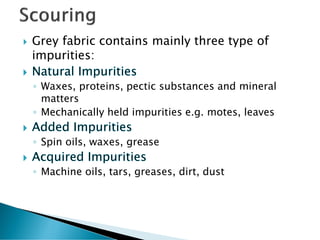
 Grey fabric contains mainly three type of
impurities:
◦ Waxes, proteins, pectic substances and mineral
matters
◦ Mechanically held impurities e.g. motes, leaves
◦ Spin oils, waxes, grease
◦ Machine oils, tars, greases, dirt, dust
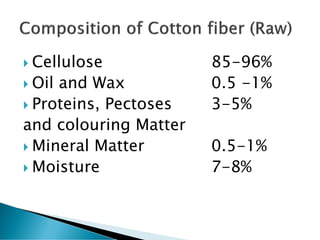
 Cellulose 85-96%
 Oil and Wax 0.5 -1%
 Proteins, Pectoses 3-5%
and colouring Matter
 Mineral Matter 0.5-1%
 Moisture 7-8%
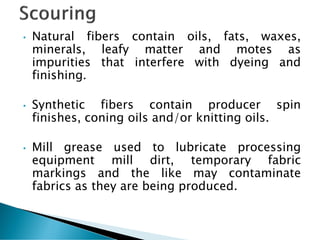
• Natural fibers contain oils, fats, waxes,
minerals, leafy matter and motes as
impurities that interfere with dyeing and
finishing.
• Synthetic fibers contain producer spin
finishes, coning oils and/or knitting oils.
• Mill grease used to lubricate processing
equipment mill dirt, temporary fabric
markings and the like may contaminate
fabrics as they are being produced.
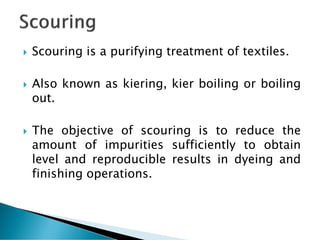
 Scouring is a purifying treatment of textiles.
 Also known as kiering, kier boiling or boiling
out.
 The objective of scouring is to reduce the
amount of impurities sufficiently to obtain
level and reproducible results in dyeing and
finishing operations.
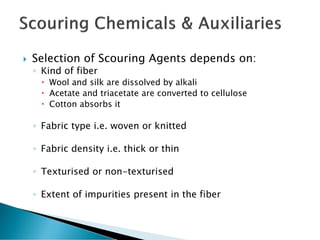
 Selection of Scouring Agents depends on:
◦ Kind of fiber
 Wool and silk are dissolved by alkali
 Acetate and triacetate are converted to cellulose
 Cotton absorbs it
◦ Fabric type i.e. woven or knitted
◦ Fabric density i.e. thick or thin
◦ Texturised or non-texturised
◦ Extent of impurities present in the fiber
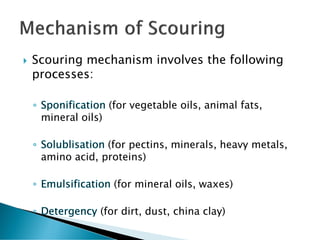
 Scouring mechanism involves the following
processes:
(for vegetable oils, animal fats,
mineral oils)
(for pectins, minerals, heavy metals,
amino acid, proteins)
(for mineral oils, waxes)
(for dirt, dust, china clay)
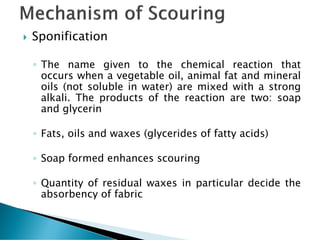
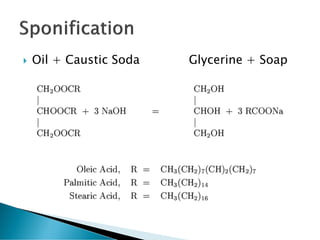
 Sponification
◦ The name given to the chemical reaction that
occurs when a vegetable oil, animal fat and mineral
oils (not soluble in water) are mixed with a strong
alkali. The products of the reaction are two: soap
and glycerin
◦ Fats, oils and waxes (glycerides of fatty acids)
◦ Soap formed enhances scouring
◦ Quantity of residual waxes in particular decide the
absorbency of fabric
 Oil + Caustic Soda Glycerine + Soap
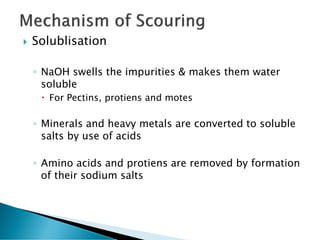
 Solublisation
◦ NaOH swells the impurities & makes them water
soluble
 For Pectins, protiens and motes
◦ Minerals and heavy metals are converted to soluble
salts by use of acids
◦ Amino acids and protiens are removed by formation
of their sodium salts
 Emulsification
◦ An emulsion is a mixture of two or
more liquids that are normally immiscible
◦ Non-sponifiable mineral oils and waxes which are
esters of higher fatty alcohols and fatty acids
(natural and added) can be removed by emulsifying
them with a surfactant (emulsifying agent)
◦ Ordinary soap (washing soap) is a good emulsifying
agent
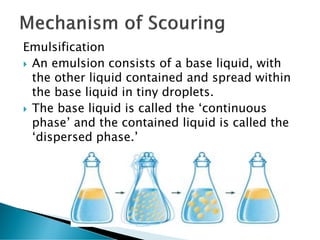
Emulsification
 An emulsion consists of a base liquid, with
the other liquid contained and spread within
the base liquid in tiny droplets.
 The base liquid is called the ‘continuous
phase’ and the contained liquid is called the
‘dispersed phase.’
 In order to keep the liquids uniformly distributed and
stable, an agent used is called emulsifying agent.
 These agents have both a hydrophilic and a lipophilic
part in their chemical structure.
 They concentrate at and are adsorbed onto the
oil:water interface to provide a protective barrier
around the dispersed droplets.
 They also reduce the interfacial tension of the system.
 Some agents enhance stability by imparting a charge
on the droplet surface.
 In scouring it is a soap formed already.
 The remaining constituent of size and other
dust and dirt particles, stains, are removed by
detergency.
 Detergency is closely bound up with surface
tension.
 When a piece of greige fabric is placed on the surface
of water in a beaker, the piece does not sink but floats
on its surface.
 This is because every molecule of water is attracted by
every other molecule of water.
 The molecules inside the water counterbalance the
forces from all sides and cancel out the overall effect
on them.
 While the surface molecules are only pulled sideways
and downward, due to which they form and interface
between liquid and solid.
 Generally, surface tension between textile fibres, and water
is high, and hence wetting of the fibre surface does not
take place thoroughly and quickly.
 A surfactant is a substance which, when applied in low
concentration, markedly reduces the surface tension of a
solution.
 A good surfactant, for example, will reduce the surface
tension of water from 72 dynes/cm to 30 dynes/ cm at a
concentration of less than 0.1%.
 The concentration at which no further reduction in surface
tension occurs is known as 'critical micelle concentration'.
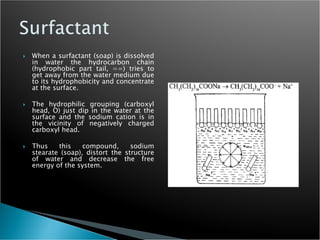
 When a surfactant (soap) is dissolved
in water the hydrocarbon chain
(hydrophobic part tail, ==) tries to
get away from the water medium due
to its hydrophobicity and concentrate
at the surface.
 The hydrophilic grouping (carboxyl
head, O) just dip in the water at the
surface and the sodium cation is in
the vicinity of negatively charged
carboxyl head.
 Thus this compound, sodium
stearate (soap), distort the structure
of water and decrease the free
energy of the system.
◦ The reason for reddish shade after bleaching with peroxide is
the high content of manganese.
◦ The contents of Fe, Mn, Ca and Mg varies depending upon the
origin of cotton
◦ Can be done by complexion and consequent solublization
using an acid or alkali
◦ Usually done by sequestering action.
◦ They form complexes with metal ions and keep them away
from fabric.
 Generally good pre-treated materials should have 100-
300 p.p.m, of Ca and Mg and 4-8 p.p.m, iron.
◦ Advantages
 Better Levelness and more Brilliance in textile dyeing
 lower peroxide consumption in bleaching
 Increase in degree of Whiteness
 regular decomposition of peroxide and No catalytic
damage
 Absorbency: Drop Test
◦ Min 3 Sec and max 10 sec
 Weight loss is also checked
 Residual Wax Content
◦ Wax is dissolved in a solvent
◦ Solvent is distilled off
◦ The sample is reweighed
 Dyeing and Chemical Technology of Textile
Fibers, By: E.R. Trotman
 Chemical Technology in the pretreatment
processes of Textiles, By: S.R. Karmakar.
 Absorbency:
◦ Drop Test
 Less than 5 sec
◦ Other tests
 Wicking Height
 Sinking Test
 Weight loss is also checked
 Residual Wax Content
◦ Wax is dissolved in a solvent
◦ Solvent is distilled off
◦ The sample is reweighed
 Removal of Motes
◦ Observed visually and given a rating of 1-5

Scouring process in textile processing

  • 2.
     Grey fabriccontains mainly three type of impurities: ◦ Waxes, proteins, pectic substances and mineral matters ◦ Mechanically held impurities e.g. motes, leaves ◦ Spin oils, waxes, grease ◦ Machine oils, tars, greases, dirt, dust
  • 3.
     Cellulose 85-96% Oil and Wax 0.5 -1%  Proteins, Pectoses 3-5% and colouring Matter  Mineral Matter 0.5-1%  Moisture 7-8%
  • 4.
    • Natural fiberscontain oils, fats, waxes, minerals, leafy matter and motes as impurities that interfere with dyeing and finishing. • Synthetic fibers contain producer spin finishes, coning oils and/or knitting oils. • Mill grease used to lubricate processing equipment mill dirt, temporary fabric markings and the like may contaminate fabrics as they are being produced.
  • 5.
     Scouring isa purifying treatment of textiles.  Also known as kiering, kier boiling or boiling out.  The objective of scouring is to reduce the amount of impurities sufficiently to obtain level and reproducible results in dyeing and finishing operations.
  • 7.
     Selection ofScouring Agents depends on: ◦ Kind of fiber  Wool and silk are dissolved by alkali  Acetate and triacetate are converted to cellulose  Cotton absorbs it ◦ Fabric type i.e. woven or knitted ◦ Fabric density i.e. thick or thin ◦ Texturised or non-texturised ◦ Extent of impurities present in the fiber
  • 8.
     Scouring mechanisminvolves the following processes: (for vegetable oils, animal fats, mineral oils) (for pectins, minerals, heavy metals, amino acid, proteins) (for mineral oils, waxes) (for dirt, dust, china clay)
  • 9.
     Sponification ◦ Thename given to the chemical reaction that occurs when a vegetable oil, animal fat and mineral oils (not soluble in water) are mixed with a strong alkali. The products of the reaction are two: soap and glycerin ◦ Fats, oils and waxes (glycerides of fatty acids) ◦ Soap formed enhances scouring ◦ Quantity of residual waxes in particular decide the absorbency of fabric
  • 10.
     Oil +Caustic Soda Glycerine + Soap
  • 11.
     Solublisation ◦ NaOHswells the impurities & makes them water soluble  For Pectins, protiens and motes ◦ Minerals and heavy metals are converted to soluble salts by use of acids ◦ Amino acids and protiens are removed by formation of their sodium salts
  • 12.
     Emulsification ◦ Anemulsion is a mixture of two or more liquids that are normally immiscible ◦ Non-sponifiable mineral oils and waxes which are esters of higher fatty alcohols and fatty acids (natural and added) can be removed by emulsifying them with a surfactant (emulsifying agent) ◦ Ordinary soap (washing soap) is a good emulsifying agent
  • 13.
    Emulsification  An emulsionconsists of a base liquid, with the other liquid contained and spread within the base liquid in tiny droplets.  The base liquid is called the ‘continuous phase’ and the contained liquid is called the ‘dispersed phase.’
  • 14.
     In orderto keep the liquids uniformly distributed and stable, an agent used is called emulsifying agent.  These agents have both a hydrophilic and a lipophilic part in their chemical structure.  They concentrate at and are adsorbed onto the oil:water interface to provide a protective barrier around the dispersed droplets.  They also reduce the interfacial tension of the system.  Some agents enhance stability by imparting a charge on the droplet surface.  In scouring it is a soap formed already.
  • 15.
     The remainingconstituent of size and other dust and dirt particles, stains, are removed by detergency.  Detergency is closely bound up with surface tension.
  • 16.
     When apiece of greige fabric is placed on the surface of water in a beaker, the piece does not sink but floats on its surface.  This is because every molecule of water is attracted by every other molecule of water.  The molecules inside the water counterbalance the forces from all sides and cancel out the overall effect on them.  While the surface molecules are only pulled sideways and downward, due to which they form and interface between liquid and solid.
  • 17.
     Generally, surfacetension between textile fibres, and water is high, and hence wetting of the fibre surface does not take place thoroughly and quickly.  A surfactant is a substance which, when applied in low concentration, markedly reduces the surface tension of a solution.  A good surfactant, for example, will reduce the surface tension of water from 72 dynes/cm to 30 dynes/ cm at a concentration of less than 0.1%.  The concentration at which no further reduction in surface tension occurs is known as 'critical micelle concentration'.
  • 18.
     When asurfactant (soap) is dissolved in water the hydrocarbon chain (hydrophobic part tail, ==) tries to get away from the water medium due to its hydrophobicity and concentrate at the surface.  The hydrophilic grouping (carboxyl head, O) just dip in the water at the surface and the sodium cation is in the vicinity of negatively charged carboxyl head.  Thus this compound, sodium stearate (soap), distort the structure of water and decrease the free energy of the system.
  • 19.
    ◦ The reasonfor reddish shade after bleaching with peroxide is the high content of manganese. ◦ The contents of Fe, Mn, Ca and Mg varies depending upon the origin of cotton ◦ Can be done by complexion and consequent solublization using an acid or alkali ◦ Usually done by sequestering action. ◦ They form complexes with metal ions and keep them away from fabric.  Generally good pre-treated materials should have 100- 300 p.p.m, of Ca and Mg and 4-8 p.p.m, iron.
  • 20.
    ◦ Advantages  BetterLevelness and more Brilliance in textile dyeing  lower peroxide consumption in bleaching  Increase in degree of Whiteness  regular decomposition of peroxide and No catalytic damage
  • 21.
     Absorbency: DropTest ◦ Min 3 Sec and max 10 sec  Weight loss is also checked  Residual Wax Content ◦ Wax is dissolved in a solvent ◦ Solvent is distilled off ◦ The sample is reweighed
  • 22.
     Dyeing andChemical Technology of Textile Fibers, By: E.R. Trotman  Chemical Technology in the pretreatment processes of Textiles, By: S.R. Karmakar.
  • 23.
     Absorbency: ◦ DropTest  Less than 5 sec ◦ Other tests  Wicking Height  Sinking Test  Weight loss is also checked  Residual Wax Content ◦ Wax is dissolved in a solvent ◦ Solvent is distilled off ◦ The sample is reweighed  Removal of Motes ◦ Observed visually and given a rating of 1-5