MERCERIZATION
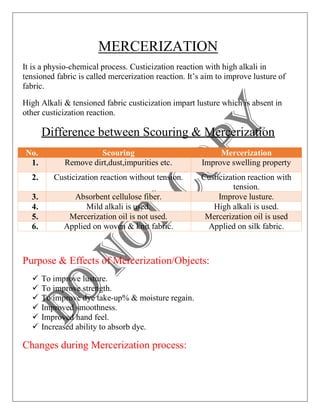
It is a physio-chemical process. Custicization reaction with high alkali in
tensioned fabric is called mercerization reaction. It’s aim to improve lusture of
fabric.
High Alkali & tensioned fabric custicization impart lusture which is absent in
other custicization reaction.
Difference between Scouring & Mercerization
No. Scouring Mercerization
1. Remove dirt,dust,impurities etc. Improve swelling property
2. Custicization reaction without tension. Custicization reaction with
tension.
3. Absorbent cellulose fiber. Improve lusture.
4. Mild alkali is used. High alkali is used.
5. Mercerization oil is not used. Mercerization oil is used
6. Applied on woven & knit fabric. Applied on silk fabric.
Purpose & Effects of Mercerization/Objects:
 To improve lusture.
 To improve strength.
 To improve dye take-up% & moisture regain.
 Improved smoothness.
 Improved hand feel.
 Increased ability to absorb dye.
Changes during Mercerization process:
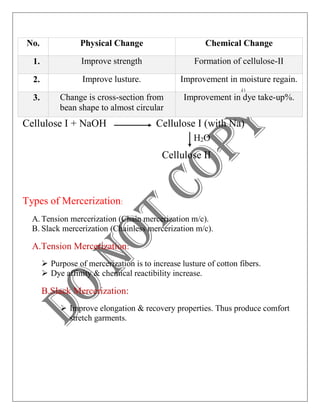
Cellulose I + NaOH Cellulose I (with Na)
Types of Mercerization:
A. Tension mercerization (Chain mercerization m/c).
B. Slack mercerization (Chainless mercerization m/c).
A.Tension Mercerization:
 Purpose of mercerization is to increase lusture of cotton fibers.
 Dye affinity & chemical reactibility increase.
B.Slack Mercerization:
 Improve elongation & recovery properties. Thus produce comfort
stretch garments.
No. Physical Change Chemical Change
1. Improve strength Formation of cellulose-II
2. Improve lusture. Improvement in moisture regain.
3. Change is cross-section from
bean shape to almost circular
Improvement in dye take-up%.
Cellulose II
H2O
Factors of Mercerization:
 Twaddle(conc.of NaOH) : In between 54 to 48 degree Tw OR, 25Be to
32Be.
 Temperature: Temperature is room temp. in between 18C -20 C
 Tension: applied on both warp & weft side by clipping.
 Time: 15 m/min fabric speed for 4-5 min.
Why lusture & strength is increased after Mercerization?
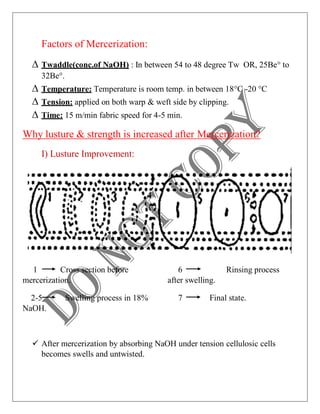
I) Lusture Improvement:
1 Cross section before
mercerization.
2-5 Swelling process in 18%
NaOH.
6 Rinsing process
after swelling.
7 Final state.
 After mercerization by absorbing NaOH under tension cellulosic cells
becomes swells and untwisted.
 We can see by SEM(Scanning Electron Microscope) that the cross-section
of cells becomes circular from kidney shape.
 Mercerizations results in the swelling of the cell wall of the cotton fiber.
This causes an increase in the surface area & reflectance and thus increased
lusture.
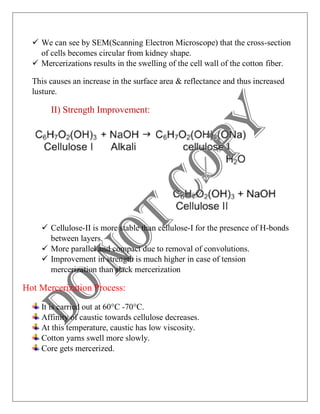
II) Strength Improvement:
 Cellulose-II is more stable than cellulose-I for the presence of H-bonds
between layers.
 More parallel and compact due to removal of convolutions.
 Improvement in strength is much higher in case of tension
mercerization than slack mercerization
Hot Mercerization Process:
It is carried out at 60C -70C.
Affinity of caustic towards cellulose decreases.
At this temperature, caustic has low viscosity.
Cotton yarns swell more slowly.
Core gets mercerized.
Hot Mercerization Parameters:
1) Concentration: In between 28-30 Be otherwise desired result is not
achieved.
2) Temperature: controlled in a range of 60C -70C.
3) Dwell time: 25-30 sec.
Dwell time is the total impregnation time of fabric in alkali solution.
Advantage & Disadvantage of Hot Mercerization:
Advantage Disadvantage
 Uniform core mercerization is
achieved.
 Gives poor lusture as compared
to cold mercerization.
 Controlled temp. Ensures
excellent shade reproducibility.
 Higher energy consumption.
 Dwell time is theoretically
reduced upto 20-25 sec giving
higher productivity.
 Costlier.
 Upto 30% less consumption of
dye, water & electricity.
Liquid Ammonia Mercerization:
Treatment of cotton fiber with liquid ammonia (NH3) produces similar
effect that of mercerization.
The liquid ammonia treatment is widely acceptable for yarns used in
sewing threads and special fabrics like denims, pillow material,linen,jute
and blend of cellulose with PET or NYLON.
Advantage & Disadvantage of Liquid Ammonia Mercerization:
Advantage Disadvantage
 Less pollution.  Very costly equipment.
 Higher productivity.  High conc.NH3 can effect
environment.
 Jute and linen can be mercerized.  Hygienic process.
 Evenness & uniformity of
swelling is comparatively better.
Comparison of Mercerization Process
Property Conventional Merc. Hot Merc. Liquid NH3 Merc.
Swelling speed Low Fast Very fast
Evenness Uneven Good Good
Lusture Good Good Very good
Dye uptake Good Not quite High Good
Dimensional stability Good Good Good

Mercerization

  • 1.
    MERCERIZATION It is aphysio-chemical process. Custicization reaction with high alkali in tensioned fabric is called mercerization reaction. It’s aim to improve lusture of fabric. High Alkali & tensioned fabric custicization impart lusture which is absent in other custicization reaction. Difference between Scouring & Mercerization No. Scouring Mercerization 1. Remove dirt,dust,impurities etc. Improve swelling property 2. Custicization reaction without tension. Custicization reaction with tension. 3. Absorbent cellulose fiber. Improve lusture. 4. Mild alkali is used. High alkali is used. 5. Mercerization oil is not used. Mercerization oil is used 6. Applied on woven & knit fabric. Applied on silk fabric. Purpose & Effects of Mercerization/Objects:  To improve lusture.  To improve strength.  To improve dye take-up% & moisture regain.  Improved smoothness.  Improved hand feel.  Increased ability to absorb dye. Changes during Mercerization process:
  • 2.
    Cellulose I +NaOH Cellulose I (with Na) Types of Mercerization: A. Tension mercerization (Chain mercerization m/c). B. Slack mercerization (Chainless mercerization m/c). A.Tension Mercerization:  Purpose of mercerization is to increase lusture of cotton fibers.  Dye affinity & chemical reactibility increase. B.Slack Mercerization:  Improve elongation & recovery properties. Thus produce comfort stretch garments. No. Physical Change Chemical Change 1. Improve strength Formation of cellulose-II 2. Improve lusture. Improvement in moisture regain. 3. Change is cross-section from bean shape to almost circular Improvement in dye take-up%. Cellulose II H2O
  • 3.
    Factors of Mercerization: Twaddle(conc.of NaOH) : In between 54 to 48 degree Tw OR, 25Be to 32Be.  Temperature: Temperature is room temp. in between 18C -20 C  Tension: applied on both warp & weft side by clipping.  Time: 15 m/min fabric speed for 4-5 min. Why lusture & strength is increased after Mercerization? I) Lusture Improvement: 1 Cross section before mercerization. 2-5 Swelling process in 18% NaOH. 6 Rinsing process after swelling. 7 Final state.  After mercerization by absorbing NaOH under tension cellulosic cells becomes swells and untwisted.
  • 4.
     We cansee by SEM(Scanning Electron Microscope) that the cross-section of cells becomes circular from kidney shape.  Mercerizations results in the swelling of the cell wall of the cotton fiber. This causes an increase in the surface area & reflectance and thus increased lusture. II) Strength Improvement:  Cellulose-II is more stable than cellulose-I for the presence of H-bonds between layers.  More parallel and compact due to removal of convolutions.  Improvement in strength is much higher in case of tension mercerization than slack mercerization Hot Mercerization Process: It is carried out at 60C -70C. Affinity of caustic towards cellulose decreases. At this temperature, caustic has low viscosity. Cotton yarns swell more slowly. Core gets mercerized.
  • 5.
    Hot Mercerization Parameters: 1)Concentration: In between 28-30 Be otherwise desired result is not achieved. 2) Temperature: controlled in a range of 60C -70C. 3) Dwell time: 25-30 sec. Dwell time is the total impregnation time of fabric in alkali solution. Advantage & Disadvantage of Hot Mercerization: Advantage Disadvantage  Uniform core mercerization is achieved.  Gives poor lusture as compared to cold mercerization.  Controlled temp. Ensures excellent shade reproducibility.  Higher energy consumption.  Dwell time is theoretically reduced upto 20-25 sec giving higher productivity.  Costlier.  Upto 30% less consumption of dye, water & electricity. Liquid Ammonia Mercerization: Treatment of cotton fiber with liquid ammonia (NH3) produces similar effect that of mercerization. The liquid ammonia treatment is widely acceptable for yarns used in sewing threads and special fabrics like denims, pillow material,linen,jute and blend of cellulose with PET or NYLON.
  • 6.
    Advantage & Disadvantageof Liquid Ammonia Mercerization: Advantage Disadvantage  Less pollution.  Very costly equipment.  Higher productivity.  High conc.NH3 can effect environment.  Jute and linen can be mercerized.  Hygienic process.  Evenness & uniformity of swelling is comparatively better. Comparison of Mercerization Process Property Conventional Merc. Hot Merc. Liquid NH3 Merc. Swelling speed Low Fast Very fast Evenness Uneven Good Good Lusture Good Good Very good Dye uptake Good Not quite High Good Dimensional stability Good Good Good