
• Natural fiber and fabrics even after scouring still
contain naturally occurring coloring matter.
• Natural fibers are off-white in color due to color
bodies present in the fiber
• This yellowish and brown coloration may be
related to of the cotton flower.
• The climate, soil, drought and frost can also
cause various degrees of yellowness.
• Tips of leaves or stalks coming in contact with
the moist ball after opening will cause dark
spots and coloration.
• Coloration may also come from dirt, dust,
insects or from harvesting or processing
equipment in the form of oils and greases.
• The objective of bleaching is to produce white
fabrics by destroying the coloring matter with
the help of bleaching agents with minimum
degradation of the fiber.
• The bleaching agents either
the coloring matter which is washed out and
whiteness thus obtained is of permanent nature.
• Chemical bleaching of textile fibers is further
aided by addition of optical brighteners.
• Mechanism of bleaching is very complicated and not
completely understood.
• One opinion is that the color producing agents in natural
fibers are often organic compounds containing conjugated
double bonds.
• It is known in dye chemistry that conjugation is necessary
for an organic molecule to perform as a dyestuff.
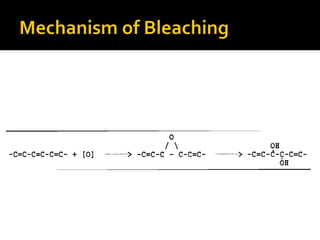
• Decoloration can occur by breaking up the chromophore,
most likely destroying one or more of the double bonds
within the conjugated system.
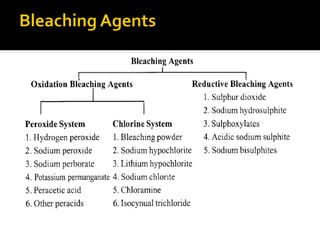
 The major bleaching agents used in textile preparation are
sodium hypochlorite, hydrogen peroxide and sodium
chlorite.
 Other bleaching agents, of lesser importance to textile
preparation but important in consumer laundry products, are
perborates, percarbonates and peracetic acid.
 All of these are oxidative bleaches.
 Known to degrade cellulose so the objective in bleaching is
to optimize whitening and minimize fiber damage.
• Most commonly & widely used bleaching agent.
• 90 to 95 % of all cotton and cotton/synthetic
blends are bleached with hydrogen peroxide
discovered hydrogen peroxide in 1818
and called it .
• It is available commercially as 35, 50 and 70 %
solutions.
• It is a corrosive, oxidizing agent which may cause
combustion when allowed to dry out on oxidizable
organic matter.
• Decomposition is accelerated by metal contamination
and is accompanied by the liberation of heat and
oxygen, which will support combustion and explosions
in confined spaces.
• The material is an irritant to the skin and mucous
membranes and dangerous to the eyes.
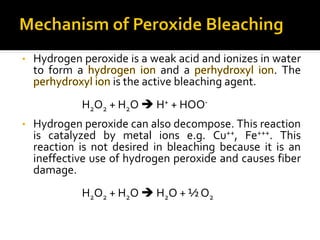
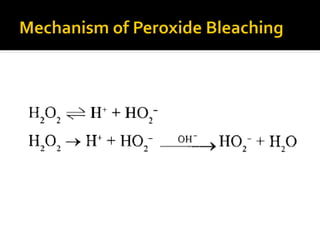
• Hydrogen peroxide is a weak acid and ionizes in water
to form a and a . The
is the active bleaching agent.
H2O2 + H2O  H+ + HOO-
• Hydrogen peroxide can also decompose. This reaction
is catalyzed by metal ions e.g. Cu++, Fe+++. This
reaction is not desired in bleaching because it is an
ineffective use of hydrogen peroxide and causes fiber
damage.
H2O2 + H2O  H2O + ½ O2
• Though hydrogen peroxide is stable in acidic medium, but
bleaching occurs by the addition of alkali or by increased
temperature. Hydrogen peroxide liberates perhydroxyl ion
(HO2-) in aqueous medium and chemically behaves like a
weak dibasic acid.
• The perhydroxyl is highly unstable and in the presence of
oxidisable substance (coloured impurities in cotton), it is
decomposed and thus bleaching action takes place.
• Sodium hydroxide activates hydrogen peroxide because
H+ ion is neutralized by alkali which is favorable for
liberation of HO2-.
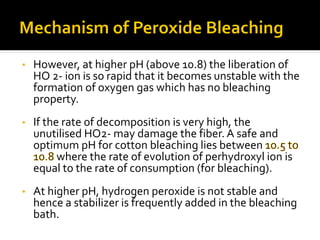
• However, at higher pH (above 10.8) the liberation of
HO 2- ion is so rapid that it becomes unstable with the
formation of oxygen gas which has no bleaching
property.
• If the rate of decomposition is very high, the
unutilised HO2- may damage the fiber. A safe and
optimum pH for cotton bleaching lies between
where the rate of evolution of perhydroxyl ion is
equal to the rate of consumption (for bleaching).
• At higher pH, hydrogen peroxide is not stable and
hence a stabilizer is frequently added in the bleaching
bath.
• The process of regulation or control of
perhydroxyl ion to prevent rapid
decomposition of bleach and to minimize
fiber degradation is described as
.
• They could include any of the followings:
• e.g. caustic soda/carbonate/silicate
• e.g. acrylates/phosphonates
• e.g. EDTA/TPA/heptonates/gluconates
• e.g. magnesium salts
• e.g. acrylic polymers
 Stabilizers
 To control the decomposition of hydrogen peroxide.
 The process of regulation or control of perhydroxyl ion to prevent
rapid decomposition of bleach and to minimize fiber degradation is
described as stabilization
 Stabilizers function
▪ Stabilisers for peroxide normally work by controlling the formation
of free radicals
▪ By providing buffering action to control the pH at the optimum
level
▪ To complex with trace metals which catalyze the degradation of the
fibers
 Stabilizers include sodium silicate, inorganic and organic compounds and
phosphates
 Sodium silicate is the most conventional, easily available and widely used
stabilizer
 It is very difficult to specify strict guidelines
for optimum bleaching conditions for
hydrogen peroxide as the operation is
normally affected by the nature and quality
of the goods to be bleached, the amount of
bleaching required and on the equipment
available.
 However, the following general variables are
considered to be important:
• The stability of hydrogen peroxide depends on
pH. At pH 1 to 3 it is stable ; but at highly alkaline
pH 11.5 to 13 it has least stability.The bleaching
takes place around 10.5 due to accumulation of
perhydroxyl ions in the bleaching bath.
• At neutral or weak alkaline media, hydrogen
peroxide does not produce any whitening effect
and may cause degradation of cellulose.
• In practice cotton bleaching with hydrogen peroxide is carried out
at 90-100°C but the temperature may be increased to 120°C in
the case of pressurized equipment with a corresponding reduction
in process time.
• The rate of bleaching increases with the increase in temperature,
but at the same time solution becomes unstable and degradation
of cotton increases.
 Better bleaching occurs at 95 to 100 C.
 This feature makes it ideal for continuous operations using insulated J-
boxes or open-width steamers.
• Below 80°C the evolution of perhydroxyl ion is very slow so also
the rate of bleaching.
• The optimum concentration of hydrogen
peroxide depends on number of factors
namely:
• Liquor ratio
• Temperature
• Class of fiber
• The time required to bleach with hydrogen peroxide
depends on:
• Temperature
• Class of fiber
• Equipment used for bleaching
 In general, the time of bleaching is inversely proportional
to the temperature of the bleaching bath.
 Usually
▪ 18-24 hrs for cold pad batch
▪ 10-20 min for continuous steaming
 Bleaching with sodium chlorite is carried out under
acidic conditions which releases chlorine dioxide, a
toxic and corrosive yellow-brown gas.
 Sodium chlorite is sold as an 80% free flowing
powder.
 Chlorine dioxide is thought to be the active
bleaching specie.
 It is not used much for bleaching but it is
sometimes used to strip dyed goods and is often
described as the bleach of last resort.
 One advantage of sodium chlorite bleaching is that
it leaves the fabrics with a soft hand.
 Because of the gaseous nature, toxicity and
corrosiveness of chlorine dioxide, special attention
must be paid to the equipment.
 It must be designed so as to not allow the gas to
escape into the work place. Emissions into the
atmosphere are of concern too.
 The gas corrodes even stainless steel so special
passivating treatments must be carried out to
prolong the life of the equipment.
 The corrosive nature of this chemical demands
exotic constructional materials such as titanium.
 When a solution of sodium chlorite is
acidified, chlorine dioxide (ClO2),
hypochlorous acid (HClO2), sodium chlorate
(NaClO3) and sodium chloride (NaCl) are
formed.
 Chlorine dioxide and hypochlorous acid are
bleaching species, sodium chlorate and
sodium chloride are not.
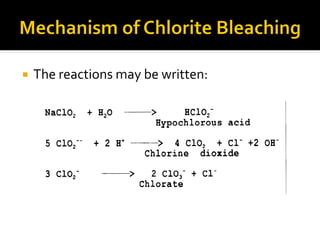
 The reactions may be written:
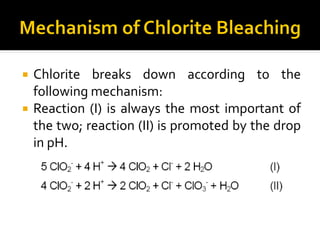
 Chlorite breaks down according to the
following mechanism:
 Reaction (I) is always the most important of
the two; reaction (II) is promoted by the drop
in pH.
 Chlorine dioxide is favored at low pH i.e., 1 to 2.5.
 It is a more active bleaching agent than hypochlorous
acid which is favored at pH 4 to 5.
 Relatively unaffected by iron or copper contamination.
 However chlorine dioxide is a corrosive and toxic gas.
 When generated too rapidly, it escapes from the
bleaching bath into the atmosphere creating an
explosion and health hazard.
 Once the chlorine dioxide is out of solution, its
effectiveness as a bleaching agent is lost.
 Little or no bleaching takes place at temperatures
below 50° C, however the bleaching rate increases
considerably up to 90° C.
 Going to the boil is not recommended because it
leads to excessive loss of chlorine dioxide with the
steam.
 Oxidation action occurs due to chlorine
peroxide which develops by acidification
process.
 Process
 Concentration 0.3-0.5 g/L
 pH is around 4
 Temperature is 95 °C
 Time give 45-60 min
 Disadvantages
 Expensive
 Can’t be used for wool and silk
 Chlorine dioxide is corrosive
 Acidic media damages the cotton
 Whiteness Measurement:
The CIEWhiteness Index value (CIEWI) is determined using
AATCCTest method-110.
 Fluidity:
Chemical degradation of cotton (using Cupriethylene Diamin)
is used to determine the chemical degradation of cotton by
measurement of its fluidity (viscosities) as per AATCC Test
Method-82.
 Tensile,Tear or Bursting Strength.

Bleaching process in textile processing

  • 2.
    • Natural fiberand fabrics even after scouring still contain naturally occurring coloring matter. • Natural fibers are off-white in color due to color bodies present in the fiber • This yellowish and brown coloration may be related to of the cotton flower. • The climate, soil, drought and frost can also cause various degrees of yellowness.
  • 3.
    • Tips ofleaves or stalks coming in contact with the moist ball after opening will cause dark spots and coloration. • Coloration may also come from dirt, dust, insects or from harvesting or processing equipment in the form of oils and greases.
  • 4.
    • The objectiveof bleaching is to produce white fabrics by destroying the coloring matter with the help of bleaching agents with minimum degradation of the fiber. • The bleaching agents either the coloring matter which is washed out and whiteness thus obtained is of permanent nature. • Chemical bleaching of textile fibers is further aided by addition of optical brighteners.
  • 5.
    • Mechanism ofbleaching is very complicated and not completely understood. • One opinion is that the color producing agents in natural fibers are often organic compounds containing conjugated double bonds. • It is known in dye chemistry that conjugation is necessary for an organic molecule to perform as a dyestuff. • Decoloration can occur by breaking up the chromophore, most likely destroying one or more of the double bonds within the conjugated system.
  • 8.
     The majorbleaching agents used in textile preparation are sodium hypochlorite, hydrogen peroxide and sodium chlorite.  Other bleaching agents, of lesser importance to textile preparation but important in consumer laundry products, are perborates, percarbonates and peracetic acid.  All of these are oxidative bleaches.  Known to degrade cellulose so the objective in bleaching is to optimize whitening and minimize fiber damage.
  • 9.
    • Most commonly& widely used bleaching agent. • 90 to 95 % of all cotton and cotton/synthetic blends are bleached with hydrogen peroxide discovered hydrogen peroxide in 1818 and called it . • It is available commercially as 35, 50 and 70 % solutions.
  • 10.
    • It isa corrosive, oxidizing agent which may cause combustion when allowed to dry out on oxidizable organic matter. • Decomposition is accelerated by metal contamination and is accompanied by the liberation of heat and oxygen, which will support combustion and explosions in confined spaces. • The material is an irritant to the skin and mucous membranes and dangerous to the eyes.
  • 11.
    • Hydrogen peroxideis a weak acid and ionizes in water to form a and a . The is the active bleaching agent. H2O2 + H2O  H+ + HOO- • Hydrogen peroxide can also decompose. This reaction is catalyzed by metal ions e.g. Cu++, Fe+++. This reaction is not desired in bleaching because it is an ineffective use of hydrogen peroxide and causes fiber damage. H2O2 + H2O  H2O + ½ O2
  • 12.
    • Though hydrogenperoxide is stable in acidic medium, but bleaching occurs by the addition of alkali or by increased temperature. Hydrogen peroxide liberates perhydroxyl ion (HO2-) in aqueous medium and chemically behaves like a weak dibasic acid. • The perhydroxyl is highly unstable and in the presence of oxidisable substance (coloured impurities in cotton), it is decomposed and thus bleaching action takes place. • Sodium hydroxide activates hydrogen peroxide because H+ ion is neutralized by alkali which is favorable for liberation of HO2-.
  • 14.
    • However, athigher pH (above 10.8) the liberation of HO 2- ion is so rapid that it becomes unstable with the formation of oxygen gas which has no bleaching property. • If the rate of decomposition is very high, the unutilised HO2- may damage the fiber. A safe and optimum pH for cotton bleaching lies between where the rate of evolution of perhydroxyl ion is equal to the rate of consumption (for bleaching). • At higher pH, hydrogen peroxide is not stable and hence a stabilizer is frequently added in the bleaching bath.
  • 15.
    • The processof regulation or control of perhydroxyl ion to prevent rapid decomposition of bleach and to minimize fiber degradation is described as .
  • 16.
    • They couldinclude any of the followings: • e.g. caustic soda/carbonate/silicate • e.g. acrylates/phosphonates • e.g. EDTA/TPA/heptonates/gluconates • e.g. magnesium salts • e.g. acrylic polymers
  • 17.
     Stabilizers  Tocontrol the decomposition of hydrogen peroxide.  The process of regulation or control of perhydroxyl ion to prevent rapid decomposition of bleach and to minimize fiber degradation is described as stabilization  Stabilizers function ▪ Stabilisers for peroxide normally work by controlling the formation of free radicals ▪ By providing buffering action to control the pH at the optimum level ▪ To complex with trace metals which catalyze the degradation of the fibers  Stabilizers include sodium silicate, inorganic and organic compounds and phosphates  Sodium silicate is the most conventional, easily available and widely used stabilizer
  • 18.
     It isvery difficult to specify strict guidelines for optimum bleaching conditions for hydrogen peroxide as the operation is normally affected by the nature and quality of the goods to be bleached, the amount of bleaching required and on the equipment available.
  • 19.
     However, thefollowing general variables are considered to be important:
  • 20.
    • The stabilityof hydrogen peroxide depends on pH. At pH 1 to 3 it is stable ; but at highly alkaline pH 11.5 to 13 it has least stability.The bleaching takes place around 10.5 due to accumulation of perhydroxyl ions in the bleaching bath. • At neutral or weak alkaline media, hydrogen peroxide does not produce any whitening effect and may cause degradation of cellulose.
  • 21.
    • In practicecotton bleaching with hydrogen peroxide is carried out at 90-100°C but the temperature may be increased to 120°C in the case of pressurized equipment with a corresponding reduction in process time. • The rate of bleaching increases with the increase in temperature, but at the same time solution becomes unstable and degradation of cotton increases.  Better bleaching occurs at 95 to 100 C.  This feature makes it ideal for continuous operations using insulated J- boxes or open-width steamers. • Below 80°C the evolution of perhydroxyl ion is very slow so also the rate of bleaching.
  • 22.
    • The optimumconcentration of hydrogen peroxide depends on number of factors namely: • Liquor ratio • Temperature • Class of fiber
  • 23.
    • The timerequired to bleach with hydrogen peroxide depends on: • Temperature • Class of fiber • Equipment used for bleaching  In general, the time of bleaching is inversely proportional to the temperature of the bleaching bath.  Usually ▪ 18-24 hrs for cold pad batch ▪ 10-20 min for continuous steaming
  • 24.
     Bleaching withsodium chlorite is carried out under acidic conditions which releases chlorine dioxide, a toxic and corrosive yellow-brown gas.  Sodium chlorite is sold as an 80% free flowing powder.  Chlorine dioxide is thought to be the active bleaching specie.
  • 25.
     It isnot used much for bleaching but it is sometimes used to strip dyed goods and is often described as the bleach of last resort.  One advantage of sodium chlorite bleaching is that it leaves the fabrics with a soft hand.  Because of the gaseous nature, toxicity and corrosiveness of chlorine dioxide, special attention must be paid to the equipment.
  • 26.
     It mustbe designed so as to not allow the gas to escape into the work place. Emissions into the atmosphere are of concern too.  The gas corrodes even stainless steel so special passivating treatments must be carried out to prolong the life of the equipment.  The corrosive nature of this chemical demands exotic constructional materials such as titanium.
  • 27.
     When asolution of sodium chlorite is acidified, chlorine dioxide (ClO2), hypochlorous acid (HClO2), sodium chlorate (NaClO3) and sodium chloride (NaCl) are formed.  Chlorine dioxide and hypochlorous acid are bleaching species, sodium chlorate and sodium chloride are not.
  • 28.
     The reactionsmay be written:
  • 29.
     Chlorite breaksdown according to the following mechanism:  Reaction (I) is always the most important of the two; reaction (II) is promoted by the drop in pH.
  • 30.
     Chlorine dioxideis favored at low pH i.e., 1 to 2.5.  It is a more active bleaching agent than hypochlorous acid which is favored at pH 4 to 5.  Relatively unaffected by iron or copper contamination.  However chlorine dioxide is a corrosive and toxic gas.  When generated too rapidly, it escapes from the bleaching bath into the atmosphere creating an explosion and health hazard.
  • 31.
     Once thechlorine dioxide is out of solution, its effectiveness as a bleaching agent is lost.  Little or no bleaching takes place at temperatures below 50° C, however the bleaching rate increases considerably up to 90° C.  Going to the boil is not recommended because it leads to excessive loss of chlorine dioxide with the steam.
  • 32.
     Oxidation actionoccurs due to chlorine peroxide which develops by acidification process.  Process  Concentration 0.3-0.5 g/L  pH is around 4  Temperature is 95 °C  Time give 45-60 min
  • 33.
     Disadvantages  Expensive Can’t be used for wool and silk  Chlorine dioxide is corrosive  Acidic media damages the cotton
  • 34.
     Whiteness Measurement: TheCIEWhiteness Index value (CIEWI) is determined using AATCCTest method-110.  Fluidity: Chemical degradation of cotton (using Cupriethylene Diamin) is used to determine the chemical degradation of cotton by measurement of its fluidity (viscosities) as per AATCC Test Method-82.  Tensile,Tear or Bursting Strength.