 What are carbon nanotubes
 Discovery of carbon nanotubes
 Classification of CNTs
 Properties of CNTs
 Synthesis of nanotubes
 Advantages and Disadvantages
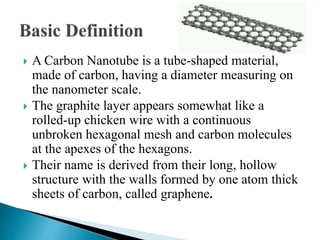
 A Carbon Nanotube is a tube-shaped material,
made of carbon, having a diameter measuring on
the nanometer scale.
 The graphite layer appears somewhat like a
rolled-up chicken wire with a continuous
unbroken hexagonal mesh and carbon molecules
at the apexes of the hexagons.
 Their name is derived from their long, hollow
structure with the walls formed by one atom thick
sheets of carbon, called graphene.
 1952- Radushkevich and Lukyanovich publish a paper in the Soviet
Journal of Physical Chemistry showing hollow graphitic carbon
fibers that are 50 nanometers in diameter.
 1979 - John Abrahamson presented evidence of carbon nanotubes at
the 14th Biennial Conference of Carbon at Pennsylvania State
University.
 1981 - A group of Soviet scientists published the results of chemical
and structural characterization of carbon nanoparticles produced by
a thermocatalytical disproportionation of carbon monoxide.
 1991 - Nanotubes discovered in the soot of arc discharge at NEC, by
Japanese researcher Sumio Iijima.
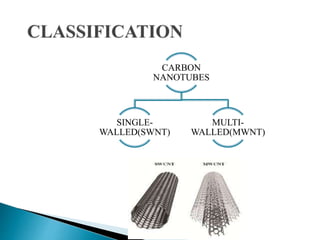
CARBON
NANOTUBES
SINGLE-
WALLED(SWNT)
MULTI-
WALLED(MWNT)
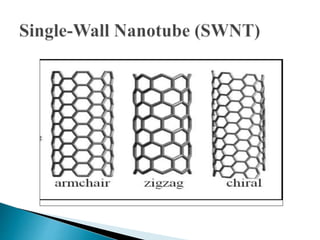
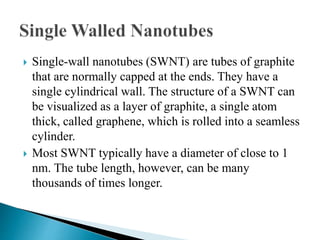
 Single-wall nanotubes (SWNT) are tubes of graphite
that are normally capped at the ends. They have a
single cylindrical wall. The structure of a SWNT can
be visualized as a layer of graphite, a single atom
thick, called graphene, which is rolled into a seamless
cylinder.
 Most SWNT typically have a diameter of close to 1
nm. The tube length, however, can be many
thousands of times longer.
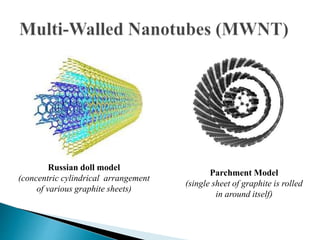
Russian doll model
(concentric cylindrical arrangement
of various graphite sheets)
Parchment Model
(single sheet of graphite is rolled
in around itself)
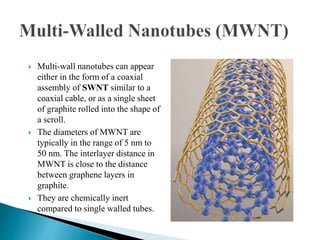
 Multi-wall nanotubes can appear
either in the form of a coaxial
assembly of SWNT similar to a
coaxial cable, or as a single sheet
of graphite rolled into the shape of
a scroll.
 The diameters of MWNT are
typically in the range of 5 nm to
50 nm. The interlayer distance in
MWNT is close to the distance
between graphene layers in
graphite.
 They are chemically inert
compared to single walled tubes.
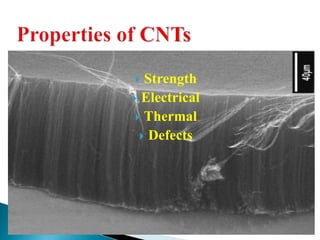
 Strength
 Electrical
 Thermal
 Defects
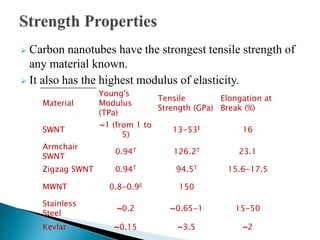
 Carbon nanotubes have the strongest tensile strength of
any material known.
 It also has the highest modulus of elasticity.
Material
Young's
Modulus
(TPa)
Tensile
Strength (GPa)
Elongation at
Break (%)
SWNT
~1 (from 1 to
5)
13-53E 16
Armchair
SWNT
0.94T 126.2T 23.1
Zigzag SWNT 0.94T 94.5T 15.6-17.5
MWNT 0.8-0.9E 150
Stainless
Steel
~0.2 ~0.65-1 15-50
Kevlar ~0.15 ~3.5 ~2
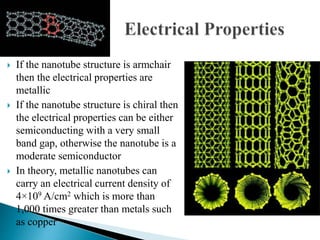
 If the nanotube structure is armchair
then the electrical properties are
metallic
 If the nanotube structure is chiral then
the electrical properties can be either
semiconducting with a very small
band gap, otherwise the nanotube is a
moderate semiconductor
 In theory, metallic nanotubes can
carry an electrical current density of
4×10⁹ A/cm2 which is more than
1,000 times greater than metals such
as copper
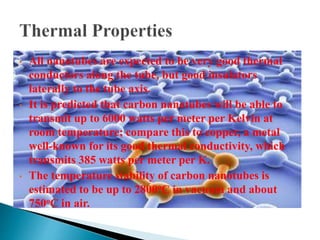
• All nanotubes are expected to be very good thermal
conductors along the tube, but good insulators
laterally to the tube axis.
• It is predicted that carbon nanotubes will be able to
transmit up to 6000 watts per meter per Kelvin at
room temperature; compare this to copper, a metal
well-known for its good thermal conductivity, which
transmits 385 watts per meter per K.
• The temperature stability of carbon nanotubes is
estimated to be up to 2800oC in vacuum and about
750oC in air.
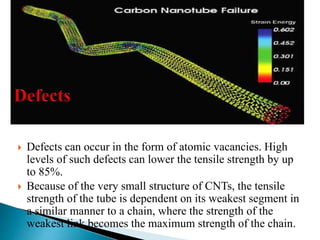
 Defects can occur in the form of atomic vacancies. High
levels of such defects can lower the tensile strength by up
to 85%.
 Because of the very small structure of CNTs, the tensile
strength of the tube is dependent on its weakest segment in
a similar manner to a chain, where the strength of the
weakest link becomes the maximum strength of the chain.
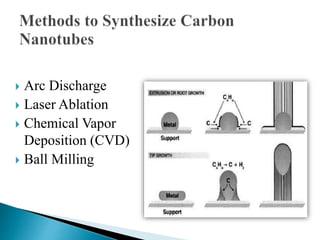
 Arc Discharge
 Laser Ablation
 Chemical Vapor
Deposition (CVD)
 Ball Milling
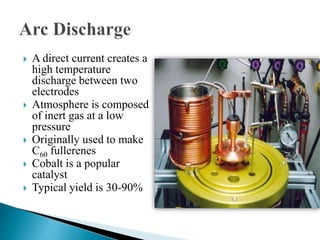
 A direct current creates a
high temperature
discharge between two
electrodes
 Atmosphere is composed
of inert gas at a low
pressure
 Originally used to make
C60 fullerenes
 Cobalt is a popular
catalyst
 Typical yield is 30-90%
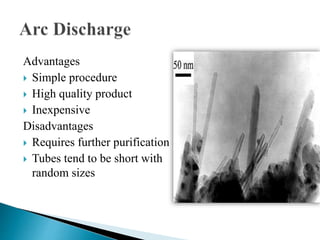
Advantages
 Simple procedure
 High quality product
 Inexpensive
Disadvantages
 Requires further purification
 Tubes tend to be short with
random sizes
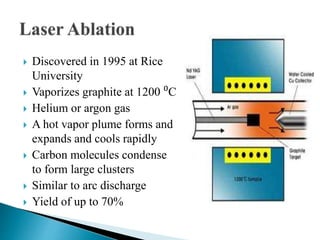
 Discovered in 1995 at Rice
University
 Vaporizes graphite at 1200 ⁰C
 Helium or argon gas
 A hot vapor plume forms and
expands and cools rapidly
 Carbon molecules condense
to form large clusters
 Similar to arc discharge
 Yield of up to 70%
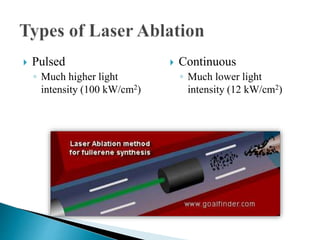
 Pulsed
◦ Much higher light
intensity (100 kW/cm2)
 Continuous
◦ Much lower light
intensity (12 kW/cm2)
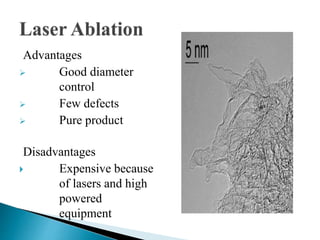
Advantages
 Good diameter
control
 Few defects
 Pure product
Disadvantages
 Expensive because
of lasers and high
powered
equipment
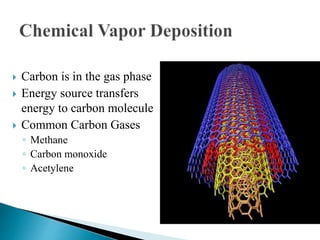
 Carbon is in the gas phase
 Energy source transfers
energy to carbon molecule
 Common Carbon Gases
◦ Methane
◦ Carbon monoxide
◦ Acetylene
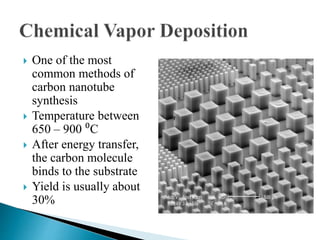
 One of the most
common methods of
carbon nanotube
synthesis
 Temperature between
650 – 900 ⁰C
 After energy transfer,
the carbon molecule
binds to the substrate
 Yield is usually about
30%
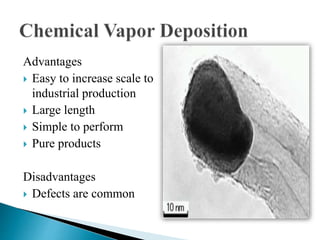
Advantages
 Easy to increase scale to
industrial production
 Large length
 Simple to perform
 Pure products
Disadvantages
 Defects are common
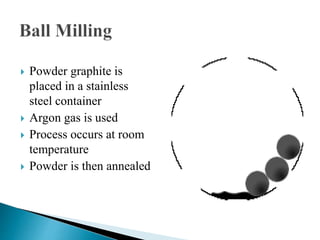
 Powder graphite is
placed in a stainless
steel container
 Argon gas is used
 Process occurs at room
temperature
 Powder is then annealed
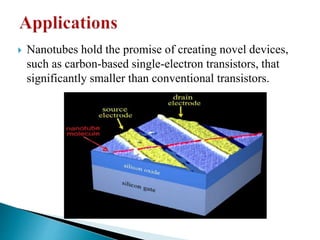
 Nanotubes hold the promise of creating novel devices,
such as carbon-based single-electron transistors, that
significantly smaller than conventional transistors.
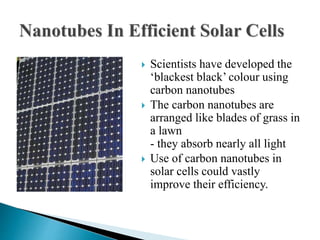
 Scientists have developed the
‘blackest black’ colour using
carbon nanotubes
 The carbon nanotubes are
arranged like blades of grass in
a lawn
- they absorb nearly all light
 Use of carbon nanotubes in
solar cells could vastly
improve their efficiency.
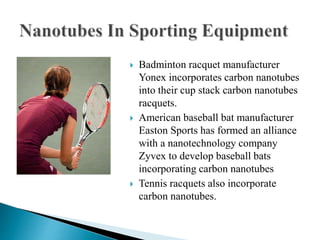
 Badminton racquet manufacturer
Yonex incorporates carbon nanotubes
into their cup stack carbon nanotubes
racquets.
 American baseball bat manufacturer
Easton Sports has formed an alliance
with a nanotechnology company
Zyvex to develop baseball bats
incorporating carbon nanotubes
 Tennis racquets also incorporate
carbon nanotubes.
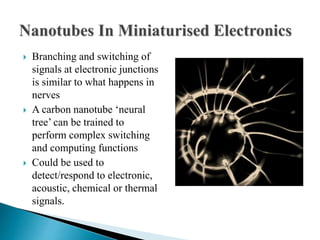
 Branching and switching of
signals at electronic junctions
is similar to what happens in
nerves
 A carbon nanotube ‘neural
tree’ can be trained to
perform complex switching
and computing functions
 Could be used to
detect/respond to electronic,
acoustic, chemical or thermal
signals.
Nanotubes and other Fullerenes can be filled
with molecules that have either an electronic
or structural property which can be used to
represent the quantum bit (Qubit) of
information, and which can be associated with
other adjacent Qubits.
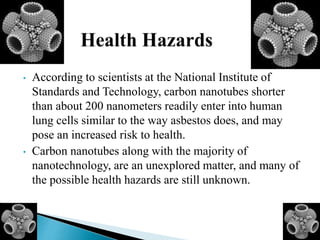
• According to scientists at the National Institute of
Standards and Technology, carbon nanotubes shorter
than about 200 nanometers readily enter into human
lung cells similar to the way asbestos does, and may
pose an increased risk to health.
• Carbon nanotubes along with the majority of
nanotechnology, are an unexplored matter, and many of
the possible health hazards are still unknown.
 Nano science is the most rapidly developing field
that has been fascinating scientists for years and
the last decade has been the most productive in
terms of research on it.
 But for this to be productive in every aspect its
impacts both positive and negative are to be
studied extensively and thereupon reach a point
where negative aspects can be worked around.
 It is however a field having quite a potential for
future applications.

Carbon nanotubes

  • 2.
     What arecarbon nanotubes  Discovery of carbon nanotubes  Classification of CNTs  Properties of CNTs  Synthesis of nanotubes  Advantages and Disadvantages
  • 3.
     A CarbonNanotube is a tube-shaped material, made of carbon, having a diameter measuring on the nanometer scale.  The graphite layer appears somewhat like a rolled-up chicken wire with a continuous unbroken hexagonal mesh and carbon molecules at the apexes of the hexagons.  Their name is derived from their long, hollow structure with the walls formed by one atom thick sheets of carbon, called graphene.
  • 4.
     1952- Radushkevichand Lukyanovich publish a paper in the Soviet Journal of Physical Chemistry showing hollow graphitic carbon fibers that are 50 nanometers in diameter.  1979 - John Abrahamson presented evidence of carbon nanotubes at the 14th Biennial Conference of Carbon at Pennsylvania State University.  1981 - A group of Soviet scientists published the results of chemical and structural characterization of carbon nanoparticles produced by a thermocatalytical disproportionation of carbon monoxide.  1991 - Nanotubes discovered in the soot of arc discharge at NEC, by Japanese researcher Sumio Iijima.
  • 5.
  • 7.
     Single-wall nanotubes(SWNT) are tubes of graphite that are normally capped at the ends. They have a single cylindrical wall. The structure of a SWNT can be visualized as a layer of graphite, a single atom thick, called graphene, which is rolled into a seamless cylinder.  Most SWNT typically have a diameter of close to 1 nm. The tube length, however, can be many thousands of times longer.
  • 8.
    Russian doll model (concentriccylindrical arrangement of various graphite sheets) Parchment Model (single sheet of graphite is rolled in around itself)
  • 9.
     Multi-wall nanotubescan appear either in the form of a coaxial assembly of SWNT similar to a coaxial cable, or as a single sheet of graphite rolled into the shape of a scroll.  The diameters of MWNT are typically in the range of 5 nm to 50 nm. The interlayer distance in MWNT is close to the distance between graphene layers in graphite.  They are chemically inert compared to single walled tubes.
  • 10.
  • 11.
     Carbon nanotubeshave the strongest tensile strength of any material known.  It also has the highest modulus of elasticity. Material Young's Modulus (TPa) Tensile Strength (GPa) Elongation at Break (%) SWNT ~1 (from 1 to 5) 13-53E 16 Armchair SWNT 0.94T 126.2T 23.1 Zigzag SWNT 0.94T 94.5T 15.6-17.5 MWNT 0.8-0.9E 150 Stainless Steel ~0.2 ~0.65-1 15-50 Kevlar ~0.15 ~3.5 ~2
  • 12.
     If thenanotube structure is armchair then the electrical properties are metallic  If the nanotube structure is chiral then the electrical properties can be either semiconducting with a very small band gap, otherwise the nanotube is a moderate semiconductor  In theory, metallic nanotubes can carry an electrical current density of 4×10⁹ A/cm2 which is more than 1,000 times greater than metals such as copper
  • 13.
    • All nanotubesare expected to be very good thermal conductors along the tube, but good insulators laterally to the tube axis. • It is predicted that carbon nanotubes will be able to transmit up to 6000 watts per meter per Kelvin at room temperature; compare this to copper, a metal well-known for its good thermal conductivity, which transmits 385 watts per meter per K. • The temperature stability of carbon nanotubes is estimated to be up to 2800oC in vacuum and about 750oC in air.
  • 14.
     Defects canoccur in the form of atomic vacancies. High levels of such defects can lower the tensile strength by up to 85%.  Because of the very small structure of CNTs, the tensile strength of the tube is dependent on its weakest segment in a similar manner to a chain, where the strength of the weakest link becomes the maximum strength of the chain.
  • 15.
     Arc Discharge Laser Ablation  Chemical Vapor Deposition (CVD)  Ball Milling
  • 16.
     A directcurrent creates a high temperature discharge between two electrodes  Atmosphere is composed of inert gas at a low pressure  Originally used to make C60 fullerenes  Cobalt is a popular catalyst  Typical yield is 30-90%
  • 17.
    Advantages  Simple procedure High quality product  Inexpensive Disadvantages  Requires further purification  Tubes tend to be short with random sizes
  • 18.
     Discovered in1995 at Rice University  Vaporizes graphite at 1200 ⁰C  Helium or argon gas  A hot vapor plume forms and expands and cools rapidly  Carbon molecules condense to form large clusters  Similar to arc discharge  Yield of up to 70%
  • 19.
     Pulsed ◦ Muchhigher light intensity (100 kW/cm2)  Continuous ◦ Much lower light intensity (12 kW/cm2)
  • 20.
    Advantages  Good diameter control Few defects  Pure product Disadvantages  Expensive because of lasers and high powered equipment
  • 21.
     Carbon isin the gas phase  Energy source transfers energy to carbon molecule  Common Carbon Gases ◦ Methane ◦ Carbon monoxide ◦ Acetylene
  • 22.
     One ofthe most common methods of carbon nanotube synthesis  Temperature between 650 – 900 ⁰C  After energy transfer, the carbon molecule binds to the substrate  Yield is usually about 30%
  • 23.
    Advantages  Easy toincrease scale to industrial production  Large length  Simple to perform  Pure products Disadvantages  Defects are common
  • 24.
     Powder graphiteis placed in a stainless steel container  Argon gas is used  Process occurs at room temperature  Powder is then annealed
  • 25.
     Nanotubes holdthe promise of creating novel devices, such as carbon-based single-electron transistors, that significantly smaller than conventional transistors.
  • 26.
     Scientists havedeveloped the ‘blackest black’ colour using carbon nanotubes  The carbon nanotubes are arranged like blades of grass in a lawn - they absorb nearly all light  Use of carbon nanotubes in solar cells could vastly improve their efficiency.
  • 27.
     Badminton racquetmanufacturer Yonex incorporates carbon nanotubes into their cup stack carbon nanotubes racquets.  American baseball bat manufacturer Easton Sports has formed an alliance with a nanotechnology company Zyvex to develop baseball bats incorporating carbon nanotubes  Tennis racquets also incorporate carbon nanotubes.
  • 28.
     Branching andswitching of signals at electronic junctions is similar to what happens in nerves  A carbon nanotube ‘neural tree’ can be trained to perform complex switching and computing functions  Could be used to detect/respond to electronic, acoustic, chemical or thermal signals.
  • 29.
    Nanotubes and otherFullerenes can be filled with molecules that have either an electronic or structural property which can be used to represent the quantum bit (Qubit) of information, and which can be associated with other adjacent Qubits.
  • 30.
    • According toscientists at the National Institute of Standards and Technology, carbon nanotubes shorter than about 200 nanometers readily enter into human lung cells similar to the way asbestos does, and may pose an increased risk to health. • Carbon nanotubes along with the majority of nanotechnology, are an unexplored matter, and many of the possible health hazards are still unknown.
  • 31.
     Nano scienceis the most rapidly developing field that has been fascinating scientists for years and the last decade has been the most productive in terms of research on it.  But for this to be productive in every aspect its impacts both positive and negative are to be studied extensively and thereupon reach a point where negative aspects can be worked around.  It is however a field having quite a potential for future applications.