BY
APURV TANAY VERMA
MECHANICAL ENGG.
• WHAT IS NANOTECHNOLOGY.
• APPLICATIONS.
• NANOTECHNOLOGY IN
ELECTRONICS & COMPUTER.
• NANOTECHNOLOGY IN HEALTH &
MEDICINE.
• NANOTECHNOLOGY IN MATERIAL &
MANUFACTURING.
• NANOTECHNOLOGY IN SPACE.
• NANOTECHNOLOGY IN FOOD.
• NANOTECHNOLOGY IN
CONSTRUCTION.
• NANOTECHNOLOGY IN
TRANSPORTATION.
• ADVANTAGES & DISADVANTAGES.
• CHALLENGES.
• FUTURE OF NANOTECHNOLOGY
• SUMMARY.
•
CONTENTSCONTENTS
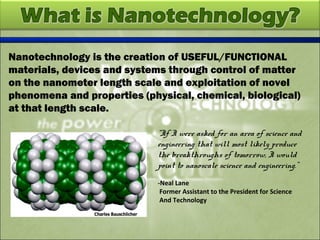
Nanotechnology is the creation of USEFUL/FUNCTIONAL
materials, devices and systems through control of matter
on the nanometer length scale and exploitation of novel
phenomena and properties (physical, chemical, biological)
at that length scale.
“If I were asked for an area of science and
engineering that will most likely produce
the breakthroughs of tomorrow, I would
point to nanoscale science and engineering.”
-Neal Lane
Former Assistant to the President for Science
And Technology
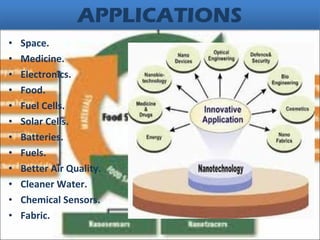
• Space.
• Medicine.
• Electronics.
• Food.
• Fuel Cells.
• Solar Cells.
• Batteries.
• Fuels.
• Better Air Quality.
• Cleaner Water.
• Chemical Sensors.
• Fabric.
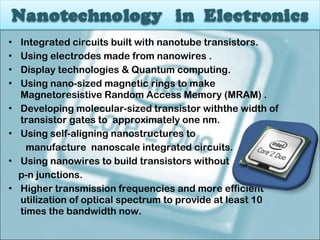
• Integrated circuits built with nanotube transistors.
• Using electrodes made from nanowires .
• Display technologies & Quantum computing.
• Using nano-sized magnetic rings to make
Magnetoresistive Random Access Memory (MRAM) .
• Developing molecular-sized transistor withthe width of
transistor gates to approximately one nm.
• Using self-aligning nanostructures to
manufacture nanoscale integrated circuits.
• Using nanowires to build transistors without
p-n junctions.
• Higher transmission frequencies and more efficient
utilization of optical spectrum to provide at least 10
times the bandwidth now.
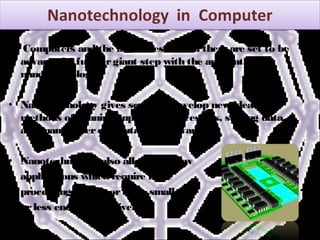
• Computers and the industries around themare set to be
advanced a furthergiant step with the application of
nanotechnology.
• Nanotechnology gives scope to develop new ideas and
methods of running super-fast processors, storing data,
and many othercomputational advances.
• Nanotechnology also allows fornew
applications which require more
processing power, orto be smaller,
orless energy intensive.
• Expanding ability to characterize
genetic makeup will revolutionize the
specificity of diagnostics and
therapeutics
- Nano devices can make gene
sequencing more efficient.
• Effective and less expensive health
care using remote and in-vivo devices.
• New formulations and routes
for drug delivery, optimal drug
usage.
• More durable, rejection-
resistant artificial tissues and
organs.
• Sensors for early detection
and prevention.
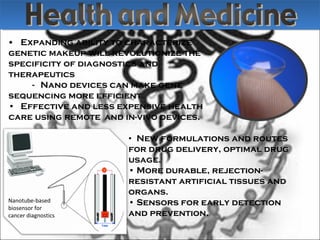
Nanotube-based
biosensor for
cancer diagnostics
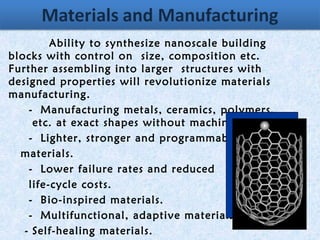
Ability to synthesize nanoscale building
blocks with control on size, composition etc.
Further assembling into larger structures with
designed properties will revolutionize materials
manufacturing.
- Manufacturing metals, ceramics, polymers,
etc. at exact shapes without machining
- Lighter, stronger and programmable
materials.
- Lower failure rates and reduced
life-cycle costs.
- Bio-inspired materials.
- Multifunctional, adaptive materials.
- Self-healing materials.
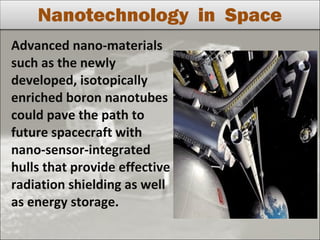
Advanced nano-materials
such as the newly
developed, isotopically
enriched boron nanotubes
could pave the path to
future spacecraft with
nano-sensor-integrated
hulls that provide effective
radiation shielding as well
as energy storage.
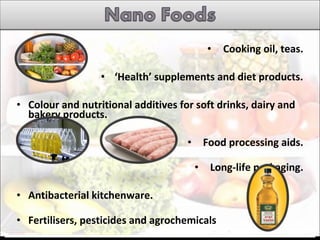
• Cooking oil, teas.
• ‘Health’ supplements and diet products.
• Colour and nutritional additives for soft drinks, dairy and
bakery products.
• Food processing aids.
• Long-life packaging.
• Antibacterial kitchenware.
• Fertilisers, pesticides and agrochemicals
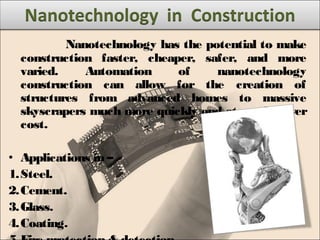
Nanotechnology has the potential to make
construction faster, cheaper, safer, and more
varied. Automation of nanotechnology
construction can allow for the creation of
structures from advanced homes to massive
skyscrapers much more quickly and at much lower
cost.
• Applications in –
1.Steel.
2.Cement.
3.Glass.
4.Coating.
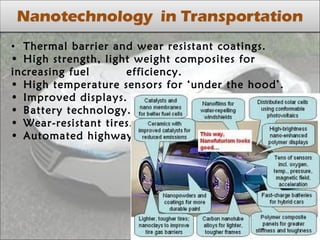
• Thermal barrier and wear resistant coatings.
• High strength, light weight composites for
increasing fuel efficiency.
• High temperature sensors for ‘under the hood’.
• Improved displays.
• Battery technology.
• Wear-resistant tires.
• Automated highways.
ADVANTAGES DISADVANTAGES
 Nanotechnology can
actually revolutionize a lot
of electronic products,
procedures, and
applications.
 Nanotechnology can also
benefit the energy sector.
 Another industry that
can benefit from
nanotechnology is the
manufacturing sector.
 In the medical world,
nanotechnology is also
seen as a boon since these
can help with creating what
is called smart drugs.
 Its development is the
possible loss of jobs in the
traditional farming and
manufacturing industry.
 Atomic weapons can now be
more accessible and made to be
more powerful and more
destructive.
 Since these particles are very
small, problems can actually
arise from the inhalation of
these
 Minute particles, much like
the problems a person gets from
inhaling minute asbestos
particles.
 Presently, nanotechnology is
very expensive and developing it
can cost you a lot of money.
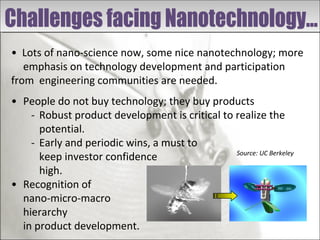
• Lots of nano-science now, some nice nanotechnology; more
emphasis on technology development and participation
from engineering communities are needed.
• People do not buy technology; they buy products
- Robust product development is critical to realize the
potential.
- Early and periodic wins, a must to
keep investor confidence
high.
• Recognition of
nano-micro-macro
hierarchy
in product development.
Source: UC Berkeley
• Need some sanity in issuing patents
• Given the long term nature of the technology and payoffs in terms
of job creation and economic returns,
- Lack of patience from Federal Government will kill the field .
- But history indicates, Federal agencies have been responsible
for numerous technology wins in the last 50 years.
- So, ignore the hype and stay the course for the long run.
• Venture community behavior will determine the fate
- Lack of patience will hurt the startup activities
- Indiscriminate investment like in the dotcom days will seal the
field.
• Educating future generation scientists and engineers.
The future of nanotechnology is completely uncharted
territory. There is the possibility that the future of
nanotechnology is very bright, that this will be the one
science of the future that no other science can live
without. There is also a chance that this is the science
that will make the world highly uncomfortable with
the potential power to transform the world.
 This technology could end world hunger. At the same
time, this process could lead to experimental
molecular manufacturing with live beings.
 The future of nanotechnology could improve the
outlook for medical patients with serious illnesses or
injuries.
• Nanotechnology is an enabling technology that will impact
electronics and computing, materials and manufacturing, energy,
transportation.
• The field is interdisciplinary but everything starts with material
science. Challenges include:
- Novel synthesis techniques
- Characterization of nanoscale properties
- Large scale production of materials
- Application development
• Opportunities and rewards are great and hence, tremendous
worldwide interest.
• Integration of this emerging field into engineering and science
curriculum is important to prepare the future generation of
scientists and engineers.
• www.google.com
• www.wikipedia.com
• Nanotechnology White Paper(by Office
of Science Advisor).
• Managing the Effects of
NANOTECHNOLOGY
(by J. Clarence Davies)
Nanotechnology

Nanotechnology

  • 1.
  • 2.
    • WHAT ISNANOTECHNOLOGY. • APPLICATIONS. • NANOTECHNOLOGY IN ELECTRONICS & COMPUTER. • NANOTECHNOLOGY IN HEALTH & MEDICINE. • NANOTECHNOLOGY IN MATERIAL & MANUFACTURING. • NANOTECHNOLOGY IN SPACE. • NANOTECHNOLOGY IN FOOD. • NANOTECHNOLOGY IN CONSTRUCTION. • NANOTECHNOLOGY IN TRANSPORTATION. • ADVANTAGES & DISADVANTAGES. • CHALLENGES. • FUTURE OF NANOTECHNOLOGY • SUMMARY. • CONTENTSCONTENTS
  • 3.
    Nanotechnology is thecreation of USEFUL/FUNCTIONAL materials, devices and systems through control of matter on the nanometer length scale and exploitation of novel phenomena and properties (physical, chemical, biological) at that length scale. “If I were asked for an area of science and engineering that will most likely produce the breakthroughs of tomorrow, I would point to nanoscale science and engineering.” -Neal Lane Former Assistant to the President for Science And Technology
  • 4.
    • Space. • Medicine. •Electronics. • Food. • Fuel Cells. • Solar Cells. • Batteries. • Fuels. • Better Air Quality. • Cleaner Water. • Chemical Sensors. • Fabric.
  • 5.
    • Integrated circuitsbuilt with nanotube transistors. • Using electrodes made from nanowires . • Display technologies & Quantum computing. • Using nano-sized magnetic rings to make Magnetoresistive Random Access Memory (MRAM) . • Developing molecular-sized transistor withthe width of transistor gates to approximately one nm. • Using self-aligning nanostructures to manufacture nanoscale integrated circuits. • Using nanowires to build transistors without p-n junctions. • Higher transmission frequencies and more efficient utilization of optical spectrum to provide at least 10 times the bandwidth now.
  • 6.
    • Computers andthe industries around themare set to be advanced a furthergiant step with the application of nanotechnology. • Nanotechnology gives scope to develop new ideas and methods of running super-fast processors, storing data, and many othercomputational advances. • Nanotechnology also allows fornew applications which require more processing power, orto be smaller, orless energy intensive.
  • 7.
    • Expanding abilityto characterize genetic makeup will revolutionize the specificity of diagnostics and therapeutics - Nano devices can make gene sequencing more efficient. • Effective and less expensive health care using remote and in-vivo devices. • New formulations and routes for drug delivery, optimal drug usage. • More durable, rejection- resistant artificial tissues and organs. • Sensors for early detection and prevention. Nanotube-based biosensor for cancer diagnostics
  • 8.
    Ability to synthesizenanoscale building blocks with control on size, composition etc. Further assembling into larger structures with designed properties will revolutionize materials manufacturing. - Manufacturing metals, ceramics, polymers, etc. at exact shapes without machining - Lighter, stronger and programmable materials. - Lower failure rates and reduced life-cycle costs. - Bio-inspired materials. - Multifunctional, adaptive materials. - Self-healing materials.
  • 9.
    Advanced nano-materials such asthe newly developed, isotopically enriched boron nanotubes could pave the path to future spacecraft with nano-sensor-integrated hulls that provide effective radiation shielding as well as energy storage.
  • 10.
    • Cooking oil,teas. • ‘Health’ supplements and diet products. • Colour and nutritional additives for soft drinks, dairy and bakery products. • Food processing aids. • Long-life packaging. • Antibacterial kitchenware. • Fertilisers, pesticides and agrochemicals
  • 11.
    Nanotechnology has thepotential to make construction faster, cheaper, safer, and more varied. Automation of nanotechnology construction can allow for the creation of structures from advanced homes to massive skyscrapers much more quickly and at much lower cost. • Applications in – 1.Steel. 2.Cement. 3.Glass. 4.Coating.
  • 12.
    • Thermal barrierand wear resistant coatings. • High strength, light weight composites for increasing fuel efficiency. • High temperature sensors for ‘under the hood’. • Improved displays. • Battery technology. • Wear-resistant tires. • Automated highways.
  • 13.
    ADVANTAGES DISADVANTAGES  Nanotechnologycan actually revolutionize a lot of electronic products, procedures, and applications.  Nanotechnology can also benefit the energy sector.  Another industry that can benefit from nanotechnology is the manufacturing sector.  In the medical world, nanotechnology is also seen as a boon since these can help with creating what is called smart drugs.  Its development is the possible loss of jobs in the traditional farming and manufacturing industry.  Atomic weapons can now be more accessible and made to be more powerful and more destructive.  Since these particles are very small, problems can actually arise from the inhalation of these  Minute particles, much like the problems a person gets from inhaling minute asbestos particles.  Presently, nanotechnology is very expensive and developing it can cost you a lot of money.
  • 14.
    • Lots ofnano-science now, some nice nanotechnology; more emphasis on technology development and participation from engineering communities are needed. • People do not buy technology; they buy products - Robust product development is critical to realize the potential. - Early and periodic wins, a must to keep investor confidence high. • Recognition of nano-micro-macro hierarchy in product development. Source: UC Berkeley
  • 15.
    • Need somesanity in issuing patents • Given the long term nature of the technology and payoffs in terms of job creation and economic returns, - Lack of patience from Federal Government will kill the field . - But history indicates, Federal agencies have been responsible for numerous technology wins in the last 50 years. - So, ignore the hype and stay the course for the long run. • Venture community behavior will determine the fate - Lack of patience will hurt the startup activities - Indiscriminate investment like in the dotcom days will seal the field. • Educating future generation scientists and engineers.
  • 16.
    The future ofnanotechnology is completely uncharted territory. There is the possibility that the future of nanotechnology is very bright, that this will be the one science of the future that no other science can live without. There is also a chance that this is the science that will make the world highly uncomfortable with the potential power to transform the world.  This technology could end world hunger. At the same time, this process could lead to experimental molecular manufacturing with live beings.  The future of nanotechnology could improve the outlook for medical patients with serious illnesses or injuries.
  • 17.
    • Nanotechnology isan enabling technology that will impact electronics and computing, materials and manufacturing, energy, transportation. • The field is interdisciplinary but everything starts with material science. Challenges include: - Novel synthesis techniques - Characterization of nanoscale properties - Large scale production of materials - Application development • Opportunities and rewards are great and hence, tremendous worldwide interest. • Integration of this emerging field into engineering and science curriculum is important to prepare the future generation of scientists and engineers.
  • 18.
    • www.google.com • www.wikipedia.com •Nanotechnology White Paper(by Office of Science Advisor). • Managing the Effects of NANOTECHNOLOGY (by J. Clarence Davies)