SOLAR POWER 
PLANT 
SUBMITTED BY 
Sindhu Nathan 
1st ece ‘b’ sec
WHAT IS SOLAR ENERGY? 
SOLAR ENERGY RADIANT LIGHT AND HEAT FROM 
THE SUN IS HARDNESSED USING A RANGE OF 
EVER-EVOLVING TECHNOLOGIES. 
 SUCH AS SOLAR HEATING, SOLAR 
PHOTOVOLTAICS, SOLAR THERMAL ELECTRICITY, 
SOLAR ARICHITECTURE AND ARITIFICAL 
PHOTOSYNTHESIS.
BASIC PRINCIPLE OF SOLAR ENEGY 
Solar radiation is reduce in intensity in 
the atmosphere by dust,clouds,haze 
and fog. 
The radiation strikes a solid or liquid, it 
is absorbed and transformed in to heat 
energy.
The heat energy is collected in a fluid 
generally water. 
This energy can be used in a solar 
heater or drier or can trated type 
collector is used to collect or parabolic 
concentrated the solar energy.
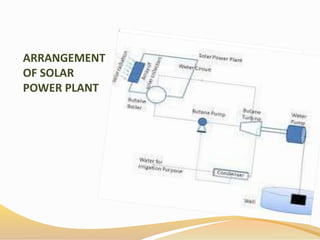
ARRANGEMENT 
OF SOLAR 
POWER PLANT
SOLAR COLLECTOR 
FLAT PLATE COLLECTOR. 
CYLINDRICAL PARABOLIC 
CONCENTRATOR COLLECTOR.
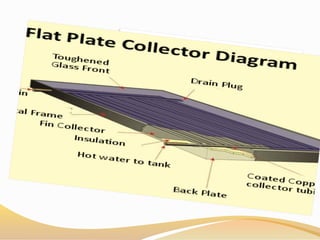
FLAT PLATE COLLECTOR 
 Head is from the absorber plate to water which is 
circulated in the copper tubes through the flat plate 
collector. 
 It is placed facing the general drection of the sun. 
 Material used for plate is copper, steel or aluminium. 
 The thickness of the plate is 1to 2mm. 
 Front cover is made up of glass and transparent to the 
incoming solar radiation.
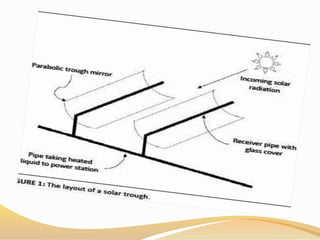
Cylindrical parabolic concentraor 
collector 
 Concentrator collectors are reflecting type utillising 
mirrors. 
 The reflecting surface is parabolic mirror. 
 The solar energy falling on the collector surface is 
rereflected and foccused along a absorber tube. 
 Large quantity of energy falling on the collector 
surface is collected over a small surface. 
 The temperature of the absorber fluid is very higher 
than flat plate collector.
Butane boiler 
The water heated in flat plate solar 
collector to 80*c is used for boiling 
butane at high pressure in the butane 
boiler. 
Boiling point of butane is about 50*c.
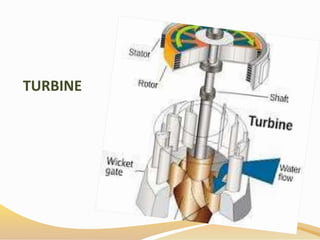
TURBINE
TURBINE 
 The butane vapor generated at high pressure in the 
boilers used to run the vapour turbine which drives 
electrical generator. 
 The vapour coming out of the turbine at low pressure 
is codensed in a condenser using water. 
 The condensed liquid butane is fed back to the butane 
boiler using feed pump.
Tower concept of power 
generation 
 The tower concept consists of an array of plane mirrors 
or heliostats are individually cotrolled to reflect 
radiations from the sun in to boiler mounted on a 500 
metres high tower. 
 Steam is generated in the boiler temperature up to 
2000*k. 
 Electricity is generated by passing stream through the 
turbine coupled to a generator.
Application of solar energy 
 SOLAR ENGINES FOR WATER PUMPING. 
 SOLAR WATER HEATERS. 
 SOLAR COOKERS. 
 SOLAR DRIERS. 
 SOLAR FURNACES. 
 PHOTO-VOLTAIC CONVERSION(SOLAR CELLS) 
 SOLAR POWER GENERATION.
ADVANTAGES 
 Sun is essentially an infinite source of energy. The solar 
energy is a very large inexhaustible and renewable 
source of energy. 
 It is enviromentally very clean and is hence pollution 
free. 
 It is dependaple energy source without new 
requirements of highly technical and specilaised 
nature for its wide sperad utilization. 
 It is the best alternative for the rapid depletion of fossil 
fuels.
Disavantages 
 It is available in a dilute form and is at low potential. 
The intensity of solar energy on sunny day india is 
about 1.1kw/metre area. 
 Solar energy is not available at night or during cloudy 
or rainy days.
Solar power plant

Solar power plant

  • 1.
    SOLAR POWER PLANT SUBMITTED BY Sindhu Nathan 1st ece ‘b’ sec
  • 3.
    WHAT IS SOLARENERGY? SOLAR ENERGY RADIANT LIGHT AND HEAT FROM THE SUN IS HARDNESSED USING A RANGE OF EVER-EVOLVING TECHNOLOGIES.  SUCH AS SOLAR HEATING, SOLAR PHOTOVOLTAICS, SOLAR THERMAL ELECTRICITY, SOLAR ARICHITECTURE AND ARITIFICAL PHOTOSYNTHESIS.
  • 4.
    BASIC PRINCIPLE OFSOLAR ENEGY Solar radiation is reduce in intensity in the atmosphere by dust,clouds,haze and fog. The radiation strikes a solid or liquid, it is absorbed and transformed in to heat energy.
  • 5.
    The heat energyis collected in a fluid generally water. This energy can be used in a solar heater or drier or can trated type collector is used to collect or parabolic concentrated the solar energy.
  • 6.
  • 7.
    SOLAR COLLECTOR FLATPLATE COLLECTOR. CYLINDRICAL PARABOLIC CONCENTRATOR COLLECTOR.
  • 9.
    FLAT PLATE COLLECTOR  Head is from the absorber plate to water which is circulated in the copper tubes through the flat plate collector.  It is placed facing the general drection of the sun.  Material used for plate is copper, steel or aluminium.  The thickness of the plate is 1to 2mm.  Front cover is made up of glass and transparent to the incoming solar radiation.
  • 11.
    Cylindrical parabolic concentraor collector  Concentrator collectors are reflecting type utillising mirrors.  The reflecting surface is parabolic mirror.  The solar energy falling on the collector surface is rereflected and foccused along a absorber tube.  Large quantity of energy falling on the collector surface is collected over a small surface.  The temperature of the absorber fluid is very higher than flat plate collector.
  • 14.
    Butane boiler Thewater heated in flat plate solar collector to 80*c is used for boiling butane at high pressure in the butane boiler. Boiling point of butane is about 50*c.
  • 15.
  • 16.
    TURBINE  Thebutane vapor generated at high pressure in the boilers used to run the vapour turbine which drives electrical generator.  The vapour coming out of the turbine at low pressure is codensed in a condenser using water.  The condensed liquid butane is fed back to the butane boiler using feed pump.
  • 18.
    Tower concept ofpower generation  The tower concept consists of an array of plane mirrors or heliostats are individually cotrolled to reflect radiations from the sun in to boiler mounted on a 500 metres high tower.  Steam is generated in the boiler temperature up to 2000*k.  Electricity is generated by passing stream through the turbine coupled to a generator.
  • 19.
    Application of solarenergy  SOLAR ENGINES FOR WATER PUMPING.  SOLAR WATER HEATERS.  SOLAR COOKERS.  SOLAR DRIERS.  SOLAR FURNACES.  PHOTO-VOLTAIC CONVERSION(SOLAR CELLS)  SOLAR POWER GENERATION.
  • 20.
    ADVANTAGES  Sunis essentially an infinite source of energy. The solar energy is a very large inexhaustible and renewable source of energy.  It is enviromentally very clean and is hence pollution free.  It is dependaple energy source without new requirements of highly technical and specilaised nature for its wide sperad utilization.  It is the best alternative for the rapid depletion of fossil fuels.
  • 21.
    Disavantages  Itis available in a dilute form and is at low potential. The intensity of solar energy on sunny day india is about 1.1kw/metre area.  Solar energy is not available at night or during cloudy or rainy days.