LDR BASED SOLAR DUAL TRACKING SYSTEM
ABSTRACT
Photovoltaic modules are devices that directly and cleanly convert the sunlight
into electricity and offer a practical solution to the problem of power generation in
remote areas. They are especially useful in situations where the demand for
electrical power is relatively low. To maximize the power extraction as per
demand, instead of installing a extra panels we can use tracking system, which
enhances the power. The solar tracker that has been designed and constructed in
this project optimizes the power output of PV modules by making sure that they
are pointed towards the sun at all times during the day. The tracker could be
implemented in any situation where solar modules are used. It would be especially
effective in situations where only a small number of modules are required and
where efficiency is of a great importance.
In this performance enhancement of solar Photo Voltaic (PV) panels has been
experimented utilizing diffused reflectors and solar-tracker in other to determine
the one with higher power output. An intelligent solar tracker and diffused
reflector augmented systems were designed, developed and installed to compare
the power output that can be generated from each of them when standing alone;
and which system will achieve higher power output so as to reduce the number of
PV panels required at any given time especially when cost is a major factor. For
this comparative study, experimental readings were simultaneously taken from the
panel, with sun tracker and the panel with diffuse reflectors aligned at 23.50 with
the horizontal. Experimental results indicate appreciable increase in the overall
power output of the solar panels. It is discovered that the power output of the
panel with reflectors was higher from about 11 am till 2 pm, while the panel with
tracking was higher at other times. The average power output of the system for a
day is about the same. Looking at the cost of fabrication and the complexity of the
tracking system, the reflector system is the better option.
2
1. INTRODUCTION
One of the most promising renewable energy sources characterized by a huge
potential of conversion into electrical power is the solar energy. The conversion of
solar radiation into electrical energy by Photo-Voltaic (PV) effect is a very
promising technology, being clean, silent and reliable, with very small
maintenance costs and small ecological impact. The interest in the Photo Voltaic
conversion systems is visibly reflected by the exponential increase of sales in this
market segment with a strong growth projection for the next decades. According
to recent market research reports carried out by European Photovoltaic Industry
Association (EPIA), the total installed power of PV conversion equipment
increased from about 1 GW in 2001up to nearly 23 GW in 2009.
The continuous evolution of the technology determined a sustained increase of
the conversion efficiency of PV panels, but nonetheless the most part of the
commercial panels have efficiencies no more than 20%. A constant research
preoccupation of the technical community involved in the solar energy harnessing
technology refers to various solutions to increase the PV panel’s conversion
efficiency. Among PV efficiency improving solutions we can mention: solar
tracking, optimization of solar cells geometry, enhancement of light trapping
capability, use of new materials, etc. The output power produced by the PV panels
depends strongly on the incident light radiation.
The continuous modification of the sun-earth relative position determines a
continuously changing of incident radiation on a fixed PV panel. The point of
maximum received energy is reached when the direction of solar radiation is
perpendicular on the panel surface. Thus an increase of the output energy of a
given PV panel can be obtained by mounting the panel on a solar tracking device
that follows the sun trajectory
3
1.1 Background
A Solar Tracker is a device onto which solar panels are fitted which tracks the
motion of the sun across the sky ensuring that the maximum amount of sunlight
strikes the panels throughout the day. The Solar Tracker will attempt to navigate
to the best angle of exposure of light from the sun. This report aims to let the
reader understand the project work which I have done. A brief introduction to
Solar Panel and Solar Tracker is explained in the Literature Research section.
Basically the Solar Tracker is divided into two main categories, hardware and
software. It is further subdivided into six main functionalities: Method of Tracker
Mount, Drives, Sensors, RTC, Motors, and Power Supply of the Solar Tracker is
also explained and explored. The reader would then be brief with some analysis
and perceptions of the information.
By using solar arrays, a series of solar cells electrically connected, a DC voltage is
generated which can be physically used on a load. Solar arrays or panels are being
used increasingly as efficiencies reach higher levels, and are especially popular in
remote areas where placement of electricity lines is not economically viable. This
alternative power source is continuously achieving greater popularity especially
since the realisation of fossil fuels shortcomings. Renewable energy in the form
of electricity has been in use to some degree as long as 75 or 100 years ago.
Sources such as Solar, Wind, Hydro and Geothermal have all been utilised with
varying levels of success. The most widely used are hydro and wind power, with
solar power being moderately used worldwide. This can be attributed to the
relatively high cost of solar cells and their low conversion efficiency. Solar power
is being heavily researched, and solar energy costs have now reached within a few
cents per kW/h of other forms of electricity
4
SYSTEM CONCEPT
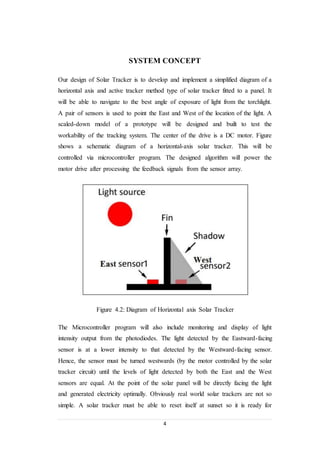
Our design of Solar Tracker is to develop and implement a simplified diagram of a
horizontal axis and active tracker method type of solar tracker fitted to a panel. It
will be able to navigate to the best angle of exposure of light from the torchlight.
A pair of sensors is used to point the East and West of the location of the light. A
scaled-down model of a prototype will be designed and built to test the
workability of the tracking system. The center of the drive is a DC motor. Figure
shows a schematic diagram of a horizontal-axis solar tracker. This will be
controlled via microcontroller program. The designed algorithm will power the
motor drive after processing the feedback signals from the sensor array.
Figure 4.2: Diagram of Horizontal axis Solar Tracker
The Microcontroller program will also include monitoring and display of light
intensity output from the photodiodes. The light detected by the Eastward-facing
sensor is at a lower intensity to that detected by the Westward-facing sensor.
Hence, the sensor must be turned westwards (by the motor controlled by the solar
tracker circuit) until the levels of light detected by both the East and the West
sensors are equal. At the point of the solar panel will be directly facing the light
and generated electricity optimally. Obviously real world solar trackers are not so
simple. A solar tracker must be able to reset itself at sunset so it is ready for
5
sunrise, it must cope with heavy cloud, and it. In addition a mount for the solar
panel must be constructed which can cope with strong winds and a suitable motor
found.
A simple light tracker using 2 light sensors. Light tracker is typical use for
maximum energy receiving of solar panel or making light following robot. In this
example, two LLS05-A light sensors is used. The sensor is given linear output
from luminance. Figure below shown the concept of how it work, it works by
finding balance between the two sensors.
6
2. LITERATURE RESEARCH
This chapter aims to provide a brief knowledge of Solar Panel, Solar Tracker and
the components which made up Solar Tracker.
2.1 Technology of Solar Panel
According to Encyclopaedia Britannica the first genuine for solar panel was built
around 1883 by Charles Fritts. He used junctions formed by coating selenium (a
semiconductor) with an extremely thin layer of gold. Crystalline silicon and
gallium arsenide are typical choices of materials for solar panels. Gallium arsenide
crystals are grown especially for photovoltaic use, but silicon crystals are
available in less-expensive standard ingots, which are produced mainly for
consumption in the microelectronics industry. Norway’s Renewable Energy
Corporation has confirmed that it will build a solar manufacturing plant in
Singapore by 2010 - the largest in the world. This plant will be able to produce
products that can generate up to 1.5 Giga watts of energy every year. That is
enough to power several million households at any one time. Last year the world
as a whole produced products that could generate just 2 GW in total.
2.3 DESIGN AND CONSTRUCTION OF A MICROCONTROLLER
BASED SINGLE AXIS SOLAR TRACKER.
S. Zubair1, A. Suleiman2, H. T. Abdulazzez2, B. A. Salihu1
Solar energy is rapidly gaining popularity as an important means of expanding
renewable energy resources. As such, it is vital that those in engineering fields
understand the technologies associated with this area. This paper presents the
design and construction of a microcontroller-based solar panel tracking system.
Solar tracking allows more energy to be produced because the solar array is able
to remain aligned to the sun. A working system will ultimately be demonstrated to
validate the design. Problems and possible improvements will also be presented.
2.4 Design of two axes sun tracking controller with analytically solar
radiation calculations
ARTICLE in RENEWABLE AND SUSTAINABLE ENERGY REVIEWS ·
MARCH 2015
Saban Yilmaz, Oguzhan Akgol, Muharrem Karaaslan.
7
Photovoltaic systems have gained a great deal of interest in the world and these
studies performed on this subject have been gaining more and more importance.
In order to design new PV systems that will be installed to operate in more
efficient and more feasible way, it is necessary to analyze parameters like solar
radiation values, the angle of incidence of the genus, temperature etc. Therefore,
in this study, theoretical works have been performed for solar radiation and angle
of incidence values of any location, plus an experimental study was carried out on
a system tracking the sun in two axes and in a fixed system. The performed
prototype is also adapted into a PV system with 4.6 kW power. Theoretical data
are consistent with the data obtained from the PV system with 4.6 kW power. This
study will be an important guide for the future PV power stations.
In this study a photovoltaic double axis sun-tracking system is briefly described
and performances of double axis tracking and fixed latitude tilt identical PV
systems are theoretically and experimentally realized. The advantages of the
proposed system over fixed systems are clearly discussed and compared with the
results from other studies in literature. In order to verify our results obtained from
the prototype, same system with the same working principle is applied to a high
power plant and the results belong to the latter one were also support our claim
that the proposed sun tracking system provide more efficient results. As a result,
the suggested model and the system can be easily used for solar power plants,
solar home systems and so on for more efficient energy production.
2.5 Time operated solar tracking for optimum power generation
Asst.Prof.K.Sambasiva rao, P.Harish, V.N.V.Ramana, M.V.S.Krishna teja
The growth or energy demand in response to industrialization, urbanization and
social affluence has led to an extremely un-even global distribution of primary
energy consumption. The Sun, Wind, Waves and geothermal heat are renewable
energy sources that will never run out. They are perpetual or self-renewing. The
rate of consumption does not exceed rate of renewability. The cost of generating
electricity from wind and solar power has decreased by 90% over the past 20
years. Maximizing power output from a solar system is desirable to increase the
efficiency of a solar tracing system. To maximize the power output from solar
panels, we need to keep the panels aligned with the sun. In this paper, the design
of an efficient solar tracking system based on Real Time Clock (RTC) using
8
design of the existing solar energy collector system has been implemented in order
to provide higher efficiency at lower cost.
The basic functional blocks of this system are four sensors1, and their operation
depends upon the intensity of light falling on solar panel. All sensors (each with
different functionality) send their output to microcontroller AT89c52. Then the
microcontroller executes predefined task in its software. These sensors are being
used with following names and functionality. Sun Tracking Sensors (STS) These
two sensors are mounted in “V” shape (figure-6) exactly in the middle of the solar
panel. The automatic sun tracking is. Accomplished according to following
9
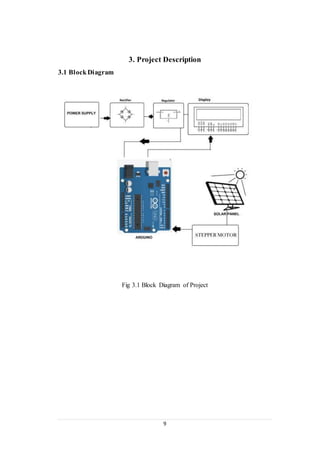
3. Project Description
3.1 BlockDiagram
Fig 3.1 Block Diagram of Project
10
3.2 Solar Tracker
Solar Tracker is basically a device onto which solar panels are fitted which tracks
the motion of the sun across the sky ensuring that the maximum amount of
sunlight strikes the panels throughout the day. After finding the sunlight, the
tracker will try to navigate through the path ensuring the best sunlight is detected.
The design of the Solar Tracker requires many components. The design and
construction of it could be divided into six main parts that would need to work
together harmoniously to achieve a smooth run for the Solar Tracker, each with
their main function. They are:
 Methods of Tracker Mount
 Methods of Drives
 Sensor and Sensor Controller
 Motor and Motor Controller
 Tracker Solving Algorithm
 Data Acquisition/Interface Card
3.3 Methods of Tracker Mount
1. Single axis solar trackers
Single axis solar trackers can either have a horizontal or a vertical axle. The
horizontal type is used in tropical regions where the sun gets very high at noon,
but the days are short. The vertical type is used in high latitudes where the sun
does not get very high, but summer days can be very long. The single axis
tracking system is the simplest solution and the most common one used.
2. Double axis solar trackers
Double axis solar trackers have both a horizontal and a vertical axle and so can
track the Sun's apparent motion exactly anywhere in the World. This type of system
is used to control astronomical telescopes, and so there is plenty of software
11
available to automatically predict and track the motion of the sun across the
sky.By tracking the sun, the efficiency of the solar panels can be increased by 30-
40%.The dual axis tracking system is also used for concentrating a solar reflector
toward the concentrator on heliostat systems.
3.4 Methods of Drive
1. Active Trackers
Active Trackers use motors and gear trains to direct the tracker as commanded
by a controller responding to the solar direction. Light-sensing trackers typically
have two photo sensors, such as photodiodes, configured differentially so that they
output a null when receiving the same light flux. Mechanically, they should be
omnidirectional and are aimed 90 degrees apart. This will cause the steepest part
of their cosine transfer functions to balance at the steepest part, which translates
into maximum sensitivity.
2. Passive Trackers
Passive Trackers use a low boiling point compressed gas fluid that is driven to one
side or the other by solar heat creating gas pressure to cause the tracker to move in
response to an imbalance.
12
5. COMPONENTS DESCRIPTION
1. LDR Sensors
A sensor is a device that measures a physical quantity and converts it into a signal
which can be read by an observer or by an instrument.
Light Dependent Resistor
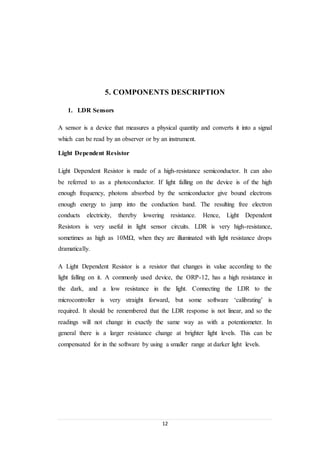
Light Dependent Resistor is made of a high-resistance semiconductor. It can also
be referred to as a photoconductor. If light falling on the device is of the high
enough frequency, photons absorbed by the semiconductor give bound electrons
enough energy to jump into the conduction band. The resulting free electron
conducts electricity, thereby lowering resistance. Hence, Light Dependent
Resistors is very useful in light sensor circuits. LDR is very high-resistance,
sometimes as high as 10MΩ, when they are illuminated with light resistance drops
dramatically.
A Light Dependent Resistor is a resistor that changes in value according to the
light falling on it. A commonly used device, the ORP-12, has a high resistance in
the dark, and a low resistance in the light. Connecting the LDR to the
microcontroller is very straight forward, but some software ‘calibrating’ is
required. It should be remembered that the LDR response is not linear, and so the
readings will not change in exactly the same way as with a potentiometer. In
general there is a larger resistance change at brighter light levels. This can be
compensated for in the software by using a smaller range at darker light levels.
13
Fig 4.1 Light Dependent Resistor
Photodiode
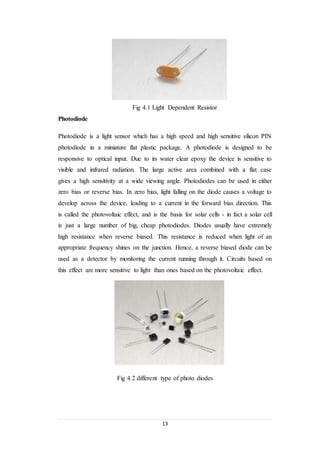
Photodiode is a light sensor which has a high speed and high sensitive silicon PIN
photodiode in a miniature flat plastic package. A photodiode is designed to be
responsive to optical input. Due to its water clear epoxy the device is sensitive to
visible and infrared radiation. The large active area combined with a flat case
gives a high sensitivity at a wide viewing angle. Photodiodes can be used in either
zero bias or reverse bias. In zero bias, light falling on the diode causes a voltage to
develop across the device, leading to a current in the forward bias direction. This
is called the photovoltaic effect, and is the basis for solar cells - in fact a solar cell
is just a large number of big, cheap photodiodes. Diodes usually have extremely
high resistance when reverse biased. This resistance is reduced when light of an
appropriate frequency shines on the junction. Hence, a reverse biased diode can be
used as a detector by monitoring the current running through it. Circuits based on
this effect are more sensitive to light than ones based on the photovoltaic effect.
Fig 4.2 different type of photo diodes
14
15
6. SOLAR CELL EFFICIENCYFACTORS
1. Maximum power point:
A solar cell may operate over a wide range of voltages (V) and currents (I). By
increasing the resistive load (voltage) in the cell from zero (indicating a short
circuit) to infinitely high values (indicating an open circuit) one can determine the
maximum power point (the maximum output electrical power
Pm = Vmax * Imax, (in watts.)
2. Energy conversion efficiency:
A solar cell's energyconversion efficiency (η, "eta"), is the percentage of
powerconverted (from absorbed light to electrical energy) and collected, when a
solar cell is connected to an electrical circuit. This term is calculated using the
ratio of Pm, divided by the input light irradiance under "standard" test conditions
(E, in W/m2) and the surface area of the solar cell (Ac in m²).
3. Peak Watt:
Solar cell output power depends on multiplefactors, such as the sun's incidence
angle, for comparison purposes between different cells and panels, the peak watt
(Wp) is used. kW(p) is a measure of the maximum (or peak) power you PV
installation can produce when the sun is brightest. It is called the “kilowatt peak
rating”.
16
SMART TRACKER PV PANEL
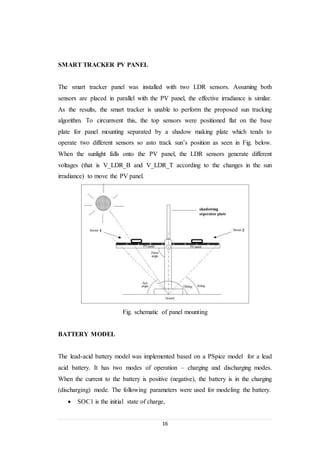
The smart tracker panel was installed with two LDR sensors. Assuming both
sensors are placed in parallel with the PV panel, the effective irradiance is similar.
As the results, the smart tracker is unable to perform the proposed sun tracking
algorithm. To circumvent this, the top sensors were positioned flat on the base
plate for panel mounting separated by a shadow making plate which tends to
operate two different sensors so asto track sun’s position as seen in Fig. below.
When the sunlight falls onto the PV panel, the LDR sensors generate different
voltages (that is V_LDR_B and V_LDR_T according to the changes in the sun
irradiance) to move the PV panel.
Fig. schematic of panel mounting
BATTERY MODEL
The lead-acid battery model was implemented based on a PSpice model for a lead
acid battery. It has two modes of operation – charging and discharging modes.
When the current to the battery is positive (negative), the battery is in the charging
(discharging) mode. The following parameters were used for modeling the battery.
 SOC1 is the initial state of charge,
17
 SOC (%) is the available charge.
 SOCm is the maximum state of charge.
 ns is the number of 2V cells in series.
 D (h-1) is the self-discharge rate of battery.
 Kb (no unit) is the charging and discharging battery efficiency.
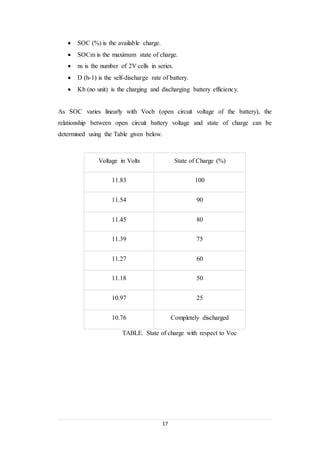
As SOC varies linearly with Vocb (open circuit voltage of the battery), the
relationship between open circuit battery voltage and state of charge can be
determined using the Table given below.
Voltage in Volts State of Charge (%)
11.83 100
11.54 90
11.45 80
11.39 75
11.27 60
11.18 50
10.97 25
10.76 Completely discharged
TABLE. State of charge with respect to Voc
18
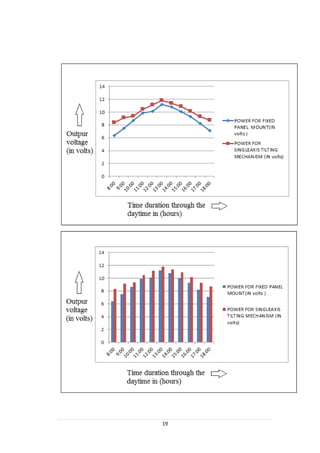
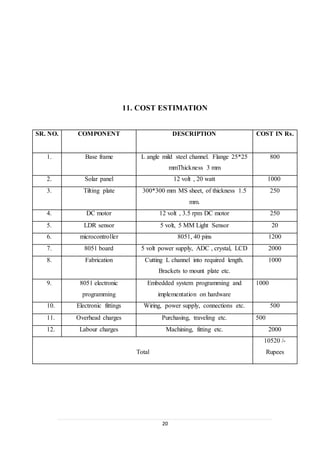
9. EXPERIMENTALRESULTS
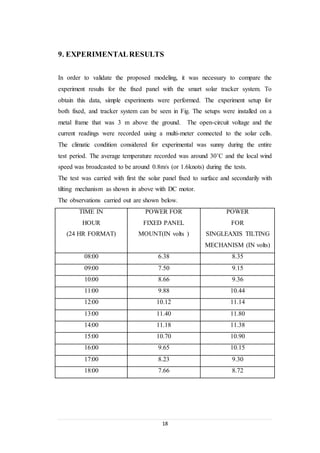
In order to validate the proposed modeling, it was necessary to compare the
experiment results for the fixed panel with the smart solar tracker system. To
obtain this data, simple experiments were performed. The experiment setup for
both fixed, and tracker system can be seen in Fig. The setups were installed on a
metal frame that was 3 m above the ground. The open-circuit voltage and the
current readings were recorded using a multi-meter connected to the solar cells.
The climatic condition considered for experimental was sunny during the entire
test period. The average temperature recorded was around 30˚C and the local wind
speed was broadcasted to be around 0.8m/s (or 1.6knots) during the tests.
The test was carried with first the solar panel fixed to surface and secondarily with
tilting mechanism as shown in above with DC motor.
The observations carried out are shown below.
TIME IN
HOUR
(24 HR FORMAT)
POWER FOR
FIXED PANEL
MOUNT(IN volts )
POWER
FOR
SINGLEAXIS TILTING
MECHANISM (IN volts)
08:00 6.38 8.35
09:00 7.50 9.15
10:00 8.66 9.36
11:00 9.88 10.44
12:00 10.12 11.14
13:00 11.40 11.80
14:00 11.18 11.38
15:00 10.70 10.90
16:00 9.65 10.15
17:00 8.23 9.30
18:00 7.66 8.72
19
20
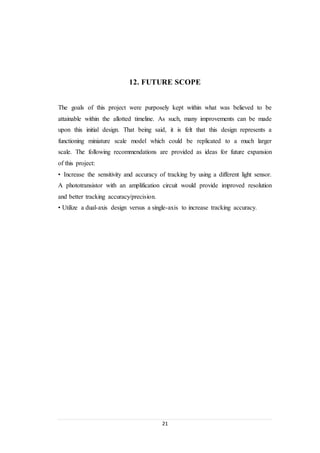
11. COST ESTIMATION
SR. NO. COMPONENT DESCRIPTION COST IN Rs.
1. Base frame L angle mild steel channel. Flange 25*25
mmThickness 3 mm
800
2. Solar panel 12 volt , 20 watt 1000
3. Tilting plate 300*300 mm MS sheet, of thickness 1.5
mm.
250
4. DC motor 12 volt , 3.5 rpm DC motor 250
5. LDR sensor 5 volt, 5 MM Light Sensor 20
6. microcontroller 8051, 40 pins 1200
7. 8051 board 5 volt power supply, ADC , crystal, LCD 2000
8. Fabrication Cutting L channel into required length.
Brackets to mount plate etc.
1000
9. 8051 electronic
programming
Embedded system programming and
implementation on hardware
1000
10. Electronic fittings Wiring, power supply, connections etc. 500
11. Overhead charges Purchasing, traveling etc. 500
12. Labour charges Machining, fitting etc. 2000
Total
10520 /-
Rupees
21
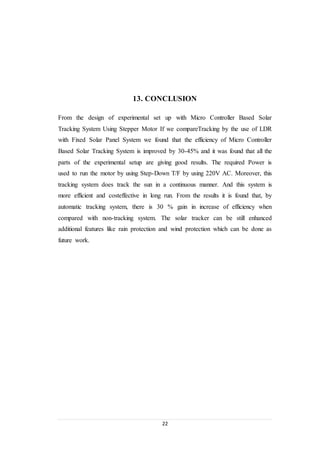
12. FUTURE SCOPE
The goals of this project were purposely kept within what was believed to be
attainable within the allotted timeline. As such, many improvements can be made
upon this initial design. That being said, it is felt that this design represents a
functioning miniature scale model which could be replicated to a much larger
scale. The following recommendations are provided as ideas for future expansion
of this project:
• Increase the sensitivity and accuracy of tracking by using a different light sensor.
A phototransistor with an amplification circuit would provide improved resolution
and better tracking accuracy/precision.
• Utilize a dual-axis design versus a single-axis to increase tracking accuracy.
22
13. CONCLUSION
From the design of experimental set up with Micro Controller Based Solar
Tracking System Using Stepper Motor If we compareTracking by the use of LDR
with Fixed Solar Panel System we found that the efficiency of Micro Controller
Based Solar Tracking System is improved by 30-45% and it was found that all the
parts of the experimental setup are giving good results. The required Power is
used to run the motor by using Step-Down T/F by using 220V AC. Moreover, this
tracking system does track the sun in a continuous manner. And this system is
more efficient and costeffective in long run. From the results it is found that, by
automatic tracking system, there is 30 % gain in increase of efficiency when
compared with non-tracking system. The solar tracker can be still enhanced
additional features like rain protection and wind protection which can be done as
future work.
23
14. REFERENCES
[1] Rizk J. and Chaiko Y. “Solar Tracking System: More Efficient Use of Solar
Panels”, World Academy of Science, Engineering and Technology 41 2008.
[2] Filfil Ahmed Nasir, Mohussen Deia Halboot, Dr. Zidan Khamis A.
“Microcontroller-Based Sun Path Tracking System”, Eng. & Tech. Journal, Vol.
29, No.7, 2011.
[3] Alimazidi Mohammad, Gillispie J, Mazidi, Rolin D. McKinlay, “The 8051
Microcontroller and Embedded Systems”, An imprint of Pearson Education.
[4] Mehta V K, Mehta Rohit, “Principles of Electronics”, S. Chand & Company
Ltd.
[5] Balagurusamy E, “Programming in ANSI C”, Tata McGraw-Hill Publishing
Company Limited.
[6] Damm, J. Issue #17, June/July 1990. An active solar tracking system, Home
Brew Magazine.
[7] Koyuncu B and Balasubramanian K, “A microprocessor controlled automatic
sun tracker,” IEEE Trans. Consumer Electron., vol. 37, no. 4,pp. 913-917, 1991.
[8] Konar A and Mandal A K, “Microprocessor based automatic sun tracker,” IEE
Proc. Sci., Meas. Technol., vol. 138, no. 4, pp. 237-241,1991.
24

Solar tracker report

  • 1.
    LDR BASED SOLARDUAL TRACKING SYSTEM ABSTRACT Photovoltaic modules are devices that directly and cleanly convert the sunlight into electricity and offer a practical solution to the problem of power generation in remote areas. They are especially useful in situations where the demand for electrical power is relatively low. To maximize the power extraction as per demand, instead of installing a extra panels we can use tracking system, which enhances the power. The solar tracker that has been designed and constructed in this project optimizes the power output of PV modules by making sure that they are pointed towards the sun at all times during the day. The tracker could be implemented in any situation where solar modules are used. It would be especially effective in situations where only a small number of modules are required and where efficiency is of a great importance. In this performance enhancement of solar Photo Voltaic (PV) panels has been experimented utilizing diffused reflectors and solar-tracker in other to determine the one with higher power output. An intelligent solar tracker and diffused reflector augmented systems were designed, developed and installed to compare the power output that can be generated from each of them when standing alone; and which system will achieve higher power output so as to reduce the number of PV panels required at any given time especially when cost is a major factor. For this comparative study, experimental readings were simultaneously taken from the panel, with sun tracker and the panel with diffuse reflectors aligned at 23.50 with the horizontal. Experimental results indicate appreciable increase in the overall power output of the solar panels. It is discovered that the power output of the panel with reflectors was higher from about 11 am till 2 pm, while the panel with tracking was higher at other times. The average power output of the system for a day is about the same. Looking at the cost of fabrication and the complexity of the tracking system, the reflector system is the better option.
  • 2.
    2 1. INTRODUCTION One ofthe most promising renewable energy sources characterized by a huge potential of conversion into electrical power is the solar energy. The conversion of solar radiation into electrical energy by Photo-Voltaic (PV) effect is a very promising technology, being clean, silent and reliable, with very small maintenance costs and small ecological impact. The interest in the Photo Voltaic conversion systems is visibly reflected by the exponential increase of sales in this market segment with a strong growth projection for the next decades. According to recent market research reports carried out by European Photovoltaic Industry Association (EPIA), the total installed power of PV conversion equipment increased from about 1 GW in 2001up to nearly 23 GW in 2009. The continuous evolution of the technology determined a sustained increase of the conversion efficiency of PV panels, but nonetheless the most part of the commercial panels have efficiencies no more than 20%. A constant research preoccupation of the technical community involved in the solar energy harnessing technology refers to various solutions to increase the PV panel’s conversion efficiency. Among PV efficiency improving solutions we can mention: solar tracking, optimization of solar cells geometry, enhancement of light trapping capability, use of new materials, etc. The output power produced by the PV panels depends strongly on the incident light radiation. The continuous modification of the sun-earth relative position determines a continuously changing of incident radiation on a fixed PV panel. The point of maximum received energy is reached when the direction of solar radiation is perpendicular on the panel surface. Thus an increase of the output energy of a given PV panel can be obtained by mounting the panel on a solar tracking device that follows the sun trajectory
  • 3.
    3 1.1 Background A SolarTracker is a device onto which solar panels are fitted which tracks the motion of the sun across the sky ensuring that the maximum amount of sunlight strikes the panels throughout the day. The Solar Tracker will attempt to navigate to the best angle of exposure of light from the sun. This report aims to let the reader understand the project work which I have done. A brief introduction to Solar Panel and Solar Tracker is explained in the Literature Research section. Basically the Solar Tracker is divided into two main categories, hardware and software. It is further subdivided into six main functionalities: Method of Tracker Mount, Drives, Sensors, RTC, Motors, and Power Supply of the Solar Tracker is also explained and explored. The reader would then be brief with some analysis and perceptions of the information. By using solar arrays, a series of solar cells electrically connected, a DC voltage is generated which can be physically used on a load. Solar arrays or panels are being used increasingly as efficiencies reach higher levels, and are especially popular in remote areas where placement of electricity lines is not economically viable. This alternative power source is continuously achieving greater popularity especially since the realisation of fossil fuels shortcomings. Renewable energy in the form of electricity has been in use to some degree as long as 75 or 100 years ago. Sources such as Solar, Wind, Hydro and Geothermal have all been utilised with varying levels of success. The most widely used are hydro and wind power, with solar power being moderately used worldwide. This can be attributed to the relatively high cost of solar cells and their low conversion efficiency. Solar power is being heavily researched, and solar energy costs have now reached within a few cents per kW/h of other forms of electricity
  • 4.
    4 SYSTEM CONCEPT Our designof Solar Tracker is to develop and implement a simplified diagram of a horizontal axis and active tracker method type of solar tracker fitted to a panel. It will be able to navigate to the best angle of exposure of light from the torchlight. A pair of sensors is used to point the East and West of the location of the light. A scaled-down model of a prototype will be designed and built to test the workability of the tracking system. The center of the drive is a DC motor. Figure shows a schematic diagram of a horizontal-axis solar tracker. This will be controlled via microcontroller program. The designed algorithm will power the motor drive after processing the feedback signals from the sensor array. Figure 4.2: Diagram of Horizontal axis Solar Tracker The Microcontroller program will also include monitoring and display of light intensity output from the photodiodes. The light detected by the Eastward-facing sensor is at a lower intensity to that detected by the Westward-facing sensor. Hence, the sensor must be turned westwards (by the motor controlled by the solar tracker circuit) until the levels of light detected by both the East and the West sensors are equal. At the point of the solar panel will be directly facing the light and generated electricity optimally. Obviously real world solar trackers are not so simple. A solar tracker must be able to reset itself at sunset so it is ready for
  • 5.
    5 sunrise, it mustcope with heavy cloud, and it. In addition a mount for the solar panel must be constructed which can cope with strong winds and a suitable motor found. A simple light tracker using 2 light sensors. Light tracker is typical use for maximum energy receiving of solar panel or making light following robot. In this example, two LLS05-A light sensors is used. The sensor is given linear output from luminance. Figure below shown the concept of how it work, it works by finding balance between the two sensors.
  • 6.
    6 2. LITERATURE RESEARCH Thischapter aims to provide a brief knowledge of Solar Panel, Solar Tracker and the components which made up Solar Tracker. 2.1 Technology of Solar Panel According to Encyclopaedia Britannica the first genuine for solar panel was built around 1883 by Charles Fritts. He used junctions formed by coating selenium (a semiconductor) with an extremely thin layer of gold. Crystalline silicon and gallium arsenide are typical choices of materials for solar panels. Gallium arsenide crystals are grown especially for photovoltaic use, but silicon crystals are available in less-expensive standard ingots, which are produced mainly for consumption in the microelectronics industry. Norway’s Renewable Energy Corporation has confirmed that it will build a solar manufacturing plant in Singapore by 2010 - the largest in the world. This plant will be able to produce products that can generate up to 1.5 Giga watts of energy every year. That is enough to power several million households at any one time. Last year the world as a whole produced products that could generate just 2 GW in total. 2.3 DESIGN AND CONSTRUCTION OF A MICROCONTROLLER BASED SINGLE AXIS SOLAR TRACKER. S. Zubair1, A. Suleiman2, H. T. Abdulazzez2, B. A. Salihu1 Solar energy is rapidly gaining popularity as an important means of expanding renewable energy resources. As such, it is vital that those in engineering fields understand the technologies associated with this area. This paper presents the design and construction of a microcontroller-based solar panel tracking system. Solar tracking allows more energy to be produced because the solar array is able to remain aligned to the sun. A working system will ultimately be demonstrated to validate the design. Problems and possible improvements will also be presented. 2.4 Design of two axes sun tracking controller with analytically solar radiation calculations ARTICLE in RENEWABLE AND SUSTAINABLE ENERGY REVIEWS · MARCH 2015 Saban Yilmaz, Oguzhan Akgol, Muharrem Karaaslan.
  • 7.
    7 Photovoltaic systems havegained a great deal of interest in the world and these studies performed on this subject have been gaining more and more importance. In order to design new PV systems that will be installed to operate in more efficient and more feasible way, it is necessary to analyze parameters like solar radiation values, the angle of incidence of the genus, temperature etc. Therefore, in this study, theoretical works have been performed for solar radiation and angle of incidence values of any location, plus an experimental study was carried out on a system tracking the sun in two axes and in a fixed system. The performed prototype is also adapted into a PV system with 4.6 kW power. Theoretical data are consistent with the data obtained from the PV system with 4.6 kW power. This study will be an important guide for the future PV power stations. In this study a photovoltaic double axis sun-tracking system is briefly described and performances of double axis tracking and fixed latitude tilt identical PV systems are theoretically and experimentally realized. The advantages of the proposed system over fixed systems are clearly discussed and compared with the results from other studies in literature. In order to verify our results obtained from the prototype, same system with the same working principle is applied to a high power plant and the results belong to the latter one were also support our claim that the proposed sun tracking system provide more efficient results. As a result, the suggested model and the system can be easily used for solar power plants, solar home systems and so on for more efficient energy production. 2.5 Time operated solar tracking for optimum power generation Asst.Prof.K.Sambasiva rao, P.Harish, V.N.V.Ramana, M.V.S.Krishna teja The growth or energy demand in response to industrialization, urbanization and social affluence has led to an extremely un-even global distribution of primary energy consumption. The Sun, Wind, Waves and geothermal heat are renewable energy sources that will never run out. They are perpetual or self-renewing. The rate of consumption does not exceed rate of renewability. The cost of generating electricity from wind and solar power has decreased by 90% over the past 20 years. Maximizing power output from a solar system is desirable to increase the efficiency of a solar tracing system. To maximize the power output from solar panels, we need to keep the panels aligned with the sun. In this paper, the design of an efficient solar tracking system based on Real Time Clock (RTC) using
  • 8.
    8 design of theexisting solar energy collector system has been implemented in order to provide higher efficiency at lower cost. The basic functional blocks of this system are four sensors1, and their operation depends upon the intensity of light falling on solar panel. All sensors (each with different functionality) send their output to microcontroller AT89c52. Then the microcontroller executes predefined task in its software. These sensors are being used with following names and functionality. Sun Tracking Sensors (STS) These two sensors are mounted in “V” shape (figure-6) exactly in the middle of the solar panel. The automatic sun tracking is. Accomplished according to following
  • 9.
    9 3. Project Description 3.1BlockDiagram Fig 3.1 Block Diagram of Project
  • 10.
    10 3.2 Solar Tracker SolarTracker is basically a device onto which solar panels are fitted which tracks the motion of the sun across the sky ensuring that the maximum amount of sunlight strikes the panels throughout the day. After finding the sunlight, the tracker will try to navigate through the path ensuring the best sunlight is detected. The design of the Solar Tracker requires many components. The design and construction of it could be divided into six main parts that would need to work together harmoniously to achieve a smooth run for the Solar Tracker, each with their main function. They are:  Methods of Tracker Mount  Methods of Drives  Sensor and Sensor Controller  Motor and Motor Controller  Tracker Solving Algorithm  Data Acquisition/Interface Card 3.3 Methods of Tracker Mount 1. Single axis solar trackers Single axis solar trackers can either have a horizontal or a vertical axle. The horizontal type is used in tropical regions where the sun gets very high at noon, but the days are short. The vertical type is used in high latitudes where the sun does not get very high, but summer days can be very long. The single axis tracking system is the simplest solution and the most common one used. 2. Double axis solar trackers Double axis solar trackers have both a horizontal and a vertical axle and so can track the Sun's apparent motion exactly anywhere in the World. This type of system is used to control astronomical telescopes, and so there is plenty of software
  • 11.
    11 available to automaticallypredict and track the motion of the sun across the sky.By tracking the sun, the efficiency of the solar panels can be increased by 30- 40%.The dual axis tracking system is also used for concentrating a solar reflector toward the concentrator on heliostat systems. 3.4 Methods of Drive 1. Active Trackers Active Trackers use motors and gear trains to direct the tracker as commanded by a controller responding to the solar direction. Light-sensing trackers typically have two photo sensors, such as photodiodes, configured differentially so that they output a null when receiving the same light flux. Mechanically, they should be omnidirectional and are aimed 90 degrees apart. This will cause the steepest part of their cosine transfer functions to balance at the steepest part, which translates into maximum sensitivity. 2. Passive Trackers Passive Trackers use a low boiling point compressed gas fluid that is driven to one side or the other by solar heat creating gas pressure to cause the tracker to move in response to an imbalance.
  • 12.
    12 5. COMPONENTS DESCRIPTION 1.LDR Sensors A sensor is a device that measures a physical quantity and converts it into a signal which can be read by an observer or by an instrument. Light Dependent Resistor Light Dependent Resistor is made of a high-resistance semiconductor. It can also be referred to as a photoconductor. If light falling on the device is of the high enough frequency, photons absorbed by the semiconductor give bound electrons enough energy to jump into the conduction band. The resulting free electron conducts electricity, thereby lowering resistance. Hence, Light Dependent Resistors is very useful in light sensor circuits. LDR is very high-resistance, sometimes as high as 10MΩ, when they are illuminated with light resistance drops dramatically. A Light Dependent Resistor is a resistor that changes in value according to the light falling on it. A commonly used device, the ORP-12, has a high resistance in the dark, and a low resistance in the light. Connecting the LDR to the microcontroller is very straight forward, but some software ‘calibrating’ is required. It should be remembered that the LDR response is not linear, and so the readings will not change in exactly the same way as with a potentiometer. In general there is a larger resistance change at brighter light levels. This can be compensated for in the software by using a smaller range at darker light levels.
  • 13.
    13 Fig 4.1 LightDependent Resistor Photodiode Photodiode is a light sensor which has a high speed and high sensitive silicon PIN photodiode in a miniature flat plastic package. A photodiode is designed to be responsive to optical input. Due to its water clear epoxy the device is sensitive to visible and infrared radiation. The large active area combined with a flat case gives a high sensitivity at a wide viewing angle. Photodiodes can be used in either zero bias or reverse bias. In zero bias, light falling on the diode causes a voltage to develop across the device, leading to a current in the forward bias direction. This is called the photovoltaic effect, and is the basis for solar cells - in fact a solar cell is just a large number of big, cheap photodiodes. Diodes usually have extremely high resistance when reverse biased. This resistance is reduced when light of an appropriate frequency shines on the junction. Hence, a reverse biased diode can be used as a detector by monitoring the current running through it. Circuits based on this effect are more sensitive to light than ones based on the photovoltaic effect. Fig 4.2 different type of photo diodes
  • 14.
  • 15.
    15 6. SOLAR CELLEFFICIENCYFACTORS 1. Maximum power point: A solar cell may operate over a wide range of voltages (V) and currents (I). By increasing the resistive load (voltage) in the cell from zero (indicating a short circuit) to infinitely high values (indicating an open circuit) one can determine the maximum power point (the maximum output electrical power Pm = Vmax * Imax, (in watts.) 2. Energy conversion efficiency: A solar cell's energyconversion efficiency (η, "eta"), is the percentage of powerconverted (from absorbed light to electrical energy) and collected, when a solar cell is connected to an electrical circuit. This term is calculated using the ratio of Pm, divided by the input light irradiance under "standard" test conditions (E, in W/m2) and the surface area of the solar cell (Ac in m²). 3. Peak Watt: Solar cell output power depends on multiplefactors, such as the sun's incidence angle, for comparison purposes between different cells and panels, the peak watt (Wp) is used. kW(p) is a measure of the maximum (or peak) power you PV installation can produce when the sun is brightest. It is called the “kilowatt peak rating”.
  • 16.
    16 SMART TRACKER PVPANEL The smart tracker panel was installed with two LDR sensors. Assuming both sensors are placed in parallel with the PV panel, the effective irradiance is similar. As the results, the smart tracker is unable to perform the proposed sun tracking algorithm. To circumvent this, the top sensors were positioned flat on the base plate for panel mounting separated by a shadow making plate which tends to operate two different sensors so asto track sun’s position as seen in Fig. below. When the sunlight falls onto the PV panel, the LDR sensors generate different voltages (that is V_LDR_B and V_LDR_T according to the changes in the sun irradiance) to move the PV panel. Fig. schematic of panel mounting BATTERY MODEL The lead-acid battery model was implemented based on a PSpice model for a lead acid battery. It has two modes of operation – charging and discharging modes. When the current to the battery is positive (negative), the battery is in the charging (discharging) mode. The following parameters were used for modeling the battery.  SOC1 is the initial state of charge,
  • 17.
    17  SOC (%)is the available charge.  SOCm is the maximum state of charge.  ns is the number of 2V cells in series.  D (h-1) is the self-discharge rate of battery.  Kb (no unit) is the charging and discharging battery efficiency. As SOC varies linearly with Vocb (open circuit voltage of the battery), the relationship between open circuit battery voltage and state of charge can be determined using the Table given below. Voltage in Volts State of Charge (%) 11.83 100 11.54 90 11.45 80 11.39 75 11.27 60 11.18 50 10.97 25 10.76 Completely discharged TABLE. State of charge with respect to Voc
  • 18.
    18 9. EXPERIMENTALRESULTS In orderto validate the proposed modeling, it was necessary to compare the experiment results for the fixed panel with the smart solar tracker system. To obtain this data, simple experiments were performed. The experiment setup for both fixed, and tracker system can be seen in Fig. The setups were installed on a metal frame that was 3 m above the ground. The open-circuit voltage and the current readings were recorded using a multi-meter connected to the solar cells. The climatic condition considered for experimental was sunny during the entire test period. The average temperature recorded was around 30˚C and the local wind speed was broadcasted to be around 0.8m/s (or 1.6knots) during the tests. The test was carried with first the solar panel fixed to surface and secondarily with tilting mechanism as shown in above with DC motor. The observations carried out are shown below. TIME IN HOUR (24 HR FORMAT) POWER FOR FIXED PANEL MOUNT(IN volts ) POWER FOR SINGLEAXIS TILTING MECHANISM (IN volts) 08:00 6.38 8.35 09:00 7.50 9.15 10:00 8.66 9.36 11:00 9.88 10.44 12:00 10.12 11.14 13:00 11.40 11.80 14:00 11.18 11.38 15:00 10.70 10.90 16:00 9.65 10.15 17:00 8.23 9.30 18:00 7.66 8.72
  • 19.
  • 20.
    20 11. COST ESTIMATION SR.NO. COMPONENT DESCRIPTION COST IN Rs. 1. Base frame L angle mild steel channel. Flange 25*25 mmThickness 3 mm 800 2. Solar panel 12 volt , 20 watt 1000 3. Tilting plate 300*300 mm MS sheet, of thickness 1.5 mm. 250 4. DC motor 12 volt , 3.5 rpm DC motor 250 5. LDR sensor 5 volt, 5 MM Light Sensor 20 6. microcontroller 8051, 40 pins 1200 7. 8051 board 5 volt power supply, ADC , crystal, LCD 2000 8. Fabrication Cutting L channel into required length. Brackets to mount plate etc. 1000 9. 8051 electronic programming Embedded system programming and implementation on hardware 1000 10. Electronic fittings Wiring, power supply, connections etc. 500 11. Overhead charges Purchasing, traveling etc. 500 12. Labour charges Machining, fitting etc. 2000 Total 10520 /- Rupees
  • 21.
    21 12. FUTURE SCOPE Thegoals of this project were purposely kept within what was believed to be attainable within the allotted timeline. As such, many improvements can be made upon this initial design. That being said, it is felt that this design represents a functioning miniature scale model which could be replicated to a much larger scale. The following recommendations are provided as ideas for future expansion of this project: • Increase the sensitivity and accuracy of tracking by using a different light sensor. A phototransistor with an amplification circuit would provide improved resolution and better tracking accuracy/precision. • Utilize a dual-axis design versus a single-axis to increase tracking accuracy.
  • 22.
    22 13. CONCLUSION From thedesign of experimental set up with Micro Controller Based Solar Tracking System Using Stepper Motor If we compareTracking by the use of LDR with Fixed Solar Panel System we found that the efficiency of Micro Controller Based Solar Tracking System is improved by 30-45% and it was found that all the parts of the experimental setup are giving good results. The required Power is used to run the motor by using Step-Down T/F by using 220V AC. Moreover, this tracking system does track the sun in a continuous manner. And this system is more efficient and costeffective in long run. From the results it is found that, by automatic tracking system, there is 30 % gain in increase of efficiency when compared with non-tracking system. The solar tracker can be still enhanced additional features like rain protection and wind protection which can be done as future work.
  • 23.
    23 14. REFERENCES [1] RizkJ. and Chaiko Y. “Solar Tracking System: More Efficient Use of Solar Panels”, World Academy of Science, Engineering and Technology 41 2008. [2] Filfil Ahmed Nasir, Mohussen Deia Halboot, Dr. Zidan Khamis A. “Microcontroller-Based Sun Path Tracking System”, Eng. & Tech. Journal, Vol. 29, No.7, 2011. [3] Alimazidi Mohammad, Gillispie J, Mazidi, Rolin D. McKinlay, “The 8051 Microcontroller and Embedded Systems”, An imprint of Pearson Education. [4] Mehta V K, Mehta Rohit, “Principles of Electronics”, S. Chand & Company Ltd. [5] Balagurusamy E, “Programming in ANSI C”, Tata McGraw-Hill Publishing Company Limited. [6] Damm, J. Issue #17, June/July 1990. An active solar tracking system, Home Brew Magazine. [7] Koyuncu B and Balasubramanian K, “A microprocessor controlled automatic sun tracker,” IEEE Trans. Consumer Electron., vol. 37, no. 4,pp. 913-917, 1991. [8] Konar A and Mandal A K, “Microprocessor based automatic sun tracker,” IEE Proc. Sci., Meas. Technol., vol. 138, no. 4, pp. 237-241,1991.
  • 24.