AUTOMATIC SOLAR STREET
LIGHT SYSYTEM
(BEEE SHIMIN SIR)
BY
ARUNDHATHI P UNNIKRISHNAN
1
INTRODUTION
 Our Project is to control the switching of
street light automatically.
 Automated systems have less manual
operation accurate , good performance.
 Renewable energy be used more as they
freely available.
 Greener power reduces pollution global
warming.
2
HOW IT WORKS ?
3
MAIN COMPONENTS USED
 Solar panel.
 Power circuit.
 Battery.
 LDR
 LED
4
COMPONENTS
BATTERY SOLAR PANEL
LED
5
LDR
 Light dependent resistor
 An LDR is a component that has a (variable)
resistance that changes with the light
intensity that falls upon it. This allows them
to be used in light sensing circuits.
6
CIRCUITARIES
 4 circuits are used :
 Charge controller circuit
 Dusk to dawn operation circuit.
 Switching circuit between conventional and
solar
 Power circuit.
7
WORKING PRINCIPLE:
 In the street lighting we have the charge controller
circuit which is charged the battery in the day time by
solar panel and by conventional power at night.
 This switching between conventional and solar
occurs through the relaying action.
 The relaying action is done by two NOT logic
operated transistor through LDR.
 Photoconductive device LDR (light depended
resistor) whose resistance changes proportional to
the extend of illumination ,which switches ON or
OFF the LED during day and night and also dusk to
dawn operation is done.
8
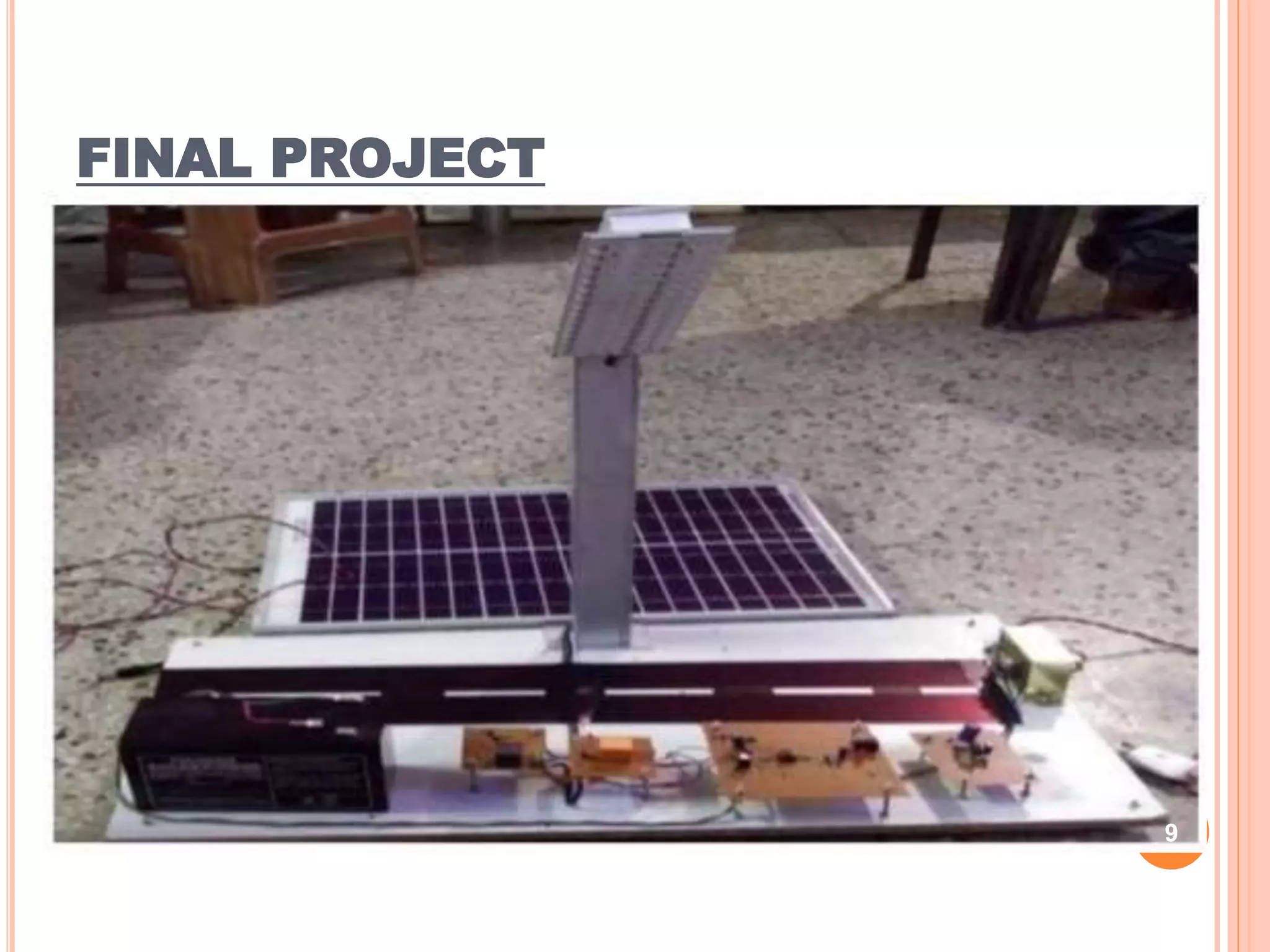
FINAL PROJECT
9
ADVANTAGES
 Low power consumption.
 Long life
 Low maintenance
 Reduced energy cost
 Elimination of man power
 Higher community satisfaction
 Low maintenance cost
10
DISADVANTAGES
 High initial cost
 Chances of theft of solar panel in case of
rural areas.
 Security aspects
11
CONCLUSTION
 Project is a cost effective, practical ,eco-friendly
and the safest way to save energy.
 It clearly tackles the problems that world is facing
today , saving of energy .
 According statistical data ,we can save more
electrical energy that is now consumed by the
highways.
12
THANK YOU
13

Automatic solar street light sysytem

  • 1.
    AUTOMATIC SOLAR STREET LIGHTSYSYTEM (BEEE SHIMIN SIR) BY ARUNDHATHI P UNNIKRISHNAN 1
  • 2.
    INTRODUTION  Our Projectis to control the switching of street light automatically.  Automated systems have less manual operation accurate , good performance.  Renewable energy be used more as they freely available.  Greener power reduces pollution global warming. 2
  • 3.
  • 4.
    MAIN COMPONENTS USED Solar panel.  Power circuit.  Battery.  LDR  LED 4
  • 5.
  • 6.
    LDR  Light dependentresistor  An LDR is a component that has a (variable) resistance that changes with the light intensity that falls upon it. This allows them to be used in light sensing circuits. 6
  • 7.
    CIRCUITARIES  4 circuitsare used :  Charge controller circuit  Dusk to dawn operation circuit.  Switching circuit between conventional and solar  Power circuit. 7
  • 8.
    WORKING PRINCIPLE:  Inthe street lighting we have the charge controller circuit which is charged the battery in the day time by solar panel and by conventional power at night.  This switching between conventional and solar occurs through the relaying action.  The relaying action is done by two NOT logic operated transistor through LDR.  Photoconductive device LDR (light depended resistor) whose resistance changes proportional to the extend of illumination ,which switches ON or OFF the LED during day and night and also dusk to dawn operation is done. 8
  • 9.
  • 10.
    ADVANTAGES  Low powerconsumption.  Long life  Low maintenance  Reduced energy cost  Elimination of man power  Higher community satisfaction  Low maintenance cost 10
  • 11.
    DISADVANTAGES  High initialcost  Chances of theft of solar panel in case of rural areas.  Security aspects 11
  • 12.
    CONCLUSTION  Project isa cost effective, practical ,eco-friendly and the safest way to save energy.  It clearly tackles the problems that world is facing today , saving of energy .  According statistical data ,we can save more electrical energy that is now consumed by the highways. 12
  • 13.