
Chapter 3

Divided attention
 Introduction
 Dual task experiments
 Theories
 Single or multiple processors?
 Summary
Introduction

 Doing two things at once
 Everyday experience
 Dual tasks
Dual task experiments

 Eysenck & Keane(1995) have identified
 three major factors that affect the
 ability to do two(or more) tasks at once
 Task similarity
 Task difficulty
 Practice
Task similarity

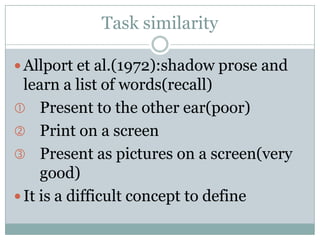
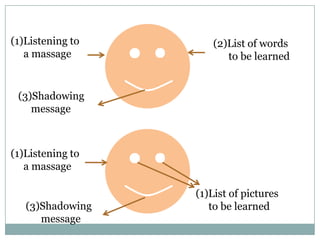
 Allport et al.(1972):shadow prose and
  learn a list of words(recall)
 Present to the other ear(poor)
 Print on a screen
 Present as pictures on a screen(very
     good)
 It is a difficult concept to define
Task difficulty

 inter-individual
 intra-individual
 Combine with a second task
Practice

 Spelke et al.(1976):write down dictated
  words while reading short stories
 Reasons
1. Reduce the amount of resource
2. Help participants learn strategies
Theories
Central capacity theory

 Kahneman(1973)
 Attention as a skill rather than a process
 Mental effort=tasks require different
  processing capacity
 The difficulty of the task & the degree of
  practice
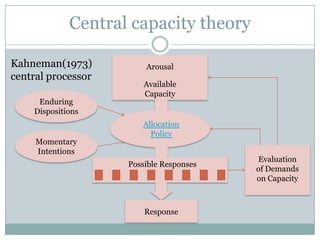
Central capacity theory

Kahneman(1973)          Arousal
central processor
                        Available
                        Capacity
     Enduring
    Dispositions
                       Allocation
                         Policy
     Momentary
     Intentions
                                         Evaluation
                    Possible Responses
                                         of Demands
                                         on Capacity


                        Response
Evaluation

 Task difficulty, the role of practice and
  arousal
 Problems
1. The limits of capacity
2. Does not explain the strong influence of
    similarity
Central capacity interference theory

 Norman and Bobrow(1975)
 Resource-limited & data-limited
Evaluation

 Cherry(1953)
 Failure to predict performance of tasks in
  experiments
 Non-falsifiable
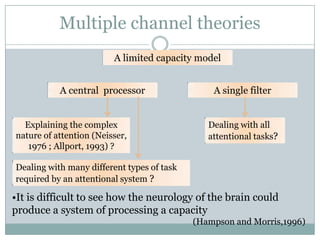
Multiple channel theories
                         A limited capacity model


           A central processor                  A single filter


  Explaining the complex                       Dealing with all
nature of attention (Neisser,                  attentional tasks?
   1976 ; Allport, 1993) ?

Dealing with many different types of task
required by an attentional system ?

•It is difficult to see how the neurology of the brain could
produce a system of processing a capacity
                                            (Hampson and Morris,1996)
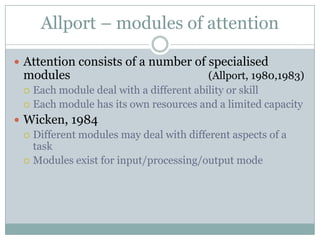
Allport – modules of attention

 Attention consists of a number of specialised
  modules                                (Allport, 1980,1983)
   Each module deal with a different ability or skill
   Each module has its own resources and a limited capacity

 Wicken, 1984
   Different modules may deal with different aspects of a
    task
   Modules exist for input/processing/output mode
(1)Listening to       (2)List of words
   a massage             to be learned


 (3)Shadowing
    message


(1)Listening to
   a massage

                  (1)List of pictures
   (3)Shadowing      to be learned
      message
Evaluation of module theory

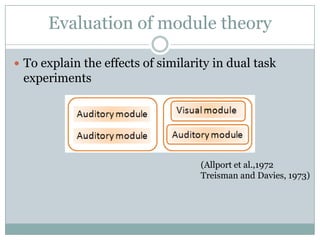
 To explain the effects of similarity in dual task
 experiments


                                    (Allport et al.,1972
                                    Treisman and Davies, 1973)
Evaluation of module theory

 The fundamental assumptions of cognitive
 neuropsychology
  Relatively   independent cognitive processors or
   modules
  Each one can function to some extent in
   isolateion
  Brain damage                  (Eysenck and Keane, 1995)
    Only   some of these modules are impaired
Evaluation of module theory
 Problem 1                   Problem 2
   It doesn’t specify the      How the modules work
    number of modules            together?
   What types of modules       How the modules are
    they are?                    co-ordinated
 The theory is therefore     Enough practice
 non-falsifiable                The similar tasks can
                                 work concurrently
                                Competing for the
                                 resources of one module
                                         (Underwood, 1974;
                                         Spelke et al., 1976)
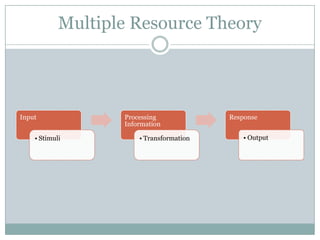
Multiple Resource Theory

 Navon & Gopher (1979)
 - specialized “mental resources” (like modules)
 - performance can be traded (new concept)
 - supply and demand
 Good explanation of effect of task similarity
 in dual task experiments
                                  (Allport et al, 1972)
Multiple Resource Theory


Input              Processing             Response
                   Information

    • Stimuli          • Transformation       • Output
Multiple Resource Theory


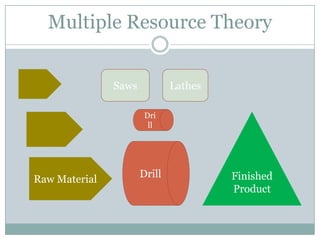
               Saws           Lathes

                       Dri
                        ll


                      Drill            Finished
Raw Material
                                       Product
Multiple Resource Theory

 Dawson and Schell (1982)
- Shadowed a message
- Classically conditioned word in non-attended ear
    (left or right)
-   Conditioning = paired with mild electric shock
-   Subsequent recognition = autonomic nervous system
    response
-   Left vs. right hemisphere - Left for speech reception
    and production
                  - Right for speech analysis
-   Automated response to unattended message in left
    ear but not right ear
Multiple Resource Theory

 Payne and Wenger (1998)
- Single capacity model
                = response in both ears or neither
-   Multiple resource model
                = response to each ear differently
-   Not able to detect unattended message in right ear
-   Left hemisphere is for speech reception and production,
    and primary task (shadow message) takes priority
-   Not enough resources to analyze unattended message at the
    same time
Multiple Resource Theory

 Failure to specify number of resources
 How the multiple resources work together
 Attentional processes highly integrated
                                  HOW?
Single or Multiple Processors?

 Flaws with both models
  Single capacity models fail to account for effect of
   similarity in dual task experiment
  Multiple capacity models fail to explain how
   different parts of attention work together
Single or Multiple Processors?

 Baddeley (1986)
- Synthesis theory
 -   combine features of both approaches
       - central, limited capacity processor
       (from central capacity theory)
       - modality-specific processing systems
       (from modular or multiple resource theory)
Single or Multiple Processors?

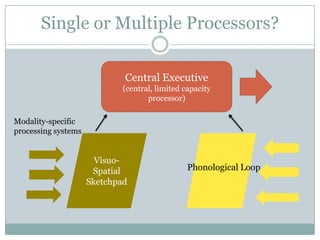
                             Central Executive
                             (central, limited capacity
                                    processor)

Modality-specific
processing systems


                       Visuo-
                      Spatial                   Phonological Loop
                     Sketchpad
Single or Multiple Processors?

 Good compromise?
 Still got problems
 Role of the central executive
 How different components are integrated
Summary

 Divided attention
 - studied using dual task experiments
 - influenced by task similarity
                 task difficulty
                 task practice
Summary

 Kahneman
    - single, limited capacity central processor
    - explains effect of task difficulty and practice
    - does not explain effect of task similarity on
     performance
Summary

 Norman and Bobrow
    - modified version of central capacity model
    - tasks: resource-limited
             data-limited
    - more flexible model
    - problem: non-falsifiable
Summary

 Allport
    - modular approach
    - different modules with individual resources &
     capacities
    - better at explaining influence of task similarity
    - supported by findings of cognitive neuropsych
    - problem: does not specify number of modules
                 how modules are integrated
Summary

 Navon and Gopher
    - multiple resource theory
    - similar to Allport
    - similar strength and weakness
Summary

 Baddeley
    - synthesis theory
    - central limited capacity processor
    - individual processors for different tasks
THANKS FOR
YOUR LISTENING

Chapter3

  • 1.
  • 2.
     Introduction  Dualtask experiments  Theories  Single or multiple processors?  Summary
  • 3.
    Introduction  Doing twothings at once  Everyday experience  Dual tasks
  • 4.
    Dual task experiments Eysenck & Keane(1995) have identified three major factors that affect the ability to do two(or more) tasks at once  Task similarity  Task difficulty  Practice
  • 5.
    Task similarity  Allportet al.(1972):shadow prose and learn a list of words(recall)  Present to the other ear(poor)  Print on a screen  Present as pictures on a screen(very good)  It is a difficult concept to define
  • 6.
    Task difficulty  inter-individual intra-individual  Combine with a second task
  • 7.
    Practice  Spelke etal.(1976):write down dictated words while reading short stories  Reasons 1. Reduce the amount of resource 2. Help participants learn strategies
  • 8.
  • 9.
    Central capacity theory Kahneman(1973)  Attention as a skill rather than a process  Mental effort=tasks require different processing capacity  The difficulty of the task & the degree of practice
  • 10.
    Central capacity theory Kahneman(1973) Arousal central processor Available Capacity Enduring Dispositions Allocation Policy Momentary Intentions Evaluation Possible Responses of Demands on Capacity Response
  • 11.
    Evaluation  Task difficulty,the role of practice and arousal  Problems 1. The limits of capacity 2. Does not explain the strong influence of similarity
  • 12.
    Central capacity interferencetheory  Norman and Bobrow(1975)  Resource-limited & data-limited
  • 13.
    Evaluation  Cherry(1953)  Failureto predict performance of tasks in experiments  Non-falsifiable
  • 14.
    Multiple channel theories A limited capacity model A central processor A single filter Explaining the complex Dealing with all nature of attention (Neisser, attentional tasks? 1976 ; Allport, 1993) ? Dealing with many different types of task required by an attentional system ? •It is difficult to see how the neurology of the brain could produce a system of processing a capacity (Hampson and Morris,1996)
  • 15.
    Allport – modulesof attention  Attention consists of a number of specialised modules (Allport, 1980,1983)  Each module deal with a different ability or skill  Each module has its own resources and a limited capacity  Wicken, 1984  Different modules may deal with different aspects of a task  Modules exist for input/processing/output mode
  • 16.
    (1)Listening to (2)List of words a massage to be learned (3)Shadowing message (1)Listening to a massage (1)List of pictures (3)Shadowing to be learned message
  • 17.
    Evaluation of moduletheory  To explain the effects of similarity in dual task experiments (Allport et al.,1972 Treisman and Davies, 1973)
  • 18.
    Evaluation of moduletheory  The fundamental assumptions of cognitive neuropsychology  Relatively independent cognitive processors or modules  Each one can function to some extent in isolateion  Brain damage (Eysenck and Keane, 1995)  Only some of these modules are impaired
  • 19.
    Evaluation of moduletheory  Problem 1  Problem 2  It doesn’t specify the  How the modules work number of modules together?  What types of modules  How the modules are they are? co-ordinated  The theory is therefore  Enough practice non-falsifiable  The similar tasks can work concurrently  Competing for the resources of one module (Underwood, 1974; Spelke et al., 1976)
  • 20.
    Multiple Resource Theory Navon & Gopher (1979) - specialized “mental resources” (like modules) - performance can be traded (new concept) - supply and demand  Good explanation of effect of task similarity in dual task experiments (Allport et al, 1972)
  • 21.
    Multiple Resource Theory Input Processing Response Information • Stimuli • Transformation • Output
  • 22.
    Multiple Resource Theory Saws Lathes Dri ll Drill Finished Raw Material Product
  • 23.
    Multiple Resource Theory Dawson and Schell (1982) - Shadowed a message - Classically conditioned word in non-attended ear (left or right) - Conditioning = paired with mild electric shock - Subsequent recognition = autonomic nervous system response - Left vs. right hemisphere - Left for speech reception and production - Right for speech analysis - Automated response to unattended message in left ear but not right ear
  • 24.
    Multiple Resource Theory Payne and Wenger (1998) - Single capacity model = response in both ears or neither - Multiple resource model = response to each ear differently - Not able to detect unattended message in right ear - Left hemisphere is for speech reception and production, and primary task (shadow message) takes priority - Not enough resources to analyze unattended message at the same time
  • 25.
    Multiple Resource Theory Failure to specify number of resources  How the multiple resources work together  Attentional processes highly integrated HOW?
  • 26.
    Single or MultipleProcessors?  Flaws with both models  Single capacity models fail to account for effect of similarity in dual task experiment  Multiple capacity models fail to explain how different parts of attention work together
  • 27.
    Single or MultipleProcessors?  Baddeley (1986) - Synthesis theory - combine features of both approaches - central, limited capacity processor (from central capacity theory) - modality-specific processing systems (from modular or multiple resource theory)
  • 28.
    Single or MultipleProcessors? Central Executive (central, limited capacity processor) Modality-specific processing systems Visuo- Spatial Phonological Loop Sketchpad
  • 29.
    Single or MultipleProcessors?  Good compromise?  Still got problems  Role of the central executive  How different components are integrated
  • 30.
    Summary  Divided attention - studied using dual task experiments - influenced by task similarity task difficulty task practice
  • 31.
    Summary  Kahneman - single, limited capacity central processor - explains effect of task difficulty and practice - does not explain effect of task similarity on performance
  • 32.
    Summary  Norman andBobrow - modified version of central capacity model - tasks: resource-limited data-limited - more flexible model - problem: non-falsifiable
  • 33.
    Summary  Allport - modular approach - different modules with individual resources & capacities - better at explaining influence of task similarity - supported by findings of cognitive neuropsych - problem: does not specify number of modules how modules are integrated
  • 34.
    Summary  Navon andGopher - multiple resource theory - similar to Allport - similar strength and weakness
  • 35.
    Summary  Baddeley - synthesis theory - central limited capacity processor - individual processors for different tasks
  • 36.