Introduction to Critical
Thinking
Welcome
to
Critical Thinking
Unit 3
Critical &
Logical
Reasoning
ISM5001 Critical Thinking and Argumentation
Logic and Reasoning
Logic – The science of correct reasoning.
Reasoning – The drawing of inferences or
conclusions from known or assumed facts.
Two basic categories of human reasoning
Deduction: reasoning from general premises,
which are known or presumed to be known, to more
specific, certain conclusions.
Induction: reasoning from specific cases to more
general, but uncertain, conclusions.
Both deductive and inductive arguments occur
frequently and naturally…both forms of reasoning can
be equally compelling and persuasive, and neither form
is preferred over the other (Hollihan & Baske, 1994).
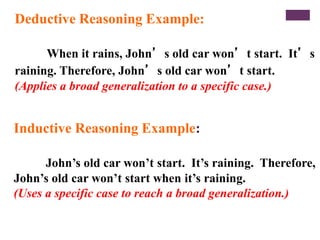
Deductive Reasoning Example:
When it rains, John’s old car won’t start. It’s
raining. Therefore, John’s old car won’t start.
(Applies a broad generalization to a specific case.)
Inductive Reasoning Example:
John’s old car won’t start. It’s raining. Therefore,
John’s old car won’t start when it’s raining.
(Uses a specific case to reach a broad generalization.)
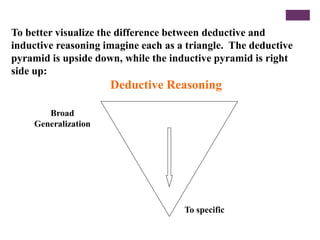
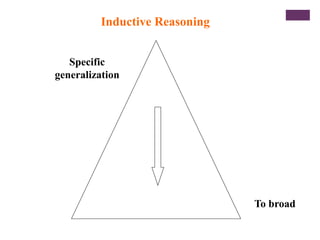
To better visualize the difference between deductive and
inductive reasoning imagine each as a triangle. The deductive
pyramid is upside down, while the inductive pyramid is right
side up:
Broad
Generalization
To specific
Deductive Reasoning
Specific
generalization
To broad
Inductive Reasoning
Inductive Reasoning:
When detectives arrive at the scene of a crime, the
first thing they do is look for clues that can help them
piece together what happened. A broken window, for
example, might suggest how a burglar entered or exited.
Likewise, the fact that an intruder didn't disturb
anything but a painting that hid a safe might suggest
that the burglar knew exactly where the safe was
hidden. And this, in turn, suggests that the burglar knew
the victim.
The process described above is called inductive
reasoning. It consists of making observations and then
drawing conclusions based on those observations.
• Like a detective, you use inductive reasoning all
the time in your daily life.
• You might notice, for example, that every time
you eat a hot dog with chili and onions, you get a
stomachache.
• Using inductive reasoning, you could logically
conclude that the chili dogs cause indigestion,
and that you should probably stop eating them.
• Similarly, you might notice that your cat tries to
scratch you every time you rub her stomach.
• In both examples, what you're doing is moving
from the specific—a particular observation—to
the general—a larger conclusion.
• Inductive reasoning starts from observation and
evidence and leads to a conclusion.
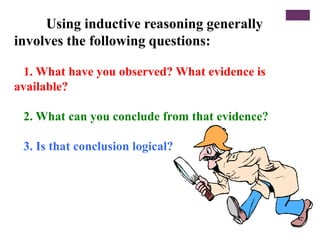
Using inductive reasoning generally
involves the following questions:
1. What have you observed? What evidence is
available?
2. What can you conclude from that evidence?
3. Is that conclusion logical?
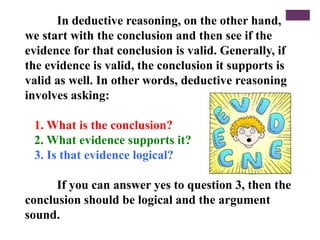
In deductive reasoning, on the other hand,
we start with the conclusion and then see if the
evidence for that conclusion is valid. Generally, if
the evidence is valid, the conclusion it supports is
valid as well. In other words, deductive reasoning
involves asking:
1. What is the conclusion?
2. What evidence supports it?
3. Is that evidence logical?
If you can answer yes to question 3, then the
conclusion should be logical and the argument
sound.
Deductive Reasoning
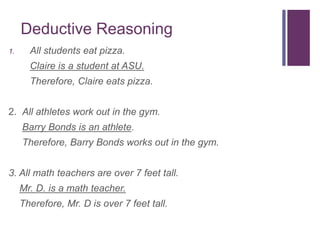
1. All students eat pizza.
Claire is a student at ASU.
Therefore, Claire eats pizza.
2. All athletes work out in the gym.
Barry Bonds is an athlete.
Therefore, Barry Bonds works out in the gym.
3. All math teachers are over 7 feet tall.
Mr. D. is a math teacher.
Therefore, Mr. D is over 7 feet tall.
Deductive Reasoning
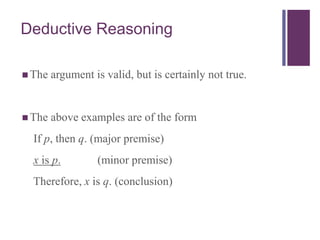
 The argument is valid, but is certainly not true.
 The above examples are of the form
If p, then q. (major premise)
x is p. (minor premise)
Therefore, x is q. (conclusion)
Deductive Versus
Inductive Reasoning
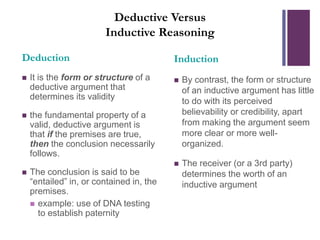
Deduction
 It is the form or structure of a
deductive argument that
determines its validity
 the fundamental property of a
valid, deductive argument is
that if the premises are true,
then the conclusion necessarily
follows.
 The conclusion is said to be
“entailed” in, or contained in, the
premises.
 example: use of DNA testing
to establish paternity
Induction
 By contrast, the form or structure
of an inductive argument has little
to do with its perceived
believability or credibility, apart
from making the argument seem
more clear or more well-
organized.
 The receiver (or a 3rd party)
determines the worth of an
inductive argument
Deduction Versus Induction
--still more
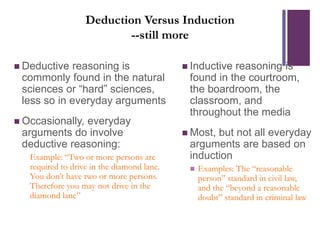
 Deductive reasoning is
commonly found in the natural
sciences or “hard” sciences,
less so in everyday arguments
 Occasionally, everyday
arguments do involve
deductive reasoning:
Example: “Two or more persons are
required to drive in the diamond lane.
You don’t have two or more persons.
Therefore you may not drive in the
diamond lane”
 Inductive reasoning is
found in the courtroom,
the boardroom, the
classroom, and
throughout the media
 Most, but not all everyday
arguments are based on
induction
 Examples: The “reasonable
person” standard in civil law,
and the “beyond a reasonable
doubt” standard in criminal law
Inductive or deductive reasoning?
 A sample of fifty motorists
who were stopped by the
CHP at a sobriety
checkpoint on a Saturday
at midnight revealed that
one in four drivers were
either uninsured,
intoxicated, or both.
Thus, if you get involved
in an accident on the
freeway there is a 25%
chance the other motorist
will be drunk or
uninsured.
 The Law of the Sea treaty
states that any vessel
beyond a 12 mile limit is in
international waters. The
treaty also states that any
vessel in international
waters cannot be legally
stopped or boarded.
Therefore, when the U.S.
Coast Guard intercepts
boats coming from Cuba
or Haiti more than 12
miles from the U.S. coast,
it is violating the Law of
the Sea.
Sample Deductive and Inductive Arguments
Example of
Deduction
 major premise: All
tortoises are
vegetarians
 minor premise:
Bessie is a tortoise
 conclusion:
Therefore, Bessie
is a vegetarian
Example of
Induction
 Boss to employee:
“John has a tattoo
of an anchor on his
arm. He probably
served in the
Navy.”
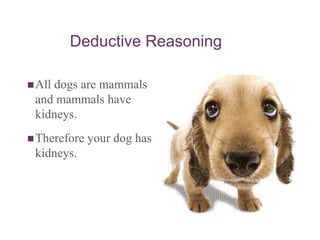
Deductive Reasoning
All dogs are mammals
and mammals have
kidneys.
Therefore your dog has
kidneys.
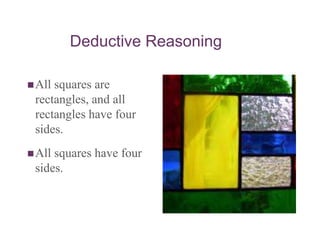
Deductive Reasoning
All squares are
rectangles, and all
rectangles have four
sides.
All squares have four
sides.
Inductive Reasoning
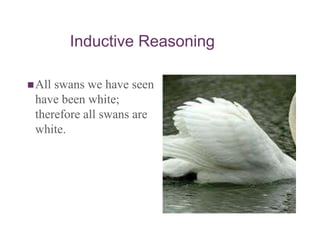
All swans we have seen
have been white;
therefore all swans are
white.
Inductive Reasoning
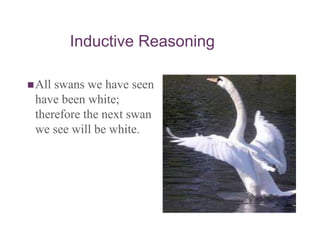
All swans we have seen
have been white;
therefore the next swan
we see will be white.
Inductive Reasoning
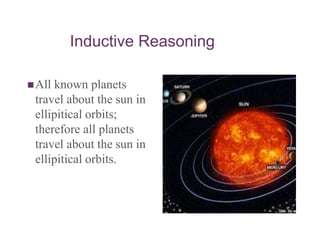
All known planets
travel about the sun in
ellipitical orbits;
therefore all planets
travel about the sun in
ellipitical orbits.
Deductive or Inductive?
Since all men are
mortal, and Socrates is
a man, Socrates is
mortal.
DEDUCTIVE
Deductive or Inductive?
Exploration of the
surface of Mars has
produced some
surprising facts.
Therefore exploration
of the surface of Jupiter
will produce some
surprising facts.
INDUCTIVE
Deductive or Inductive?
Since Chris is a good
athlete, Chris's sister
must be a good athlete
also.
INDUCTIVE
Deductive or Inductive?
The sun is a star; the
sun has planets;
therefore some stars
have planets.
DEDUCTIVE
Advantages/Disadvantages
 Advantage of deductive reasoning is the truths that it
establishes are absolute
 Disadvantage of deductive reasoning is that must
have some truths in hand before starting
Advantages/Disadvantages
 Advantage with inductive reasoning can start with
nothing, make some observations, reach
conclusions
 Disadvantage is the conclusions are tentative
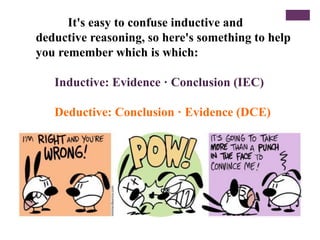
It's easy to confuse inductive and
deductive reasoning, so here's something to help
you remember which is which:
Inductive: Evidence · Conclusion (IEC)
Deductive: Conclusion · Evidence (DCE)
Three Fundamental
Patterns of Reasoning
3. Comparative reasoning
 Makes interpretations, draws inferences, or offers
explanations by relying on something that is more familiar in
order to understand something that is
less familiar.
 “This is like that” reasoning.
 Useful for suggesting ideas and promising areas of inquiry
and investigation
Copyright © 2011 Pearson
Education, Inc. All rights
reserved.

Lecture 3 Reasoning

  • 1.
    Introduction to Critical Thinking Welcome to CriticalThinking Unit 3 Critical & Logical Reasoning ISM5001 Critical Thinking and Argumentation
  • 2.
    Logic and Reasoning Logic– The science of correct reasoning. Reasoning – The drawing of inferences or conclusions from known or assumed facts.
  • 3.
    Two basic categoriesof human reasoning Deduction: reasoning from general premises, which are known or presumed to be known, to more specific, certain conclusions. Induction: reasoning from specific cases to more general, but uncertain, conclusions. Both deductive and inductive arguments occur frequently and naturally…both forms of reasoning can be equally compelling and persuasive, and neither form is preferred over the other (Hollihan & Baske, 1994).
  • 4.
    Deductive Reasoning Example: Whenit rains, John’s old car won’t start. It’s raining. Therefore, John’s old car won’t start. (Applies a broad generalization to a specific case.) Inductive Reasoning Example: John’s old car won’t start. It’s raining. Therefore, John’s old car won’t start when it’s raining. (Uses a specific case to reach a broad generalization.)
  • 5.
    To better visualizethe difference between deductive and inductive reasoning imagine each as a triangle. The deductive pyramid is upside down, while the inductive pyramid is right side up: Broad Generalization To specific Deductive Reasoning
  • 6.
  • 7.
    Inductive Reasoning: When detectivesarrive at the scene of a crime, the first thing they do is look for clues that can help them piece together what happened. A broken window, for example, might suggest how a burglar entered or exited. Likewise, the fact that an intruder didn't disturb anything but a painting that hid a safe might suggest that the burglar knew exactly where the safe was hidden. And this, in turn, suggests that the burglar knew the victim. The process described above is called inductive reasoning. It consists of making observations and then drawing conclusions based on those observations.
  • 8.
    • Like adetective, you use inductive reasoning all the time in your daily life. • You might notice, for example, that every time you eat a hot dog with chili and onions, you get a stomachache. • Using inductive reasoning, you could logically conclude that the chili dogs cause indigestion, and that you should probably stop eating them. • Similarly, you might notice that your cat tries to scratch you every time you rub her stomach.
  • 9.
    • In bothexamples, what you're doing is moving from the specific—a particular observation—to the general—a larger conclusion. • Inductive reasoning starts from observation and evidence and leads to a conclusion.
  • 10.
    Using inductive reasoninggenerally involves the following questions: 1. What have you observed? What evidence is available? 2. What can you conclude from that evidence? 3. Is that conclusion logical?
  • 11.
    In deductive reasoning,on the other hand, we start with the conclusion and then see if the evidence for that conclusion is valid. Generally, if the evidence is valid, the conclusion it supports is valid as well. In other words, deductive reasoning involves asking: 1. What is the conclusion? 2. What evidence supports it? 3. Is that evidence logical? If you can answer yes to question 3, then the conclusion should be logical and the argument sound.
  • 12.
    Deductive Reasoning 1. Allstudents eat pizza. Claire is a student at ASU. Therefore, Claire eats pizza. 2. All athletes work out in the gym. Barry Bonds is an athlete. Therefore, Barry Bonds works out in the gym. 3. All math teachers are over 7 feet tall. Mr. D. is a math teacher. Therefore, Mr. D is over 7 feet tall.
  • 13.
    Deductive Reasoning  Theargument is valid, but is certainly not true.  The above examples are of the form If p, then q. (major premise) x is p. (minor premise) Therefore, x is q. (conclusion)
  • 14.
    Deductive Versus Inductive Reasoning Deduction It is the form or structure of a deductive argument that determines its validity  the fundamental property of a valid, deductive argument is that if the premises are true, then the conclusion necessarily follows.  The conclusion is said to be “entailed” in, or contained in, the premises.  example: use of DNA testing to establish paternity Induction  By contrast, the form or structure of an inductive argument has little to do with its perceived believability or credibility, apart from making the argument seem more clear or more well- organized.  The receiver (or a 3rd party) determines the worth of an inductive argument
  • 15.
    Deduction Versus Induction --stillmore  Deductive reasoning is commonly found in the natural sciences or “hard” sciences, less so in everyday arguments  Occasionally, everyday arguments do involve deductive reasoning: Example: “Two or more persons are required to drive in the diamond lane. You don’t have two or more persons. Therefore you may not drive in the diamond lane”  Inductive reasoning is found in the courtroom, the boardroom, the classroom, and throughout the media  Most, but not all everyday arguments are based on induction  Examples: The “reasonable person” standard in civil law, and the “beyond a reasonable doubt” standard in criminal law
  • 16.
    Inductive or deductivereasoning?  A sample of fifty motorists who were stopped by the CHP at a sobriety checkpoint on a Saturday at midnight revealed that one in four drivers were either uninsured, intoxicated, or both. Thus, if you get involved in an accident on the freeway there is a 25% chance the other motorist will be drunk or uninsured.  The Law of the Sea treaty states that any vessel beyond a 12 mile limit is in international waters. The treaty also states that any vessel in international waters cannot be legally stopped or boarded. Therefore, when the U.S. Coast Guard intercepts boats coming from Cuba or Haiti more than 12 miles from the U.S. coast, it is violating the Law of the Sea.
  • 17.
    Sample Deductive andInductive Arguments Example of Deduction  major premise: All tortoises are vegetarians  minor premise: Bessie is a tortoise  conclusion: Therefore, Bessie is a vegetarian Example of Induction  Boss to employee: “John has a tattoo of an anchor on his arm. He probably served in the Navy.”
  • 18.
    Deductive Reasoning All dogsare mammals and mammals have kidneys. Therefore your dog has kidneys.
  • 19.
    Deductive Reasoning All squaresare rectangles, and all rectangles have four sides. All squares have four sides.
  • 20.
    Inductive Reasoning All swanswe have seen have been white; therefore all swans are white.
  • 21.
    Inductive Reasoning All swanswe have seen have been white; therefore the next swan we see will be white.
  • 22.
    Inductive Reasoning All knownplanets travel about the sun in ellipitical orbits; therefore all planets travel about the sun in ellipitical orbits.
  • 23.
    Deductive or Inductive? Sinceall men are mortal, and Socrates is a man, Socrates is mortal.
  • 24.
  • 25.
    Deductive or Inductive? Explorationof the surface of Mars has produced some surprising facts. Therefore exploration of the surface of Jupiter will produce some surprising facts.
  • 26.
  • 27.
    Deductive or Inductive? SinceChris is a good athlete, Chris's sister must be a good athlete also.
  • 28.
  • 29.
    Deductive or Inductive? Thesun is a star; the sun has planets; therefore some stars have planets.
  • 30.
  • 31.
    Advantages/Disadvantages  Advantage ofdeductive reasoning is the truths that it establishes are absolute  Disadvantage of deductive reasoning is that must have some truths in hand before starting
  • 32.
    Advantages/Disadvantages  Advantage withinductive reasoning can start with nothing, make some observations, reach conclusions  Disadvantage is the conclusions are tentative
  • 33.
    It's easy toconfuse inductive and deductive reasoning, so here's something to help you remember which is which: Inductive: Evidence · Conclusion (IEC) Deductive: Conclusion · Evidence (DCE)
  • 34.
    Three Fundamental Patterns ofReasoning 3. Comparative reasoning  Makes interpretations, draws inferences, or offers explanations by relying on something that is more familiar in order to understand something that is less familiar.  “This is like that” reasoning.  Useful for suggesting ideas and promising areas of inquiry and investigation Copyright © 2011 Pearson Education, Inc. All rights reserved.