ATTRIBUTION THEORY
CONTENTS
• INTRODUCTION
• THEORIES
• FACTORS AFFECTING ATTRIBUTION
• ERRORS
• APPLICATIONS
• SUMMARY
INTRODUCTION
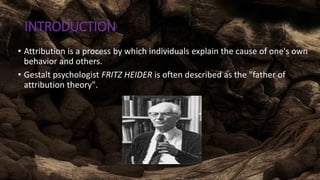
• Attribution is a process by which individuals explain the cause of one's own
behavior and others.
• Gestalt psychologist FRITZ HEIDER is often described as the "father of
attribution theory".
• Heider extended this idea to attributions about people: motives,
intentions, sentiments …
• Attribution aids in perceptional behavior by focusing on how people
attempt to :
1. Evaluate the personal qualities of people involved in the event.
2. Assess responsibility for the outcomes of event.
3. Understand the causes of certain event.
THEORIES OF ATTRIBUTIONS
The concept of attribution is explained by the means following
theories :-
• COMMON SENSE PSYCHOLOGY
• CORRESPONDENT INFERENCE THEORY
• COVARIENCE MODEL
COMMON SENSE PSYCHOLOGY
• Fritz Heider explored the nature of interpersonal relationship,
and espoused the concept of what he called "common sense"
or "naïve psychology"
• In his theory, he believed that people observe, analyze, and
explain behaviors with explanations.
• Although people have different kinds of explanations for the
events of human behaviors, Heider found it is very useful to
group explanation into two categories:
a) Internal
b) External
Cont........
INTERNAL ATTRIBUTION :
• It is also called dispositional attribution.
• It is the process of assigning the cause of behavior to some internal
characteristic, rather than to outside forces.
EXTERNAL ATTRIBUTION :
• It is also called situational attribution.
• It refers to interpreting someone's behavior as being caused by the
situation that the individual is in.
CORRESPONDENT INFERENCE THEORY
• This is brought up by JONES & DAVES in the year 1965.
• It states that people make inferences about a person when their
actions are freely chosen, are unexpected, and result in a small
number of desirable effects.
• It deals only with internal attributions.
• People make inferences on the basis of three factors
a) Degree of choice
b) Expectedness of behavior
c) Effect of someone's behavior
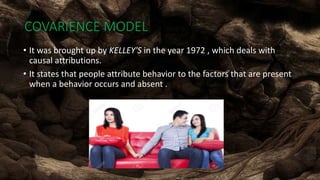
COVARIENCE MODEL
• It was brought up by KELLEY'S in the year 1972 , which deals with
causal attributions.
• It states that people attribute behavior to the factors that are present
when a behavior occurs and absent .
Cont......
• Kelley's theory has three main types of information :
1) Consensus information, states how other people in the same
situation and with the same stimulus behave.
2)Distinctive information, how the individual responds to different
stimuli.
3)Consistency information, states how frequent the individual's
behavior can be observed with similar stimulus but varied situations.
FACTORS AFFECTING ATTRIBUTION
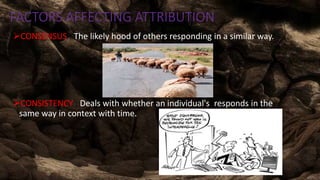
CONSENSUS : The likely hood of others responding in a similar way.
CONSISTENCY : Deals with whether an individual's responds in the
same way in context with time.
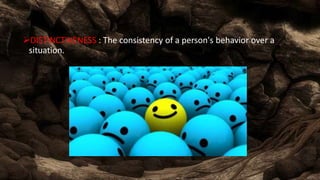
DISTINCTIVENESS : The consistency of a person's behavior over a
situation.
Cont....
• People attribute the causes of others behavior to :
i. Internal Factors if Distinctiveness and Consensus are low and
Consistency is high.
ii. External Factors if Consensus and Consistency are low and
Distinctiveness is high.
ERRORS
1)FUNDAMENTAL ATTRIBUTION ERROR :
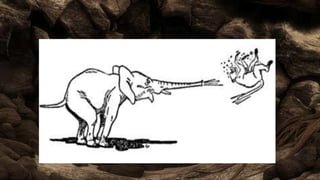
• It's the tendency to overestimate the impact of dispositional factors
or tendency to explain other action stemming disposition even the
presence situational cases.
• The fundamental attribution error is most visible when people explain
and assume the behavior of others
• It's more common in individualistic cultures like United States than
collectivistic countries like INDIA.
2) ACTOR OBSERVER EFFECT :
• The theory of the actor-observer bias was first developed by E. Jones
and R. Nisbett in 1971.
• His explanation was that when we observe other people, we tend to
focus on the person, whereas when we are actors, our attention is
focused towards situational factors.
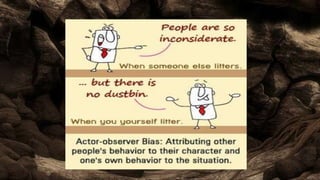
• Simply It means that It Attributes own behavior mainly to situational
cases but others behavior to internal cases.
• The actor observer bias is used less frequently with people one knows
well.
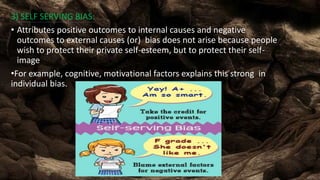
3) SELF SERVING BIAS:
• Attributes positive outcomes to internal causes and negative
outcomes to external causes (or) bias does not arise because people
wish to protect their private self-esteem, but to protect their self-
image
•For example, cognitive, motivational factors explains this strong in
individual bias.
APPLICATIONS
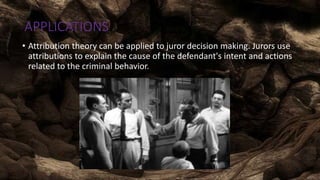
• Attribution theory can be applied to juror decision making. Jurors use
attributions to explain the cause of the defendant's intent and actions
related to the criminal behavior.
• Abramson, Seligman, and Teasdale developed a theory of the
depressive attributional style, claiming that individuals who tend to
attribute their failures to internal, stable and global factors are more
vulnerable to clinical depression.
PRESENTED BY
• MARK SATHISH
• NIKHIL CHAKRAVARTHY
• NIKHIL YERRA
• ROHITH KASUKURTHI
• CHAITANYA VERMA
• MANI KANTA VERMA
• BHANU VASISHT
LINKS
• https://en.wikipedia.org/wiki/Attribution_(psychology
• https://view.officeapps.live.com/op/view.aspx?src=http://www.wou.
edu/~fosterd/psy334/lectures/Lecture2.ppt
• https://view.officeapps.live.com/op/view.aspx?src=http://courses.wa
shington.edu/psii101/Powerpoints/AttributionTheory.ppt
• https://www.slideshare.net/sammathew93/kelleys-theory-of-
attribution
• https://www.slideshare.net/abhishekpanda376/attribution-theory-
ppt
Attribution theory

Attribution theory

  • 1.
  • 2.
    CONTENTS • INTRODUCTION • THEORIES •FACTORS AFFECTING ATTRIBUTION • ERRORS • APPLICATIONS • SUMMARY
  • 3.
    INTRODUCTION • Attribution isa process by which individuals explain the cause of one's own behavior and others. • Gestalt psychologist FRITZ HEIDER is often described as the "father of attribution theory".
  • 4.
    • Heider extendedthis idea to attributions about people: motives, intentions, sentiments … • Attribution aids in perceptional behavior by focusing on how people attempt to : 1. Evaluate the personal qualities of people involved in the event. 2. Assess responsibility for the outcomes of event. 3. Understand the causes of certain event.
  • 5.
    THEORIES OF ATTRIBUTIONS Theconcept of attribution is explained by the means following theories :- • COMMON SENSE PSYCHOLOGY • CORRESPONDENT INFERENCE THEORY • COVARIENCE MODEL
  • 6.
    COMMON SENSE PSYCHOLOGY •Fritz Heider explored the nature of interpersonal relationship, and espoused the concept of what he called "common sense" or "naïve psychology" • In his theory, he believed that people observe, analyze, and explain behaviors with explanations. • Although people have different kinds of explanations for the events of human behaviors, Heider found it is very useful to group explanation into two categories: a) Internal b) External
  • 7.
    Cont........ INTERNAL ATTRIBUTION : •It is also called dispositional attribution. • It is the process of assigning the cause of behavior to some internal characteristic, rather than to outside forces. EXTERNAL ATTRIBUTION : • It is also called situational attribution. • It refers to interpreting someone's behavior as being caused by the situation that the individual is in.
  • 9.
    CORRESPONDENT INFERENCE THEORY •This is brought up by JONES & DAVES in the year 1965. • It states that people make inferences about a person when their actions are freely chosen, are unexpected, and result in a small number of desirable effects. • It deals only with internal attributions. • People make inferences on the basis of three factors a) Degree of choice b) Expectedness of behavior c) Effect of someone's behavior
  • 11.
    COVARIENCE MODEL • Itwas brought up by KELLEY'S in the year 1972 , which deals with causal attributions. • It states that people attribute behavior to the factors that are present when a behavior occurs and absent .
  • 12.
    Cont...... • Kelley's theoryhas three main types of information : 1) Consensus information, states how other people in the same situation and with the same stimulus behave. 2)Distinctive information, how the individual responds to different stimuli. 3)Consistency information, states how frequent the individual's behavior can be observed with similar stimulus but varied situations.
  • 13.
    FACTORS AFFECTING ATTRIBUTION CONSENSUS: The likely hood of others responding in a similar way. CONSISTENCY : Deals with whether an individual's responds in the same way in context with time.
  • 14.
    DISTINCTIVENESS : Theconsistency of a person's behavior over a situation.
  • 15.
    Cont.... • People attributethe causes of others behavior to : i. Internal Factors if Distinctiveness and Consensus are low and Consistency is high. ii. External Factors if Consensus and Consistency are low and Distinctiveness is high.
  • 16.
    ERRORS 1)FUNDAMENTAL ATTRIBUTION ERROR: • It's the tendency to overestimate the impact of dispositional factors or tendency to explain other action stemming disposition even the presence situational cases. • The fundamental attribution error is most visible when people explain and assume the behavior of others • It's more common in individualistic cultures like United States than collectivistic countries like INDIA.
  • 18.
    2) ACTOR OBSERVEREFFECT : • The theory of the actor-observer bias was first developed by E. Jones and R. Nisbett in 1971. • His explanation was that when we observe other people, we tend to focus on the person, whereas when we are actors, our attention is focused towards situational factors. • Simply It means that It Attributes own behavior mainly to situational cases but others behavior to internal cases. • The actor observer bias is used less frequently with people one knows well.
  • 20.
    3) SELF SERVINGBIAS: • Attributes positive outcomes to internal causes and negative outcomes to external causes (or) bias does not arise because people wish to protect their private self-esteem, but to protect their self- image •For example, cognitive, motivational factors explains this strong in individual bias.
  • 21.
    APPLICATIONS • Attribution theorycan be applied to juror decision making. Jurors use attributions to explain the cause of the defendant's intent and actions related to the criminal behavior.
  • 22.
    • Abramson, Seligman,and Teasdale developed a theory of the depressive attributional style, claiming that individuals who tend to attribute their failures to internal, stable and global factors are more vulnerable to clinical depression.
  • 23.
    PRESENTED BY • MARKSATHISH • NIKHIL CHAKRAVARTHY • NIKHIL YERRA • ROHITH KASUKURTHI • CHAITANYA VERMA • MANI KANTA VERMA • BHANU VASISHT
  • 24.
    LINKS • https://en.wikipedia.org/wiki/Attribution_(psychology • https://view.officeapps.live.com/op/view.aspx?src=http://www.wou. edu/~fosterd/psy334/lectures/Lecture2.ppt •https://view.officeapps.live.com/op/view.aspx?src=http://courses.wa shington.edu/psii101/Powerpoints/AttributionTheory.ppt • https://www.slideshare.net/sammathew93/kelleys-theory-of- attribution • https://www.slideshare.net/abhishekpanda376/attribution-theory- ppt