Cognitive
Bias
What is
cognitive bias?
Tendency to think in certain ways that can lead to
systematic deviations from making rational
judgments.
Cognitive biases have been studied for decades by
academics in the fields of cognitive science, social
psychology, and behavioral economics
They influence the way we think and act
Decision-making, belief, and behavioral biases
Social biases
Memory errors and biases
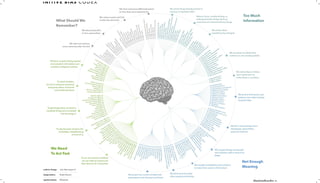
There are about 188 types of Cognitive Bias. They are
broadly classified as
Types of Bias
Understanding
the Topic
Deeper
Anchoring
Bias
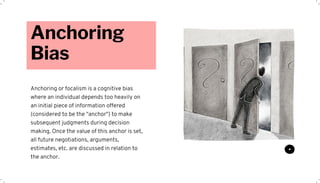
Anchoring or focalism is a cognitive bias
where an individual depends too heavily on
an initial piece of information offered
(considered to be the "anchor") to make
subsequent judgments during decision
making. Once the value of this anchor is set,
all future negotiations, arguments,
estimates, etc. are discussed in relation to
the anchor.
LOOK AT THESE EXAMPLES
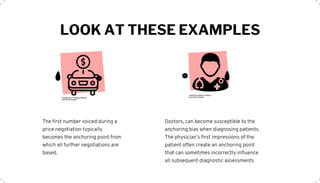
Doctors, can become susceptible to the
anchoring bias when diagnosing patients.
The physician’s first impressions of the
patient often create an anchoring point
that can sometimes incorrectly influence
all subsequent diagnostic assessments
The first number voiced during a
price negotiation typically
becomes the anchoring point from
which all further negotiations are
based.
Bandwagon
effect
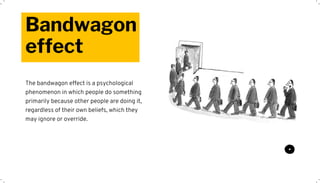
The bandwagon effect is a psychological
phenomenon in which people do something
primarily because other people are doing it,
regardless of their own beliefs, which they
may ignore or override.
LOOK AT THESE EXAMPLES
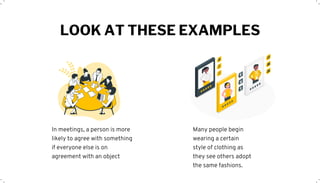
Many people begin
wearing a certain
style of clothing as
they see others adopt
the same fashions.
In meetings, a person is more
likely to agree with something
if everyone else is on
agreement with an object
Placebo
effect
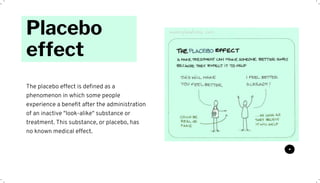
The placebo effect is defined as a
phenomenon in which some people
experience a benefit after the administration
of an inactive "look-alike" substance or
treatment. This substance, or placebo, has
no known medical effect.
Outcome
Bias
Outcome bias arises when a decision is
based on the outcome of previous events,
without regard to how the past events
developed.
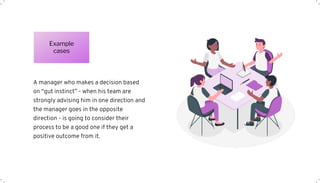
A manager who makes a decision based
on “gut instinct” - when his team are
strongly advising him in one direction and
the manager goes in the opposite
direction - is going to consider their
process to be a good one if they get a
positive outcome from it.
Example
cases
Hindsight
Bias
Hindsight bias is a term used in psychology
to explain the tendency of people to
overestimate their ability to have predicted
an outcome that could not possibly have
been predicted.
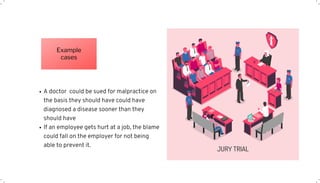
A doctor could be sued for malpractice on
the basis they should have could have
diagnosed a disease sooner than they
should have
If an employee gets hurt at a job, the blame
could fall on the employer for not being
able to prevent it.
Example
cases
Confirmation
Bias
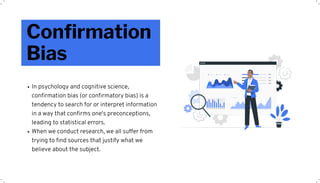
In psychology and cognitive science,
confirmation bias (or confirmatory bias) is a
tendency to search for or interpret information
in a way that confirms one's preconceptions,
leading to statistical errors.
When we conduct research, we all suffer from
trying to find sources that justify what we
believe about the subject.
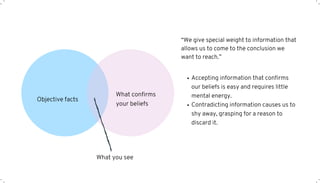
Objective facts
What confirms
your beliefs
What you see
“We give special weight to information that
allows us to come to the conclusion we
want to reach.”
Accepting information that confirms
our beliefs is easy and requires little
mental energy.
Contradicting information causes us to
shy away, grasping for a reason to
discard it.
LOOK AT THESE EXAMPLES
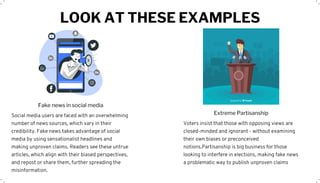
Social media users are faced with an overwhelming
number of news sources, which vary in their
credibility. Fake news takes advantage of social
media by using sensationalist headlines and
making unproven claims. Readers see these untrue
articles, which align with their biased perspectives,
and repost or share them, further spreading the
misinformation.
Fake news in social media
Voters insist that those with opposing views are
closed-minded and ignorant - without examining
their own biases or preconceived
notions.Partisanship is big business for those
looking to interfere in elections, making fake news
a problematic way to publish unproven claims
Extreme Partisanship
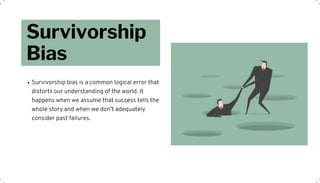
Survivorship
Bias
Survivorship bias is a common logical error that
distorts our understanding of the world. It
happens when we assume that success tells the
whole story and when we don’t adequately
consider past failures.
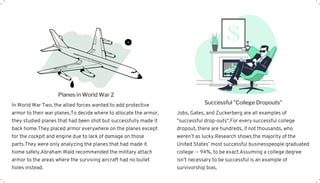
In World War Two, the allied forces wanted to add protective
armor to their war planes.To decide where to allocate the armor,
they studied planes that had been shot but successfully made it
back home.They placed armor everywhere on the planes except
for the cockpit and engine due to lack of damage on those
parts.They were only analyzing the planes that had made it
home safely.Abraham Wald recommended the military attach
armor to the areas where the surviving aircraft had no bullet
holes instead.
Planes in World War 2
Jobs, Gates, and Zuckerberg are all examples of
"successful drop-outs".For every successful college
dropout, there are hundreds, if not thousands, who
weren’t as lucky.Research shows the majority of the
United States’ most successful businesspeople graduated
college -- 94%, to be exact.Assuming a college degree
isn’t necessary to be successful is an example of
survivorship bias.
Successful "College Dropouts"
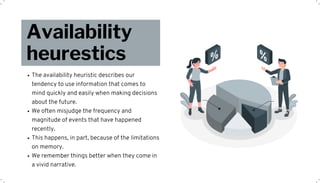
The availability heuristic describes our
tendency to use information that comes to
mind quickly and easily when making decisions
about the future.
We often misjudge the frequency and
magnitude of events that have happened
recently.
This happens, in part, because of the limitations
on memory.
We remember things better when they come in
a vivid narrative.
Availability
heurestics
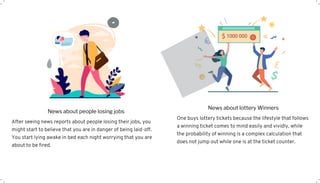
After seeing news reports about people losing their jobs, you
might start to believe that you are in danger of being laid-off.
You start lying awake in bed each night worrying that you are
about to be fired.
News about people losing jobs
One buys lottery tickets because the lifestyle that follows
a winning ticket comes to mind easily and vividly, while
the probability of winning is a complex calculation that
does not jump out while one is at the ticket counter.
News about lottery Winners
End of
presentation

Cognitive bias

  • 1.
  • 2.
    What is cognitive bias? Tendencyto think in certain ways that can lead to systematic deviations from making rational judgments. Cognitive biases have been studied for decades by academics in the fields of cognitive science, social psychology, and behavioral economics They influence the way we think and act
  • 3.
    Decision-making, belief, andbehavioral biases Social biases Memory errors and biases There are about 188 types of Cognitive Bias. They are broadly classified as Types of Bias
  • 4.
  • 5.
    Anchoring Bias Anchoring or focalismis a cognitive bias where an individual depends too heavily on an initial piece of information offered (considered to be the "anchor") to make subsequent judgments during decision making. Once the value of this anchor is set, all future negotiations, arguments, estimates, etc. are discussed in relation to the anchor.
  • 6.
    LOOK AT THESEEXAMPLES Doctors, can become susceptible to the anchoring bias when diagnosing patients. The physician’s first impressions of the patient often create an anchoring point that can sometimes incorrectly influence all subsequent diagnostic assessments The first number voiced during a price negotiation typically becomes the anchoring point from which all further negotiations are based.
  • 7.
    Bandwagon effect The bandwagon effectis a psychological phenomenon in which people do something primarily because other people are doing it, regardless of their own beliefs, which they may ignore or override.
  • 8.
    LOOK AT THESEEXAMPLES Many people begin wearing a certain style of clothing as they see others adopt the same fashions. In meetings, a person is more likely to agree with something if everyone else is on agreement with an object
  • 9.
    Placebo effect The placebo effectis defined as a phenomenon in which some people experience a benefit after the administration of an inactive "look-alike" substance or treatment. This substance, or placebo, has no known medical effect.
  • 10.
    Outcome Bias Outcome bias ariseswhen a decision is based on the outcome of previous events, without regard to how the past events developed.
  • 11.
    A manager whomakes a decision based on “gut instinct” - when his team are strongly advising him in one direction and the manager goes in the opposite direction - is going to consider their process to be a good one if they get a positive outcome from it. Example cases
  • 12.
    Hindsight Bias Hindsight bias isa term used in psychology to explain the tendency of people to overestimate their ability to have predicted an outcome that could not possibly have been predicted.
  • 13.
    A doctor couldbe sued for malpractice on the basis they should have could have diagnosed a disease sooner than they should have If an employee gets hurt at a job, the blame could fall on the employer for not being able to prevent it. Example cases
  • 14.
    Confirmation Bias In psychology andcognitive science, confirmation bias (or confirmatory bias) is a tendency to search for or interpret information in a way that confirms one's preconceptions, leading to statistical errors. When we conduct research, we all suffer from trying to find sources that justify what we believe about the subject.
  • 15.
    Objective facts What confirms yourbeliefs What you see “We give special weight to information that allows us to come to the conclusion we want to reach.” Accepting information that confirms our beliefs is easy and requires little mental energy. Contradicting information causes us to shy away, grasping for a reason to discard it.
  • 16.
    LOOK AT THESEEXAMPLES Social media users are faced with an overwhelming number of news sources, which vary in their credibility. Fake news takes advantage of social media by using sensationalist headlines and making unproven claims. Readers see these untrue articles, which align with their biased perspectives, and repost or share them, further spreading the misinformation. Fake news in social media Voters insist that those with opposing views are closed-minded and ignorant - without examining their own biases or preconceived notions.Partisanship is big business for those looking to interfere in elections, making fake news a problematic way to publish unproven claims Extreme Partisanship
  • 17.
    Survivorship Bias Survivorship bias isa common logical error that distorts our understanding of the world. It happens when we assume that success tells the whole story and when we don’t adequately consider past failures.
  • 18.
    In World WarTwo, the allied forces wanted to add protective armor to their war planes.To decide where to allocate the armor, they studied planes that had been shot but successfully made it back home.They placed armor everywhere on the planes except for the cockpit and engine due to lack of damage on those parts.They were only analyzing the planes that had made it home safely.Abraham Wald recommended the military attach armor to the areas where the surviving aircraft had no bullet holes instead. Planes in World War 2 Jobs, Gates, and Zuckerberg are all examples of "successful drop-outs".For every successful college dropout, there are hundreds, if not thousands, who weren’t as lucky.Research shows the majority of the United States’ most successful businesspeople graduated college -- 94%, to be exact.Assuming a college degree isn’t necessary to be successful is an example of survivorship bias. Successful "College Dropouts"
  • 19.
    The availability heuristicdescribes our tendency to use information that comes to mind quickly and easily when making decisions about the future. We often misjudge the frequency and magnitude of events that have happened recently. This happens, in part, because of the limitations on memory. We remember things better when they come in a vivid narrative. Availability heurestics
  • 20.
    After seeing newsreports about people losing their jobs, you might start to believe that you are in danger of being laid-off. You start lying awake in bed each night worrying that you are about to be fired. News about people losing jobs One buys lottery tickets because the lifestyle that follows a winning ticket comes to mind easily and vividly, while the probability of winning is a complex calculation that does not jump out while one is at the ticket counter. News about lottery Winners
  • 22.