Activity Aids
Presented by
Talib Hussain Roll # 20
Hina Ambreen Roll # 26
Farzana Aziz Roll# 33
Activity Aids
Demonstration
Presented by
Talib Hussain Roll # 20
Activity aids
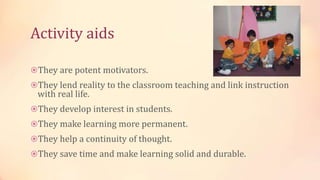
They are potent motivators.
They lend reality to the classroom teaching and link instruction
with real life.
They develop interest in students.
They make learning more permanent.
They help a continuity of thought.
They save time and make learning solid and durable.
Type of activity aids
 Demonstration.
 Experimentation.
 Field work
 Dramatic
 CAI
Demonstration Method
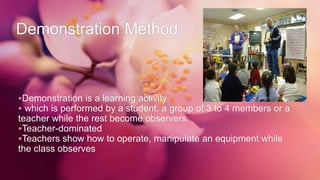
Demonstration is a learning activity
 which is performed by a student, a group of 3 to 4 members or a
teacher while the rest become observers.
Teacher-dominated
Teachers show how to operate, manipulate an equipment while
the class observes
Demonstration Method
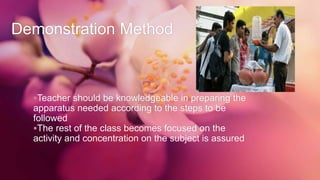
Teacher should be knowledgeable in preparing the
apparatus needed according to the steps to be
followed
The rest of the class becomes focused on the
activity and concentration on the subject is assured
Advantages of demonstration
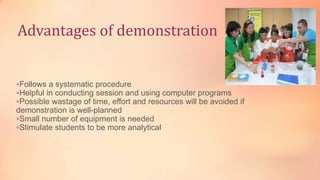
Follows a systematic procedure
Helpful in conducting session and using computer programs
Possible wastage of time, effort and resources will be avoided if
demonstration is well-planned
Small number of equipment is needed
Stimulate students to be more analytical
Advantages of demonstration
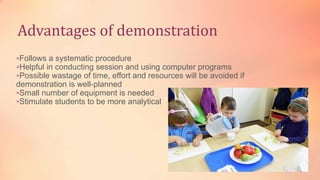
Follows a systematic procedure
Helpful in conducting session and using computer programs
Possible wastage of time, effort and resources will be avoided if
demonstration is well-planned
Small number of equipment is needed
Stimulate students to be more analytical
Disadvantages of demonstration
All contents can not be covered
All students can not participate
Low thinking in fast demonstration
No discussion
Only useful for skilled subjects
Lack of sincerity
Suggestion
Teacher should be sincere, diligent and skilled person
Demonstrator should prepare himself for demonstration and
encourage the learners
Demonstration should followed discussion
Advance planning is essential for effective demonstration
Summarize the concepts in few words
List visual aids such as graphs, drawing, computer driven aids and
models etc
Demonstration must have the ability to use audio visual aids with
expertise
Determine the concept with good examples

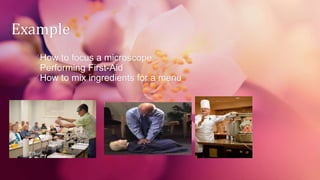
Example
How to focus a microscope
Performing First-Aid
How to mix ingredients for a menu
Activity Aids
Field Trip
Presented by
Hina Ambreen Roll # 26
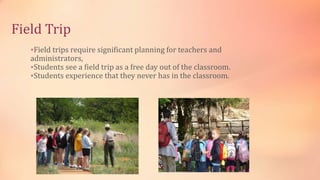
Field Trip
Field trips require significant planning for teachers and
administrators,
Students see a field trip as a free day out of the classroom.
Students experience that they never has in the classroom.
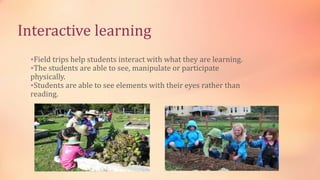
Interactive learning
Field trips help students interact with what they are learning.
The students are able to see, manipulate or participate
physically.
Students are able to see elements with their eyes rather than
reading.
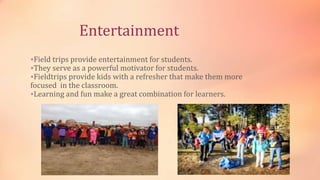
Entertainment
Field trips provide entertainment for students.
They serve as a powerful motivator for students.
Fieldtrips provide kids with a refresher that make them more
focused in the classroom.
Learning and fun make a great combination for learners.
Extension of classroom study
Field trips take the learning from classroom to life.
Field trips can answer the question of how learning can be
applied in life.
There are also opportunities to incorporate experience back into
classroom activity.
Through presentations, slide shows and answering questions,
the kids can learn the lessons.
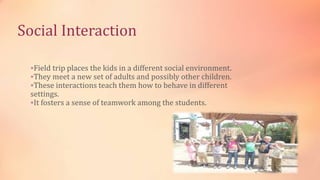
Social Interaction
Field trip places the kids in a different social environment.
They meet a new set of adults and possibly other children.
These interactions teach them how to behave in different
settings.
It fosters a sense of teamwork among the students.
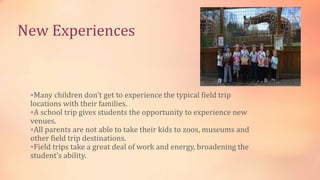
New Experiences
Many children don't get to experience the typical field trip
locations with their families.
A school trip gives students the opportunity to experience new
venues.
All parents are not able to take their kids to zoos, museums and
other field trip destinations.
Field trips take a great deal of work and energy, broadening the
student’s ability.
Activity Aids
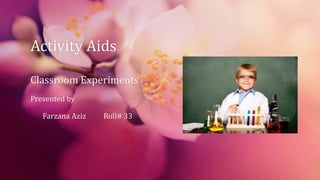
Classroom Experiments
Presented by
Farzana Aziz Roll# 33
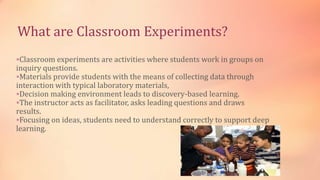
What are Classroom Experiments?
Classroom experiments are activities where students work in groups on
inquiry questions.
Materials provide students with the means of collecting data through
interaction with typical laboratory materials,
Decision making environment leads to discovery-based learning.
The instructor acts as facilitator, asks leading questions and draws
results.
Focusing on ideas, students need to understand correctly to support deep
learning.
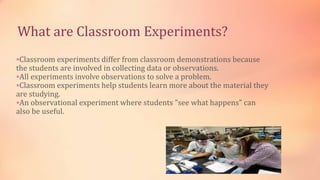
What are Classroom Experiments?
Classroom experiments differ from classroom demonstrations because
the students are involved in collecting data or observations.
All experiments involve observations to solve a problem.
Classroom experiments help students learn more about the material they
are studying.
An observational experiment where students "see what happens" can
also be useful.
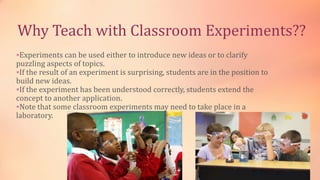
Why Teach with Classroom Experiments??
Experiments can be used either to introduce new ideas or to clarify
puzzling aspects of topics.
If the result of an experiment is surprising, students are in the position to
build new ideas.
If the experiment has been understood correctly, students extend the
concept to another application.
Note that some classroom experiments may need to take place in a
laboratory.
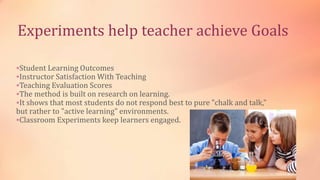
Experiments help teacher achieve Goals
Student Learning Outcomes
Instructor Satisfaction With Teaching
Teaching Evaluation Scores
The method is built on research on learning.
It shows that most students do not respond best to pure "chalk and talk,"
but rather to "active learning" environments.
Classroom Experiments keep learners engaged.
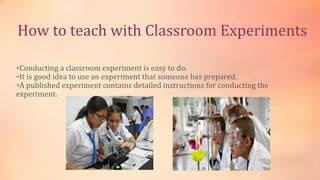
How to teach with Classroom Experiments
Conducting a classroom experiment is easy to do.
It is good idea to use an experiment that someone has prepared.
A published experiment contains detailed instructions for conducting the
experiment.
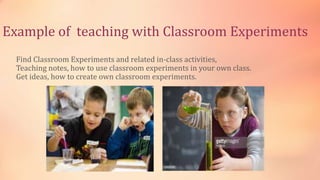
Example of teaching with Classroom Experiments
Find Classroom Experiments and related in-class activities,
Teaching notes, how to use classroom experiments in your own class.
Get ideas, how to create own classroom experiments.
Thanks

activity aids

  • 1.
    Activity Aids Presented by TalibHussain Roll # 20 Hina Ambreen Roll # 26 Farzana Aziz Roll# 33
  • 2.
  • 3.
    Activity aids They arepotent motivators. They lend reality to the classroom teaching and link instruction with real life. They develop interest in students. They make learning more permanent. They help a continuity of thought. They save time and make learning solid and durable.
  • 4.
    Type of activityaids  Demonstration.  Experimentation.  Field work  Dramatic  CAI
  • 5.
    Demonstration Method Demonstration isa learning activity  which is performed by a student, a group of 3 to 4 members or a teacher while the rest become observers. Teacher-dominated Teachers show how to operate, manipulate an equipment while the class observes
  • 6.
    Demonstration Method Teacher shouldbe knowledgeable in preparing the apparatus needed according to the steps to be followed The rest of the class becomes focused on the activity and concentration on the subject is assured
  • 7.
    Advantages of demonstration Followsa systematic procedure Helpful in conducting session and using computer programs Possible wastage of time, effort and resources will be avoided if demonstration is well-planned Small number of equipment is needed Stimulate students to be more analytical
  • 8.
    Advantages of demonstration Followsa systematic procedure Helpful in conducting session and using computer programs Possible wastage of time, effort and resources will be avoided if demonstration is well-planned Small number of equipment is needed Stimulate students to be more analytical
  • 9.
    Disadvantages of demonstration Allcontents can not be covered All students can not participate Low thinking in fast demonstration No discussion Only useful for skilled subjects Lack of sincerity
  • 10.
    Suggestion Teacher should besincere, diligent and skilled person Demonstrator should prepare himself for demonstration and encourage the learners Demonstration should followed discussion Advance planning is essential for effective demonstration Summarize the concepts in few words List visual aids such as graphs, drawing, computer driven aids and models etc Demonstration must have the ability to use audio visual aids with expertise Determine the concept with good examples 
  • 11.
    Example How to focusa microscope Performing First-Aid How to mix ingredients for a menu
  • 12.
    Activity Aids Field Trip Presentedby Hina Ambreen Roll # 26
  • 13.
    Field Trip Field tripsrequire significant planning for teachers and administrators, Students see a field trip as a free day out of the classroom. Students experience that they never has in the classroom.
  • 14.
    Interactive learning Field tripshelp students interact with what they are learning. The students are able to see, manipulate or participate physically. Students are able to see elements with their eyes rather than reading.
  • 15.
    Entertainment Field trips provideentertainment for students. They serve as a powerful motivator for students. Fieldtrips provide kids with a refresher that make them more focused in the classroom. Learning and fun make a great combination for learners.
  • 16.
    Extension of classroomstudy Field trips take the learning from classroom to life. Field trips can answer the question of how learning can be applied in life. There are also opportunities to incorporate experience back into classroom activity. Through presentations, slide shows and answering questions, the kids can learn the lessons.
  • 17.
    Social Interaction Field tripplaces the kids in a different social environment. They meet a new set of adults and possibly other children. These interactions teach them how to behave in different settings. It fosters a sense of teamwork among the students.
  • 18.
    New Experiences Many childrendon't get to experience the typical field trip locations with their families. A school trip gives students the opportunity to experience new venues. All parents are not able to take their kids to zoos, museums and other field trip destinations. Field trips take a great deal of work and energy, broadening the student’s ability.
  • 19.
  • 20.
    What are ClassroomExperiments? Classroom experiments are activities where students work in groups on inquiry questions. Materials provide students with the means of collecting data through interaction with typical laboratory materials, Decision making environment leads to discovery-based learning. The instructor acts as facilitator, asks leading questions and draws results. Focusing on ideas, students need to understand correctly to support deep learning.
  • 21.
    What are ClassroomExperiments? Classroom experiments differ from classroom demonstrations because the students are involved in collecting data or observations. All experiments involve observations to solve a problem. Classroom experiments help students learn more about the material they are studying. An observational experiment where students "see what happens" can also be useful.
  • 22.
    Why Teach withClassroom Experiments?? Experiments can be used either to introduce new ideas or to clarify puzzling aspects of topics. If the result of an experiment is surprising, students are in the position to build new ideas. If the experiment has been understood correctly, students extend the concept to another application. Note that some classroom experiments may need to take place in a laboratory.
  • 23.
    Experiments help teacherachieve Goals Student Learning Outcomes Instructor Satisfaction With Teaching Teaching Evaluation Scores The method is built on research on learning. It shows that most students do not respond best to pure "chalk and talk," but rather to "active learning" environments. Classroom Experiments keep learners engaged.
  • 24.
    How to teachwith Classroom Experiments Conducting a classroom experiment is easy to do. It is good idea to use an experiment that someone has prepared. A published experiment contains detailed instructions for conducting the experiment.
  • 25.
    Example of teachingwith Classroom Experiments Find Classroom Experiments and related in-class activities, Teaching notes, how to use classroom experiments in your own class. Get ideas, how to create own classroom experiments.
  • 26.