 Introduction of Activity Aids.
 Definition of activity aids
 Purposes of activity aids
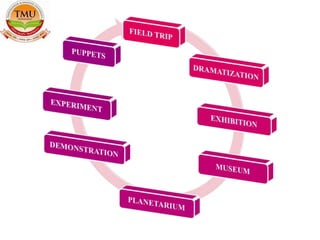
 Types of activity aids
 Importance of activity aids in nursing
 Summarization
 Conclusion
Teaching aids play a key role in teaching-learning situations.
It works as the support for the teacher and taught in the pursuit
of knowledge.Teaching aids are the tools purposefully
designed to overcome verbal deficiencies in communication in
a classroom situation.
• To provide opportunities for shared learning.
• To highlight innovative approaches.
• Increase the student involvement in learning process
• Make the student to attain increase level of cognitive objective
 To develop and perfect their skills in collaboration.
 To deepen and integrate their understandings of theoretical
approaches.
 Historical contexts for understanding conflicts.
 To cultivate and refine their abilities.
“Activity aids induce direct participation of student and teachers
to get first hand knowledge.”
“An educational procedure by which the student studies
firsthand objects and materials in their natural environment”
 It gives the opportunity to interact with the content
 It allows them to comprehend more easily.
 It helps the student to make the learning environment
interesting and engaging
 It improve the quality of education .
 It provides students with the sense of excitement
they desire.
DEFINITION:
“It is defined as a planned & supervised visit of a group of
students outside the normal classroom to get the first hand
experience” (basavanthapa, 2009)
 To get the first hand experience and direct contact with the
things and system of real life related to the textual material of
classroom instruction
 To have an in-depth study of an instructional unit
 To arouse interest in an instructional unit
 To impart positive attitudes and sharpen social skills
 To review a class lesson by relating it to the real situation
(basavanthapa, 2009)
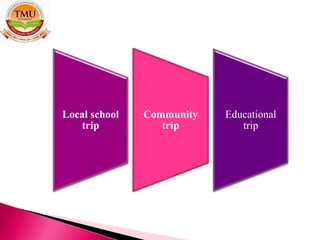
Local school
trip
Community
trip
Educational
trip
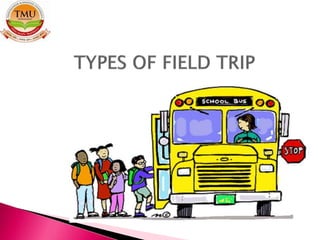
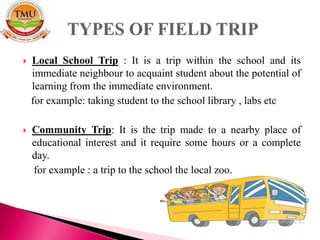
 Local School Trip : It is a trip within the school and its
immediate neighbour to acquaint student about the potential of
learning from the immediate environment.
for example: taking student to the school library , labs etc
 Community Trip: It is the trip made to a nearby place of
educational interest and it require some hours or a complete
day.
for example : a trip to the school the local zoo.
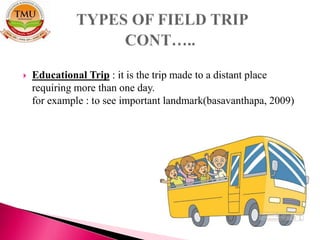
 Educational Trip : it is the trip made to a distant place
requiring more than one day.
for example : to see important landmark(basavanthapa, 2009)
A field trip should organised in the following steps:
 Prepare yourself & student for the trip so as to make specific
observation during the trip.
 Indentify the main purpose of the trip.
 Specific instruction should be given regarding the schedule,
departure, transportation, stay, meal.
 Take a managable group of student for the field trip.
 Prepare a guide & activity sheet for the educational tour based
upon the prior information about the place visit.
 Observe discipline , decorum, & regulation during the field
trip
 Inform the proper agency.
 Prepare activity & worksheet & distribute the student to
collect & write the information, draw sketches & stick picture
& postcard
 Instruct the student regarding safety rules and precaution
against hazards which can happen during field trip.
 Take camera, binoculars for recording the visual observation
.(basavanthapa, 2009)
 It provide accurate information about objects, processes &
system in their real setting
 It provide meaningful direct experience & hence result in
lasting learning
 Student enthusiasm for field trip can be easily diverted to
effective learning
 It provide student the opportunities to utilize all their senses
for learning(basavanthapa, 2009)
 Preparation
 Affordability
 Transportation cost
 Medical risks
 Collect parental consent
 Need budget
A well planned session after the field trip increases its
educational value this session will give the feedback about the
information learnt and attitudes develop during the trip. Some
of the post trip activities could be as follows :
 a group discussion about the outcomes and education
effectiveness of the trip
 collection and display of the learning material collected during
the trip
 Relating the field trip gains with the learning units in the
syllabus.
 Extending the learning from the field trip in the form of
preparations reports projects etc.
 Testing the gains from the educational trip through opinion
and questions .(basavanthapa, 2009)
 It helps the nurse in understanding his/her scope of practice in
all settings.
 To ensure that the medical regimen is followed.
 It helps to respond to actual or potential health concerns and
needs of people.
 Helps in collecting the health information & records
 Provide training to people regarding any health care procedures
to be performed.
 “It is a very potent method of keeping the classroom
instruction lively & interesting.”(basavanthapa, 2009)
 “A play or film adapted from a novel or depicting a particular
incident.”[1]
 “The process of adapting a novel or presenting a particular
incident in a play or film.”[1]
 Expressing the need for social change.
 Communicating a universal theme.
 Recreation
 Interpreting information, ideas, and emotion entertaining, which
diverts our attention from our everyday lives.
The major elements of a drama are as follows:
 Characters
 Dialogues
 Plots
 Setting
 Stage direction
 Themes
 Role playing
 Playlets
 Pagents
 Pantomine
 Tableaux
 We can develop the creative instincts of the children.
 It helps in proper utilization of knowledge and activities of
the children.
 It provides a change to the students from the formal and rigid
atmosphere of class room and reading of books.
 It is psychological to help in developing the power of the
learning of the students.
 It provides them an opportunity to acquire knowledge through
activity.
 It has to develop the power of self creativeness and activity.
 It also help them to develop the power of sympathy and
imagination.
 Power of observation also develop through this method.
 It provides education along with precaution.
 The student develop the art of speaking.
 Develops self confidence and the power of understanding.
 In the lower classes,it is easy to teach the history to students
through this method in an effective manner.
(basavanthapa, 2009)
The use of drama in teaching learning situations might
sometimes fail for the reasons below:
 Activities are artificial. The situations are sometimes irrelevant
to the learner’s need.
 Activities are difficult to monitor.
 There is a fear among teachers that drama use may cause sort of
uncontrolled fun among learners.
 It encourages incorrect forms of language
 Activities may not be suitable to all the class.
 The activities that succeeded with a group of students may fail
with another. (basavanthapa, 2009)
 Lack of knowledge in the art of dramatization
 Apprehension of indiscipline
 Economic factor
 Difficult enacting
 Problem of dialogue
(Basavanthapa, 2009)
It helps the nurses in following ways:
 Self-confidence
 Imagination
 Empathy
 Cooperation & collaboration
 Problem solving
 Fun Relaxation
 Self-discipline
 Physical Fitness
 Sharpen Memory
 Social Awareness
 Activity aids
 Purposes of activity aids
 Types of activity aids
 Importance of activity aids in nursing
 Field trip
 Dramatization
Activity Aids.pdf

Activity Aids.pdf

  • 2.
     Introduction ofActivity Aids.  Definition of activity aids  Purposes of activity aids  Types of activity aids  Importance of activity aids in nursing
  • 3.
  • 4.
    Teaching aids playa key role in teaching-learning situations. It works as the support for the teacher and taught in the pursuit of knowledge.Teaching aids are the tools purposefully designed to overcome verbal deficiencies in communication in a classroom situation.
  • 5.
    • To provideopportunities for shared learning. • To highlight innovative approaches. • Increase the student involvement in learning process • Make the student to attain increase level of cognitive objective
  • 6.
     To developand perfect their skills in collaboration.  To deepen and integrate their understandings of theoretical approaches.  Historical contexts for understanding conflicts.  To cultivate and refine their abilities.
  • 7.
    “Activity aids inducedirect participation of student and teachers to get first hand knowledge.” “An educational procedure by which the student studies firsthand objects and materials in their natural environment”
  • 8.
     It givesthe opportunity to interact with the content  It allows them to comprehend more easily.  It helps the student to make the learning environment interesting and engaging
  • 9.
     It improvethe quality of education .  It provides students with the sense of excitement they desire.
  • 13.
    DEFINITION: “It is definedas a planned & supervised visit of a group of students outside the normal classroom to get the first hand experience” (basavanthapa, 2009)
  • 14.
     To getthe first hand experience and direct contact with the things and system of real life related to the textual material of classroom instruction  To have an in-depth study of an instructional unit  To arouse interest in an instructional unit  To impart positive attitudes and sharpen social skills
  • 15.
     To reviewa class lesson by relating it to the real situation (basavanthapa, 2009)
  • 17.
  • 18.
     Local SchoolTrip : It is a trip within the school and its immediate neighbour to acquaint student about the potential of learning from the immediate environment. for example: taking student to the school library , labs etc  Community Trip: It is the trip made to a nearby place of educational interest and it require some hours or a complete day. for example : a trip to the school the local zoo.
  • 19.
     Educational Trip: it is the trip made to a distant place requiring more than one day. for example : to see important landmark(basavanthapa, 2009)
  • 20.
    A field tripshould organised in the following steps:  Prepare yourself & student for the trip so as to make specific observation during the trip.  Indentify the main purpose of the trip.  Specific instruction should be given regarding the schedule, departure, transportation, stay, meal.  Take a managable group of student for the field trip.
  • 21.
     Prepare aguide & activity sheet for the educational tour based upon the prior information about the place visit.  Observe discipline , decorum, & regulation during the field trip  Inform the proper agency.  Prepare activity & worksheet & distribute the student to collect & write the information, draw sketches & stick picture & postcard
  • 22.
     Instruct thestudent regarding safety rules and precaution against hazards which can happen during field trip.  Take camera, binoculars for recording the visual observation .(basavanthapa, 2009)
  • 23.
     It provideaccurate information about objects, processes & system in their real setting  It provide meaningful direct experience & hence result in lasting learning  Student enthusiasm for field trip can be easily diverted to effective learning  It provide student the opportunities to utilize all their senses for learning(basavanthapa, 2009)
  • 24.
     Preparation  Affordability Transportation cost  Medical risks  Collect parental consent  Need budget
  • 25.
    A well plannedsession after the field trip increases its educational value this session will give the feedback about the information learnt and attitudes develop during the trip. Some of the post trip activities could be as follows :  a group discussion about the outcomes and education effectiveness of the trip  collection and display of the learning material collected during the trip
  • 26.
     Relating thefield trip gains with the learning units in the syllabus.  Extending the learning from the field trip in the form of preparations reports projects etc.  Testing the gains from the educational trip through opinion and questions .(basavanthapa, 2009)
  • 27.
     It helpsthe nurse in understanding his/her scope of practice in all settings.  To ensure that the medical regimen is followed.  It helps to respond to actual or potential health concerns and needs of people.  Helps in collecting the health information & records
  • 28.
     Provide trainingto people regarding any health care procedures to be performed.
  • 31.
     “It isa very potent method of keeping the classroom instruction lively & interesting.”(basavanthapa, 2009)  “A play or film adapted from a novel or depicting a particular incident.”[1]  “The process of adapting a novel or presenting a particular incident in a play or film.”[1]
  • 32.
     Expressing theneed for social change.  Communicating a universal theme.  Recreation  Interpreting information, ideas, and emotion entertaining, which diverts our attention from our everyday lives.
  • 33.
    The major elementsof a drama are as follows:  Characters  Dialogues  Plots  Setting  Stage direction  Themes
  • 34.
     Role playing Playlets  Pagents  Pantomine  Tableaux
  • 36.
     We candevelop the creative instincts of the children.  It helps in proper utilization of knowledge and activities of the children.  It provides a change to the students from the formal and rigid atmosphere of class room and reading of books.  It is psychological to help in developing the power of the learning of the students.
  • 37.
     It providesthem an opportunity to acquire knowledge through activity.  It has to develop the power of self creativeness and activity.  It also help them to develop the power of sympathy and imagination.  Power of observation also develop through this method.  It provides education along with precaution.
  • 38.
     The studentdevelop the art of speaking.  Develops self confidence and the power of understanding.  In the lower classes,it is easy to teach the history to students through this method in an effective manner. (basavanthapa, 2009)
  • 39.
    The use ofdrama in teaching learning situations might sometimes fail for the reasons below:  Activities are artificial. The situations are sometimes irrelevant to the learner’s need.  Activities are difficult to monitor.  There is a fear among teachers that drama use may cause sort of uncontrolled fun among learners.
  • 40.
     It encouragesincorrect forms of language  Activities may not be suitable to all the class.  The activities that succeeded with a group of students may fail with another. (basavanthapa, 2009)
  • 41.
     Lack ofknowledge in the art of dramatization  Apprehension of indiscipline  Economic factor  Difficult enacting  Problem of dialogue (Basavanthapa, 2009)
  • 42.
    It helps thenurses in following ways:  Self-confidence  Imagination  Empathy  Cooperation & collaboration
  • 43.
     Problem solving Fun Relaxation  Self-discipline  Physical Fitness  Sharpen Memory  Social Awareness
  • 44.
     Activity aids Purposes of activity aids  Types of activity aids  Importance of activity aids in nursing  Field trip  Dramatization