An Overview of
Peer Teaching
By
Melissa Winfield-Corbett
What is peer
teaching?
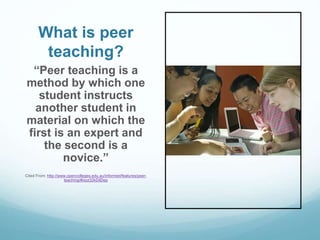
“Peer teaching is a
method by which one
student instructs
another student in
material on which the
first is an expert and
the second is a
novice.”
Cited From: http://www.opencolleges.edu.au/informed/features/peer-
teaching/#ixzz32kDilDep
Benefits of Peer
Teaching
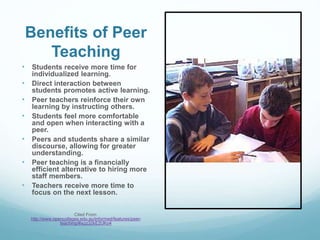
• Students receive more time for
individualized learning.
• Direct interaction between
students promotes active learning.
• Peer teachers reinforce their own
learning by instructing others.
• Students feel more comfortable
and open when interacting with a
peer.
• Peers and students share a similar
discourse, allowing for greater
understanding.
• Peer teaching is a financially
efficient alternative to hiring more
staff members.
• Teachers receive more time to
focus on the next lesson.
Cited From:
http://www.opencolleges.edu.au/informed/features/peer-
teaching/#ixzz32kE2UKo4
Questions to
Consider
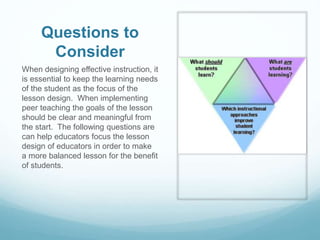
When designing effective instruction, it
is essential to keep the learning needs
of the student as the focus of the
lesson design. When implementing
peer teaching the goals of the lesson
should be clear and meaningful from
the start. The following questions are
can help educators focus the lesson
design of educators in order to make
a more balanced lesson for the benefit
of students.
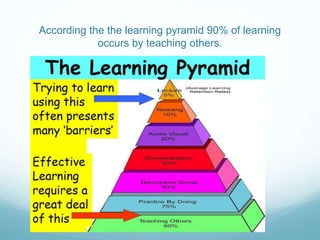
According the the learning pyramid 90% of learning
occurs by teaching others.
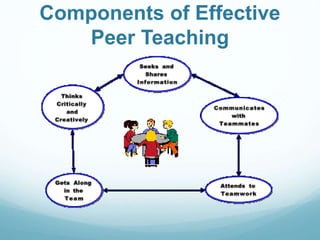
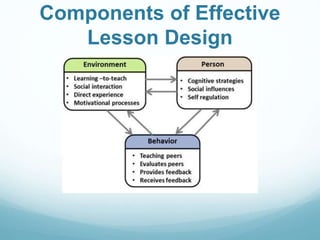
Components of Effective
Peer Teaching
Lesson Design
Elements
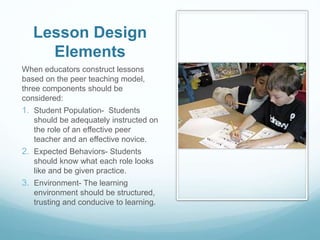
When educators construct lessons
based on the peer teaching model,
three components should be
considered:
1. Student Population- Students
should be adequately instructed on
the role of an effective peer
teacher and an effective novice.
2. Expected Behaviors- Students
should know what each role looks
like and be given practice.
3. Environment- The learning
environment should be structured,
trusting and conducive to learning.
Components of Effective
Lesson Design
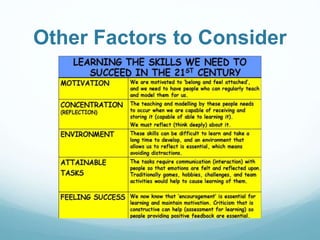
Other Factors to Consider
Video: Peer Teaching in the
Classroom

An Overview of Peer Teaching

  • 1.
    An Overview of PeerTeaching By Melissa Winfield-Corbett
  • 2.
    What is peer teaching? “Peerteaching is a method by which one student instructs another student in material on which the first is an expert and the second is a novice.” Cited From: http://www.opencolleges.edu.au/informed/features/peer- teaching/#ixzz32kDilDep
  • 3.
    Benefits of Peer Teaching •Students receive more time for individualized learning. • Direct interaction between students promotes active learning. • Peer teachers reinforce their own learning by instructing others. • Students feel more comfortable and open when interacting with a peer. • Peers and students share a similar discourse, allowing for greater understanding. • Peer teaching is a financially efficient alternative to hiring more staff members. • Teachers receive more time to focus on the next lesson. Cited From: http://www.opencolleges.edu.au/informed/features/peer- teaching/#ixzz32kE2UKo4
  • 4.
    Questions to Consider When designingeffective instruction, it is essential to keep the learning needs of the student as the focus of the lesson design. When implementing peer teaching the goals of the lesson should be clear and meaningful from the start. The following questions are can help educators focus the lesson design of educators in order to make a more balanced lesson for the benefit of students.
  • 5.
    According the thelearning pyramid 90% of learning occurs by teaching others.
  • 6.
  • 7.
    Lesson Design Elements When educatorsconstruct lessons based on the peer teaching model, three components should be considered: 1. Student Population- Students should be adequately instructed on the role of an effective peer teacher and an effective novice. 2. Expected Behaviors- Students should know what each role looks like and be given practice. 3. Environment- The learning environment should be structured, trusting and conducive to learning.
  • 8.
  • 9.
  • 10.
    Video: Peer Teachingin the Classroom