ACTIVITY AIDS
INTRODUCTION
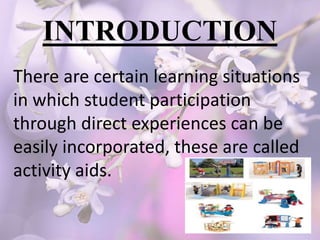
There are certain learning situations
in which student participation
through direct experiences can be
easily incorporated, these are called
activity aids.
DEFINITION
“ Activity aids induce
direct participation of
student and teachers to
get first hand
knowledge”.
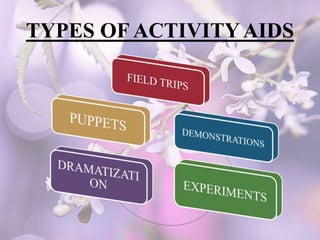
TYPES OF ACTIVITYAIDS
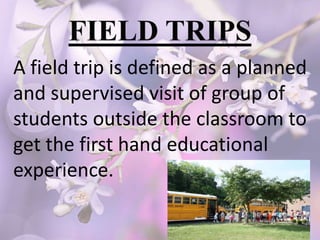
A field trip is defined as a planned
and supervised visit of group of
students outside the classroom to
get the first hand educational
experience.
TYPES OF FIELD TRIPS
LOCAL
SCHOOL
TRIPS
COMMUNITY
TRIPS
EDUCATIONAL
TRIPS
NATURAL
TRIPS
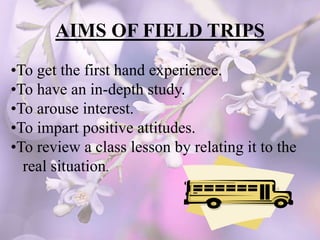
AIMS OF FIELD TRIPS
•To get the first hand experience.
•To have an in-depth study.
•To arouse interest.
•To impart positive attitudes.
•To review a class lesson by relating it to the
real situation.
ADVANTAGES OF FIELD
TRIPS
•It provides accurate information.
•It provides direct experience.
•Students can be easily diverted to effective
learning.
•It can supplement the classroom learning.
•It develops proper attitude and social
skills.
DISADVANTAGES OF FIELD
TRIPS
•It is an occasional activity.
•It can be expensive.
•It requires proper and detailed planning.
•It is time consuming.
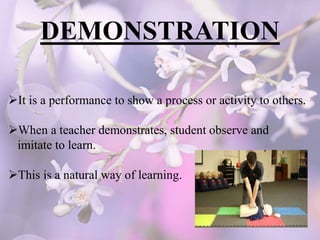
DEMONSTRATION
It is a performance to show a process or activity to others.
When a teacher demonstrates, student observe and
imitate to learn.
This is a natural way of learning.
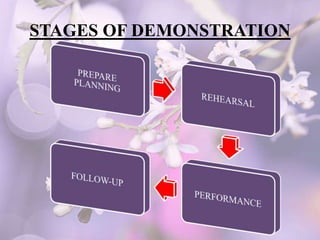
STAGES OF DEMONSTRATION
ADVANTAGES OF DEMONSTRATION
•It is good for acquiring and perfecting operational
skills.
•It engages student’s attention and cooperation.
•It encourages student’s participation in learning.
•It activates several senses.
DISADVANTAGES OF
DEMONSTRATIONS
•All content cannot be covered.
•All students cannot participate.
•Low thinking in fast demonstration.
•No discussion.
•Only useful for skilled subjects.
•Lack of sincerity.
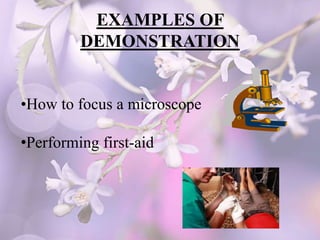
EXAMPLES OF
DEMONSTRATION
•How to focus a microscope
•Performing first-aid
EXPERIMENTS
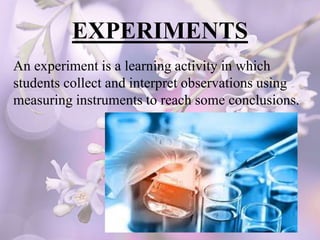
An experiment is a learning activity in which
students collect and interpret observations using
measuring instruments to reach some conclusions.
ADVANTAGES OF
EXPERIMENTS
•In group experiments, students learn cooperation and
coordination.
•It helps students to learn the use of apparatus.
•It enhances learning because students learn by doing.
•It builds scientific attitude.
•It makes students patient, regular and punctual.
DISADVANTAGES OF
EXPERIMENTS
It is time consuming.
All experiments cannot be done in
lab.
It cannot be properly used with
large classes
DRAMATIZATION
It is a very potent method of keeping the classroom
instruction lively and interesting”.
ADVANTAGES OF DRAMATIZATION
•Dramatization gives an added advantage of student
working as both observers and doers (participants).
•It makes learning a pleasure children love to act.
•It involve students totally.
•It develops the skills.
•It makes student creative, sensitive and alert.
DISADVANTAGES OF
DRAMATIZATIONS
•Activities are artificial.
•Activities are difficult to monitor.
• There is a fear among teachers that drama use may cause sort
of uncontrolled fun among learner’s.
•It encourages incorrect form of language.
•Activities are not suitable for all the classes.
PUPPETS
Puppetry is an education cum entertaining aid in
which puppets manipulated by the performer is
a person termed as a characters in a story to be
depicted.
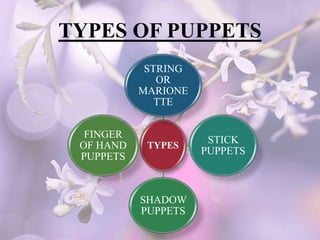
TYPES OF PUPPETS
TYPES
STRING
OR
MARIONE
TTE
STICK
PUPPETS
SHADOW
PUPPETS
FINGER
OF HAND
PUPPETS
ADVANTAGES OF PUPPETS
Creates interest
Gives the knowledge in a brief period
 Puppet is an effective method in teaching
Motivate students
Easy to carry and operate
DISADVANTAGES OF PUPPETS
Needs group cooperation and coordination
 Requires skills in preparation and supply
Skills needed in presentation
Activity aids ppt

Activity aids ppt

  • 2.
  • 3.
    INTRODUCTION There are certainlearning situations in which student participation through direct experiences can be easily incorporated, these are called activity aids.
  • 4.
    DEFINITION “ Activity aidsinduce direct participation of student and teachers to get first hand knowledge”.
  • 5.
  • 6.
    A field tripis defined as a planned and supervised visit of group of students outside the classroom to get the first hand educational experience.
  • 7.
    TYPES OF FIELDTRIPS LOCAL SCHOOL TRIPS COMMUNITY TRIPS EDUCATIONAL TRIPS NATURAL TRIPS
  • 8.
    AIMS OF FIELDTRIPS •To get the first hand experience. •To have an in-depth study. •To arouse interest. •To impart positive attitudes. •To review a class lesson by relating it to the real situation.
  • 9.
    ADVANTAGES OF FIELD TRIPS •Itprovides accurate information. •It provides direct experience. •Students can be easily diverted to effective learning. •It can supplement the classroom learning. •It develops proper attitude and social skills.
  • 10.
    DISADVANTAGES OF FIELD TRIPS •Itis an occasional activity. •It can be expensive. •It requires proper and detailed planning. •It is time consuming.
  • 11.
    DEMONSTRATION It is aperformance to show a process or activity to others. When a teacher demonstrates, student observe and imitate to learn. This is a natural way of learning.
  • 12.
  • 13.
    ADVANTAGES OF DEMONSTRATION •Itis good for acquiring and perfecting operational skills. •It engages student’s attention and cooperation. •It encourages student’s participation in learning. •It activates several senses.
  • 14.
    DISADVANTAGES OF DEMONSTRATIONS •All contentcannot be covered. •All students cannot participate. •Low thinking in fast demonstration. •No discussion. •Only useful for skilled subjects. •Lack of sincerity.
  • 15.
    EXAMPLES OF DEMONSTRATION •How tofocus a microscope •Performing first-aid
  • 16.
    EXPERIMENTS An experiment isa learning activity in which students collect and interpret observations using measuring instruments to reach some conclusions.
  • 17.
    ADVANTAGES OF EXPERIMENTS •In groupexperiments, students learn cooperation and coordination. •It helps students to learn the use of apparatus. •It enhances learning because students learn by doing. •It builds scientific attitude. •It makes students patient, regular and punctual.
  • 18.
    DISADVANTAGES OF EXPERIMENTS It istime consuming. All experiments cannot be done in lab. It cannot be properly used with large classes
  • 19.
    DRAMATIZATION It is avery potent method of keeping the classroom instruction lively and interesting”.
  • 20.
    ADVANTAGES OF DRAMATIZATION •Dramatizationgives an added advantage of student working as both observers and doers (participants). •It makes learning a pleasure children love to act. •It involve students totally. •It develops the skills. •It makes student creative, sensitive and alert.
  • 21.
    DISADVANTAGES OF DRAMATIZATIONS •Activities areartificial. •Activities are difficult to monitor. • There is a fear among teachers that drama use may cause sort of uncontrolled fun among learner’s. •It encourages incorrect form of language. •Activities are not suitable for all the classes.
  • 22.
    PUPPETS Puppetry is aneducation cum entertaining aid in which puppets manipulated by the performer is a person termed as a characters in a story to be depicted.
  • 23.
  • 24.
    ADVANTAGES OF PUPPETS Createsinterest Gives the knowledge in a brief period  Puppet is an effective method in teaching Motivate students Easy to carry and operate
  • 25.
    DISADVANTAGES OF PUPPETS Needsgroup cooperation and coordination  Requires skills in preparation and supply Skills needed in presentation