5th
International Disaster and Risk Conference IDRC 2014
‘Integrative Risk Management - The role of science, technology & practice‘ • 24-28 August 2014 • Davos • Switzerland
www.grforum.org
Effectiveness of Risk Information
Containing Religious Messages in
Adopting Tsunami Resilience
Preparedness
Wignyo Adiyoso
National Development Planning Agency (BAPPENAS) Indonesia
Hidehiko Kanegae
Institute of Disaster Mitigation and Urban Cultural Heritage (DMUCH),
Ritsumeikan University, Japan
5th
International Disaster and Risk Conference IDRC 2014
‘Integrative Risk Management - The role of science, technology & practice‘ • 24-28 August 2014 • Davos • Switzerland
www.grforum.org
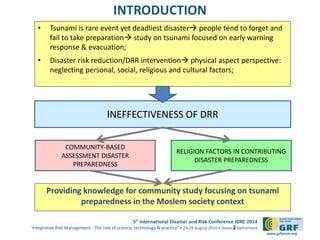
INTRODUCTION
• Tsunami is rare event yet deadliest disaster people tend to forget and
fail to take preparation study on tsunami focused on early warning
response & evacuation;
• Disaster risk reduction/DRR intervention physical aspect perspective:
neglecting personal, social, religious and cultural factors;
2
INEFFECTIVENESS OF DRR
COMMUNITY-BASED
ASSESSMENT DISASTER
PREPAREDNESS
RELIGION FACTORS IN CONTRIBUTING
DISASTER PREPAREDNESS
Providing knowledge for community study focusing on tsunami
preparedness in the Moslem society context
5th
International Disaster and Risk Conference IDRC 2014
‘Integrative Risk Management - The role of science, technology & practice‘ • 24-28 August 2014 • Davos • Switzerland
www.grforum.org
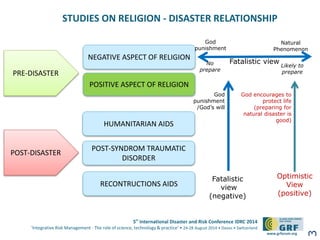
STUDIES ON RELIGION - DISASTER RELATIONSHIP
3
PRE-DISASTER
POST-DISASTER
NEGATIVE ASPECT OF RELIGION
HUMANITARIAN AIDS
POST-SYNDROM TRAUMATIC
DISORDER
POSITIVE ASPECT OF RELIGION
Fatalistic view
God
punishment
No
prepare
Natural
Phenomenon
Likely to
prepare
Optimistic
View
(positive)
Fatalistic
view
(negative)
God encourages to
protect life
(preparing for
natural disaster is
good)
God
punishment
/God’s will
RECONTRUCTIONS AIDS
5th
International Disaster and Risk Conference IDRC 2014
‘Integrative Risk Management - The role of science, technology & practice‘ • 24-28 August 2014 • Davos • Switzerland
www.grforum.org
RESEARCH OJECTIVES
 To investigate religious aspects in influencing tsunami resilient
preparedness;
 To examine the effectiveness of risk information containing religious
messages and using religious leader to reinforce message in enhancing
people to take tsunami resilient preparedness.
4
RESEARCH QUESTIONS
 Does religious aspects influence tsunami resilient preparedness based on
social interactions?
 To what extend does the effectiveness of risk information containing
religious messages and using religious leader to reinforce message in
enhancing people to take tsunami resilient preparedness?
5th
International Disaster and Risk Conference IDRC 2014
‘Integrative Risk Management - The role of science, technology & practice‘ • 24-28 August 2014 • Davos • Switzerland
www.grforum.org
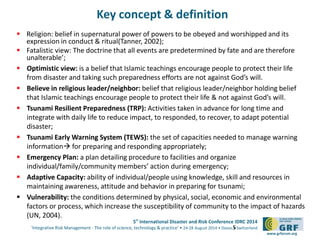
Key concept & definition
 Religion: belief in supernatural power of powers to be obeyed and worshipped and its
expression in conduct & ritual(Tanner, 2002);
 Fatalistic view: The doctrine that all events are predetermined by fate and are therefore
unalterable’;
 Optimistic view: is a belief that Islamic teachings encourage people to protect their life
from disaster and taking such preparedness efforts are not against God’s will.
 Believe in religious leader/neighbor: belief that religious leader/neighbor holding belief
that Islamic teachings encourage people to protect their life & not against God’s will.
 Tsunami Resilient Preparedness (TRP): Activities taken in advance for long time and
integrate with daily life to reduce impact, to responded, to recover, to adapt potential
disaster;
 Tsunami Early Warning System (TEWS): the set of capacities needed to manage warning
information for preparing and responding appropriately;
 Emergency Plan: a plan detailing procedure to facilities and organize
individual/family/community members’ action during emergency;
 Adaptive Capacity: ability of individual/people using knowledge, skill and resources in
maintaining awareness, attitude and behavior in preparing for tsunami;
 Vulnerability: the conditions determined by physical, social, economic and environmental
factors or process, which increase the susceptibility of community to the impact of hazards
(UN, 2004).
5
5th
International Disaster and Risk Conference IDRC 2014
‘Integrative Risk Management - The role of science, technology & practice‘ • 24-28 August 2014 • Davos • Switzerland
www.grforum.org
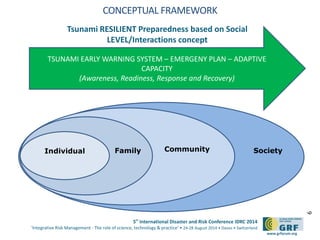
Tsunami RESILIENT Preparedness based on Social
LEVEL/Interactions concept
6
Individual Family Community Society
TSUNAMI EARLY WARNING SYSTEM – EMERGENY PLAN – ADAPTIVE
CAPACITY
(Awareness, Readiness, Response and Recovery)
CONCEPTUAL FRAMEWORK
5th
International Disaster and Risk Conference IDRC 2014
‘Integrative Risk Management - The role of science, technology & practice‘ • 24-28 August 2014 • Davos • Switzerland
www.grforum.org
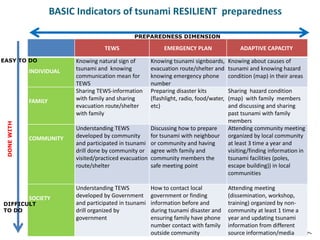
BASIC Indicators of tsunami RESILIENT preparedness
7
TEWS EMERGENCY PLAN ADAPTIVE CAPACITY
INDIVIDUAL
Knowing natural sign of
tsunami and knowing
communication mean for
TEWS
Knowing tsunami signboards,
evacuation route/shelter and
knowing emergency phone
number
Knowing about causes of
tsunami and knowing hazard
condition (map) in their areas
FAMILY
Sharing TEWS-information
with family and sharing
evacuation route/shelter
with family
Preparing disaster kits
(flashlight, radio, food/water,
etc)
Sharing hazard condition
(map) with family members
and discussing and sharing
past tsunami with family
members
COMMUNITY
Understanding TEWS
developed by community
and participated in tsunami
drill done by community or
visited/practiced evacuation
route/shelter
Discussing how to prepare
for tsunami with neighbour
or community and having
agree with family and
community members the
safe meeting point
Attending community meeting
organized by local community
at least 3 time a year and
visiting/finding information in
tsunami facilities (poles,
escape building)) in local
communities
SOCIETY
Understanding TEWS
developed by Government
and participated in tsunami
drill organized by
government
How to contact local
government or finding
information before and
during tsunami disaster and
ensuring family have phone
number contact with family
outside community
Attending meeting
(dissemination, workshop,
training) organized by non-
community at least 1 time a
year and updating tsunami
information from different
source information/media
EASY TO DO
DIFFICULT
TO DO
DONEWITH
PREPAREDNESS DIMENSION
5th
International Disaster and Risk Conference IDRC 2014
‘Integrative Risk Management - The role of science, technology & practice‘ • 24-28 August 2014 • Davos • Switzerland
www.grforum.org
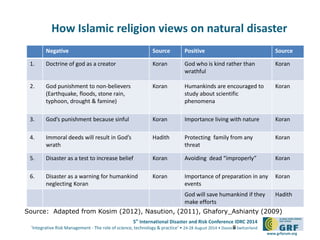
How Islamic religion views on natural disaster
Negative Source Positive Source
1. Doctrine of god as a creator Koran God who is kind rather than
wrathful
Koran
2. God punishment to non-believers
(Earthquake, floods, stone rain,
typhoon, drought & famine)
Koran Humankinds are encouraged to
study about scientific
phenomena
Koran
3. God’s punishment because sinful Koran Importance living with nature Koran
4. Immoral deeds will result in God’s
wrath
Hadith Protecting family from any
threat
Koran
5. Disaster as a test to increase belief Koran Avoiding dead “improperly” Koran
6. Disaster as a warning for humankind
neglecting Koran
Koran Importance of preparation in any
events
Koran
God will save humankind if they
make efforts
Hadith
8
Source: Adapted from Kosim (2012), Nasution, (2011), Ghafory_Ashianty (2009)
5th
International Disaster and Risk Conference IDRC 2014
‘Integrative Risk Management - The role of science, technology & practice‘ • 24-28 August 2014 • Davos • Switzerland
www.grforum.org
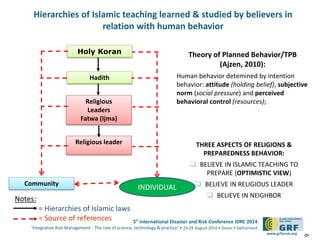
Hierarchies of Islamic teaching learned & studied by believers in
relation with human behavior
Holy Koran
Hadith
Community
Religious leader
Notes:
= Hierarchies of Islamic laws
= Source of references
Religious
Leaders
Fatwa (Ijma)
INDIVIDUAL
Theory of Planned Behavior/TPB
(Ajzen, 2010):
Human behavior detemined by intention
behavior: attitude (holding belief), subjective
norm (social pressure) and perceived
behavioral control (resources);
THREE ASPECTS OF RELIGIONS &
PREPAREDNESS BEHAVIOR:
 BELIEVE IN ISLAMIC TEACHING TO
PREPARE (OPTIMISTIC VIEW)
 BELIEVE IN RELIGIOUS LEADER
 BELIEVE IN NEIGHBOR
5th
International Disaster and Risk Conference IDRC 2014
‘Integrative Risk Management - The role of science, technology & practice‘ • 24-28 August 2014 • Davos • Switzerland
www.grforum.org
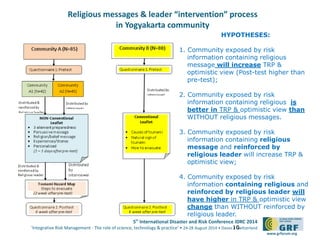
Religious messages & leader “intervention” process
in Yogyakarta community
10
HYPOTHESES:
1. Community exposed by risk
information containing religious
message will increase TRP &
optimistic view (Post-test higher than
pre-test);
2. Community exposed by risk
information containing religious is
better in TRP & optimistic view than
WITHOUT religious messages.
3. Community exposed by risk
information containing religious
message and reinforced by
religious leader will increase TRP &
optimistic view;
4. Community exposed by risk
information containing religious and
reinforced by religious leader will
have higher in TRP & optimistic view
change than WITHOUT reinforced by
religious leader.
5th
International Disaster and Risk Conference IDRC 2014
‘Integrative Risk Management - The role of science, technology & practice‘ • 24-28 August 2014 • Davos • Switzerland
www.grforum.org
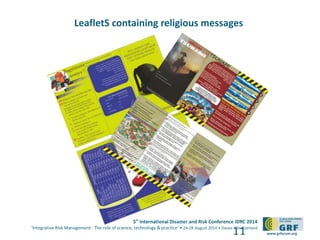
LeafletS containing religious messages
11
5th
International Disaster and Risk Conference IDRC 2014
‘Integrative Risk Management - The role of science, technology & practice‘ • 24-28 August 2014 • Davos • Switzerland
www.grforum.org
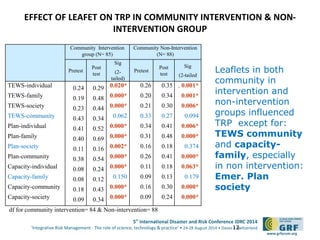
EFFECT OF LEAFET ON TRP IN COMMUNITY INTERVENTION & NON-
INTERVENTION GROUP
12
Leaflets in both
community in
intervention and
non-intervention
groups influenced
TRP except for:
TEWS community
and capacity-
family, especially
in non intervention:
Emer. Plan
society
Community Intervention
group (N= 85)
Community Non-Intervention
(N= 88)
Pretest
Post
test
Sig
(2-
tailed)
Pretest
Post
test
Sig
(2-tailed
TEWS-individual
TEWS-family
TEWS-society
TEWS-community
Plan-individual
Plan-family
Plan-society
Plan-community
Capacity-individual
Capacity-family
Capacity-community
Capacity-society
0.24
0.19
0.23
0.43
0.41
0.40
0.11
0.38
0.08
0.08
0.18
0.09
0.29
0.48
0.44
0.34
0.52
0.69
0.16
0.54
0.24
0.12
0.43
0.34
0.020*
0.000*
0.000*
0.062
0.000*
0.000*
0.002*
0.000*
0.000*
0.150
0.000*
0.000*
0.26
0.20
0.21
0.33
0.34
0.31
0.16
0.26
0.11
0.09
0.16
0.09
0.35
0.34
0.30
0.27
0.41
0.48
0.18
0.41
0.18
0.13
0.30
0.24
. 0.001*
0.001*
0.006*
0.094
0.006*
0.000*
0.374
0.000*
0.063*
0.179
0.000*
0.000*
df for community intervention= 84 & Non-intervention= 88
5th
International Disaster and Risk Conference IDRC 2014
‘Integrative Risk Management - The role of science, technology & practice‘ • 24-28 August 2014 • Davos • Switzerland
www.grforum.org
13
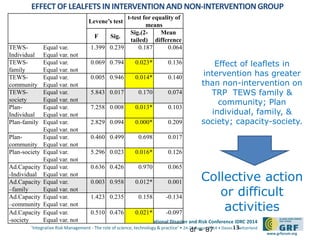
Effect of leaflets in
intervention has greater
than non-intervention on
TRP TEWS family &
community; Plan
individual, family, &
society; capacity-society.
Levene’s test
t-test for equality of
means
F Sig.
Sig.(2-
tailed)
Mean
difference
TEWS-
Individual
Equal var.
Equal var. not
1.399 0.239 0.187 0.064
TEWS-
family
Equal var.
Equal var. not
0.069 0.794 0.023* 0.136
TEWS-
community
Equal var.
Equal var. not
0.005 0.946 0.014* 0.140
TEWS-
society
Equal var.
Equal var. not
5.843 0.017 0.170 0.074
Plan-
Individual
Equal var.
Equal var. not
7.258 0.008 0.013* 0.103
Plan-family Equal var.
Equal var. not
2.829 0.094 0.000* 0.209
Plan-
community
Equal var.
Equal var. not
0.460 0.499 0.698 0.017
Plan-society Equal var.
Equal var. not
5.296 0.023 0.016* 0.126
Ad.Capacity
-Individual
Equal var.
Equal var. not
0.636 0.426 0.970 0.065
Ad.Capacity
–family
Equal var.
Equal var. not
0.003 0.958 0.012* 0.001
Ad.Capacity
–community
Equal var.
Equal var. not
1.423 0.235 0.158 -0.134
Ad.Capacity
-society
Equal var.
Equal var. not
0.510 0.476 0.021* -0.097
EFFECT OF LEALFETS IN INTERVENTIONAND NON-INTERVENTIONGROUP
df = 87
Collective action
or difficult
activities
5th
International Disaster and Risk Conference IDRC 2014
‘Integrative Risk Management - The role of science, technology & practice‘ • 24-28 August 2014 • Davos • Switzerland
www.grforum.org
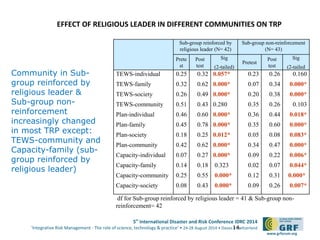
EFFECT OF RELIGIOUS LEADER IN DIFFERENT COMMUNITIES ON TRP
14
Sub-group reinforced by
religious leader (N= 42)
Sub-group non-reinforcement
(N= 43)
Prete
st
Post
test
Sig
(2-tailed)
Pretest
Post
test
Sig
(2-tailed
TEWS-individual
TEWS-family
TEWS-society
TEWS-community
Plan-individual
Plan-family
Plan-society
Plan-community
Capacity-individual
Capacity-family
Capacity-community
Capacity-society
0.25
0.32
0.26
0.51
0.46
0.45
0.18
0.42
0.07
0.14
0.25
0.08
0.32
0.62
0.49
0.43
0.60
0.78
0.25
0.62
0.27
0.18
0.55
0.43
0.057*
0.000*
0.000*
0.280
0.000*
0.000*
0.012*
0.000*
0.000*
0.323
0.000*
0.000*
0.23
0.07
0.20
0.35
0.36
0.35
0.05
0.34
0.09
0.02
0.12
0.09
0.26
0.34
0.38
0.26
0.44
0.60
0.08
0.47
0.22
0.07
0.31
0.26
0.160
0.000*
0.000*
0.103
0.018*
0.000*
0.083*
0.000*
0.006*
0.044*
0.000*
0.007*
df for Sub-group reinforced by religious leader = 41 & Sub-group non-
reinforcement= 42
Community in Sub-
group reinforced by
religious leader &
Sub-group non-
reinforcement
increasingly changed
in most TRP except:
TEWS-community and
Capacity-family (sub-
group reinforced by
religious leader)
5th
International Disaster and Risk Conference IDRC 2014
‘Integrative Risk Management - The role of science, technology & practice‘ • 24-28 August 2014 • Davos • Switzerland
www.grforum.org
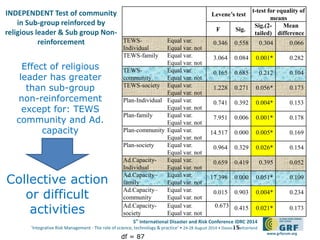
INDEPENDENT Test of community
in Sub-group reinforced by
religious leader & Sub group Non-
reinforcement
15
Effect of religious
leader has greater
than sub-group
non-reinforcement
except for: TEWS
community and Ad.
capacity
Levene’s test
t-test for equality of
means
F Sig.
Sig.(2-
tailed)
Mean
difference
TEWS-
Individual
Equal var.
Equal var. not
0.346 0.558 0.304 0.066
TEWS-family Equal var.
Equal var. not
3.064 0.084 0.001* 0.282
TEWS-
community
Equal var.
Equal var. not
0.165 0.685 0.212 0.104
TEWS-society Equal var.
Equal var. not
1.228 0.271 0.056* 0.173
Plan-Individual Equal var.
Equal var. not
0.741 0.392 0.004* 0.153
Plan-family Equal var.
Equal var. not
7.951 0.006 0.001* 0.178
Plan-community Equal var.
Equal var. not
14.517 0.000 0.005* 0.169
Plan-society Equal var.
Equal var. not
0.964 0.329 0.026* 0.154
Ad.Capacity-
Individual
Equal var.
Equal var. not
0.659 0.419 0.395 0.052
Ad.Capacity–
family
Equal var.
Equal var. not
17.398 0.000 0.051* 0.109
Ad.Capacity–
community
Equal var.
Equal var. not
0.015 0.903 0.004* 0.234
Ad.Capacity-
society
Equal var.
Equal var. not
0.673 0.415 0.021* 0.173
df = 87
Collective action
or difficult
activities
5th
International Disaster and Risk Conference IDRC 2014
‘Integrative Risk Management - The role of science, technology & practice‘ • 24-28 August 2014 • Davos • Switzerland
www.grforum.org
EFFECT OF LEAFLETS ON OPTIMISTIC VIEW IN COMMUNITY
INTERVENTION & NON- INTERVENTION GROUP
16
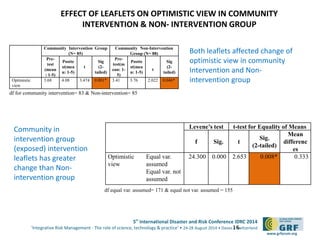
Both leaflets affected change of
optimistic view in community
Intervention and Non-
intervention group
Community Intervention Group
(N= 85)
Community Non-Intervention
Group (N= 88)
Pre-
test
(mean
: 1-5)
Postte
st(mea
n: 1-5)
t
Sig
(2-
tailed)
Pre-
test(m
ean: 1-
5)
Postte
st(mea
n: 1-5)
t
Sig
(2-
tailed)
Optimistic
view
3.68 4.08 3.474 0.001* 3.41 3.76 2.022 0.046*
df for community intervention= 83 & Non-intervention= 85
Levene’s test t-test for Equality of Means
f Sig. t
Sig.
(2-tailed)
Mean
differenc
es
Optimistic
view
Equal var.
assumed
Equal var. not
assumed
24.300 0.000 2.653 0.008* 0.333
df equal var. assumed= 171 & equal not var. assumed = 155
Community in
intervention group
(exposed) intervention
leaflets has greater
change than Non-
intervention group
5th
International Disaster and Risk Conference IDRC 2014
‘Integrative Risk Management - The role of science, technology & practice‘ • 24-28 August 2014 • Davos • Switzerland
www.grforum.org
EFFECT OF RELIGIOUS LEADER ON OPTIMISTIC IN DIFFERENT
COMMUNITIES
17
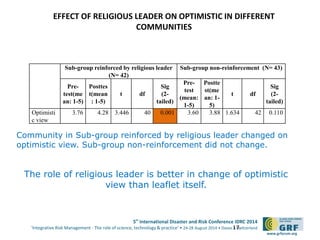
Community in Sub-group reinforced by religious leader changed on
optimistic view. Sub-group non-reinforcement did not change.
The role of religious leader is better in change of optimistic
view than leaflet itself.
Sub-group reinforced by religious leader
(N= 42)
Sub-group non-reinforcement (N= 43)
Pre-
test(me
an: 1-5)
Posttes
t(mean
: 1-5)
t df
Sig
(2-
tailed)
Pre-
test
(mean:
1-5)
Postte
st(me
an: 1-
5)
t df
Sig
(2-
tailed)
Optimisti
c view
3.76 4.28 3.446 40 0.001 3.60 3.88 1.634 42 0.110
5th
International Disaster and Risk Conference IDRC 2014
‘Integrative Risk Management - The role of science, technology & practice‘ • 24-28 August 2014 • Davos • Switzerland
www.grforum.org
CONCLUSION
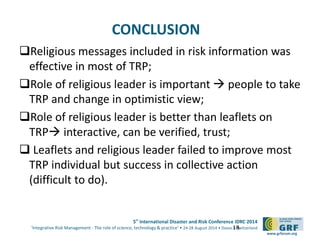
Religious messages included in risk information was
effective in most of TRP;
Role of religious leader is important  people to take
TRP and change in optimistic view;
Role of religious leader is better than leaflets on
TRP interactive, can be verified, trust;
 Leaflets and religious leader failed to improve most
TRP individual but success in collective action
(difficult to do).
18
5th
International Disaster and Risk Conference IDRC 2014
‘Integrative Risk Management - The role of science, technology & practice‘ • 24-28 August 2014 • Davos • Switzerland
www.grforum.org
Recommendations
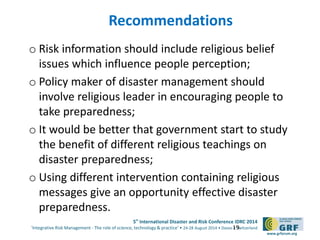
o Risk information should include religious belief
issues which influence people perception;
o Policy maker of disaster management should
involve religious leader in encouraging people to
take preparedness;
o It would be better that government start to study
the benefit of different religious teachings on
disaster preparedness;
o Using different intervention containing religious
messages give an opportunity effective disaster
preparedness.
19
5th
International Disaster and Risk Conference IDRC 2014
‘Integrative Risk Management - The role of science, technology & practice‘ • 24-28 August 2014 • Davos • Switzerland
www.grforum.org
THANK YOU

Presentasi IDRC14 Wignyo 26 Agustus 2014

  • 1.
    5th International Disaster andRisk Conference IDRC 2014 ‘Integrative Risk Management - The role of science, technology & practice‘ • 24-28 August 2014 • Davos • Switzerland www.grforum.org Effectiveness of Risk Information Containing Religious Messages in Adopting Tsunami Resilience Preparedness Wignyo Adiyoso National Development Planning Agency (BAPPENAS) Indonesia Hidehiko Kanegae Institute of Disaster Mitigation and Urban Cultural Heritage (DMUCH), Ritsumeikan University, Japan
  • 2.
    5th International Disaster andRisk Conference IDRC 2014 ‘Integrative Risk Management - The role of science, technology & practice‘ • 24-28 August 2014 • Davos • Switzerland www.grforum.org INTRODUCTION • Tsunami is rare event yet deadliest disaster people tend to forget and fail to take preparation study on tsunami focused on early warning response & evacuation; • Disaster risk reduction/DRR intervention physical aspect perspective: neglecting personal, social, religious and cultural factors; 2 INEFFECTIVENESS OF DRR COMMUNITY-BASED ASSESSMENT DISASTER PREPAREDNESS RELIGION FACTORS IN CONTRIBUTING DISASTER PREPAREDNESS Providing knowledge for community study focusing on tsunami preparedness in the Moslem society context
  • 3.
    5th International Disaster andRisk Conference IDRC 2014 ‘Integrative Risk Management - The role of science, technology & practice‘ • 24-28 August 2014 • Davos • Switzerland www.grforum.org STUDIES ON RELIGION - DISASTER RELATIONSHIP 3 PRE-DISASTER POST-DISASTER NEGATIVE ASPECT OF RELIGION HUMANITARIAN AIDS POST-SYNDROM TRAUMATIC DISORDER POSITIVE ASPECT OF RELIGION Fatalistic view God punishment No prepare Natural Phenomenon Likely to prepare Optimistic View (positive) Fatalistic view (negative) God encourages to protect life (preparing for natural disaster is good) God punishment /God’s will RECONTRUCTIONS AIDS
  • 4.
    5th International Disaster andRisk Conference IDRC 2014 ‘Integrative Risk Management - The role of science, technology & practice‘ • 24-28 August 2014 • Davos • Switzerland www.grforum.org RESEARCH OJECTIVES  To investigate religious aspects in influencing tsunami resilient preparedness;  To examine the effectiveness of risk information containing religious messages and using religious leader to reinforce message in enhancing people to take tsunami resilient preparedness. 4 RESEARCH QUESTIONS  Does religious aspects influence tsunami resilient preparedness based on social interactions?  To what extend does the effectiveness of risk information containing religious messages and using religious leader to reinforce message in enhancing people to take tsunami resilient preparedness?
  • 5.
    5th International Disaster andRisk Conference IDRC 2014 ‘Integrative Risk Management - The role of science, technology & practice‘ • 24-28 August 2014 • Davos • Switzerland www.grforum.org Key concept & definition  Religion: belief in supernatural power of powers to be obeyed and worshipped and its expression in conduct & ritual(Tanner, 2002);  Fatalistic view: The doctrine that all events are predetermined by fate and are therefore unalterable’;  Optimistic view: is a belief that Islamic teachings encourage people to protect their life from disaster and taking such preparedness efforts are not against God’s will.  Believe in religious leader/neighbor: belief that religious leader/neighbor holding belief that Islamic teachings encourage people to protect their life & not against God’s will.  Tsunami Resilient Preparedness (TRP): Activities taken in advance for long time and integrate with daily life to reduce impact, to responded, to recover, to adapt potential disaster;  Tsunami Early Warning System (TEWS): the set of capacities needed to manage warning information for preparing and responding appropriately;  Emergency Plan: a plan detailing procedure to facilities and organize individual/family/community members’ action during emergency;  Adaptive Capacity: ability of individual/people using knowledge, skill and resources in maintaining awareness, attitude and behavior in preparing for tsunami;  Vulnerability: the conditions determined by physical, social, economic and environmental factors or process, which increase the susceptibility of community to the impact of hazards (UN, 2004). 5
  • 6.
    5th International Disaster andRisk Conference IDRC 2014 ‘Integrative Risk Management - The role of science, technology & practice‘ • 24-28 August 2014 • Davos • Switzerland www.grforum.org Tsunami RESILIENT Preparedness based on Social LEVEL/Interactions concept 6 Individual Family Community Society TSUNAMI EARLY WARNING SYSTEM – EMERGENY PLAN – ADAPTIVE CAPACITY (Awareness, Readiness, Response and Recovery) CONCEPTUAL FRAMEWORK
  • 7.
    5th International Disaster andRisk Conference IDRC 2014 ‘Integrative Risk Management - The role of science, technology & practice‘ • 24-28 August 2014 • Davos • Switzerland www.grforum.org BASIC Indicators of tsunami RESILIENT preparedness 7 TEWS EMERGENCY PLAN ADAPTIVE CAPACITY INDIVIDUAL Knowing natural sign of tsunami and knowing communication mean for TEWS Knowing tsunami signboards, evacuation route/shelter and knowing emergency phone number Knowing about causes of tsunami and knowing hazard condition (map) in their areas FAMILY Sharing TEWS-information with family and sharing evacuation route/shelter with family Preparing disaster kits (flashlight, radio, food/water, etc) Sharing hazard condition (map) with family members and discussing and sharing past tsunami with family members COMMUNITY Understanding TEWS developed by community and participated in tsunami drill done by community or visited/practiced evacuation route/shelter Discussing how to prepare for tsunami with neighbour or community and having agree with family and community members the safe meeting point Attending community meeting organized by local community at least 3 time a year and visiting/finding information in tsunami facilities (poles, escape building)) in local communities SOCIETY Understanding TEWS developed by Government and participated in tsunami drill organized by government How to contact local government or finding information before and during tsunami disaster and ensuring family have phone number contact with family outside community Attending meeting (dissemination, workshop, training) organized by non- community at least 1 time a year and updating tsunami information from different source information/media EASY TO DO DIFFICULT TO DO DONEWITH PREPAREDNESS DIMENSION
  • 8.
    5th International Disaster andRisk Conference IDRC 2014 ‘Integrative Risk Management - The role of science, technology & practice‘ • 24-28 August 2014 • Davos • Switzerland www.grforum.org How Islamic religion views on natural disaster Negative Source Positive Source 1. Doctrine of god as a creator Koran God who is kind rather than wrathful Koran 2. God punishment to non-believers (Earthquake, floods, stone rain, typhoon, drought & famine) Koran Humankinds are encouraged to study about scientific phenomena Koran 3. God’s punishment because sinful Koran Importance living with nature Koran 4. Immoral deeds will result in God’s wrath Hadith Protecting family from any threat Koran 5. Disaster as a test to increase belief Koran Avoiding dead “improperly” Koran 6. Disaster as a warning for humankind neglecting Koran Koran Importance of preparation in any events Koran God will save humankind if they make efforts Hadith 8 Source: Adapted from Kosim (2012), Nasution, (2011), Ghafory_Ashianty (2009)
  • 9.
    5th International Disaster andRisk Conference IDRC 2014 ‘Integrative Risk Management - The role of science, technology & practice‘ • 24-28 August 2014 • Davos • Switzerland www.grforum.org Hierarchies of Islamic teaching learned & studied by believers in relation with human behavior Holy Koran Hadith Community Religious leader Notes: = Hierarchies of Islamic laws = Source of references Religious Leaders Fatwa (Ijma) INDIVIDUAL Theory of Planned Behavior/TPB (Ajzen, 2010): Human behavior detemined by intention behavior: attitude (holding belief), subjective norm (social pressure) and perceived behavioral control (resources); THREE ASPECTS OF RELIGIONS & PREPAREDNESS BEHAVIOR:  BELIEVE IN ISLAMIC TEACHING TO PREPARE (OPTIMISTIC VIEW)  BELIEVE IN RELIGIOUS LEADER  BELIEVE IN NEIGHBOR
  • 10.
    5th International Disaster andRisk Conference IDRC 2014 ‘Integrative Risk Management - The role of science, technology & practice‘ • 24-28 August 2014 • Davos • Switzerland www.grforum.org Religious messages & leader “intervention” process in Yogyakarta community 10 HYPOTHESES: 1. Community exposed by risk information containing religious message will increase TRP & optimistic view (Post-test higher than pre-test); 2. Community exposed by risk information containing religious is better in TRP & optimistic view than WITHOUT religious messages. 3. Community exposed by risk information containing religious message and reinforced by religious leader will increase TRP & optimistic view; 4. Community exposed by risk information containing religious and reinforced by religious leader will have higher in TRP & optimistic view change than WITHOUT reinforced by religious leader.
  • 11.
    5th International Disaster andRisk Conference IDRC 2014 ‘Integrative Risk Management - The role of science, technology & practice‘ • 24-28 August 2014 • Davos • Switzerland www.grforum.org LeafletS containing religious messages 11
  • 12.
    5th International Disaster andRisk Conference IDRC 2014 ‘Integrative Risk Management - The role of science, technology & practice‘ • 24-28 August 2014 • Davos • Switzerland www.grforum.org EFFECT OF LEAFET ON TRP IN COMMUNITY INTERVENTION & NON- INTERVENTION GROUP 12 Leaflets in both community in intervention and non-intervention groups influenced TRP except for: TEWS community and capacity- family, especially in non intervention: Emer. Plan society Community Intervention group (N= 85) Community Non-Intervention (N= 88) Pretest Post test Sig (2- tailed) Pretest Post test Sig (2-tailed TEWS-individual TEWS-family TEWS-society TEWS-community Plan-individual Plan-family Plan-society Plan-community Capacity-individual Capacity-family Capacity-community Capacity-society 0.24 0.19 0.23 0.43 0.41 0.40 0.11 0.38 0.08 0.08 0.18 0.09 0.29 0.48 0.44 0.34 0.52 0.69 0.16 0.54 0.24 0.12 0.43 0.34 0.020* 0.000* 0.000* 0.062 0.000* 0.000* 0.002* 0.000* 0.000* 0.150 0.000* 0.000* 0.26 0.20 0.21 0.33 0.34 0.31 0.16 0.26 0.11 0.09 0.16 0.09 0.35 0.34 0.30 0.27 0.41 0.48 0.18 0.41 0.18 0.13 0.30 0.24 . 0.001* 0.001* 0.006* 0.094 0.006* 0.000* 0.374 0.000* 0.063* 0.179 0.000* 0.000* df for community intervention= 84 & Non-intervention= 88
  • 13.
    5th International Disaster andRisk Conference IDRC 2014 ‘Integrative Risk Management - The role of science, technology & practice‘ • 24-28 August 2014 • Davos • Switzerland www.grforum.org 13 Effect of leaflets in intervention has greater than non-intervention on TRP TEWS family & community; Plan individual, family, & society; capacity-society. Levene’s test t-test for equality of means F Sig. Sig.(2- tailed) Mean difference TEWS- Individual Equal var. Equal var. not 1.399 0.239 0.187 0.064 TEWS- family Equal var. Equal var. not 0.069 0.794 0.023* 0.136 TEWS- community Equal var. Equal var. not 0.005 0.946 0.014* 0.140 TEWS- society Equal var. Equal var. not 5.843 0.017 0.170 0.074 Plan- Individual Equal var. Equal var. not 7.258 0.008 0.013* 0.103 Plan-family Equal var. Equal var. not 2.829 0.094 0.000* 0.209 Plan- community Equal var. Equal var. not 0.460 0.499 0.698 0.017 Plan-society Equal var. Equal var. not 5.296 0.023 0.016* 0.126 Ad.Capacity -Individual Equal var. Equal var. not 0.636 0.426 0.970 0.065 Ad.Capacity –family Equal var. Equal var. not 0.003 0.958 0.012* 0.001 Ad.Capacity –community Equal var. Equal var. not 1.423 0.235 0.158 -0.134 Ad.Capacity -society Equal var. Equal var. not 0.510 0.476 0.021* -0.097 EFFECT OF LEALFETS IN INTERVENTIONAND NON-INTERVENTIONGROUP df = 87 Collective action or difficult activities
  • 14.
    5th International Disaster andRisk Conference IDRC 2014 ‘Integrative Risk Management - The role of science, technology & practice‘ • 24-28 August 2014 • Davos • Switzerland www.grforum.org EFFECT OF RELIGIOUS LEADER IN DIFFERENT COMMUNITIES ON TRP 14 Sub-group reinforced by religious leader (N= 42) Sub-group non-reinforcement (N= 43) Prete st Post test Sig (2-tailed) Pretest Post test Sig (2-tailed TEWS-individual TEWS-family TEWS-society TEWS-community Plan-individual Plan-family Plan-society Plan-community Capacity-individual Capacity-family Capacity-community Capacity-society 0.25 0.32 0.26 0.51 0.46 0.45 0.18 0.42 0.07 0.14 0.25 0.08 0.32 0.62 0.49 0.43 0.60 0.78 0.25 0.62 0.27 0.18 0.55 0.43 0.057* 0.000* 0.000* 0.280 0.000* 0.000* 0.012* 0.000* 0.000* 0.323 0.000* 0.000* 0.23 0.07 0.20 0.35 0.36 0.35 0.05 0.34 0.09 0.02 0.12 0.09 0.26 0.34 0.38 0.26 0.44 0.60 0.08 0.47 0.22 0.07 0.31 0.26 0.160 0.000* 0.000* 0.103 0.018* 0.000* 0.083* 0.000* 0.006* 0.044* 0.000* 0.007* df for Sub-group reinforced by religious leader = 41 & Sub-group non- reinforcement= 42 Community in Sub- group reinforced by religious leader & Sub-group non- reinforcement increasingly changed in most TRP except: TEWS-community and Capacity-family (sub- group reinforced by religious leader)
  • 15.
    5th International Disaster andRisk Conference IDRC 2014 ‘Integrative Risk Management - The role of science, technology & practice‘ • 24-28 August 2014 • Davos • Switzerland www.grforum.org INDEPENDENT Test of community in Sub-group reinforced by religious leader & Sub group Non- reinforcement 15 Effect of religious leader has greater than sub-group non-reinforcement except for: TEWS community and Ad. capacity Levene’s test t-test for equality of means F Sig. Sig.(2- tailed) Mean difference TEWS- Individual Equal var. Equal var. not 0.346 0.558 0.304 0.066 TEWS-family Equal var. Equal var. not 3.064 0.084 0.001* 0.282 TEWS- community Equal var. Equal var. not 0.165 0.685 0.212 0.104 TEWS-society Equal var. Equal var. not 1.228 0.271 0.056* 0.173 Plan-Individual Equal var. Equal var. not 0.741 0.392 0.004* 0.153 Plan-family Equal var. Equal var. not 7.951 0.006 0.001* 0.178 Plan-community Equal var. Equal var. not 14.517 0.000 0.005* 0.169 Plan-society Equal var. Equal var. not 0.964 0.329 0.026* 0.154 Ad.Capacity- Individual Equal var. Equal var. not 0.659 0.419 0.395 0.052 Ad.Capacity– family Equal var. Equal var. not 17.398 0.000 0.051* 0.109 Ad.Capacity– community Equal var. Equal var. not 0.015 0.903 0.004* 0.234 Ad.Capacity- society Equal var. Equal var. not 0.673 0.415 0.021* 0.173 df = 87 Collective action or difficult activities
  • 16.
    5th International Disaster andRisk Conference IDRC 2014 ‘Integrative Risk Management - The role of science, technology & practice‘ • 24-28 August 2014 • Davos • Switzerland www.grforum.org EFFECT OF LEAFLETS ON OPTIMISTIC VIEW IN COMMUNITY INTERVENTION & NON- INTERVENTION GROUP 16 Both leaflets affected change of optimistic view in community Intervention and Non- intervention group Community Intervention Group (N= 85) Community Non-Intervention Group (N= 88) Pre- test (mean : 1-5) Postte st(mea n: 1-5) t Sig (2- tailed) Pre- test(m ean: 1- 5) Postte st(mea n: 1-5) t Sig (2- tailed) Optimistic view 3.68 4.08 3.474 0.001* 3.41 3.76 2.022 0.046* df for community intervention= 83 & Non-intervention= 85 Levene’s test t-test for Equality of Means f Sig. t Sig. (2-tailed) Mean differenc es Optimistic view Equal var. assumed Equal var. not assumed 24.300 0.000 2.653 0.008* 0.333 df equal var. assumed= 171 & equal not var. assumed = 155 Community in intervention group (exposed) intervention leaflets has greater change than Non- intervention group
  • 17.
    5th International Disaster andRisk Conference IDRC 2014 ‘Integrative Risk Management - The role of science, technology & practice‘ • 24-28 August 2014 • Davos • Switzerland www.grforum.org EFFECT OF RELIGIOUS LEADER ON OPTIMISTIC IN DIFFERENT COMMUNITIES 17 Community in Sub-group reinforced by religious leader changed on optimistic view. Sub-group non-reinforcement did not change. The role of religious leader is better in change of optimistic view than leaflet itself. Sub-group reinforced by religious leader (N= 42) Sub-group non-reinforcement (N= 43) Pre- test(me an: 1-5) Posttes t(mean : 1-5) t df Sig (2- tailed) Pre- test (mean: 1-5) Postte st(me an: 1- 5) t df Sig (2- tailed) Optimisti c view 3.76 4.28 3.446 40 0.001 3.60 3.88 1.634 42 0.110
  • 18.
    5th International Disaster andRisk Conference IDRC 2014 ‘Integrative Risk Management - The role of science, technology & practice‘ • 24-28 August 2014 • Davos • Switzerland www.grforum.org CONCLUSION Religious messages included in risk information was effective in most of TRP; Role of religious leader is important  people to take TRP and change in optimistic view; Role of religious leader is better than leaflets on TRP interactive, can be verified, trust;  Leaflets and religious leader failed to improve most TRP individual but success in collective action (difficult to do). 18
  • 19.
    5th International Disaster andRisk Conference IDRC 2014 ‘Integrative Risk Management - The role of science, technology & practice‘ • 24-28 August 2014 • Davos • Switzerland www.grforum.org Recommendations o Risk information should include religious belief issues which influence people perception; o Policy maker of disaster management should involve religious leader in encouraging people to take preparedness; o It would be better that government start to study the benefit of different religious teachings on disaster preparedness; o Using different intervention containing religious messages give an opportunity effective disaster preparedness. 19
  • 20.
    5th International Disaster andRisk Conference IDRC 2014 ‘Integrative Risk Management - The role of science, technology & practice‘ • 24-28 August 2014 • Davos • Switzerland www.grforum.org THANK YOU

Editor's Notes

  • #7 I USED 3 DIMENSION OF EFFECTIVE PREPAREDENESS FROM THEORY & EXPERIENCE. I ALSO USE CONCEPT OF SOCIAL INTERACTION: SELF-HELP, MUTUAL HELP & PUBLIC HELP. TRP will be effective involve in individual/family/community/society to address 3 DIMENSION
  • #10 This slide describe about hirarchies of Islamic Laws and Teaching referred by Believer. The implication is that individual’s views, attitude & behavior on their life are shaped by their interpretation of Koran, Hadith, religious leader and other community members