Inter-American Development Bank 
New approaches to sustainability – 
A Shared Value Approach 
Dr. Bettina Boekle 
Social Sustainability Specialist 
Davos, August 26, 2014
Structure of presentation 
2 
1 IDB context 
2 Shifting from Business as Usual: Shared Value 
3 Shared Value Examples 
4 Cost-Benefit Analysis in Jamaica’s Hospitality 
5 Key lessons learned and what is next 
6 Reactions from our clients
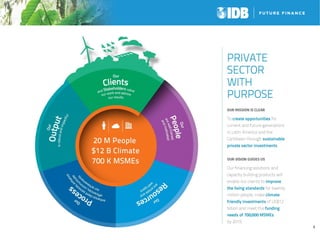
Leading regional development bank in LAC 
3 
Our Clients 
 Corporations, private utilities, 
infrastructure operators, financial 
institutions, and PPPs 
 [Public Sector IDB: Governments] 
Our Products and Services 
 Loans and guarantees 
 Senior and subordinated 
 Corporate and Project Finance 
 Ticket size: US$10-400 million 
 Concessional climate finance 
 Value creation services
4
5 
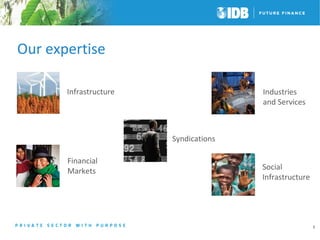
Our expertise 
Infrastructure 
Industries 
and Services 
Social 
Infrastructure 
Financial 
Markets 
Syndications
Shifting from Business as Usual: 
Products to build value and innovate 
performance
What is Shared Value? 
Driving business growth through solutions 
that also drive social value creation
8 
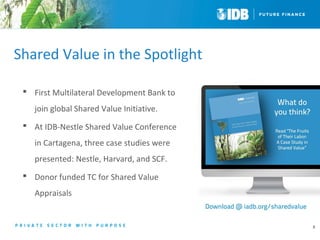
Shared Value in the Spotlight 
 First Multilateral Development Bank to 
join global Shared Value Initiative. 
 At IDB-Nestle Shared Value Conference 
in Cartagena, three case studies were 
presented: Nestle, Harvard, and SCF. 
 Donor funded TC for Shared Value 
Appraisals
9 
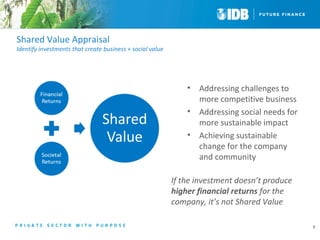
• Addressing challenges to 
more competitive business 
• Addressing social needs for 
more sustainable impact 
• Achieving sustainable 
change for the company 
and community 
If the investment doesn’t produce 
higher financial returns for the 
company, it’s not Shared Value 
Shared Value Appraisal 
Identify investments that create business + social value
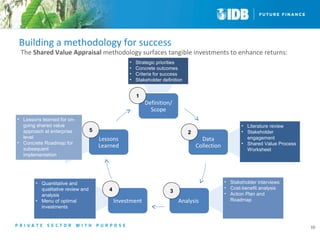
Building a methodology for success 
10 
The Shared Value Appraisal methodology surfaces tangible investments to enhance returns: 
• Strategic priorities 
• Concrete outcomes 
• Criteria for success 
• Stakeholder definition 
Definition/ 
Scope 
Data 
Collection 
Lessons 
Learned 
Investment Analysis 
• Literature review 
• Stakeholder 
engagement 
• Shared Value Process 
Worksheet 
• Quantitative and 
qualitative review and 
analysis 
• Menu of optimal 
investments 
• Stakeholder interviews 
• Cost-benefit analysis 
• Action Plan and 
Roadmap 
• Lessons learned for on-going 
shared value 
approach at enterprise 
level 
• Concrete Roadmap for 
subsequent 
implementation 
1 
2 
4 3 
5
Social, Environmental AND 
Financial Sustainability as Goal 
 We see investments in sustainability as a business opportunity, moving 
beyond a pure risk mitigation or compliance strategy (separate ESG 
process) 
 Our shared value appraisals have to pass the test of: 
 Addressing a current and/or future business challenge of our client 
 Business and profitability (We are the Private Sector Department of a Bank!) 
 Developmental Impact (Social and/or environmental) 
 What else is needed to make it happen? 
 Innovative leadership with long-term vision and a willingness to commit time and 
resources for design AND implementation (sustainability vision) 
 The ability to collect the relevant data and establish benchmarks to demonstrate and 
measure impact over time (ex-ante and ex-post) 
 Motivation of internal clients (investment officers) and change management
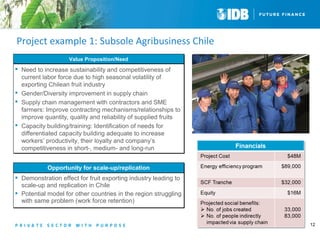
Project example 1: Subsole Agribusiness Chile 
12 
VVaalluuee PPrrooppoossiittiioonn//NNeeeedd 
 Need to increase sustainability and competitiveness of 
current labor force due to high seasonal volatility of 
exporting Chilean fruit industry 
 Gender/Diversity improvement in supply chain 
 Supply chain management with contractors and SME 
farmers: Improve contracting mechanisms/relationships to 
improve quantity, quality and reliability of supplied fruits 
 Capacity building/training: Identification of needs for 
differentiated capacity building adequate to increase 
workers’ productivity, their loyalty and company’s 
competitiveness in short-, medium- and long-run 
OOppppoorrttuunniittyy ffoorr ssccaallee--uupp//rreepplliiccaattiioonn 
 Demonstration effect for fruit exporting industry leading to 
scale-up and replication in Chile 
 Potential model for other countries in the region struggling 
with same problem (work force retention)
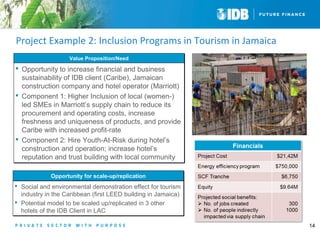
Project Example 2: Inclusion Programs in Tourism in Jamaica 
14 
VVaalluuee PPrrooppoossiittiioonn//NNeeeedd 
 Opportunity to increase financial and business 
sustainability of IDB client (Caribe), Jamaican 
construction company and hotel operator (Marriott) 
 Component 1: Higher Inclusion of local (women-) 
led SMEs in Marriott’s supply chain to reduce its 
procurement and operating costs, increase 
freshness and uniqueness of products, and provide 
Caribe with increased profit-rate 
 Component 2: Hire Youth-At-Risk during hotel’s 
construction and operation; increase hotel’s 
reputation and trust building with local community 
OOppppoorrttuunniittyy ffoorr ssccaallee--uupp//rreepplliiccaattiioonn 
 Social and environmental demonstration effect for tourism 
industry in the Caribbean (first LEED building in Jamaica) 
 Potential model to be scaled up/replicated in 3 other 
hotels of the IDB Client in LAC
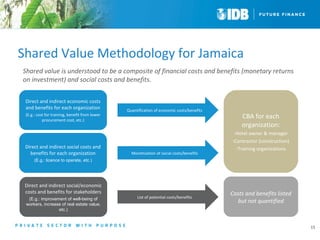
Shared Value Methodology for Jamaica 
15 
Shared value is understood to be a composite of financial costs and benefits (monetary returns 
on investment) and social costs and benefits. 
Direct and indirect economic costs 
and benefits for each organization 
(E.g.: cost for training, benefit from lower 
procurement cost, etc.) 
Direct and indirect social costs and 
benefits for each organization 
(E.g.: licence to operate, etc.) 
Direct and indirect social/economic 
costs and benefits for stakeholders 
(E.g.: improvement of well-being of 
workers, increase of real estate value, 
etc.) 
Quantification of economic costs/benefits 
List of potential costs/benefits 
CBA for each 
organization: 
-Hotel owner & manager 
-Contractor (construction) 
-Training organizations 
Monetization of social costs/benefits 
Costs and benefits listed 
but not quantified
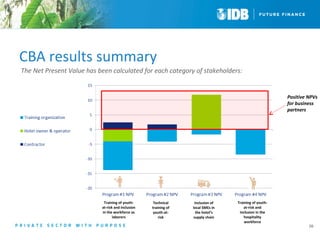
CBA results summary 
16 
The Net Present Value has been calculated for each category of stakeholders: 
Training of youth-at- 
risk and inclusion 
in the workforce as 
laborers 
Technical 
training of 
youth-at-risk 
Inclusion of 
local SMEs in 
the hotel’s 
supply chain 
Training of youth-at- 
risk and 
inclusion in the 
hospitality 
workforce 
Positive NPVs 
for business 
partners
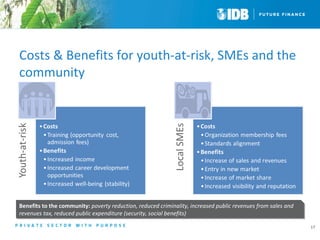
Costs & Benefits for youth-at-risk, SMEs and the 
community 
17 
Benefits to the community: poverty reduction, reduced criminality, increased public revenues from sales and 
revenues tax, reduced public expenditure (security, social benefits) 
Benefits to the community: poverty reduction, reduced criminality, increased public revenues from sales and 
revenues tax, reduced public expenditure (security, social benefits)
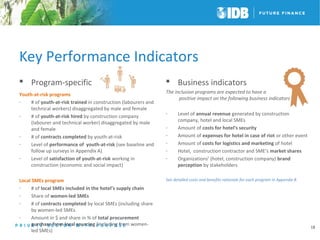
Key Performance Indicators 
 Program-specific 
Youth-at-risk programs 
- # of youth-at-risk trained in construction (labourers and 
technical workers) disaggregated by male and female 
- # of youth-at-risk hired by construction company 
(labourer and technical worker) disaggregated by male 
and female 
- # of contracts completed by youth-at-risk 
- Level of performance of youth-at-risk (see baseline and 
follow up surveys in Appendix A) 
- Level of satisfaction of youth-at-risk working in 
construction (economic and social impact) 
Local SMEs program 
- # of local SMEs included in the hotel’s supply chain 
- Share of women-led SMEs 
- # of contracts completed by local SMEs (including share 
by women-led SMEs 
- Amount in $ and share in % of total procurement 
purchase from local sourcing (including from women-led 
SMEs) 
 Business indicators 
The inclusion programs are expected to have a 
positive impact on the following business indicators 
- Level of annual revenue generated by construction 
company, hotel and local SMEs 
- Amount of costs for hotel’s security 
- Amount of expenses for hotel in case of riot or other event 
- Amount of costs for logistics and marketing of hotel 
- Hotel, construction contractor and SME’s market shares 
- Organizations’ (hotel, construction company) brand 
perception by stakeholders 
See detailed costs and benefits rationale for each program in Appendix B 
18
19 
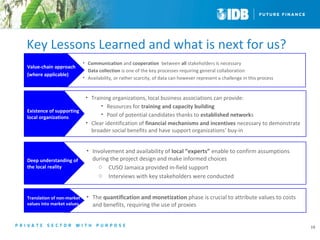
Key Lessons Learned and what is next for us? 
• Communication and cooperation between all stakeholders is necessary 
• Data collection is one of the key processes requiring general collaboration 
• Availability, or rather scarcity, of data can however represent a challenge in this process 
• Training organizations, local business associations can provide: 
• Resources for training and capacity building 
• Pool of potential candidates thanks to established networks 
• Clear identification of financial mechanisms and incentives necessary to demonstrate 
broader social benefits and have support organizations’ buy-in 
• Involvement and availability of local “experts” enable to confirm assumptions 
during the project design and make informed choices 
o CUSO Jamaica provided in-field support 
o Interviews with key stakeholders were conducted 
• The quantification and monetization phase is crucial to attribute values to costs 
and benefits, requiring the use of proxies 
Value-chain approach 
(where applicable) 
Existence of supporting 
local organizations 
Deep understanding of 
the local reality 
Translation of non-market 
values into market values
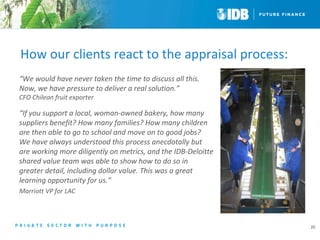
How our clients react to the appraisal process: 
“We would have never taken the time to discuss all this. 
Now, we have pressure to deliver a real solution.” 
CFO Chilean fruit exporter 
“If you support a local, woman-owned bakery, how many 
suppliers benefit? How many families? How many children 
are then able to go to school and move on to good jobs? 
We have always understood this process anecdotally but 
are working more diligently on metrics, and the IDB-Deloitte 
shared value team was able to show how to do so in 
greater detail, including dollar value. This was a great 
learning opportunity for us.” 
Marriott VP for LAC 
20
www.iadb.org/sharedvalue 
Email: bettinab@iadb.org

Davos Shared Value Deck August 2014 (1)

  • 1.
    Inter-American Development Bank New approaches to sustainability – A Shared Value Approach Dr. Bettina Boekle Social Sustainability Specialist Davos, August 26, 2014
  • 2.
    Structure of presentation 2 1 IDB context 2 Shifting from Business as Usual: Shared Value 3 Shared Value Examples 4 Cost-Benefit Analysis in Jamaica’s Hospitality 5 Key lessons learned and what is next 6 Reactions from our clients
  • 3.
    Leading regional developmentbank in LAC 3 Our Clients  Corporations, private utilities, infrastructure operators, financial institutions, and PPPs  [Public Sector IDB: Governments] Our Products and Services  Loans and guarantees  Senior and subordinated  Corporate and Project Finance  Ticket size: US$10-400 million  Concessional climate finance  Value creation services
  • 4.
  • 5.
    5 Our expertise Infrastructure Industries and Services Social Infrastructure Financial Markets Syndications
  • 6.
    Shifting from Businessas Usual: Products to build value and innovate performance
  • 7.
    What is SharedValue? Driving business growth through solutions that also drive social value creation
  • 8.
    8 Shared Valuein the Spotlight  First Multilateral Development Bank to join global Shared Value Initiative.  At IDB-Nestle Shared Value Conference in Cartagena, three case studies were presented: Nestle, Harvard, and SCF.  Donor funded TC for Shared Value Appraisals
  • 9.
    9 • Addressingchallenges to more competitive business • Addressing social needs for more sustainable impact • Achieving sustainable change for the company and community If the investment doesn’t produce higher financial returns for the company, it’s not Shared Value Shared Value Appraisal Identify investments that create business + social value
  • 10.
    Building a methodologyfor success 10 The Shared Value Appraisal methodology surfaces tangible investments to enhance returns: • Strategic priorities • Concrete outcomes • Criteria for success • Stakeholder definition Definition/ Scope Data Collection Lessons Learned Investment Analysis • Literature review • Stakeholder engagement • Shared Value Process Worksheet • Quantitative and qualitative review and analysis • Menu of optimal investments • Stakeholder interviews • Cost-benefit analysis • Action Plan and Roadmap • Lessons learned for on-going shared value approach at enterprise level • Concrete Roadmap for subsequent implementation 1 2 4 3 5
  • 11.
    Social, Environmental AND Financial Sustainability as Goal  We see investments in sustainability as a business opportunity, moving beyond a pure risk mitigation or compliance strategy (separate ESG process)  Our shared value appraisals have to pass the test of:  Addressing a current and/or future business challenge of our client  Business and profitability (We are the Private Sector Department of a Bank!)  Developmental Impact (Social and/or environmental)  What else is needed to make it happen?  Innovative leadership with long-term vision and a willingness to commit time and resources for design AND implementation (sustainability vision)  The ability to collect the relevant data and establish benchmarks to demonstrate and measure impact over time (ex-ante and ex-post)  Motivation of internal clients (investment officers) and change management
  • 12.
    Project example 1:Subsole Agribusiness Chile 12 VVaalluuee PPrrooppoossiittiioonn//NNeeeedd  Need to increase sustainability and competitiveness of current labor force due to high seasonal volatility of exporting Chilean fruit industry  Gender/Diversity improvement in supply chain  Supply chain management with contractors and SME farmers: Improve contracting mechanisms/relationships to improve quantity, quality and reliability of supplied fruits  Capacity building/training: Identification of needs for differentiated capacity building adequate to increase workers’ productivity, their loyalty and company’s competitiveness in short-, medium- and long-run OOppppoorrttuunniittyy ffoorr ssccaallee--uupp//rreepplliiccaattiioonn  Demonstration effect for fruit exporting industry leading to scale-up and replication in Chile  Potential model for other countries in the region struggling with same problem (work force retention)
  • 13.
    Project Example 2:Inclusion Programs in Tourism in Jamaica 14 VVaalluuee PPrrooppoossiittiioonn//NNeeeedd  Opportunity to increase financial and business sustainability of IDB client (Caribe), Jamaican construction company and hotel operator (Marriott)  Component 1: Higher Inclusion of local (women-) led SMEs in Marriott’s supply chain to reduce its procurement and operating costs, increase freshness and uniqueness of products, and provide Caribe with increased profit-rate  Component 2: Hire Youth-At-Risk during hotel’s construction and operation; increase hotel’s reputation and trust building with local community OOppppoorrttuunniittyy ffoorr ssccaallee--uupp//rreepplliiccaattiioonn  Social and environmental demonstration effect for tourism industry in the Caribbean (first LEED building in Jamaica)  Potential model to be scaled up/replicated in 3 other hotels of the IDB Client in LAC
  • 14.
    Shared Value Methodologyfor Jamaica 15 Shared value is understood to be a composite of financial costs and benefits (monetary returns on investment) and social costs and benefits. Direct and indirect economic costs and benefits for each organization (E.g.: cost for training, benefit from lower procurement cost, etc.) Direct and indirect social costs and benefits for each organization (E.g.: licence to operate, etc.) Direct and indirect social/economic costs and benefits for stakeholders (E.g.: improvement of well-being of workers, increase of real estate value, etc.) Quantification of economic costs/benefits List of potential costs/benefits CBA for each organization: -Hotel owner & manager -Contractor (construction) -Training organizations Monetization of social costs/benefits Costs and benefits listed but not quantified
  • 15.
    CBA results summary 16 The Net Present Value has been calculated for each category of stakeholders: Training of youth-at- risk and inclusion in the workforce as laborers Technical training of youth-at-risk Inclusion of local SMEs in the hotel’s supply chain Training of youth-at- risk and inclusion in the hospitality workforce Positive NPVs for business partners
  • 16.
    Costs & Benefitsfor youth-at-risk, SMEs and the community 17 Benefits to the community: poverty reduction, reduced criminality, increased public revenues from sales and revenues tax, reduced public expenditure (security, social benefits) Benefits to the community: poverty reduction, reduced criminality, increased public revenues from sales and revenues tax, reduced public expenditure (security, social benefits)
  • 17.
    Key Performance Indicators  Program-specific Youth-at-risk programs - # of youth-at-risk trained in construction (labourers and technical workers) disaggregated by male and female - # of youth-at-risk hired by construction company (labourer and technical worker) disaggregated by male and female - # of contracts completed by youth-at-risk - Level of performance of youth-at-risk (see baseline and follow up surveys in Appendix A) - Level of satisfaction of youth-at-risk working in construction (economic and social impact) Local SMEs program - # of local SMEs included in the hotel’s supply chain - Share of women-led SMEs - # of contracts completed by local SMEs (including share by women-led SMEs - Amount in $ and share in % of total procurement purchase from local sourcing (including from women-led SMEs)  Business indicators The inclusion programs are expected to have a positive impact on the following business indicators - Level of annual revenue generated by construction company, hotel and local SMEs - Amount of costs for hotel’s security - Amount of expenses for hotel in case of riot or other event - Amount of costs for logistics and marketing of hotel - Hotel, construction contractor and SME’s market shares - Organizations’ (hotel, construction company) brand perception by stakeholders See detailed costs and benefits rationale for each program in Appendix B 18
  • 18.
    19 Key LessonsLearned and what is next for us? • Communication and cooperation between all stakeholders is necessary • Data collection is one of the key processes requiring general collaboration • Availability, or rather scarcity, of data can however represent a challenge in this process • Training organizations, local business associations can provide: • Resources for training and capacity building • Pool of potential candidates thanks to established networks • Clear identification of financial mechanisms and incentives necessary to demonstrate broader social benefits and have support organizations’ buy-in • Involvement and availability of local “experts” enable to confirm assumptions during the project design and make informed choices o CUSO Jamaica provided in-field support o Interviews with key stakeholders were conducted • The quantification and monetization phase is crucial to attribute values to costs and benefits, requiring the use of proxies Value-chain approach (where applicable) Existence of supporting local organizations Deep understanding of the local reality Translation of non-market values into market values
  • 19.
    How our clientsreact to the appraisal process: “We would have never taken the time to discuss all this. Now, we have pressure to deliver a real solution.” CFO Chilean fruit exporter “If you support a local, woman-owned bakery, how many suppliers benefit? How many families? How many children are then able to go to school and move on to good jobs? We have always understood this process anecdotally but are working more diligently on metrics, and the IDB-Deloitte shared value team was able to show how to do so in greater detail, including dollar value. This was a great learning opportunity for us.” Marriott VP for LAC 20
  • 20.

Editor's Notes

  • #4 IDB partners with private sector stakeholders to achieve breakthrough financial results with high development impact All of our deals have a focus on development, we have three high level goals, by 2015 to have supported $10B in climate friendly investment and 250,000 small and medium enterprises, as well as positively impacting 15 million people
  • #5 IDB partners with private sector stakeholders to achieve breakthrough financial results with high development impact All of our deals have a focus on development, we have three high level goals, by 2015 to have supported $10B in climate friendly investment and 250,000 small and medium enterprises, as well as positively impacting 15 million people
  • #6 IDB partners with private sector stakeholders to achieve breakthrough financial results with high development impact All of our deals have a focus on development, we have three high level goals, by 2015 to have supported $10B in climate friendly investment and 250,000 small and medium enterprises, as well as positively impacting 15 million people
  • #9 Hydroelectrica Rio Las Vacas – Guatemala 45MW run of river hydro, 18KM northeast of Guatemala City. Business Challenge: High maintenance costs due to high level of solid waste that must be removed before water can pass through the turbines. Social problem: Local demographics show high levels of unemployment of unskilled labor in surrounding area and environmental degradation. Shared Value Investment The company invested in a recycling plant to recycle the plastic waste removed from the river, transform it into posts used for fencing, and helped form a cooperative of pickers to perform the work. Financial Return to the Company Decreased O&M costs due to reduced maintenance of turbines, damage-related shutdowns and fence posts. Social Return to the Community New source of local employment Oxygenation of water flow improves water quality Recycled fences used to reduce erosion and risk of landslides Reduced need for incinerators and landfills, reduced carbon emissions.
  • #10 Key Points: Challenges faced by many companies in emerging markets often cannot be resolved internally because they are driven or exacerbated by the political, economic or social context and trends. Such challenges are more effectively addressed through a shared value approach, leading to better outcomes over the long term, because they account for external factors over which the company has no control (contextualize and embed) Successful implementation of shared value strategy and interventions may make companies better loan candidates via improved financial and risk profile of a client As a consequence, a company’s reputation will improve as well as their business (word of mouth); this will benefit IDB indirectly
  • #16 In the CBA calculations, the hotel owner (Caribe Hospitality) and the hotel manager (Marriott) are not distinguished as the agreement binding both parties (interests on revenues and on profit) makes it difficult to separate who will assume the costs and who will get the benefits.
  • #17 Even using conservative assumptions, the model showed that including local businesses in the supply chain will bring economic benefits to the hotel’s owners and operators primarily from lower cost of local vs imported goods and logistics and process efficiencies, beginning in the first year of operations. Tangible returns on providing job training and experience to at-risk youth were harder to quantify, but the IDB-Deloitte team concluded—based on its interviews in Jamaica and research elsewhere—that efforts in this area would pay off in the long run, by fostering community goodwill, improving neighborhood security, and in general contributing to the broad goal of social inclusion SME results for Caribe and Marriott: Note: In the CBA calculations, the hotel owner (Caribe Hospitality) and the hotel manager (Marriott) are not distinguished as the agreement binding both parties (interests on revenues and on profit) makes it difficult to separate who will assume the costs and who will get the benefits. Largest benefits starts in 2015, corresponding to the hotel’s opening and beginning of full operations Costs are mainly administrative in order to identify, communicate with, monitor the SMEs and assess and adapt the needs: these are on-going costs but which are fairly minimal compared to the benefits as showed from 2015 to 2022 Benefits reflects various sources of savings and gains compared to « business-as-usual » as presented in preliminary projections, especially: Avoided custom duties on imported goods thanks to locally sourced goods Lower marketing costs thanks to local involvement Lower logistics costs thanks to an increased resilience of the supply chain Lower costs due to higher competition locally Higher banquet revenues: local population expected to chose this hotel because it supports the local community and businesses Youth-at risk results for Caribe/Marriott: The costs mainly reflects the stipends/salaries paid by the hotel owner (CH) to the youth-at-risk 2018 costs explanation: Last cohort in 2017 with contracts that could extend until 2018 Benefits are minimal for this stakeholder at this point, as they mainly benefit the contractors in charge of the hotel’s construction The program starts to have a real impact 3 years after the beginning of the program (2016/2017) as it accounts for the time needed to improve the corporative image and the reputation to be built, eventually leading to greater business opportunities. It is expected that hotel would engage less security costs or have lower expenses in case of riot or social event due to the inclusion of youth at risk showing a certain level of engagement with the local community Generation of proxies based on conservative estimates and taking into account expert input (e.g. lower productivity and higher turnover for youth at risk inclusion into hospitality workforce.