5th International Disaster and Risk Conference IDRC 2014 
‘Integrative Risk Management - The role of science, technology & practice‘ • 24-28 August 2014 • Davos • Switzerland 
www.grforum.org 
The use of DRR science in an 
international comparative context: 
an interdisciplinary framework 
Susanne Sargeant, British Geological Survey, UK 
Eric Lindquist, Boise State University, US
5th International Disaster and Risk Conference IDRC 2014 
‘Integrative Risk Management - The role of science, technology & practice‘ • 24-28 August 2014 • Davos • Switzerland 
www.grforum.org 
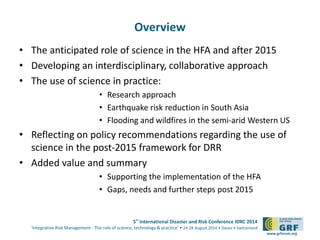
Overview 
• The anticipated role of science in the HFA and after 2015 
• Developing an interdisciplinary, collaborative approach 
• The use of science in practice: 
• Research approach 
• Earthquake risk reduction in South Asia 
• Flooding and wildfires in the semi-arid Western US 
• Reflecting on policy recommendations regarding the use of 
science in the post-2015 framework for DRR 
• Added value and summary 
• Supporting the implementation of the HFA 
• Gaps, needs and further steps post 2015
The role of science in HFA and post-2015 
Recommendations of the UN ISDR Science and Technology 
Advisory Group (Global Platform, 2013) 
5th International Disaster and Risk Conference IDRC 2014 
‘Integrative Risk Management - The role of science, technology & practice‘ • 24-28 August 2014 • Davos • Switzerland 
www.grforum.org 
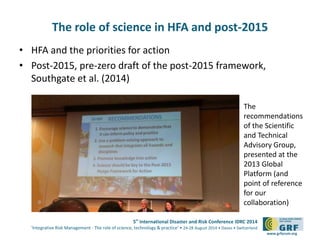
• HFA and the priorities for action 
• Post-2015, pre-zero draft of the post-2015 framework, 
Southgate et al. (2014) 
The 
recommendations 
of the Scientific 
and Technical 
Advisory Group, 
presented at the 
2013 Global 
Platform (and 
point of reference 
for our 
collaboration)
Developing an interdisciplinary, collaborative 
5th International Disaster and Risk Conference IDRC 2014 
‘Integrative Risk Management - The role of science, technology & practice‘ • 24-28 August 2014 • Davos • Switzerland 
www.grforum.org 
approach 
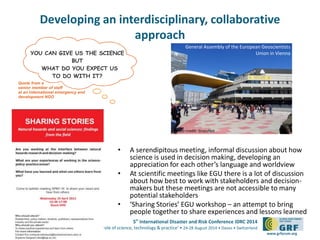
• A serendipitous meeting, informal discussion about how 
science is used in decision making, developing an 
appreciation for each other’s language and worldview 
• At scientific meetings like EGU there is a lot of discussion 
about how best to work with stakeholders and decision-makers 
but these meetings are not accessible to many 
potential stakeholders 
• ‘Sharing Stories’ EGU workshop – an attempt to bring 
people together to share experiences and lessons learned 
YOU CAN GIVE US THE SCIENCE 
BUT 
WHAT DO YOU EXPECT US 
TO DO WITH IT? 
Quote from a 
senior member of staff 
at an international emergency and 
development NGO 
General Assembly of the European Geoscientists 
Union in Vienna 
Photo credit: GrassNet
5th International Disaster and Risk Conference IDRC 2014 
‘Integrative Risk Management - The role of science, technology & practice‘ • 24-28 August 2014 • Davos • Switzerland 
www.grforum.org 
Research Approach 
• “How is science used to make decisions from the international 
to local scale, and what can be learned from a comparison 
between hazards, disciplines, and contexts?” 
• First step: Take two existing studies and relate them to the 
UNISDR (Southgate et al. 2014) recommendations. 
• Second step: develop preliminary case study findings across 
the recommendations. 
• Third step: Integrate and compare findings for commonalities 
and differences. 
• Fourth step: Address the value-added perspective of the IDRC 
• Fifth step: Where do we go from here?
Case study 1: Earthquake risk reduction in South Asia 
• Location – Bangladesh and Nepal. Both densely populated 
and highly seismically active with histories of devastating 
earthquakes 
• Case studies are projects that aim to increase the impact of 
earthquake science on DRR and resilience building through 
knowledge exchange (Bangladesh) and transdisciplinary 
research (Nepal) 
• Bangladesh: earthquake risk management training for NGO 
5th International Disaster and Risk Conference IDRC 2014 
‘Integrative Risk Management - The role of science, technology & practice‘ • 24-28 August 2014 • Davos • Switzerland 
www.grforum.org 
staff in Dhaka 
• Nepal: Earthquakes without Frontiers – a transdisciplinary 
research project that brings physical and social scientists from 
the UK together with local scientists and decision makers
5th International Disaster and Risk Conference IDRC 2014 
‘Integrative Risk Management - The role of science, technology & practice‘ • 24-28 August 2014 • Davos • Switzerland 
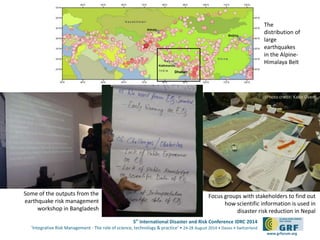
(Photo credit: Katie Oven) 
www.grforum.org 
Dhaka 
The 
distribution of 
large 
earthquakes 
in the Alpine- 
Himalaya Belt 
Some of the outputs from the 
earthquake risk management 
workshop in Bangladesh 
Focus groups with stakeholders to find out 
how scientific information is used in 
disaster risk reduction in Nepal
Reflections on the Southgate Recommendations 
• R1: While it is possible to demonstrate what science informed the 
design and implementation of the training, how this informs 
organisational decision making in the longer term is less easy to 
demonstrate 
• R2: Navigating the local context, working across disciplines and 
building the necessary relationships with stakeholders to define the 
problem and work towards a solution requires sustained 
engagement and can take a long time 
• R3: Sharing and disseminating scientific information and translating 
it into action should be done with a good understanding of what 
information currently exists and the barriers that prevent that 
information from being used or shared 
• R4: The complexity of the decision-making process and the context 
in which it occurs can make it difficult to provide evidence of what 
impact science had on decision making 
5th International Disaster and Risk Conference IDRC 2014 
‘Integrative Risk Management - The role of science, technology & practice‘ • 24-28 August 2014 • Davos • Switzerland 
www.grforum.org
5th International Disaster and Risk Conference IDRC 2014 
‘Integrative Risk Management - The role of science, technology & practice‘ • 24-28 August 2014 • Davos • Switzerland 
www.grforum.org 
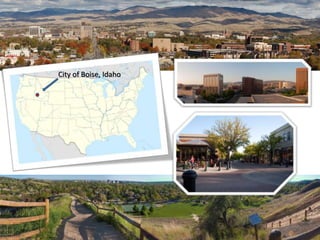
City of Boise, Idaho
5th International Disaster and Risk Conference IDRC 2014 
‘Integrative Risk Management - The role of science, technology & practice‘ • 24-28 August 2014 • Davos • Switzerland 
www.grforum.org 
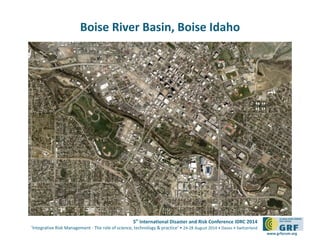
Boise River Basin, Boise Idaho
5th International Disaster and Risk Conference IDRC 2014 
‘Integrative Risk Management - The role of science, technology & practice‘ • 24-28 August 2014 • Davos • Switzerland 
www.grforum.org 
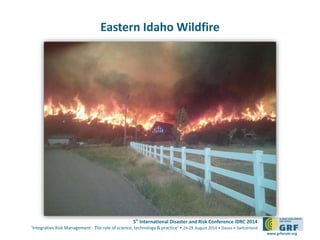
Eastern Idaho Wildfire
Case study 2: Flooding and wildfires in Boise 
• Location – Southwest Idaho, semi-arid region of the northern 
5th International Disaster and Risk Conference IDRC 2014 
‘Integrative Risk Management - The role of science, technology & practice‘ • 24-28 August 2014 • Davos • Switzerland 
www.grforum.org 
Great Basin. 
• Policy network approach to multiple natural hazards: urban 
flooding and wildfires at the wildland-urban interface. 
• Stakeholder engagement with both networks. 
• 4 comparative factors of the policy networks: 
– Type and frequency of hazard 
– Size and type of network 
– Network member interactions 
– Role of uncertainty and impact of climate change
Reflections on the Southgate Recommendations 
• R1: Both cases involve the use of science and science and policy 
interaction; engagement in the case of wildfires is more frequent 
and interactive; both cases rely heavily on predictions and 
probability of risk and disaster. 
• R2: Wildfire policy network is inclusive across disciplines (planning, 
policy sciences, and hydrology); most flood risk problems are solved 
by “hard” or infrastructure solutions, rather than policy or 
behavioral solutions. 
• R3: Significant effort expended on wildfire education and knowledge 
transfer; the urban flooding problem is rarely mentioned or 
considered outside the domain of the few major stakeholders. 
• R4: Science is but one factor in larger information and advocacy 
5th International Disaster and Risk Conference IDRC 2014 
‘Integrative Risk Management - The role of science, technology & practice‘ • 24-28 August 2014 • Davos • Switzerland 
www.grforum.org 
efforts, understanding this reality is critical.
5th International Disaster and Risk Conference IDRC 2014 
‘Integrative Risk Management - The role of science, technology & practice‘ • 24-28 August 2014 • Davos • Switzerland 
www.grforum.org 
Integration and Comparing Cases 
• R1: There is significant decision making activity that science 
has no impact on; need a better understanding of the decision 
context and the competition among information types. 
• R2: Science is critical to DRR problem solving but defining the 
problem is often a political process; organizational culture and 
capacity also contribute. 
• R3: Transition of knowledge to action is non-linear; need to 
understand where, when and how science engages with 
decision making. 
• R4: Are we expecting too much of “science” and scientists 
within this larger more dynamic process?
Added value for the Post 2015 Framework for 
5th International Disaster and Risk Conference IDRC 2014 
‘Integrative Risk Management - The role of science, technology & practice‘ • 24-28 August 2014 • Davos • Switzerland 
www.grforum.org 
Disaster Risk Reduction 
• How did your work support the implementation of the Hyogo 
Framework for Action: 
– Sub-national perspective on the use of science in DRR 
– Contributes to our understanding of DRR implementation 
– Context for decision making requires an interdisciplinary approach 
– Recognition by HFA and others (ICLEI) that understanding the context is 
critical to success 
• From your perspective what are the main gaps, needs and further 
steps to be addressed in the Post 2015 Framework for Disaster Risk 
Reduction in 
– Research: Coordination across research projects 
– Education & Training: Create an enabling environment to implement 
training outcomes 
– Implementation & Practice: Incentivise full participation by the scientific 
community in the long tem 
– Policy: Responsibility on all stakeholders (including scientists) to 
participate fully in the policy process

Sargeant and Lindquist_IDRC2014_8.25.14b

  • 1.
    5th International Disasterand Risk Conference IDRC 2014 ‘Integrative Risk Management - The role of science, technology & practice‘ • 24-28 August 2014 • Davos • Switzerland www.grforum.org The use of DRR science in an international comparative context: an interdisciplinary framework Susanne Sargeant, British Geological Survey, UK Eric Lindquist, Boise State University, US
  • 2.
    5th International Disasterand Risk Conference IDRC 2014 ‘Integrative Risk Management - The role of science, technology & practice‘ • 24-28 August 2014 • Davos • Switzerland www.grforum.org Overview • The anticipated role of science in the HFA and after 2015 • Developing an interdisciplinary, collaborative approach • The use of science in practice: • Research approach • Earthquake risk reduction in South Asia • Flooding and wildfires in the semi-arid Western US • Reflecting on policy recommendations regarding the use of science in the post-2015 framework for DRR • Added value and summary • Supporting the implementation of the HFA • Gaps, needs and further steps post 2015
  • 3.
    The role ofscience in HFA and post-2015 Recommendations of the UN ISDR Science and Technology Advisory Group (Global Platform, 2013) 5th International Disaster and Risk Conference IDRC 2014 ‘Integrative Risk Management - The role of science, technology & practice‘ • 24-28 August 2014 • Davos • Switzerland www.grforum.org • HFA and the priorities for action • Post-2015, pre-zero draft of the post-2015 framework, Southgate et al. (2014) The recommendations of the Scientific and Technical Advisory Group, presented at the 2013 Global Platform (and point of reference for our collaboration)
  • 4.
    Developing an interdisciplinary,collaborative 5th International Disaster and Risk Conference IDRC 2014 ‘Integrative Risk Management - The role of science, technology & practice‘ • 24-28 August 2014 • Davos • Switzerland www.grforum.org approach • A serendipitous meeting, informal discussion about how science is used in decision making, developing an appreciation for each other’s language and worldview • At scientific meetings like EGU there is a lot of discussion about how best to work with stakeholders and decision-makers but these meetings are not accessible to many potential stakeholders • ‘Sharing Stories’ EGU workshop – an attempt to bring people together to share experiences and lessons learned YOU CAN GIVE US THE SCIENCE BUT WHAT DO YOU EXPECT US TO DO WITH IT? Quote from a senior member of staff at an international emergency and development NGO General Assembly of the European Geoscientists Union in Vienna Photo credit: GrassNet
  • 5.
    5th International Disasterand Risk Conference IDRC 2014 ‘Integrative Risk Management - The role of science, technology & practice‘ • 24-28 August 2014 • Davos • Switzerland www.grforum.org Research Approach • “How is science used to make decisions from the international to local scale, and what can be learned from a comparison between hazards, disciplines, and contexts?” • First step: Take two existing studies and relate them to the UNISDR (Southgate et al. 2014) recommendations. • Second step: develop preliminary case study findings across the recommendations. • Third step: Integrate and compare findings for commonalities and differences. • Fourth step: Address the value-added perspective of the IDRC • Fifth step: Where do we go from here?
  • 6.
    Case study 1:Earthquake risk reduction in South Asia • Location – Bangladesh and Nepal. Both densely populated and highly seismically active with histories of devastating earthquakes • Case studies are projects that aim to increase the impact of earthquake science on DRR and resilience building through knowledge exchange (Bangladesh) and transdisciplinary research (Nepal) • Bangladesh: earthquake risk management training for NGO 5th International Disaster and Risk Conference IDRC 2014 ‘Integrative Risk Management - The role of science, technology & practice‘ • 24-28 August 2014 • Davos • Switzerland www.grforum.org staff in Dhaka • Nepal: Earthquakes without Frontiers – a transdisciplinary research project that brings physical and social scientists from the UK together with local scientists and decision makers
  • 7.
    5th International Disasterand Risk Conference IDRC 2014 ‘Integrative Risk Management - The role of science, technology & practice‘ • 24-28 August 2014 • Davos • Switzerland (Photo credit: Katie Oven) www.grforum.org Dhaka The distribution of large earthquakes in the Alpine- Himalaya Belt Some of the outputs from the earthquake risk management workshop in Bangladesh Focus groups with stakeholders to find out how scientific information is used in disaster risk reduction in Nepal
  • 8.
    Reflections on theSouthgate Recommendations • R1: While it is possible to demonstrate what science informed the design and implementation of the training, how this informs organisational decision making in the longer term is less easy to demonstrate • R2: Navigating the local context, working across disciplines and building the necessary relationships with stakeholders to define the problem and work towards a solution requires sustained engagement and can take a long time • R3: Sharing and disseminating scientific information and translating it into action should be done with a good understanding of what information currently exists and the barriers that prevent that information from being used or shared • R4: The complexity of the decision-making process and the context in which it occurs can make it difficult to provide evidence of what impact science had on decision making 5th International Disaster and Risk Conference IDRC 2014 ‘Integrative Risk Management - The role of science, technology & practice‘ • 24-28 August 2014 • Davos • Switzerland www.grforum.org
  • 9.
    5th International Disasterand Risk Conference IDRC 2014 ‘Integrative Risk Management - The role of science, technology & practice‘ • 24-28 August 2014 • Davos • Switzerland www.grforum.org City of Boise, Idaho
  • 10.
    5th International Disasterand Risk Conference IDRC 2014 ‘Integrative Risk Management - The role of science, technology & practice‘ • 24-28 August 2014 • Davos • Switzerland www.grforum.org Boise River Basin, Boise Idaho
  • 11.
    5th International Disasterand Risk Conference IDRC 2014 ‘Integrative Risk Management - The role of science, technology & practice‘ • 24-28 August 2014 • Davos • Switzerland www.grforum.org Eastern Idaho Wildfire
  • 12.
    Case study 2:Flooding and wildfires in Boise • Location – Southwest Idaho, semi-arid region of the northern 5th International Disaster and Risk Conference IDRC 2014 ‘Integrative Risk Management - The role of science, technology & practice‘ • 24-28 August 2014 • Davos • Switzerland www.grforum.org Great Basin. • Policy network approach to multiple natural hazards: urban flooding and wildfires at the wildland-urban interface. • Stakeholder engagement with both networks. • 4 comparative factors of the policy networks: – Type and frequency of hazard – Size and type of network – Network member interactions – Role of uncertainty and impact of climate change
  • 13.
    Reflections on theSouthgate Recommendations • R1: Both cases involve the use of science and science and policy interaction; engagement in the case of wildfires is more frequent and interactive; both cases rely heavily on predictions and probability of risk and disaster. • R2: Wildfire policy network is inclusive across disciplines (planning, policy sciences, and hydrology); most flood risk problems are solved by “hard” or infrastructure solutions, rather than policy or behavioral solutions. • R3: Significant effort expended on wildfire education and knowledge transfer; the urban flooding problem is rarely mentioned or considered outside the domain of the few major stakeholders. • R4: Science is but one factor in larger information and advocacy 5th International Disaster and Risk Conference IDRC 2014 ‘Integrative Risk Management - The role of science, technology & practice‘ • 24-28 August 2014 • Davos • Switzerland www.grforum.org efforts, understanding this reality is critical.
  • 14.
    5th International Disasterand Risk Conference IDRC 2014 ‘Integrative Risk Management - The role of science, technology & practice‘ • 24-28 August 2014 • Davos • Switzerland www.grforum.org Integration and Comparing Cases • R1: There is significant decision making activity that science has no impact on; need a better understanding of the decision context and the competition among information types. • R2: Science is critical to DRR problem solving but defining the problem is often a political process; organizational culture and capacity also contribute. • R3: Transition of knowledge to action is non-linear; need to understand where, when and how science engages with decision making. • R4: Are we expecting too much of “science” and scientists within this larger more dynamic process?
  • 15.
    Added value forthe Post 2015 Framework for 5th International Disaster and Risk Conference IDRC 2014 ‘Integrative Risk Management - The role of science, technology & practice‘ • 24-28 August 2014 • Davos • Switzerland www.grforum.org Disaster Risk Reduction • How did your work support the implementation of the Hyogo Framework for Action: – Sub-national perspective on the use of science in DRR – Contributes to our understanding of DRR implementation – Context for decision making requires an interdisciplinary approach – Recognition by HFA and others (ICLEI) that understanding the context is critical to success • From your perspective what are the main gaps, needs and further steps to be addressed in the Post 2015 Framework for Disaster Risk Reduction in – Research: Coordination across research projects – Education & Training: Create an enabling environment to implement training outcomes – Implementation & Practice: Incentivise full participation by the scientific community in the long tem – Policy: Responsibility on all stakeholders (including scientists) to participate fully in the policy process

Editor's Notes

  • #2 Poss say what our disciplinary backgrounds are here?
  • #4 Within the priorities for action that underpin the strategic goals, the anticipated role of science and scientists is clear, in particular, with respect to risk assessment, loss estimation, space-based observation, early warning and forecasting (Priority 2: Identify, assess and monitor disaster risks and enhance early warning). However, more generally, the importance of information sharing and cooperation, and cross-disciplinary networks (Priority 3: Use knowledge, innovation and education to build a culture of safety and resilience at all levels) and developing technical and institutional capacity for effective disaster management (Priority 5: Strengthen disaster preparedness for effective response at all levels) are also relevant here. - Make sure to say that the Southgate recommendations gave us a tangible, common point of reference that allowed us to collaborate in a substantial way
  • #5 Our response as scientists to that statement is what woke us up Points raised in the sharing stories discussion included the need for strong arguments to persuade researchers to collaborate across the physical-social science divide, the challenges for scientists relating to identifying and engaging with the right audience, and the importance of identifying and understanding the needs of decision makers.
  • #7 - Give them enough info to know that we did something. The relevant stuff for this and the value is in the integration
  • #9 -I’ve italicised the point I’d like to focus on
  • #10 Transition slide. Eric takes over from Susanne City of Boise ~208,000 residents Capitol city, 3 major Universities Metro region about 660,000 residents – projected growth about 400k more in the next 25 years. What are the disaster problems in this area – segue to pics
  • #16 Gaps, needs and further steps from my point of view Research: In general, there is a significant need for greater coordination between research projects with an impact focus to avoid duplicating effort. There is also a strong need to design new research with a good understanding of the context in which it will be applied so that it complements existing DRR activities and supports the development of local capacity. There is a need for greater recognition of the value of interdisciplinary research and the time it takes to develop an effective collaboration, greater support in general for fostering physical-social science collaboration. The enormous value of developing and supporting fundamental monitoring capabilities (e.g. seismic networks) and attendant capacity at the national and local levels should not be underestimated. Gap = understanding amongst scientists of how information is used for decision making and how to influence the decision making process Education and training: Again, coordination with other initiatives is important. Training for scientists on identifying and reaching the right audience, understanding the needs of decision makers and how to bridge the gap between science and action. Implementation and practice: Recognise the importance of context in implementation and the fact that one size rarely fits all. Policy: I don’t have anything to say for this