Disasters as Drivers for Policy Change in the 
5th International Disaster and Risk Conference IDRC 2014 
‘Integrative Risk Management - The role of science, technology & practice‘ • 24-28 August 2014 • Davos • Switzerland 
www.grforum.org 
Context of Recurrent Hazards? 
The Case of Disaster Risk Management in Mozambique 
Jenni Koivisto 
Centre for Clime and Safety 
Centre for Natural Disaster Science 
Karlstad University, Sweden
5th International Disaster and Risk Conference IDRC 2014 
‘Integrative Risk Management - The role of science, technology & practice‘ • 24-28 August 2014 • Davos • Switzerland 
www.grforum.org 
Introduction 
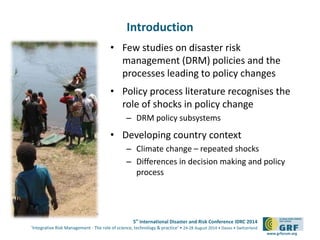
• Few studies on disaster risk 
management (DRM) policies and the 
processes leading to policy changes 
• Policy process literature recognises the 
role of shocks in policy change 
– DRM policy subsystems 
• Developing country context 
– Climate change – repeated shocks 
– Differences in decision making and policy 
process
5th International Disaster and Risk Conference IDRC 2014 
‘Integrative Risk Management - The role of science, technology & practice‘ • 24-28 August 2014 • Davos • Switzerland 
www.grforum.org 
This Study 
• How do actors involved in DRM 
perceive the role of disasters in 
the policy process 
• How do disasters influence DRM 
policy process in a subsystem 
facing recurrent natural 
disasters? 
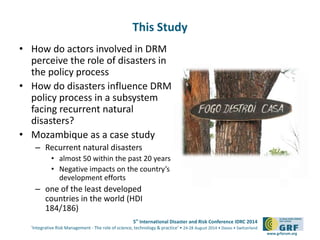
• Mozambique as a case study 
– Recurrent natural disasters 
• almost 50 within the past 20 years 
• Negative impacts on the country’s 
development efforts 
– one of the least developed 
countries in the world (HDI 
184/186)
5th International Disaster and Risk Conference IDRC 2014 
‘Integrative Risk Management - The role of science, technology & practice‘ • 24-28 August 2014 • Davos • Switzerland 
www.grforum.org 
Theoretical Background 
• Disasters can open “Policy Windows”: separate streams of 
problems, policies and politics come together (Kingdon) 
• Natural disasters do not open “windows of opportunity” in 
disaster management domain since DM and DRM policies are 
“policies without public” (May 1991) 
• Different types of changes: 
– Institutional culture, training, leadership and network building 
(software) 
– Formal structures and legal frameworks (hardware) 
(Boin & ‘t Hart 2010)
5th International Disaster and Risk Conference IDRC 2014 
‘Integrative Risk Management - The role of science, technology & practice‘ • 24-28 August 2014 • Davos • Switzerland 
www.grforum.org 
Methodology 
• Qualitative research 
• Data collected in Maputo, Mozambique in 2013. 
• Semi-structured interviews with 40 informants actively 
involved in DRM domain in Mozambique. 
– Ministries/other governmental bodies, NGOs, inter-governmental and 
bilateral organisations and academia. 
• Governmental documents and various policy studies 
• Data on disasters and their impacts were drawn from EM-DAT 
• Delimited to cover only the post-civil war era (1992 onwards)
5th International Disaster and Risk Conference IDRC 2014 
‘Integrative Risk Management - The role of science, technology & practice‘ • 24-28 August 2014 • Davos • Switzerland 
www.grforum.org 
DRM in Mozambique 
• A more proactive approach to disaster management and DRM 
appeared from mid 90s onward 
– The end of the civil war in 1992: from relief to development 
– The IDNDR lifted DRM on the international agenda 
• 1999: Disaster management bill and the National Disaster 
Management Institute (INGC) 
• Since 2005 DRM as cross-cutting issue in the Government 5- 
year-plans and poverty reduction strategies 
• 2006: Disaster Risk Reduction Master Plan 
• 2013 DRM one of the main pillars in the National strategy for 
climate change mitigation and adaptation 
• 2014: Disaster management law
5th International Disaster and Risk Conference IDRC 2014 
‘Integrative Risk Management - The role of science, technology & practice‘ • 24-28 August 2014 • Davos • Switzerland 
www.grforum.org 
Analysis 
• Past disasters have played a role in policy process but not the 
immediate or the main cause for changes 
• Policy diffusion and institutionalism were seen as more direct 
drivers 
• Disasters were seen to impact at the background through various 
processes: 
– Lessons drawn: Institutional and individual learning important 
but slow 
– Keep DRM on the agenda: DRM is overshadowed by response 
and recovery activities but the importance of DRM is 
acknowledged 
– Help pushing ready-made plans: The worst floods since 2000 in 
early 2013 were hoped to help in passing the new disaster 
management law 
– Disasters as “wake-up calls”: disasters in bigger scale (2000 
floods) or new types of hazards (2006 earthquake)
5th International Disaster and Risk Conference IDRC 2014 
‘Integrative Risk Management - The role of science, technology & practice‘ • 24-28 August 2014 • Davos • Switzerland 
www.grforum.org 
Conclusions 
• Disasters have not directly led to policy changes - A lot of 
disasters but few changes 
• Changes incremental rather than knee-jerk reactions 
• More “software” changes: 
– Training, programme planning 
– Networks and information sharing among actors improved 
• A lot of attention. However perhaps not enough 
criticism/blame-game to “force” changes at political level 
• Because of connections to climate change and development 
the public and actors participating is ever growing – How to 
frame DRM? 
• Contextual factors: 
– Subsystem exhausted, focus on preparedness, response and 
recovery 
– Disasters less of a shock
Added value for the Post 2015 Framework for 
5th International Disaster and Risk Conference IDRC 2014 
‘Integrative Risk Management - The role of science, technology & practice‘ • 24-28 August 2014 • Davos • Switzerland 
www.grforum.org 
Disaster Risk Reduction 
• How did your work support the implementation of the Hyogo 
Framework for Action: 
– Reveals that international cooperation and agreements, such as HFA, 
are perceived important in domestic policy process 
• From your perspective what are the main gaps, needs and 
further steps to be addressed in the Post 2015 Framework for 
Disaster Risk Reduction in 
– Need to embrace the different settings and institutions 
– Tools for coordination 
– Platforms to share experiences and best practices
5th International Disaster and Risk Conference IDRC 2014 
‘Integrative Risk Management - The role of science, technology & practice‘ • 24-28 August 2014 • Davos • Switzerland 
www.grforum.org 
Thank you 
Jenni Koivisto 
Jenni.koivisto@kau.se 
Centre for Natural Disaster Science 
Centre for Climate and Safety 
Karlstad Univeristy

JKoivisto_IDRC14

  • 1.
    Disasters as Driversfor Policy Change in the 5th International Disaster and Risk Conference IDRC 2014 ‘Integrative Risk Management - The role of science, technology & practice‘ • 24-28 August 2014 • Davos • Switzerland www.grforum.org Context of Recurrent Hazards? The Case of Disaster Risk Management in Mozambique Jenni Koivisto Centre for Clime and Safety Centre for Natural Disaster Science Karlstad University, Sweden
  • 2.
    5th International Disasterand Risk Conference IDRC 2014 ‘Integrative Risk Management - The role of science, technology & practice‘ • 24-28 August 2014 • Davos • Switzerland www.grforum.org Introduction • Few studies on disaster risk management (DRM) policies and the processes leading to policy changes • Policy process literature recognises the role of shocks in policy change – DRM policy subsystems • Developing country context – Climate change – repeated shocks – Differences in decision making and policy process
  • 3.
    5th International Disasterand Risk Conference IDRC 2014 ‘Integrative Risk Management - The role of science, technology & practice‘ • 24-28 August 2014 • Davos • Switzerland www.grforum.org This Study • How do actors involved in DRM perceive the role of disasters in the policy process • How do disasters influence DRM policy process in a subsystem facing recurrent natural disasters? • Mozambique as a case study – Recurrent natural disasters • almost 50 within the past 20 years • Negative impacts on the country’s development efforts – one of the least developed countries in the world (HDI 184/186)
  • 4.
    5th International Disasterand Risk Conference IDRC 2014 ‘Integrative Risk Management - The role of science, technology & practice‘ • 24-28 August 2014 • Davos • Switzerland www.grforum.org Theoretical Background • Disasters can open “Policy Windows”: separate streams of problems, policies and politics come together (Kingdon) • Natural disasters do not open “windows of opportunity” in disaster management domain since DM and DRM policies are “policies without public” (May 1991) • Different types of changes: – Institutional culture, training, leadership and network building (software) – Formal structures and legal frameworks (hardware) (Boin & ‘t Hart 2010)
  • 5.
    5th International Disasterand Risk Conference IDRC 2014 ‘Integrative Risk Management - The role of science, technology & practice‘ • 24-28 August 2014 • Davos • Switzerland www.grforum.org Methodology • Qualitative research • Data collected in Maputo, Mozambique in 2013. • Semi-structured interviews with 40 informants actively involved in DRM domain in Mozambique. – Ministries/other governmental bodies, NGOs, inter-governmental and bilateral organisations and academia. • Governmental documents and various policy studies • Data on disasters and their impacts were drawn from EM-DAT • Delimited to cover only the post-civil war era (1992 onwards)
  • 6.
    5th International Disasterand Risk Conference IDRC 2014 ‘Integrative Risk Management - The role of science, technology & practice‘ • 24-28 August 2014 • Davos • Switzerland www.grforum.org DRM in Mozambique • A more proactive approach to disaster management and DRM appeared from mid 90s onward – The end of the civil war in 1992: from relief to development – The IDNDR lifted DRM on the international agenda • 1999: Disaster management bill and the National Disaster Management Institute (INGC) • Since 2005 DRM as cross-cutting issue in the Government 5- year-plans and poverty reduction strategies • 2006: Disaster Risk Reduction Master Plan • 2013 DRM one of the main pillars in the National strategy for climate change mitigation and adaptation • 2014: Disaster management law
  • 7.
    5th International Disasterand Risk Conference IDRC 2014 ‘Integrative Risk Management - The role of science, technology & practice‘ • 24-28 August 2014 • Davos • Switzerland www.grforum.org Analysis • Past disasters have played a role in policy process but not the immediate or the main cause for changes • Policy diffusion and institutionalism were seen as more direct drivers • Disasters were seen to impact at the background through various processes: – Lessons drawn: Institutional and individual learning important but slow – Keep DRM on the agenda: DRM is overshadowed by response and recovery activities but the importance of DRM is acknowledged – Help pushing ready-made plans: The worst floods since 2000 in early 2013 were hoped to help in passing the new disaster management law – Disasters as “wake-up calls”: disasters in bigger scale (2000 floods) or new types of hazards (2006 earthquake)
  • 8.
    5th International Disasterand Risk Conference IDRC 2014 ‘Integrative Risk Management - The role of science, technology & practice‘ • 24-28 August 2014 • Davos • Switzerland www.grforum.org Conclusions • Disasters have not directly led to policy changes - A lot of disasters but few changes • Changes incremental rather than knee-jerk reactions • More “software” changes: – Training, programme planning – Networks and information sharing among actors improved • A lot of attention. However perhaps not enough criticism/blame-game to “force” changes at political level • Because of connections to climate change and development the public and actors participating is ever growing – How to frame DRM? • Contextual factors: – Subsystem exhausted, focus on preparedness, response and recovery – Disasters less of a shock
  • 9.
    Added value forthe Post 2015 Framework for 5th International Disaster and Risk Conference IDRC 2014 ‘Integrative Risk Management - The role of science, technology & practice‘ • 24-28 August 2014 • Davos • Switzerland www.grforum.org Disaster Risk Reduction • How did your work support the implementation of the Hyogo Framework for Action: – Reveals that international cooperation and agreements, such as HFA, are perceived important in domestic policy process • From your perspective what are the main gaps, needs and further steps to be addressed in the Post 2015 Framework for Disaster Risk Reduction in – Need to embrace the different settings and institutions – Tools for coordination – Platforms to share experiences and best practices
  • 10.
    5th International Disasterand Risk Conference IDRC 2014 ‘Integrative Risk Management - The role of science, technology & practice‘ • 24-28 August 2014 • Davos • Switzerland www.grforum.org Thank you Jenni Koivisto Jenni.koivisto@kau.se Centre for Natural Disaster Science Centre for Climate and Safety Karlstad Univeristy