5th International Disaster and Risk Conference IDRC 2014 
‘Integrative Risk Management - The role of science, technology & practice‘ • 24-28 August 2014 • Davos • Switzerland 
www.grforum.org 
Human Behavior in 
Disaster 
Literature Study 
Commissioned by the Federal Office for Civil Protection (BABS) 
Anna-Lena Köng, Matthias Holenstein 
Risk Dialogue Foundation, August 26th 2014 
1
5th International Disaster and Risk Conference IDRC 2014 
‘Integrative Risk Management - The role of science, technology & practice‘ • 24-28 August 2014 • Davos • Switzerland 
www.grforum.org 
Introduction 
Background and goals 
• Few empirical findings 
– Especially in Switzerland relative low risk perception of Swiss public 
due to lack of major incidents 
• Traditional approaches 
– General public as a passive element that needs to be informed and 
guided 
• New approaches 
– Significance of the individual coping behavior und its enhancement 
 Summarizing of the current state of scientific knowledge 
 Identification of essential factors influencing appropriate coping behavior 
2
5th International Disaster and Risk Conference IDRC 2014 
‘Integrative Risk Management - The role of science, technology & practice‘ • 24-28 August 2014 • Davos • Switzerland 
www.grforum.org 
Often discussed behavioral patterns 
Panic, looting, altruism 
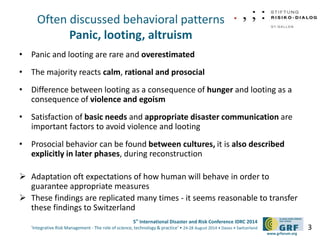
• Panic and looting are rare and overestimated 
• The majority reacts calm, rational and prosocial 
• Difference between looting as a consequence of hunger and looting as a 
consequence of violence and egoism 
• Satisfaction of basic needs and appropriate disaster communication are 
important factors to avoid violence and looting 
• Prosocial behavior can be found between cultures, it is also described 
explicitly in later phases, during reconstruction 
 Adaptation oft expectations of how human will behave in order to 
guarantee appropriate measures 
 These findings are replicated many times - it seems reasonable to transfer 
these findings to Switzerland 
3
Preconditions Action frame 
5th International Disaster and Risk Conference IDRC 2014 
‘Integrative Risk Management - The role of science, technology & practice‘ • 24-28 August 2014 • Davos • Switzerland 
www.grforum.org 
Factors on coping behavior 
Schematic overview 
4 
Measures 
• Disaster precautions 
• Disaster communication 
Target 
variable 
Appropriate 
coping behavior 
Mechanisms 
• Information processing 
• Stress resistance 
• Self-efficacy 
Variable factors 
• Risk perception 
• Trust in relevant 
institutions 
• Knowledge 
Social dispositions 
• Culture 
• Sex 
• Age/experience 
• Domicile 
• Economical resources 
• Social resources 
Event specific factors 
• Region and time 
• Manmade vs. natural
5th International Disaster and Risk Conference IDRC 2014 
‘Integrative Risk Management - The role of science, technology & practice‘ • 24-28 August 2014 • Davos • Switzerland 
www.grforum.org 
Measures 
Requirements for appropriate disaster precautions 
• Involvement of the general public 
– Increase knowledge and trust preventive 
CH: High trust in public authorities 
– Provide clear information 
– Enhancing social networks as neighborhood help 
– Informing public about possibilities of social media tools 
• Target group specific precautions 
– women, young people, persons living in urban areas, people with few 
social and economic resources show less appropriate coping 
behavior 
• Consideration of emotional aspects 
– booklets and flyers mainly contain technical information but miss 
emotional aspects, e.g. how to deal with uncertainty 
5
5th International Disaster and Risk Conference IDRC 2014 
‘Integrative Risk Management - The role of science, technology & practice‘ • 24-28 August 2014 • Davos • Switzerland 
www.grforum.org 
Measures 
Requirements for appropriate disaster 
communication (1) 
• Warnings 
– Framing, presentation and channel of information 
– Target group 
• Foster appropriate risk perception 
– Consider gap between lay persons and experts 
• Foster readiness to act 
– Convey appropriate target group specific behavior 
• Credibility of information 
– Local persons are more trusted 
– The more involvement the higher the confidence in public authorities 
– Transparency is an essential requirement 
6
5th International Disaster and Risk Conference IDRC 2014 
‘Integrative Risk Management - The role of science, technology & practice‘ • 24-28 August 2014 • Davos • Switzerland 
www.grforum.org 
Measures 
Requirements for appropriate disaster 
communication (2) 
• Consideration of media use of affected people 
– Social and cultural environment needs to be 
considered 
• Consideration of chances and risks of new media 
– Chances: independent, fast, interactive, 
satisfaction of various needs, social networks, 
possibility of feedback, etc. 
– Risks: Difficulties of verification, social fragmentation, etc. 
• Influence of emotions on perception 
– «Risk as a feeling» vs. «risk as analysis»: Risks that are transmitted 
emotionally sometime have a higher impact on risk decisions than risk 
that are transmitted rationally 
– The use of fear appeal should be checked depending on the initial 
situation 
7
5th International Disaster and Risk Conference IDRC 2014 
‘Integrative Risk Management - The role of science, technology & practice‘ • 24-28 August 2014 • Davos • Switzerland 
www.grforum.org 
Mechanisms 
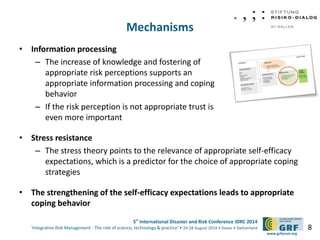
• Information processing 
– The increase of knowledge and fostering of 
appropriate risk perceptions supports an 
appropriate information processing and coping 
behavior 
– If the risk perception is not appropriate trust is 
even more important 
• Stress resistance 
– The stress theory points to the relevance of appropriate self-efficacy 
expectations, which is a predictor for the choice of appropriate coping 
strategies 
• The strengthening of the self-efficacy expectations leads to appropriate 
coping behavior 
8
5th International Disaster and Risk Conference IDRC 2014 
‘Integrative Risk Management - The role of science, technology & practice‘ • 24-28 August 2014 • Davos • Switzerland 
www.grforum.org 
Conclusion 
1. Little empirical information about human behavior in disaster 
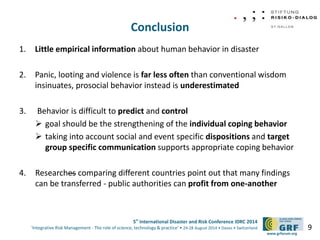
2. Panic, looting and violence is far less often than conventional wisdom 
insinuates, prosocial behavior instead is underestimated 
3. Behavior is difficult to predict and control 
 goal should be the strengthening of the individual coping behavior 
 taking into account social and event specific dispositions and target 
group specific communication supports appropriate coping behavior 
4. Researches comparing different countries point out that many findings 
can be transferred - public authorities can profit from one-another 
9
5th International Disaster and Risk Conference IDRC 2014 
‘Integrative Risk Management - The role of science, technology & practice‘ • 24-28 August 2014 • Davos • Switzerland 
www.grforum.org 
Thank you! 
Risk Dialogue Foundation 
Technoparkstrasse 2 
CH-8406 Winterthur 
Switzerland 
Tel. +41 52 551 10 04 
www.risiko-dialog.ch 
anna-lena.koeng@risiko-dialog.ch 
10
Added value for the Post 2015 Framework for 
5th International Disaster and Risk Conference IDRC 2014 
‘Integrative Risk Management - The role of science, technology & practice‘ • 24-28 August 2014 • Davos • Switzerland 
www.grforum.org 
Disaster Risk Reduction 
• How did your work support the implementation of the Hyogo Framework 
for Action: 
– Consolidation of scientific state of knowledge 
– Schematic overview of factors affecting appropriate coping behavior 
– Relevance of target group specific communication 
• From your perspective what are the main gaps, needs and further steps to 
be addressed in the Post 2015 Framework for Disaster Risk Reduction in 
– Research: Empirical data, use of social media tools, target group specific 
communication (social and cultural milieus) 
– Education & Training: Adaptation of expectations regarding panic, looting, 
violence and altruism; knowledge about when and how the public can be 
involved during disaster 
11

IDRC14_Human_behavior_in_disaster_Anna-Lena_Koeng

  • 1.
    5th International Disasterand Risk Conference IDRC 2014 ‘Integrative Risk Management - The role of science, technology & practice‘ • 24-28 August 2014 • Davos • Switzerland www.grforum.org Human Behavior in Disaster Literature Study Commissioned by the Federal Office for Civil Protection (BABS) Anna-Lena Köng, Matthias Holenstein Risk Dialogue Foundation, August 26th 2014 1
  • 2.
    5th International Disasterand Risk Conference IDRC 2014 ‘Integrative Risk Management - The role of science, technology & practice‘ • 24-28 August 2014 • Davos • Switzerland www.grforum.org Introduction Background and goals • Few empirical findings – Especially in Switzerland relative low risk perception of Swiss public due to lack of major incidents • Traditional approaches – General public as a passive element that needs to be informed and guided • New approaches – Significance of the individual coping behavior und its enhancement  Summarizing of the current state of scientific knowledge  Identification of essential factors influencing appropriate coping behavior 2
  • 3.
    5th International Disasterand Risk Conference IDRC 2014 ‘Integrative Risk Management - The role of science, technology & practice‘ • 24-28 August 2014 • Davos • Switzerland www.grforum.org Often discussed behavioral patterns Panic, looting, altruism • Panic and looting are rare and overestimated • The majority reacts calm, rational and prosocial • Difference between looting as a consequence of hunger and looting as a consequence of violence and egoism • Satisfaction of basic needs and appropriate disaster communication are important factors to avoid violence and looting • Prosocial behavior can be found between cultures, it is also described explicitly in later phases, during reconstruction  Adaptation oft expectations of how human will behave in order to guarantee appropriate measures  These findings are replicated many times - it seems reasonable to transfer these findings to Switzerland 3
  • 4.
    Preconditions Action frame 5th International Disaster and Risk Conference IDRC 2014 ‘Integrative Risk Management - The role of science, technology & practice‘ • 24-28 August 2014 • Davos • Switzerland www.grforum.org Factors on coping behavior Schematic overview 4 Measures • Disaster precautions • Disaster communication Target variable Appropriate coping behavior Mechanisms • Information processing • Stress resistance • Self-efficacy Variable factors • Risk perception • Trust in relevant institutions • Knowledge Social dispositions • Culture • Sex • Age/experience • Domicile • Economical resources • Social resources Event specific factors • Region and time • Manmade vs. natural
  • 5.
    5th International Disasterand Risk Conference IDRC 2014 ‘Integrative Risk Management - The role of science, technology & practice‘ • 24-28 August 2014 • Davos • Switzerland www.grforum.org Measures Requirements for appropriate disaster precautions • Involvement of the general public – Increase knowledge and trust preventive CH: High trust in public authorities – Provide clear information – Enhancing social networks as neighborhood help – Informing public about possibilities of social media tools • Target group specific precautions – women, young people, persons living in urban areas, people with few social and economic resources show less appropriate coping behavior • Consideration of emotional aspects – booklets and flyers mainly contain technical information but miss emotional aspects, e.g. how to deal with uncertainty 5
  • 6.
    5th International Disasterand Risk Conference IDRC 2014 ‘Integrative Risk Management - The role of science, technology & practice‘ • 24-28 August 2014 • Davos • Switzerland www.grforum.org Measures Requirements for appropriate disaster communication (1) • Warnings – Framing, presentation and channel of information – Target group • Foster appropriate risk perception – Consider gap between lay persons and experts • Foster readiness to act – Convey appropriate target group specific behavior • Credibility of information – Local persons are more trusted – The more involvement the higher the confidence in public authorities – Transparency is an essential requirement 6
  • 7.
    5th International Disasterand Risk Conference IDRC 2014 ‘Integrative Risk Management - The role of science, technology & practice‘ • 24-28 August 2014 • Davos • Switzerland www.grforum.org Measures Requirements for appropriate disaster communication (2) • Consideration of media use of affected people – Social and cultural environment needs to be considered • Consideration of chances and risks of new media – Chances: independent, fast, interactive, satisfaction of various needs, social networks, possibility of feedback, etc. – Risks: Difficulties of verification, social fragmentation, etc. • Influence of emotions on perception – «Risk as a feeling» vs. «risk as analysis»: Risks that are transmitted emotionally sometime have a higher impact on risk decisions than risk that are transmitted rationally – The use of fear appeal should be checked depending on the initial situation 7
  • 8.
    5th International Disasterand Risk Conference IDRC 2014 ‘Integrative Risk Management - The role of science, technology & practice‘ • 24-28 August 2014 • Davos • Switzerland www.grforum.org Mechanisms • Information processing – The increase of knowledge and fostering of appropriate risk perceptions supports an appropriate information processing and coping behavior – If the risk perception is not appropriate trust is even more important • Stress resistance – The stress theory points to the relevance of appropriate self-efficacy expectations, which is a predictor for the choice of appropriate coping strategies • The strengthening of the self-efficacy expectations leads to appropriate coping behavior 8
  • 9.
    5th International Disasterand Risk Conference IDRC 2014 ‘Integrative Risk Management - The role of science, technology & practice‘ • 24-28 August 2014 • Davos • Switzerland www.grforum.org Conclusion 1. Little empirical information about human behavior in disaster 2. Panic, looting and violence is far less often than conventional wisdom insinuates, prosocial behavior instead is underestimated 3. Behavior is difficult to predict and control  goal should be the strengthening of the individual coping behavior  taking into account social and event specific dispositions and target group specific communication supports appropriate coping behavior 4. Researches comparing different countries point out that many findings can be transferred - public authorities can profit from one-another 9
  • 10.
    5th International Disasterand Risk Conference IDRC 2014 ‘Integrative Risk Management - The role of science, technology & practice‘ • 24-28 August 2014 • Davos • Switzerland www.grforum.org Thank you! Risk Dialogue Foundation Technoparkstrasse 2 CH-8406 Winterthur Switzerland Tel. +41 52 551 10 04 www.risiko-dialog.ch anna-lena.koeng@risiko-dialog.ch 10
  • 11.
    Added value forthe Post 2015 Framework for 5th International Disaster and Risk Conference IDRC 2014 ‘Integrative Risk Management - The role of science, technology & practice‘ • 24-28 August 2014 • Davos • Switzerland www.grforum.org Disaster Risk Reduction • How did your work support the implementation of the Hyogo Framework for Action: – Consolidation of scientific state of knowledge – Schematic overview of factors affecting appropriate coping behavior – Relevance of target group specific communication • From your perspective what are the main gaps, needs and further steps to be addressed in the Post 2015 Framework for Disaster Risk Reduction in – Research: Empirical data, use of social media tools, target group specific communication (social and cultural milieus) – Education & Training: Adaptation of expectations regarding panic, looting, violence and altruism; knowledge about when and how the public can be involved during disaster 11

Editor's Notes

  • #4 1. by the public and decision makers 3. This implies that there are big differences between developing countries and economically strong countries What does this mean for disaster management? Firstly risk communicators and disaster experts should adapt… Secondly it’s important to note that these findings.. --
  • #5 involvement of the general public gains importance and the individual coping behavior -> factors influencing appropriate coping behavior. With disaster precautions and disaster management its possible to directly influence these variable factors and those in turn have a significant impact on coping behavior through these mechanisms.
  • #6 Change of paradigm indicates-> the involvement of the public has become much more significant. CH: Public authorities enjoy great confindence
  • #9 variable factors trust, risk perception and knowledge are codetermined by the preconditions and disaster management.