Understanding the role of human 
and non-human actants in post-disaster 
5th International Disaster and Risk Conference IDRC 2014 
‘Integrative Risk Management - The role of science, technology & practice‘ • 24-28 August 2014 • Davos • Switzerland 
www.grforum.org 
contexts 
Graham Brewer, Helen Giggins, Aoibheann McVeigh, 
Jason von Meding, Jamie Mackee and Thayaparan 
Gajendran 
Centre for Interdisciplinary Built Environment Research 
The University of Newcastle 
Australia
5th International Disaster and Risk Conference IDRC 2014 
‘Integrative Risk Management - The role of science, technology & practice‘ • 24-28 August 2014 • Davos • Switzerland 
www.grforum.org 
Actor Network Theory 
Newton did not really act alone in creating the theory of 
gravitation: he needed observational data from the 
Astronomer Royal, John Flamsteed, he needed publication 
support from the Royal Society and its members (most 
especially Edmund Halley), he needed the geometry of 
Euclid, the astronomy of Kepler, the mechanics of Galileo, 
the rooms, lab, food, etc. at Trinity College, an assistant to 
work in the lab, the mystical idea of action at a distance, 
and more, much more. The same can be said of any 
scientific or technological project. 
(Goguen, J.A. (1999), Art and the Brain. Journal of Consciousness Studies, 6(6/7), June/July.)
5th International Disaster and Risk Conference IDRC 2014 
‘Integrative Risk Management - The role of science, technology & practice‘ • 24-28 August 2014 • Davos • Switzerland 
www.grforum.org 
ANT process 
• Networks come into being through the three steps of 
Translation: 
– Problematisation: defining problem network, boundaries and actants 
(by Obligatory Passage Point who defines network membership rules) 
– Interessment: OPP seeks universal actant “buy-in” 
– Enrolment: occurs when this is achieved 
– Mobilisation: of allies in pursuit of a common cause 
• Human and non-human actants 
– Equal emphasis placed on people, things and concepts 
– Potentially of equal agency and equal importance to outcomes 
– Non-human actants can therefore posess motivations
5th International Disaster and Risk Conference IDRC 2014 
‘Integrative Risk Management - The role of science, technology & practice‘ • 24-28 August 2014 • Davos • Switzerland 
www.grforum.org 
ANT lens 
• ANT concepts adopted (but NOT process) 
• Systematic re-use of interview data 
• Eyewitness accounts and/or reflections of practitioners 
engaged in disaster recovery and resilient reconstruction 
• Deconstructed to identify 
– Full range of actants (human and nonhuman) 
– Their concerns/motivations 
• Limitations 
– Range of actants constrained by interviewee list and interviewee 
testimony 
– Development of concern/motivations constrained by original interview 
script
5th International Disaster and Risk Conference IDRC 2014 
‘Integrative Risk Management - The role of science, technology & practice‘ • 24-28 August 2014 • Davos • Switzerland 
www.grforum.org 
Contexts, themes and motivations 
• Three disaster theatres 
– Cuba 
– Haiti 
– Victoria 
• Coding 
– Open: to allow meaning (themes) to emerge from accounts 
– Axial: to allow detail about themes to emerge from data 
• Motivations (of non-human actants) 
– Design intent 
– Creation 
– Deployment
5th International Disaster and Risk Conference IDRC 2014 
‘Integrative Risk Management - The role of science, technology & practice‘ • 24-28 August 2014 • Davos • Switzerland 
www.grforum.org 
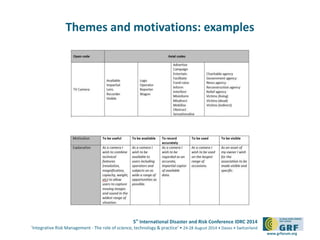
Themes and motivations: examples
5th International Disaster and Risk Conference IDRC 2014 
‘Integrative Risk Management - The role of science, technology & practice‘ • 24-28 August 2014 • Davos • Switzerland 
www.grforum.org 
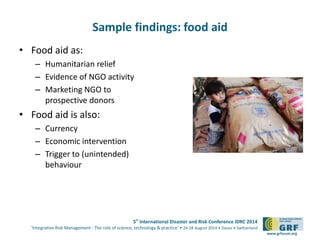
Sample findings: food aid 
• Food aid as: 
– Humanitarian relief 
– Evidence of NGO activity 
– Marketing NGO to 
prospective donors 
• Food aid is also: 
– Currency 
– Economic intervention 
– Trigger to (unintended) 
behaviour
Sample findings: coherent & integrated policy 
5th International Disaster and Risk Conference IDRC 2014 
‘Integrative Risk Management - The role of science, technology & practice‘ • 24-28 August 2014 • Davos • Switzerland 
www.grforum.org 
Haiti 
• Haiti characterised by a lack of 
government regulation and 
control, unregulated urban and 
rural development. 
• Economic policies driven by need 
to create export revenues: cash 
crops predominated. 
• Land clearance led to 
deforestation: increased 
vulnerabilities to landslides and a 
general loss of the topsoil. 
• Also resulted in a lack of timber 
for construction, increasing local 
reliance upon concrete as the 
predominant building material. 
Cuba 
• Whole-of-community engagement with 
disaster preparedness initiatives. 
• Mutual responsibility amongst the 
population for health and safety 
outcomes.. 
• Long-term planning and resourcing of 
disaster refuges and health facilities. 
• Constant communication between 
disaster actors and the general 
population. 
• Reduction of social inequalities to 
mitigate post-disaster vulnerabilities 
and accentuate resilience outcomes 
• Development of innovative building 
materials, techniques, and training.
5th International Disaster and Risk Conference IDRC 2014 
‘Integrative Risk Management - The role of science, technology & practice‘ • 24-28 August 2014 • Davos • Switzerland 
www.grforum.org 
Sample findings: TV cameras 
Benefits 
• Alerts 
• Informs 
• Mobilises 
Drawbacks 
• Triggers uncharacteristic 
behaviour 
• Fosters ill-informed, fringe 
commentary 
• Encourages ill-conceived 
promises 
• Intrudes/breaches privacy
5th International Disaster and Risk Conference IDRC 2014 
‘Integrative Risk Management - The role of science, technology & practice‘ • 24-28 August 2014 • Davos • Switzerland 
www.grforum.org 
Conclusions 
• Benefits 
– Facilitates rich description of complex situations 
– Freedom to include seemingly unrelated actants into descriptions 
– Enables freer consideration of the non-human influence 
– Potential to reveal new insights 
– Holism at its best 
• Cautions 
– Is it science? 
– Is it replicable? 
– Is it enough to reliably inform the DRR CCA agenda?
Added value for the Post 2015 Framework for 
5th International Disaster and Risk Conference IDRC 2014 
‘Integrative Risk Management - The role of science, technology & practice‘ • 24-28 August 2014 • Davos • Switzerland 
www.grforum.org 
Disaster Risk Reduction 
• How did this research support the implementation of the 
Hyogo Framework for Action? 
– ……it didn’t, but…. 
• The Post 2015 Framework for Disaster Risk Reduction is 
intended to address gaps, needs and further steps in relation 
to 
– Informed policy development 
– Where outcomes more closely match intent 
• Careful deployment by researchers of ANT has the capacity to 
sensitise policymakers and practitioners to the consequences 
of their actions, leading to 
– Better policy 
– Better deployment 
– Resilient outcomes!

IDRC14-ppp-GB ANT presentation

  • 1.
    Understanding the roleof human and non-human actants in post-disaster 5th International Disaster and Risk Conference IDRC 2014 ‘Integrative Risk Management - The role of science, technology & practice‘ • 24-28 August 2014 • Davos • Switzerland www.grforum.org contexts Graham Brewer, Helen Giggins, Aoibheann McVeigh, Jason von Meding, Jamie Mackee and Thayaparan Gajendran Centre for Interdisciplinary Built Environment Research The University of Newcastle Australia
  • 2.
    5th International Disasterand Risk Conference IDRC 2014 ‘Integrative Risk Management - The role of science, technology & practice‘ • 24-28 August 2014 • Davos • Switzerland www.grforum.org Actor Network Theory Newton did not really act alone in creating the theory of gravitation: he needed observational data from the Astronomer Royal, John Flamsteed, he needed publication support from the Royal Society and its members (most especially Edmund Halley), he needed the geometry of Euclid, the astronomy of Kepler, the mechanics of Galileo, the rooms, lab, food, etc. at Trinity College, an assistant to work in the lab, the mystical idea of action at a distance, and more, much more. The same can be said of any scientific or technological project. (Goguen, J.A. (1999), Art and the Brain. Journal of Consciousness Studies, 6(6/7), June/July.)
  • 3.
    5th International Disasterand Risk Conference IDRC 2014 ‘Integrative Risk Management - The role of science, technology & practice‘ • 24-28 August 2014 • Davos • Switzerland www.grforum.org ANT process • Networks come into being through the three steps of Translation: – Problematisation: defining problem network, boundaries and actants (by Obligatory Passage Point who defines network membership rules) – Interessment: OPP seeks universal actant “buy-in” – Enrolment: occurs when this is achieved – Mobilisation: of allies in pursuit of a common cause • Human and non-human actants – Equal emphasis placed on people, things and concepts – Potentially of equal agency and equal importance to outcomes – Non-human actants can therefore posess motivations
  • 4.
    5th International Disasterand Risk Conference IDRC 2014 ‘Integrative Risk Management - The role of science, technology & practice‘ • 24-28 August 2014 • Davos • Switzerland www.grforum.org ANT lens • ANT concepts adopted (but NOT process) • Systematic re-use of interview data • Eyewitness accounts and/or reflections of practitioners engaged in disaster recovery and resilient reconstruction • Deconstructed to identify – Full range of actants (human and nonhuman) – Their concerns/motivations • Limitations – Range of actants constrained by interviewee list and interviewee testimony – Development of concern/motivations constrained by original interview script
  • 5.
    5th International Disasterand Risk Conference IDRC 2014 ‘Integrative Risk Management - The role of science, technology & practice‘ • 24-28 August 2014 • Davos • Switzerland www.grforum.org Contexts, themes and motivations • Three disaster theatres – Cuba – Haiti – Victoria • Coding – Open: to allow meaning (themes) to emerge from accounts – Axial: to allow detail about themes to emerge from data • Motivations (of non-human actants) – Design intent – Creation – Deployment
  • 6.
    5th International Disasterand Risk Conference IDRC 2014 ‘Integrative Risk Management - The role of science, technology & practice‘ • 24-28 August 2014 • Davos • Switzerland www.grforum.org Themes and motivations: examples
  • 7.
    5th International Disasterand Risk Conference IDRC 2014 ‘Integrative Risk Management - The role of science, technology & practice‘ • 24-28 August 2014 • Davos • Switzerland www.grforum.org Sample findings: food aid • Food aid as: – Humanitarian relief – Evidence of NGO activity – Marketing NGO to prospective donors • Food aid is also: – Currency – Economic intervention – Trigger to (unintended) behaviour
  • 8.
    Sample findings: coherent& integrated policy 5th International Disaster and Risk Conference IDRC 2014 ‘Integrative Risk Management - The role of science, technology & practice‘ • 24-28 August 2014 • Davos • Switzerland www.grforum.org Haiti • Haiti characterised by a lack of government regulation and control, unregulated urban and rural development. • Economic policies driven by need to create export revenues: cash crops predominated. • Land clearance led to deforestation: increased vulnerabilities to landslides and a general loss of the topsoil. • Also resulted in a lack of timber for construction, increasing local reliance upon concrete as the predominant building material. Cuba • Whole-of-community engagement with disaster preparedness initiatives. • Mutual responsibility amongst the population for health and safety outcomes.. • Long-term planning and resourcing of disaster refuges and health facilities. • Constant communication between disaster actors and the general population. • Reduction of social inequalities to mitigate post-disaster vulnerabilities and accentuate resilience outcomes • Development of innovative building materials, techniques, and training.
  • 9.
    5th International Disasterand Risk Conference IDRC 2014 ‘Integrative Risk Management - The role of science, technology & practice‘ • 24-28 August 2014 • Davos • Switzerland www.grforum.org Sample findings: TV cameras Benefits • Alerts • Informs • Mobilises Drawbacks • Triggers uncharacteristic behaviour • Fosters ill-informed, fringe commentary • Encourages ill-conceived promises • Intrudes/breaches privacy
  • 10.
    5th International Disasterand Risk Conference IDRC 2014 ‘Integrative Risk Management - The role of science, technology & practice‘ • 24-28 August 2014 • Davos • Switzerland www.grforum.org Conclusions • Benefits – Facilitates rich description of complex situations – Freedom to include seemingly unrelated actants into descriptions – Enables freer consideration of the non-human influence – Potential to reveal new insights – Holism at its best • Cautions – Is it science? – Is it replicable? – Is it enough to reliably inform the DRR CCA agenda?
  • 11.
    Added value forthe Post 2015 Framework for 5th International Disaster and Risk Conference IDRC 2014 ‘Integrative Risk Management - The role of science, technology & practice‘ • 24-28 August 2014 • Davos • Switzerland www.grforum.org Disaster Risk Reduction • How did this research support the implementation of the Hyogo Framework for Action? – ……it didn’t, but…. • The Post 2015 Framework for Disaster Risk Reduction is intended to address gaps, needs and further steps in relation to – Informed policy development – Where outcomes more closely match intent • Careful deployment by researchers of ANT has the capacity to sensitise policymakers and practitioners to the consequences of their actions, leading to – Better policy – Better deployment – Resilient outcomes!