5th
International Disaster and Risk Conference IDRC 2014
‘Integrative Risk Management - The role of science, technology & practice‘ • 24-28 August 2014 • Davos • Switzerland
www.grforum.org
Building disaster-resilient communities
The Global Resilience Project of the
UNEP FI Principles for Sustainable Insurance Initiative
Butch Bacani
Programme Leader
UNEP FI Principles for Sustainable Insurance Initiative
PSI
Principles
for Sustainable
Insurance
5th
International Disaster and Risk Conference IDRC 2014
‘Integrative Risk Management - The role of science, technology & practice‘ • 24-28 August 2014 • Davos • Switzerland
www.grforum.org
The case for action: A skewed funding focus
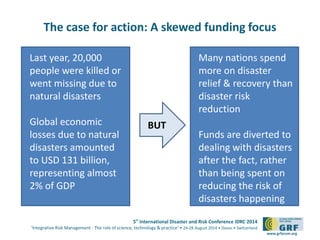
Last year, 20,000
people were killed or
went missing due to
natural disasters
Global economic
losses due to natural
disasters amounted
to USD 131 billion,
representing almost
2% of GDP
Many nations spend
more on disaster
relief & recovery than
disaster risk
reduction
Funds are diverted to
dealing with disasters
after the fact, rather
than being spent on
reducing the risk of
disasters happening
BUT
5th
International Disaster and Risk Conference IDRC 2014
‘Integrative Risk Management - The role of science, technology & practice‘ • 24-28 August 2014 • Davos • Switzerland
www.grforum.org
An example: The Australian experience
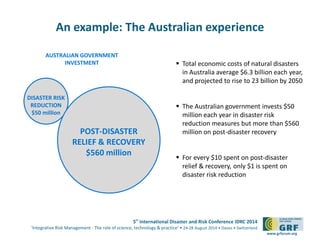
 Total economic costs of natural disasters
in Australia average $6.3 billion each year,
and projected to rise to 23 billion by 2050
 The Australian government invests $50
million each year in disaster risk
reduction measures but more than $560
million on post-disaster recovery
 For every $10 spent on post-disaster
relief & recovery, only $1 is spent on
disaster risk reduction
AUSTRALIAN GOVERNMENT
INVESTMENT
DISASTER RISK
REDUCTION
$50 million
POST-DISASTER
RELIEF & RECOVERY
$560 million
5th
International Disaster and Risk Conference IDRC 2014
‘Integrative Risk Management - The role of science, technology & practice‘ • 24-28 August 2014 • Davos • Switzerland
www.grforum.org
Risk reduction investment: The benefits
More investment in disaster risk reduction will lead to:
 Less economic, social and environmental losses
 Safer and more disaster-resilient communities and economies
 Less public and private funds spent on disaster relief and
recovery, enabling better investment
 More access to affordable insurance to help communities
manage the uncertainty of adversity and the financial
hardship associated with unexpected losses
5th
International Disaster and Risk Conference IDRC 2014
‘Integrative Risk Management - The role of science, technology & practice‘ • 24-28 August 2014 • Davos • Switzerland
www.grforum.org
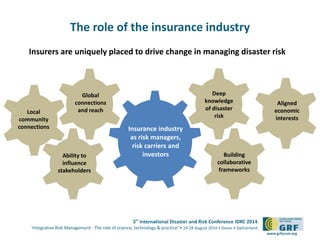
The role of the insurance industry
Insurers are uniquely placed to drive change in managing disaster risk
Global
connections
and reachLocal
community
connections
Ability to
influence
stakeholders
Deep
knowledge
of disaster
risk
Building
collaborative
frameworks
Aligned
economic
interests
Insurance industry
as risk managers,
risk carriers and
investors
5th
International Disaster and Risk Conference IDRC 2014
‘Integrative Risk Management - The role of science, technology & practice‘ • 24-28 August 2014 • Davos • Switzerland
www.grforum.org
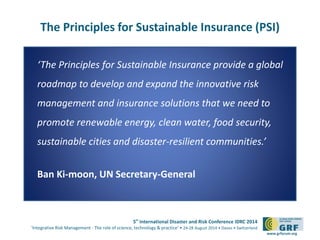
The Principles for Sustainable Insurance (PSI)
‘The Principles for Sustainable Insurance provide a global
roadmap to develop and expand the innovative risk
management and insurance solutions that we need to
promote renewable energy, clean water, food security,
sustainable cities and disaster-resilient communities.’
Ban Ki-moon, UN Secretary-General
5th
International Disaster and Risk Conference IDRC 2014
‘Integrative Risk Management - The role of science, technology & practice‘ • 24-28 August 2014 • Davos • Switzerland
www.grforum.org
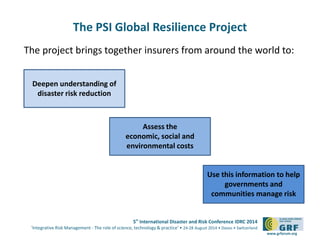
The PSI Global Resilience Project
The project brings together insurers from around the world to:
Deepen understanding of
disaster risk reduction
Assess the
economic, social and
environmental costs
Use this information to help
governments and
communities manage risk
5th
International Disaster and Risk Conference IDRC 2014
‘Integrative Risk Management - The role of science, technology & practice‘ • 24-28 August 2014 • Davos • Switzerland
www.grforum.org
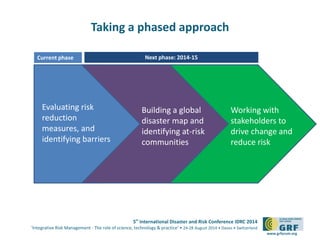
Taking a phased approach
Evaluating risk
reduction
measures, and
identifying barriers
Building a global
disaster map and
identifying at-risk
communities
Working with
stakeholders to
drive change and
reduce risk
Current phase Next phase: 2014-15
5th
International Disaster and Risk Conference IDRC 2014
‘Integrative Risk Management - The role of science, technology & practice‘ • 24-28 August 2014 • Davos • Switzerland
www.grforum.org
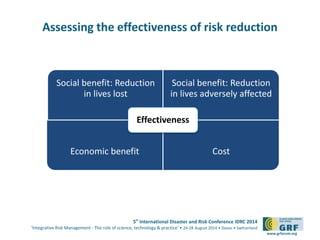
Assessing the effectiveness of risk reduction
Social benefit: Reduction
in lives lost
Social benefit: Reduction
in lives adversely affected
Economic benefit Cost
Effectiveness
5th
International Disaster and Risk Conference IDRC 2014
‘Integrative Risk Management - The role of science, technology & practice‘ • 24-28 August 2014 • Davos • Switzerland
www.grforum.org
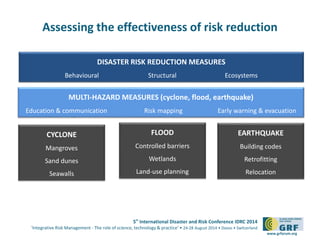
Assessing the effectiveness of risk reduction
DISASTER RISK REDUCTION MEASURES
Behavioural Structural Ecosystems
CYCLONE
Mangroves
Sand dunes
Seawalls
FLOOD
Controlled barriers
Wetlands
Land-use planning
EARTHQUAKE
Building codes
Retrofitting
Relocation
MULTI-HAZARD MEASURES (cyclone, flood, earthquake)
Education & communication Risk mapping Early warning & evacuation
5th
International Disaster and Risk Conference IDRC 2014
‘Integrative Risk Management - The role of science, technology & practice‘ • 24-28 August 2014 • Davos • Switzerland
www.grforum.org
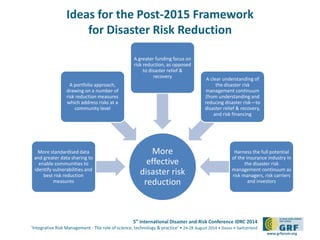
Ideas for the Post-2015 Framework
for Disaster Risk Reduction
More
effective
disaster risk
reduction
More standardised data
and greater data sharing to
enable communities to
identify vulnerabilities and
best risk reduction
measures
A portfolio approach,
drawing on a number of
risk reduction measures
which address risks at a
community level
A greater funding focus on
risk reduction, as opposed
to disaster relief &
recovery A clear understanding of
the disaster risk
management continuum
(from understanding and
reducing disaster risk—to
disaster relief & recovery,
and risk financing
Harness the full potential
of the insurance industry in
the disaster risk
management continuum as
risk managers, risk carriers
and investors
5th
International Disaster and Risk Conference IDRC 2014
‘Integrative Risk Management - The role of science, technology & practice‘ • 24-28 August 2014 • Davos • Switzerland
www.grforum.org
The Principles for Sustainable Insurance
A global sustainability framework and initiative of the
United Nations Environment Programme Finance Initiative
Learn more at www.unepfi.org/psi
12

IDRC 2014 - Presentation by Butch Bacani (final)

  • 1.
    5th International Disaster andRisk Conference IDRC 2014 ‘Integrative Risk Management - The role of science, technology & practice‘ • 24-28 August 2014 • Davos • Switzerland www.grforum.org Building disaster-resilient communities The Global Resilience Project of the UNEP FI Principles for Sustainable Insurance Initiative Butch Bacani Programme Leader UNEP FI Principles for Sustainable Insurance Initiative PSI Principles for Sustainable Insurance
  • 2.
    5th International Disaster andRisk Conference IDRC 2014 ‘Integrative Risk Management - The role of science, technology & practice‘ • 24-28 August 2014 • Davos • Switzerland www.grforum.org The case for action: A skewed funding focus Last year, 20,000 people were killed or went missing due to natural disasters Global economic losses due to natural disasters amounted to USD 131 billion, representing almost 2% of GDP Many nations spend more on disaster relief & recovery than disaster risk reduction Funds are diverted to dealing with disasters after the fact, rather than being spent on reducing the risk of disasters happening BUT
  • 3.
    5th International Disaster andRisk Conference IDRC 2014 ‘Integrative Risk Management - The role of science, technology & practice‘ • 24-28 August 2014 • Davos • Switzerland www.grforum.org An example: The Australian experience  Total economic costs of natural disasters in Australia average $6.3 billion each year, and projected to rise to 23 billion by 2050  The Australian government invests $50 million each year in disaster risk reduction measures but more than $560 million on post-disaster recovery  For every $10 spent on post-disaster relief & recovery, only $1 is spent on disaster risk reduction AUSTRALIAN GOVERNMENT INVESTMENT DISASTER RISK REDUCTION $50 million POST-DISASTER RELIEF & RECOVERY $560 million
  • 4.
    5th International Disaster andRisk Conference IDRC 2014 ‘Integrative Risk Management - The role of science, technology & practice‘ • 24-28 August 2014 • Davos • Switzerland www.grforum.org Risk reduction investment: The benefits More investment in disaster risk reduction will lead to:  Less economic, social and environmental losses  Safer and more disaster-resilient communities and economies  Less public and private funds spent on disaster relief and recovery, enabling better investment  More access to affordable insurance to help communities manage the uncertainty of adversity and the financial hardship associated with unexpected losses
  • 5.
    5th International Disaster andRisk Conference IDRC 2014 ‘Integrative Risk Management - The role of science, technology & practice‘ • 24-28 August 2014 • Davos • Switzerland www.grforum.org The role of the insurance industry Insurers are uniquely placed to drive change in managing disaster risk Global connections and reachLocal community connections Ability to influence stakeholders Deep knowledge of disaster risk Building collaborative frameworks Aligned economic interests Insurance industry as risk managers, risk carriers and investors
  • 6.
    5th International Disaster andRisk Conference IDRC 2014 ‘Integrative Risk Management - The role of science, technology & practice‘ • 24-28 August 2014 • Davos • Switzerland www.grforum.org The Principles for Sustainable Insurance (PSI) ‘The Principles for Sustainable Insurance provide a global roadmap to develop and expand the innovative risk management and insurance solutions that we need to promote renewable energy, clean water, food security, sustainable cities and disaster-resilient communities.’ Ban Ki-moon, UN Secretary-General
  • 7.
    5th International Disaster andRisk Conference IDRC 2014 ‘Integrative Risk Management - The role of science, technology & practice‘ • 24-28 August 2014 • Davos • Switzerland www.grforum.org The PSI Global Resilience Project The project brings together insurers from around the world to: Deepen understanding of disaster risk reduction Assess the economic, social and environmental costs Use this information to help governments and communities manage risk
  • 8.
    5th International Disaster andRisk Conference IDRC 2014 ‘Integrative Risk Management - The role of science, technology & practice‘ • 24-28 August 2014 • Davos • Switzerland www.grforum.org Taking a phased approach Evaluating risk reduction measures, and identifying barriers Building a global disaster map and identifying at-risk communities Working with stakeholders to drive change and reduce risk Current phase Next phase: 2014-15
  • 9.
    5th International Disaster andRisk Conference IDRC 2014 ‘Integrative Risk Management - The role of science, technology & practice‘ • 24-28 August 2014 • Davos • Switzerland www.grforum.org Assessing the effectiveness of risk reduction Social benefit: Reduction in lives lost Social benefit: Reduction in lives adversely affected Economic benefit Cost Effectiveness
  • 10.
    5th International Disaster andRisk Conference IDRC 2014 ‘Integrative Risk Management - The role of science, technology & practice‘ • 24-28 August 2014 • Davos • Switzerland www.grforum.org Assessing the effectiveness of risk reduction DISASTER RISK REDUCTION MEASURES Behavioural Structural Ecosystems CYCLONE Mangroves Sand dunes Seawalls FLOOD Controlled barriers Wetlands Land-use planning EARTHQUAKE Building codes Retrofitting Relocation MULTI-HAZARD MEASURES (cyclone, flood, earthquake) Education & communication Risk mapping Early warning & evacuation
  • 11.
    5th International Disaster andRisk Conference IDRC 2014 ‘Integrative Risk Management - The role of science, technology & practice‘ • 24-28 August 2014 • Davos • Switzerland www.grforum.org Ideas for the Post-2015 Framework for Disaster Risk Reduction More effective disaster risk reduction More standardised data and greater data sharing to enable communities to identify vulnerabilities and best risk reduction measures A portfolio approach, drawing on a number of risk reduction measures which address risks at a community level A greater funding focus on risk reduction, as opposed to disaster relief & recovery A clear understanding of the disaster risk management continuum (from understanding and reducing disaster risk—to disaster relief & recovery, and risk financing Harness the full potential of the insurance industry in the disaster risk management continuum as risk managers, risk carriers and investors
  • 12.
    5th International Disaster andRisk Conference IDRC 2014 ‘Integrative Risk Management - The role of science, technology & practice‘ • 24-28 August 2014 • Davos • Switzerland www.grforum.org The Principles for Sustainable Insurance A global sustainability framework and initiative of the United Nations Environment Programme Finance Initiative Learn more at www.unepfi.org/psi 12