5th
International Disaster and Risk Conference IDRC 2014
‘Integrative Risk Management - The role of science, technology & practice‘ • 24-28 August 2014 • Davos • Switzerland
www.grforum.org
A vulnerability model for the
impact of multiple hazards on
critical infrastructures
Carmelo DI MAURO 1, Paolo FRATTINI2, Sara BOUCHON1 , Serena LARI2
1 RGS Srl – Risk Governance Solutions, Italy
2 Dept. Earth and Environmental Sciences, University of Milano Bicocca, Italy
5th
International Disaster and Risk Conference IDRC 2014
‘Integrative Risk Management - The role of science, technology & practice‘ • 24-28 August 2014 • Davos • Switzerland
www.grforum.org
Problem Setting
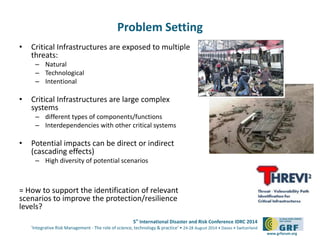
• Critical Infrastructures are exposed to multiple
threats:
– Natural
– Technological
– Intentional
• Critical Infrastructures are large complex
systems
– different types of components/functions
– Interdependencies with other critical systems
• Potential impacts can be direct or indirect
(cascading effects)
– High diversity of potential scenarios
= How to support the identification of relevant
scenarios to improve the protection/resilience
levels?
5th
International Disaster and Risk Conference IDRC 2014
‘Integrative Risk Management - The role of science, technology & practice‘ • 24-28 August 2014 • Davos • Switzerland
www.grforum.org
Research objectives
• THREVI2 EU-CIPS Project funded by EU DG HOME
( Threat-Vulnerability Path Identification For Critical
Infrastructures)
• Objective:
“To create a Database (DB) linking the relationships
between all the hazards threatening CIs and the
vulnerability of the CIs’ systems or components; the
query of the DB will allow the end-users (CIP
Authorities and operators) to identify relevant
scenarios, according to their own priorities and
criteria”
Co-financed by the European Union under the
CIPS/ISEC Programmes (HOME/2011/CIPS/AG)
5th
International Disaster and Risk Conference IDRC 2014
‘Integrative Risk Management - The role of science, technology & practice‘ • 24-28 August 2014 • Davos • Switzerland
www.grforum.org
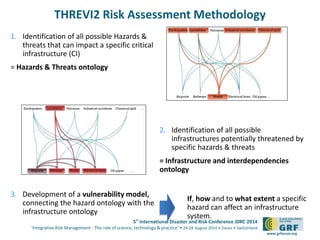
THREVI2 Risk Assessment Methodology
If, how and to what extent a specific
hazard can affect an infrastructure
system.
1. Identification of all possible Hazards &
threats that can impact a specific critical
infrastructure (CI)
= Hazards & Threats ontology
3. Development of a vulnerability model,
connecting the hazard ontology with the
infrastructure ontology
2. Identification of all possible
infrastructures potentially threatened by
specific hazards & threats
= Infrastructure and interdependencies
ontology
5th
International Disaster and Risk Conference IDRC 2014
‘Integrative Risk Management - The role of science, technology & practice‘ • 24-28 August 2014 • Davos • Switzerland
www.grforum.org
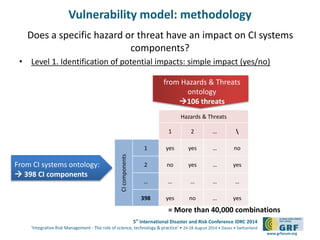
Vulnerability model: methodology
Does a specific hazard or threat have an impact on CI systems
components?
• Level 1. Identification of potential impacts: simple impact (yes/no)
Hazards & Threats
1 2 … 
CIcomponents
1 yes yes … no
2 no yes … yes
… … … … …
398 yes no … yes
From CI systems ontology:
 398 CI components
from Hazards & Threats
ontology
106 threats
= More than 40,000 combinations
5th
International Disaster and Risk Conference IDRC 2014
‘Integrative Risk Management - The role of science, technology & practice‘ • 24-28 August 2014 • Davos • Switzerland
www.grforum.org
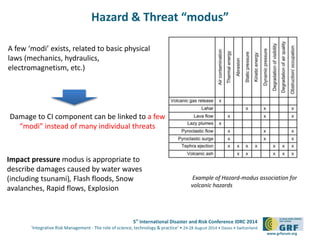
Damage to CI component can be linked to a few
“modi” instead of many individual threats
A few ‘modi’ exists, related to basic physical
laws (mechanics, hydraulics,
electromagnetism, etc.)
Impact pressure modus is appropriate to
describe damages caused by water waves
(including tsunami), Flash floods, Snow
avalanches, Rapid flows, Explosion
Hazard & Threat “modus”
Example of Hazard-modus association for
volcanic hazards
5th
International Disaster and Risk Conference IDRC 2014
‘Integrative Risk Management - The role of science, technology & practice‘ • 24-28 August 2014 • Davos • Switzerland
www.grforum.org
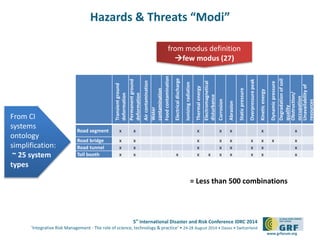
Hazards & Threats “Modi”
From CI
systems
ontology
simplification:
~ 25 system
types
from modus definition
few modus (27)
= Less than 500 combinations
Transientground
deformation
Permanentground
deformation
Aircontamination
Water
contamination
Foodcontamination
Electricaldischarge
Ionizingradiation
Thermalenergy
Electromagnetical
disturbance
Corrosion
Abrasion
Staticpressure
Overpressurepeak
Kineticenergy
Dynamicpressure
Degradationofsoil
quality
Obstruction/
occupation
Unavailabilityof
resources
Road segment x x x x x x x
Road bridge x x x x x x x x x
Road tunnel x x x x x x x x
Toll booth x x x x x x x x x x
5th
International Disaster and Risk Conference IDRC 2014
‘Integrative Risk Management - The role of science, technology & practice‘ • 24-28 August 2014 • Davos • Switzerland
www.grforum.org
Vulnerability model: methodology
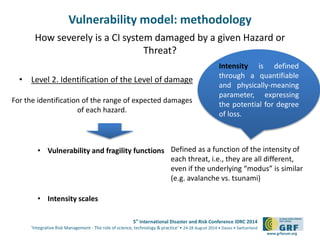
How severely is a CI system damaged by a given Hazard or
Threat?
• Level 2. Identification of the Level of damage
• Vulnerability and fragility functions
• Intensity scales
For the identification of the range of expected damages
of each hazard.
Defined as a function of the intensity of
each threat, i.e., they are all different,
even if the underlying “modus” is similar
(e.g. avalanche vs. tsunami)
Intensity is defined
through a quantifiable
and physically-meaning
parameter, expressing
the potential for degree
of loss.
5th
International Disaster and Risk Conference IDRC 2014
‘Integrative Risk Management - The role of science, technology & practice‘ • 24-28 August 2014 • Davos • Switzerland
www.grforum.org
from modus definition
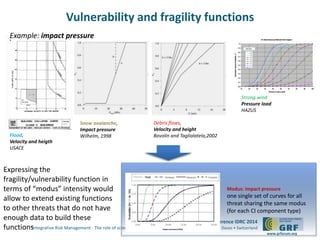
few modus (~15)
Snow avalanche,
Impact pressure
Wilhelm, 1998Flood,
Velocity and heigth
USACE
Example: impact pressure
Debris flows,
Velocity and height
Bovolin and Taglialatela,2002
Strong wind
Pressure load
HAZUS
Modus: impact pressure
one single set of curves for all
threat sharing the same modus
(for each CI component type)
Impact pressure(kPa)
.
Expressing the
fragility/vulnerability function in
terms of “modus” intensity would
allow to extend existing functions
to other threats that do not have
enough data to build these
functions
Vulnerability and fragility functions
5th
International Disaster and Risk Conference IDRC 2014
‘Integrative Risk Management - The role of science, technology & practice‘ • 24-28 August 2014 • Davos • Switzerland
www.grforum.org
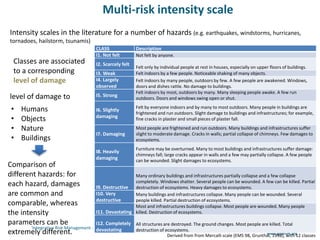
CLASS Description
I1. Not felt Not felt by anyone.
I2. Scarcely felt
Felt only by individual people at rest in houses, especially on upper floors of buildings.
I3. Weak Felt indoors by a few people. Noticeable shaking of many objects.
I4. Largely
observed
Felt indoors by many people, outdoors by few. A few people are awakened. Windows,
doors and dishes rattle. No damage to buildings.
I5. Strong
Felt indoors by most, outdoors by many. Many sleeping people awake. A few run
outdoors. Doors and windows swing open or shut.
I6. Slightly
damaging
Felt by everyone indoors and by many to most outdoors. Many people in buildings are
frightened and run outdoors. Slight damage to buildings and infrastructures; for example,
fine cracks in plaster and small pieces of plaster fall.
I7. Damaging
Most people are frightened and run outdoors. Many buildings and infrastructures suffer
slight to moderate damage. Cracks in walls; partial collapse of chimneys. Few damages to
ecosystems.
I8. Heavily
damaging
Furniture may be overturned. Many to most buildings and infrastructures suffer damage:
chimneys fall; large cracks appear in walls and a few may partially collapse. A few people
can be wounded. Slight damages to ecosystems.
I9. Destructive
Many ordinary buildings and infrastructures partially collapse and a few collapse
completely. Windows shatter. Several people can be wounded. A few can be killed. Partial
destruction of ecosystems. Heavy damages to ecosystems.
I10. Very
destructive
Many buildings and infrastructures collapse. Many people can be wounded. Several
people killed. Partial destruction of ecosystems.
I11. Devastating
Most and infrastructures buildings collapse. Most people are wounded. Many people
killed. Destruction of ecosystems.
I12. Completely
devastating
All structures are destroyed. The ground changes. Most people are killed. Total
destruction of ecosystems.
level of damage to
Comparison of
different hazards: for
each hazard, damages
are common and
comparable, whereas
the intensity
parameters can be
extremely different. Derived from from Mercalli scale (EMS 98, Grunthal, 1998), with 12 classes
• Humans
• Objects
• Nature
• Buildings
Intensity scales in the literature for a number of hazards (e.g. earthquakes, windstorms, hurricanes,
tornadoes, hailstorm, tsunamis)
Classes are associated
to a corresponding
level of damage
Multi-risk intensity scale
5th
International Disaster and Risk Conference IDRC 2014
‘Integrative Risk Management - The role of science, technology & practice‘ • 24-28 August 2014 • Davos • Switzerland
www.grforum.org
11
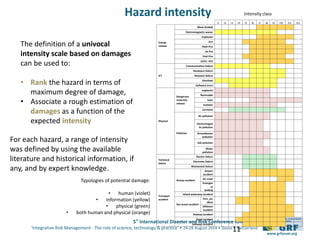
For each hazard, a range of intensity
was defined by using the available
literature and historical information, if
any, and by expert knowledge.
I1 I2 I3 I4 I5 I6 I7 I8 I9 I10 I11 I12
Energy
release
Bleve-fireball
Electromagnetic-waves
Explosion
Fire
Flash Fire
Jet fire
Pool Fire
UVCE- VCE
ICT
Communication failure
Hardware failure
Network failure
Overload
Software error
Physical
Dangerous
materials
release
explosive
flammable
toxic
ecotoxic
corrosive
Pollution
Air pollution
Electromagne
tic pollution
Groundwater
pollution
Soil pollution
Water
pollution
Technical
failure
Electric failure
Electronic failure
Mechanical failure
Transport
accident
Airway accident
Airport
accident
Air crash
Emergen
cy
landing
Inland waterway accident
Sea ocean accident
Port_acc
ident
Offshore
accident
Railway accident
Road accident
Subways accident
Typologies of potential damage:
• human (violet)
• information (yellow)
• physical (green)
• both human and physical (orange)
Intensity class
The definition of a univocal
intensity scale based on damages
can be used to:
• Rank the hazard in terms of
maximum degree of damage,
• Associate a rough estimation of
damages as a function of the
expected intensity
Hazard intensity
5th
International Disaster and Risk Conference IDRC 2014
‘Integrative Risk Management - The role of science, technology & practice‘ • 24-28 August 2014 • Davos • Switzerland
www.grforum.org
12
The presented vulnerability model links the ontology of hazards and
infrastructures.
The ontology will be used to develop a simple support tool, the Pathfinder Tool,
that can be used by hazard expert, infrastructure operators and public
administrators to:
• Identify the infrastructure components potentially affected by a certain set of
hazards, and trace the ability to provide the service. Providing an expected
level of intensity, the pathfinder will recognize the associated degree of
damage to the components
• Identify the hazards that can potentially affect an infrastructure defined by
the user
• Rank the hazards potentially affecting the infrastructure in terms of maximum
potential intensity.
Conclusions

IDRC14-Bouchon-Threvi2

  • 1.
    5th International Disaster andRisk Conference IDRC 2014 ‘Integrative Risk Management - The role of science, technology & practice‘ • 24-28 August 2014 • Davos • Switzerland www.grforum.org A vulnerability model for the impact of multiple hazards on critical infrastructures Carmelo DI MAURO 1, Paolo FRATTINI2, Sara BOUCHON1 , Serena LARI2 1 RGS Srl – Risk Governance Solutions, Italy 2 Dept. Earth and Environmental Sciences, University of Milano Bicocca, Italy
  • 2.
    5th International Disaster andRisk Conference IDRC 2014 ‘Integrative Risk Management - The role of science, technology & practice‘ • 24-28 August 2014 • Davos • Switzerland www.grforum.org Problem Setting • Critical Infrastructures are exposed to multiple threats: – Natural – Technological – Intentional • Critical Infrastructures are large complex systems – different types of components/functions – Interdependencies with other critical systems • Potential impacts can be direct or indirect (cascading effects) – High diversity of potential scenarios = How to support the identification of relevant scenarios to improve the protection/resilience levels?
  • 3.
    5th International Disaster andRisk Conference IDRC 2014 ‘Integrative Risk Management - The role of science, technology & practice‘ • 24-28 August 2014 • Davos • Switzerland www.grforum.org Research objectives • THREVI2 EU-CIPS Project funded by EU DG HOME ( Threat-Vulnerability Path Identification For Critical Infrastructures) • Objective: “To create a Database (DB) linking the relationships between all the hazards threatening CIs and the vulnerability of the CIs’ systems or components; the query of the DB will allow the end-users (CIP Authorities and operators) to identify relevant scenarios, according to their own priorities and criteria” Co-financed by the European Union under the CIPS/ISEC Programmes (HOME/2011/CIPS/AG)
  • 4.
    5th International Disaster andRisk Conference IDRC 2014 ‘Integrative Risk Management - The role of science, technology & practice‘ • 24-28 August 2014 • Davos • Switzerland www.grforum.org THREVI2 Risk Assessment Methodology If, how and to what extent a specific hazard can affect an infrastructure system. 1. Identification of all possible Hazards & threats that can impact a specific critical infrastructure (CI) = Hazards & Threats ontology 3. Development of a vulnerability model, connecting the hazard ontology with the infrastructure ontology 2. Identification of all possible infrastructures potentially threatened by specific hazards & threats = Infrastructure and interdependencies ontology
  • 5.
    5th International Disaster andRisk Conference IDRC 2014 ‘Integrative Risk Management - The role of science, technology & practice‘ • 24-28 August 2014 • Davos • Switzerland www.grforum.org Vulnerability model: methodology Does a specific hazard or threat have an impact on CI systems components? • Level 1. Identification of potential impacts: simple impact (yes/no) Hazards & Threats 1 2 … CIcomponents 1 yes yes … no 2 no yes … yes … … … … … 398 yes no … yes From CI systems ontology:  398 CI components from Hazards & Threats ontology 106 threats = More than 40,000 combinations
  • 6.
    5th International Disaster andRisk Conference IDRC 2014 ‘Integrative Risk Management - The role of science, technology & practice‘ • 24-28 August 2014 • Davos • Switzerland www.grforum.org Damage to CI component can be linked to a few “modi” instead of many individual threats A few ‘modi’ exists, related to basic physical laws (mechanics, hydraulics, electromagnetism, etc.) Impact pressure modus is appropriate to describe damages caused by water waves (including tsunami), Flash floods, Snow avalanches, Rapid flows, Explosion Hazard & Threat “modus” Example of Hazard-modus association for volcanic hazards
  • 7.
    5th International Disaster andRisk Conference IDRC 2014 ‘Integrative Risk Management - The role of science, technology & practice‘ • 24-28 August 2014 • Davos • Switzerland www.grforum.org Hazards & Threats “Modi” From CI systems ontology simplification: ~ 25 system types from modus definition few modus (27) = Less than 500 combinations Transientground deformation Permanentground deformation Aircontamination Water contamination Foodcontamination Electricaldischarge Ionizingradiation Thermalenergy Electromagnetical disturbance Corrosion Abrasion Staticpressure Overpressurepeak Kineticenergy Dynamicpressure Degradationofsoil quality Obstruction/ occupation Unavailabilityof resources Road segment x x x x x x x Road bridge x x x x x x x x x Road tunnel x x x x x x x x Toll booth x x x x x x x x x x
  • 8.
    5th International Disaster andRisk Conference IDRC 2014 ‘Integrative Risk Management - The role of science, technology & practice‘ • 24-28 August 2014 • Davos • Switzerland www.grforum.org Vulnerability model: methodology How severely is a CI system damaged by a given Hazard or Threat? • Level 2. Identification of the Level of damage • Vulnerability and fragility functions • Intensity scales For the identification of the range of expected damages of each hazard. Defined as a function of the intensity of each threat, i.e., they are all different, even if the underlying “modus” is similar (e.g. avalanche vs. tsunami) Intensity is defined through a quantifiable and physically-meaning parameter, expressing the potential for degree of loss.
  • 9.
    5th International Disaster andRisk Conference IDRC 2014 ‘Integrative Risk Management - The role of science, technology & practice‘ • 24-28 August 2014 • Davos • Switzerland www.grforum.org from modus definition few modus (~15) Snow avalanche, Impact pressure Wilhelm, 1998Flood, Velocity and heigth USACE Example: impact pressure Debris flows, Velocity and height Bovolin and Taglialatela,2002 Strong wind Pressure load HAZUS Modus: impact pressure one single set of curves for all threat sharing the same modus (for each CI component type) Impact pressure(kPa) . Expressing the fragility/vulnerability function in terms of “modus” intensity would allow to extend existing functions to other threats that do not have enough data to build these functions Vulnerability and fragility functions
  • 10.
    5th International Disaster andRisk Conference IDRC 2014 ‘Integrative Risk Management - The role of science, technology & practice‘ • 24-28 August 2014 • Davos • Switzerland www.grforum.org CLASS Description I1. Not felt Not felt by anyone. I2. Scarcely felt Felt only by individual people at rest in houses, especially on upper floors of buildings. I3. Weak Felt indoors by a few people. Noticeable shaking of many objects. I4. Largely observed Felt indoors by many people, outdoors by few. A few people are awakened. Windows, doors and dishes rattle. No damage to buildings. I5. Strong Felt indoors by most, outdoors by many. Many sleeping people awake. A few run outdoors. Doors and windows swing open or shut. I6. Slightly damaging Felt by everyone indoors and by many to most outdoors. Many people in buildings are frightened and run outdoors. Slight damage to buildings and infrastructures; for example, fine cracks in plaster and small pieces of plaster fall. I7. Damaging Most people are frightened and run outdoors. Many buildings and infrastructures suffer slight to moderate damage. Cracks in walls; partial collapse of chimneys. Few damages to ecosystems. I8. Heavily damaging Furniture may be overturned. Many to most buildings and infrastructures suffer damage: chimneys fall; large cracks appear in walls and a few may partially collapse. A few people can be wounded. Slight damages to ecosystems. I9. Destructive Many ordinary buildings and infrastructures partially collapse and a few collapse completely. Windows shatter. Several people can be wounded. A few can be killed. Partial destruction of ecosystems. Heavy damages to ecosystems. I10. Very destructive Many buildings and infrastructures collapse. Many people can be wounded. Several people killed. Partial destruction of ecosystems. I11. Devastating Most and infrastructures buildings collapse. Most people are wounded. Many people killed. Destruction of ecosystems. I12. Completely devastating All structures are destroyed. The ground changes. Most people are killed. Total destruction of ecosystems. level of damage to Comparison of different hazards: for each hazard, damages are common and comparable, whereas the intensity parameters can be extremely different. Derived from from Mercalli scale (EMS 98, Grunthal, 1998), with 12 classes • Humans • Objects • Nature • Buildings Intensity scales in the literature for a number of hazards (e.g. earthquakes, windstorms, hurricanes, tornadoes, hailstorm, tsunamis) Classes are associated to a corresponding level of damage Multi-risk intensity scale
  • 11.
    5th International Disaster andRisk Conference IDRC 2014 ‘Integrative Risk Management - The role of science, technology & practice‘ • 24-28 August 2014 • Davos • Switzerland www.grforum.org 11 For each hazard, a range of intensity was defined by using the available literature and historical information, if any, and by expert knowledge. I1 I2 I3 I4 I5 I6 I7 I8 I9 I10 I11 I12 Energy release Bleve-fireball Electromagnetic-waves Explosion Fire Flash Fire Jet fire Pool Fire UVCE- VCE ICT Communication failure Hardware failure Network failure Overload Software error Physical Dangerous materials release explosive flammable toxic ecotoxic corrosive Pollution Air pollution Electromagne tic pollution Groundwater pollution Soil pollution Water pollution Technical failure Electric failure Electronic failure Mechanical failure Transport accident Airway accident Airport accident Air crash Emergen cy landing Inland waterway accident Sea ocean accident Port_acc ident Offshore accident Railway accident Road accident Subways accident Typologies of potential damage: • human (violet) • information (yellow) • physical (green) • both human and physical (orange) Intensity class The definition of a univocal intensity scale based on damages can be used to: • Rank the hazard in terms of maximum degree of damage, • Associate a rough estimation of damages as a function of the expected intensity Hazard intensity
  • 12.
    5th International Disaster andRisk Conference IDRC 2014 ‘Integrative Risk Management - The role of science, technology & practice‘ • 24-28 August 2014 • Davos • Switzerland www.grforum.org 12 The presented vulnerability model links the ontology of hazards and infrastructures. The ontology will be used to develop a simple support tool, the Pathfinder Tool, that can be used by hazard expert, infrastructure operators and public administrators to: • Identify the infrastructure components potentially affected by a certain set of hazards, and trace the ability to provide the service. Providing an expected level of intensity, the pathfinder will recognize the associated degree of damage to the components • Identify the hazards that can potentially affect an infrastructure defined by the user • Rank the hazards potentially affecting the infrastructure in terms of maximum potential intensity. Conclusions