PTC Taster Gene
Scientific
Investigation
Types of
Inheritance
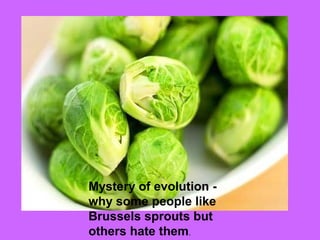
Mystery of evolution -
why some people like
Brussels sprouts but
others hate them.
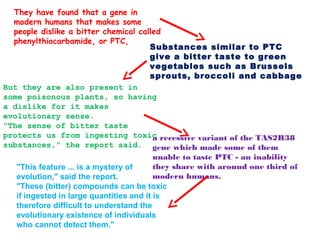
Substances similar to PTC
give a bitter taste to green
vegetables such as Brussels
sprouts, broccoli and cabbage
They have found that a gene in
modern humans that makes some
people dislike a bitter chemical called
phenylthiocarbamide, or PTC,
But they are also present in
some poisonous plants, so having
a dislike for it makes
evolutionary sense.
"The sense of bitter taste
protects us from ingesting toxic
substances," the report said.
a recessive variant of the TAS2R38
gene which made some of them
unable to taste PTC - an inability
they share with around one third of
modern humans.
"This feature ... is a mystery of
evolution," said the report.
"These (bitter) compounds can be toxic
if ingested in large quantities and it is
therefore difficult to understand the
evolutionary existence of individuals
who cannot detect them."
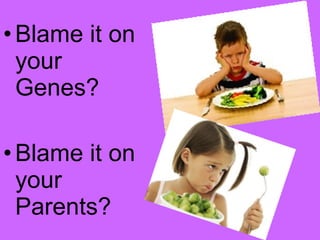
•Blame it on
your
Genes?
•Blame it on
your
Parents?
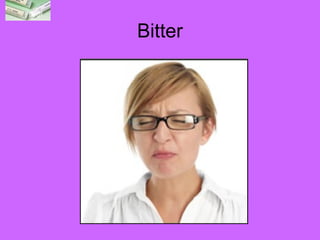
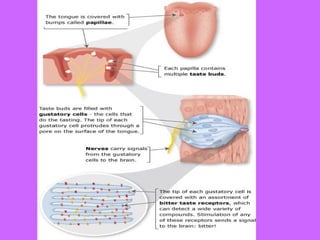
Bitter
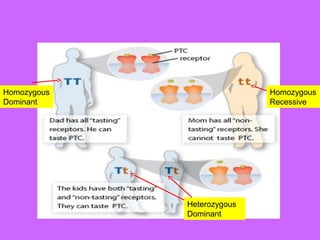
Homozygous
Dominant
Homozygous
Recessive
Heterozygous
Dominant
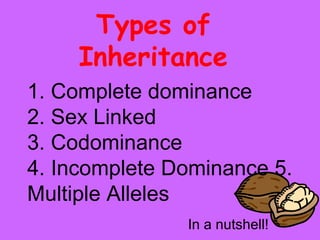
1. Complete dominance
2. Sex Linked
3. Codominance
4. Incomplete Dominance 5.
Multiple Alleles
In a nutshell!
Types of
Inheritance
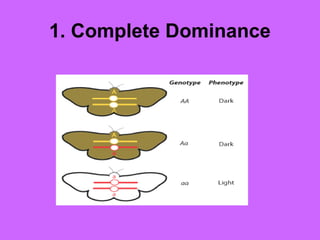
1. Complete Dominance
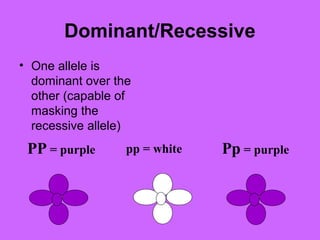
Dominant/Recessive
• One allele is
dominant over the
other (capable of
masking the
recessive allele)
PP = purple pp = white Pp = purple
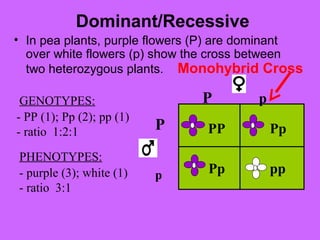
Dominant/Recessive
• In pea plants, purple flowers (P) are dominant
over white flowers (p) show the cross between
two heterozygous plants. Monohybrid Cross
P
p
P p
pp
Pp
Pp
PP
- PP (1); Pp (2); pp (1)
- ratio 1:2:1
- purple (3); white (1)
- ratio 3:1
GENOTYPES:
PHENOTYPES:
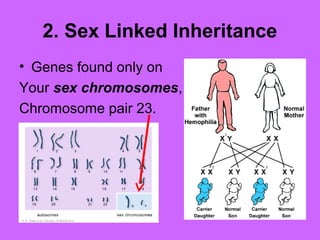
2. Sex Linked Inheritance
• Genes found only on
Your sex chromosomes,
Chromosome pair 23.
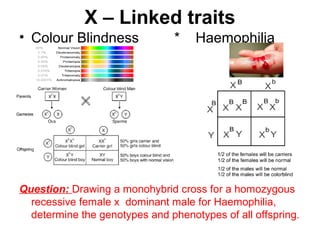
X – Linked traits
• Colour Blindness * Haemophilia
Question: Drawing a monohybrid cross for a homozygous
recessive female x dominant male for Haemophilia,
determine the genotypes and phenotypes of all offspring.
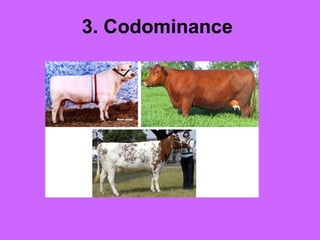
3. Codominance
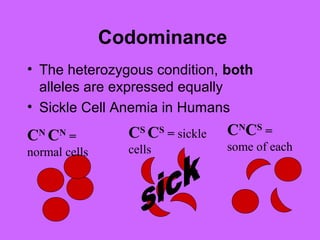
Codominance
• The heterozygous condition, both
alleles are expressed equally
• Sickle Cell Anemia in Humans
CN
CN
=
normal cells
CS
CS
= sickle
cells
CN
CS
=
some of each
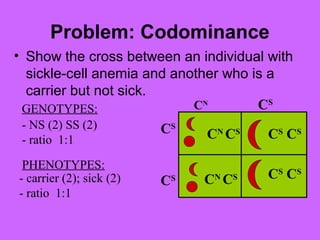
Problem: Codominance
• Show the cross between an individual with
sickle-cell anemia and another who is a
carrier but not sick.
CN
CS
CS
CS
CN
CS
CN
CS
CS
CS
CS
CS
- NS (2) SS (2)
- ratio 1:1
- carrier (2); sick (2)
- ratio 1:1
GENOTYPES:
PHENOTYPES:
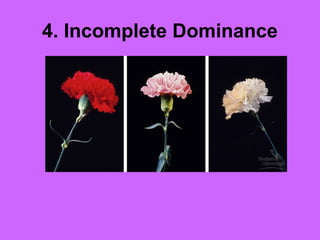
4. Incomplete Dominance
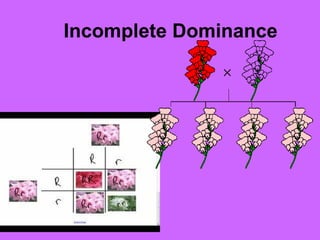
Incomplete Dominance
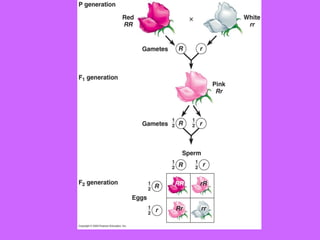
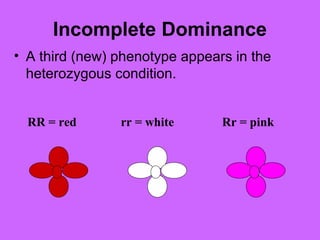
• A third (new) phenotype appears in the
heterozygous condition.
RR = red rr = white Rr = pink
Problem: Incomplete
Dominance
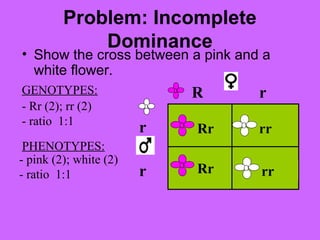
• Show the cross between a pink and a
white flower.
- Rr (2); rr (2)
- ratio 1:1
- pink (2); white (2)
- ratio 1:1
R r
r
r
rrRr
rrRr
GENOTYPES:
PHENOTYPES:
So is PTC taster gene
Incomplete Dominance?
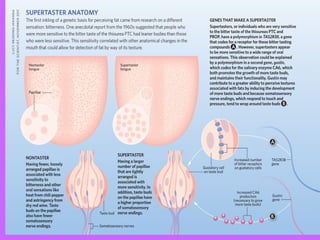
• Since all people have two copies of
every gene, combinations of the bitter
taste gene variants determine whether
someone finds PTC intensely bitter,
somewhat bitter, or without taste at all.
• To people who are tasters, the paper
tastes very bitter, but to non-tasters, it
just tastes like paper
• More precise analysis of the
phenotype indicated that the "taster"
gene is incompletely dominant to the
"nontaster" gene, so that people with
two copies of the taster gene have a
lower threshold of sensitivity to PTC
than people with only one copy.
• When there is a T allele present, this
usually predicts the ability of PTC
tasting
• The heterozygotes tend to be weak
tasters compared to the homozygous
dominant genotype.
• other studies have indicated that
another gene may determine taste
sensitivity.
• The frequency of PTC taster and non-
taster allele vary in different human
populations
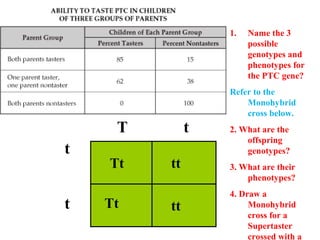
t
t
T t
Tt tt
Tt tt
1. Name the 3
possible
genotypes and
phenotypes for
the PTC gene?
Refer to the
Monohybrid
cross below.
2. What are the
offspring
genotypes?
3. What are their
phenotypes?
4. Draw a
Monohybrid
cross for a
Supertaster
crossed with a
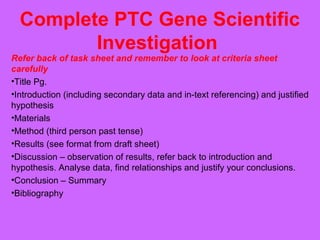
Complete PTC Gene Scientific
Investigation
Refer back of task sheet and remember to look at criteria sheet
carefully
•Title Pg.
•Introduction (including secondary data and in-text referencing) and justified
hypothesis
•Materials
•Method (third person past tense)
•Results (see format from draft sheet)
•Discussion – observation of results, refer back to introduction and
hypothesis. Analyse data, find relationships and justify your conclusions.
•Conclusion – Summary
•Bibliography
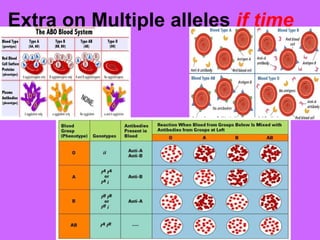
Extra on Multiple alleles if time
Red blood cell compatibility table[60][61]
Recipint[1]
Donor[1]
O− O+ A− A+ B− B+ AB− AB+
O− Y N N N N N N N
O+ Y Y N N N N N N
A− Y N Y N N N N N
A+ Y Y Y Y N N N N
B− Y N N N Y N N N
B+ Y Y N N Y Y N N
AB− Y N Y N Y N Y N
AB+ Y Y Y Y Y Y Y
• http://www.youtube.com/watch?v=NJHgZhbn8
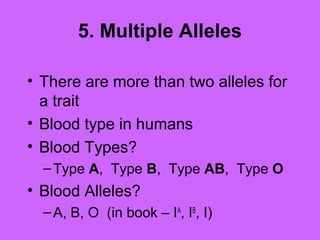
5. Multiple Alleles
• There are more than two alleles for
a trait
• Blood type in humans
• Blood Types?
–Type A, Type B, Type AB, Type O
• Blood Alleles?
–A, B, O (in book – IA
, IB
, I)
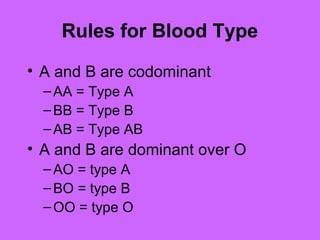
Rules for Blood Type
• A and B are codominant
–AA = Type A
–BB = Type B
–AB = Type AB
• A and B are dominant over O
–AO = type A
–BO = type B
–OO = type O
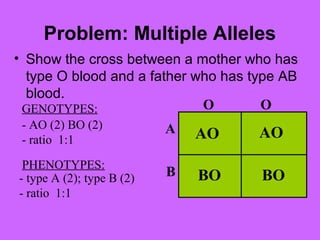
Problem: Multiple Alleles
• Show the cross between a mother who has
type O blood and a father who has type AB
blood.
- AO (2) BO (2)
- ratio 1:1
- type A (2); type B (2)
- ratio 1:1
GENOTYPES:
PHENOTYPES:
O O
A
B
AO
BO
AO
BO
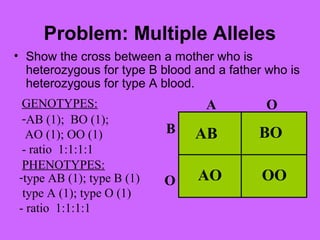
Problem: Multiple Alleles
• Show the cross between a mother who is
heterozygous for type B blood and a father who is
heterozygous for type A blood.
-AB (1); BO (1);
AO (1); OO (1)
- ratio 1:1:1:1
-type AB (1); type B (1)
type A (1); type O (1)
- ratio 1:1:1:1
GENOTYPES:
PHENOTYPES:
A O
B
O
AB
OO
BO
AO
Exercises
• Textbook pg. 77. q. 1 to 4, 6, 7, 9

Ptc gene background information

  • 1.
  • 2.
  • 3.
    Mystery of evolution- why some people like Brussels sprouts but others hate them.
  • 4.
    Substances similar toPTC give a bitter taste to green vegetables such as Brussels sprouts, broccoli and cabbage They have found that a gene in modern humans that makes some people dislike a bitter chemical called phenylthiocarbamide, or PTC, But they are also present in some poisonous plants, so having a dislike for it makes evolutionary sense. "The sense of bitter taste protects us from ingesting toxic substances," the report said. a recessive variant of the TAS2R38 gene which made some of them unable to taste PTC - an inability they share with around one third of modern humans. "This feature ... is a mystery of evolution," said the report. "These (bitter) compounds can be toxic if ingested in large quantities and it is therefore difficult to understand the evolutionary existence of individuals who cannot detect them."
  • 5.
  • 6.
  • 9.
  • 10.
    1. Complete dominance 2.Sex Linked 3. Codominance 4. Incomplete Dominance 5. Multiple Alleles In a nutshell! Types of Inheritance
  • 11.
  • 12.
    Dominant/Recessive • One alleleis dominant over the other (capable of masking the recessive allele) PP = purple pp = white Pp = purple
  • 13.
    Dominant/Recessive • In peaplants, purple flowers (P) are dominant over white flowers (p) show the cross between two heterozygous plants. Monohybrid Cross P p P p pp Pp Pp PP - PP (1); Pp (2); pp (1) - ratio 1:2:1 - purple (3); white (1) - ratio 3:1 GENOTYPES: PHENOTYPES:
  • 14.
    2. Sex LinkedInheritance • Genes found only on Your sex chromosomes, Chromosome pair 23.
  • 15.
    X – Linkedtraits • Colour Blindness * Haemophilia Question: Drawing a monohybrid cross for a homozygous recessive female x dominant male for Haemophilia, determine the genotypes and phenotypes of all offspring.
  • 16.
  • 18.
    Codominance • The heterozygouscondition, both alleles are expressed equally • Sickle Cell Anemia in Humans CN CN = normal cells CS CS = sickle cells CN CS = some of each
  • 19.
    Problem: Codominance • Showthe cross between an individual with sickle-cell anemia and another who is a carrier but not sick. CN CS CS CS CN CS CN CS CS CS CS CS - NS (2) SS (2) - ratio 1:1 - carrier (2); sick (2) - ratio 1:1 GENOTYPES: PHENOTYPES:
  • 20.
  • 21.
  • 23.
    Incomplete Dominance • Athird (new) phenotype appears in the heterozygous condition. RR = red rr = white Rr = pink
  • 24.
    Problem: Incomplete Dominance • Showthe cross between a pink and a white flower. - Rr (2); rr (2) - ratio 1:1 - pink (2); white (2) - ratio 1:1 R r r r rrRr rrRr GENOTYPES: PHENOTYPES:
  • 25.
    So is PTCtaster gene Incomplete Dominance?
  • 26.
    • Since allpeople have two copies of every gene, combinations of the bitter taste gene variants determine whether someone finds PTC intensely bitter, somewhat bitter, or without taste at all.
  • 27.
    • To peoplewho are tasters, the paper tastes very bitter, but to non-tasters, it just tastes like paper
  • 28.
    • More preciseanalysis of the phenotype indicated that the "taster" gene is incompletely dominant to the "nontaster" gene, so that people with two copies of the taster gene have a lower threshold of sensitivity to PTC than people with only one copy.
  • 29.
    • When thereis a T allele present, this usually predicts the ability of PTC tasting • The heterozygotes tend to be weak tasters compared to the homozygous dominant genotype.
  • 30.
    • other studieshave indicated that another gene may determine taste sensitivity. • The frequency of PTC taster and non- taster allele vary in different human populations
  • 31.
    t t T t Tt tt Tttt 1. Name the 3 possible genotypes and phenotypes for the PTC gene? Refer to the Monohybrid cross below. 2. What are the offspring genotypes? 3. What are their phenotypes? 4. Draw a Monohybrid cross for a Supertaster crossed with a
  • 32.
    Complete PTC GeneScientific Investigation Refer back of task sheet and remember to look at criteria sheet carefully •Title Pg. •Introduction (including secondary data and in-text referencing) and justified hypothesis •Materials •Method (third person past tense) •Results (see format from draft sheet) •Discussion – observation of results, refer back to introduction and hypothesis. Analyse data, find relationships and justify your conclusions. •Conclusion – Summary •Bibliography
  • 33.
    Extra on Multiplealleles if time
  • 34.
    Red blood cellcompatibility table[60][61] Recipint[1] Donor[1] O− O+ A− A+ B− B+ AB− AB+ O− Y N N N N N N N O+ Y Y N N N N N N A− Y N Y N N N N N A+ Y Y Y Y N N N N B− Y N N N Y N N N B+ Y Y N N Y Y N N AB− Y N Y N Y N Y N AB+ Y Y Y Y Y Y Y
  • 35.
  • 36.
    5. Multiple Alleles •There are more than two alleles for a trait • Blood type in humans • Blood Types? –Type A, Type B, Type AB, Type O • Blood Alleles? –A, B, O (in book – IA , IB , I)
  • 37.
    Rules for BloodType • A and B are codominant –AA = Type A –BB = Type B –AB = Type AB • A and B are dominant over O –AO = type A –BO = type B –OO = type O
  • 38.
    Problem: Multiple Alleles •Show the cross between a mother who has type O blood and a father who has type AB blood. - AO (2) BO (2) - ratio 1:1 - type A (2); type B (2) - ratio 1:1 GENOTYPES: PHENOTYPES: O O A B AO BO AO BO
  • 39.
    Problem: Multiple Alleles •Show the cross between a mother who is heterozygous for type B blood and a father who is heterozygous for type A blood. -AB (1); BO (1); AO (1); OO (1) - ratio 1:1:1:1 -type AB (1); type B (1) type A (1); type O (1) - ratio 1:1:1:1 GENOTYPES: PHENOTYPES: A O B O AB OO BO AO
  • 40.
    Exercises • Textbook pg.77. q. 1 to 4, 6, 7, 9