Tanu Verma
1801793
B.Tech. 3rd Year
Computer-Integrated Manufacturing
(CIM)
Content
 Introduction
 Definition
 Need of CIM
 CIM Processes
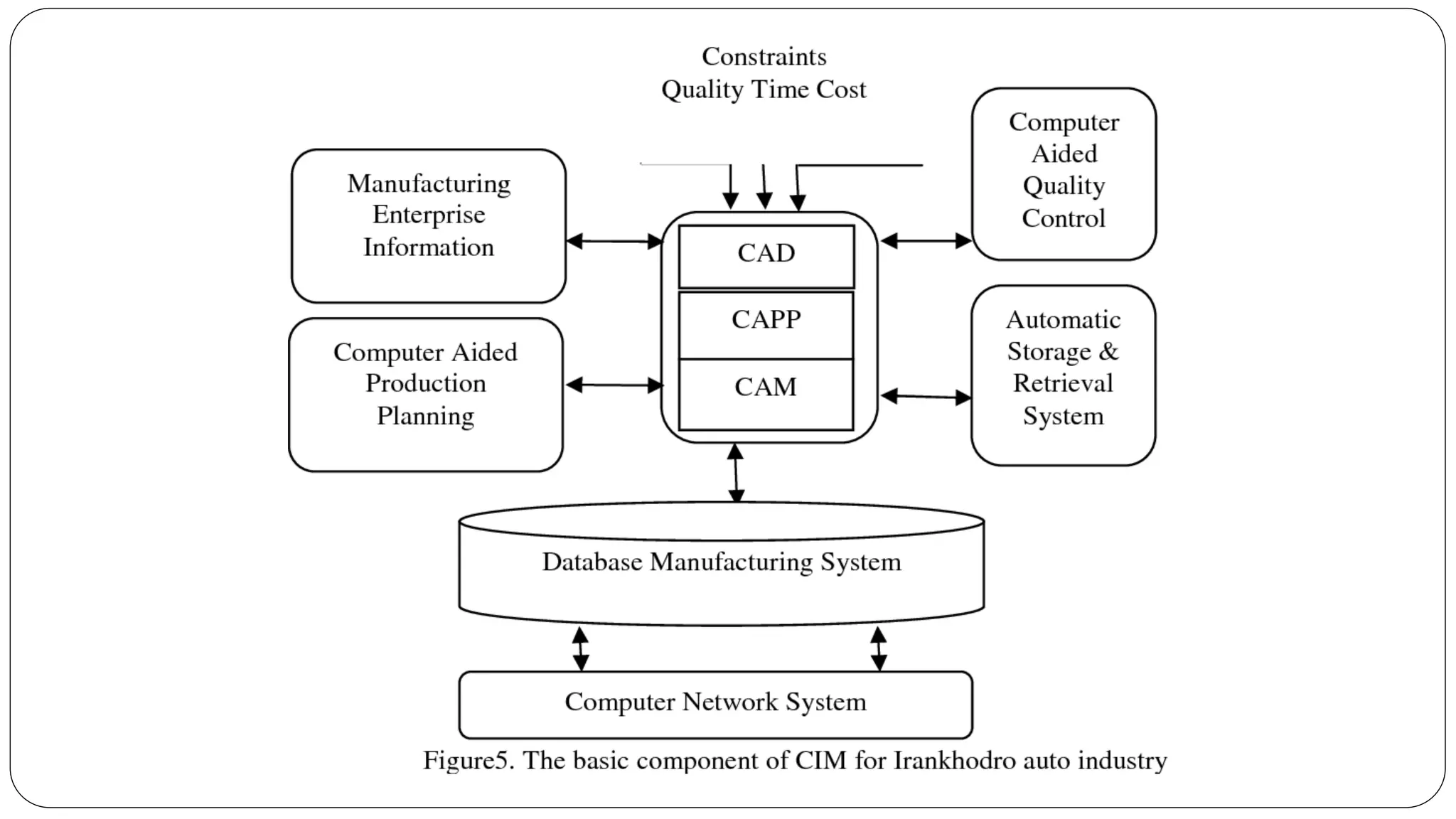
 Components of CIM
 CIM Hardware and Software
 Benefits of CIM
 Limitations of CIM
 Relationship between automation
and CIM by developing a
conceptual model of manufacturing
 Conclusion
Introduction
 Computer-integrated manufacturing (CIM) refers to the use of
computer-controlled machineries and automation systems in
manufacturing products.
 CIM combines various technologies like computer-aided design
(CAD) and computer-aided manufacturing (CAM) to provide an
error-free manufacturing process that reduces manual labor and
automates repetitive tasks.
 CIM is not a product that can be purchased and installed. It is a
way of thinking and solving problems
 The CIM approach increases the speed of the manufacturing
process and uses real-time sensors and closed-loop control
processes to automate the manufacturing process.
 It is widely used in the automotive, aviation, space and ship-
building industries.
Definition
 The society of manufacturing engineers (SME) Defines CIM is
integration of the total manufacturing enterprise through the use
of integrated systems and data communications coupled with the
new managerial philosophies that improve organizational and
personal efficiency.
Need of CIM
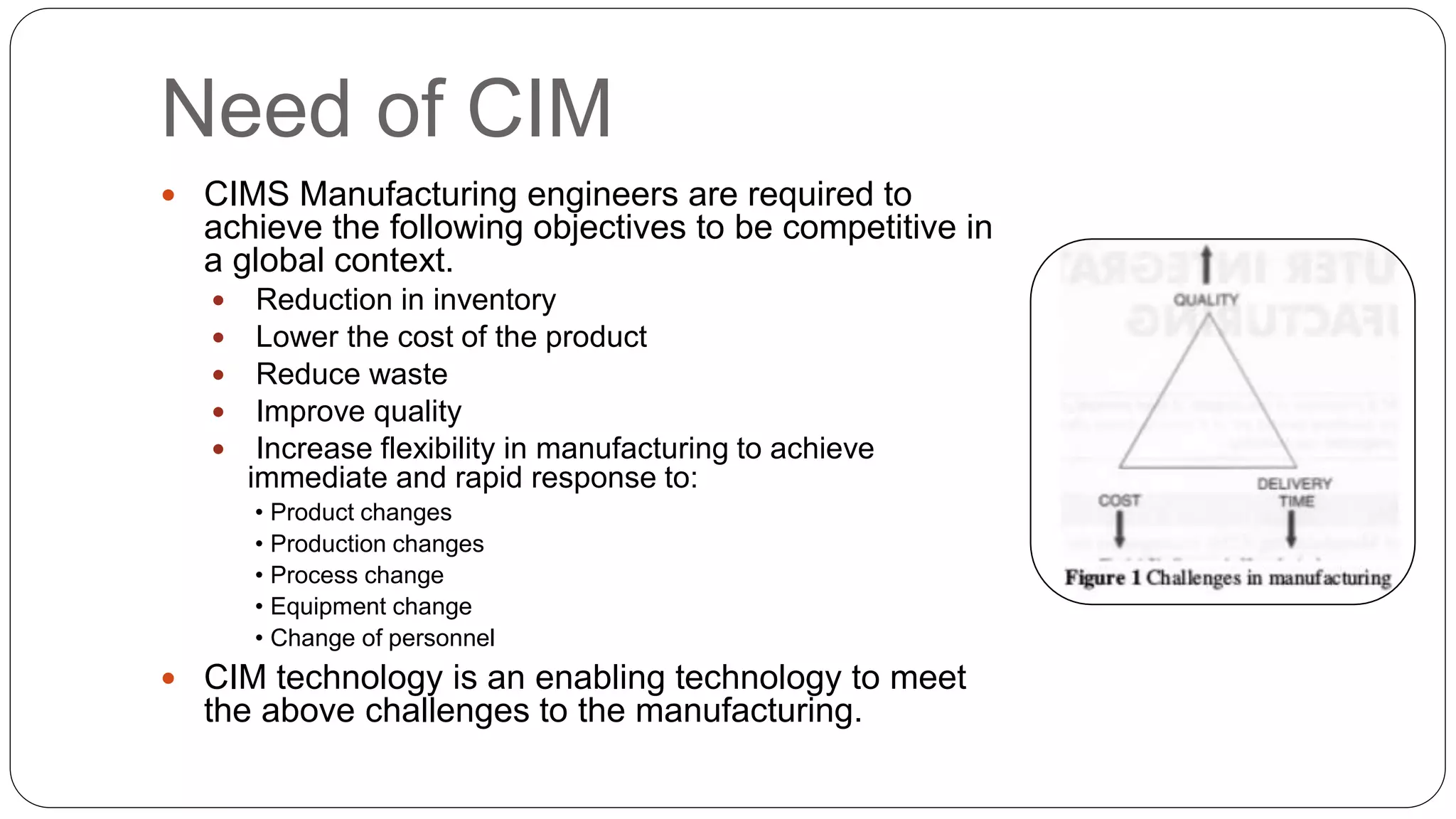
 CIMS Manufacturing engineers are required to
achieve the following objectives to be competitive in
a global context.
 Reduction in inventory
 Lower the cost of the product
 Reduce waste
 Improve quality
 Increase flexibility in manufacturing to achieve
immediate and rapid response to:
• Product changes
• Production changes
• Process change
• Equipment change
• Change of personnel
 CIM technology is an enabling technology to meet
the above challenges to the manufacturing.
CIM Processes
 CIM is a manufacturing approach that provides a complete automation of a manufacturing
facility. All the operations are controlled by computers and have a common storage and
distribution.
The various processes involved in a CIM are listed as follows:
1) Computer-aided design (CAD)
2) Prototype manufacture
3) Determining the efficient method for manufacturing by calculating the costs and
considering the production methods, volume of products, storage and distribution
4) Ordering of the necessary materials needed for the manufacturing process
5) Computer-aided manufacturing (CAM) of the products with the help of computer
numerical controllers
6) Quality controls at each phase of the development.
7) Product assembly with the help of robots
8) Quality check and automated storage
9) Automatic distribution of products from the storage areas to awaiting lorries/trucks
10) Automatic updating of logs, financial data and bills in the computer system
Components of CIM
The major components of CIM are as follows:
 Data storage, retrieval, manipulation and presentation
mechanisms
 Real-time sensors for sensing the current state and for modifying
processes
 Data processing algorithms
These components distinguish CIM from other manufacturing
methodologies.
CIM Hardware and Software
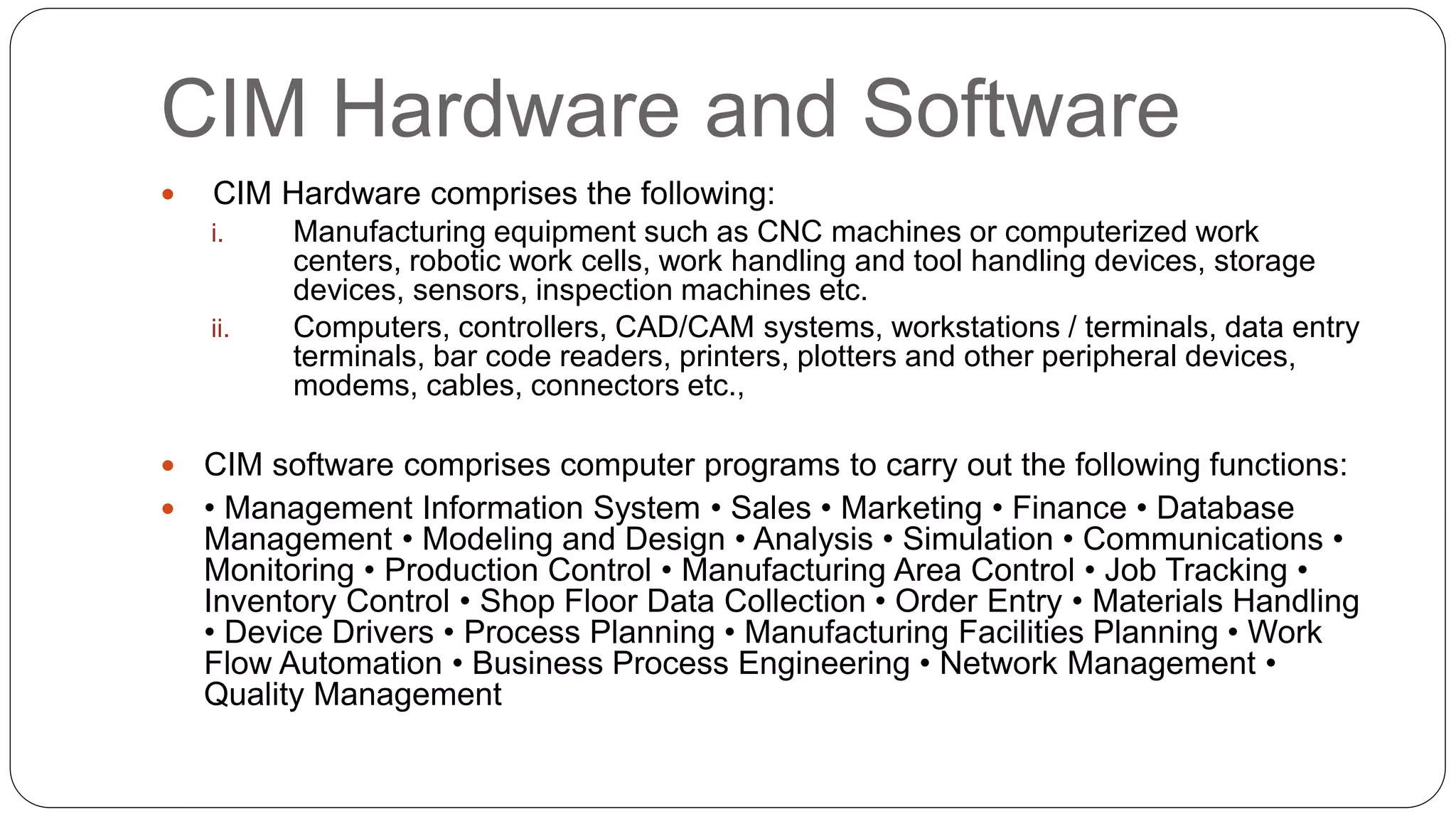
 CIM Hardware comprises the following:
i. Manufacturing equipment such as CNC machines or computerized work
centers, robotic work cells, work handling and tool handling devices, storage
devices, sensors, inspection machines etc.
ii. Computers, controllers, CAD/CAM systems, workstations / terminals, data entry
terminals, bar code readers, printers, plotters and other peripheral devices,
modems, cables, connectors etc.,
 CIM software comprises computer programs to carry out the following functions:
 • Management Information System • Sales • Marketing • Finance • Database
Management • Modeling and Design • Analysis • Simulation • Communications •
Monitoring • Production Control • Manufacturing Area Control • Job Tracking •
Inventory Control • Shop Floor Data Collection • Order Entry • Materials Handling
• Device Drivers • Process Planning • Manufacturing Facilities Planning • Work
Flow Automation • Business Process Engineering • Network Management •
Quality Management
Benefits of CIM
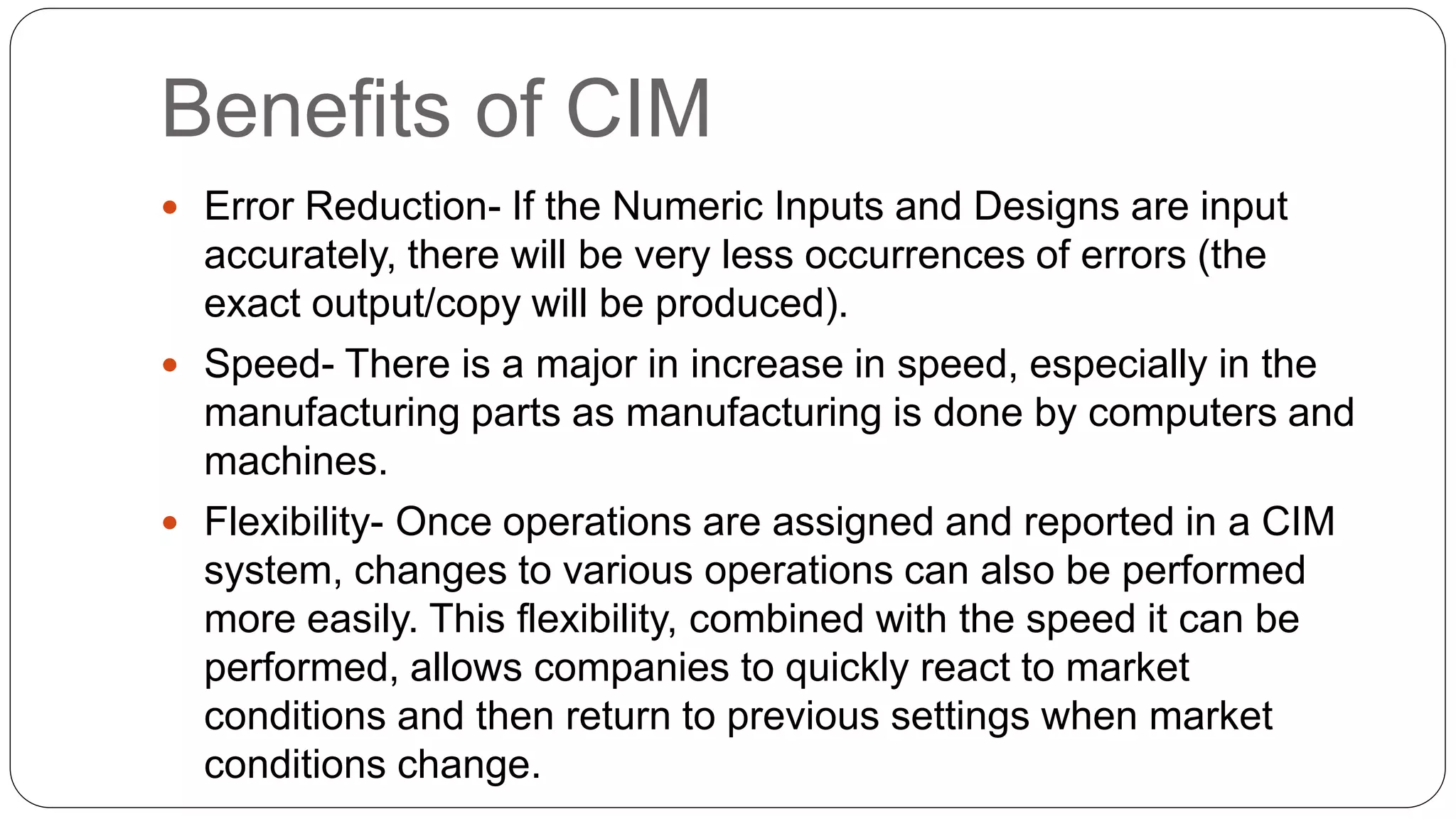
 Error Reduction- If the Numeric Inputs and Designs are input
accurately, there will be very less occurrences of errors (the
exact output/copy will be produced).
 Speed- There is a major in increase in speed, especially in the
manufacturing parts as manufacturing is done by computers and
machines.
 Flexibility- Once operations are assigned and reported in a CIM
system, changes to various operations can also be performed
more easily. This flexibility, combined with the speed it can be
performed, allows companies to quickly react to market
conditions and then return to previous settings when market
conditions change.
Limitations of CIM
 Cost- The initial cost of buying the equipment is extremely high.
 Maintenance- Maintaining(repairing broken machines etc.) is
extremely expensive, difficult and time consuming.
 Training- Employees need initial training to get comfortable and
used to the new equipment(especially in CAD).
Relationship between automation and CIM by developing a
conceptual model of manufacturing
In the figure Model of
manufacturing, showing
(a] the factory as a processing
pipeline where the physical
manufacturing activities are
performed
(b) the information- processing
activities that support
manufacturing as a ring that
surrounds the factory concerned
more with the information-
processing functions that are
required to support the
Relationship between automation and CIM by developing a
conceptual model of manufacturing
CIM Automation
 CIM deals with automating the information-
processing activities that usually occurs in
an office environment.
 These information-processing functions
include
(1) certain business activities (e.g.,
marketing and sales, order entry,
customer billing, etc.)
(2) product design
(3) manufacturing planning
(4) manufacturing control
 These four functions form a cycle of events
that must accompany the physical
production activities but which do not
directly touch the product.
 Automation deals with the physical
activities related to production
 The physical activities include all of the
manufacturing processing, assembly,
material handling, and inspections that are
performed on the product.
 These operations come in direct contact
with the product during manufacture
Conclusion
 Even though CIM may have its share of disadvantages, but its
advantages outweigh them. Regardless of its high cost, it increases
productivity greatly and is one of the most important factors for the
expansion of a company.
CIM Computer Integrated Manufacturing

CIM Computer Integrated Manufacturing

  • 1.
    Tanu Verma 1801793 B.Tech. 3rdYear Computer-Integrated Manufacturing (CIM)
  • 2.
    Content  Introduction  Definition Need of CIM  CIM Processes  Components of CIM  CIM Hardware and Software  Benefits of CIM  Limitations of CIM  Relationship between automation and CIM by developing a conceptual model of manufacturing  Conclusion
  • 3.
    Introduction  Computer-integrated manufacturing(CIM) refers to the use of computer-controlled machineries and automation systems in manufacturing products.  CIM combines various technologies like computer-aided design (CAD) and computer-aided manufacturing (CAM) to provide an error-free manufacturing process that reduces manual labor and automates repetitive tasks.  CIM is not a product that can be purchased and installed. It is a way of thinking and solving problems  The CIM approach increases the speed of the manufacturing process and uses real-time sensors and closed-loop control processes to automate the manufacturing process.  It is widely used in the automotive, aviation, space and ship- building industries.
  • 4.
    Definition  The societyof manufacturing engineers (SME) Defines CIM is integration of the total manufacturing enterprise through the use of integrated systems and data communications coupled with the new managerial philosophies that improve organizational and personal efficiency.
  • 5.
    Need of CIM CIMS Manufacturing engineers are required to achieve the following objectives to be competitive in a global context.  Reduction in inventory  Lower the cost of the product  Reduce waste  Improve quality  Increase flexibility in manufacturing to achieve immediate and rapid response to: • Product changes • Production changes • Process change • Equipment change • Change of personnel  CIM technology is an enabling technology to meet the above challenges to the manufacturing.
  • 6.
    CIM Processes  CIMis a manufacturing approach that provides a complete automation of a manufacturing facility. All the operations are controlled by computers and have a common storage and distribution. The various processes involved in a CIM are listed as follows: 1) Computer-aided design (CAD) 2) Prototype manufacture 3) Determining the efficient method for manufacturing by calculating the costs and considering the production methods, volume of products, storage and distribution 4) Ordering of the necessary materials needed for the manufacturing process 5) Computer-aided manufacturing (CAM) of the products with the help of computer numerical controllers 6) Quality controls at each phase of the development. 7) Product assembly with the help of robots 8) Quality check and automated storage 9) Automatic distribution of products from the storage areas to awaiting lorries/trucks 10) Automatic updating of logs, financial data and bills in the computer system
  • 8.
    Components of CIM Themajor components of CIM are as follows:  Data storage, retrieval, manipulation and presentation mechanisms  Real-time sensors for sensing the current state and for modifying processes  Data processing algorithms These components distinguish CIM from other manufacturing methodologies.
  • 9.
    CIM Hardware andSoftware  CIM Hardware comprises the following: i. Manufacturing equipment such as CNC machines or computerized work centers, robotic work cells, work handling and tool handling devices, storage devices, sensors, inspection machines etc. ii. Computers, controllers, CAD/CAM systems, workstations / terminals, data entry terminals, bar code readers, printers, plotters and other peripheral devices, modems, cables, connectors etc.,  CIM software comprises computer programs to carry out the following functions:  • Management Information System • Sales • Marketing • Finance • Database Management • Modeling and Design • Analysis • Simulation • Communications • Monitoring • Production Control • Manufacturing Area Control • Job Tracking • Inventory Control • Shop Floor Data Collection • Order Entry • Materials Handling • Device Drivers • Process Planning • Manufacturing Facilities Planning • Work Flow Automation • Business Process Engineering • Network Management • Quality Management
  • 10.
    Benefits of CIM Error Reduction- If the Numeric Inputs and Designs are input accurately, there will be very less occurrences of errors (the exact output/copy will be produced).  Speed- There is a major in increase in speed, especially in the manufacturing parts as manufacturing is done by computers and machines.  Flexibility- Once operations are assigned and reported in a CIM system, changes to various operations can also be performed more easily. This flexibility, combined with the speed it can be performed, allows companies to quickly react to market conditions and then return to previous settings when market conditions change.
  • 11.
    Limitations of CIM Cost- The initial cost of buying the equipment is extremely high.  Maintenance- Maintaining(repairing broken machines etc.) is extremely expensive, difficult and time consuming.  Training- Employees need initial training to get comfortable and used to the new equipment(especially in CAD).
  • 12.
    Relationship between automationand CIM by developing a conceptual model of manufacturing In the figure Model of manufacturing, showing (a] the factory as a processing pipeline where the physical manufacturing activities are performed (b) the information- processing activities that support manufacturing as a ring that surrounds the factory concerned more with the information- processing functions that are required to support the
  • 13.
    Relationship between automationand CIM by developing a conceptual model of manufacturing CIM Automation  CIM deals with automating the information- processing activities that usually occurs in an office environment.  These information-processing functions include (1) certain business activities (e.g., marketing and sales, order entry, customer billing, etc.) (2) product design (3) manufacturing planning (4) manufacturing control  These four functions form a cycle of events that must accompany the physical production activities but which do not directly touch the product.  Automation deals with the physical activities related to production  The physical activities include all of the manufacturing processing, assembly, material handling, and inspections that are performed on the product.  These operations come in direct contact with the product during manufacture
  • 14.
    Conclusion  Even thoughCIM may have its share of disadvantages, but its advantages outweigh them. Regardless of its high cost, it increases productivity greatly and is one of the most important factors for the expansion of a company.