COMPUTER IN DESIGN AND
MANUFACTURING
Dr. Mahmoud Abbas Mahmoud
Assist. Prof.
University of Technology
Department of Production Engineering and Metallurgy
Industrial Engineering Branch
2014 - 2015
The
. It is
important to understand CAD as a technology, because it
interrelates with so many of the other production systems.
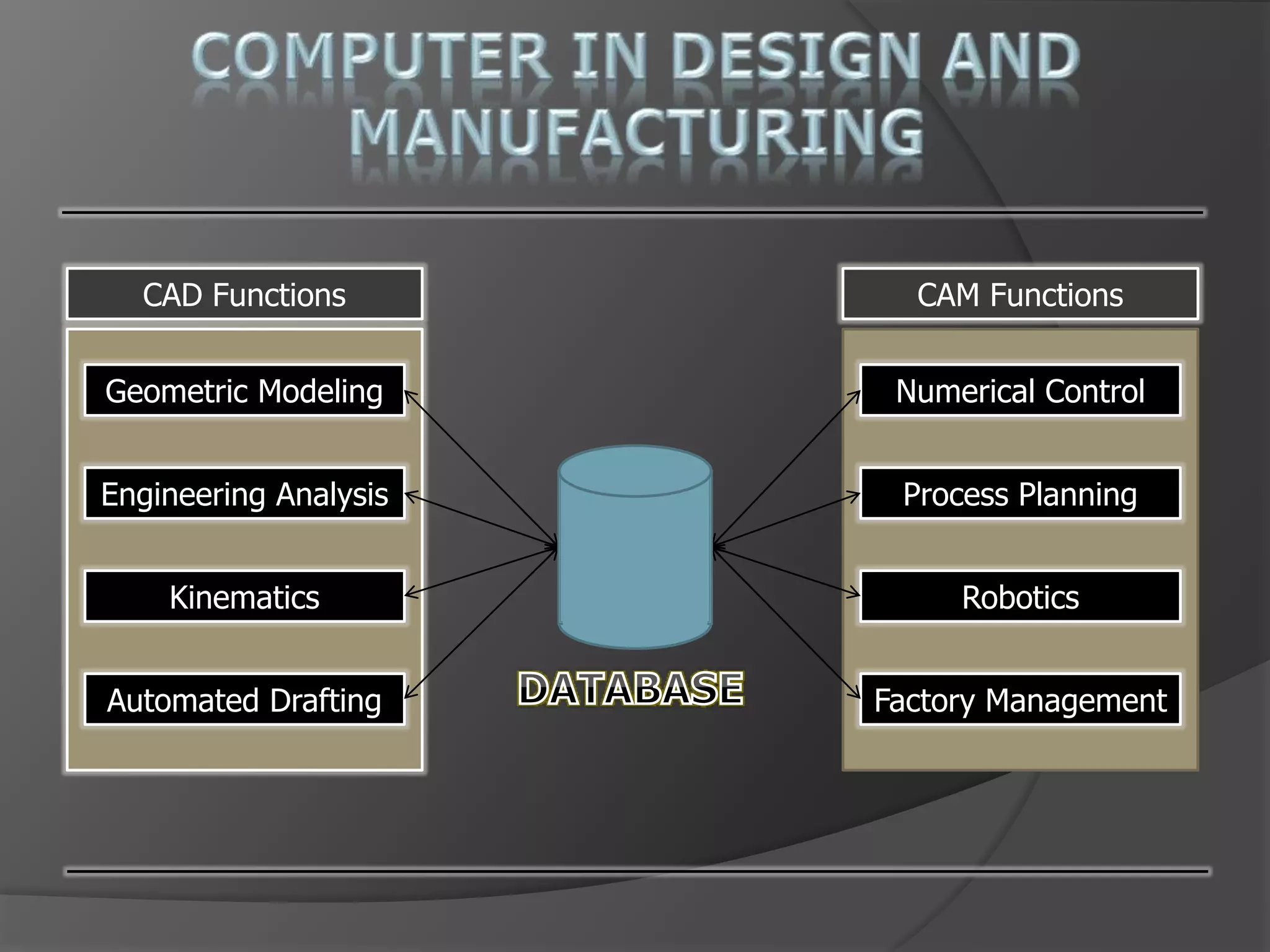
Geometric Modeling
Engineering Analysis
Kinematics
Automated Drafting
Numerical Control
Process Planning
Robotics
Factory Management
CAD Functions CAM Functions
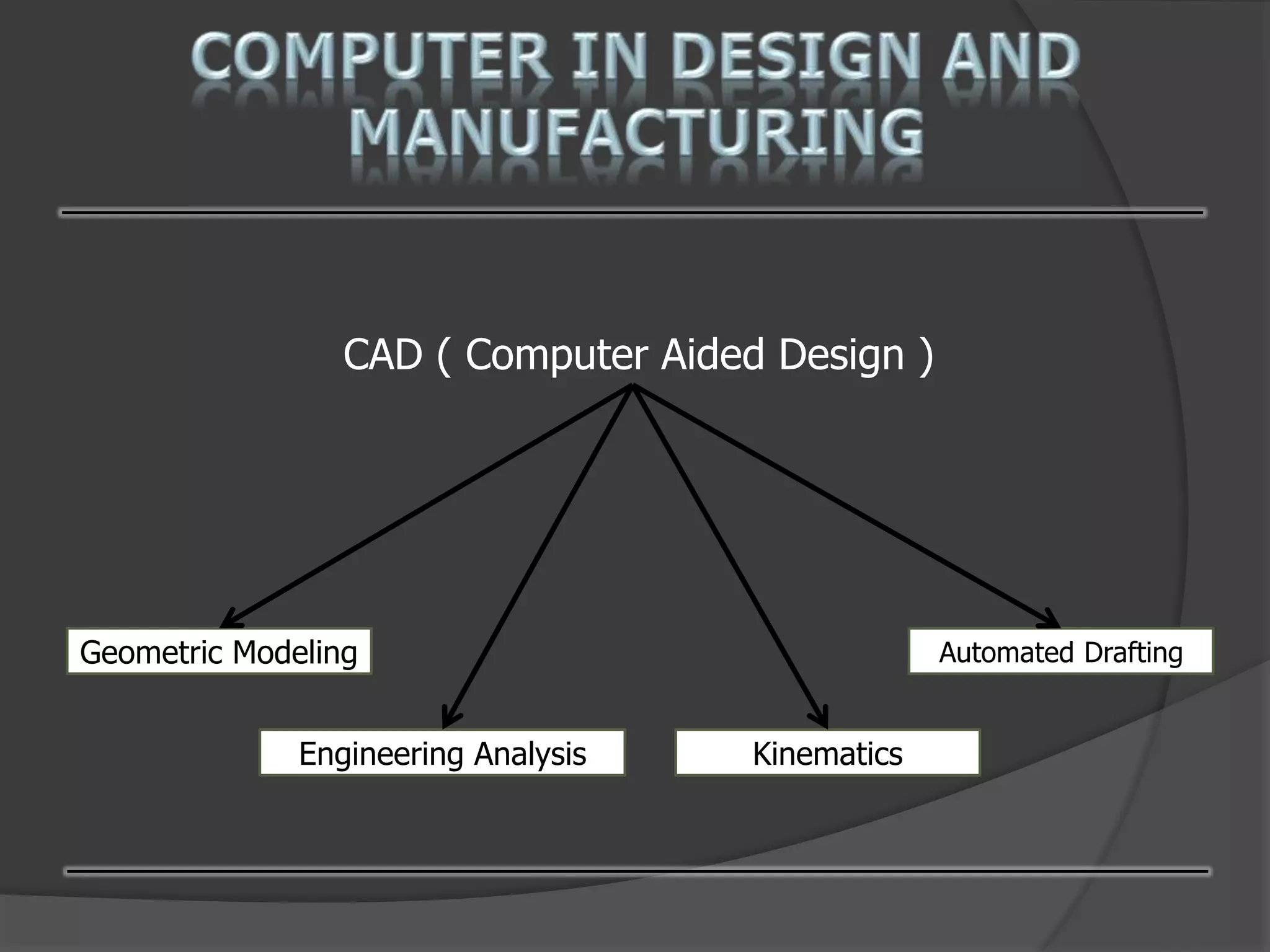
CAD ( Computer Aided Design )
Geometric Modeling
Engineering Analysis Kinematics
Automated Drafting
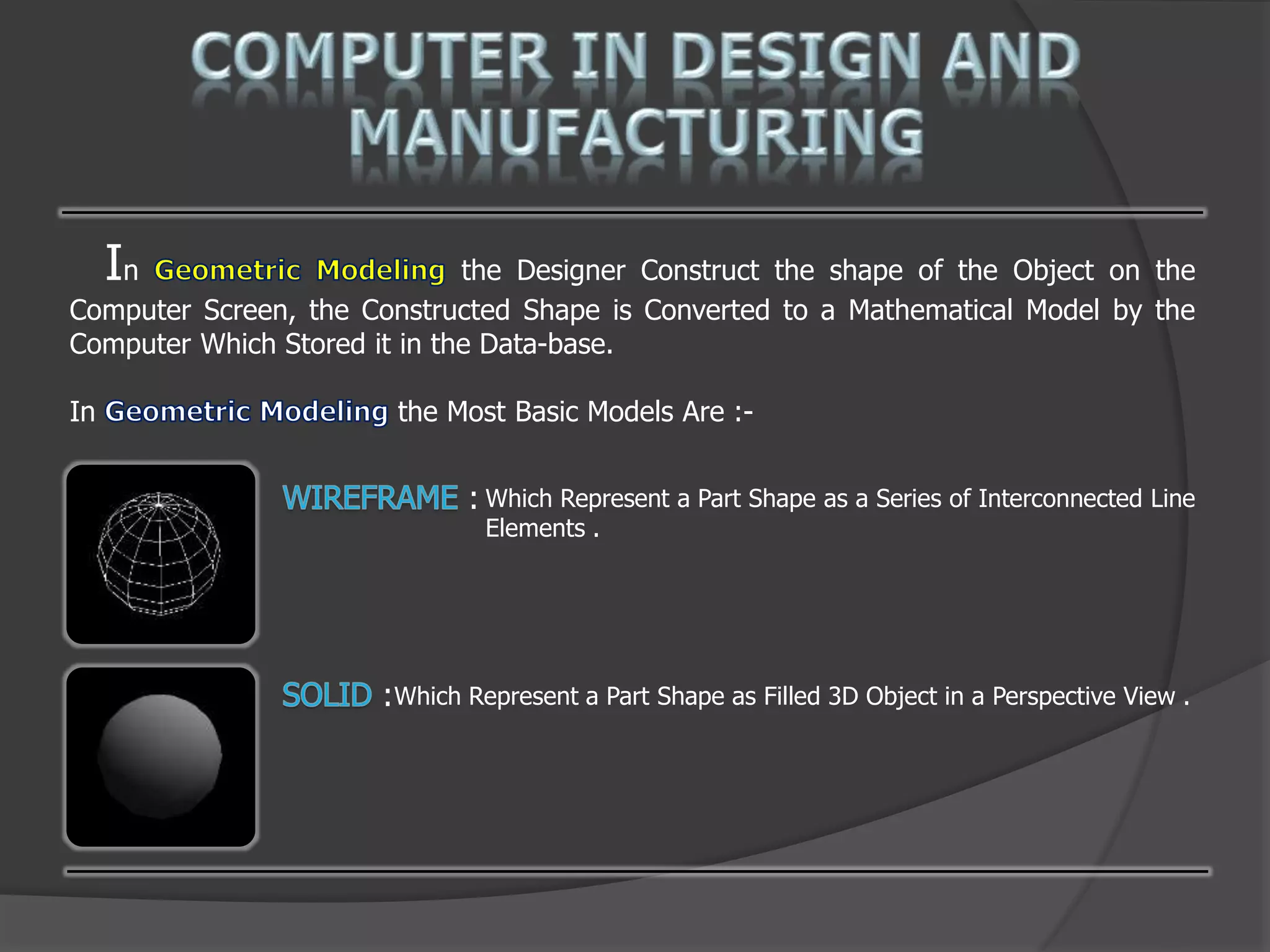
In the Designer Construct the shape of the Object on the
Computer Screen, the Constructed Shape is Converted to a Mathematical Model by the
Computer Which Stored it in the Data-base.
In the Most Basic Models Are :-
: Which Represent a Part Shape as a Series of Interconnected Line
Elements .
:Which Represent a Part Shape as Filled 3D Object in a Perspective View .
In the Computer Calculates Areas, Volumes, Masses, Moment
of Inertia. And Also the Computer Can Calculate a set of Structural Characteristics Like
Calculating Stresses, Deflections and Many others. And finally the Computer Can Simulate
the validly of the Design to Eliminate the Faults Before Starting Production .
The Feature of CAD System allows the Designer to Assure that Moving
Parts Neither Interfere With One Another Nor Impact on Adjoining Parts of a Structure,
So the Proper Clearance and Position Can Be Checked in The Early Design Stages to
Eliminate the Potential Fit Problems .
With • Detailed Engineering Drawing Can Be Produced Auto-
matically From Database.
• Most Drafting Systems Can Generate Up to Six Views on
a Screen.
• These Systems Have Automatic Scaling, Cross-Hatching,
Notation and Dimensioning Features.
So With All These Features The CAD
Drawing System Can Be Five Times Faster
Than The Traditional Board Method.
The is an important CAD
application with a number of distance attributes it gives to
designer who can with this application have 3D solid object
to hold and measure, evaluate and verify. Other advantages
include speed, accuracy, and elimination of design flaws.
CAD has many application that serve many design theory, like:
: in nesting theory CAD system software can
develop a flat pattern from 3D CAD model and can also specifying the
type of seam or joint or determination the bend allowances according
to the thickness of material sheet and then nesting the patterns for
economic cutting.
An innovative application of the nesting theory is a method referred to
as tiling construction. A tiling is a set of polygons that cover the
euclidian plane without gaps or overlaps, just as the single set square
can tile a floor.
The
. The aim is to provide an
efficient manufacturing environment, and the computer is
an integral part of this
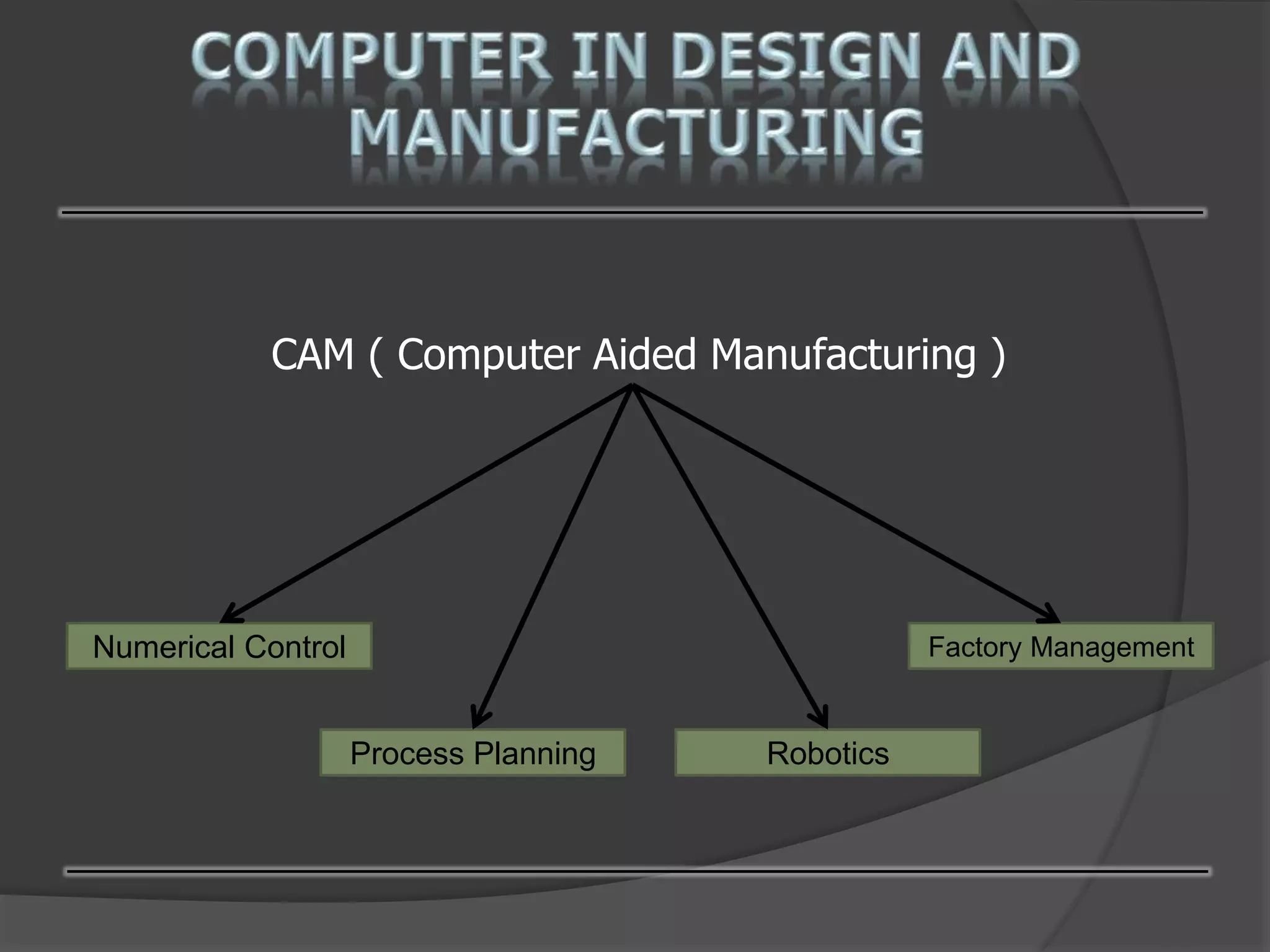
CAM ( Computer Aided Manufacturing )
Numerical Control
Process Planning Robotics
Factory Management
Refers to the Method of Directing a Machine Tool to
Produce a Part According to Prerecorded, Coded Numbers, Letters and Symbols .
Refers to the Machine Tool Contains a
Microcomputer That Stores the Information and Controls the Machine .
is a Sophisticated System in Which Several CNC
Machines are Linked to a Central Computer .
Numerical Control :
Process Planning :
A is the Determination of how specific part will be made in a
factory.
The Important Aspect of is
Which is a Way of Organizing Parts Having Similar Shaped Features into Families to Permit
Standardized Fabrication Stapes . The GT is a Special Type of Cellar Production .
Other type of machining cell is Which
Refers to the Arrangement of Machines, Material Transport Devices and Common
Computer Hard-ware, It Also Known as .
Robotics:
A is Programmable , Multifunctional Manipulator Design to Move Material,
Parts, Tools or Specialized Devices Through Various Programmed Motions for the
Performance of a Variety of Task .
A Can Also Spray Paint, Assemble Parts, Move Workpieces in Hostile
Environment, And Perform a Range of Similar Manual Tasks . It is a Integral Element in
Many Automated Fabrication Schemes and Manufacturing Cells Because It Can Do This
Work Efficiently And Without Tiring . So the Robotics is Machine That Can Be Directed to
Do Work Accurately and Tirelessly .
Robots Parts :
A is Usually Consist of Four Base Part :
: It Can Be Fixed to Floor, Attached to Movable Platform , or Hung From an Over-
head Gantry .
: is The Action End of The Robot , the is The Hand
Unit of The Robot. The Manipulator May Be Mechanical Grippers, Electromagnet
Attractors, or Vacuum-Driver Suction Cups Programmed to Simulate Human Movement .
: is Energizes The Manipulator And is Operated Variously by Electric
Motors, Hydraulic Actuators, or Pneumatic Units .
: Which is Directing The Movement of The Manipulator, And Sometimes
of The Base .
Robots Power Units Advantages :
: Are Fast, Quiet, Clean, Accurate, And Expensive .
: Are Heavy, Slow, Dirty, Precise, And Powerful .
: Are Lightweight, Inaccurate,
Fast, Weak, And Inexpensive .
Type of Robots Control Systems :
: Which Has Closed-Loop or Feedback
Systems, Where Signals Sent by The Controller to The Manipulator are Fed
Back to The Controller to Indicate Whether or not The Proper Action Has
Taken Place . If not, The Situation Can Be Corrected by Further Controller
Signals .
: In This System There is no
Sensor That Measures Manipulator Performance in Response to a Controller
Signal .
Although There is no Feedback in Such Nonservo Robots, They Are Simple,
Fast, Reliable, And Inexpensive, And They Are Valuable Tools For Light,
Repetitive Tasks.
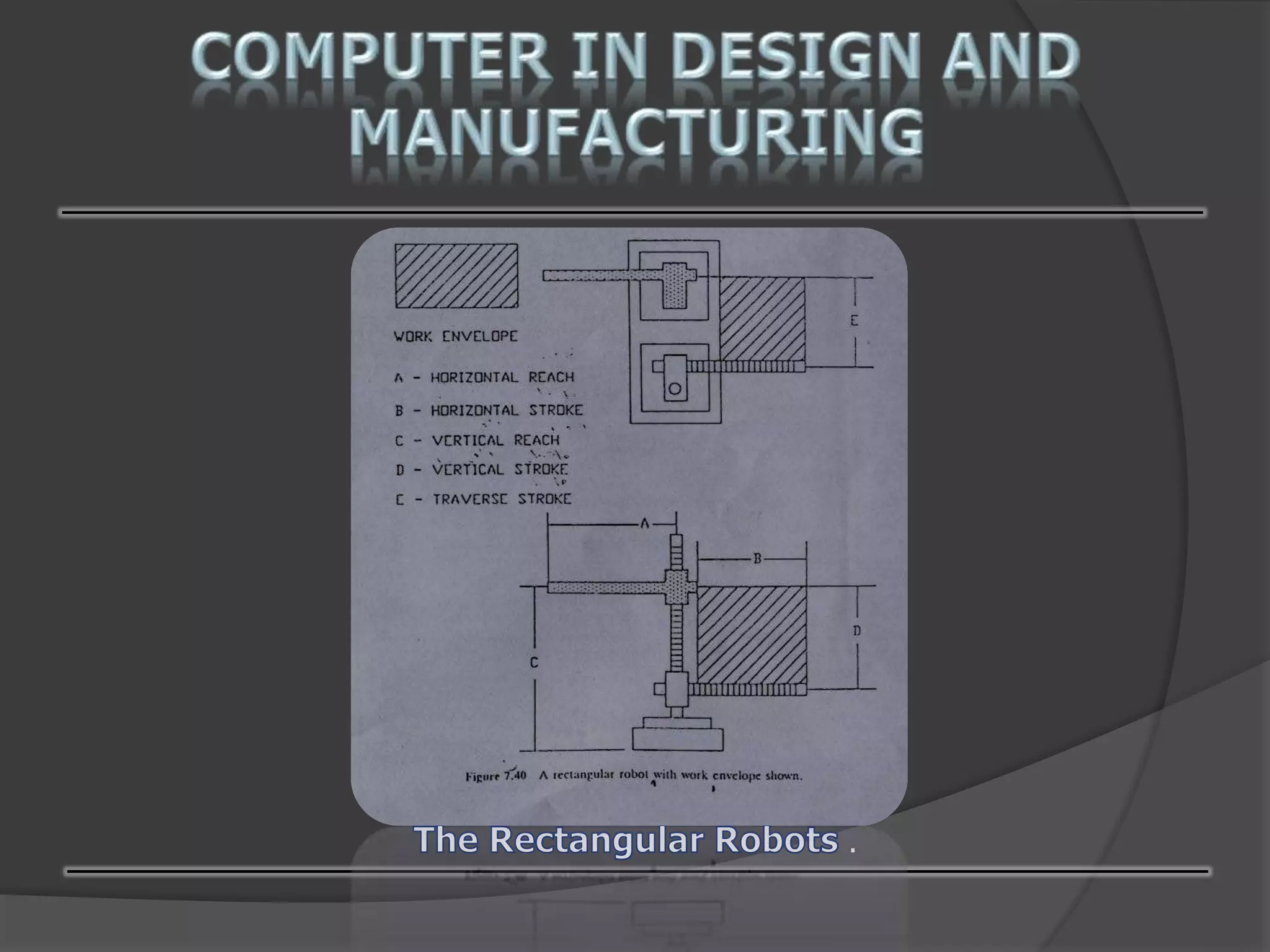
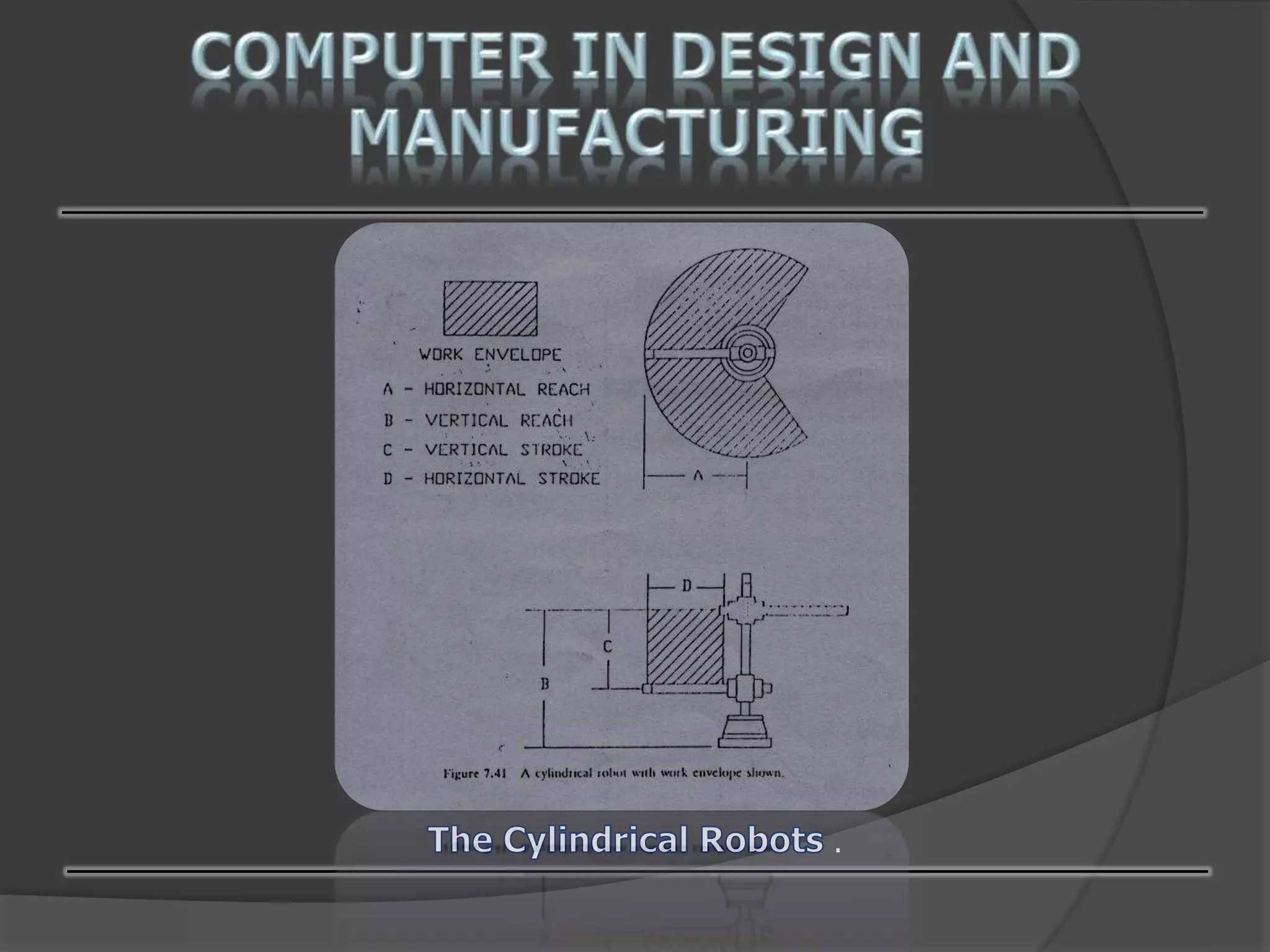
Type of Robots:
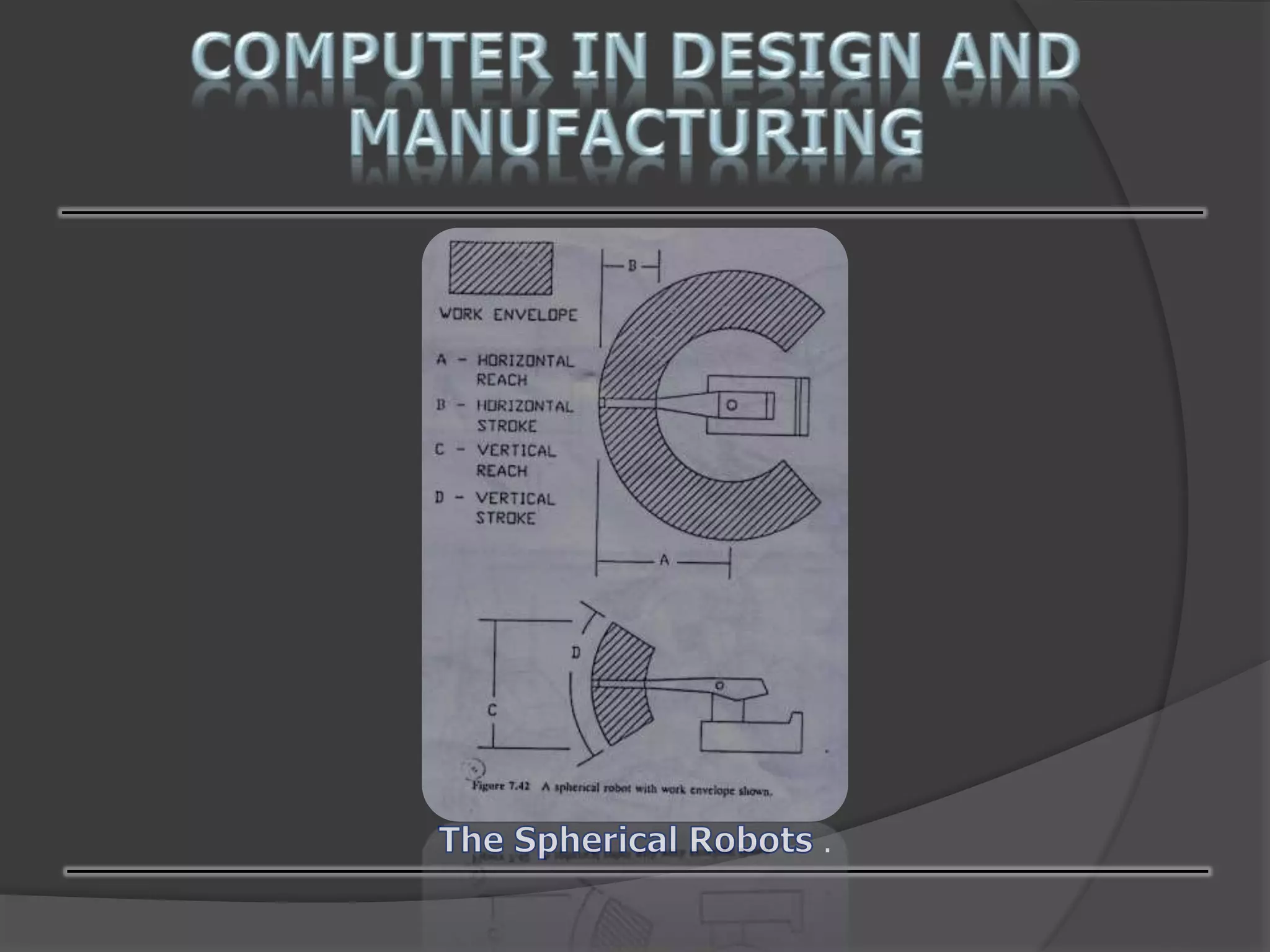
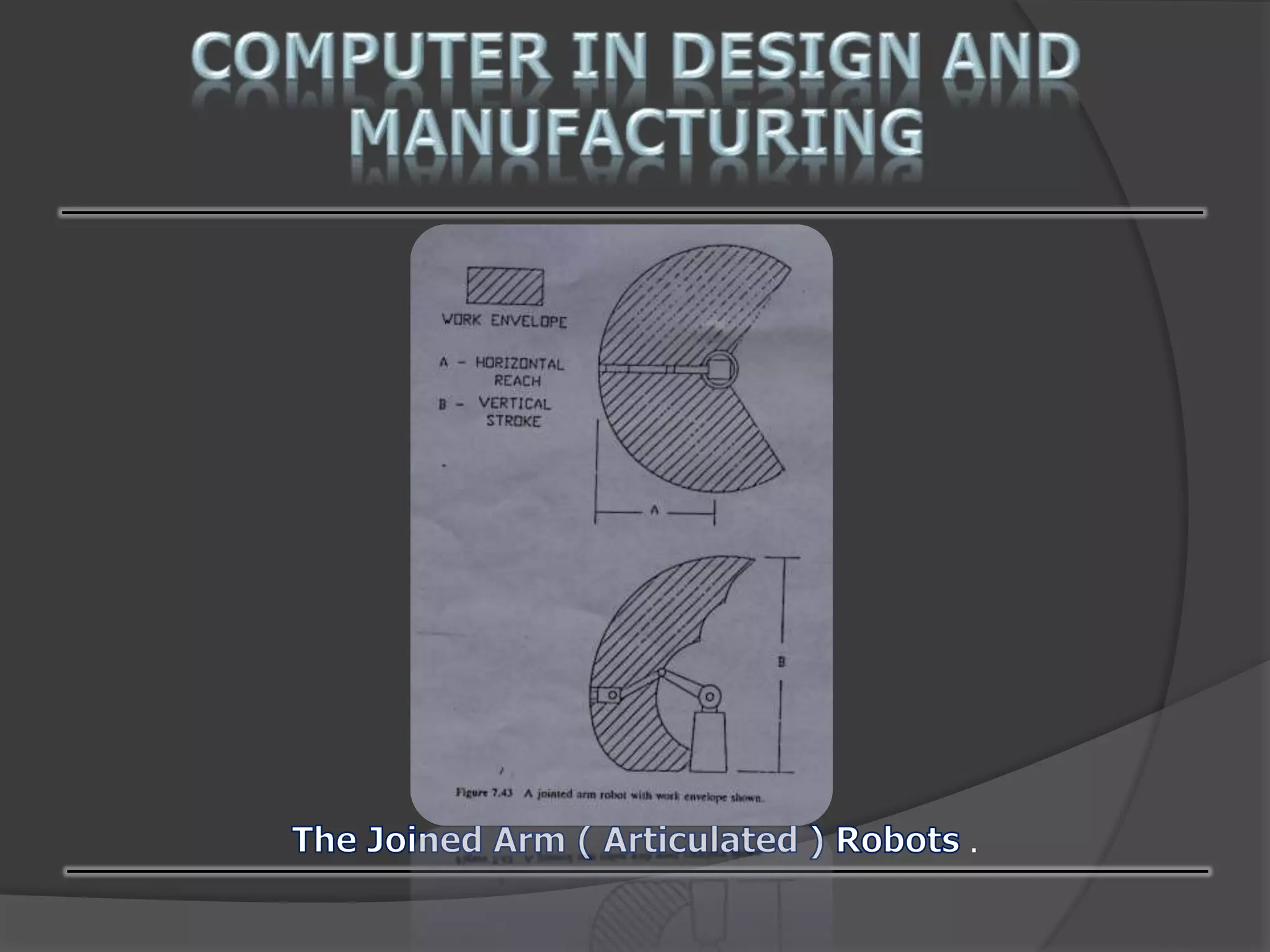
The Type of Robots Depend on The Work Envelope ( The Outer
Limits of the Places a Robot Can Reach With It’s End Effector . This
Area is Determined By a Robot’s Axes of Operation ) , There is Four
Type Of Robots :
.
.
.
.

Computer in Design and Manufacturing

  • 1.
    COMPUTER IN DESIGNAND MANUFACTURING Dr. Mahmoud Abbas Mahmoud Assist. Prof. University of Technology Department of Production Engineering and Metallurgy Industrial Engineering Branch 2014 - 2015
  • 2.
    The . It is importantto understand CAD as a technology, because it interrelates with so many of the other production systems.
  • 3.
    Geometric Modeling Engineering Analysis Kinematics AutomatedDrafting Numerical Control Process Planning Robotics Factory Management CAD Functions CAM Functions
  • 4.
    CAD ( ComputerAided Design ) Geometric Modeling Engineering Analysis Kinematics Automated Drafting
  • 5.
    In the DesignerConstruct the shape of the Object on the Computer Screen, the Constructed Shape is Converted to a Mathematical Model by the Computer Which Stored it in the Data-base. In the Most Basic Models Are :- : Which Represent a Part Shape as a Series of Interconnected Line Elements . :Which Represent a Part Shape as Filled 3D Object in a Perspective View .
  • 6.
    In the ComputerCalculates Areas, Volumes, Masses, Moment of Inertia. And Also the Computer Can Calculate a set of Structural Characteristics Like Calculating Stresses, Deflections and Many others. And finally the Computer Can Simulate the validly of the Design to Eliminate the Faults Before Starting Production . The Feature of CAD System allows the Designer to Assure that Moving Parts Neither Interfere With One Another Nor Impact on Adjoining Parts of a Structure, So the Proper Clearance and Position Can Be Checked in The Early Design Stages to Eliminate the Potential Fit Problems . With • Detailed Engineering Drawing Can Be Produced Auto- matically From Database. • Most Drafting Systems Can Generate Up to Six Views on a Screen. • These Systems Have Automatic Scaling, Cross-Hatching, Notation and Dimensioning Features.
  • 7.
    So With AllThese Features The CAD Drawing System Can Be Five Times Faster Than The Traditional Board Method.
  • 8.
    The is animportant CAD application with a number of distance attributes it gives to designer who can with this application have 3D solid object to hold and measure, evaluate and verify. Other advantages include speed, accuracy, and elimination of design flaws.
  • 9.
    CAD has manyapplication that serve many design theory, like: : in nesting theory CAD system software can develop a flat pattern from 3D CAD model and can also specifying the type of seam or joint or determination the bend allowances according to the thickness of material sheet and then nesting the patterns for economic cutting. An innovative application of the nesting theory is a method referred to as tiling construction. A tiling is a set of polygons that cover the euclidian plane without gaps or overlaps, just as the single set square can tile a floor.
  • 10.
    The . The aimis to provide an efficient manufacturing environment, and the computer is an integral part of this
  • 11.
    CAM ( ComputerAided Manufacturing ) Numerical Control Process Planning Robotics Factory Management
  • 12.
    Refers to theMethod of Directing a Machine Tool to Produce a Part According to Prerecorded, Coded Numbers, Letters and Symbols . Refers to the Machine Tool Contains a Microcomputer That Stores the Information and Controls the Machine . is a Sophisticated System in Which Several CNC Machines are Linked to a Central Computer . Numerical Control :
  • 13.
    Process Planning : Ais the Determination of how specific part will be made in a factory. The Important Aspect of is Which is a Way of Organizing Parts Having Similar Shaped Features into Families to Permit Standardized Fabrication Stapes . The GT is a Special Type of Cellar Production . Other type of machining cell is Which Refers to the Arrangement of Machines, Material Transport Devices and Common Computer Hard-ware, It Also Known as .
  • 14.
    Robotics: A is Programmable, Multifunctional Manipulator Design to Move Material, Parts, Tools or Specialized Devices Through Various Programmed Motions for the Performance of a Variety of Task . A Can Also Spray Paint, Assemble Parts, Move Workpieces in Hostile Environment, And Perform a Range of Similar Manual Tasks . It is a Integral Element in Many Automated Fabrication Schemes and Manufacturing Cells Because It Can Do This Work Efficiently And Without Tiring . So the Robotics is Machine That Can Be Directed to Do Work Accurately and Tirelessly .
  • 15.
    Robots Parts : Ais Usually Consist of Four Base Part : : It Can Be Fixed to Floor, Attached to Movable Platform , or Hung From an Over- head Gantry . : is The Action End of The Robot , the is The Hand Unit of The Robot. The Manipulator May Be Mechanical Grippers, Electromagnet Attractors, or Vacuum-Driver Suction Cups Programmed to Simulate Human Movement . : is Energizes The Manipulator And is Operated Variously by Electric Motors, Hydraulic Actuators, or Pneumatic Units . : Which is Directing The Movement of The Manipulator, And Sometimes of The Base .
  • 16.
    Robots Power UnitsAdvantages : : Are Fast, Quiet, Clean, Accurate, And Expensive . : Are Heavy, Slow, Dirty, Precise, And Powerful . : Are Lightweight, Inaccurate, Fast, Weak, And Inexpensive .
  • 17.
    Type of RobotsControl Systems : : Which Has Closed-Loop or Feedback Systems, Where Signals Sent by The Controller to The Manipulator are Fed Back to The Controller to Indicate Whether or not The Proper Action Has Taken Place . If not, The Situation Can Be Corrected by Further Controller Signals . : In This System There is no Sensor That Measures Manipulator Performance in Response to a Controller Signal . Although There is no Feedback in Such Nonservo Robots, They Are Simple, Fast, Reliable, And Inexpensive, And They Are Valuable Tools For Light, Repetitive Tasks.
  • 18.
    Type of Robots: TheType of Robots Depend on The Work Envelope ( The Outer Limits of the Places a Robot Can Reach With It’s End Effector . This Area is Determined By a Robot’s Axes of Operation ) , There is Four Type Of Robots :
  • 19.
  • 20.
  • 21.
  • 22.