Practical approach to interstitial lung
diseases
Hamdi Turkey - Pulmonologist
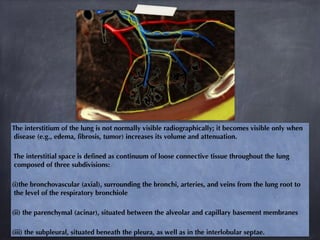
The interstitium of the lung is not normally visible radiographically; it becomes visible only when
disease (e.g., edema, fibrosis, tumor) increases its volume and attenuation.
The interstitial space is defined as continuum of loose connective tissue throughout the lung
composed of three subdivisions:
(i)the bronchovascular (axial), surrounding the bronchi, arteries, and veins from the lung root to
the level of the respiratory bronchiole
(ii) the parenchymal (acinar), situated between the alveolar and capillary basement membranes
(iii) the subpleural, situated beneath the pleura, as well as in the interlobular septae.
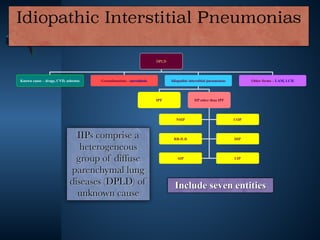
DPLD
Known cause – drugs, CVD, asbestos Granulomatous - sarcoidosis Idiopathic interstitial pneumonias Other forms – LAM, LCH
IPF IIP other than IPF
NSIP COP
RB-ILD DIP
AIP LIP
IIPs comprise a
heterogeneous
group of diffuse
parenchymal lung
diseases (DPLD) of
unknown cause
Include seven entities
Idiopathic Interstitial Pneumonias
History
Pathology
Laboratory
studies
Chest
radiology
Physical
examination
DIFFERENT
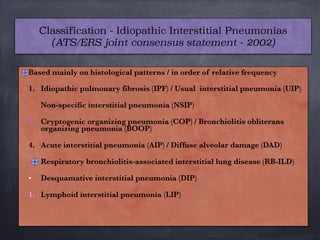
Based mainly on histological patterns / in order of relative frequency
1. Idiopathic pulmonary fibrosis (IPF) / Usual interstitial pneumonia (UIP)

2. Non-specific interstitial pneumonia (NSIP)

3. Cryptogenic organizing pneumonia (COP) / Bronchiolitis obliterans
organizing pneumonia (BOOP)

4. Acute interstitial pneumonia (AIP) / Diffuse alveolar damage (DAD)

Respiratory bronchiolitis-associated interstitial lung disease (RB-ILD)

• Desquamative interstitial pneumonia (DIP)

1. Lymphoid interstitial pneumonia (LIP)
Classification - Idiopathic Interstitial Pneumonias 

(ATS/ERS joint consensus statement - 2002)
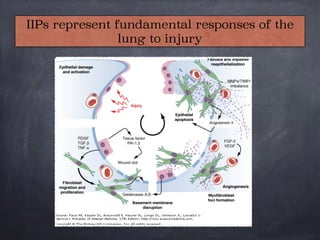
IIPs represent fundamental responses of the
lung to injury
Do not represent 'diseases' per se

Idiopathic - unknown cause
Interstitial pneumonia - injury to lung
parenchyma by varying patterns of
inflammation and fibrosis

All truly idiopathic or cryptogenic?
Common findings in collagen vascular
diseases and drug-related lung diseases
Idiopathic Interstitial Pneumonias
Achieving the correct diagnosis is a dynamic process
–diagnosis may take time
–may have to be revised at several stages

Final diagnosis only after all the data have been
reviewed by
Pulmonologist
Radiologist
Pathologist

Clinico-radiologic-pathologic diagnosis
•C-R-P diagnosis
Idiopathic Interstitial Pneumonias
Diagnosis
History
Nature of the first symptoms
dyspnoea /OE, cough +/–, little sputum

Progression

Comorbid diseases
CTD – arthritis, rashes, raynaud’s, dysphagia
Immune deficiency diseases
Drugs

Environmental / occupational exposures - with dates & durations
Asbestos, silica

Smoking status

Previous malignancies and treatment

Family history of lung diseases
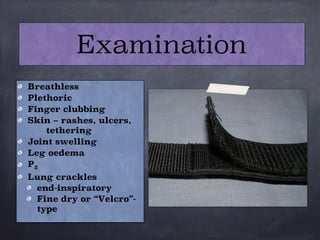
Breathless
Plethoric
Finger clubbing
Skin – rashes, ulcers,
tethering
Joint swelling
Leg oedema
P2
Lung crackles
end-inspiratory
Fine dry or “Velcro”-
type
Examination
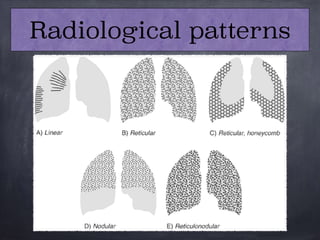
Interstitial lung disease may result in four patterns
of abnormal opacity on chest radiographs and CT
scans: linear, reticular, nodular, and
reticulonodular
These patterns are more accurately and specifically
defined on CT
Radiology
Radiological patterns
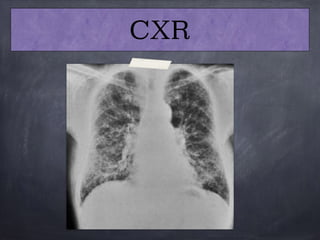
CXR
HRCT
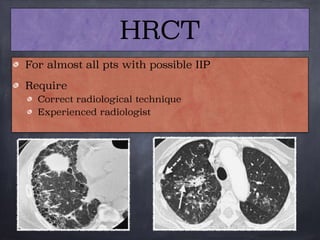
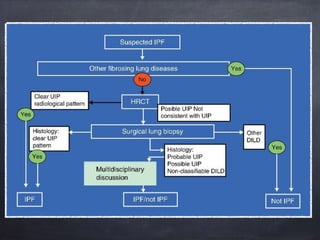
For almost all pts with possible IIP

Require
Correct radiological technique
Experienced radiologist
HRCT
Confident- UIP Confident- UIP Confident- UIP Confident- UIP
Biopsy
What is next?
Waiting for clinical / radiological deterioration before
obtaining biopsy is not recommended
– Delays diagnosis
– Least helpful when obtained late in the course of the
illness or after commencement of treatment
– Pt receives unnecessary or inappropriate treatments

CTD-associated ILD – biopsy is not usually performed
Surgical lung biopsy
Establishes a firm clinicopathological diagnosis

Prevents unnecessary exposure to toxic treatments

Confirms or excludes alternative diagnoses
– sarcoidosis, LAM, LCH, PAP, lymphangitis
carcinomatosis, occupational diseases
Benefits of Surgical lung biopsy
TBLB
– Not useful for most IIPs
• except AIP and occasionally COP
• Tissue obtained is very small
• May not be representative
– 1ry role is to exclude sarcoidosis, neoplasms and certain
infections
FOB
BAL
– Not essential

– Done as part of the diagnostic workup of a DPLD
• to exclude infection, tumour
• Rarely diagnostic – PAP, LCH
IPF/ UIP
UIP is a histological diagnosis

Has distinctive HRCT findings and they are usually
shown at lung biopsy

If the UIP pattern is of unknown cause the disease
is called
– Idiopathic pulmonary fibrosis (IPF)


IPF accounts for more than 60% of the cases of UIP
Requires exclusion of other known causes of UIP
– Drug toxicities – a long list
•Commonly cytotoxic agents

– Environmental exposures (asbestos, silica)

– Collagen vascular diseases
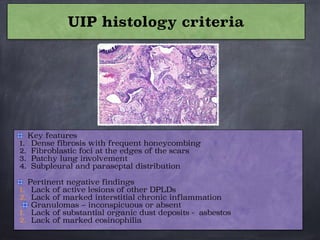
IPF/ UIP
Key features
1. Dense fibrosis with frequent honeycombing
2. Fibroblastic foci at the edges of the scars
3. Patchy lung involvement
4. Subpleural and paraseptal distribution

Pertinent negative findings
1. Lack of active lesions of other DPLDs
2. Lack of marked interstitial chronic inflammation
Granulomas – inconspicuous or absent
1. Lack of substantial organic dust deposits - asbestos
2. Lack of marked eosinophilia
UIP histology criteria
Age of onset > 50 yrs
–usually present > 6/12 after the onset

M > F – slightly

Dyspnoea
–the most prominent and gradual
–Occasionally – periods of rapid decline
• accelerated phase
intercurrent viral infection
• development of organizing pneumonia
• Diffuse alveolar damage

• Cough – paroxysmal

• Constitutional symptoms – unusual
Clinical features
Finger clubbing – 25-50%

Fine end-inspiratory crackles
– bases → other areas

Rt. Ht failure & leg oedema

Medium length of survival 2.5-3.5 yrs
Clinical features
BAL
–Neutrophil α extent of reticular damage

–E - mild – moderate

–L - not a feature
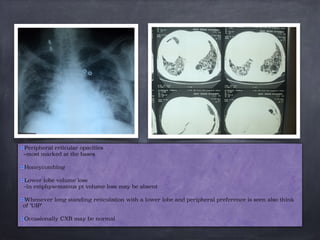
Peripheral reticular opacities
–most marked at the bases

Honeycombing

Lower lobe volume loss
–in emphysematous pt volume loss may be absent

Whenever long standing reticulation with a lower lobe and peripheral preference is seen also think
of ‘UIP’

Occasionally CXR may be normal
General
– Oxygen therapy
• For patients with documented hypoxia
– SpO2 < 89%
– PaO2 < 55 mmHg
• Improves exercise tolerance
– Adequate nutrition
– Immunizations (pneumococcal, influenza)
Pulmonary rehabilitation
– Treatment of PHT
– Single-lung transplantation is a viable
option
management
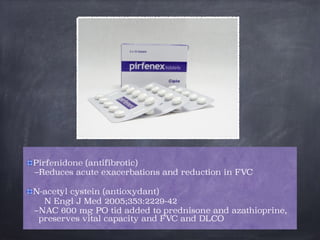
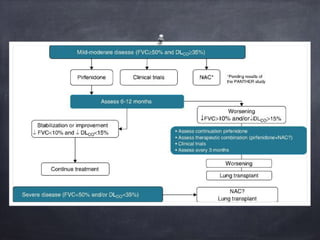
Pirfenidone (antifibrotic)
–Reduces acute exacerbations and reduction in FVC

N-acetyl cystein (antioxydant)
N Engl J Med 2005;353:2229-42
–NAC 600 mg PO tid added to prednisone and azathioprine,
preserves vital capacity and FVC and DLCO
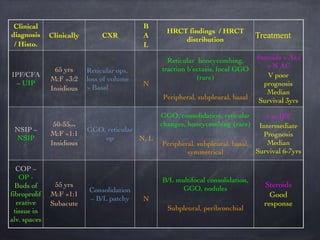
Clinical
diagnosis
/ Histo.
Clinically CXR
B
A
L
HRCT findings / HRCT
distribution Treatment
IPF/CFA
– UIP
65 yrs
M:F =3:2
Insidious
Reticular ops,
loss of volume
> Basal

N
Reticular honeycombing,
traction b’ectasis, focal GGO
(rare) 

Peripheral, subpleural, basal
Steroids + Aza
+ N AC
V poor
prognosis
Median
Survival 3yrs
NSIP –
NSIP
50-55yrs
M:F =1:1
Insidious
GGO, reticular
op

N, L
GGO, consolidation, reticular
changes, honeycombing (rare) 

Peripheral, subpleural, basal,
symmetrical
≈ to IPF
Intermediate
Prognosis
Median
Survival 6-7yrs
COP –
OP -
Buds of
fibroprolif
erative
tissue in
alv. spaces
55 yrs
M:F =1:1
Subacute
Consolidation
– B/L patchy

N
B/L multifocal consolidation,
GGO, nodules 

Subpleural, peribronchial
Steroids
Good
response
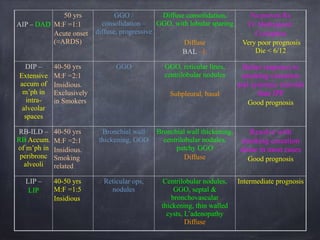
AIP – DAD
50 yrs
M:F =1:1
Acute onset
(≈ARDS)
GGO /
consolidation –
diffuse, progressive
Diffuse consolidation,
GGO, with lobular sparing

Diffuse
BAL - L
No proven Rx
IV Methylpred:
Cyclophos
Very poor prognosis
Die < 6/12
DIP –
Extensive
accum of
m’ph in
intra-
alveolar
spaces
40-50 yrs
M:F =2:1
Insidious.
Exclusively
in Smokers
GGO GGO, reticular lines,
centrilobular nodules

Subpleural, basal
Better response to
smoking cessation
and systemic steroids
than IPF
Good prognosis
RB-ILD –
RB Accum.
of m’ph in
peribronc
alveoli
40-50 yrs
M:F =2:1
Insidious.
Smoking
related
Bronchial wall
thickening, GGO
Bronchial wall thickening,
centrilobular nodules,
patchy GGO
Diffuse
Resolve with
smoking cessation
alone in most cases
Good prognosis
LIP –
LIP
40-50 yrs
M:F =1:5
Insidious
Reticular ops,
nodules
Centrilobular nodules,
GGO, septal &
bronchovascular
thickening, thin walled
cysts, L’adenopathy
Diffuse
Intermediate prognosis
Practical approach to interstitial lung diseases

Practical approach to interstitial lung diseases

  • 1.
    Practical approach tointerstitial lung diseases Hamdi Turkey - Pulmonologist
  • 2.
    The interstitium ofthe lung is not normally visible radiographically; it becomes visible only when disease (e.g., edema, fibrosis, tumor) increases its volume and attenuation. The interstitial space is defined as continuum of loose connective tissue throughout the lung composed of three subdivisions: (i)the bronchovascular (axial), surrounding the bronchi, arteries, and veins from the lung root to the level of the respiratory bronchiole (ii) the parenchymal (acinar), situated between the alveolar and capillary basement membranes (iii) the subpleural, situated beneath the pleura, as well as in the interlobular septae.
  • 3.
    DPLD Known cause –drugs, CVD, asbestos Granulomatous - sarcoidosis Idiopathic interstitial pneumonias Other forms – LAM, LCH IPF IIP other than IPF NSIP COP RB-ILD DIP AIP LIP IIPs comprise a heterogeneous group of diffuse parenchymal lung diseases (DPLD) of unknown cause Include seven entities Idiopathic Interstitial Pneumonias
  • 4.
  • 5.
    Based mainly onhistological patterns / in order of relative frequency 1. Idiopathic pulmonary fibrosis (IPF) / Usual interstitial pneumonia (UIP) 2. Non-specific interstitial pneumonia (NSIP) 3. Cryptogenic organizing pneumonia (COP) / Bronchiolitis obliterans organizing pneumonia (BOOP) 4. Acute interstitial pneumonia (AIP) / Diffuse alveolar damage (DAD) Respiratory bronchiolitis-associated interstitial lung disease (RB-ILD) • Desquamative interstitial pneumonia (DIP) 1. Lymphoid interstitial pneumonia (LIP) Classification - Idiopathic Interstitial Pneumonias 
 (ATS/ERS joint consensus statement - 2002)
  • 6.
    IIPs represent fundamentalresponses of the lung to injury
  • 7.
    Do not represent'diseases' per se Idiopathic - unknown cause Interstitial pneumonia - injury to lung parenchyma by varying patterns of inflammation and fibrosis All truly idiopathic or cryptogenic? Common findings in collagen vascular diseases and drug-related lung diseases Idiopathic Interstitial Pneumonias
  • 8.
    Achieving the correctdiagnosis is a dynamic process –diagnosis may take time –may have to be revised at several stages Final diagnosis only after all the data have been reviewed by Pulmonologist Radiologist Pathologist Clinico-radiologic-pathologic diagnosis •C-R-P diagnosis Idiopathic Interstitial Pneumonias Diagnosis
  • 9.
    History Nature of thefirst symptoms dyspnoea /OE, cough +/–, little sputum Progression Comorbid diseases CTD – arthritis, rashes, raynaud’s, dysphagia Immune deficiency diseases Drugs Environmental / occupational exposures - with dates & durations Asbestos, silica Smoking status Previous malignancies and treatment Family history of lung diseases
  • 10.
    Breathless Plethoric Finger clubbing Skin –rashes, ulcers, tethering Joint swelling Leg oedema P2 Lung crackles end-inspiratory Fine dry or “Velcro”- type Examination
  • 11.
    Interstitial lung diseasemay result in four patterns of abnormal opacity on chest radiographs and CT scans: linear, reticular, nodular, and reticulonodular These patterns are more accurately and specifically defined on CT Radiology
  • 12.
  • 13.
  • 14.
    HRCT For almost allpts with possible IIP Require Correct radiological technique Experienced radiologist
  • 15.
    HRCT Confident- UIP Confident-UIP Confident- UIP Confident- UIP Biopsy What is next?
  • 16.
    Waiting for clinical/ radiological deterioration before obtaining biopsy is not recommended – Delays diagnosis – Least helpful when obtained late in the course of the illness or after commencement of treatment – Pt receives unnecessary or inappropriate treatments CTD-associated ILD – biopsy is not usually performed Surgical lung biopsy
  • 17.
    Establishes a firmclinicopathological diagnosis Prevents unnecessary exposure to toxic treatments Confirms or excludes alternative diagnoses – sarcoidosis, LAM, LCH, PAP, lymphangitis carcinomatosis, occupational diseases Benefits of Surgical lung biopsy
  • 18.
    TBLB – Not usefulfor most IIPs • except AIP and occasionally COP • Tissue obtained is very small • May not be representative – 1ry role is to exclude sarcoidosis, neoplasms and certain infections FOB BAL – Not essential – Done as part of the diagnostic workup of a DPLD • to exclude infection, tumour • Rarely diagnostic – PAP, LCH
  • 19.
    IPF/ UIP UIP isa histological diagnosis Has distinctive HRCT findings and they are usually shown at lung biopsy If the UIP pattern is of unknown cause the disease is called – Idiopathic pulmonary fibrosis (IPF)
 IPF accounts for more than 60% of the cases of UIP
  • 20.
    Requires exclusion ofother known causes of UIP – Drug toxicities – a long list •Commonly cytotoxic agents – Environmental exposures (asbestos, silica) – Collagen vascular diseases IPF/ UIP
  • 21.
    Key features 1. Densefibrosis with frequent honeycombing 2. Fibroblastic foci at the edges of the scars 3. Patchy lung involvement 4. Subpleural and paraseptal distribution Pertinent negative findings 1. Lack of active lesions of other DPLDs 2. Lack of marked interstitial chronic inflammation Granulomas – inconspicuous or absent 1. Lack of substantial organic dust deposits - asbestos 2. Lack of marked eosinophilia UIP histology criteria
  • 22.
    Age of onset> 50 yrs –usually present > 6/12 after the onset M > F – slightly Dyspnoea –the most prominent and gradual –Occasionally – periods of rapid decline • accelerated phase intercurrent viral infection • development of organizing pneumonia • Diffuse alveolar damage • Cough – paroxysmal • Constitutional symptoms – unusual Clinical features
  • 23.
    Finger clubbing –25-50% Fine end-inspiratory crackles – bases → other areas Rt. Ht failure & leg oedema Medium length of survival 2.5-3.5 yrs Clinical features BAL –Neutrophil α extent of reticular damage –E - mild – moderate –L - not a feature
  • 24.
    Peripheral reticular opacities –mostmarked at the bases Honeycombing Lower lobe volume loss –in emphysematous pt volume loss may be absent Whenever long standing reticulation with a lower lobe and peripheral preference is seen also think of ‘UIP’ Occasionally CXR may be normal
  • 26.
    General – Oxygen therapy •For patients with documented hypoxia – SpO2 < 89% – PaO2 < 55 mmHg • Improves exercise tolerance – Adequate nutrition – Immunizations (pneumococcal, influenza) Pulmonary rehabilitation – Treatment of PHT – Single-lung transplantation is a viable option management
  • 27.
    Pirfenidone (antifibrotic) –Reduces acuteexacerbations and reduction in FVC N-acetyl cystein (antioxydant) N Engl J Med 2005;353:2229-42 –NAC 600 mg PO tid added to prednisone and azathioprine, preserves vital capacity and FVC and DLCO
  • 29.
    Clinical diagnosis / Histo. Clinically CXR B A L HRCTfindings / HRCT distribution Treatment IPF/CFA – UIP 65 yrs M:F =3:2 Insidious Reticular ops, loss of volume > Basal N Reticular honeycombing, traction b’ectasis, focal GGO (rare) Peripheral, subpleural, basal Steroids + Aza + N AC V poor prognosis Median Survival 3yrs NSIP – NSIP 50-55yrs M:F =1:1 Insidious GGO, reticular op N, L GGO, consolidation, reticular changes, honeycombing (rare) Peripheral, subpleural, basal, symmetrical ≈ to IPF Intermediate Prognosis Median Survival 6-7yrs COP – OP - Buds of fibroprolif erative tissue in alv. spaces 55 yrs M:F =1:1 Subacute Consolidation – B/L patchy N B/L multifocal consolidation, GGO, nodules Subpleural, peribronchial Steroids Good response
  • 30.
    AIP – DAD 50yrs M:F =1:1 Acute onset (≈ARDS) GGO / consolidation – diffuse, progressive Diffuse consolidation, GGO, with lobular sparing Diffuse BAL - L No proven Rx IV Methylpred: Cyclophos Very poor prognosis Die < 6/12 DIP – Extensive accum of m’ph in intra- alveolar spaces 40-50 yrs M:F =2:1 Insidious. Exclusively in Smokers GGO GGO, reticular lines, centrilobular nodules Subpleural, basal Better response to smoking cessation and systemic steroids than IPF Good prognosis RB-ILD – RB Accum. of m’ph in peribronc alveoli 40-50 yrs M:F =2:1 Insidious. Smoking related Bronchial wall thickening, GGO Bronchial wall thickening, centrilobular nodules, patchy GGO Diffuse Resolve with smoking cessation alone in most cases Good prognosis LIP – LIP 40-50 yrs M:F =1:5 Insidious Reticular ops, nodules Centrilobular nodules, GGO, septal & bronchovascular thickening, thin walled cysts, L’adenopathy Diffuse Intermediate prognosis