Pneumoconiosis
Hamdi Turkey- Pulmonologist
Definition
•Non neoplastic lung reaction to inhalation of mineral
dusts encountered in the workplace.

•Also includes diseases induced by organic, inorganic
particulates and chemical fumes and vapors.

•Important to diagnose as they are “occupational lung
diseases.”e.g. silica, coal, asbestos

•Some dusts e.g. tin, iron are innocuous
Normal protective mechanisms
•Mucociliary apparatus >10 μm diameter, deposit in bronchi
& bronchioles and removed in the mucociliary escalator.

•Intra-alveolar macrophages-phagocytosis of particles &
expectorated. Some go through interstitium into
lymphatics.

•Very Small particles behave like gas & exhaled
•Nose & trachea traps all particles >10 μm 
& 50% of 3μm

•Mucociliary blanket 2-10 μm removed in the mucociliary
escalator.

•Alveolar macrophages <2 μm removed

•Very small particles are not phagocytosed,but exhaled.
Normal protective mechanisms
•Amount of dust retained in the lung (concentration,
duration, clearence mechanisms)

•Size, shape and bouyancy of particles (aerodynamic
diameter) (1-5μ size dangerous sized particles reach the
periphery : bronchioles & alveoli)

•Additional effects of other irritants (smoking)

• Solubility & physiochemical

• reactivity
Factors affecting fibrogenic potential
Solubility & cytotoxicity of particles
•Small particles dissolve in pulmonary fluids→ acute
toxicity
•Larger,non soluble persist in lung parenchyma
•Some dusts directly penetrate the epithelial cells into the
interstitium.

Physiochemical reactivity 
•Direct injury to tissue (free radicals )e.g. Quartz
Fibrosing pneumoconiosis (eg silicosis)
Factors affecting fibrogenic potential
Pathogenesis
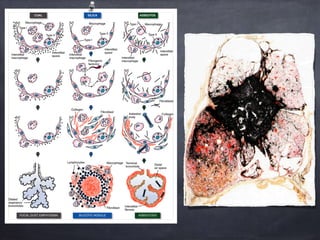
• Ingested dusts trigger macrophages to release
chemical mediators that trigger fibrosis (TNF, IL
1,PDGF).
• Persistent release of factors causes fibrosis
• Migrating macrophages to lymphatics trigger
immune reaction 
• Fibrosis (nodular-silica, interstitial – asbestos ??)
• Inhalation 
• Escape removal by defence apparatus
• Particles penetrate epithelium → direct injury
• Fibrosis 
• Engulfment by alveolar & interstitial macrophages
→ lymphatics → lymph node (modify immune
response )
Pathogenesis
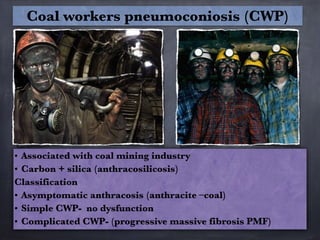
• Associated with coal mining industry
• Carbon + silica (anthracosilicosis)
Classification
• Asymptomatic anthracosis (anthracite –coal)
• Simple CWP- no dysfunction
• Complicated CWP- (progressive massive fibrosis PMF)
Coal workers pneumoconiosis (CWP)
•Gross Streaks of anthracotic pigment in
lymphatics and draining hilar lymph nodes
Microscopy 
•Carbon pigment in alveolar and interstitial
macrophages,in connective tissue and
lymphatics and lung hilus.
Anthracosis (urban dwellers)

morphology
Gross :Coal macules (1-2mm) & Coal nodules
>upper lobes and upper zones of lower lobes

Microscopy: Carbon laden macrophages & delicate
collagen fibres. Adjacent to respiratory bronchioles
initially (where dust settles), later interstium &
alveoli.

Dilatation of respiratory bronchioles –focal dust
emphysema
Simple CWP
Gross
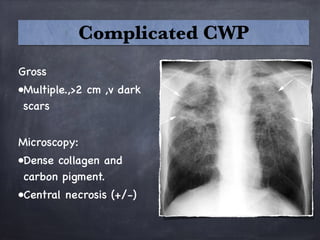
•Multiple.,>2 cm ,v dark
scars

Microscopy:
•Dense collagen and
carbon pigment.
•Central necrosis (+/-)
Complicated CWP
• Usually asymptomatic with little decrease of lung function
• PMF pulmonary dysfunction (restrictive)
• Pulmonary hypertension, cor pulmonale
• Progressive even if further exposure to dust is prevented
• ↑ chronic bronchitis and emphysema
• No association with TB or carcinoma 
Clinical course
• 1st
described in coal workers, may be seen in
other pneumoconiosis
• ?? Immunopathologic mechanism
• Rheumatoid arthritis (RA) + Rheumatoid
nodules (Caplan nodules) in the lung 
• Rheumatoid arthritis + pneumoconioses
• Caplans nodule = necrosis surrounded by
fibroblasts,monocytes and collagen
• s/s RA > lung symptoms
Caplans syndrome
Silicosis

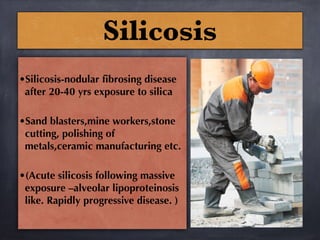
•Silicosis-nodular fibrosing disease
after 20-40 yrs exposure to silica

•Sand blasters,mine workers,stone
cutting, polishing of
metals,ceramic manufacturing etc.

•(Acute silicosis following massive
exposure –alveolar lipoproteinosis
like. Rapidly progressive disease. )
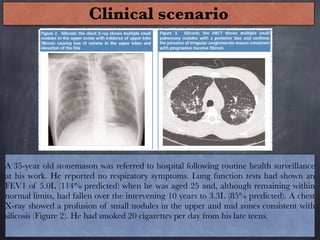
A 35-year old stonemason was referred to hospital following routine health surveillance
at his work. He reported no respiratory symptoms. Lung function tests had shown an
FEV1 of 5.0L (114% predicted) when he was aged 25 and, although remaining within
normal limits, had fallen over the intervening 10 years to 3.3L (85% predicted). A chest
X-ray showed a profusion of small nodules in the upper and mid zones consistent with
silicosis (Figure 2). He had smoked 20 cigarettes per day from his late teens.
Clinical scenario
Pathogenesis
• Fibrogenic activity depends on physical form, association
with other minerals. 
• Crystalline silica (quartz) more toxic.
• (Amorphous forms talc, mica less toxic)
• Size 0.2-2μm more dangerous
• Silica particles ingested by alveolar macrophages, kill them
and release fibrogenic factors. Released silica ingested
again.
• Recruitment of lymphocytes and macrophages
• Fibrotic silicotic nodule
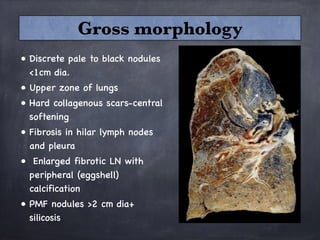
• Discrete pale to black nodules
<1cm dia.
• Upper zone of lungs
• Hard collagenous scars-central
softening
• Fibrosis in hilar lymph nodes
and pleura
• Enlarged fibrotic LN with
peripheral (eggshell)
calcification 
• PMF nodules >2 cm dia+
silicosis
Gross morphology
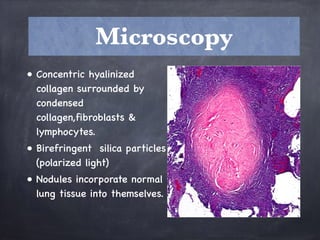
• Concentric hyalinized
collagen surrounded by
condensed
collagen,fibroblasts &
lymphocytes.
• Birefringent silica particles
(polarized light)
• Nodules incorporate normal
lung tissue into themselves.
Microscopy
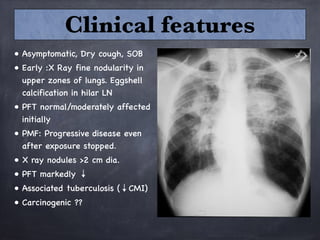
• Asymptomatic, Dry cough, SOB
• Early :X Ray fine nodularity in
upper zones of lungs. Eggshell
calcification in hilar LN
• PFT normal/moderately affected
initially 
• PMF: Progressive disease even
after exposure stopped.
• X ray nodules >2 cm dia.
• PFT markedly ↓
• Associated tuberculosis (↓CMI)
• Carcinogenic ??
Clinical features
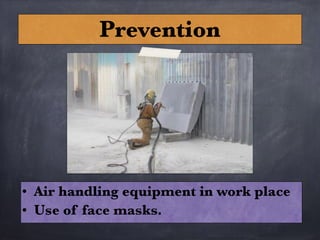
Prevention
• Air handling equipment in work place
• Use of face masks.
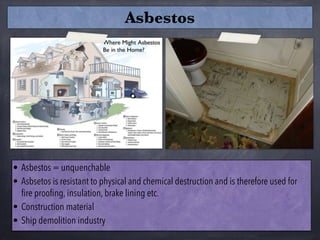
• Asbestos = unquenchable
• Asbsetos is resistant to physical and chemical destruction and is therefore used for
fire proofing, insulation, brake lining etc.
• Construction material
• Ship demolition industry
Asbestos
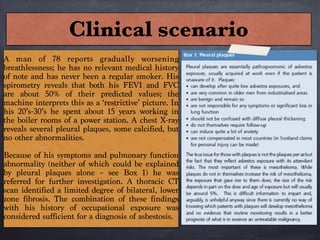
Clinical scenario
A man of 78 reports gradually worsening
breathlessness; he has no relevant medical history
of note and has never been a regular smoker. His
spirometry reveals that both his FEV1 and FVC
are about 50% of their predicted values; the
machine interprets this as a ‘restrictive’ picture. In
his 20’s-30’s he spent about 15 years working in
the boiler rooms of a power station. A chest X-ray
reveals several pleural plaques, some calcified, but
no other abnormalities.

Because of his symptoms and pulmonary function
abnormality (neither of which could be explained
by pleural plaques alone – see Box 1) he was
referred for further investigation. A thoracic CT
scan identified a limited degree of bilateral, lower
zone fibrosis. The combination of these findings
with his history of occupational exposure was
considered sufficient for a diagnosis of asbestosis.
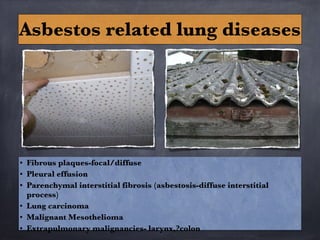
• Fibrous plaques-focal/diffuse
• Pleural effusion
• Parenchymal interstitial fibrosis (asbestosis-diffuse interstitial
process)
• Lung carcinoma
• Malignant Mesothelioma
• Extrapulmonary malignancies- larynx,?colon
Asbestos related lung diseases
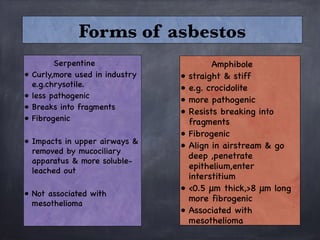
Serpentine 
• Curly,more used in industry
e.g.chrysotile.
• less pathogenic
• Breaks into fragments 
• Fibrogenic 

• Impacts in upper airways &
removed by mucociliary
apparatus & more soluble-
leached out

• Not associated with
mesothelioma
Amphibole
• straight & stiff 
• e.g. crocidolite
• more pathogenic 
• Resists breaking into
fragments 
• Fibrogenic 
• Align in airstream & go
deep ,penetrate
epithelium,enter
interstitium
• <0.5 μm thick,>8 μm long
more fibrogenic 
• Associated with
mesothelioma
Forms of asbestos
Fibrogenic potential like other inorganic dusts
Tumour initiator and promoter

Asbestos fibers localized in distal airways (close to
mesothelium) release reactive free radicals 

Absorption of carcinogens on asbestos fibres e.g.
smoking
Pathogenesis
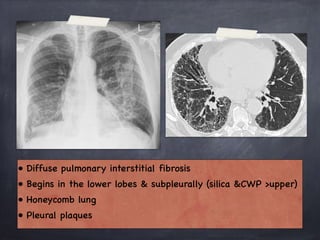
• Diffuse pulmonary interstitial fibrosis
• Begins in the lower lobes & subpleurally (silica &CWP >upper)
• Honeycomb lung 
• Pleural plaques
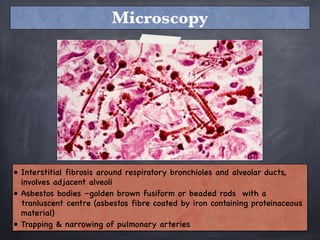
• Interstitial fibrosis around respiratory bronchioles and alveolar ducts,
involves adjacent alveoli
• Asbestos bodies –golden brown fusiform or beaded rods with a
tranluscent centre (asbestos fibre coated by iron containing proteinaceous
material)
• Trapping & narrowing of pulmonary arteries
Microscopy
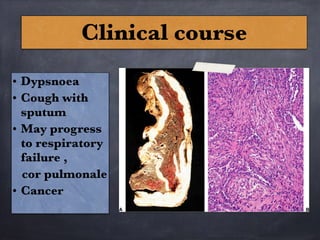
Clinical course
• Dypsnoea
• Cough with
sputum
• May progress
to respiratory
failure ,
cor pulmonale
• Cancer
Pneumoconiosis

Pneumoconiosis

  • 1.
  • 2.
    Definition •Non neoplastic lungreaction to inhalation of mineral dusts encountered in the workplace. •Also includes diseases induced by organic, inorganic particulates and chemical fumes and vapors. •Important to diagnose as they are “occupational lung diseases.”e.g. silica, coal, asbestos •Some dusts e.g. tin, iron are innocuous
  • 4.
    Normal protective mechanisms •Mucociliaryapparatus >10 μm diameter, deposit in bronchi & bronchioles and removed in the mucociliary escalator. •Intra-alveolar macrophages-phagocytosis of particles & expectorated. Some go through interstitium into lymphatics. •Very Small particles behave like gas & exhaled
  • 5.
    •Nose & tracheatraps all particles >10 μm & 50% of 3μm •Mucociliary blanket 2-10 μm removed in the mucociliary escalator. •Alveolar macrophages <2 μm removed •Very small particles are not phagocytosed,but exhaled. Normal protective mechanisms
  • 6.
    •Amount of dustretained in the lung (concentration, duration, clearence mechanisms) •Size, shape and bouyancy of particles (aerodynamic diameter) (1-5μ size dangerous sized particles reach the periphery : bronchioles & alveoli) •Additional effects of other irritants (smoking) • Solubility & physiochemical • reactivity Factors affecting fibrogenic potential
  • 7.
    Solubility & cytotoxicityof particles •Small particles dissolve in pulmonary fluids→ acute toxicity •Larger,non soluble persist in lung parenchyma •Some dusts directly penetrate the epithelial cells into the interstitium. Physiochemical reactivity •Direct injury to tissue (free radicals )e.g. Quartz Fibrosing pneumoconiosis (eg silicosis) Factors affecting fibrogenic potential
  • 8.
    Pathogenesis • Ingested duststrigger macrophages to release chemical mediators that trigger fibrosis (TNF, IL 1,PDGF). • Persistent release of factors causes fibrosis • Migrating macrophages to lymphatics trigger immune reaction • Fibrosis (nodular-silica, interstitial – asbestos ??)
  • 9.
    • Inhalation •Escape removal by defence apparatus • Particles penetrate epithelium → direct injury • Fibrosis • Engulfment by alveolar & interstitial macrophages → lymphatics → lymph node (modify immune response ) Pathogenesis
  • 10.
    • Associated withcoal mining industry • Carbon + silica (anthracosilicosis) Classification • Asymptomatic anthracosis (anthracite –coal) • Simple CWP- no dysfunction • Complicated CWP- (progressive massive fibrosis PMF) Coal workers pneumoconiosis (CWP)
  • 11.
    •Gross Streaks ofanthracotic pigment in lymphatics and draining hilar lymph nodes Microscopy •Carbon pigment in alveolar and interstitial macrophages,in connective tissue and lymphatics and lung hilus. Anthracosis (urban dwellers)
 morphology
  • 12.
    Gross :Coal macules(1-2mm) & Coal nodules >upper lobes and upper zones of lower lobes Microscopy: Carbon laden macrophages & delicate collagen fibres. Adjacent to respiratory bronchioles initially (where dust settles), later interstium & alveoli. Dilatation of respiratory bronchioles –focal dust emphysema Simple CWP
  • 13.
    Gross •Multiple.,>2 cm ,vdark scars Microscopy: •Dense collagen and carbon pigment. •Central necrosis (+/-) Complicated CWP
  • 14.
    • Usually asymptomaticwith little decrease of lung function • PMF pulmonary dysfunction (restrictive) • Pulmonary hypertension, cor pulmonale • Progressive even if further exposure to dust is prevented • ↑ chronic bronchitis and emphysema • No association with TB or carcinoma Clinical course
  • 16.
    • 1st described incoal workers, may be seen in other pneumoconiosis • ?? Immunopathologic mechanism • Rheumatoid arthritis (RA) + Rheumatoid nodules (Caplan nodules) in the lung • Rheumatoid arthritis + pneumoconioses • Caplans nodule = necrosis surrounded by fibroblasts,monocytes and collagen • s/s RA > lung symptoms Caplans syndrome
  • 17.
    Silicosis •Silicosis-nodular fibrosing disease after20-40 yrs exposure to silica •Sand blasters,mine workers,stone cutting, polishing of metals,ceramic manufacturing etc. •(Acute silicosis following massive exposure –alveolar lipoproteinosis like. Rapidly progressive disease. )
  • 18.
    A 35-year oldstonemason was referred to hospital following routine health surveillance at his work. He reported no respiratory symptoms. Lung function tests had shown an FEV1 of 5.0L (114% predicted) when he was aged 25 and, although remaining within normal limits, had fallen over the intervening 10 years to 3.3L (85% predicted). A chest X-ray showed a profusion of small nodules in the upper and mid zones consistent with silicosis (Figure 2). He had smoked 20 cigarettes per day from his late teens. Clinical scenario
  • 19.
    Pathogenesis • Fibrogenic activitydepends on physical form, association with other minerals. • Crystalline silica (quartz) more toxic. • (Amorphous forms talc, mica less toxic) • Size 0.2-2μm more dangerous • Silica particles ingested by alveolar macrophages, kill them and release fibrogenic factors. Released silica ingested again. • Recruitment of lymphocytes and macrophages • Fibrotic silicotic nodule
  • 20.
    • Discrete paleto black nodules <1cm dia. • Upper zone of lungs • Hard collagenous scars-central softening • Fibrosis in hilar lymph nodes and pleura • Enlarged fibrotic LN with peripheral (eggshell) calcification • PMF nodules >2 cm dia+ silicosis Gross morphology
  • 21.
    • Concentric hyalinized collagensurrounded by condensed collagen,fibroblasts & lymphocytes. • Birefringent silica particles (polarized light) • Nodules incorporate normal lung tissue into themselves. Microscopy
  • 22.
    • Asymptomatic, Drycough, SOB • Early :X Ray fine nodularity in upper zones of lungs. Eggshell calcification in hilar LN • PFT normal/moderately affected initially • PMF: Progressive disease even after exposure stopped. • X ray nodules >2 cm dia. • PFT markedly ↓ • Associated tuberculosis (↓CMI) • Carcinogenic ?? Clinical features
  • 23.
    Prevention • Air handlingequipment in work place • Use of face masks.
  • 24.
    • Asbestos =unquenchable • Asbsetos is resistant to physical and chemical destruction and is therefore used for fire proofing, insulation, brake lining etc. • Construction material • Ship demolition industry Asbestos
  • 25.
    Clinical scenario A manof 78 reports gradually worsening breathlessness; he has no relevant medical history of note and has never been a regular smoker. His spirometry reveals that both his FEV1 and FVC are about 50% of their predicted values; the machine interprets this as a ‘restrictive’ picture. In his 20’s-30’s he spent about 15 years working in the boiler rooms of a power station. A chest X-ray reveals several pleural plaques, some calcified, but no other abnormalities. Because of his symptoms and pulmonary function abnormality (neither of which could be explained by pleural plaques alone – see Box 1) he was referred for further investigation. A thoracic CT scan identified a limited degree of bilateral, lower zone fibrosis. The combination of these findings with his history of occupational exposure was considered sufficient for a diagnosis of asbestosis.
  • 26.
    • Fibrous plaques-focal/diffuse •Pleural effusion • Parenchymal interstitial fibrosis (asbestosis-diffuse interstitial process) • Lung carcinoma • Malignant Mesothelioma • Extrapulmonary malignancies- larynx,?colon Asbestos related lung diseases
  • 27.
    Serpentine • Curly,moreused in industry e.g.chrysotile. • less pathogenic • Breaks into fragments • Fibrogenic • Impacts in upper airways & removed by mucociliary apparatus & more soluble- leached out • Not associated with mesothelioma Amphibole • straight & stiff • e.g. crocidolite • more pathogenic • Resists breaking into fragments • Fibrogenic • Align in airstream & go deep ,penetrate epithelium,enter interstitium • <0.5 μm thick,>8 μm long more fibrogenic • Associated with mesothelioma Forms of asbestos
  • 28.
    Fibrogenic potential likeother inorganic dusts Tumour initiator and promoter Asbestos fibers localized in distal airways (close to mesothelium) release reactive free radicals Absorption of carcinogens on asbestos fibres e.g. smoking Pathogenesis
  • 29.
    • Diffuse pulmonaryinterstitial fibrosis • Begins in the lower lobes & subpleurally (silica &CWP >upper) • Honeycomb lung • Pleural plaques
  • 30.
    • Interstitial fibrosisaround respiratory bronchioles and alveolar ducts, involves adjacent alveoli • Asbestos bodies –golden brown fusiform or beaded rods with a tranluscent centre (asbestos fibre coated by iron containing proteinaceous material) • Trapping & narrowing of pulmonary arteries Microscopy
  • 31.
    Clinical course • Dypsnoea •Cough with sputum • May progress to respiratory failure , cor pulmonale • Cancer