Interstitial Lung Disease
• ILD refers to a heterogeneous collection of
more than one hundred distinct lung disorders
that tend to be grouped together because
they share clinical, radiographic, and
pathologic features.
• These disorders are sometimes called diffuse
parenchymal lung disease (DPLD) to make the
point that the interstitium is not the only
compartment of the lung affected.
CLASSIFICATION
Several classification schemes for ILD have been
proposed.
• Histopathologic &
• Clinical characteristics
• American Thoracic Society (ATS)/European
Respiratory Society (ERS) consensus panel
classification system (2001)
Clinical History
• Typical presentation of ILD -nonspecific
• Dyspnea on exertion or cough & abnormal
radiograph.
• Symptoms are usually progressive.
• two-thirds of patients with ILD are over 60
years of age at diagnosis.
• Women- LAM
Time Course of Disease Onset
Acute:
• Cryptogenic organizing pneumonia (COP)
• Acute eosinophilic pneumonia (AEP)
• Acute hypersensitivity pneumonitis
• Diffuse alveolar hemorrhage
• Acute interstitial pneumonia (AIP)
• Acute exacerbation of idiopathic pulmonary
fibrosis or other ILDs
Subacute to Chronic
• Connective tissue disease–associated ILD
• Idiopathic pulmonary fibrosis (IPF)
• Sarcoidosis
• Chronic hypersensitivity pneumonitis (CHP)
• Occupational lung disease
• Nonspecific interstitial pneumonia (NSIP)
• Desquamative interstitial pneumonitis (DIP)
• Respiratory bronchiolitis interstitial lung disease (RB-ILD)
• Lymphocytic interstitial pneumonia (LIP)
• Chronic eosinophilic pneumonia (CEP)
• h/o wheezing- hypersensitivity pneumonitis,
eosinophilic pneumonia or sarcoidosis.
• h/o pleuritic chest pain- serositis in a patient
with CTD, or pneumothorax from LAM, LCH.
• Hemoptysis- diffuse alveolar hemorrhage
Systemic Symptoms
• Connective tissue disease is a frequent cause
of ILD
• nonspecific symptoms such as night sweats,
fever, fatigue, or weight loss suggest an
underlying inflammatory condition.
Dermatologic symptoms
Dermatomyositis
Gottron’s papules, or
“mechanic’s hands
• Systemic sclerosis
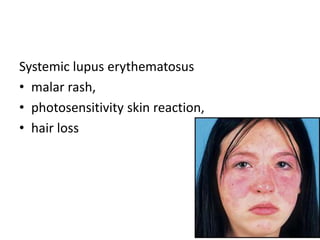
Systemic lupus erythematosus
• malar rash,
• photosensitivity skin reaction,
• hair loss
Gastrointestinal symptoms
• esophageal motility problems- systemic
sclerosis and polymyositis
• Chronic, intermittent aspiration can lead to
progressive fibrotic lung disease.
• bloating and diarrhea- inflammatory bowel
disease
Musculoskeletal complaints
• Connective tissue disease- arthralgias,
morning stiffness, joint swelling and
erythema.
• Swollen fingers (“sausage digits”) may be
observed in systemic sclerosis and
polymyositis.
• Raynaud’s phenomenon- scleroderma, mixed
CTD, SLE & antisynthetase syndrome.
Ophthalmologic symptoms
• Dry eyes- Sjögren syndrome
• h/o uveitis may have- SLE or sarcoidosis
• Increasing edema, syncopal events, or
exertional chest discomfort may indicate
severe pulmonary hypertension.
• presence of palpitations or syncope in a
patient with sarcoidosis - Cardiac sarcoidosis.
• pleuritic chest pain, leg swelling & increasing
dyspnea- consideration of acute pulmonary
embolism.
PAST MEDICAL HISTORY
• Prior diagnosis of connective tissue disease
• Case of HIV disease- lymphocytic interstitial
pneumonia (LIP) are common.
• h/o acute or chronic kidney disease might
suggest underlying vasculitis, pulmonary–
renal syndromes, or CTD.
• h/o liver disease could suggest sarcoidosis,
primary biliary cirrhosis.
OCCUPATIONAL HISTORY
• Inorganic Exposure
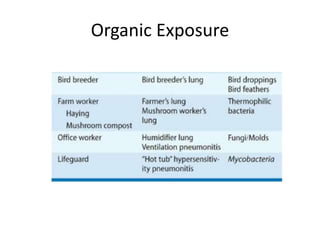
• Organic Exposure
Inorganic Exposure
Organic Exposure
MEDICATION HISTORY
• Nitrofurantoin
• Amiodarone
• NSAIDs
• h/o recent chemotherapy
• h/o immune-modulating drug use
PHYSICAL EXAMINATION
• Typical ‘velcro’ crepts - IPF, crepts frequently absent in
sarcoidosis.
• Inspiratory squeaks – COP.
• Clubbing- IPF, DIP, IBD.
• Skin involvement- Sarcoidosis, CTD, Vasculitis,
Tuberous sclerosis.
• Arthritis- CTD, sarcoidosis.
• Eye changes (uveitis, conjunctivitis)- , Sarcoidosis, CTD.
• Muscle weakness- Polymyositis, dermatomyositis.
• Neuropathy- Sarcoidosis, CTD.
• Lymphadenopathy- Sarcoidosis, CTD.
CHEST IMAGING
• Abnormal chest radiograph is often the first
indication of underlying ILD.
• Normal : Sarcoidosis, CTD, RB-ILD
Distribution of ILD
Pattern of ILD
HRCT
• more sensitive than chest radiograph
Radiographic Characteristics of the UIP Pattern
“Definite UIP”
• Peripheral, subpleural distribution
• Basilar predominance
• Reticular markings and traction bronchiectasis
• Honeycombing
• Absence of inconsistent features
• peripheral reticular markings
• small subpleural cysts/honeycombing
Idiopathic pulmonary fibrosis
• ground-glass opacities in a peripheral distribution
• reticular markings
• Subpleural sparing is evident
Nonspecific interstitial pneumonia
• ground-glass opacities and areas of consolidation
• A 58-year-old woman with organizing pneumonia
(OP) secondary to radiation for breast cancer
LABORATORY TESTING
• Elevated liver enzymes or hypercalcemia-
Sarcoidosis
• Renal insufficiency- Pulmonary renal
syndromes-
• Peripheral eosinophilia- chronic eosinophilic
pneumonia, Churg–Strauss syndrome, drug
reaction.
Serologic testing
PULMONARY FUNCTION TESTS
• Most forms of ILD demonstrates a restrictive
ventilatory defect due to decreased
compliance and increased recoil of the lung
parenchyma.
• Presence of obstruction suggests either
concomitant obstructive lung disease, or the
presence of an airway-centered lung ILD such
as LCH, LAM or sarcoidosis.
BRONCHOSCOPY
• useful in the diagnosis of DPLD.
• inspection of the upper and lower airways,
bronchoalveolar lavage (BAL), and the
performance of transbronchial lung biopsy.
BAL:
• Cell count and differential,
• Cytology,
• Viral assays
• Microbiologic cultures
• bloody lavage specimens- diffuse alveolar
hemorrhage
• milky white BAL fluid- pulmonary alveolar
proteinosis
• BAL eosinophilia (>25%)- acute eosinophilic
pneumonia
• BAL lymphocytosis - granulomatous ILD,
suggestive of hypersensitivity pneumonitis,
drug reaction, or cellular NSIP
• Positive lymphocyte proliferation assay in
chronic beryllium disease.
• Asbestos bodies in asbestosis.
• CD1a positive cells on flow cytometry may
lead to a diagnosis of LCH.
• In the immunocompromised host, BAL fluid is
highly sensitive for the diagnosis of bacterial,
viral, fungal, and mycobacterial diseases.
SURGICAL LUNG BIOPSY
• Despite a high yield in certain forms of lung
disease, the utility of transbronchial biopsy for
most of the IIP (such as IPF, NSIP, and LIP) is
low and surgical biopsy is often required for
accurate diagnosis.
• The usual technique is video-assisted
thoracoscopic surgery (VATS) that has a low
morbidity and mortality in selected
populations.
TREATMENT
• REMOVAL FROM EXPOSURES
• IMMUNOSUPPRESSIVE THERAPY
• ANTIFIBROTIC DRUGS
• TREATMENT OF COMORBIDITIES
• PALLIATIVE CARE
• LUNG TRANSPLANTATION
Treatment objectives in ILD
1. Provide symptom-relief
2. Slow down disease progression
3. Prevent complications
4. Improve quality of life
5. Prolong survival
6. Prevent treatment-complications
7. End-of-Life care and palliative treatment
REMOVAL FROM EXPOSURES
• drug reaction is suspected- should be
discontinued
• mold growth, removal of birds from the home,
extensive cleaning of upholstery, window
coverings, and ventilation systems.
• occupational exposures- avoided
IMMUNOSUPPRESSIVE THERAPY
• Some forms of ILD, including COP, CTD–
associated ILD, and sarcoidosis, shows favorable
response to steroids and other
immunosuppressive agents.
• when a more prolonged course of therapy is
anticipated, azathioprine or cyclophosphamide,
permit low dose of steroids.
• If no clinical improvement is seen after 3 to 6
months of therapy, discontinuation of
immunosuppressive therapy should be strongly
considered.
ANTIFIBROTIC DRUGS
• Useful in progressive fibrotic lung diseases.
• Pirfenidone, a small-molecule drug which
have antifibrotic properties.
• stabilize lung function.
Lung transplant
• Most patients with ILD referred for lung
transplantation have IPF- advanced stage.
• a severely impaired DLCO (<39%) as well as
advanced fibrosis on HRCT predict poor
survival and are considered to be triggers for
active listing.
• Early referral to a lung transplant center is
useful

ild-190205120035 (1).pdf

  • 1.
  • 2.
    • ILD refersto a heterogeneous collection of more than one hundred distinct lung disorders that tend to be grouped together because they share clinical, radiographic, and pathologic features. • These disorders are sometimes called diffuse parenchymal lung disease (DPLD) to make the point that the interstitium is not the only compartment of the lung affected.
  • 3.
    CLASSIFICATION Several classification schemesfor ILD have been proposed. • Histopathologic & • Clinical characteristics • American Thoracic Society (ATS)/European Respiratory Society (ERS) consensus panel classification system (2001)
  • 5.
    Clinical History • Typicalpresentation of ILD -nonspecific • Dyspnea on exertion or cough & abnormal radiograph. • Symptoms are usually progressive. • two-thirds of patients with ILD are over 60 years of age at diagnosis. • Women- LAM
  • 6.
    Time Course ofDisease Onset Acute: • Cryptogenic organizing pneumonia (COP) • Acute eosinophilic pneumonia (AEP) • Acute hypersensitivity pneumonitis • Diffuse alveolar hemorrhage • Acute interstitial pneumonia (AIP) • Acute exacerbation of idiopathic pulmonary fibrosis or other ILDs
  • 7.
    Subacute to Chronic •Connective tissue disease–associated ILD • Idiopathic pulmonary fibrosis (IPF) • Sarcoidosis • Chronic hypersensitivity pneumonitis (CHP) • Occupational lung disease • Nonspecific interstitial pneumonia (NSIP) • Desquamative interstitial pneumonitis (DIP) • Respiratory bronchiolitis interstitial lung disease (RB-ILD) • Lymphocytic interstitial pneumonia (LIP) • Chronic eosinophilic pneumonia (CEP)
  • 8.
    • h/o wheezing-hypersensitivity pneumonitis, eosinophilic pneumonia or sarcoidosis. • h/o pleuritic chest pain- serositis in a patient with CTD, or pneumothorax from LAM, LCH. • Hemoptysis- diffuse alveolar hemorrhage
  • 9.
    Systemic Symptoms • Connectivetissue disease is a frequent cause of ILD • nonspecific symptoms such as night sweats, fever, fatigue, or weight loss suggest an underlying inflammatory condition.
  • 10.
  • 11.
  • 12.
    Systemic lupus erythematosus •malar rash, • photosensitivity skin reaction, • hair loss
  • 13.
    Gastrointestinal symptoms • esophagealmotility problems- systemic sclerosis and polymyositis • Chronic, intermittent aspiration can lead to progressive fibrotic lung disease. • bloating and diarrhea- inflammatory bowel disease
  • 14.
    Musculoskeletal complaints • Connectivetissue disease- arthralgias, morning stiffness, joint swelling and erythema. • Swollen fingers (“sausage digits”) may be observed in systemic sclerosis and polymyositis. • Raynaud’s phenomenon- scleroderma, mixed CTD, SLE & antisynthetase syndrome.
  • 15.
    Ophthalmologic symptoms • Dryeyes- Sjögren syndrome • h/o uveitis may have- SLE or sarcoidosis
  • 16.
    • Increasing edema,syncopal events, or exertional chest discomfort may indicate severe pulmonary hypertension. • presence of palpitations or syncope in a patient with sarcoidosis - Cardiac sarcoidosis. • pleuritic chest pain, leg swelling & increasing dyspnea- consideration of acute pulmonary embolism.
  • 17.
    PAST MEDICAL HISTORY •Prior diagnosis of connective tissue disease • Case of HIV disease- lymphocytic interstitial pneumonia (LIP) are common. • h/o acute or chronic kidney disease might suggest underlying vasculitis, pulmonary– renal syndromes, or CTD. • h/o liver disease could suggest sarcoidosis, primary biliary cirrhosis.
  • 18.
    OCCUPATIONAL HISTORY • InorganicExposure • Organic Exposure
  • 19.
  • 20.
  • 21.
    MEDICATION HISTORY • Nitrofurantoin •Amiodarone • NSAIDs • h/o recent chemotherapy • h/o immune-modulating drug use
  • 23.
    PHYSICAL EXAMINATION • Typical‘velcro’ crepts - IPF, crepts frequently absent in sarcoidosis. • Inspiratory squeaks – COP. • Clubbing- IPF, DIP, IBD. • Skin involvement- Sarcoidosis, CTD, Vasculitis, Tuberous sclerosis. • Arthritis- CTD, sarcoidosis. • Eye changes (uveitis, conjunctivitis)- , Sarcoidosis, CTD. • Muscle weakness- Polymyositis, dermatomyositis. • Neuropathy- Sarcoidosis, CTD. • Lymphadenopathy- Sarcoidosis, CTD.
  • 25.
    CHEST IMAGING • Abnormalchest radiograph is often the first indication of underlying ILD. • Normal : Sarcoidosis, CTD, RB-ILD
  • 26.
  • 27.
  • 29.
    HRCT • more sensitivethan chest radiograph Radiographic Characteristics of the UIP Pattern “Definite UIP” • Peripheral, subpleural distribution • Basilar predominance • Reticular markings and traction bronchiectasis • Honeycombing • Absence of inconsistent features
  • 30.
    • peripheral reticularmarkings • small subpleural cysts/honeycombing Idiopathic pulmonary fibrosis
  • 31.
    • ground-glass opacitiesin a peripheral distribution • reticular markings • Subpleural sparing is evident Nonspecific interstitial pneumonia
  • 32.
    • ground-glass opacitiesand areas of consolidation • A 58-year-old woman with organizing pneumonia (OP) secondary to radiation for breast cancer
  • 33.
    LABORATORY TESTING • Elevatedliver enzymes or hypercalcemia- Sarcoidosis • Renal insufficiency- Pulmonary renal syndromes- • Peripheral eosinophilia- chronic eosinophilic pneumonia, Churg–Strauss syndrome, drug reaction.
  • 34.
  • 35.
    PULMONARY FUNCTION TESTS •Most forms of ILD demonstrates a restrictive ventilatory defect due to decreased compliance and increased recoil of the lung parenchyma. • Presence of obstruction suggests either concomitant obstructive lung disease, or the presence of an airway-centered lung ILD such as LCH, LAM or sarcoidosis.
  • 36.
    BRONCHOSCOPY • useful inthe diagnosis of DPLD. • inspection of the upper and lower airways, bronchoalveolar lavage (BAL), and the performance of transbronchial lung biopsy. BAL: • Cell count and differential, • Cytology, • Viral assays • Microbiologic cultures
  • 37.
    • bloody lavagespecimens- diffuse alveolar hemorrhage • milky white BAL fluid- pulmonary alveolar proteinosis • BAL eosinophilia (>25%)- acute eosinophilic pneumonia • BAL lymphocytosis - granulomatous ILD, suggestive of hypersensitivity pneumonitis, drug reaction, or cellular NSIP
  • 38.
    • Positive lymphocyteproliferation assay in chronic beryllium disease. • Asbestos bodies in asbestosis. • CD1a positive cells on flow cytometry may lead to a diagnosis of LCH. • In the immunocompromised host, BAL fluid is highly sensitive for the diagnosis of bacterial, viral, fungal, and mycobacterial diseases.
  • 39.
    SURGICAL LUNG BIOPSY •Despite a high yield in certain forms of lung disease, the utility of transbronchial biopsy for most of the IIP (such as IPF, NSIP, and LIP) is low and surgical biopsy is often required for accurate diagnosis. • The usual technique is video-assisted thoracoscopic surgery (VATS) that has a low morbidity and mortality in selected populations.
  • 40.
    TREATMENT • REMOVAL FROMEXPOSURES • IMMUNOSUPPRESSIVE THERAPY • ANTIFIBROTIC DRUGS • TREATMENT OF COMORBIDITIES • PALLIATIVE CARE • LUNG TRANSPLANTATION
  • 41.
    Treatment objectives inILD 1. Provide symptom-relief 2. Slow down disease progression 3. Prevent complications 4. Improve quality of life 5. Prolong survival 6. Prevent treatment-complications 7. End-of-Life care and palliative treatment
  • 42.
    REMOVAL FROM EXPOSURES •drug reaction is suspected- should be discontinued • mold growth, removal of birds from the home, extensive cleaning of upholstery, window coverings, and ventilation systems. • occupational exposures- avoided
  • 43.
    IMMUNOSUPPRESSIVE THERAPY • Someforms of ILD, including COP, CTD– associated ILD, and sarcoidosis, shows favorable response to steroids and other immunosuppressive agents. • when a more prolonged course of therapy is anticipated, azathioprine or cyclophosphamide, permit low dose of steroids. • If no clinical improvement is seen after 3 to 6 months of therapy, discontinuation of immunosuppressive therapy should be strongly considered.
  • 44.
    ANTIFIBROTIC DRUGS • Usefulin progressive fibrotic lung diseases. • Pirfenidone, a small-molecule drug which have antifibrotic properties. • stabilize lung function.
  • 45.
    Lung transplant • Mostpatients with ILD referred for lung transplantation have IPF- advanced stage. • a severely impaired DLCO (<39%) as well as advanced fibrosis on HRCT predict poor survival and are considered to be triggers for active listing. • Early referral to a lung transplant center is useful