Approach to  INTERSTITIAL LUNG DISEASE Prof. Dr. MAGHESHKUMAR  Unit Dr. Devendra Patil
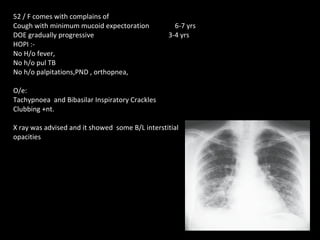
52 / F comes with complains of  Cough with minimum mucoid expectoration   6-7 yrs DOE gradually progressive    3-4 yrs HOPI :- No H/o fever, No h/o pul TB No h/o palpitations,PND , orthopnea, O/e: Tachypnoea  and Bibasilar Inspiratory Crackles Clubbing +nt. X ray was advised and it showed  some B/L interstitial  opacities
How to suspect  an INTERSTITIAL LUNG DISEASE.  How to find its Cause How to differentiate using imaging and simpler procedure rather than doing a TBLB or Open lung biopsy Which ILDs have good prognosis Whats the Supportive Treatment
COMMON FEATURES OF ILD History : Chronic non productive cough with progressive exertional dysnoea. Examination :- Tachypnoea +/- Respiratory distress Cynosis and clubbing  Bibasilar Inspiratory crackles f/s/o pul HT and cor pulmonale IMAGING : - Interstitial pattern  PFT:- Restrictive pattern DLco :- Reduced
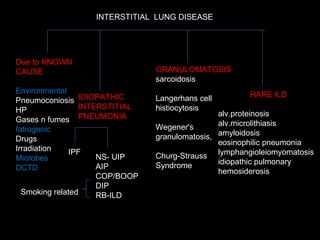
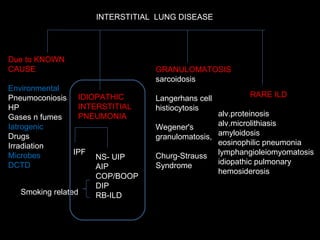
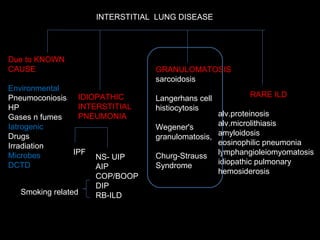
IDIOPATHIC INTERSTITIAL PNEUMONIA NS- UIP AIP COP/BOOP DIP RB-ILD IPF Smoking related Due to KNOWN CAUSE Environmental Pneumoconiosis HP Gases n fumes Iatrogenic Drugs Irradiation Microbes DCTD GRANULOMATOSIS sarcoidosis Langerhans cell histiocytosis Wegener's granulomatosis, Churg-Strauss Syndrome RARE ILD alv.proteinosis alv.microlithiasis amyloidosis eosinophilic pneumonia lymphangioleiomyomatosis idiopathic pulmonary hemosiderosis INTERSTITIAL  LUNG DISEASE
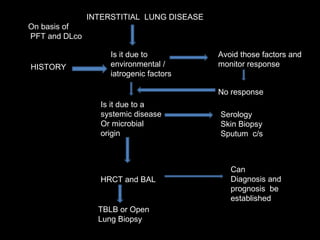
INTERSTITIAL  LUNG DISEASE On basis of PFT and DLco Is it due to environmental / iatrogenic factors Avoid those factors and monitor response Is it due to a systemic disease Or microbial origin No response Serology Skin Biopsy Sputum  c/s  HRCT and BAL TBLB or Open Lung Biopsy Can Diagnosis and prognosis  be established HISTORY
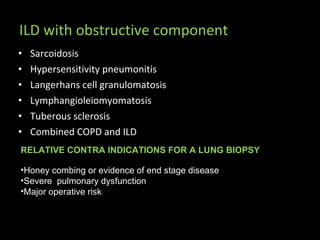
ILD with obstructive component Sarcoidosis Hypersensitivity pneumonitis Langerhans cell granulomatosis Lymphangioleiomyomatosis Tuberous sclerosis Combined COPD and ILD RELATIVE CONTRA INDICATIONS FOR A LUNG BIOPSY Honey combing or evidence of end stage disease Severe  pulmonary dysfunction Major operative risk
Environment Dependent ILD MINING INDUSTRY : Coal workers pneumoconiosis Silicosis Asbestosis HYPERSENSITVE PNEUMONITIS GAS or FUME Exposure
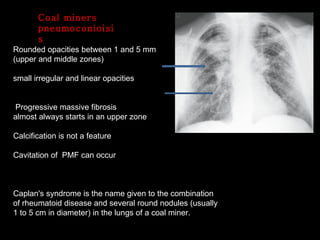
Coal miners pneumoconioisis Rounded opacities between 1 and 5 mm (upper and middle zones) small irregular and linear opacities Progressive massive fibrosis  almost always starts in an upper zone Calcification is not a feature Cavitation of  PMF can occur Caplan's syndrome is the name given to the combination of rheumatoid disease and several round nodules (usually 1 to 5 cm in diameter) in the lungs of a coal miner.
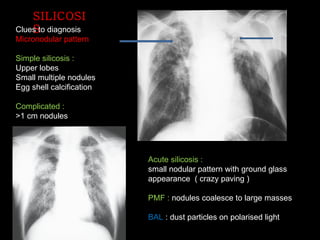
SILICOSIS Clues to diagnosis  Micronodular pattern Simple silicosis : Upper lobes Small multiple nodules Egg shell calcification Complicated : >1 cm nodules  Acute silicosis : small nodular pattern with ground glass appearance  ( crazy paving )  PMF :  nodules coalesce to large masses BAL  : dust particles on polarised light
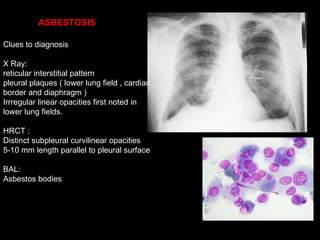
Clues to diagnosis X Ray: reticular interstitial pattern  pleural plaques ( lower lung field , cardiac border and diaphragm ) Irrregular linear opacities first noted in lower lung fields. HRCT : Distinct subpleural curvilinear opacities 5-10 mm length parallel to pleural surface BAL: Asbestos bodies  ASBESTOSIS
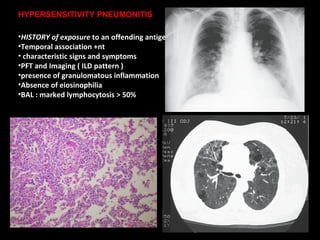
HISTORY of exposure  to an offending antigen Temporal association +nt characteristic signs and symptoms PFT and Imaging ( ILD pattern ) presence of granulomatous inflammation Absence of eiosinophilia BAL : marked lymphocytosis > 50% HYPERSENSITIVITY PNEUMONITIS
Suspect a CTD if Musculosketetal pain Weakness Fatigue Joint pains and swelling Photosensitivity Raynauds  phenomenon Pleuritis  Dry eyes or mouth  INTERSTITIAL  LUNG  DISEASE  in  CTD
SYSTEMIC SLEROSIS Lung manifestation may be first SS sign in 55% Lung involvement +nt in 90 % ( detected by PFT ) Vascular Involvement is not vasculitis but intimal hypertrophy ( CREST  ) RA MC lung manifestation : Fibrosing alveolitis Male predominance Pleural disease Pleuro pulmonary nodules (may cavitate to produce pneumothorax ) Caplan Syndrome SLE ILD is rare .  Pleural involvement is common POLYMYOSITIS / DERMATOMYOSITIS ILD in 10 %  a combination of patchy consolidation with a peripheral reticular pattern being highly characteristic.
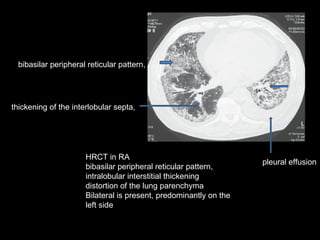
HRCT in RA bibasilar peripheral reticular pattern, intralobular interstitial thickening distortion of the lung parenchyma Bilateral is present, predominantly on the left side bibasilar peripheral reticular pattern,  pleural effusion thickening of the interlobular septa,
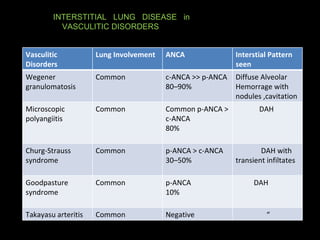
INTERSTITIAL  LUNG  DISEASE  in  VASCULITIC DISORDERS Vasculitic Disorders Lung Involvement ANCA  Interstial Pattern seen Wegener granulomatosis  Common c-ANCA >> p-ANCA 80–90% Diffuse Alveolar Hemorrage with nodules ,cavitation Microscopic polyangiitis Common Common p-ANCA > c-ANCA 80% DAH Churg-Strauss syndrome Common p-ANCA > c-ANCA 30–50% DAH with transient infiltates Goodpasture syndrome Common p-ANCA 10% DAH Takayasu arteritis  Common Negative “
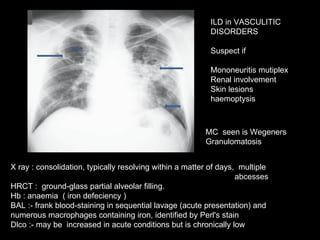
X ray : consolidation, typically resolving within a matter of days,  multiple  abcesses HRCT :  ground-glass partial alveolar filling.  Hb : anaemia  ( iron defeciency ) BAL :-  frank blood-staining in sequential lavage (acute presentation) and numerous macrophages containing iron, identified by Perl's stain Dlco :- may be  increased in acute conditions but is chronically low MC  seen is Wegeners Granulomatosis ILD in VASCULITIC DISORDERS Suspect if  Mononeuritis mutiplex Renal involvement Skin lesions haemoptysis
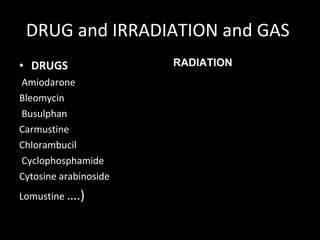
DRUG and IRRADIATION and GAS  DRUGS Amiodarone Bleomycin    Busulphan     Carmustine Chlorambucil   Cyclophosphamide       Cytosine arabinoside       Lomustine  ….) RADIATION
IDIOPATHIC INTERSTITIAL PNEUMONIA NS- UIP AIP COP/BOOP DIP RB-ILD IPF Smoking related Due to KNOWN CAUSE Environmental Pneumoconiosis HP Gases n fumes Iatrogenic Drugs Irradiation Microbes DCTD GRANULOMATOSIS sarcoidosis Langerhans cell histiocytosis Wegener's granulomatosis, Churg-Strauss Syndrome RARE ILD alv.proteinosis alv.microlithiasis amyloidosis eosinophilic pneumonia lymphangioleiomyomatosis idiopathic pulmonary hemosiderosis INTERSTITIAL  LUNG DISEASE
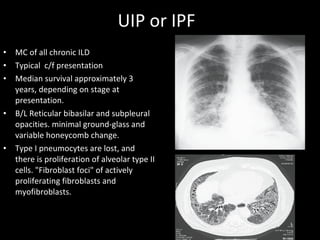
UIP or IPF MC of all chronic ILD  Typical  c/f presentation Median survival approximately 3 years, depending on stage at presentation.  B/L Reticular bibasilar and subpleural opacities. minimal ground-glass and variable honeycomb change.  Type I pneumocytes are lost, and there is proliferation of alveolar type II cells. "Fibroblast foci" of actively proliferating fibroblasts and myofibroblasts.
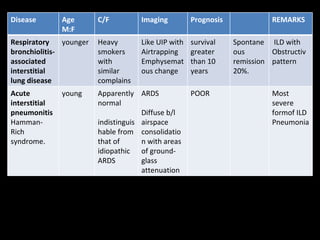
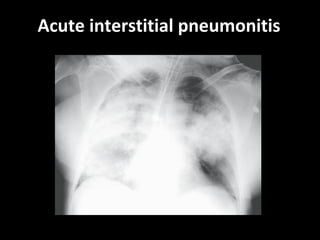
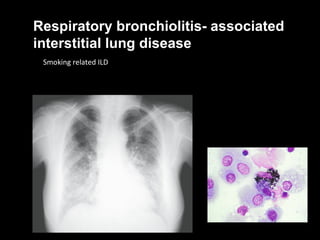
Disease Age  M:F C/F Imaging Prognosis REMARKS Respiratory bronchiolitis- associated interstitial lung disease  younger Heavy smokers with  similar complains  Like UIP with Airtrapping Emphysematous change survival greater than 10 years   Spontaneous remission 20%. ILD with Obstructiv pattern Acute interstitial pneumonitis Hamman-Rich syndrome.  young Apparently normal  indistinguishable from that of idiopathic ARDS ARDS Diffuse b/l airspace consolidation with areas of ground-glass attenuation  POOR Most severe formof ILD Pneumonia
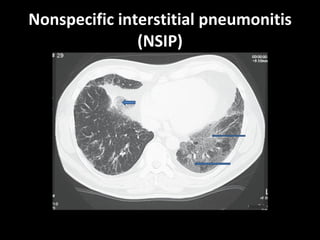
Disease Age  M:F C/F Imaging Prognosis REMARKS Nonspecific interstitial pneumonitis (NSIP) 40-50 May be indistinguishable from UIP Like  But uniform in time, suggesting response to single injury  UIP Honeycombing is rare.  Prognosis good but depends on the extent of fibrosis at diagnosis greater than 10 years.  But Surgical Biopsy is needed to confirm.  Cryptogenic organizing pneumonitis (bronchiolitis obliterans organizing pneumonia [BOOP])   50–60 Abrupt onset, frequently weeks to a few months following a flu-like illness. constitutional symptoms are common Ground glass infiltrate subpleural consolidation and bronchial wall thickening and dilation. Xray – interstitial pattern with nodules Good  Rule out infection and  treat with steroids
Acute interstitial pneumonitis
Nonspecific interstitial pneumonitis (NSIP)
Cryptogenic organizing pneumonitis (bronchiolitis obliterans organizing pneumonia [BOOP])  
Smoking related ILD Respiratory bronchiolitis- associated interstitial lung disease
IDIOPATHIC INTERSTITIAL PNEUMONIA NS- UIP AIP COP/BOOP DIP RB-ILD IPF Smoking related Due to KNOWN CAUSE Environmental Pneumoconiosis HP Gases n fumes Iatrogenic Drugs Irradiation Microbes DCTD GRANULOMATOSIS sarcoidosis Langerhans cell histiocytosis Wegener's granulomatosis, Churg-Strauss Syndrome RARE ILD alv.proteinosis alv.microlithiasis amyloidosis eosinophilic pneumonia lymphangioleiomyomatosis idiopathic pulmonary hemosiderosis INTERSTITIAL  LUNG DISEASE
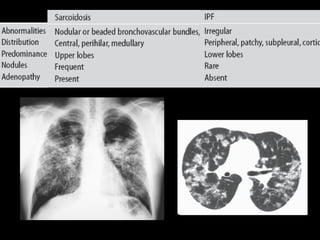
Sarcoidosis Incidental X-ray  (20-30 %) Cough , chest discomfort  ( upto 50 – 60 % )  Skin lesions  ( 20 -25 % )
 
SARCOIDOSIS  ctd…. BAL :-  lymphocytosis  CD4 : CD8 > 3.5 is most specific PFT :-  Restrictive pattern  But  Obstructive component  present in many Biopsy :-  non caseating  granulomas lymphocytosis Sr.  ACE levels:- Hyper calciuria or  Hypercalcemia
RARE ILD
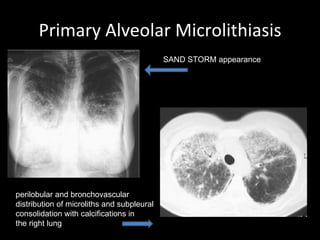
Primary Alveolar Microlithiasis perilobular and bronchovascular distribution of microliths and subpleural consolidation with calcifications in the right lung SAND STORM appearance
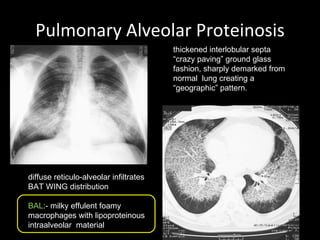
Pulmonary Alveolar Proteinosis diffuse reticulo-alveolar infiltrates  BAT WING distribution BAL :- milky effulent foamy macrophages with lipoproteinous intraalveolar  material thickened interlobular septa “ crazy paving” ground glass fashion, sharply demarked from normal  lung creating a “geographic” pattern.
TREATMENT Removal of offending agent if noted Aggressive suppression on inflammatory response Supportive management  ( O 2   or ) Treatment of  Right heart Failure Treatment of Infections Combined effort from family , doctors , physioherapists.
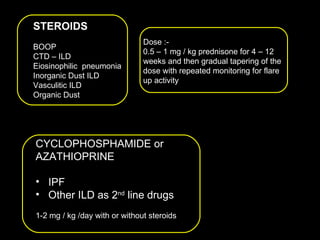
CYCLOPHOSPHAMIDE or  AZATHIOPRINE  IPF Other ILD as 2 nd  line drugs 1-2 mg / kg /day with or without steroids STEROIDS BOOP CTD – ILD Eiosinophilic  pneumonia Inorganic Dust ILD Vasculitic ILD Organic Dust  Dose :-  0.5 – 1 mg / kg prednisone for 4 – 12 weeks and then gradual tapering of the dose with repeated monitoring for flare  up activity
THANK  - -  YOU References: Harrisons 16/e Atlas Of ILD  by  OP Sharma Oxford’s Text book of Medicine 4/e

Interstitial Lung Disease

  • 1.
    Approach to INTERSTITIAL LUNG DISEASE Prof. Dr. MAGHESHKUMAR Unit Dr. Devendra Patil
  • 2.
    52 / Fcomes with complains of Cough with minimum mucoid expectoration 6-7 yrs DOE gradually progressive 3-4 yrs HOPI :- No H/o fever, No h/o pul TB No h/o palpitations,PND , orthopnea, O/e: Tachypnoea and Bibasilar Inspiratory Crackles Clubbing +nt. X ray was advised and it showed some B/L interstitial opacities
  • 3.
    How to suspect an INTERSTITIAL LUNG DISEASE. How to find its Cause How to differentiate using imaging and simpler procedure rather than doing a TBLB or Open lung biopsy Which ILDs have good prognosis Whats the Supportive Treatment
  • 4.
    COMMON FEATURES OFILD History : Chronic non productive cough with progressive exertional dysnoea. Examination :- Tachypnoea +/- Respiratory distress Cynosis and clubbing Bibasilar Inspiratory crackles f/s/o pul HT and cor pulmonale IMAGING : - Interstitial pattern PFT:- Restrictive pattern DLco :- Reduced
  • 5.
    IDIOPATHIC INTERSTITIAL PNEUMONIANS- UIP AIP COP/BOOP DIP RB-ILD IPF Smoking related Due to KNOWN CAUSE Environmental Pneumoconiosis HP Gases n fumes Iatrogenic Drugs Irradiation Microbes DCTD GRANULOMATOSIS sarcoidosis Langerhans cell histiocytosis Wegener's granulomatosis, Churg-Strauss Syndrome RARE ILD alv.proteinosis alv.microlithiasis amyloidosis eosinophilic pneumonia lymphangioleiomyomatosis idiopathic pulmonary hemosiderosis INTERSTITIAL LUNG DISEASE
  • 6.
    INTERSTITIAL LUNGDISEASE On basis of PFT and DLco Is it due to environmental / iatrogenic factors Avoid those factors and monitor response Is it due to a systemic disease Or microbial origin No response Serology Skin Biopsy Sputum c/s HRCT and BAL TBLB or Open Lung Biopsy Can Diagnosis and prognosis be established HISTORY
  • 7.
    ILD with obstructivecomponent Sarcoidosis Hypersensitivity pneumonitis Langerhans cell granulomatosis Lymphangioleiomyomatosis Tuberous sclerosis Combined COPD and ILD RELATIVE CONTRA INDICATIONS FOR A LUNG BIOPSY Honey combing or evidence of end stage disease Severe pulmonary dysfunction Major operative risk
  • 8.
    Environment Dependent ILDMINING INDUSTRY : Coal workers pneumoconiosis Silicosis Asbestosis HYPERSENSITVE PNEUMONITIS GAS or FUME Exposure
  • 9.
    Coal miners pneumoconioisisRounded opacities between 1 and 5 mm (upper and middle zones) small irregular and linear opacities Progressive massive fibrosis almost always starts in an upper zone Calcification is not a feature Cavitation of PMF can occur Caplan's syndrome is the name given to the combination of rheumatoid disease and several round nodules (usually 1 to 5 cm in diameter) in the lungs of a coal miner.
  • 10.
    SILICOSIS Clues todiagnosis Micronodular pattern Simple silicosis : Upper lobes Small multiple nodules Egg shell calcification Complicated : >1 cm nodules Acute silicosis : small nodular pattern with ground glass appearance ( crazy paving ) PMF : nodules coalesce to large masses BAL : dust particles on polarised light
  • 11.
    Clues to diagnosisX Ray: reticular interstitial pattern pleural plaques ( lower lung field , cardiac border and diaphragm ) Irrregular linear opacities first noted in lower lung fields. HRCT : Distinct subpleural curvilinear opacities 5-10 mm length parallel to pleural surface BAL: Asbestos bodies ASBESTOSIS
  • 12.
    HISTORY of exposure to an offending antigen Temporal association +nt characteristic signs and symptoms PFT and Imaging ( ILD pattern ) presence of granulomatous inflammation Absence of eiosinophilia BAL : marked lymphocytosis > 50% HYPERSENSITIVITY PNEUMONITIS
  • 13.
    Suspect a CTDif Musculosketetal pain Weakness Fatigue Joint pains and swelling Photosensitivity Raynauds phenomenon Pleuritis Dry eyes or mouth INTERSTITIAL LUNG DISEASE in CTD
  • 14.
    SYSTEMIC SLEROSIS Lungmanifestation may be first SS sign in 55% Lung involvement +nt in 90 % ( detected by PFT ) Vascular Involvement is not vasculitis but intimal hypertrophy ( CREST ) RA MC lung manifestation : Fibrosing alveolitis Male predominance Pleural disease Pleuro pulmonary nodules (may cavitate to produce pneumothorax ) Caplan Syndrome SLE ILD is rare . Pleural involvement is common POLYMYOSITIS / DERMATOMYOSITIS ILD in 10 % a combination of patchy consolidation with a peripheral reticular pattern being highly characteristic.
  • 15.
    HRCT in RAbibasilar peripheral reticular pattern, intralobular interstitial thickening distortion of the lung parenchyma Bilateral is present, predominantly on the left side bibasilar peripheral reticular pattern, pleural effusion thickening of the interlobular septa,
  • 16.
    INTERSTITIAL LUNG DISEASE in VASCULITIC DISORDERS Vasculitic Disorders Lung Involvement ANCA Interstial Pattern seen Wegener granulomatosis Common c-ANCA >> p-ANCA 80–90% Diffuse Alveolar Hemorrage with nodules ,cavitation Microscopic polyangiitis Common Common p-ANCA > c-ANCA 80% DAH Churg-Strauss syndrome Common p-ANCA > c-ANCA 30–50% DAH with transient infiltates Goodpasture syndrome Common p-ANCA 10% DAH Takayasu arteritis Common Negative “
  • 17.
    X ray :consolidation, typically resolving within a matter of days, multiple abcesses HRCT : ground-glass partial alveolar filling. Hb : anaemia ( iron defeciency ) BAL :- frank blood-staining in sequential lavage (acute presentation) and numerous macrophages containing iron, identified by Perl's stain Dlco :- may be increased in acute conditions but is chronically low MC seen is Wegeners Granulomatosis ILD in VASCULITIC DISORDERS Suspect if Mononeuritis mutiplex Renal involvement Skin lesions haemoptysis
  • 18.
    DRUG and IRRADIATIONand GAS DRUGS Amiodarone Bleomycin   Busulphan     Carmustine Chlorambucil   Cyclophosphamide       Cytosine arabinoside       Lomustine ….) RADIATION
  • 19.
    IDIOPATHIC INTERSTITIAL PNEUMONIANS- UIP AIP COP/BOOP DIP RB-ILD IPF Smoking related Due to KNOWN CAUSE Environmental Pneumoconiosis HP Gases n fumes Iatrogenic Drugs Irradiation Microbes DCTD GRANULOMATOSIS sarcoidosis Langerhans cell histiocytosis Wegener's granulomatosis, Churg-Strauss Syndrome RARE ILD alv.proteinosis alv.microlithiasis amyloidosis eosinophilic pneumonia lymphangioleiomyomatosis idiopathic pulmonary hemosiderosis INTERSTITIAL LUNG DISEASE
  • 20.
    UIP or IPFMC of all chronic ILD Typical c/f presentation Median survival approximately 3 years, depending on stage at presentation. B/L Reticular bibasilar and subpleural opacities. minimal ground-glass and variable honeycomb change. Type I pneumocytes are lost, and there is proliferation of alveolar type II cells. "Fibroblast foci" of actively proliferating fibroblasts and myofibroblasts.
  • 21.
    Disease Age M:F C/F Imaging Prognosis REMARKS Respiratory bronchiolitis- associated interstitial lung disease younger Heavy smokers with similar complains Like UIP with Airtrapping Emphysematous change survival greater than 10 years Spontaneous remission 20%. ILD with Obstructiv pattern Acute interstitial pneumonitis Hamman-Rich syndrome. young Apparently normal indistinguishable from that of idiopathic ARDS ARDS Diffuse b/l airspace consolidation with areas of ground-glass attenuation POOR Most severe formof ILD Pneumonia
  • 22.
    Disease Age M:F C/F Imaging Prognosis REMARKS Nonspecific interstitial pneumonitis (NSIP) 40-50 May be indistinguishable from UIP Like But uniform in time, suggesting response to single injury UIP Honeycombing is rare. Prognosis good but depends on the extent of fibrosis at diagnosis greater than 10 years. But Surgical Biopsy is needed to confirm. Cryptogenic organizing pneumonitis (bronchiolitis obliterans organizing pneumonia [BOOP])   50–60 Abrupt onset, frequently weeks to a few months following a flu-like illness. constitutional symptoms are common Ground glass infiltrate subpleural consolidation and bronchial wall thickening and dilation. Xray – interstitial pattern with nodules Good Rule out infection and treat with steroids
  • 23.
  • 24.
  • 25.
    Cryptogenic organizing pneumonitis(bronchiolitis obliterans organizing pneumonia [BOOP])  
  • 26.
    Smoking related ILDRespiratory bronchiolitis- associated interstitial lung disease
  • 27.
    IDIOPATHIC INTERSTITIAL PNEUMONIANS- UIP AIP COP/BOOP DIP RB-ILD IPF Smoking related Due to KNOWN CAUSE Environmental Pneumoconiosis HP Gases n fumes Iatrogenic Drugs Irradiation Microbes DCTD GRANULOMATOSIS sarcoidosis Langerhans cell histiocytosis Wegener's granulomatosis, Churg-Strauss Syndrome RARE ILD alv.proteinosis alv.microlithiasis amyloidosis eosinophilic pneumonia lymphangioleiomyomatosis idiopathic pulmonary hemosiderosis INTERSTITIAL LUNG DISEASE
  • 28.
    Sarcoidosis Incidental X-ray (20-30 %) Cough , chest discomfort ( upto 50 – 60 % ) Skin lesions ( 20 -25 % )
  • 29.
  • 30.
    SARCOIDOSIS ctd….BAL :- lymphocytosis CD4 : CD8 > 3.5 is most specific PFT :- Restrictive pattern But Obstructive component present in many Biopsy :- non caseating granulomas lymphocytosis Sr. ACE levels:- Hyper calciuria or Hypercalcemia
  • 31.
  • 32.
    Primary Alveolar Microlithiasisperilobular and bronchovascular distribution of microliths and subpleural consolidation with calcifications in the right lung SAND STORM appearance
  • 33.
    Pulmonary Alveolar Proteinosisdiffuse reticulo-alveolar infiltrates BAT WING distribution BAL :- milky effulent foamy macrophages with lipoproteinous intraalveolar material thickened interlobular septa “ crazy paving” ground glass fashion, sharply demarked from normal lung creating a “geographic” pattern.
  • 34.
    TREATMENT Removal ofoffending agent if noted Aggressive suppression on inflammatory response Supportive management ( O 2 or ) Treatment of Right heart Failure Treatment of Infections Combined effort from family , doctors , physioherapists.
  • 35.
    CYCLOPHOSPHAMIDE or AZATHIOPRINE IPF Other ILD as 2 nd line drugs 1-2 mg / kg /day with or without steroids STEROIDS BOOP CTD – ILD Eiosinophilic pneumonia Inorganic Dust ILD Vasculitic ILD Organic Dust Dose :- 0.5 – 1 mg / kg prednisone for 4 – 12 weeks and then gradual tapering of the dose with repeated monitoring for flare up activity
  • 36.
    THANK -- YOU References: Harrisons 16/e Atlas Of ILD by OP Sharma Oxford’s Text book of Medicine 4/e

Editor's Notes