Interstitial Lung diseases
&
Idiopathic Pulmonary fibrosis
By
Majid Nawaz
&
Tehsina Nawaz
Bannu Medical College Bannu.
Scenario
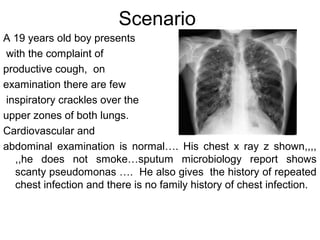
A 19 years old boy presents
with the complaint of
productive cough, on
examination there are few
inspiratory crackles over the
upper zones of both lungs.
Cardiovascular and
abdominal examination is normal…. His chest x ray z shown,,,,
,,he does not smoke…sputum microbiology report shows
scanty pseudomonas …. He also gives the history of repeated
chest infection and there is no family history of chest infection.
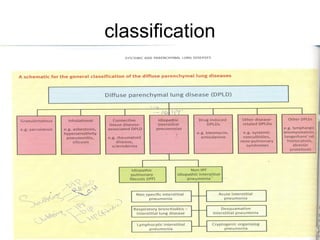
Interstitial lung diseases
A variety of acute & chronic lung diseases with
variable degrees of pulmonary inflammation &
fibrosis – ILDs
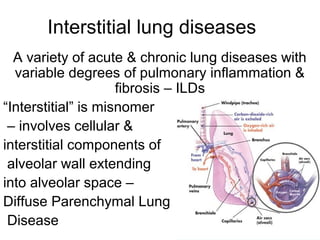
“Interstitial” is misnomer
– involves cellular &
interstitial components of
alveolar wall extending
into alveolar space –
Diffuse Parenchymal Lung
Disease
classification
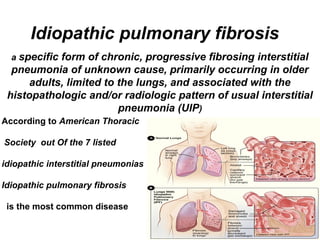
Idiopathic pulmonary fibrosis
a specific

form of chronic, progressive fibrosing interstitial
pneumonia of unknown cause, primarily occurring in older
adults, limited to the lungs, and associated with the
histopathologic and/or radiologic pattern of usual interstitial
pneumonia (UIP)
According to American Thoracic
Society out Of the 7 listed
idiopathic interstitial pneumonias
Idiopathic pulmonary fibrosis
is the most common disease
Why is it bad?
• a poor prognosis,
• upto date, no proven effective therapies are
available for the treatment beyond lung
transplantation
• 60% of patients with idiopathic pulmonary fibrosis
die from their idiopathic pulmonary fibrosis,
• mean survival of 2-5 years from the time of
diagnosis
• Death rates increase with increasing age, and are
consistently higher in men than women .
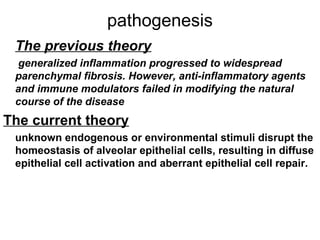
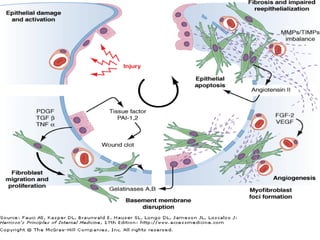
pathogenesis
The previous theory
generalized inflammation progressed to widespread
parenchymal fibrosis. However, anti-inflammatory agents
and immune modulators failed in modifying the natural
course of the disease

The current theory
unknown endogenous or environmental stimuli disrupt the
homeostasis of alveolar epithelial cells, resulting in diffuse
epithelial cell activation and aberrant epithelial cell repair.
Causes
The etiology of idiopathic pulmonary fibrosis remains
undefined; however, in the current hypothesis , exposure
to following inciting agent in a susceptible host may lead
to the initial alveolar epithelial damage
• smoke,
• environmental pollutants,
• environmental dust,
• viral infections,
• gastroesophageal reflux disease,
• chronic aspiration
Contributors
• Prostaglandin E2 deficiency
• Genetic basis
• Caveolin-1 deficiency
clinical presentation
History
It is critical to obtain a complete history, including medication
history, social history, occupational history, exposure history, and
review of systems, to ensure other causes of interstitial lung disease
are excluded.
•

exertional dyspnea .

•

nonproductive cough .

•

obstructive sleep apnea

•

Associated systemic symptoms can occur but are not common. E.g

•
•
•
•
•

weight loss,
fatigue,
arthralgias,
low-grade fevers,
myalgias.
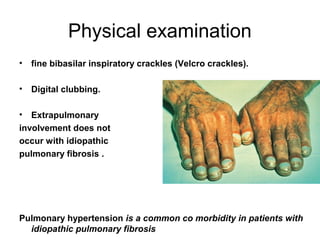
Physical examination
•

fine bibasilar inspiratory crackles (Velcro crackles).

•

Digital clubbing.

•

Extrapulmonary
involvement does not
occur with idiopathic
pulmonary fibrosis .

Pulmonary hypertension is a common co morbidity in patients with
idiopathic pulmonary fibrosis
American Thoracic Society –
Diagnostic Criteria
• According to them, in immunocompetent
adult, the presence of all of the major
diagnostic criteria as well as at least 3 -4
minor criteria increases the likelihood of
correct diagnosis of IPF.
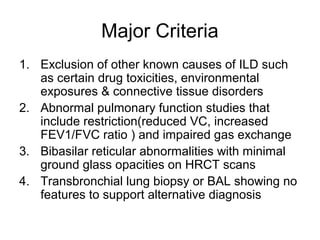
Major Criteria
1. Exclusion of other known causes of ILD such
as certain drug toxicities, environmental
exposures & connective tissue disorders
2. Abnormal pulmonary function studies that
include restriction(reduced VC, increased
FEV1/FVC ratio ) and impaired gas exchange
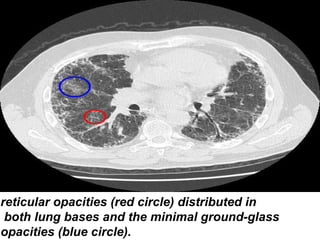
3. Bibasilar reticular abnormalities with minimal
ground glass opacities on HRCT scans
4. Transbronchial lung biopsy or BAL showing no
features to support alternative diagnosis
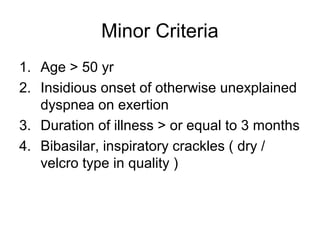
Minor Criteria
1. Age > 50 yr
2. Insidious onset of otherwise unexplained
dyspnea on exertion
3. Duration of illness > or equal to 3 months
4. Bibasilar, inspiratory crackles ( dry /
velcro type in quality )
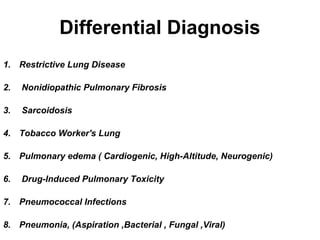
Differential Diagnosis
1. Restrictive Lung Disease
2.

Nonidiopathic Pulmonary Fibrosis

3.

Sarcoidosis

4. Tobacco Worker's Lung
5. Pulmonary edema ( Cardiogenic, High-Altitude, Neurogenic)
6.

Drug-Induced Pulmonary Toxicity

7. Pneumococcal Infections
8. Pneumonia, (Aspiration ,Bacterial , Fungal ,Viral)
Laboratory Studies
Results from routine laboratory studies are nonspecific for the
diagnosis of idiopathic pulmonary fibrosis; however, some
Routine lab Investigations are to rule out other causes of
parenchymal diseases
1. Elevated ESR, hypergammaglobinemia may be foun
2. Positive anti nuclear antibodies / RA Factor occur in 10 -20 %
of cases, usually in low titres.
Imaging Studies
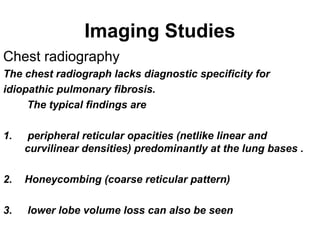
Chest radiography
The chest radiograph lacks diagnostic specificity for
idiopathic pulmonary fibrosis.
The typical findings are
1.

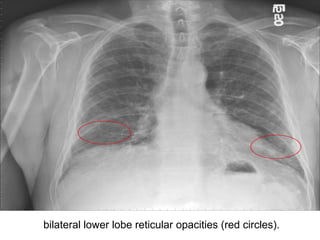
peripheral reticular opacities (netlike linear and
curvilinear densities) predominantly at the lung bases .

2.

Honeycombing (coarse reticular pattern)

3.

lower lobe volume loss can also be seen
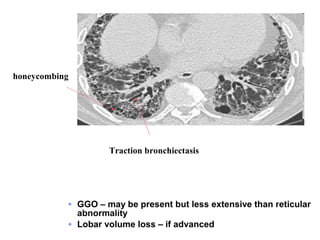
bilateral lower lobe reticular opacities (red circles).
High-resolution computed tomography
HRCT findings are significantly more sensitive and
specific for the diagnosis of idiopathic pulmonary
fibrosis . The typical findings are
1. Bilateral basal and subpleural reticulation .
2.

Traction bronchiectasis .

3.

Basal honeycombing with minmal ground glass
opacities.
honeycombing

Traction bronchiectasis

GGO – may be present but less extensive than reticular
abnormality
Lobar volume loss – if advanced
reticular opacities (red circle) distributed in
both lung bases and the minimal ground-glass
opacities (blue circle).
Other tests
Pulmonary function testing
Vital capacity, functional residual
capacity, total lung capacity, and forced vital
capacity (FVC) all are reduced.
Decreased diffusion capacity of carbon monoxide
(DLCO).
a decline in DLCO greater than 15% over 1 year is
also associated with increased mortality.
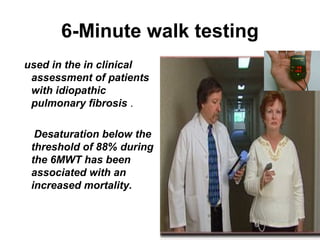
6-Minute walk testing
used in the in clinical
assessment of patients
with idiopathic
pulmonary fibrosis .
Desaturation below the
threshold of 88% during
the 6MWT has been
associated with an
increased mortality.
Heart rate recovery (HRR)
specifically the failure of the heart rate to decline at 1
or 2 minutes postexercise, is associated with
increased mortality

Bronchoalveolar lavage
BAL is not required for the diagnosis of idiopathic
pulmonary fibrosis; however, BAL fluid analysis can
be useful to exclude other alternative diagnoses .
Increased numbers of neutrophils in BAL fluid are
found in 70-90% of all patients with idiopathic
pulmonary fibrosis,
Transthoracic echocardiography
• Transthoracic echocardiography is an excellent modality
to detect pulmonary hypertension.

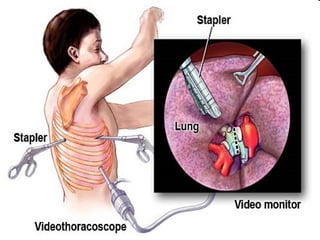
Surgical lung biopsy
• A surgical lung biopsy specimen can be obtained through
either an open lung biopsy or video-assisted
thoracoscopic surgery (VATS). VATS is preferred because
it is associated with less morbidity and a shorter hospital
stay compared with open lung biopsy.
In patients with UIP pattern on HRCT a surgical lung biopsy
is not needed for the diagnosis of idiopathic pulmonary
fibrosis. However, in patients with possible UIP pattern or
inconsistent with UIP pattern on HRCT, a surgical lung
biopsy is needed for the diagnosis of idiopathic pulmonary
fibrosis
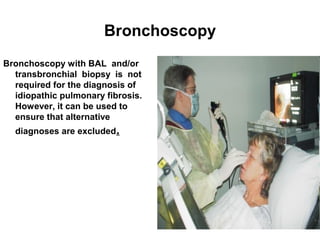
Bronchoscopy
Bronchoscopy with BAL and/or
transbronchial biopsy is not
required for the diagnosis of
idiopathic pulmonary fibrosis.
However, it can be used to
ensure that alternative
diagnoses are excluded.
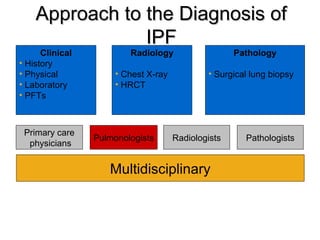
Approach to the Diagnosis of
IPF

Clinical
• History
• Physical
• Laboratory
• PFTs

Primary care
physicians

Radiology

• Chest X-ray
• HRCT

Pulmonologists

Pathology

• Surgical lung biopsy

Radiologists

Multidisciplinary

Pathologists
treatment
Medical Care
The goal of is the assessment and treatment of comorbid medical
conditions. Common comorbid medical conditions e,g chronic
obstructive
pulmonary
disease,
obstructive
sleep
apnea,
gastroesophageal reflux disease, and coronary artery disease.
Therefore, if any of these comorbid illnesses are present, they should
be managed according to current practice guidelines

.

Patients with hypoxemia

oxygen saturation
< 88%) at rest or with exercise should be prescribed
oxygen therapy to maintain a saturation of at least 90% at
rest, with sleep, and with exertion.
Vaccination against influenza and pneumococcal
infection should be encouraged in all patients with idiopathic
pulmonary fibrosis.

Sufficient clinical evidence is lacking to show
that any treatment definitely improves
survival / quality of life
Conventional treatment options:
1.Corticosteroids
2.Immunosupressants/cytotoxic agents
3.Antifibrotic agents
in alone or combination
Surgical Care
Cadaveric Lung transplantation for idiopathic pulmonary
fibrosis has been shows a survival benefit over medical
therapy
Guidelines for listing a patient for lung transplantation
evaluation include
1. diffusion capacity of carbon monoxide less than 39%
2. 10% or greater decrement in forced vital capacity during 6
months of follow-up,
3. decrease in pulse oximetry below 88% during a 6-minute
walk test (6MWT),
4. honeycombing on high-resolution computed
tomography (HRCT) imaging (fibrosis score >2
Complications
The following are complications that can be seen in
patients with idiopathic pulmonary fibrosis:
1. Pulmonary hypertension
2. Acute exacerbation of pulmonary fibrosis
3. Respiratory infection
4. Acute coronary syndrome
5. Thromboembolic disease
6. Adverse medication effects
7. Lung cancer
Consultations
• A suspected patient should be referred to a pulmonologist
for further evaluation and management.
•

A diagnosed patient should be referred for lung
transplantation evaluation .

Diet
• Any patient

who is overweight should be encouraged to
meet with a nutritionist and make dietary changes to
achieve ideal body weight.

•

Maintaining adequate nutritional intake is important for
quality of life in patients with idiopathic pulmonary fibrosis
Activity
•

Regular activity improves walk distance and
symptoms or quality of life.

• Therefore, patients should be encouraged to
participate in regular exercise to maintain a maximal
degree of musculoskeletal conditioning.
interstitial lung diseses and idiopathic pulmonary fibrosis

interstitial lung diseses and idiopathic pulmonary fibrosis

  • 1.
    Interstitial Lung diseases & IdiopathicPulmonary fibrosis By Majid Nawaz & Tehsina Nawaz Bannu Medical College Bannu.
  • 2.
    Scenario A 19 yearsold boy presents with the complaint of productive cough, on examination there are few inspiratory crackles over the upper zones of both lungs. Cardiovascular and abdominal examination is normal…. His chest x ray z shown,,,, ,,he does not smoke…sputum microbiology report shows scanty pseudomonas …. He also gives the history of repeated chest infection and there is no family history of chest infection.
  • 3.
    Interstitial lung diseases Avariety of acute & chronic lung diseases with variable degrees of pulmonary inflammation & fibrosis – ILDs “Interstitial” is misnomer – involves cellular & interstitial components of alveolar wall extending into alveolar space – Diffuse Parenchymal Lung Disease
  • 4.
  • 5.
    Idiopathic pulmonary fibrosis aspecific form of chronic, progressive fibrosing interstitial pneumonia of unknown cause, primarily occurring in older adults, limited to the lungs, and associated with the histopathologic and/or radiologic pattern of usual interstitial pneumonia (UIP) According to American Thoracic Society out Of the 7 listed idiopathic interstitial pneumonias Idiopathic pulmonary fibrosis is the most common disease
  • 6.
    Why is itbad? • a poor prognosis, • upto date, no proven effective therapies are available for the treatment beyond lung transplantation • 60% of patients with idiopathic pulmonary fibrosis die from their idiopathic pulmonary fibrosis, • mean survival of 2-5 years from the time of diagnosis • Death rates increase with increasing age, and are consistently higher in men than women .
  • 7.
    pathogenesis The previous theory generalizedinflammation progressed to widespread parenchymal fibrosis. However, anti-inflammatory agents and immune modulators failed in modifying the natural course of the disease The current theory unknown endogenous or environmental stimuli disrupt the homeostasis of alveolar epithelial cells, resulting in diffuse epithelial cell activation and aberrant epithelial cell repair.
  • 9.
    Causes The etiology ofidiopathic pulmonary fibrosis remains undefined; however, in the current hypothesis , exposure to following inciting agent in a susceptible host may lead to the initial alveolar epithelial damage • smoke, • environmental pollutants, • environmental dust, • viral infections, • gastroesophageal reflux disease, • chronic aspiration Contributors • Prostaglandin E2 deficiency • Genetic basis • Caveolin-1 deficiency
  • 10.
    clinical presentation History It iscritical to obtain a complete history, including medication history, social history, occupational history, exposure history, and review of systems, to ensure other causes of interstitial lung disease are excluded. • exertional dyspnea . • nonproductive cough . • obstructive sleep apnea • Associated systemic symptoms can occur but are not common. E.g • • • • • weight loss, fatigue, arthralgias, low-grade fevers, myalgias.
  • 11.
    Physical examination • fine bibasilarinspiratory crackles (Velcro crackles). • Digital clubbing. • Extrapulmonary involvement does not occur with idiopathic pulmonary fibrosis . Pulmonary hypertension is a common co morbidity in patients with idiopathic pulmonary fibrosis
  • 12.
    American Thoracic Society– Diagnostic Criteria • According to them, in immunocompetent adult, the presence of all of the major diagnostic criteria as well as at least 3 -4 minor criteria increases the likelihood of correct diagnosis of IPF.
  • 13.
    Major Criteria 1. Exclusionof other known causes of ILD such as certain drug toxicities, environmental exposures & connective tissue disorders 2. Abnormal pulmonary function studies that include restriction(reduced VC, increased FEV1/FVC ratio ) and impaired gas exchange 3. Bibasilar reticular abnormalities with minimal ground glass opacities on HRCT scans 4. Transbronchial lung biopsy or BAL showing no features to support alternative diagnosis
  • 14.
    Minor Criteria 1. Age> 50 yr 2. Insidious onset of otherwise unexplained dyspnea on exertion 3. Duration of illness > or equal to 3 months 4. Bibasilar, inspiratory crackles ( dry / velcro type in quality )
  • 15.
    Differential Diagnosis 1. RestrictiveLung Disease 2. Nonidiopathic Pulmonary Fibrosis 3. Sarcoidosis 4. Tobacco Worker's Lung 5. Pulmonary edema ( Cardiogenic, High-Altitude, Neurogenic) 6. Drug-Induced Pulmonary Toxicity 7. Pneumococcal Infections 8. Pneumonia, (Aspiration ,Bacterial , Fungal ,Viral)
  • 16.
    Laboratory Studies Results fromroutine laboratory studies are nonspecific for the diagnosis of idiopathic pulmonary fibrosis; however, some Routine lab Investigations are to rule out other causes of parenchymal diseases 1. Elevated ESR, hypergammaglobinemia may be foun 2. Positive anti nuclear antibodies / RA Factor occur in 10 -20 % of cases, usually in low titres.
  • 17.
    Imaging Studies Chest radiography Thechest radiograph lacks diagnostic specificity for idiopathic pulmonary fibrosis. The typical findings are 1. peripheral reticular opacities (netlike linear and curvilinear densities) predominantly at the lung bases . 2. Honeycombing (coarse reticular pattern) 3. lower lobe volume loss can also be seen
  • 18.
    bilateral lower lobereticular opacities (red circles).
  • 19.
    High-resolution computed tomography HRCTfindings are significantly more sensitive and specific for the diagnosis of idiopathic pulmonary fibrosis . The typical findings are 1. Bilateral basal and subpleural reticulation . 2. Traction bronchiectasis . 3. Basal honeycombing with minmal ground glass opacities.
  • 20.
    honeycombing Traction bronchiectasis GGO –may be present but less extensive than reticular abnormality Lobar volume loss – if advanced
  • 21.
    reticular opacities (redcircle) distributed in both lung bases and the minimal ground-glass opacities (blue circle).
  • 22.
    Other tests Pulmonary functiontesting Vital capacity, functional residual capacity, total lung capacity, and forced vital capacity (FVC) all are reduced. Decreased diffusion capacity of carbon monoxide (DLCO). a decline in DLCO greater than 15% over 1 year is also associated with increased mortality.
  • 23.
    6-Minute walk testing usedin the in clinical assessment of patients with idiopathic pulmonary fibrosis . Desaturation below the threshold of 88% during the 6MWT has been associated with an increased mortality.
  • 24.
    Heart rate recovery(HRR) specifically the failure of the heart rate to decline at 1 or 2 minutes postexercise, is associated with increased mortality Bronchoalveolar lavage BAL is not required for the diagnosis of idiopathic pulmonary fibrosis; however, BAL fluid analysis can be useful to exclude other alternative diagnoses . Increased numbers of neutrophils in BAL fluid are found in 70-90% of all patients with idiopathic pulmonary fibrosis,
  • 25.
    Transthoracic echocardiography • Transthoracicechocardiography is an excellent modality to detect pulmonary hypertension. Surgical lung biopsy • A surgical lung biopsy specimen can be obtained through either an open lung biopsy or video-assisted thoracoscopic surgery (VATS). VATS is preferred because it is associated with less morbidity and a shorter hospital stay compared with open lung biopsy. In patients with UIP pattern on HRCT a surgical lung biopsy is not needed for the diagnosis of idiopathic pulmonary fibrosis. However, in patients with possible UIP pattern or inconsistent with UIP pattern on HRCT, a surgical lung biopsy is needed for the diagnosis of idiopathic pulmonary fibrosis
  • 27.
    Bronchoscopy Bronchoscopy with BALand/or transbronchial biopsy is not required for the diagnosis of idiopathic pulmonary fibrosis. However, it can be used to ensure that alternative diagnoses are excluded.
  • 28.
    Approach to theDiagnosis of IPF Clinical • History • Physical • Laboratory • PFTs Primary care physicians Radiology • Chest X-ray • HRCT Pulmonologists Pathology • Surgical lung biopsy Radiologists Multidisciplinary Pathologists
  • 29.
    treatment Medical Care The goalof is the assessment and treatment of comorbid medical conditions. Common comorbid medical conditions e,g chronic obstructive pulmonary disease, obstructive sleep apnea, gastroesophageal reflux disease, and coronary artery disease. Therefore, if any of these comorbid illnesses are present, they should be managed according to current practice guidelines . Patients with hypoxemia oxygen saturation < 88%) at rest or with exercise should be prescribed oxygen therapy to maintain a saturation of at least 90% at rest, with sleep, and with exertion.
  • 30.
    Vaccination against influenzaand pneumococcal infection should be encouraged in all patients with idiopathic pulmonary fibrosis. Sufficient clinical evidence is lacking to show that any treatment definitely improves survival / quality of life Conventional treatment options: 1.Corticosteroids 2.Immunosupressants/cytotoxic agents 3.Antifibrotic agents in alone or combination
  • 31.
    Surgical Care Cadaveric Lungtransplantation for idiopathic pulmonary fibrosis has been shows a survival benefit over medical therapy Guidelines for listing a patient for lung transplantation evaluation include 1. diffusion capacity of carbon monoxide less than 39% 2. 10% or greater decrement in forced vital capacity during 6 months of follow-up, 3. decrease in pulse oximetry below 88% during a 6-minute walk test (6MWT), 4. honeycombing on high-resolution computed tomography (HRCT) imaging (fibrosis score >2
  • 32.
    Complications The following arecomplications that can be seen in patients with idiopathic pulmonary fibrosis: 1. Pulmonary hypertension 2. Acute exacerbation of pulmonary fibrosis 3. Respiratory infection 4. Acute coronary syndrome 5. Thromboembolic disease 6. Adverse medication effects 7. Lung cancer
  • 33.
    Consultations • A suspectedpatient should be referred to a pulmonologist for further evaluation and management. • A diagnosed patient should be referred for lung transplantation evaluation . Diet • Any patient who is overweight should be encouraged to meet with a nutritionist and make dietary changes to achieve ideal body weight. • Maintaining adequate nutritional intake is important for quality of life in patients with idiopathic pulmonary fibrosis
  • 34.
    Activity • Regular activity improveswalk distance and symptoms or quality of life. • Therefore, patients should be encouraged to participate in regular exercise to maintain a maximal degree of musculoskeletal conditioning.

Editor's Notes